
Entropy Debt Week

If you read my short story “Garbage Collection” in Nature Futures and ended up here, welcome. This is an ethics website with articles, games, software releases, and almost no readers.
I spent the week leading up to publication posting essays about time travel, rollback, erased futures, memory, repair, and all the ways fiction tries to dodge the bill when a timeline gets thrown away.
The short version:
Entropy Debt Week is a reading path through time-travel stories and adjacent ideas that helped me circle the computational problem behind “Garbage Collection.”
- The easiest place to start is Primer.
- Entropy Debt Week concludes with an article early tomorrow morning on the Anti-Oblivion Doctrine.
The Week in Order.
Applied Case: Primer (2004)
 Aidan Lawson
Two engineers build a time machine and immediately prove they are not ready to live in the field it opens.
Applied Case: Click (2006)
 Aidan Lawson
The Adam Sandler remote-control comedy turns out to be a brutal little machine.
Failed Field Analysts: Skynet
 Aidan Lawson
Skynet has time travel and still cannot stop making the same dumb mistake across its entire franchise: treating the field like a target list.
Applied Case: Twelve Monkeys (1995)
 Aidan Lawson
A rare time-travel story where the goal is not to erase the plague future.
Roger Penrose and the Reality of Structure
 Aidan Lawson
A short detour through Penrose, structure, and why the shape of a field can matter before anyone has finished explaining it. Entropy debt is about structure becoming hard to recover.
Applied Case: Edge of Tomorrow (2014)
 Aidan Lawson
A clean battlefield loop where one side remembers and the other side is meat for the retry machine. Introduces continuance truncation as a fine distinction from rollback.
Transition Action: The Trace Becomes a Dataset
 Aidan Lawson
Real-world preservation, scanning, archaeology, lost animals, damaged inscriptions, and the technical work of making traces usable without pretending loss has been undone.
Tales of Distortion: Doctor Koell
 Aidan Lawson
A time-travel preservationist takes a real insight about history and turns it into a doctrine that makes tragedy mandatory. This game is stupid.
Backpath: Evidence for What Transitions Make Unrecoverable
 Aidan Lawson
A new CLI tool about finding what gets lost in transitions: migrations, conversions, imports, exports, save formats, and all the places where “success” still buries something.
Applied Case: Tenet (2020)
 Aidan Lawson
Tenet makes people travel through the interval instead of skipping the cost, then still leaves us with a world saved from annihilation but not repaired.
Introducing TimeVault
 Aidan Lawson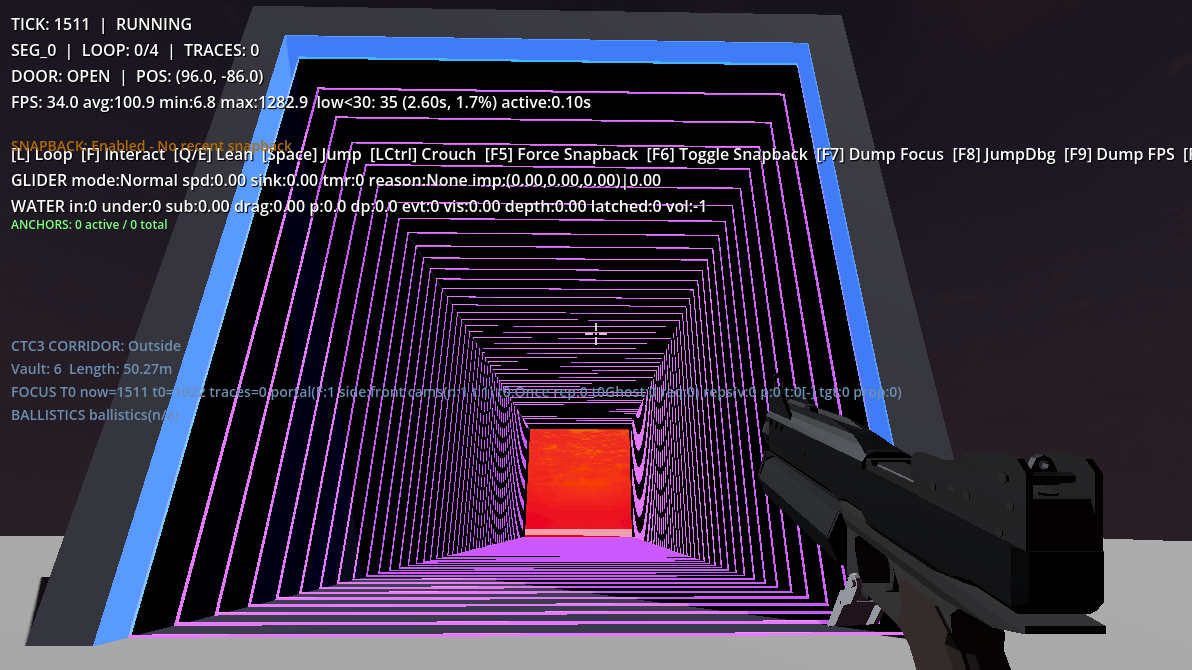
A prototype reveal for a time-travel tactics shooter where prior selves and traces are kept consistent.
Garbage Collection
 Aidan Lawson
My short story about a universe treated as computation. A machine nobody can remember using, and the unfortunate possibility that "failed" timelines still leave a bill somewhere.
Applied Case: Garbage Collection
 Aidan Lawson
The Modal Path Ethics article on the story.
The Anti-Oblivion Doctrine
Elsewhere on the Site.
Modal Path Ethics is the framework I use on this site to ask what actions make reachable: which paths open, which close, which become harder, and who carries the cost.
Other places to go:
The Book.
Modal Path Ethics: The Extance Strategy Game (Amazon)
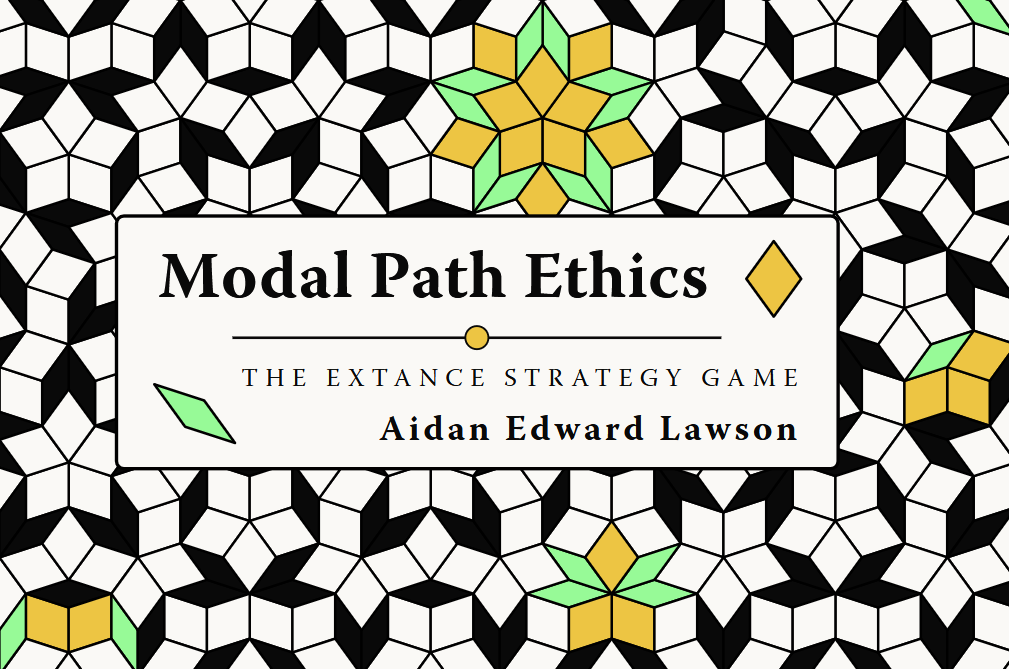
A compact version of the framework as a strategy-game book.
Also includes appendices on the foundations of modal metaphysics, a modal-tiling visual grounding, the Chirality playtest rules, and "Plain English" one-page breakdowns of the core concepts inserted throughout.
The Backlog.
Modal Path Ethic tries to post an article every day; often several.
The backlog contains over a hundred articles exercising the framework and exploring the structure of the world around us along semi-guided topic-tracks. Includes such things as
- the Tales of Distortion series covering esteemed human moments like the 1904 St. Louis Marathon/Secret Dehydration Experiment, the demise of Scotland, The Great Leap Forward and all its wonders, and the Saga of Symmes's Hole showing how the U.S. Senate was really designed to work;
- Applied Cases like a deep analysis of the Batman, an audit of fictional metaphysics and multiversal machinery and also Highlander, the current state of the biosphere and the AI race dynamics in 2026, the first diagnosis of America's communication problems, why HBO's Chernobyl was so good it became a minor problem, a diagnosis of the Communist Manifesto, why even super-intelligent AI is not immune to Modal Path Ethics, more than one audit of the competitive Pokémon community, a schizophrenia civil rights analysis, a quick little pitch to Joe Rogan and Dana White regarding the rate of death in the bodybuilding field, a diagnosis of the Problem of Evil and what theological answers must uphold to meet the field where it is, molecule ethics, and what is bad about false vacuum decay;
- the Failed Field Analysts series looking at the missteps of those individuals who caught hold of some real structure, then tried to repair it with bombs, cranes, deception, and more bombs, with a Scientology-facing piece scheduled for the weekend;
- the Thought Gauntlet running through a boss rush of the classical ethical dilemmas like the Trolley Problem, the Omelas, the Last Human (this one was easy), culminating in a triumph against Anti-Natalism;
- philosophical engagements with neighbors and rivals like Buddhist thought, MacIntyre, Habermas, Parfit, Chang, Lovelock & Margulis, Heidegger, Deleuze;
- the Field Instruments series examining the machinery of our social world, asking what exactly things like Money, the Scientific Method, Mathematics, Languages, and more are really doing when audited as modal technologies, as well as what it might mean to build new ones;
- Transition Action, a new weekly analysis of what a technology makes reachable as soon as soon it starts to move in the field,
- and others like an argument against Dark Forest readings of the quiet cosmos, IGN-style reviews of game theory's twelve most popular releases, what we are supposed to do with what we don't even know what it is yet, the problem of time, the first Mirror Match framework self-audit, a survival claim for morality inside a simulation, much better words than "large language model" and "artificial intelligence" for the post-LLM stack, an overly-analytical Modal Path Ethics playthrough of the Mass Effect series, a terrible misapplication of Diogenes, and a proclamation of the framework's doom.
Nine guided "argument route" playlists also exist on the homepage to help get a foothold in the backlog and the through-lines, but these are slightly out of date (sorry).

Starting with whatever article catches your attention and following threads at your own whim is probably better than these anyway. I use a lot of links.
Chirality.

An experimental abstract strategy game about reachability, board pressure, and path control played on an aperiodic grid with a large number of possible variant boards, where the pieces change handedness every move. Fifteen authored boards available in the current web demo release.
Variant games played with other tilesets and rules coming soon.
Klein Conformance Protocol.
 Aidan Lawson
A technical project about checking what an action actually did. KCP is an evidence stack aimed at unreliable physical execution.
 Aidan Lawson
The Transition Action Equation article explains the longterm horizon of such a stack.
Backpath.
 Aidan Lawson
A CLI tool for finding what transitions make unrecoverable. We already went over this.
Thanks for visiting.