The Great Ludic Audit
Modal Path Ethics played Game Theory’s twelve most celebrated games so you don’t have to.

September 2026 note: The audit's central lesson survives: a game can be formally elegant while hiding sequence, memory, asymmetry, burden, or the destruction of later moves, and a philosophical model should be judged partly by what its abstraction makes playable or invisible. The later framework makes several boundaries more exact. First, ludic contraction is not automatically moral harm. A game state, metagame, payoff matrix, or trapped piece can model foreclosure and resistance without itself becoming a harmed locus; moral harm still requires an extant bearer satisfying the locus test. Second, the audit's repeated discovery that time changes the game is better stated now in terms of ordered continuation and active history: repeated interaction matters because prior transitions alter information, expectation, capability, resistance, and what remains reachable, not because time is an additional moral substance. Third, agency and standing remain separate. The Dictator Game correctly shows that a human recipient can bear the consequences of a transition they do not control, but the general lesson is not that every passive object is therefore a locus. Establish the bearer independently. Fourth, the Ultimatum Game's veto insight is only a thin constitutional beginning. Later Bounded Last Words and Material Bounded Finality distinguish bounded final authority, review, replacement, protected continuity, and materially effective correction from a single power to say no. Fifth, “institutions are gameplay” later becomes a fuller constitutional claim: rules and mechanisms shape reachability, but a corrigible institution must preserve an independent route through which its own rules can lose.
Game theory has spent roughly three quarters of the last century releasing some of the most influential games in intellectual history without anyone in the gaming press having the courage and integrity to review them.
This is unacceptable. This ends today.
Modal Path Ethics is officially joining the games journalism industry.

The neglect of these Nobel-lauded games is admittedly somewhat understandable.
Most game-theory games contain two players, two buttons, four possible outcomes, no animation, no sound, no tutorial, no campaign, no skill-based matchmaking, no battle pass, and almost no evidence that the developers have ever observed two human beings interacting outside a laboratory.
Several are sold entirely through a single diagram. One of them does not allow the second player to move. Another is considered successfully solved when the players skip almost all of its available content.
Still, these games have received extraordinary critical acclaim. These games have shaped economics, political science, evolutionary biology, military strategy, moral philosophy, negotiation theory, psychology, and the management literature inflicted upon office workers. So where is all the coverage, Gamespot?
They are almost bigger than Pokèmon. They have been used to explain nuclear war, climate change, labor relations, animal conflict, romantic commitment, traffic congestion, international diplomacy, market competition, and why nobody cleaned the work refrigerator.
This is a remarkable performance from a genre whose standard graphical interface remains a square divided into four smaller squares.
Modal Path Ethics has already argued that philosophy once possessed a much stronger ludic tradition than it does now.
Philosophical work happened through structured exchange, staged opposition, formal disputation, and practices in which thought was performed between participants rather than just delivered to readers on Amazon.
Game theory appears, at first glance, to be the great modern survival of that tradition. It places agents inside constrained fields. Their choices alter one another’s outcomes. The structure becomes visible through the moves. Modal Path Ethics was excited at first.
Then you try to play some of these things.
A strange fact immediately appears.
Game theory preserved the formal structure of games while often discarding most of what makes a game playerly.
Unfortunately, that was the very thing most in need of preservation.
Many of game theory's canonical titles are better understood as models, demonstrations, behavioral experiments, or tiny wicked mathematical traps.
Their philosophical conclusions are frequently fully visible before the first move. This is often the point. Their players may have almost no opportunity to discover, adapt, revise, express, interpret, or become skilled. Some provide more intellectual value to the person reading the payoff matrix than to the person allegedly “playing the game.”
This does not make these games worthless. A thermometer is not a bad instrument because it fails as a musical. A behavioral experiment can reveal something important without becoming a rich form of play. And a formal model can isolate one feature of strategic life precisely by destroying everything around it.
The classifications still matter.
If a game is repeatedly used to make claims about human cooperation, conflict, rationality, trust, punishment, sacrifice, or social order, we should determine what philosophical work the game itself can actually perform.
We should review the game.
The Official Modal Path Ethical Review Policy.
The Ludic Audit does not ask whether a game is famous, mathematically elegant, experimentally useful, or historically important.
It asks a much more impolite, IGN-style question:
What happens when somebody actually plays this thing?
A philosophical game should do more than place a lesson inside a set of rules. Its structure should create an encounter through which the lesson can be discovered, complicated, resisted, revised, or transformed.
The distinction is the difference between reading that territorial influence matters in Go and gradually becoming able to see influence. It is the difference between being told that a chess position is dangerous and developing the positional sense through which the danger becomes visible before it can be fully calculated.
A philosophical game succeeds when something comparable happens to human thought.
- The positions are not simply represented.
- They are inhabited.
- The disagreement is not just described.
- It is enacted.
- The insight does not just appear in the explanatory paragraph below the diagram.
- It emerges from the player’s effort to navigate the structure.
Every game in this audit will therefore be reviewed across six categories:
1. Graphics
- What does the player actually see?
Most game-theory games are visually represented by payoff matrices, decision trees, line graphs, population curves, spatial simulations, or dots connected by arrows.
These are not, upon review, neutral packaging. A good representation can reveal the structure of the game. A bad one can hide sequence, uncertainty, asymmetry, dependence, or the loss of future options behind four clean boxes.
The graphics score evaluates whether the game’s visual language helps players understand the field they are navigating.
This will not be a high-scoring category.
2. Gameplay
- Are there meaningful decisions?
Can players develop skill, revise strategy, recognize patterns, or discover properties of the game through action? Or does the payoff matrix contain the complete philosophical experience before anyone touches it?
A choice is not automatically gameplay. A button wired directly to a conclusion remains a button.
3. Multiplayer
- Does the other participant exist as an agent whose interpretation and behavior must be encountered?
Some games contain two payoff recipients but only one meaningful player. Others reduce the second player to a hidden variable. The strongest multiplayer games create reciprocal interpretation: I must understand the field, understand your position within it, and understand how you understand mine.
Simply suffering the consequences of somebody else’s decision does not qualify as robust multiplayer support.
4. Replay Value
- Does repeated play expose deeper structure?
Some games become substantially more interesting when repeated. Others cease functioning once their central trick is understood. Some develop a meta. Some become rituals. Some mutate into entirely different games as memory, reputation, retaliation, and learning enter the field.
Replay value is philosophically decisive. A game that produces one surprising result may be a demonstration. A game that continues reorganizing how its players perceive the problem may be an instrument.
5. Field Fidelity
- What had to be removed to make the game work?
Every model simplifies. The question is whether the missing features are incidental details or the actual mechanisms through which the real phenomenon operates.
Communication, memory, history, affection, institutions, unequal power, outside options, uncertain payoffs, repair, reputation, third parties, and consequences after the final turn are not graphical flourishes. In many human fields, these are the systems that make cooperation, resistance, exploitation, or escape possible.
A game should not lose points for being abstract. It should lose points when its abstraction is forgotten and the model begins claiming jurisdiction over structures it has removed.
6. Ludic Value
- What can be learned through playing that could not be learned just as well from reading the rules?
This is the final standard.
A game may contain a profound idea and still possess very little ludic value. The idea may already be complete in the table. The “players” may exist only to generate data for the observer. The decision may demonstrate a contradiction without opening any sustained field of inquiry. Ludic value belongs to the surplus created by play.
After these six scientific numbers, each game receives a real-deal classification:
- Full Ludic Instrument: The game reliably produces philosophical insight through play.
- Conditional Instrument: The game becomes philosophically productive only under particular variants or conditions.
- Thin Demonstration: The game illustrates an important idea but offers little playerly discovery.
- Behavioral Apparatus: The game primarily measures participants rather than creating a shared philosophical practice between them.
- Formal Object: The structure is mathematically significant but barely functions as playable philosophy.
- Degenerate Instrument: The game contains a meaningful field that known strategy, optimization, or repetition subsequently collapses.
The numerical score is for readers who skip to the end and become furious.
1. The Prisoner’s Dilemma
The Most Overrated Game of All Time
|
|
|
|
First formulated |
1950 |
|
Original researchers |
Merrill Flood and Melvin Dresher |
|
Original research setting |
RAND Corporation |
|
Named and given its prison framing by |
Albert W. Tucker |
|
Players |
2 |
|
Formal type |
Simultaneous, non-cooperative, variable-sum
game |
|
Standard interface |
2 × 2 payoff matrix |
|
Available modes |
One-shot and iterated |
|
Dominant strategy in the one-shot game |
Defection |
|
Collectively superior outcome |
Mutual cooperation |
The Good
● Exceptionally compact
● Historically important
● Demonstrates incentive failure clearly
● Runs on almost any hardware
● Strong mod support
The Bad
● Extremely limited communication options
● One-shot campaign ends immediately
● Moralized button labels
● Most-all real social mechanisms removed
● Fan community applies it to everything
The Review.
The Prisoner’s Dilemma is the game-theory equivalent of a title that received a perfect score in 1950 and has been included in every “greatest games of all time” list since, despite almost nobody returning to the original release for fun.
Its premise is now famous enough to feel older than its actual history, which is still very old. Two prisoners are separated. Each must choose whether to remain silent or betray the other. Betrayal produces a better individual result regardless of what the other prisoner chooses. If the other remains silent, betrayal yields the best available outcome. If the other betrays, betrayal prevents the worst available outcome. Defection therefore dominates cooperation.
Unfortunately, when both players make the individually dominant choice, both receive a worse outcome than they would have received through mutual cooperation. This is an excellent problem. Unfortunately, it is also almost the entire game.
The Prisoner’s Dilemma has one of the cleanest central mechanics in its genre. Each player’s local incentive points toward an outcome neither player collectively prefers. The game demonstrates that rational action at the level of the isolated agent can produce an irrational field at the level of the relation. That remains philosophically powerful, despite what Modal Path Ethics may tell you about it.
The Prisoner’s Dilemma does not reveal that human beings are naturally selfish. It reveals something more structurally exact: a field can be organized so that betrayal remains locally defensible even when everyone would benefit from a stable cooperative path. The failure is in the incentive structure before it appears in the character of either prisoner.
This is where the game remains useful to Modal Path Ethics. Moral language is often eager to locate the defect in the actor. The game redirects attention toward the shape of the available paths. Cooperation is mutually better, but unilateral cooperation carries the worst individual risk. Defection is collectively destructive, but individually protective. A damaged field can make closure rational.
The trouble begins when the Prisoner’s Dilemma is treated as a complete game of cooperation rather than a highly specific game about cooperation under deliberately hostile conditions.
The original release removes communication. It removes enforceable agreements. It removes reputation. It removes shared history. It removes affection, loyalty, solidarity, law, institutions, repair, apology, surveillance, third parties, mobility, exit, and future retaliation. It ordinarily assumes that the players know the payoffs, interpret them the same way, possess roughly symmetrical strategic positions, and cannot alter the rules.
These are not minor pieces of cut content. These are the technologies through which actual cooperative futures are made reachable. Remove every bridge and the resulting model will indeed demonstrate that crossing is difficult.
The problem is not that the Prisoner’s Dilemma produces the wrong answer. Under its stipulated conditions, the answer is brutally clear. The problem is the tendency to export that answer into fields where the stipulated conditions do not hold.
A marriage with memory is not the one-shot Prisoner’s Dilemma. A labor negotiation with unequal bargaining power is not the one-shot Prisoner’s Dilemma. A community governed by laws, norms, records, and future contact is not the one-shot Prisoner’s Dilemma.
An arms race between states capable of signaling, inspection, treaty, infiltration, retaliation, accident, regime change, and total destruction is certainly not exhausted by the one-shot Prisoner’s Dilemma. The model can still illuminate a structural feature inside those fields. It cannot replace the fields.
Gameplay
There are two available actions. One strictly dominates the other. This creates a very serious replayability problem.
Once both players understand the one-shot game and accept its assumptions, there is no remaining strategic question. The player does not need to interpret the opponent. The opponent’s move cannot change which action is individually favored. There is no positional development, no learning curve, no adaptation, and no meaningful distinction between a novice and an expert once the payoff structure has been recognized.
The one-shot Prisoner’s Dilemma therefore performs more philosophical work as a diagram than it ever does as a game. Reading the matrix produces the insight. Playing it mostly supplies the sensation of pressing the button you already know the structure recommends.
This is not nothing. The emotional experience can remain revealing. A player may resent the prescribed defection, trust irrationally, cooperate from principle, or discover that they care about the other participant’s outcome. Experimental results can expose preferences not represented in the stipulated utility values.
That discovery, however, concerns the player more than the game. The structure says, “Defect.” The human being says, “Those are not actually all of my values.” The laboratory writes this news down.
Graphics
The Prisoner’s Dilemma’s 2 × 2 payoff matrix is one of the most recognizable images in game theory. It is also less informative than its prestige suggests.
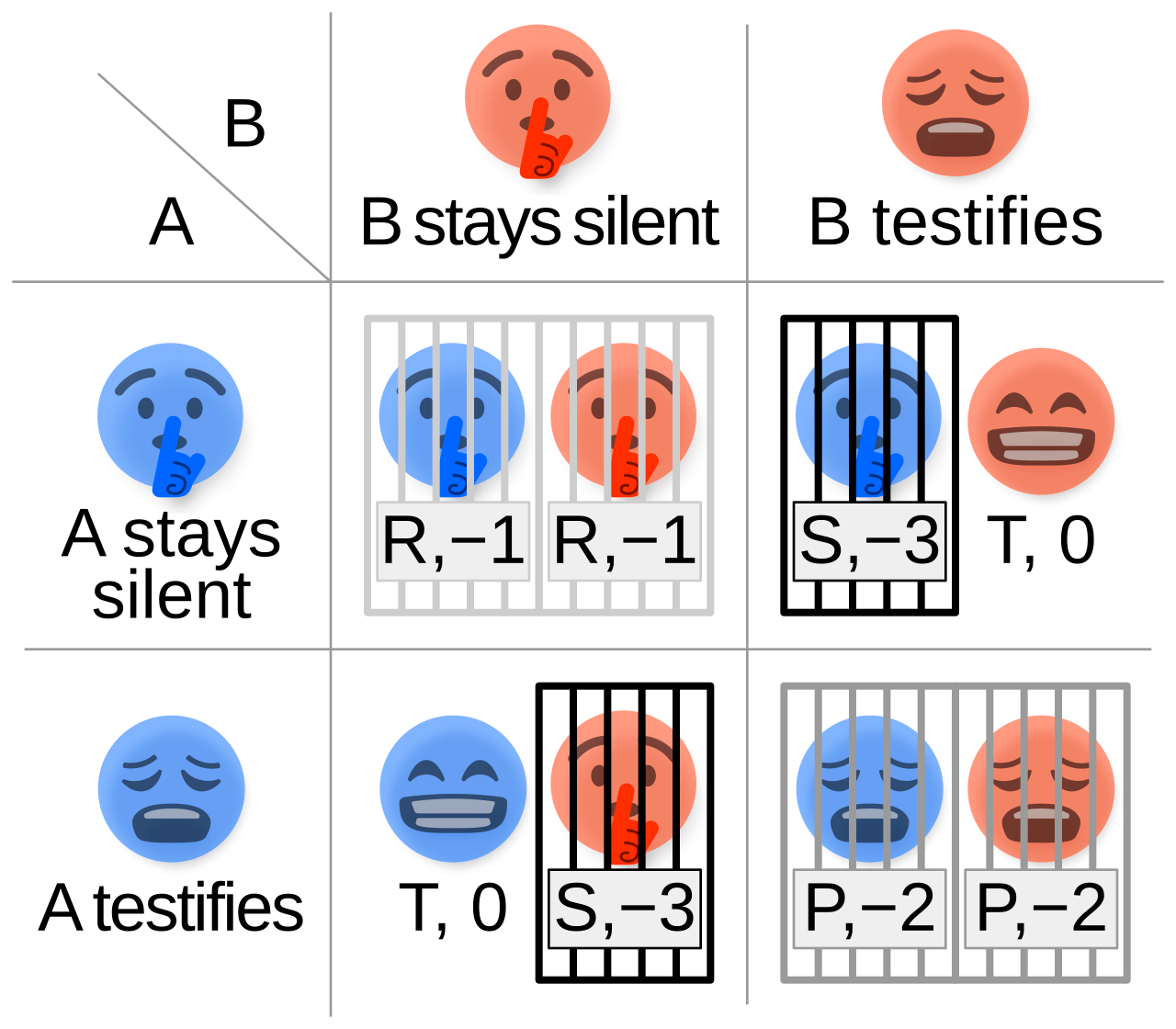
The matrix displays all four terminal outcomes with extraordinary efficiency. For a formal analyst, this is excellent interface design. Every payoff is visible at once. Dominance can be identified by comparing rows or columns. The collectively superior and individually stable outcomes can be seen within seconds.
For a player, however, the screen is almost entirely end states. Nothing visually represents the fear of exploitation, the absence of communication, the destruction of trust, or the strategic meaning of not knowing the other player’s move. The matrix shows where choices terminate but not what it feels like to choose within the field.
The standard labels also smuggle moral characterization directly into the interface. “Cooperate” and “defect” do not simply identify two buttons. They tell players which action is socially good and which is a betrayal before play begins. Rename the options to A and B, and the formal structure remains unchanged while much of the apparent moral drama disappears.
Replace the prisoners with firms setting prices, animals selecting behavior, or automated agents allocating resources, and the same numbers begin telling a different story. The graphics are clear. The user interface is editorializing.
Graphics: 4/10
Extremely readable, iconic, technically efficient, and visually incapable of showing almost everything for which the game is famous.
Multiplayer
The other player matters to your payoff but does not matter to your decision. This is very thin multiplayer.
You do not need to read the opponent because the same move is favored regardless of what the opponent does. You do not need to build trust because there is no future in which trust can operate. You do not need to signal because signaling has been disabled. You do not need to negotiate because negotiation is not supported.
The other player is strategically consequential but interpretively unnecessary. However, this changes completely in the iterated release.
Once the same participants meet again, previous actions can alter future decisions. Cooperation can be rewarded. Defection can be punished. Forgiveness, retaliation, noise, reputation, exploitation, and strategic recognition enter the game. A player must now decide what kind of opponent they face and what kind of opponent they are becoming.
The iterated Prisoner’s Dilemma is not simply the original game with additional rounds. It restores the existence of time. Time restores consequence. Consequence restores much of the missing game.
Multiplayer: 3/10 one-shot, 8/10 iterated
The expansion is a much better multiplayer experience than the base release by an almost embarrassing margin.
Replay Value
One-shot replay value is nearly nonexistent unless the players change, the framing changes, or the experiment is measuring human deviation from formal rationality. However, iterated play can support entire ecologies of strategy.
This creates a classification problem. The canonical Prisoner’s Dilemma is often praised for insights generated by versions that have added precisely the memory, history, retaliation, learning, and continuity missing from the original. Its reputation has absorbed the accomplishments of its own sequel.
We cannot award the base game points for features available only after installing time.
Replay Value: 2/10 one-shot, 9/10 iterated
The Modal Audit
The Prisoner’s Dilemma passes one Modal Path Ethics test with extraordinary force: it shows how a field can convert mutual preservation into unilateral vulnerability. That insight survives.
The game fails when it is promoted from a precise model of hostile incentives into a general ontology of cooperation. Human beings do not choose inside payoff structures. They build, enforce, damage, flee, conceal, repair, and redesign them.
The important question is not only: “should the prisoner cooperate?” It is also: “who the hell built a field in which cooperation requires accepting the worst available exposure?” The one-shot game provides almost no way to ask that question from inside play. Its rules are fixed, its future is absent, and its field cannot be repaired.
The game does not teach players how to cooperate. It teaches them to diagnose one structure in which cooperation has been made irrational. That is still important work. It is not all the work people keep assigning it.
Final Scores
|
Category |
Score |
|
Graphics |
4/10 |
|
Gameplay |
4/10 |
|
Multiplayer |
3/10 |
|
Replay Value |
2/10 |
|
Field Fidelity |
4/10 |
|
Ludic Value |
5/10 |
Final Score: 4.2/10
● Thin Demonstration
The original remains one of the most important diagrams ever marketed as a game. The iterated edition is a substantially different and much better title. Modal Path Ethics has already said enough.
2. Stag Hunt
A Co-op-First Classic
|
|
|
|
Narrative source |
Jean-Jacques Rousseau’s Discourse on
Inequality |
|
Players |
Usually 2 in its canonical matrix form |
|
Formal type |
Coordination or assurance game |
|
Standard interface |
2 × 2 payoff matrix |
|
Pure-strategy equilibria |
Mutual stag and mutual hare |
|
Highest joint payoff |
Mutual stag |
|
Safer unilateral choice |
Hare |
|
Primary design problem |
Equilibrium selection |
The Good
● Two viable equilibria
● Genuine dependence on the other player
● Excellent co-op tension
● Strong connection between trust and reachability
● No dominant strategy telling players what to do
The Bad
● Hunting theme poorly explains most modern applications
● Matrix undersells the psychological game
● Matchmaking provides no assurance
● Hare players can claim they technically survived
The Review.
A group of hunters can cooperate to bring down a stag. The stag provides the better outcome, but success requires the hunters to remain at their positions. A hare passes within reach. One hunter can abandon the shared effort and secure the smaller prize alone. If that hunter leaves, the stag may escape and the others receive nothing.
Welcome to Stag Hunt, the rare game-theory classic with an actual cooperative campaign.
Unlike the Prisoner’s Dilemma, Stag Hunt does not assign each player a dominant move. Mutual stag is an equilibrium. If both players pursue it, neither benefits from abandoning the plan. Mutual hare is also an equilibrium. If each expects the other to pursue the safer individual prize, unilateral commitment to the stag becomes dangerous.
The central problem is therefore not whether cooperation is rational. Cooperation is rational when cooperation is sufficiently assured. The difficulty lies in reaching the better equilibrium from a field in which the worse equilibrium is safer. This is already a much richer game.
The player must form a belief about another player. The belief is not incidental to the decision. It creates the practical value of the available paths. Stag is not simply the higher-payoff button. Stag becomes the higher-payoff button only when another agent remains reachable, reliable, and aligned. The better future exists. Neither player can enter it alone.
Gameplay
Stag Hunt contains one of the most important mechanics missing from the Prisoner’s Dilemma: uncertainty about the other player can rationally change what you should do.
The safe choice is not necessarily selfish. The cooperative choice is not necessarily wise. A player may want the stag, value the stag, and sincerely prefer mutual stag while still selecting hare because the path to stag depends upon assurance they do not possess.
A great deal of moral language treats failed cooperation as if somebody simply failed to choose the larger good. Stag Hunt shows why this can be structurally false. The larger good may not be an individually available action. It may be a jointly sustained route whose accessibility depends on expectations, commitments, communication, history, and confidence.
“Choose stag” is not a complete strategy. It is a request for another player to make choosing stag survivable.
The strongest moments in Stag Hunt occur before the formal choice. Players look at one another. They search for commitment. They ask whether communication is binding, whether previous rounds matter, whether the other player is cautious, and whether the promise of the superior joint outcome can overcome the security of the lesser private one. The game acquires philosophical force through hesitation.
That hesitation is playerly surplus. The matrix can tell us that two equilibria exist. Play reveals exactly how much of social life happens in the distance between preferring an equilibrium and trusting that it can be reached.
Graphics
Stag Hunt is usually presented through the same 2 × 2 matrix architecture as the Prisoner’s Dilemma, because game theory has never encountered a human crisis it did not think it could place inside Microsoft Excel.
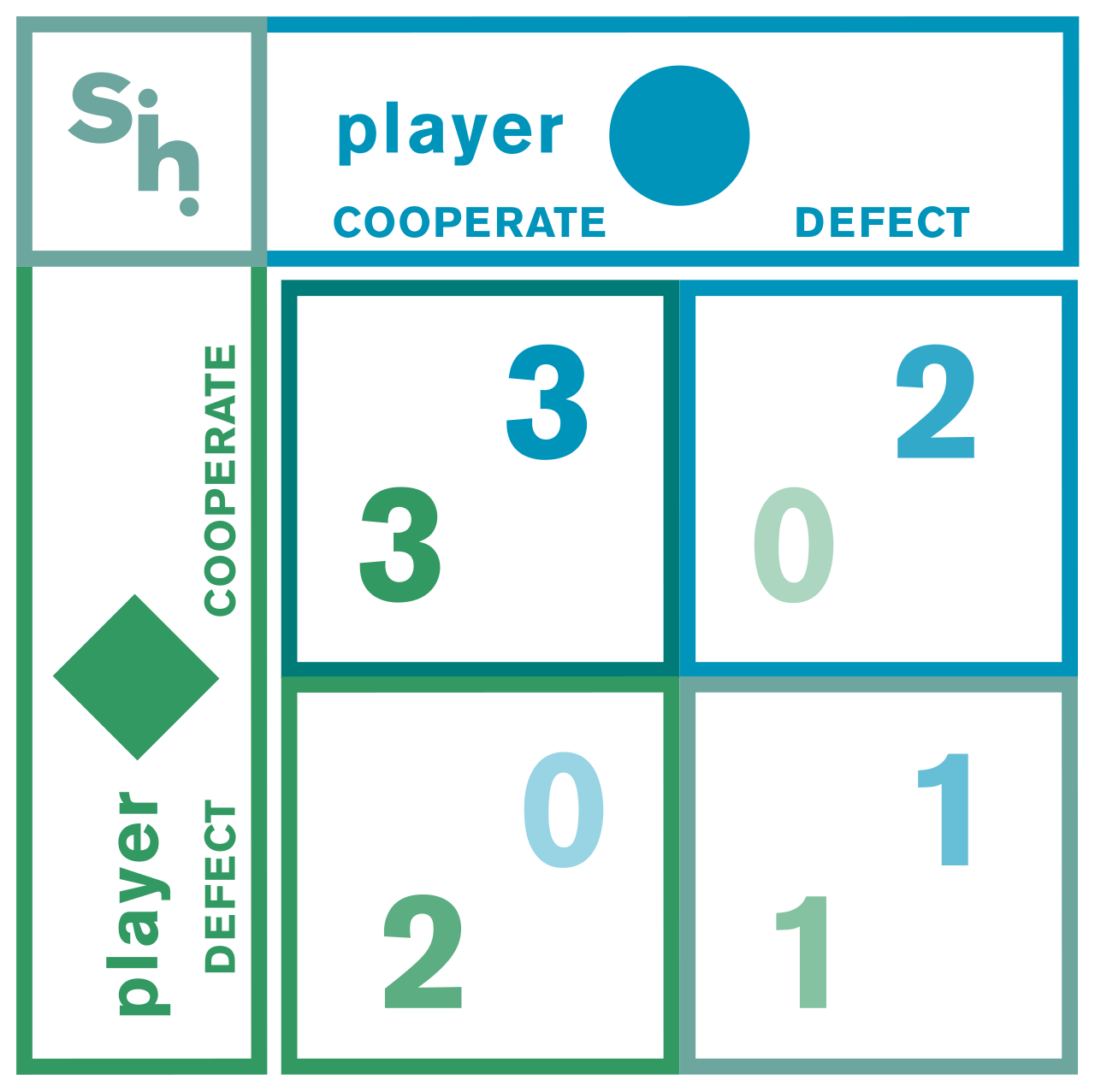
The matrix clearly displays the two equilibria. Mutual stag offers the greater payoff. Mutual hare offers the safer one. Miscoordination punishes the hunter who commits to stag while the other takes the hare.
Formally, the display works. Ludically, it hides the game’s most important feature.
Stag Hunt is about a path that exists only through maintained coordination, but the standard visual representation contains no path. There is no shared project, no duration, no point at which commitment becomes visible, and no representation of the hunter watching another hunter’s posture change as the hare appears. Four boxes flatten assurance into an output.
A better graphical treatment would show the basins surrounding the two equilibria: the range of expectations under which stag remains reachable and the range under which both players retreat toward hare. An even better playable version would spatialize the dependence itself. Players would invest in the hunt, observe partial commitment, and experience the growing cost of abandonment. The matrix tells us where the players land. It does not show how a social field tips.
Graphics: 5/10
The information is accurate. The main mechanic remains offscreen.
Multiplayer
This is actual multiplayer, game theory. Your choice depends on what the other player will do, what you believe the other player will do, what the other player believes you will do, and whether either of you can make those beliefs sufficiently reliable.
Another human being is not just a source of payoff variation. They are a condition of access. That makes Stag Hunt an unusually clean ludic model of relational reachability. The better outcome cannot be reduced to two isolated good choices. It is produced by a relation capable of holding both choices in place.
Communication dramatically changes the game, but it does not automatically solve it. Cheap talk can help coordinate expectations without guaranteeing performance. Repetition can create reputation. Visible commitment can reduce uncertainty. Institutions can stabilize the stag path. Shared history can make the better equilibrium easier to enter.
Every one of these modifications teaches the same larger lesson: trust is not simply a pleasant attitude inside a cooperative field. Trust changes which futures are rationally reachable.
Multiplayer: 9/10
Minimal content, excellent dependence.
Replay Value
Stag Hunt improves through repetition because each round creates evidence. A player who reliably hunts stag makes future stag hunting safer. A player who defects toward hare under modest uncertainty narrows the cooperative field in subsequent rounds. Expectations become self-reinforcing. Mutual caution can stabilize a worse equilibrium even when neither participant prefers it.
This is where the game begins producing knowledge through play rather than simply displaying it. Players can watch a cooperative field become easier or harder to inhabit. They can discover that one successful stag hunt does more than produce one large payoff. It alters the credibility of the same path next time.
The game can still degenerate. Once both players possess complete assurance, mutual stag becomes automatic and much of the tension disappears. If neither trusts the other at all, mutual hare may become equally automatic. The interesting game occupies the unstable region in which assurance can still be built, damaged, tested, or withdrawn.
Replay Value: 8/10
The meta can stabilize, but the route toward stabilization is the game.
The Modal Audit
Stag Hunt provides a direct correction to moral theories that treat Better as if it were always an individually selectable object. The stag is always better. That does not mean the stag is reachable.
A person can correctly perceive the superior future and still lack a viable path into it. The missing structure may be assurance, protection, coordination, communication, institutional support, or evidence that another necessary agent will remain in position.
This does not excuse every retreat toward hare; it relocates the analysis. We must ask what conditions would make the better path supportable, who bears the risk while those conditions are absent, and whether demands for cooperation are distributing that risk honestly.
Stag Hunt also reveals how damaged fields reproduce themselves. When previous failures reduce trust, the safer inferior equilibrium becomes more attractive. Each retreat then confirms the expectations that produced it. The field can close without either participant wanting it closed. This one is not a morality play about greedy hunters. It is a game about the infrastructure of confidence.
Final Scores
|
Category |
Score |
|
Graphics |
5/10 |
|
Gameplay |
8/10 |
|
Multiplayer |
9/10 |
|
Replay Value |
8/10 |
|
Field Fidelity |
8/10 |
|
Ludic Value |
9/10 |
Final Score: 7.8/10
● Full Ludic Instrument
Excellent cooperative design. Limited assets. No dedicated servers or end of life roadmap. Teaches more about trust in ten minutes than many books manage in three hundred pages.
3. Chicken
Saved By The Modding Community
|
|
|
|
Players |
2 |
|
Formal type |
Anti-coordination game |
|
Common aliases |
Hawk–Dove; Snowdrift |
|
Standard interface |
2 × 2 payoff matrix |
|
Pure-strategy equilibria |
Two asymmetric outcomes in which one player
yields |
|
Mixed equilibrium |
Both players randomize |
|
Worst outcome |
Neither player yields |
|
Notable cultural interface |
Two vehicles approaching collision |
|
Major applications |
Brinkmanship, deterrence, conflict,
biological competition |
The Good
● Strong theme
● Immediate stakes
● Excellent asymmetrical tension
● Supports signaling and commitment analysis
● One of the few titles with a memorable vehicle section
The Bad
● Catastrophic failure state
● Base matrix omits most actual brinkmanship
● Reputation system encourages idiocy
● Balance depends on both players valuing survival
● Famous steering-wheel strategy is not included in the standard rules
The Review.
Two drivers accelerate toward one another. The first to swerve loses face. If one swerves and the other continues, the unyielding driver wins. If both swerve, neither wins outright. If neither swerves, both experience the game’s collision physics.
Chicken is the best-looking member of the canonical 2 × 2 lineup because it has fast cars and explosions. It is also among the most alarming.
Where Stag Hunt asks players to converge on the same cooperative action, Chicken rewards them for selecting different actions. Each wants the other to yield. Neither wants mutual escalation. The stable outcomes are asymmetric: one proceeds, one retreats.
This is not a failure to coordinate in the ordinary sense. The players agree that somebody should absolutely swerve. The disagreement concerns who must absorb the loss.
Chicken therefore models conflict over burden allocation. Both players prefer avoiding catastrophe. Each also prefers that the other party pay the price of avoiding it. That is enough to produce brinkmanship.
Gameplay
Chicken contains no dominant strategy. The correct action depends on what the other player will do. This immediately creates more gameplay than the one-shot Prisoner’s Dilemma. Players must estimate resolve. They must interpret signals. They may cultivate a reputation for refusing to yield. They may attempt to convince the opponent that continued escalation is inevitable.
The game’s most famous strategic lesson concerns commitment. A driver who visibly removes or disables the steering wheel has reduced their own options. In almost every ordinary account of agency, possessing fewer options is a disadvantage. Inside Chicken, eliminating the ability to swerve can transfer the full burden of avoiding catastrophe to the other player.
This is a profound strategic fact: an agent can gain control over a field by destroying their own capacity to choose within it. The resulting advantage does not come from strength in the ordinary sense. It comes from making Better somebody else’s unilateral responsibility.
The player without a steering wheel has not courageously prevailed over fear. They have directly attacked the joint decision field. They have closed their own exit so that the remaining exit belongs only to the opponent.
That is one of the cleanest game-theoretic demonstrations of coercion through self-binding. However, it is a community mod. This is technically absent from the standard game.
The canonical simultaneous 2 × 2 matrix begins after signaling, commitment, identity, reputation, mechanical sabotage, and opportunities for de-escalation have already been compressed into two final choices. The famous steering-wheel move is a pre-play modification to the field. It changes what the other player knows and what each player can still do.
The most philosophically interesting strategy in Chicken requires modding Chicken. This will become a recurring problem throughout The Ludic Audit.
Graphics
Chicken has enjoyed more generous visual adaptations than most game-theory games. Its central image is immediately comprehensible: two cars, one road, one looming collision. The scenario has appeared in film, political cartoons, military discussions, classroom diagrams, and several generations of lectures delivered by professors delighted to have found a reason to mention teenagers.
The visual metaphor does real work. Distance represents remaining time. The road represents constrained mobility. The opposing vehicle represents reciprocal threat. The approaching collision represents a future that becomes harder to avoid as commitment deepens.
Unfortunately, the standard payoff matrix deletes all of this and returns the player to four boxes.
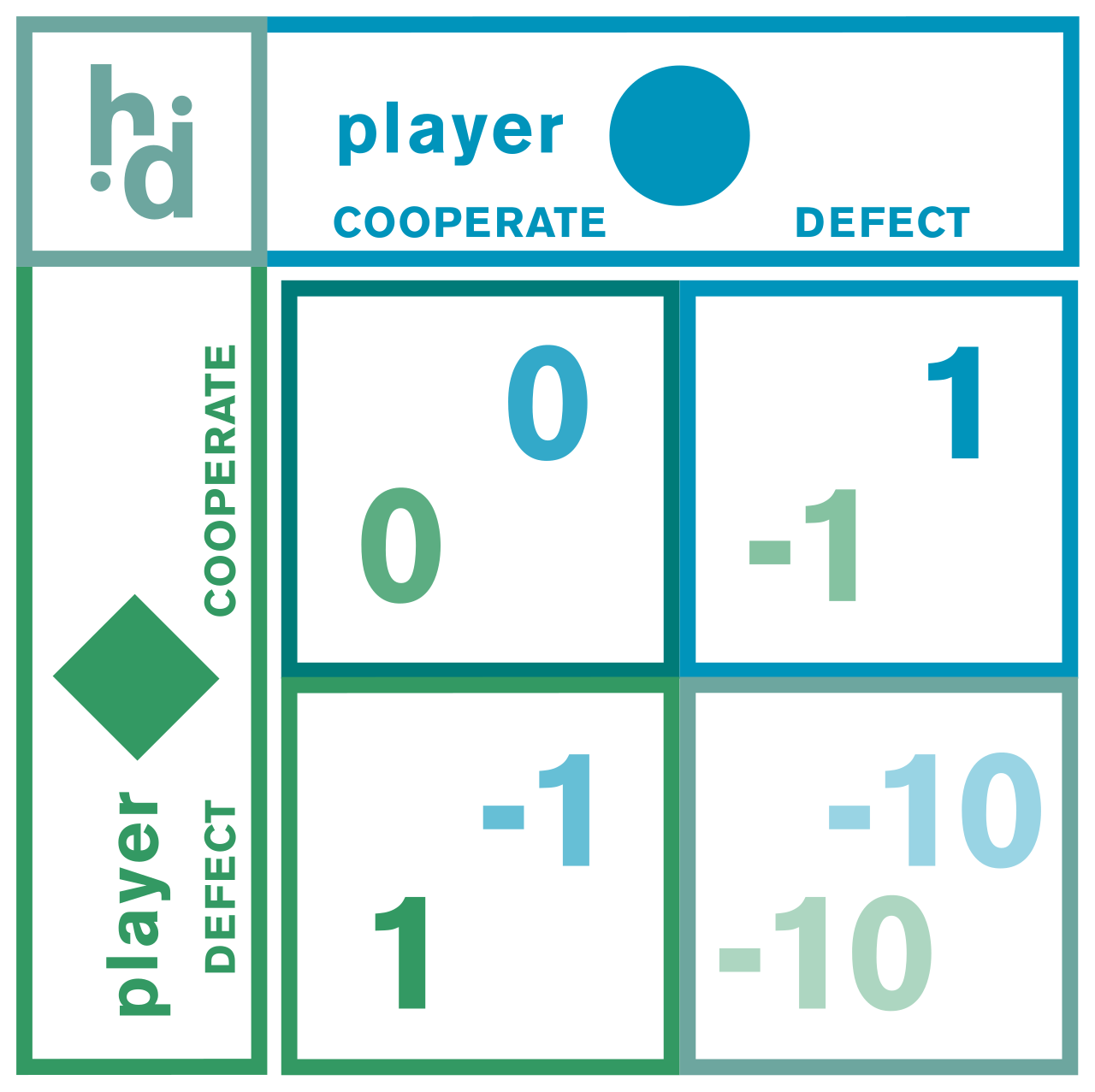
The matrix accurately orders the outcomes: unilateral victory, mutual retreat, unilateral humiliation, mutual catastrophe. It also makes the game look static. Brinkmanship is not static. The whole phenomenon concerns the progressive loss of room for maneuver.
A decision tree or temporal track would represent the game better. Players should be able to signal, accelerate, disable options, misread one another, and discover that an apparently credible threat has become materially uncontrollable. The matrix contains the collision, not the drive.
Graphics: 7/10 with cars, 4/10 in the standard matrix edition
This is still one of the strongest art directions in game theory.
Multiplayer
Chicken requires another player in the fullest possible sense. The opponent’s beliefs matter. Their appetite for risk matters. Their estimate of your appetite for risk matters. Their understanding of your commitments matters. Their confidence in the reliability of your vehicle may matter more than anyone intended.
The game supports bluffing, reputation, signaling, and second-order interpretation even when these features are not formally represented in the base matrix. The thin rules invite a much richer human contest around them.
That richness is also dangerous. When the strategy of appearing irrational becomes rational, players are rewarded for degrading the quality of information in the field. Calm reassessment can look like weakness. Flexibility can become exploitable. The ability to de-escalate can reduce bargaining power. Public commitments can trap players inside positions they privately recognize as catastrophic.
The multiplayer field therefore selects for behavior that makes later correction more difficult. Chicken models the strategic production of inflexibility, not just conflict.
Multiplayer: 9/10
Outstanding psychological PvP. Terrible community norms.
Replay Value
Repeated Chicken develops reputation very quickly. A player who yielded last time may feel pressure not to yield again. A player who never yields can gain an advantage until another player decides that preserving the field requires testing the reputation. Audiences, allies, domestic constituencies, and prior threats can all increase the social cost of retreat.
Repetition therefore does not necessarily stabilize cooperation. It can accumulate performative burden. Every round brings history into the next confrontation. History can enable prediction, but it can also harden identity. A player stops choosing whether to yield in this encounter and begins defending the proposition that they are not the kind of player who yields.
The meta moves from strategy into character. This produces enormous analytical value, though not necessarily good play conditions.
Replay Value: 8/10
The game keeps changing because players remember who blinked.
The Modal Audit
Chicken reveals a class of action Modal Path Ethics must treat with particular suspicion: the deliberate destruction of one’s own future options in order to control another agent’s present choice.
Self-limitation can be morally serious. Promises, contracts, vows, disciplines, and commitments often preserve valuable paths by making some actions harder to take. Chicken exposes the hostile form.
The player closes their own path to retreat and converts that closure into pressure on somebody else. The field has fewer safe futures than before, but the player responsible for that contraction may become strategically stronger within what remains. This is why power cannot be measured simply by the number of options an agent possesses. An actor can gain local power by deleting global options.
The steering-wheel strategy is the pure form. Political red lines, automatic retaliation systems, irreversible mobilization, public vows, delegated launch authority, and cultivated irrationality can perform comparable work. Each mechanism attempts to make one player’s restraint unavailable so that another player must supply all remaining restraint for the field.
The usual framing calls the yielding player a coward. The modal framing asks who made yielding necessary.
Chicken is not fundamentally a game about bravery. It is a game about the distribution of responsibility for preventing a mutually recognized catastrophe. Its moral center belongs to the person still capable of turning. That person may lose the round. They also preserve the world in which another round remains possible.
Final Scores
|
Category |
Score |
|
Graphics |
7/10 |
|
Gameplay |
8/10 |
|
Multiplayer |
9/10 |
|
Replay Value |
8/10 |
|
Field Fidelity |
6/10 |
|
Ludic Value |
9/10 |
Final Score: 7.8/10
● Full Ludic Instrument (With Mods)
An excellent conflict game whose most famous mechanic occurs outside the supplied matrix. Toxic but deeply dedicated community. Deep, tense, culturally influential, and responsible for some of the worst player behavior ever rewarded by a ruleset.
4. The Dictator Game
Player Two's Controller Is Unplugged
|
|
|
|
Early experimental form |
Daniel Kahneman, Jack Knetsch, and Richard
Thaler, 1986 |
|
Canonical experimental comparison |
Robert Forsythe, Joel Horowitz, N. E. Savin,
and Martin Sefton, 1994 |
|
Players listed |
2 |
|
Players with available actions |
1 |
|
Formal type |
Unilateral allocation game |
|
Standard decision |
Divide a fixed endowment between oneself and
a recipient |
|
Recipient controls |
Zero |
|
Self-interested monetary prediction |
Allocator keeps the entire endowment |
|
Primary research use |
Other-regarding preferences, fairness,
altruism, and experimental context |
|
Strategic interaction included |
None |
The Good
● Easy to learn
● Runs in a single turn
● Useful behavioral instrument
● Clear distributional outcome
● Recipient cannot slow down the session
The Bad
● Recipient cannot do anything else either
● No strategic interaction
● No multiplayer decisions
● Limited opportunities for mastery
● Calling it a game has done lasting damage to the word
The Review.
The Dictator Game is the highly anticipated follow-up to bargaining. It removes the bargaining.
One participant receives an endowment and decides how much of it to allocate to another participant. The second participant cannot accept, reject, counteroffer, retaliate, leave, appeal, negotiate, conceal information, alter the relationship, or perform any other action traditionally associated with playing a game.
The recipient receives whatever the allocator selects. That is the full ruleset.
The Dictator Game was developed as a way of separating generosity or fairness from strategic bargaining. In the Ultimatum Game, a proposer may offer a fair division because the responder can reject an unfair one. Remove the responder’s veto and any remaining transfer becomes harder to explain as fear of rejection. The game therefore isolates what the allocator does when material self-interest faces no strategic resistance.
As an experimental control, this is elegant. As a game, it is a tray containing money and a nearby witness.
The Dictator Game nevertheless deserves its place in the audit because its classification failure reveals something important about the larger game-theoretic tradition. The presence of multiple people and multiple payoffs is often treated as sufficient to establish a game. Under a genuinely ludic standard, this is not enough.
A game requires more than plural consequences. It requires plural agency inside a shared structure.
The recipient is morally present. What happens matters to them. Their welfare forms part of the outcome being studied. They may feel gratitude, humiliation, anger, surprise, or resignation. None of these responses can enter the formal decision field. The recipient is affected by play without being allowed to participate in it.
This is still technically a relationship. It is an allocation. It is definitely an experiment. It is not meaningfully multiplayer.
Gameplay
The Dictator Game has one meaningful decision: how much to keep and how much to give.
That decision may be morally revealing. It may expose fairness preferences, generosity, aversion to inequality, concern for reputation, sensitivity to ownership, experimenter expectations, or a desire not to look like the sort of person who takes everything while another human being watches.
These are serious research questions. They do not create serious gameplay. There is no opponent to interpret. There is no strategic uncertainty. There is no response to anticipate. There is no risk that the recipient will alter the outcome. The allocator does not need to understand the recipient’s plan because the recipient has not been issued one.
The game has no tempo. The only uncertainty lies inside the allocator: what kind of person am I going to be while somebody records this?
That can be psychologically powerful. It can also be philosophically interesting. The decision may force the allocator to discover that the value represented by the experimenter’s money is not the only value active in the room.
The formal prediction for a narrowly self-interested monetary maximizer is simple: keep everything. Many participants do not.
This does not mean they have failed to understand the controls. It means the experiment has located motivations outside the model’s deliberately restricted payoff description. The participant may care about equality, decency, convention, self-conception, the gaze of the experimenter, the imagined judgment of the recipient, or the norm governing unexpected windfalls.
The Dictator Game is therefore very good at demonstrating that a person cannot always be reconstructed from the monetary number written beside their name. It remains poor at allowing that person to play.
The entire philosophical event occurs in the allocator’s relationship to their own action. The recipient supplies moral gravity but no counterforce.
Gameplay: 2/10
One consequential choice. No strategy. Strong character-creation screen.
Graphics
The Dictator Game is commonly represented through an allocation, a line, a pair of boxes, a slider, or a simple division of an endowment between two recipients. Visually, this is honest.
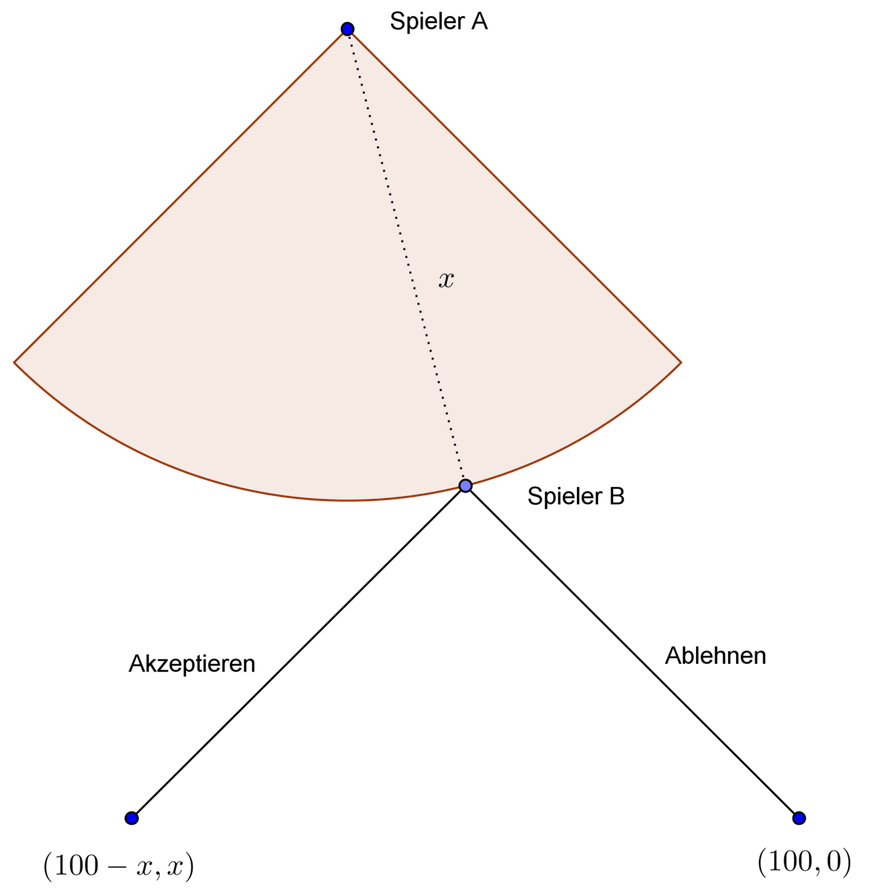
Unlike the Prisoner’s Dilemma, it does not require a matrix because the second player has no strategy to place on an axis. Unlike Centipede, it does not require a tree because there is no sequence of decisions. A diagram can show one quantity entering the allocator’s control and leaving in two unequal streams.
The cleanest representations resemble a pie chart before anyone has decided how much pie another person deserves. This interface efficiently shows the distributive question: how much exists? How much does the allocator retain? How much reaches the recipient?
It does not show the recipient as an agent because the rules do not contain one. This creates an unusual case in which the graphical poverty accurately reports the ludic poverty. The absence of a second decision path is not a design oversight. It is the entire point of the experiment.
Some implementations display photographs, anonymous identification numbers, envelopes, separate rooms, or computer interfaces. These presentation choices can affect how socially distant the recipient feels and how visible the allocator believes the decision will be. The experiment’s apparently austere graphics can therefore become part of the measured field.
A human face and a participant number do not present the same moral interface. The game itself has almost nothing to display, but the display can change the behavior under observation.
Graphics: 3/10
Accurate, legible, and approximately as dynamic as dividing a restaurant bill alone.
Multiplayer
No.
The recipient is a person affected by another person’s choice. That does not make them a player any more than being struck by a tennis ball makes a window the third participant in a doubles match.
The distinction should be stated carefully. Calling the recipient a non-player does not reduce their moral standing. It identifies the very thing that has been taken from them.
They have stakes without agency. They possess an outcome without a move. They are inside the consequence field and outside the decision field.
This configuration is not rare. Children, patients, prisoners, employees, tenants, dependents, occupied populations, future generations, nonhuman animals, and people represented by institutions are routinely placed in fields where others make decisions about their reachable futures while they possess little or no effective reply.
The Dictator Game can model the unilateral shape of those decisions in miniature. That makes it morally relevant.
It does not make it multiplayer.
Multiplayer: 0/10
Two humans required. One player included.
Replay Value
The base game contains almost no ludic replay value. The allocator can choose differently on another occasion. Researchers can change anonymity, earned ownership, social distance, framing, recipient identity, endowment size, or the visibility of the decision. These variations may produce valuable evidence about what influences giving. The experiment has replay value for the researcher. The player has a repeated moral prompt. This is not the same thing as a developing game.
There is no internal strategic structure to master. The recipient cannot learn how to respond more effectively. The allocator cannot become more skillful except by becoming more adept at satisfying whichever personal or experimental objective they have inferred.
Repeated versions can add reputation, role rotation, networks, partner selection, or future consequences. Once these appear, however, the recipient’s existence begins to matter strategically. The resulting activity acquires genuine multiplayer features precisely by becoming less like the canonical Dictator Game. The modding community keeps attempting to add a game where none was designed to exist.
Replay Value: 2/10
Considerable experimental variation. Almost no playerly development.
Field Fidelity
The Dictator Game accurately represents one extremely important structure: one agent controls a divisible benefit, and another agent lacks any power to alter the allocation. That structure definitely exists.
A donor deciding how much to give, a parent dividing an allowance, an institution setting compensation for people excluded from negotiation, a colonial administration distributing resources, or a wealthy actor deciding whether to share an unexpected gain may all approximate aspects of the game.
The model becomes less faithful when it is treated as a general test of generosity. Where did the endowment come from? Why does the allocator control it? Does the recipient have a prior claim? Did either participant earn it? Will they meet again? Does anyone observe the decision? Can the recipient later alter the relationship? Does refusal exist outside the laboratory even if the experiment has disabled it inside the interface?
A transfer of two dollars from an unearned experimental endowment does not carry the same field meaning as returning stolen property, paying a debt, sharing jointly produced value, tipping a worker, funding a stranger’s need, or surrendering wealth one has been socially authorized to regard as entirely one’s own.
The Dictator Game removes these histories to isolate the allocation. That is legitimate experimental design. The excised histories should not then be smuggled back into the conclusion.
Field Fidelity: 5/10
Excellent model of unilateral allocation. Unreliable universal morality scanner.
The Modal Audit
The Dictator Game produces an important Modal Path Ethical distinction: a field can be morally relational without being ludically reciprocal.
The recipient’s future is altered. Their reachable resources expand or contract according to another person’s decision. Harm and benefit remain fully intelligible even though no strategic contest occurs.
This prevents Modal Path Ethics from making the opposite mistake: treating agency as a prerequisite for moral relevance. The recipient does not need a move in order to matter. Indeed, their absence of a move may be the most important fact in this field.
The allocator possesses almost total local path-setting power. They determine which distributions remain reachable. The recipient cannot resist an unfair division or demand a better one. Responsibility therefore accumulates around the participant whose options are widest.
The game does not reveal what two agents do together. It reveals what one agent does when another has been structurally reduced to a consequence. That is useful and also why the title fails.
Final Scores
|
Category |
Score |
|
Graphics |
3/10 |
|
Gameplay |
2/10 |
|
Multiplayer |
0/10 |
|
Replay Value |
2/10 |
|
Field Fidelity |
5/10 |
|
Ludic Value |
2/10 |
Final Score: 2.3/10
● Behavioral Apparatus
A rigorous experimental control and a catastrophic multiplayer release. The recipient is never bad at the game. The recipient has not been given a game to play. Does not respect the player's time.
5. The Ultimatum Game
Now Player Two Has A Button
|
|
|
|
First experimental study |
Werner Güth, Rolf Schmittberger, and Bernd
Schwarze, 1982 |
|
Players |
2 |
|
Formal type |
Sequential bargaining game |
|
Roles |
Proposer and responder |
|
Proposer action |
Offer a division of a fixed endowment |
|
Responder actions |
Accept or reject |
|
If accepted |
The proposed division is implemented |
|
If rejected |
Both players receive nothing |
|
Standard monetary backward-induction
prediction |
The proposer offers the smallest acceptable
amount; the responder accepts |
|
Persistent experimental complication |
Responders often reject sufficiently unequal
offers |
The Good
● Restores agency to the second player
● Excellent veto mechanic
● Strong psychological multiplayer
● Easy to learn
● Generates immediate arguments after the match
The Bad
● No counteroffers
● No negotiation
● Character classes permanently locked
● Rejection deletes the entire prize
● Many reviewers confuse destroying value with failing to understand value, as if the players are idiots
The Review.
The Ultimatum Game begins with the same basic setup as the Dictator Game. One player receives control over an endowment. That player proposes a division between themselves and another person.
Then, the developers added one button.
- The responder may accept.
- The responder may reject.
If the responder accepts, the proposed division occurs. If the responder rejects, both players receive nothing. This single addition transforms the entire field.
The recipient is no longer just the destination of an allocation. The recipient becomes a veto point through which the allocation must pass. The proposer must now consider not only what they would like to keep, but what the responder will permit them to keep.
The other person returns. Gameplay begins.
Gameplay
The formal monetary solution appears simple. A responder who prefers more money to less should accept any positive offer. One unit is better than zero. Knowing this, the proposer should offer the smallest amount the rules permit and retain everything else.
This prediction has spent decades colliding with human beings.
Responders frequently reject offers they consider intolerably unfair, even though rejection leaves them with less money. Proposers, anticipating this, commonly offer substantially more than the smallest possible amount.
The monetary payoffs have not ceased to matter. They have ceased to describe the entire game. The responder may value fairness, dignity, punishment, reciprocity, norm enforcement, or refusal to participate in their own degradation. The proposer may care about fairness directly, but even a proposer who does not must account for the possibility that the responder does.
The game therefore creates real strategic interpretation. What will this person accept? What will they regard as insulting? Are they willing to pay to punish me? Do they consider the endowment mine to divide, ours to divide, or simply money temporarily placed under my control? Does an offer of twenty percent look like free money, an unfair bargain, or an attempt to purchase their consent at the lowest survivable price?
The responder must also interpret. Is this a hostile offer? Is it the proposer following the formal prediction? Does accepting reward a rule that should be resisted? Does rejection preserve anything beyond the vanished money? Is the offer bad enough to justify closing the only path through which either player receives value?
These questions arise through the move. The Ultimatum Game does not simply tell us that people care about fairness. It forces players to discover how much fairness is worth when preserving it has a price. That is genuine philosophical gameplay.
The One-Button Revolution
The difference between Dictator and Ultimatum is so severe that it deserves to be isolated.
● The endowment has not changed.
● The proposer’s initial range of divisions has not changed.
● The identities of the participants need not change.
● The responder receives only one additional action.
Yet this one action changes the likely behavior of the player who moves first.
This is power in one of its cleanest forms.
The responder does not need control over the allocation. They need control over whether the allocation becomes real. They cannot select the better distribution directly. They can make the worse distribution fail. This is a limited and destructive power. It is still power.
A veto does not create the desired path. It prevents another agent from treating an undesired path as inevitable. The responder’s button converts their judgment into a structural condition of the proposer’s success. The entire game improves because Player Two can now ruin it.
Graphics
The Ultimatum Game is often represented as an extensive-form decision tree. This is a substantial graphical improvement over the payoff matrix.
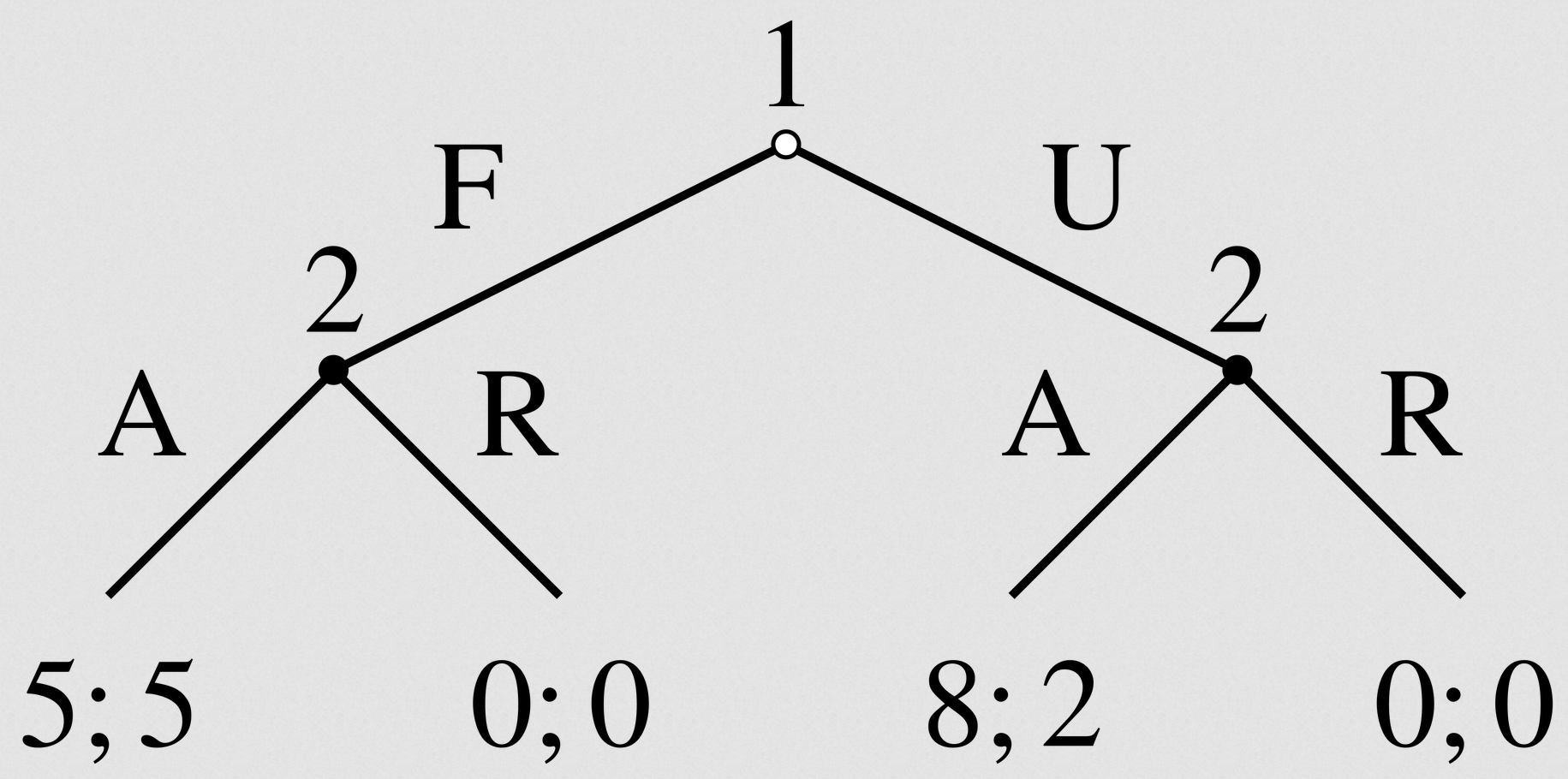
The proposer moves first. The responder’s acceptance or rejection branches from the proposed division. The terminal outcomes visibly depend upon the second player’s action. Sequence, control, and consequence appear in the diagram rather than being compressed into a static grid.
The tree tells the truth about the game:
- One participant defines the initial reachable distributions.
- Another participant decides whether the selected distribution survives.
- Rejection closes every monetary branch.
This is excellent structural communication.
The weakness lies in how quickly the complete bargaining field becomes visually flattened. A formal tree may show a large number of possible offers, each followed by the same accept-or-reject fork. The human meaning of those offers appears only as numbers at the endpoints.
A 50–50 division and a 99–1 division differ graphically by labels. For the responder, they may differ as entirely different social acts.
Many experimental interfaces improve this with bars, tokens, coins, or divided pools that make inequality immediately visible. A nearly empty recipient column can communicate something that a terminal payoff pair leaves abstract. The distribution becomes spatial before it becomes numerical.
This is one of the rare game-theory titles where the most effective graphics are not decorative. The representation can alter how the offer is perceived. The game’s central object is a division. Players should be able to see the cut.
Graphics: 7/10
Strong decision-tree support. Excellent bar-chart mods. Facial animation still absent.
Multiplayer
The Ultimatum Game has exactly enough multiplayer to become dangerous. The proposer must form a model of the responder. The responder knows that their willingness to reject has already shaped the offer placed before them. Each move is therefore haunted by an earlier or anticipated judgment.
The proposer does not simply divide money. The proposer prices the responder’s resistance. The responder does not simply accept or reject money. The responder reveals whether the price was accurate.
This creates a compact loop of strategic interpretation. A generous offer may express fairness, fear of rejection, generosity disguised as prudence, cultural expectation, or simple desire to avoid the stress of discovering another person’s threshold. An unequal offer may be greed, experimentation, contempt, confidence, or a sincere belief that free money should always be accepted.
The responder’s choice is similarly overdetermined. Acceptance may indicate satisfaction, resignation, monetary discipline, indifference to fairness, urgent need, or refusal to burn value for symbolic reasons. Rejection may express anger, dignity, punishment, norm defense, spite, or an attempt to become the kind of person future proposers would fear if future proposers existed.
The rules contain only two buttons. The people bring all the rest.
Multiplayer: 8/10
Extremely limited moveset. Excellent mind games.
Replay Value
The canonical one-shot Ultimatum Game has modest replay value between the same players.
Once a proposer knows a particular responder’s threshold, much of the uncertainty disappears. Once a responder knows how a particular proposer behaves, rejection can become part of a larger relationship. This creates reputation, retaliation, learning, and strategic adjustment not present in the one-shot design.
With changing partners, repeated sessions can teach players about a population rather than an individual. Proposers develop beliefs about typical acceptance thresholds. Responders discover whether their own standards are unusually strict or permissive. Norms become statistically visible through play.
The game can therefore support learning, though the learning often occurs around the base rules rather than inside a developing position. There is no persistent board. There is no accumulated resource. There is no counteroffer tree. There is no opportunity to recover after rejection.
Every round is a fresh terminal confrontation.
The replay value comes from other human beings refusing to behave like interchangeable payoff functions.
Replay Value: 6/10
The maps never change. The players do.
Field Fidelity
The Ultimatum Game faithfully models take-it-or-leave-it power. One participant determines the offer. The other cannot modify it. Acceptance implements the proposer’s terms. Rejection destroys the transaction.
This structure appears in employment offers, plea bargains, emergency sales, contract renewals, institutional settlements, political votes, platform terms, ransom demands, and relationships where one side controls the available proposal while the other retains only the power to leave it unrealized.
The game becomes less faithful when these applications contain outside options the model has removed. A worker may seek another employer. A defendant may go to trial. A tenant may organize. A buyer may wait. A voter may amend the proposal.
A person who rejects a relationship may preserve resources, allies, identity, or future bargaining power not represented by the game’s zero.
The Ultimatum Game makes rejection maximally clean:
This offer or nothing.
Real fields often make “nothing” a false description of everything that remains outside the proposed exchange.
The game also excludes the processes through which offers are produced. There is no conversation, justification, history, claim, ownership dispute, or opportunity for the responder to shape what the proposer regards as reasonable.
The proposer authors the path. The responder audits it at the terminal gate. This is a real structure; not all bargaining.
Field Fidelity: 7/10
Excellent take-it-or-leave-it simulator. Negotiation expansion not included.
The Modal Audit
The Ultimatum Game poses a problem that simple outcome maximization handles badly:
When can closing an available path preserve a wider field?
Rejecting an offer destroys immediate value. Both participants receive less than they would have received through acceptance. Viewed only at the terminal monetary outcome, rejection appears self-defeating.
The responder may nevertheless be protecting something the payoff table has failed to count. A norm against exploitative division can preserve future bargaining conditions. A refusal to ratify humiliation can preserve the responder’s agency and self-relation. A costly punishment can alter what proposers believe they are permitted to offer.
Even in a genuinely one-shot anonymous encounter, the responder may regard participation itself as an act that shapes the kind of world they are willing to instantiate. This does not make every rejection wise.
The language of dignity and norm enforcement can easily romanticize actions that destroy needed resources without changing any future field. A responder in desperate need may bear the full cost of demonstrating a principle no future proposer will observe. Pride can close paths as effectively as exploitation.
The modal question is not whether refusal is noble. It is:
What remains reachable because this offer was rejected, and what becomes unreachable with it?
The answer may include future norms, social meaning, bargaining position, self-respect, or collective resistance. The answer may also be nothing but two vanished payments. The game’s philosophical power lies in forcing that ambiguity into one button.
The responder receives almost no constructive agency. They cannot write a better offer. They cannot redirect the surplus. They cannot repair the relation. Their power is entirely negative. Yet negative agency is enough to transform the proposer’s field.
- The Dictator Game asks what power does without resistance.
- The Ultimatum Game asks what resistance can do without authorship.
Final Scores
|
Category |
Score |
|
Graphics |
7/10 |
|
Gameplay |
7/10 |
|
Multiplayer |
8/10 |
|
Replay Value |
6/10 |
|
Field Fidelity |
7/10 |
|
Ludic Value |
8/10 |
Final Score: 7.2/10
● Full Ludic Instrument, Minimalist Edition
An extraordinary sequel. Adds one button, restores the second player, and immediately discovers fairness, punishment, dignity, bargaining power, strategic anticipation, and arguments that continue long after both participants have received zero dollars. Must buy.
6. The Centipede Game
The Speedrunning Community Has Ruined Everything
|
|
|
|
Introduced by |
Robert W. Rosenthal, 1981 |
|
Landmark experimental study |
Richard McKelvey and Thomas Palfrey, 1992 |
|
Players |
2 |
|
Formal type |
Finite sequential game of perfect
information |
|
Standard interface |
Extensive-form decision tree |
|
Available actions at each node |
Take or pass |
|
Effect of passing |
The total available payoff increases and
play moves to the other player |
|
Effect of taking |
The game ends; the player who takes receives
the larger share at that node |
|
Potential campaign length |
Depends on the version |
|
Predicted campaign length under backward
induction |
One move |
|
Primary technical attraction |
The tension between backward induction and
observed play |
The Good
● Visible world-state progression
● Alternating turns
● Payoffs increase during play
● Strong trust and signaling systems
● One of the genre’s best decision trees
The Bad
● Fixed ending contaminates the entire campaign
● Optimal play skips nearly all content
● Passing may be classified as an error
● No save system
● Final boss defeated by refusing to approach it
The Review
The Centipede Game is the first game in the audit with a campaign mode. Two players alternate turns along a finite sequence of decision nodes. At each node, the active player may take or pass.
- Taking ends the game. The player who takes ordinarily receives the larger portion of the currently available payoff.
- Passing allows the game to continue. The total reward grows, the other player receives the next decision, and both participants become eligible for outcomes better than many of those already left behind.
The path expands through restraint. Then the backward induction exploit arrives and skips the campaign during the opening cutscene.
The Rules
The exact numbers vary by version, but the basic structure remains.
- Player One moves first.
- Player One can take the current payoff or pass.
- If Player One passes, Player Two can take a somewhat larger payoff or pass again.
Each pass generally increases the total value available, although the player who takes at any node secures a slightly better personal outcome than they would receive if they passed and the next player immediately took.
Eventually, the sequence reaches a final decision. At that last node, the active player compares taking with passing to the terminal outcome. Taking is individually better. The player therefore takes.
The preceding player anticipates this. Knowing that the next player will take, the preceding player does slightly better by taking one node earlier. The player before that anticipates the same result.
The reasoning continues backward.
Every future pass becomes irrational because the later player will eventually take. The logic reaches the first decision. Player One takes immediately.
The game ends. The growing reward path remains almost entirely unused.
Congratulations on completing Centipede.
Backward Induction: The Official Strategy Guide
Backward induction is not an arbitrary mistake imposed upon the game by joyless analysts. It is the standard solution method for finite sequential games of perfect information.
- Begin at the end.
- Determine what a rational player will do at the final decision.
- Use that answer to determine what a rational player will do at the preceding decision.
- Continue until the first move has been solved by the future.
- Use that answer to determine what a rational player will do at the preceding decision.
Under the standard Centipede assumptions, this reasoning is coherent. The players know the game. They know the payoffs. They know when it ends. They are assumed to maximize their represented individual payoffs. They are rational. They know the other player is rational. They know the other player knows they are rational, continuing through the common-knowledge structure required by the analysis.
Given all of this, taking immediately is not a bug in the calculation. It is the result. The audit should resist the cheap conclusion that backward induction is simply “stupid,” or “horrible game design” because real people often pass. Backward induction is doing exactly what it was built to do.
The important question is why a completely valid method produces a strategy that prevents almost the entire jointly expanding field from being entered.
Centipede is not interesting because rationality makes a silly little mistake.
Centipede is interesting because the specified rationality, preferences, horizon, and knowledge conditions make closure propagate backward through time. The final defection does not remain at the end. It reaches into every earlier decision and removes the reason to continue.
Gameplay
Unlike the one-shot Prisoner’s Dilemma, Centipede contains actual developing play. A player observes the opponent’s previous decision. Every pass creates evidence.
The other player could have taken. They did not. Why?
- Perhaps they are cooperative.
- Perhaps they expect repayment.
- Perhaps they are testing whether you will reciprocate.
- Perhaps they have reasoned only partway through the tree.
- Perhaps they value the other player’s payoff.
- Perhaps they want to build the pot before taking.
- Perhaps they believe you will mistake strategic patience for trustworthiness.
- Perhaps they simply want to see more of the game they were asked to play.
The move does not disclose its own reason. This is excellent multiplayer design.
A pass expands the reward field and the interpretive field simultaneously. More value becomes reachable, but so do more forms of betrayal. Each player must decide what the previous restraint means and whether the next restraint will be answered in kind.
The game therefore creates something the formal solution has difficulty preserving: a live history.
After Player One passes, Player Two is no longer deciding inside the untouched game tree presented at the beginning. Player Two is deciding in a field where Player One has already declined an opportunity to close it. The formal payoffs are unchanged. The relational evidence is not.
Standard backward induction can incorporate strategies and beliefs under its stated assumptions, but the ordinary human player is doing something messier. They are learning who appears to be present. They are deciding whether the observed pass justifies departing from the prediction that made passing irrational.
The game becomes a sequence of trust probes. Every pass asks:
Can this future survive one more person having the power to end it?
That is real gameplay.
The Experimental Problem
When Centipede has been tested with human participants, players have often passed for at least some portion of the game rather than taking immediately. They also commonly stop before reaching the terminal end.
This is exactly the kind of result capable of generating decades of interpretation. Are the players altruistic? Do they possess social preferences not represented by the monetary payoff? Are they boundedly rational? Have they failed to perform the full backward-induction chain? Do they believe the other player may fail to perform it? Are they learning through repeated play? Are they strategically testing for a cooperative type? Do they feel compelled to reciprocate an earlier pass? Do they understand the game perfectly and simply reject the stipulated conception of utility?
These explanations cannot be cleanly separated by pointing at the first move.
Passing may reflect generosity, confusion, experimentation, strategic sophistication, or a different account of what is valuable. Taking may reflect rigorous backward induction, mistrust, competitiveness, experience, fear, or simple impatience.
Centipede does not produce a transparent measure of rationality. It produces behavior inside a structure where rationality has been defined tightly enough to make most of the playable future officially inaccessible.
The players then enter it anyway.
Graphics
Centipede has some of the best graphics in game theory. This is not a difficult contest, but the praise is deserved. The standard extensive-form tree alternates decision nodes between the players. At each node, one branch terminates in a payoff pair while the other continues to the next decision. The spine lengthens across the page. Terminal branches extend from it like legs.
The diagram resembles a centipede.
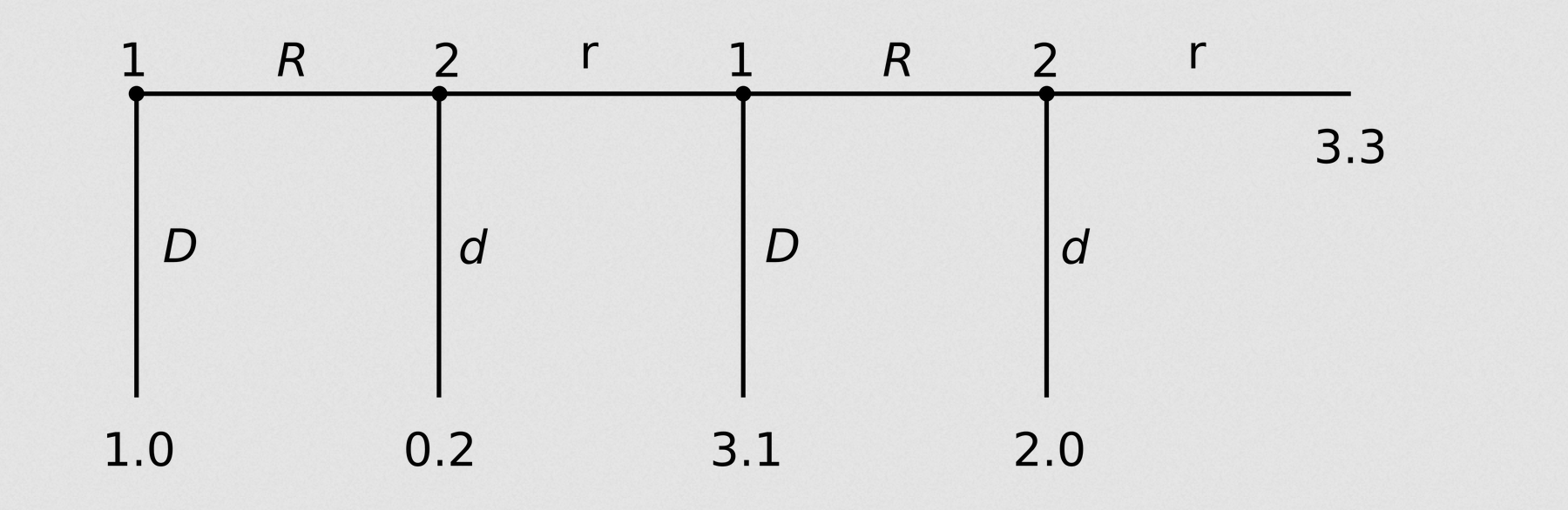
Game theory has achieved visual theming.
More importantly, the tree shows actual temporal structure. The Prisoner’s Dilemma matrix displays four endings simultaneously. The Centipede tree displays a field unfolding. The player can see the sequence of opportunities, the expanding payoffs, the distribution of control, the remaining horizon, and the points at which either participant can terminate play.
The graphical representation also makes backward induction visible. Begin at the final node and trace the preferred actions in reverse. The chain of anticipated closure can be watched moving leftward until the opening choice has been consumed.
This is exceptional philosophical interface design. The tree exposes the paradox rather than just reporting it:
- The right side of the image contains larger possible rewards.
- The formal strategy points left.
- The whole represented future exists as content the solution recommends nobody experience.
The graphics also contain the game’s greatest weakness. Because the final node is visible, the end is present from the beginning. The horizon is not just finite, its finitude is common knowledge.
The player can count exactly how many opportunities remain. The final turn therefore casts a shadow across the entire tree. Games are art, after all.
A concealed or probabilistic horizon would produce a different game. A continuing probability after each pass could interrupt the clean backward-induction collapse. An uncertain endpoint would restore ambiguity about whether this is truly the last moment at which cooperation can be repaid. The standard visual design does not just represent the fixed horizon, it makes it operational.
Graphics: 9/10
Clear, thematic, mechanically informative, and directly responsible for spoiling the ending. My new desktop background.
Multiplayer
Centipede contains the richest multiplayer interaction encountered so far. The players do not simply select actions in ignorance of one another. They alternate. They observe. They inherit a field transformed by the other player’s restraint or seizure. Every pass is both an economic move and a communicative act. It says:
I have left value in the field.
It may also say:
I expect you to return the favor.
Or maybe:
I think you are unlikely to take yet.
Or even:
I am increasing the prize before I betray you.
The receiving player cannot know which message was sent because the move is compatible with all of them. This ambiguity generates interpretation.
Trust does not arrive as a declared resource. It is inferred from a history that can always be reinterpreted by the next move. A long sequence of mutual passing can look like stable cooperation until one player takes. The taking player may then describe every earlier pass as preparation. The betrayed player may describe the same history as a relation that existed until it was destroyed.
Both accounts can fit the visible actions.This is one of the game’s deepest achievements.
Centipede shows why cooperation is difficult to locate from behavior alone. The same action can preserve a shared future or prepare its exploitation. Intent becomes legible only through later events, and later events can retroactively reorganize the meaning of everything that preceded them.
Multiplayer: 10/10
The game has two buttons and supports betrayal arcs.
Replay Value
Centipede changes under repetition. Players may learn the backward-induction prediction and begin taking earlier. They may also learn the behavior of particular opponents, develop reputations, classify player types, or discover that apparent generosity can itself be exploited.
Repeated play creates a tension between two kinds of learning.
The first is solution learning:
- I should take earlier because the game unravels from the end.
The second is relational learning:
- I can safely pass longer because this particular player has repeatedly sustained the path.
These learning processes pull in opposite directions. One teaches the player to collapse the formal field. The other teaches the player that the formal assumptions may not fully describe the real person across from them.
A player who encounters only immediate takers will rapidly stop passing. A player embedded among reciprocal passers may discover that entering the formally irrational path produces consistently better results. The population becomes part of the game.
This gives Centipede excellent replay value, though the competitive meta can become grim. As players become more experienced with backward induction, the campaign may grow shorter. Mastery can remove content.
Most games reward expertise by giving players access to more of the game. Centipede may reward expertise by teaching them not to play it.
Replay Value: 9/10
Exceptional depth. Severe speedrunning problem leaks into public lobbies.
Field Fidelity
Centipede faithfully models a recognizable family of situations. Two agents can preserve and enlarge a shared opportunity by delaying unilateral appropriation. At every stage, one party can seize a locally favorable share and terminate the process. Continued restraint creates greater total value but exposes each participant to the possibility that the other will capture it first.
This appears in investment, arms restraint, partnership, political coalition, research collaboration, environmental stewardship, repeated concession, and relationships where both parties can continue building a field or convert it into a private advantage.
The model also contains severe restrictions.
- The horizon is fixed and known.
- The payoffs are known.
- The players cannot communicate.
- They cannot divide the growing value through negotiation.
- They cannot create shared ownership.
- They cannot punish a player after the game ends.
- They cannot repair the relationship.
- They cannot exit while preserving part of the accumulated field.
- They cannot bind themselves to pass.
- They cannot alter the terminal choice.
- The player who takes ends the entire relevant universe.
These restrictions matter because real cooperative systems are often designed specifically to prevent Centipede’s unraveling. Contracts, shared titles, escrow, vesting, mutual monitoring, staggered control, uncertain horizons, reputational networks, and institutions that survive individual transactions all interfere with the final player’s capacity to convert shared growth into terminal seizure.
A society that resembles Centipede too closely has not discovered an eternal law of cooperation. It has instead failed to build infrastructure around the last move.
Field Fidelity: 8/10
Powerful model of expanding cooperation under terminal appropriation. Desperately needs institutional support.
The Modal Audit
Centipede is a nearly perfect machine for demonstrating how an anticipated closure can travel backward through a field.
The final node contains one local incentive:
Take.
Backward induction carries that incentive to the preceding node.
Then the node before that.
Then the node before that.
The future is not closed at the moment betrayal finally occurs. It is closed in advance by the expectation that betrayal will occur later.
This gives Modal Path Ethics a precise structure for one of its central concerns. Reachability is shaped not only by present barriers but by anticipated future decisions. A path can disappear before anyone physically enters it because every participant expects it to terminate badly.
- The expectation may be rational.
- The closure remains real.
Centipede therefore distinguishes two questions that are too often collapsed:
What action is rational inside this field?
and:
What kind of field makes that action rational?
Under the standard assumptions, taking immediately can be the correct answer to the first question. That answer indicts the field described by the second.
The players possess no mechanism for preserving the expanding joint value against the final incentive to seize it. Every act of trust remains revocable. Every shared gain remains convertible. Every pass transfers control without securing continuation. The field creates value and leaves that value permanently exposed to unilateral closure.
Backward induction does not cause this structural vulnerability, it only reveals it.
The ludic achievement lies in allowing human players to contest the revelation. They pass. They test. They reciprocate. They sometimes reach outcomes that the formal equilibrium leaves inaccessible. Their behavior does not disprove the logic of the game. It demonstrates that the people inside the game may carry values, uncertainty, bounded reasoning, social expectations, and interpretive capacities that the narrow solution does not include.
Centipede’s better path remains fragile because it depends on each player repeatedly refusing the locally superior closure. That is a chain of mercies, not a durable cooperative institution. The game asks how long the chain can hold.
The formal solution answers:
- It cannot begin.
Actual players answer:
- Well. Let us see.
Final Scores
|
Category |
Score |
|
Graphics |
9/10 |
|
Gameplay |
9/10 |
|
Multiplayer |
10/10 |
|
Replay Value |
9/10 |
|
Field Fidelity |
8/10 |
|
Ludic Value |
10/10 |
Final Score: 9.2/10
● Full Ludic Instrument, Degenerate Official Meta
One of game theory’s finest games. Exceptional decision-tree graphics, excellent turn-based multiplayer, meaningful strategic communication, and a formal solution that recommends uninstalling before the second player moves.
7. Traveler’s Dilemma
This Happened To Me Once
|
|
|
|
Introduced by |
Kaushik Basu, 1994 |
|
Players |
2 |
|
Formal type |
Simultaneous, non-cooperative, variable-sum
game |
|
Original scenario |
Two travelers claiming compensation for
identical lost antiques |
|
Available actions |
Select an integer claim between a stated
minimum and maximum |
|
If claims match |
Both players receive the claimed amount |
|
If claims differ |
Both settlements are based on the lower
claim |
|
Lower claimant receives |
The lower claim plus a reward |
|
Higher claimant receives |
The lower claim minus a penalty |
|
Unique Nash equilibrium |
Both players submit the minimum permitted
claim |
|
Notable experimental study |
Capra, Goeree, Gomez, and Holt, 1999 |
The Good
● Large strategy set
● Excellent recursive reasoning
● Strong tension between local and global optimization
● Difficulty can be adjusted through the reward and penalty
● Airline has agreed to compensate both players
The Bad
● Airline has designed the compensation process
● Players are rewarded for undercutting one another
● No evidence submission
● No appeals process
● Rational play may reduce a hundred-dollar claim to two dollars
The Review
An airline loses two suitcases.
Each suitcase contains an identical antique. The airline cannot determine the antique’s value, so it asks the two owners to submit compensation claims independently. Both travelers must choose an amount between a minimum and maximum established by the airline.
If they submit the same claim, both receive that amount.
If they submit different claims, the airline assumes the lower claimant has told the truth. Both settlements are therefore based on the lower claim. The lower claimant receives an additional reward for honesty. The higher claimant pays an equal penalty for exaggeration.
This is the Traveler’s Dilemma, a game about what happens when an airline loses your property and then designs a mechanism that turns the other victim into your enemy. Suppose the maximum claim is one hundred dollars and the reward or penalty is two dollars. Both travelers would be pleased to submit one hundred. Each would receive one hundred.
Then one player notices that submitting ninety-nine against an opponent’s one hundred produces one hundred and one: the accepted lower claim plus the honesty reward.
One hundred is vulnerable to ninety-nine.
Knowing this, a rational opponent should avoid one hundred. But if ninety-nine appears likely, ninety-eight can undercut it. Then ninety-seven can undercut ninety-eight.
Every proposed resting point remains vulnerable to the number immediately below it. The chain continues until it reaches the minimum permitted claim, where no further undercut is available.
The unique Nash equilibrium is the floor.
Both travelers recover the smallest amount the airline allows. The airline keeps the antiques.
The Recursive Descent
Traveler’s Dilemma resembles Centipede because both games allow a reasoning procedure to eliminate a field of mutually superior outcomes. The mechanism differs.
Centipede unfolds through time. Players pass or take across a visible sequence. Backward induction begins at the final node and propagates closure toward the opening move.
Traveler’s Dilemma is simultaneous. Neither player sees the other’s claim before submitting their own. The descent therefore occurs entirely inside anticipation.
No one actually submits one hundred, observes ninety-nine, and returns for another round with ninety-eight. The players perform that entire collapse in thought.
- They imagine a high agreement.
- They imagine its profitable undercut.
- They imagine the opponent imagining the same undercut.
- Then they undercut the anticipated undercut.
The game’s full movement occurs before either player acts.
This makes Traveler’s Dilemma an unusually pure model of recursive strategic contraction. Each step downward appears locally justified. No single undercut produces the catastrophic result. Every undercut just improves one player’s position by a small amount against one expected claim.
The field collapses through a sequence of individually modest corrections. By the time the reasoning reaches the floor, almost the entire available value has disappeared. No player intended to destroy it. Each just refused to occupy a position that could be beaten by one dollar.
Gameplay
Traveler’s Dilemma offers far more actions than the 2 × 2 classics. This initially looks promising. A standard implementation may allow every integer from two through one hundred. Players receive ninety-nine possible strategies instead of two.
Most of them are then removed by reasoning.
The game’s central move is the one-unit undercut. Against any claim above the minimum, a player can choose slightly less and receive the reward while imposing the penalty on the opponent. That move appears to establish the superiority of the lower claim.
The same logic then attacks the new claim. Strategic reasoning becomes a staircase descending toward the floor. The interesting gameplay lies in deciding whether to follow it.
A player must ask:
- Will the opponent reason all the way down?
- Will they stop at a salient high amount?
- Do they regard the small reward as worth destroying a much larger shared settlement?
- Will they expect me to behave conventionally rather than recursively?
- Does the reward make undercutting attractive enough to overcome the value lost by moving lower?
- How many rounds of reasoning does this opponent expect me to perform?
- How many rounds do I believe they believe I will perform?
The action space is numerical. The real game is epistemic.
Players are not simply estimating what the antique was worth. They are estimating the depth, temperament, and model of rationality present in the other player.
This gives Traveler’s Dilemma considerable playerly surplus. Reading the equilibrium proof explains why the minimum claim is stable. Playing the game reveals how difficult it is to believe another human being will actually choose it.
A player selecting a high number may be cooperative, intuitive, strategically sophisticated, insufficiently recursive, dismissive of the equilibrium, or simply aware that the reward for undercutting is small relative to the value destroyed by descending.
A player selecting the minimum may have followed the reasoning impeccably.
They may also be the only person in the session who receives two dollars.
Difficulty Settings
Traveler’s Dilemma contains an unusually elegant difficulty slider.
Change the reward and penalty.
When the reward for submitting the lower claim is small, undercutting a high claim produces only a minor advantage. Players have more reason to remain near the top of the range and hope the other participant does the same.
When the reward and penalty become large, the cost of being the higher claimant becomes severe. Undercutting grows more attractive. Experimental behavior tends to move downward.
The formal equilibrium remains the minimum across these settings. The experienced game does not. This is enormously important.
The equilibrium identifies the endpoint of the recursive logic. The reward parameter controls how strongly the field pulls players toward that endpoint.
- A one-dollar advantage can theoretically begin the descent.
- A large reward makes players feel the staircase under their feet.
Traveler’s Dilemma therefore shows why equilibrium alone does not describe the whole playable structure. Two versions may possess the same unique Nash equilibrium while generating dramatically different patterns of behavior.
The destination matches. The gravity does not.
Graphics
Traveler’s Dilemma has a major presentational problem.
Its normal-form payoff matrix is enormous.
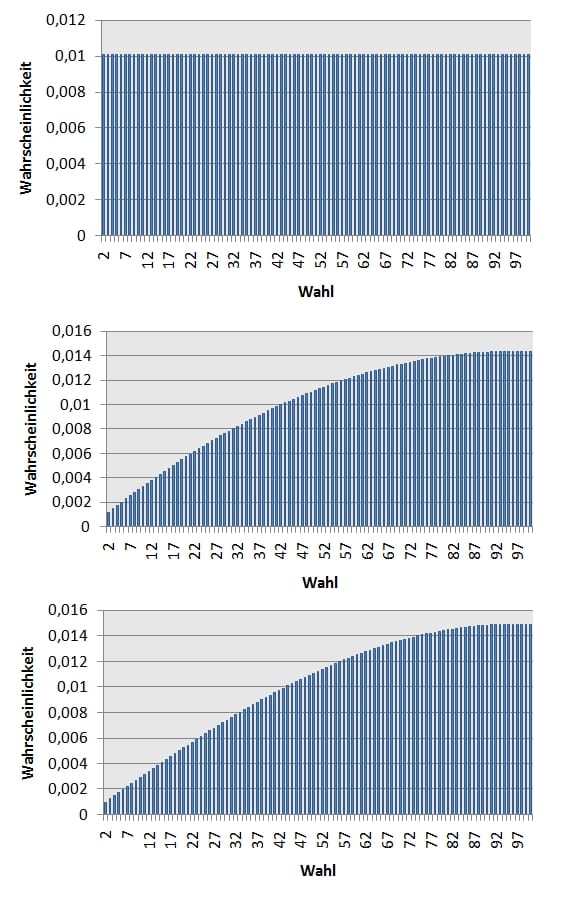
A version allowing claims from two through one hundred would require ninety-nine strategies for each player and 9,801 outcome cells. Game theory’s favorite four-box interface has become a spreadsheet capable of inflicting permanent eye damage.
The game is therefore usually presented through prose, selected examples, a compact rule, or graphs of claims and payoffs.
This is the correct decision.
The most revealing graphical representation places possible claims along a number line. Against an opponent’s chosen claim, the player’s payoff forms a peculiar shape:
● matching the opponent produces the stated amount;
● choosing one unit less creates an immediate reward;
● choosing one unit more creates an immediate penalty;
● moving far below the opponent continues lowering the shared settlement.
The key visual feature is a discontinuity surrounding the opponent’s claim. The number immediately below it receives special treatment. The number immediately above it is punished.
The entire recursive collapse begins inside this tiny graphical notch. A heat map of both players’ claims can also show the game’s strange geometry. High matching claims form a valuable diagonal. Immediately beside that diagonal lies a strip where one player can gain by undercutting. That strip destabilizes the diagonal all the way down. The shared good region is visible. It cannot defend itself from its own lower edge.
The original lost-luggage story supplies the only substantial artwork. Two identical antiques disappear before play and are never rendered. The airline manager remains offscreen, presumably developing another settlement mechanism.
Graphics: 6/10
The full matrix is unplayable as a visual interface. The payoff landscape is excellent once somebody bothers to draw it.
Multiplayer
Traveler’s Dilemma contains genuine multiplayer despite its simultaneous one-shot design. The opponent’s expected choice changes yours. Their expected depth of reasoning changes yours. Their estimate of your reasoning changes theirs.
Unlike the one-shot Prisoner’s Dilemma, there is no single action that remains individually best against every possible opponent action. A high claim performs wonderfully against another high claim and terribly against a slightly lower one. A low claim protects against undercutting but sacrifices the enormous value available through mutual restraint.
The other player therefore matters as an interpreter. The problem is that the rules provide no channel through which the players can produce shared assurance. They cannot communicate, bind themselves, submit evidence, or agree upon a valuation. Their entire relation is reconstructed through guesses about one hidden number.
The multiplayer becomes a private simulation of another mind. This can be compelling. It can also become an arms race in imagined cleverness.
Each player fears being one step less recursive than the other. The result is a contest where intelligence is expressed through willingness to lower both players’ rewards before the opponent does. The multiplayer field does not reward understanding the other person’s needs, evidence, or interests. It rewards understanding how much mutual value they expect you to destroy.
Multiplayer: 8/10
Excellent mind games. No social features.
Replay Value
Traveler’s Dilemma improves through repeated play, although repetition changes the problem.
Players can learn the opponent’s tendencies. They can discover whether a person remains near the maximum, undercuts common focal points, follows recent claims downward, or behaves differently as the reward changes.
A repeated pair may establish an informal high-claim convention.
That convention is always vulnerable. Either player can gain in the current round by undercutting it. Successful cooperation therefore depends on future retaliation, reputation, role continuity, or a shared refusal to treat the one-step advantage as decisive.
Once these enter the game, the travelers are no longer anonymous strangers making a single insurance claim. They have become a small society.
This is a recurring result in the audit. Replay value often enters game-theory games by restoring the social structures removed from the base model.
The game also supports meaningful variation through different claim ranges and reward values. A narrow range reduces the distance between cooperative and equilibrium outcomes. A large penalty increases fear. A small reward makes mutual high claims more plausible. The formal strategy guide continues to recommend the minimum. Players continue to produce more interesting communities than the guide anticipated.
Replay Value: 8/10
Strong parameter support. Recurring matches gradually become diplomacy.
Field Fidelity
Traveler’s Dilemma models a real structural pattern:
Two agents can preserve a large mutual benefit by selecting compatible high claims, while each remains tempted to gain a smaller local advantage by moving just below the other.
This can illuminate price competition, bidding, bargaining, claims, standards, arms reduction, and fields where each participant fears being left slightly more exposed than the other.
The original insurance scenario is much less faithful.
The airline already knows the suitcases and antiques are identical. It imposes a maximum liability. It then treats the lower claim as truthful without gathering evidence and rewards one victim for contradicting the other.
This is not a neutral discovery process. It is an undercutting machine.
The mechanism creates the strategic behavior it later interprets as information.
A low claim does not reliably prove honesty. It may prove that the claimant understood the payment rule. A matching high claim does not prove collusion. It may reflect the shared value of identical goods.
The airline has replaced appraisal with competitive self-harm.
This matters beyond the story. Institutions frequently design systems that force people with aligned interests to compete over a fixed procedure, then interpret the resulting conflict as evidence that their interests were never aligned.
- Workers underbid workers.
- Jurisdictions undercut tax and regulatory standards.
- Suppliers accept progressively worse terms.
- Victims compete for limited recognition.
The field rewards whichever participant first converts shared value into a private edge. Traveler’s Dilemma captures that structure well.
It should not allow the mechanism designer to leave the review unnoticed.
Field Fidelity: 7/10
Excellent recursive-undercutting simulator. Appalling luggage policy.
The Modal Audit
Traveler’s Dilemma shows how a field can be destroyed by the repeated discovery that every good position contains a local vulnerability. The high matching claims are not unstable because they produce bad outcomes. They are unstable because each can be exploited by a neighboring claim.
The path from one hundred to two consists entirely of moves that appear to improve the mover’s relative position. At no step does a player announce an intention to eliminate ninety-eight dollars of reachable value.
The contraction is cumulative. This is one of the clearest distinctions between strategic intelligence and field intelligence.
Strategic intelligence asks:
What claim gives me an advantage against the claim I expect?
Field intelligence asks:
What happens to the space of mutually valuable claims when both players repeatedly answer that question in the same way?
The first detects the undercut. The second detects the staircase.
A player can execute every local improvement correctly and still participate in a catastrophic global descent.
The game’s lesson cannot be reduced to “people should cooperate.” Cooperation is only a moral label placed over the upper region of the claim space. The deeper problem is that the settlement rule leaves every high agreement exposed to unilateral profit.
The field lacks a mechanism for making a jointly beneficial valuation stable. No verification process exists. No binding agreement exists. No shared claim exists. No appeal exists. No reward exists for preserving total value. The mechanism pays for being slightly lower.
The result is a system in which reason repeatedly finds the next available closure.
Traveler’s Dilemma is therefore not just a paradox of rationality.
It is a review of institutional design.
The airline receives a zero.
Final Scores
|
Category |
Score |
|
Graphics |
6/10 |
|
Gameplay |
8/10 |
|
Multiplayer |
8/10 |
|
Replay Value |
8/10 |
|
Field Fidelity |
7/10 |
|
Ludic Value |
9/10 |
Final Score: 7.7/10
● Full Ludic Instrument, Recursively Degenerate Meta
A beautifully constructed numerical strategy game in which one profitable step is discovered ninety-eight consecutive times. Excellent mind games. Horrific claims administration.
8. The Public Goods Game
The Team Upgrade Nobody Wants to Purchase
|
|
|
|
Major early experimental program |
Gerald Marwell and Ruth Ames, beginning in
1979 |
|
Players |
Usually a group rather than a pair |
|
Formal type |
Social-dilemma contribution game |
|
Common experimental form |
Voluntary Contributions Mechanism |
|
Starting resource |
Individual token endowments |
|
Player decision |
Allocate tokens between a private account
and a group account |
|
Group-account treatment |
Contributions are multiplied or generate a
shared return |
|
Benefit distribution |
Usually shared among all group members |
|
Individual incentive under standard
parameters |
Keep tokens privately |
|
Group-efficient action |
Contribute all tokens |
|
Common modes |
One-shot, repeated, communication,
punishment, leadership, threshold, and unequal-endowment variants |
The Good
● Supports more than two players
● Simple allocation controls
● Team objective is immediately clear
● Highly configurable
● Generates a functioning resentment system without additional software
The Bad
● Everyone receives the upgrade
● Only contributors purchase it
● Anonymous mode hides who keeps clicking “private account”
● Base game contains no actual public infrastructure
● Average-contribution graphs conceal most of the cast
The Review
Every player receives a set of tokens. Each token can be placed into a private account or contributed to a public account. Tokens kept privately return value only to the player who kept them. Tokens contributed to the public account generate value for the group. In the standard linear form, the public contribution is multiplied and then distributed among all players, including those who contributed nothing.
The group earns the most when everyone contributes everything.
Each individual earns more by keeping their own tokens while everyone else contributes.
Welcome to the Public Goods Game, the first multiplayer title whose entire strategy discussion can be reconstructed from one person asking why they are always the one buying toilet paper.
The Public Good
The game’s core mechanic is elegant. Suppose four players each receive ten tokens.
Every token kept privately returns one unit to its owner.
Every token contributed to the public account is multiplied by some factor greater than one, then divided among all four players. A contributed token may therefore create more than one unit of total group value while returning less than one unit to the person who contributed it.
From the group’s perspective, contribution is efficient.
From the individual contributor’s perspective, private retention pays better.
The public good is worth funding. It is worth funding with somebody else’s tokens.
This produces the free-rider problem in its cleanest playable form. A player can benefit from a shared field without bearing a proportional share of its maintenance cost. The best private outcome often belongs to the player who contributes nothing while everyone else contributes heavily. The worst group outcome emerges when everyone attempts to become that player.
Gameplay
The Public Goods Game gives players a continuous or multi-level decision rather than a simple binary choice.
How much should be contributed?
The player may give everything, nothing, or any amount between. This creates considerably more expressive play than the canonical two-button games.
- A contribution can signal generosity.
- It can test the group.
- It can reciprocate previous contributions.
- It can punish previous free riding.
- It can represent a cautious investment in collective capacity.
- It can also be an attempt to look cooperative while retaining most of the available endowment.
The most interesting gameplay appears in repeated rounds with feedback.
- A player contributes generously.
- The public return is disappointing.
- They infer that others held back.
- Their next contribution falls.
- Other players observe the reduced total and make the same inference.
Cooperation decays through reciprocal disappointment. The free rider does not need to convert every contributor into a committed egoist. They only need to make continued contribution feel foolish. This creates one of the Public Goods Game’s most important dynamics: a group can lose a cooperative field even when most participants initially prefer to maintain it.
Conditional cooperators are willing to contribute when others contribute. They withdraw when they believe the burden is becoming unequal. Their retreat is individually understandable and collectively destructive. The field does not collapse because every player wanted the public good to fail. It collapses because too many players refuse to remain the final person paying for it.
The Average Player Does Not Exist
Public Goods experiments are often displayed through an average contribution line across repeated rounds. The line begins somewhere above zero. Then it slopes downward. This is useful. It is also a graphical alibi.
The average may combine radically different players:
● persistent contributors;
● persistent free riders;
● conditional cooperators;
● retaliatory withdrawers;
● confused participants;
● strategic experimenters;
● players who increase contribution after good rounds;
● players who exploit good rounds;
● and one participant who has misunderstood the multiplier but is carrying the entire group.
The mean turns these social roles into one smooth decline.
No individual player actually moved like the line.
This matters because the public-goods field is generated through heterogeneity. A committed free rider changes the incentives faced by a conditional cooperator. A highly generous player can temporarily conceal widespread under-contribution. A punitive player can stabilize contribution or begin an expensive feud.
The aggregate graph displays the health of the field. It can hide the agents producing it.
Gameplay Modes
The base Public Goods Game is extremely sensitive to configuration.
- Anonymous One-Shot Mode
Players contribute once without observing individual behavior.
This is closer to a moral and behavioral test than a developing game. The player forms a belief about an unknown group and chooses how much exposure to accept.
Strategic interpretation is limited.
- Anonymous Repeated Mode
Players observe aggregate contributions across rounds but may not know who contributed what.
This creates population inference. A poor group result tells each player that somebody withheld resources without identifying whom.
Suspicion becomes ambient.
Every participant may lower their contribution in response to the same unknown defector.
- Visible-Contribution Mode
Individual actions become legible.
Reciprocity, reputation, praise, blame, and targeted response enter the field. Multiplayer quality rises immediately.
So does hostility.
- Communication Mode
Players can discuss intended contributions, establish expectations, explain shortfalls, and form informal agreements.
The public good stops being a silent payout mechanism and becomes a shared project.
Communication may be nonbinding in formal terms. It still changes what participants believe others intend, what counts as a violation, and what behavior will be socially interpreted.
- Punishment Mode
Players may spend resources to reduce the earnings of low contributors.
This can sustain cooperation by making free riding costly. It can also consume value, produce revenge, enable antisocial punishment, and create a second public-goods problem around who will pay to punish the free riders.
The game has added moderation tools.
The moderators are unpaid.
- Threshold Mode
The public good is provided only if total contributions reach a required level.
This makes coordination more urgent. A contribution below the threshold may produce no public return. Players must estimate not simply whether others will give, but whether the total will be enough.
The public field can now fail discontinuously.
This is often more faithful to bridges, campaigns, disaster prevention, and systems that do not become ten percent functional because ten percent of the funding arrived.
The Public Goods Game is therefore less one game than a highly moddable platform, like GMod. Some configurations are thin allocation experiments. Others support serious institutional play.
Graphics
The standard Public Goods Game has three major graphical forms.
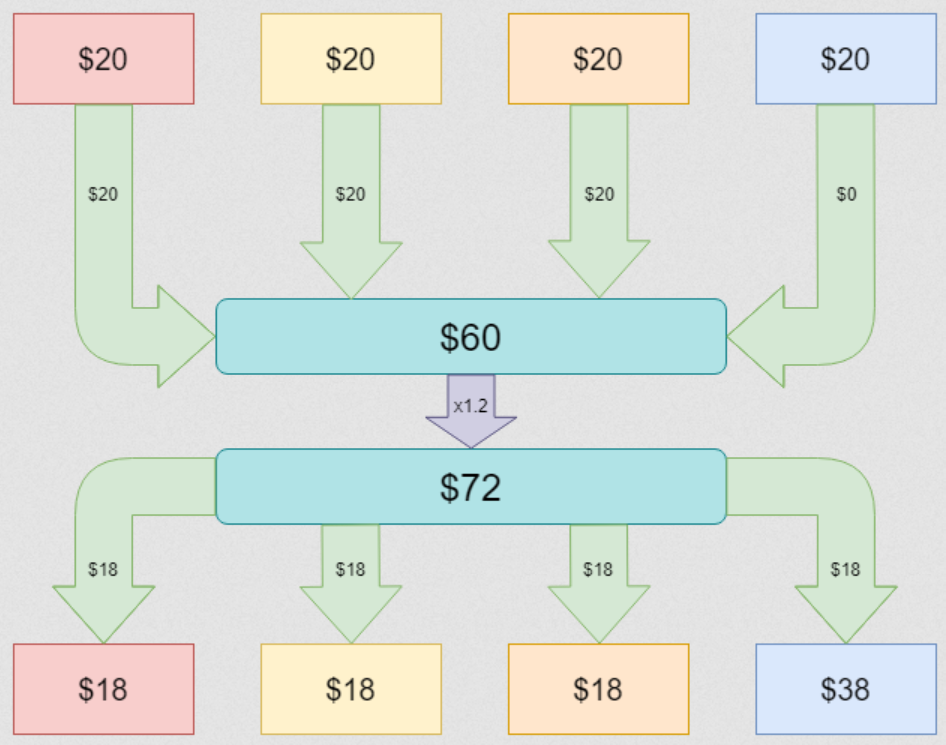
The first is the allocation interface: tokens, sliders, private boxes, and a public pot.
This is clear and effective. Players can see the immediate sacrifice involved in moving resources from private possession into the shared account. The interface makes contribution spatial.
The second is the payoff formula.
This is less welcoming. The marginal per-capita return explains the game precisely while presenting collective life as a fraction attached to a token.
The third is the contribution graph across repeated rounds.
This is the iconic image: an average line declining as the group gradually discovers disappointment.
The graphical problem is the public good itself. There usually is no road, school, defense system, clean atmosphere, research program, or maintained institution. The “good” is a monetary multiplier. Players contribute money to a box so that the box returns more money.
This cleanly isolates the incentive problem. It also removes almost every reason anyone might value the public project beyond payout.
● No player uses the bridge.
● No child attends the school.
● No flood is prevented.
● No air becomes breathable.
The collective achievement is an increased number at the end of the round.
This makes the base game visually faithful to its mathematics and visually empty as an account of public life. The best implementations use contribution bars, individual histories, and visible group targets. These reveal who is carrying the field and how close the group is to producing something together. The worst show one aggregate number and allow every player to imagine somebody else caused it.
Graphics: 6/10
Strong resource-allocation interface. Public-good asset still awaiting implementation.
Multiplayer
The Public Goods Game is unmistakably multiplayer.
Every player’s return depends on the contribution profile of the whole group. A single free rider may not destroy the good, but they alter the burden carried by everyone else. Several conditional withdrawals can move the group into a self-reinforcing decline.
The multiplayer quality depends upon visibility. In an anonymous one-shot game, the other players are mostly a statistical expectation. In repeated aggregate-feedback play, they become a hidden population whose behavior can be inferred but not individually answered. With visible contributions, communication, punishment, voting, or leadership, they become recognizable agents inside a political field. This progression is philosophically valuable.
The game demonstrates that “a group” is not one strategic condition. The institutional interface determines what kinds of group intelligence are possible.
- Can participants identify exploitation?
- Can they distinguish incapacity from refusal?
- Can they discuss unequal needs?
- Can they revise the contribution rule?
- Can they remove or forgive a persistent free rider?
- Can they see whether everyone benefits equally?
- Can they decide what the public good should be?
The base game answers almost none of these questions. Its expansions turn them into gameplay.
Multiplayer: 8/10
Excellent group dependency. Feature set varies wildly by server.
Replay Value
Repeated Public Goods play is where the game earns its reputation.
Each round produces social evidence. Players learn whether the group is generous, exploitative, cautious, punitive, confused, or capable of maintaining a norm.
The trouble is that repeated play often teaches players to contribute less.
- A high contributor learns that others may exploit the contribution.
- A low contributor learns that the public good may arrive anyway.
- A conditional contributor learns to lower their exposure as the average falls.
The game session can therefore become a tutorial in how cooperation disappears.
This is genuine learning. It may also be a degenerate meta.
Once every participant expects low contributions, giving becomes a private sacrifice with little chance of changing the field. The equilibrium prediction begins to manufacture its own evidence.
Communication, repeated partnership, visible histories, sanctions, rewards, and endogenous institutions can interrupt the decline. Each addition creates more replay value because players can alter the conditions of cooperation instead of simply observing its decay. The strongest public-goods games let a group become better at being a group. The weakest simply rerun the disappointment graph.
Replay Value: 8/10
Potentially excellent. Anonymous queue becomes bleak after several rounds.
Field Fidelity
The game captures one essential public-goods structure:
An individually costly contribution can generate benefits shared beyond the contributor, allowing non-contributors to enjoy value they did not help produce.
This is real. The standard laboratory form also simplifies aggressively.
Actual public goods vary in excludability, rivalry, scale, durability, quality, and distribution. Some require continuous maintenance. Some have thresholds. Some primarily benefit particular communities. Some impose costs on people who did not request them. Some are supplied through taxes rather than voluntary contributions. Some become harmful when overproduced or badly designed.
The standard game normally assumes:
● everyone agrees the public good is valuable;
● the contribution technology is known;
● benefits are distributed equally;
● every token has the same opportunity cost;
● contributions are immediately converted;
● administration is perfect;
● no resources are stolen;
● the group good cannot be captured by a subgroup;
● and the only political problem is how much each individual contributes.
This begins the game after most politics has ended. A public institution may fail because people free ride. It may also fail because they disagree over its purpose, distrust its administrators, receive unequal benefits, cannot afford equal contributions, recognize corruption, or have been excluded from determining what the institution does.
- A player who withholds from the public account may be exploiting the group.
- They may also be refusing to fund the wrong project.
The base interface cannot distinguish these.
Field Fidelity: 7/10
Excellent contribution problem. Governance campaign sold separately.
The Modal Audit
The Public Goods Game turns field maintenance into a playable allocation. A contributor accepts local cost to preserve or enlarge a shared future. A free rider benefits from the maintained field while retaining resources privately. When enough players free ride, the public capacity contracts. This seems straightforward until contribution begins declining among players who were initially willing to cooperate.
Then the deeper structure appears.
The field depends not only on willingness to contribute. It depends on whether contributors believe their contribution forms part of a reciprocated and supportable pattern.
A generous act can preserve the public good for one round while making its contributor more vulnerable to future exploitation.
A retaliatory withdrawal can protect one player from carrying an unfair burden while accelerating collective failure.
Punishment can defend contribution norms while consuming the resources those norms were meant to preserve.
The Public Goods Game therefore produces no simple division between good contributors and bad defectors. It shows a group attempting to distribute the cost of its own continuation.
Modal Path Ethics must ask more than whether a player contributed. It must ask:
- Who was capable of contributing?
- Who benefited?
- Who carried repeated shortfalls?
- What information was available?
- Could the rules be changed?
- Was the public good itself worth producing?
- Did punishment preserve cooperation or become a new extraction system?
- Did the field make sustained contribution rational, legible, and fair?
The canonical game offers one decision per player. Its best variants reveal that the decisive moral work occurs in constructing the conditions around that decision. Communication is not noise added to the model. Monitoring is not an external moral supplement. Rule formation is not a distraction from the public good. These are among the mechanisms that make a public good continuable. The base game asks whether people will fund the field. The full ludic question is whether they can govern it.
Final Scores
|
Category |
Score |
|
Graphics |
6/10 |
|
Gameplay |
8/10 |
|
Multiplayer |
8/10 |
|
Replay Value |
8/10 |
|
Field Fidelity |
7/10 |
|
Ludic Value |
8/10 |
Final Score: 7.5/10
● Conditional Instrument
The core contribution system is excellent. The base release mistakes a multiplier for a public world. Communication, visibility, thresholds, punishment, leadership, and institutional design determine whether the game becomes philosophy or a declining line graph.
9. The Common-Pool Resource Game
The Fishing Game Without Fish
|
|
|
|
Major early experimental work |
James Walker, Roy Gardner, and Elinor Ostrom |
|
Early experimental publication |
1990 |
|
Major synthesis |
Rules,
Games, and Common-Pool Resources, 1994 |
|
Players in the classic baseline
experiments |
8 |
|
Formal type |
Repeated common-pool appropriation game |
|
Starting resource |
Individual token endowments |
|
Classic player decision |
Allocate effort between a fixed-return
market and a common-pool market |
|
Common-pool return |
Depends upon total group appropriation
effort |
|
Classic group-efficient total investment |
36 tokens |
|
Classic symmetric Nash total investment |
64 tokens |
|
Information in the baseline design |
Aggregate results rather than individual
actions |
|
Common modes |
Baseline, communication, sanctioning,
voting, and self-governance |
The Good
● Eight-player support
● Nonlinear resource returns
● Strong ecological metaphor
● Genuine institutional expansions
● Players can collectively earn more by taking less
The Bad
● Baseline game contains no visible ecosystem
● Classic resource resets between rounds
● Everyone is allowed to buy another boat
● Individual extraction remains hidden
● Players may destroy the yield and blame “the market”
The Review
The Public Goods Game asks players to place resources into a shared field. The Common-Pool Resource Game reverses the direction. The shared field is already there. Players decide how intensively to exploit it. Common-pool resources include fisheries, forests, grazing lands, water systems, irrigation networks, and other systems where excluding users is difficult and one person’s appropriation reduces what remains available to others.
The canonical experimental game converts this into a token-allocation problem. Each player receives a limited quantity of effort. Some effort can be placed into a private activity with a fixed return. The rest can be invested in extracting value from a common-pool market.
At first, additional common-pool effort is productive. Then congestion and overuse begin reducing returns. The group earns the most by limiting total exploitation. Each individual has reason to exploit more.
Everybody buys a boat. The fish remain theoretical.
Public Goods in Reverse
Public Goods and Common-Pool Resource games are often grouped together because both involve social dilemmas. Their decision fields point in opposite directions. In the Public Goods Game, players begin with private resources and decide how much to contribute toward a shared benefit.
In the Common-Pool Resource Game, players encounter a shared productive system and decide how much private effort to direct toward appropriating from it.
Public Goods asks:
Who will build and maintain the field?
Common-Pool Resource asks:
Who will restrain themselves from exhausting its yield?
Contribution and restraint are different moral actions. A public-goods contributor gives up privately held resources to create collective capacity. A common-pool user already possesses access to collective capacity and must limit the pressure they place upon it. The free rider withholds support. The over-appropriator takes too much.
Both can collapse a shared future. They do so from different sides.
The Classic Baseline
The classic Indiana University experiments used eight participants. Each received tokens that could be allocated between two markets. Market 1 provided a fixed return. It represented an outside activity, comparable to earning a predictable wage instead of devoting effort to extraction. Market 2 represented the common-pool resource. Returns depended on how much the individual invested and how much the entire group invested.
Under the experimental parameters, total group earnings were maximized when the eight players collectively invested thirty-six tokens into the common-pool market. The symmetric Nash equilibrium predicted sixty-four tokens. The group could earn considerably more by restricting total appropriation effort. Each player still had an incentive to invest beyond the socially efficient level.
This is the tragedy compressed into one production function. The resource is most valuable when users leave some of their extraction capacity unused. Unused capacity looks privately wasteful.
Collective overuse makes the resource itself wasteful.
Gameplay
The Common-Pool Resource Game contains one of the best emergent behavioral patterns in the audit. Players do not just settle at the predicted equilibrium. In baseline experiments, groups displayed a pulsing pattern.
Participants increased investment in the common-pool market. Returns deteriorated. They reduced investment. Returns recovered. They increased investment again. The resource game began breathing. This is actual gameplay. Players probe the productive capacity of the shared field. They observe aggregate returns. They respond to collapse. Once the field begins recovering, the incentive to exploit it rises again.
The sequence resembles a population repeatedly rediscovering the same ecological limit. High yield invites pressure. Pressure destroys yield. Low yield forces restraint. Restraint restores the opportunity for pressure. The players do not need to intend a cycle. Their adaptations generate it. This is much richer than a one-shot equilibrium demonstration. The group learns from the resource while failing to stabilize its relationship with it.
The environment becomes a participant of sorts, although it has no agency. Its changing return function answers collective action. The players move. The field moves back.
The Missing Fish
There is one important complication. The classic baseline experiment is static. Players receive a fresh token endowment each round. The common-pool return changes with total appropriation effort during that round, but the resource stock itself does not necessarily carry damage into the next. The fishery can suffer severe congestion today and arrive fully reset tomorrow.
This models rent dissipation and excessive appropriation effort. It does not yet model ecological depletion across time. The difference is enormous. Too many boats chasing a fixed current yield is a common-pool problem. Catching so many fish that the breeding population collapses is a dynamic common-pool problem.
The first damages current returns. The second damages future reachability. They should not be treated as identical games. Dynamic common-pool models add a persistent resource stock, regeneration, extraction, and possible exhaustion. Current harvesting then changes what future players can harvest. Ecological conditions such as growth rate become part of strategy.
These versions are much closer to MPE’s full concern. The field can remember what the players did to it. The classic game remains valuable, but its environmental theme should not receive credit for persistence the base mechanics have not implemented.
Graphics
The classic Common-Pool Resource Game is usually visualized through payoff formulas, production curves, and time-series graphs. The central production curve is excellent. At low total investment, additional effort increases common-pool output.
Eventually the curve bends. Further investment produces diminishing returns. Past the efficient point, players continue adding effort while total group earnings deteriorate. The graph shows a field being overloaded. This is far more informative than a static payoff matrix. Players and readers can see that the common resource is not simply divided into fixed pieces. Its productive capacity depends upon the pressure placed upon it.
The time-series graphics are even better. Group investment rises. Yield falls. Investment retreats. Yield recovers. The pulsing pattern becomes visible as a repeated failure to stabilize around sustainable use.
The graphical weakness is ecological absence.
The common pool is represented as Market 2 and a quadratic production function. No stock of fish, water level, forest cover, soil condition, or recovery process appears in the classic interface. The environment is a payout curve wearing a conservation badge.
This abstraction is analytically useful. It also makes overuse look like poor portfolio allocation rather than damage to a living or material system. Dynamic versions improve substantially by showing the resource stock over time. Once players can watch a fish population shrink, a forest disappear, or a water reserve fail to regenerate, current profit becomes visibly connected to future scarcity.
The classic graphs show what overuse does to returns. The best dynamic graphics show what overuse does to the world.
Graphics: 8/10
Outstanding production curves. Best fishing graphics ever released without fish.
Multiplayer
The Common-Pool Resource Game supports strong multiplayer interaction, but the baseline information structure makes that interaction strangely atmospheric. Players receive aggregate results. They know the group overinvested. They may not know who did it. A low return therefore produces suspicion without identification. Each player sees that the field was overused while retaining uncertainty about whether the cause was one aggressive appropriator, several moderate ones, or almost everyone.
This mirrors many real common-pool problems. The damaged resource is public evidence. The individual action is private. A depleted fishery does not label the boat responsible for each missing fish. A falling aquifer reports extraction without automatically assigning it. The resulting multiplayer field is diffuse. Players must decide whether to restrain themselves while suspecting others may use the recovered capacity.
This is the common-pool trap in its strongest form: My restraint can improve the resource and thereby create a better opportunity for someone else to exploit it. Without communication or monitoring, conservation becomes an exposed contribution to the future profitability of less restrained users.
The game becomes much richer when participants can identify one another, communicate, create agreements, monitor use, or impose sanctions. Those additions are not convenience features. They are technologies of collective perception. They allow a group to distinguish a failing resource from a failing agreement.
Multiplayer: 9/10
Excellent group ecology. Baseline privacy settings favor ecological paranoia.
Communication
The communication condition is among the most important expansions in the entire audit. Players were allowed to speak face-to-face before returning to private terminals to make decisions. Their agreements were not externally enforced.
In formal terms, this was cheap talk. In play, it changed the field. Participants could discuss the efficient level of use, divide an agreed total among themselves, explain strategies, establish expectations, and confront the group after aggregate investment exceeded what had been promised.
Words created a social record.
A player who overinvested was no longer just an anonymous optimizer. They became someone who had violated an agreement, even when their identity remained uncertain. Communication also allowed players to reason collectively about the production curve. The group could become a field analyst rather than eight isolated users receiving the same bad return.
This does not mean talk automatically solves common-pool problems. Promises can fail. Dominant participants can control discussion. Unequal needs can be ignored. Groups can agree upon ecologically harmful targets. Communication still has to produce a workable rule. The experiments nevertheless demonstrate that nonbinding speech can perform structural work. It can alter expectations, create commitments, establish shared interpretation, and make coordinated restraint reachable.
The voice-chat patch substantially improves the game.
Sanctions and Self-Governance
Sanctioning adds another layer. Players may spend resources to punish those who violate a contribution or appropriation norm. This can make excessive exploitation less attractive. Poorly structured punishment can also reduce group wealth, trigger retaliation, and become an arena for personal conflict.
Externally supplied sanctioning is therefore not automatically a repair. The strongest results appear when participants can communicate and choose their own sanctioning arrangements. In the classic experimental program, groups operating under self-selected systems achieved very high returns relative to the optimum, even after the costs of the limited punishment actually imposed were deducted.
This is crucial. The players did not become cooperative because an omniscient designer discovered the perfect fine. They were given some capacity to author the institution governing their shared field.
The game stopped asking only:
How much will you extract?
It began asking:
What rules can you live under together?
That is the point where the Common-Pool Resource Game becomes a major philosophical instrument.
Replay Value
Replay value is excellent because the resource return carries information between rounds even in the static baseline. Players learn where congestion begins. They discover whether others respond to falling yield.
They test agreements. They experience the temptation to exploit a recovering field. Repeated play also allows institutions to acquire histories. A rule that worked once becomes more credible. A violated agreement becomes harder to renew. A successful sanction may stabilize expectations. A revenge punishment may destroy them.
The dynamic versions go further by allowing the environment itself to persist. Now previous extraction changes future stocks, making every round part of one cumulative ecological history. This is the correct direction for the genre.
A common-pool resource should remember. Its users certainly will.
Replay Value: 9/10
Excellent emergent cycles. Dynamic-resource expansion strongly recommended.
Field Fidelity
The Common-Pool Resource Game begins from a more faithful account of its subject than many canonical games. It recognizes two defining features:
- exclusion is difficult;
- use is subtractable.
A resource can be open or costly to police while still being depleted, congested, or degraded by its users. The game also recognizes that exploitation is rarely a simple choice between harvesting and doing nothing. Players possess outside activities with more predictable returns. Their dependence on the resource can therefore shape how much pressure they place upon it.
The classic laboratory model remains highly simplified. Real users differ in:
● equipment;
● wealth;
● dependency;
● location;
● knowledge;
● legal rights;
● cultural position;
● political influence;
● ability to survive restraint;
● and capacity to externalize damage.
Real resources also differ in:
● regeneration;
● mobility;
● observability;
● scale;
● seasonal variation;
● uncertainty;
● tipping points;
● and connection to larger ecological systems.
The eight experimental players begin symmetrically. Real fishers do not arrive with identical boats. The model also abstracts from the long work through which actual communities establish boundaries, monitoring, graduated sanctions, conflict-resolution mechanisms, collective-choice arrangements, and nested governance. Elinor Ostrom’s broader work is especially important here because the experimental game was never the whole theory. The games were controlled instruments used alongside extensive field study of communities that had succeeded or failed in governing shared resources.
The model isolates pressure. The field work restores worlds.
Field Fidelity: 8/10
Strong core simulation. Ecology, history, and political economy remain hardware-intensive.
The Modal Audit
The Common-Pool Resource Game may be the clearest game yet for showing that a field is not simply the location where players act. The field is produced by those actions.
Every player enters Market 2 seeking value. Collectively, they alter the function through which value remains available. This is deeper than dividing a fixed resource. The players can make the whole productive system worse. Their choices do not determine who receives the yield. They determine how much yield the field can still generate.
In dynamic versions, the relation becomes fully modal. Current extraction changes future stock. Future stock changes future action. Damage narrows the available strategies of players who have not yet moved and may not yet exist. The resource becomes a carrier of accumulated decisions.
The classic pulsing pattern reveals what happens when players respond to symptoms without repairing the generating structure. Yield falls. They restrain themselves. Yield recovers. The recovery is interpreted as renewed permission to exploit. The field is never stabilized because its improvement reactivates the incentive that damaged it.
This is not simply irrationality. It is a feedback failure. Players can accurately perceive that extraction is again profitable while failing to preserve the conditions that made profitability return. Communication and self-governance matter because they introduce memory at the social level. Agreements, boundaries, monitoring, and sanctions can prevent each ecological recovery from resetting the decision field to its original temptation.
These institutions are sometimes described as constraints placed upon free actors. The game reveals another interpretation. They are path-preservation systems. A harvesting limit closes some immediate extraction options so that the resource continues producing future options. Monitoring restricts secrecy so that restraint does not remain uniquely vulnerable.
Conflict resolution prevents every violation from escalating into abandonment of the cooperative regime. Graduated sanctions create correction paths between permissiveness and expulsion. Collective-choice arrangements allow those living inside the resource field to revise its rules. The relevant question is not whether freedom or regulation wins.
It is which restrictions preserve a resource field in which meaningful freedom remains possible. The Common-Pool Resource Game becomes philosophically complete only when players can do more than choose their extraction level. They must be able to become governors of the system their choices are changing.
Final Scores
|
Category |
Score |
|
Graphics |
8/10 |
|
Gameplay |
9/10 |
|
Multiplayer |
9/10 |
|
Replay Value |
9/10 |
|
Field Fidelity |
8/10 |
|
Ludic Value |
10/10 |
Final Score: 8.8/10
● Full Ludic Instrument, Especially with Institutional Expansions
The base game successfully models a group overloading a productive field while staring at Market 2. Communication, monitoring, sanctions, and self-governance transform it from a resource-allocation exercise into one of game theory’s best simulations of collective field repair.
10. The Volunteer’s Dilemma
Nobody Picked Support
|
|
|
|
Introduced by |
Andreas Diekmann, 1985 |
|
Players |
2 or more |
|
Formal type |
N-player threshold public-good game |
|
Available actions |
Volunteer or abstain |
|
Provision threshold |
One volunteer |
|
Volunteer outcome |
Receives the collective benefit minus a
private cost |
|
Non-volunteer outcome |
Receives the full collective benefit if
somebody else volunteers |
|
Failure state |
Nobody volunteers; everyone loses the
collective benefit |
|
Pure-strategy equilibria |
Exactly one player volunteers |
|
Symmetric mixed equilibrium |
Every player volunteers with some
probability |
|
Primary design problem |
Selecting who absorbs the necessary cost |
The Good
● One volunteer can save the entire lobby
● Excellent burden-transfer mechanics
● No dominant strategy
● Group size creates unexpected difficulty scaling
● Timed versions produce genuine social suspense
The Bad
● Every successful pure equilibrium sends one player the bill
● The rules provide no method for choosing that player
● Multiple volunteers waste duplicate effort
● Simultaneous mode hides the best gameplay
● Matchmaking does not include a role queue
The Review
The Public Goods Game asked everyone to contribute something. The Common-Pool Resource Game asked everyone to take a little less. The Volunteer’s Dilemma has reviewed these systems and concluded that collective participation sounds expensive. This time, the group needs exactly one person to do the work.
One player must incur a private cost. If somebody does, everyone receives a larger collective benefit. If several players volunteer, the benefit is still produced, but the additional costs were unnecessary. If nobody volunteers, the entire group fails.
Every player wants the public good. Every player would prefer that somebody else provide it. Welcome to the support-class selection screen. The Volunteer’s Dilemma isolates a collective problem different from ordinary free riding. The group does not need broad contribution. It does not need unanimous restraint. It does not even need a majority.
It needs one name. Someone must report the fire. Someone must call emergency services. Someone must interrupt the abuse. Someone must perform the unpleasant maintenance task, challenge the dangerous decision, initiate the rescue, file the complaint, or step forward while every other player enjoys the strategic possibility that another person will do it first.
“Somebody should” is the entire mission briefing. Unfortunately, nobody has been assigned the quest.
The Rules
Assume that every player receives a benefit if the collective good is produced. Volunteering produces that good at a personal cost. The volunteer therefore receives the benefit minus the cost. Every non-volunteer receives the full benefit without paying the cost. If nobody volunteers, nobody pays the cost, but the public good is not produced. Everyone receives the failure outcome.
The player’s decision depends completely upon what the other players will do. If somebody else is certain to volunteer, abstaining is better. The good will be produced either way, and the player avoids the cost. If nobody else will volunteer, volunteering is better. The player accepts a smaller private payoff than a successful free rider would receive, but avoids the still-worse outcome in which the entire group fails.
There is no dominant strategy. The same action changes from sensible to wasteful depending upon whether another volunteer exists. This already qualifies as gameplay. The pure-strategy equilibria are also revealing. In every pure equilibrium, exactly one player volunteers. If nobody volunteers, any player could improve their outcome by volunteering and rescuing the public good.
If several players volunteer, any one of them could stop, preserve the good through the remaining volunteers, and avoid the cost. One volunteer is stable. Zero volunteers fails.
Two volunteers are inefficient. The game has found the desired number of heroes. It has not explained how the group chooses which player must become one. With two players, the Volunteer’s Dilemma resembles a degenerate version of Chicken. Each player wants the other to perform the costly action, while mutual refusal produces the bad outcome.
Adding more players changes the experience.
The approaching collision in Chicken has two visible drivers. The Volunteer’s Dilemma can distribute responsibility across a crowd. Each additional player becomes another possible rescuer and another reason for every existing player to wait.
The group becomes larger. Responsibility becomes harder to locate.
The Mixed-Strategy Solution
Symmetrical players cannot select a unique volunteer through pure strategy without some coordinating feature. Each player has the same costs. Each receives the same benefit. Each knows that one volunteer is enough. Nothing inside the base rules identifies who should move.
The standard symmetrical solution therefore requires randomization. Every player volunteers with some probability. That probability balances two risks:
- volunteer and discover that somebody else also paid the cost;
- abstain and discover that everyone made the same calculation.
As the number of players grows, the equilibrium probability that any particular player volunteers falls. This sounds reasonable. A player surrounded by ten possible rescuers should feel less individual pressure than a player facing the problem alone.
The aggregate result is less reassuring.
Under the standard mixed-equilibrium prediction, adding more potential volunteers can increase the probability that nobody volunteers. Each additional player lowers their own volunteering probability enough that the expanding group does not automatically become safer.
The lobby fills. Support availability declines. The game has implemented diffusion of responsibility as a scaling mechanic. Human experiments complicate the formal prediction. Individual volunteering generally does decline as groups become larger, but observed groups have not always failed more often in the way the symmetrical equilibrium predicts. In some experiments, additional players reduce the incidence of total failure despite lowering each individual’s likelihood of volunteering.
The extra humans do sometimes help. They simply refuse to become identical probability functions while doing it. This is good news for endangered collective goods and bad news for anyone hoping to summarize the game through one smooth equilibrium curve.
Gameplay
The simultaneous one-shot Volunteer’s Dilemma is strategically sound and dramatically underproduced. Each player chooses privately. The decisions are revealed. Either somebody volunteered or the group experiences a cutscene explaining that everyone assumed somebody else had it. The choice is meaningful. The player must form beliefs about the population, the cost, the seriousness of failure, and the likelihood that another participant will act.
The base release still removes most of the visible social event. Nobody watches another player hesitate. Nobody signals readiness. Nobody begins moving and then stops after seeing somebody else move.
Nobody asks who is best equipped. Nobody learns that the player nearest the problem has frozen, misunderstood the situation, or lacks the ability to help. The decisions occur simultaneously, which converts a collective emergency into a set of isolated probability estimates. The player encounters the group as an expectation.
Timed and sequential versions are substantially better games. When players can observe whether the public good has been produced, waiting becomes an action. Each person may delay, hoping another volunteer moves first. Delay preserves the chance to avoid the private cost. It may also impose damage upon the group while the necessary action remains unperformed.
The waiting room becomes the board. At first, every player has time. Then every player has slightly less time. The cost of volunteering remains visible. The cost of nobody volunteering begins to approach. Each second transfers pressure toward whoever still appears capable of acting.
This produces genuine strategic suspense. Who is waiting because they expect another player to move? Who has failed to notice the problem? Who wants to volunteer but is checking whether somebody else has already done so?
Who is unable to act? Who has privately decided that the collective benefit is not worth their cost? Who will move when the timer becomes frightening enough? The game no longer ends with a surprising absence of volunteers.
It allows the absence to form.
Gameplay: 8/10
The base decision is strong. Installing time reveals the game hidden inside it.
The Volunteer Selection Problem
The Volunteer’s Dilemma is often described as a conflict between volunteering and free riding. The sharper problem concerns role selection. All successful pure equilibria produce the same public outcome. The good is provided. They differ in one politically decisive respect:
Who paid? Game theory can list each one-volunteer outcome as an equilibrium. The players cannot inhabit those outcomes as interchangeable. A costly role assigned to Player One is not socially identical to the same role assigned to Player Four.
One player may possess more time. One may face greater danger. One may be more skilled. One may benefit more from success. One may already have volunteered during every previous round.
One may be institutionally responsible. One may have been selected because the rest of the group has learned that guilt works on them. The identity of the volunteer is not cosmetic character customization. It determines how the cost of collective survival is distributed.
The clean symmetrical game suppresses this question by giving everyone identical payoffs. Even then, the problem survives. Someone must accept a lower payoff than everyone they rescue. The group has solved provision.
It has not solved fairness.
Asymmetrical versions restore differences among players. If one person can provide the good at lower cost, the efficient assignment may appear obvious. The player best positioned to act should act.
This can improve coordination. It can also create a permanent support-class trap. The person with the greatest capacity becomes the person everyone expects to absorb the cost. Their competence increases the reachability of the collective good while decreasing the likelihood that anyone else prepares to provide it.
A reliable volunteer creates evidence that waiting is safe. Every rescue may therefore strengthen the strategic conditions that make the same rescuer necessary next time. The group succeeds.
One player is being consumed.
Graphics
The Volunteer’s Dilemma has no standard visual identity comparable to Chicken’s cars or Centipede’s decision tree. The game is commonly represented through payoff cases, formulas, probability graphs, or expanded tables showing what happens when zero, one, or several players volunteer.
These representations are formally adequate. They are terrible emergency interfaces. An N-player normal-form table becomes unreadable quickly because the number of possible action profiles grows with the group. Most presentations sensibly compress the outcomes into three cases:
● nobody volunteers;
● exactly one player volunteers;
● more than one player volunteers.
This displays the provision structure clearly. It hides the selection problem completely. The diagram tells the reader that one volunteer is desirable. It does not show a crowd of players each trying to determine whether that volunteer already exists. Probability graphs perform better. They can show individual volunteering declining with group size and compare that decline with the probability that the collective good is actually produced.
The graph exposes the scaling problem. It still represents hesitation as a curve. The best graphical version would place the threatened good at the center of the screen and arrange the possible volunteers around it. The interface would show:
- remaining time;
- the cost faced by each player;
- whether actions are visible;
- who possesses the capacity to intervene;
- whether another intervention is already underway;
- and how delay is changing the reachable outcome.
A player should be able to see responsibility failing to condense. The base graphics display the solution conditions. The game itself concerns a missing assignment.
Graphics: 5/10
Excellent graphs. No characters. The raid boss remains a probability distribution.
Multiplayer
The Volunteer’s Dilemma contains serious multiplayer dependence. Every other player’s possible action changes the value of your own. Unlike the Prisoner’s Dilemma, no action remains best against every possible group response. Unlike the Public Goods Game, the player does not need to estimate a total contribution level. Unlike the Common-Pool Resource Game, the group is not gradually altering a shared production function.
The central multiplayer question is brutally discrete: Will at least one of these people act? In simultaneous anonymous mode, the other players remain thinly rendered. They are members of a probability mass. The player may infer general willingness, but cannot interpret individual posture, urgency, capacity, or commitment.
Visible timing restores them as agents. A player can watch another person wait. That wait may communicate confidence that somebody else will volunteer. It may communicate refusal. It may communicate confusion. It may communicate the belief that the observing player is the obvious volunteer.
Non-action becomes socially legible without becoming unambiguous. Communication changes the game again.
Players can nominate a volunteer, request help, compare costs, make commitments, establish rotations, or divide compensation. The original coordination failure can disappear quickly once the group is allowed to answer the question the base game refuses to ask:
Who is doing this?
Communication does not guarantee fairness.
- A confident player may assign the burden to somebody with less power.
- A group may pressure its most conscientious member.
- A nominal volunteer may promise to act and then fail.
Several players may still move at once because they distrust the assignment.
The communication layer creates a political game around the strategic one.
That is an improvement.
The collective good cannot be separated from the procedure through which its cost was allocated.
Multiplayer: 9/10
Excellent dependency. Anonymous mode treats the lobby as weather.
Replay Value
Repeated Volunteer’s Dilemma creates one of the strongest metas in the audit. The first round asks whether somebody will act. The second asks who acted last time. A player who volunteered previously may expect somebody else to take the next cost. Other players may reach the opposite conclusion. The proven volunteer is the safest person to rely upon again.
Reliability becomes exploitable.
The player who repeatedly rescues the group develops a reputation. That reputation can earn trust, gratitude, authority, resentment, exhaustion, or a permanent unpaid appointment to every unpleasant task. Meanwhile, persistent non-volunteers develop reputations of their own. The group may stop expecting them to act. Their refusal becomes incorporated into everyone else’s strategy.
This can stabilize provision while normalizing unequal burden. One person volunteers because everyone knows the others will not. The good is produced. The equilibrium is appalling. Repeated play can also support fairer systems.
Players can rotate the volunteer role. They can compensate the person who acts. They can assign responsibility before the emergency. They can train backups. They can create a queue. They can lower the volunteer’s cost by supplying tools, authority, protection, or shared assistance.
They can redesign the task so that several partial contributions replace one severe sacrifice. Every one of these modifications converts a moral appeal into infrastructure. The replay value therefore extends beyond learning who will volunteer. Players can learn how a group distributes necessary asymmetry.
Does the burden rotate? Does competence become punishment? Does urgency repeatedly override fairness? Does the group remember sacrifices after receiving the benefit? Does one player’s refusal force a less capable player to intervene? Can the system preserve the public good without requiring spontaneous heroism every round?
A one-shot game reveals hesitation. A repeated game reveals a society.
Replay Value: 9/10
Excellent long-term burden meta. Support mains should unionize.
Field Fidelity
The Volunteer’s Dilemma models a specific and widespread structure with unusual precision. A collective benefit can be produced through one sufficiently costly action. Everyone prefers successful intervention to collective failure. Everyone prefers successful intervention by somebody else to providing it themselves. Without assignment, communication, or differentiated responsibility, the action may never occur.
The structure appears in emergencies, reporting systems, workplace maintenance, political organization, community defense, whistleblowing, informal care, online moderation, and any field where one person can initiate a necessary response from which many others benefit. The model should not be applied simply because an activity has been called volunteering.
Many collective tasks require several contributors. Some improve with every additional helper. Some require a threshold larger than one. Some involve specialized authority. Some impose different benefits upon different players.
Some allow costs to be shared. Some punish redundant intervention far more severely than the standard game represents. A person calling emergency services after somebody else has already called may waste a small amount of time. Two people independently activating incompatible emergency procedures may create a new crisis.
The meaning of duplicate volunteering depends upon the field. The game also assumes that players recognize the need and understand that one volunteer will be sufficient. Real emergencies contain uncertainty. Players may disagree about whether intervention is required, whether the apparent victim wants help, whether another person is already responding, or whether volunteering will make the situation worse.
A non-volunteer may be free riding. They may also possess a different model of the field. The timed versions improve fidelity by allowing players to wait for information, observe action, and incur delay costs. Asymmetrical versions improve it further by representing different capacities, risks, benefits, and positions.
Institutions improve it most.
Real groups create designated responders, on-call rotations, reporting obligations, emergency services, elected representatives, paid maintenance roles, and chains of command precisely because waiting for an anonymous volunteer is a terrible production system. These mechanisms do not eliminate the Volunteer’s Dilemma from human life.
They are technologies built after people noticed the wipe mechanic.
Field Fidelity: 9/10
Exceptionally precise when one intervention really is enough. Frequently miscast in roles requiring an actual party.
The Modal Audit
The Volunteer’s Dilemma gives Modal Path Ethics a necessary correction. A collectively preferred future may require an asymmetrical action. The group cannot always enter Better by asking every participant to make the same choice.
Sometimes one person must move first. Sometimes one person must accept the cost. Sometimes one person occupies the only position from which intervention remains possible. The moral field therefore contains two simultaneous questions:
- What must happen now to preserve the reachable future?
- How should the cost of that preservation be distributed?
The immediate answer may be severe. A player who can prevent catastrophe should not allow the field to collapse while waiting for a perfectly fair assignment procedure. The fire does not become less real because the rota was poorly designed. The endangered person does not regain time because every bystander possesses a valid complaint about unequal responsibility.
Someone may need to act before the group has earned the right to ask them. That urgency does not settle the second question. Once the field has been preserved, the group must audit how the burden reached that person.
Were they uniquely capable? Were they simply nearest? Did everyone else reasonably believe another response was underway? Did the group rely upon the most conscientious player because conscience was cheaper than building a system? Will the volunteer receive support, repair, recognition, compensation, or relief from the next emergency?
Does success conceal a field that repeatedly saves itself by narrowing one participant’s future? Modal Path Ethics cannot treat the production of the collective good as the complete moral outcome. A future preserved through the repeated depletion of the same person remains damaged.
The game also clarifies the relationship between capacity and responsibility. An agent with wider effective options may carry greater responsibility at the moment of decision. They can reach an intervention others cannot.
That principle cannot become an extraction license. Greater capacity should make preservation more reachable. It should also trigger obligations upon the surrounding field to maintain, distribute, replenish, and eventually replace that capacity. Otherwise, the most capable player becomes a common-pool resource.
Everyone draws upon them. Nobody performs maintenance. The Volunteer’s Dilemma is finally a game about the distance between recognizing a necessary action and making that action belong to someone.
“Someone should help” identifies a desirable outcome. It does not establish a path. A path requires an agent, sufficient capacity, a moment of action, and a field that does not leave every participant strategically rewarded for waiting.
The heroic solution is one player volunteering. The durable solution is a group that no longer needs heroism to determine whose turn it is.
Final Scores
|
Category |
Score |
|
Graphics |
5/10 |
|
Gameplay |
8/10 |
|
Multiplayer |
9/10 |
|
Replay Value |
9/10 |
|
Field Fidelity |
9/10 |
|
Ludic Value |
9/10 |
Final Score: 8.2/10
● Full Ludic Instrument, Timed Mode Recommended
A superb responsibility-allocation game. One player can preserve the entire field, every player would rather preserve it for free, and the matchmaking system has made no attempt to determine who brought the resurrection spell.
11. The Dollar Auction
The Auctioneer Has Already Won
|
|
|
|
Introduced by |
Martin Shubik, 1971 |
|
Players |
A crowd at first; usually 2 by the time
everything goes wrong |
|
Formal type |
Sequential ascending-bid escalation game |
|
Prize |
One dollar |
|
Standard bid increment |
Five cents |
|
Winner’s obligation |
Pays the highest bid and receives the dollar |
|
Runner-up’s obligation |
Pays the second-highest bid and receives
nothing |
|
Primary failure state |
Both active bidders pay more in total than
the prize is worth |
|
Advanced failure state |
Both active bidders individually bid more
than the prize is worth |
|
Most profitable role |
Auctioneer |
|
Primary design problem |
Every available exit assigns the accumulated
loss to the player taking it |
The Good
● Exceptional physical-component support
● Strong escalation pacing
● Meaningful decisions at every bid
● Spectators become horrified in real time
● Produces philosophical insight without requiring a debriefing patch
The Bad
● The losing finalist still pays
● Value proposition becomes negative before the session ends
● No surrender option that does not count as total defeat
● Matchmaking rapidly collapses into a two-player feud
● The publisher is also the house
The Review
The Dollar Auction is the first game in the audit whose designer can place one real dollar on a table, sell it for more than one dollar, charge the losing bidder too, and then watch the players blame themselves.
The rules are extremely simple. A dollar bill is auctioned to the highest bidder. Bids increase in fixed increments, traditionally five cents. When the auction ends, the highest bidder pays their bid and receives the dollar.
The second-highest bidder also pays their bid. The second-highest bidder receives nothing. Everyone else gets to become a case-study audience. At the beginning, the game looks like free money. A player bids five cents for one dollar. If nobody responds, the player earns ninety-five cents.
Another player can bid ten cents and still earn ninety cents. The first player can bid fifteen cents and still earn eighty-five cents. For a while, every bid appears to purchase a profitable future.
Then the game crosses a line. The two leading bids begin to add up to more than the prize. The auctioneer can no longer lose. One player will win the dollar but pay for it.
The other player will pay for nothing.
Eventually, one of the bids may reach the value of the dollar itself. The leading player can now win without profit. The trailing player faces a certain loss if they stop.
So the trailing player bids again. They are no longer trying to buy a dollar cheaply. They are trying to avoid becoming the person who pays nearly a dollar for nothing.
The object of play has changed. The Dollar Auction begins as a competition for surplus. It becomes a competition over who must absorb the loss.
The Rules
Suppose Player One has bid ninety cents. Player Two has bid ninety-five cents. Player Two is currently winning. If the auction ends, Player Two pays ninety-five cents, receives the dollar, and earns five cents. Player One pays ninety cents and receives nothing.
Player One can stop and lose ninety cents. Or Player One can bid one dollar. If Player Two stops, Player One pays one dollar, receives one dollar, and breaks even. Compared with the certain loss of ninety cents, bidding again looks extraordinarily attractive.
Player Two now faces the same problem. Player Two can stop and lose ninety-five cents. Or Player Two can bid one dollar and five cents. If Player One stops, Player Two wins the dollar and loses only five cents overall. Losing five cents is better than losing ninety-five cents.
Player Two bids. Player One can now lose one dollar by stopping or bid one dollar and ten cents for the possibility of losing only ten cents. The auction continues. Every bid beyond the value of the prize looks absurd when compared with the original opportunity to stay out.
Every bid may remain locally defensible when compared with the loss the player currently faces. This is the entire machine.
The player does not ask:
Is this dollar worth one dollar and ten cents?
Of course it is not.
The player asks:
Is a possible loss of ten cents better than a certain loss of one dollar?
Of course it is.
The Dollar Auction manufactures escalation by changing the comparison relevant to each move.
The original baseline disappears from practical reach.
The player is no longer selecting between keeping their money and buying a dollar.
They are selecting between accepting the damage already assigned to them and making one more attempt to assign the damage to somebody else.
The Lobby Becomes a Duel
The Dollar Auction is technically playable by a large group. This support does not last long. Early in the auction, several players may bid because the prize remains available below its face value. As bids rise, most participants withdraw before acquiring one of the two financially significant positions.
Only the two highest bidders remain exposed. The other players can no longer lose money under the standard rules. Their earlier bids have fallen outside the top two. They become spectators. The multiplayer lobby therefore contracts into a duel.
One player holds the winning bid. One player holds the invoice. The trailing player bids to escape the invoice. The previous leader then inherits it. Every new bid transfers the losing position across the table. This is one of the Dollar Auction’s most elegant mechanics.
The players are not just competing to possess the prize. They are passing a growing loss back and forth. The dollar remains stationary. The damage moves. At low bids, leadership is desirable because the leader stands to profit. At high bids, leadership becomes desirable because second place is worse.
The game has preserved the ordinal ranking while destroying the reward. Players still prefer first place to second place. First place may now be a loss. Second place is simply a larger loss. This permits the contest to continue long after the original reason for entering has vanished.
The players are no longer climbing toward victory. They are climbing away from the floor collapsing beneath the lower position.
Is This Just the Sunk-Cost Fallacy?
The Dollar Auction is frequently presented as a demonstration of sunk-cost reasoning. This is partly right and strategically incomplete. Past expenditure should not determine whether a new expenditure is worthwhile. Money already irrecoverably spent cannot be rescued as easily as spending more. A player who continues only because they have “come too far to stop” is reasoning badly.
The Dollar Auction contains something nastier. The trailing player’s bid is a live liability that becomes payable when the game ends. The player has not already paid and become psychologically attached to the project. The player currently occupies the position that will pay without receiving the prize.
Raising the bid can change that outcome. If the opponent stops, the trailing player becomes the winner. Their total loss may become dramatically smaller than the loss they faced by quitting. The new bid therefore possesses real strategic value. It can rescue the player from second place.
The trouble is that rescue occurs by placing the opponent into the same position. The opponent then receives the same reason to continue. The Dollar Auction does not only exploit attachment to past investment. It creates a field where the only available private repair reproduces the damage for somebody else.
This distinction matters. “Forget the sunk cost” is excellent advice when present options are independent of past expenditure. The Dollar Auction makes the accumulated position determine which player receives the loss if play stops now.
The past cannot be recovered. Its burden can still be transferred. That transfer mechanism keeps the escalation alive.
The Strategy Guide Objects
The Dollar Auction’s reputation sometimes outruns its formal analysis. The familiar story says that rational players become trapped after entering. Each further bid minimizes the immediate bidder’s loss, so rationality drives both players upward without limit.
Later game-theoretic analysis has challenged that conclusion. The result depends upon details the party version leaves suspiciously underdeveloped:
● Are player budgets finite?
● Does everyone know those budgets?
● Who moves first?
● Must bids rise by fixed increments?
● Can players communicate?
● Can they threaten future bids credibly?
● Is the game genuinely unbounded?
● What happens when a bidder cannot raise again?
● Are all participants equally willing and able to absorb losses?
With sufficiently specified limits, rational strategies can prevent escalation. A strong opening bid may credibly deter entry. A player who expects an opponent to continue farther may refuse to begin. Budget constraints can determine which threats remain believable.
This does not ruin the game. It improves the audit. The Dollar Auction is not a mystical machine that forces ideal rational agents to bid forever under every formalization. It is a remarkably effective game for generating escalation among actual players who enter cheaply, infer one another’s limits imperfectly, update their commitments during play, and dislike accepting a conspicuous loss.
The trap is neither pure arithmetic nor pure irrationality. It is an interaction between the mechanism and the players inhabiting it. The rules create the transfer structure. Limited foresight, competitive arousal, uncertainty, pride, hope, and aversion to becoming the visible loser help carry the players through it.
A perfectly informed strategy guide may prevent the match from beginning. The human release still produces matches. That difference is itself philosophically useful. A field can contain an available high-level solution that participants fail to implement because reaching it requires knowledge, coordination, restraint, or credible commitment they do not possess at the moment of entry.
“Never enter” is an excellent strategy. It is not a move available after the player has entered.
Gameplay
The Dollar Auction contains actual gameplay.
The player must decide whether to enter, whether to raise, how aggressively to bid, what another player’s bids reveal, whether an apparent limit is credible, and when accepting a loss is better than extending the contest.
Each bid changes the field. The current leader changes. The current loser changes. The auctioneer’s guaranteed revenue changes. The maximum remaining upside contracts. The minimum possible damage expands.
The player also receives incomplete information. How much money does the opponent possess? How much are they willing to lose? Did their last bid express calculation, anger, embarrassment, commitment, or simple failure to notice that the auction passed one dollar three turns ago?
Will one more bid make them stop? Did they ask themselves exactly the same question? The most important decision occurs at the threshold between profitable bidding and loss allocation. Before that point, the players compete over who can obtain a positive return.
After that point, they compete over who can avoid the larger negative return. The interface barely announces the transition. The same action performs both functions. Raise by five cents.
Raise by five cents. Raise by five cents. The button does not change when the game does. This is excellent design. Many harmful fields preserve familiar actions while quietly altering what those actions now accomplish. A policy, retaliation, investment, deployment, lawsuit, acquisition, or public commitment begins as a means of reaching a positive goal. The same action later serves only to prevent the actor from being the party left with the accumulated loss.
The activity continues. Its purpose has inverted. The player may not notice because the controls remain identical. The game also supports bluffing and commitment. A player can bid rapidly to suggest that their ceiling lies far away. They can hesitate to induce confidence. They can announce that they will continue, although the original rules prefer to suppress collusion and threats. They can attempt to make the opponent believe that one more bid will be answered.
This introduces a Chicken-like layer. Credible willingness to suffer can force another player to absorb the loss first. The crucial difference is that the collision in Chicken remains avoidable until neither player turns. In the Dollar Auction, once two serious bids exist, somebody is already losing.
The contest concerns how much larger the total loss will become before that assignment is accepted.
Gameplay: 9/10
Easy controls, changing incentives, excellent escalation curve, and one of the strongest “the objective has secretly changed” mechanics in the genre.
Graphics
The Dollar Auction has unusually effective graphics because it uses a dollar. The prize can sit visibly on the table. Players can see the object whose value the bidding has surpassed. This is better visual design than another 2 × 2 matrix.
At fifty cents, the dollar still appears to be a bargain. At one dollar, the visual comparison becomes exact. At one dollar and five cents, the absurdity becomes materially visible. The bid is now larger than the object directly beside it.
Nothing needs to be explained. The game places price and value in the same frame and lets escalation pull them apart. A basic scoreboard can add the missing structural information:
- current highest bid;
- current second-highest bid;
- leader’s net outcome if play stops;
- runner-up’s net outcome if play stops;
- auctioneer’s total revenue;
- total value destroyed beyond the prize.
Most informal versions display only the bids. This hides the auctioneer’s position. The players watch one another climb while the mechanism designer’s return quietly improves. Once the top two bids total more than one dollar, the auctioneer has crossed into guaranteed profit. Once both bids exceed one dollar, the auctioneer profits and both players lose regardless of who finally wins.
A proper heads-up display would make this visible.
CURRENT OBJECTIVE: $1.00
PLAYER LOSSES IF AUCTION ENDS: –$0.35 / –$1.30
HOUSE REVENUE: $2.65
CONTINUE?
The game does not need photorealism. It needs accounting. The dollar bill supplies an iconic central asset. The bids supply a rising danger meter. The missing graphic is the field-wide balance sheet.
Graphics: 8/10
Outstanding prop design. The default HUD conceals that the house crossed its victory threshold several turns ago.
Multiplayer
The Dollar Auction is superb multiplayer in the same sense that a bear trap is an excellent two-foot coordination device. The opponent matters at every move. Their budget matters.
Their temperament matters. Their understanding of the rules matters. Their model of your understanding matters. Their willingness to accept a visible loss may matter more than the dollar itself.
Every bid communicates.
A small raise may say:
I am still calculating.
A rapid raise may say:
You cannot outlast me.
A bid past one dollar may say:
I am no longer playing for profit.
A further bid may say:
Neither am I.
The players begin by estimating the prize. They end by estimating each other.
This is a strong multiplayer transformation. The fixed dollar becomes less strategically important than the opponent’s threshold for pain, shame, stubbornness, or retreat. The game also recruits an audience. Spectators watch the loss expand. Their laughter, surprise, encouragement, and disbelief can alter the players’ willingness to stop. A private financial decision becomes a public contest.
The bidder does not simply face losing money. They face being seen choosing to lose. Continuing can delay that social moment. It can also increase the amount eventually lost. The crowd therefore acts as an informal reputation system despite possessing no formal moves. The players may perform resolve for people who bear none of the cost.
This is an unusually faithful social mechanic. Escalating conflicts are frequently sustained by audiences, allies, constituencies, institutions, and observers who reward toughness while remaining insulated from the immediate damage. The Dollar Auction does not formally model those spectators.
The party release accidentally includes them. The auctioneer deserves separate attention. The auctioneer is not a neutral game master. The auctioneer created the payment rule. The auctioneer supplies the prize.
The auctioneer collects both final bids. The auctioneer benefits from escalation. This makes the Dollar Auction at least a three-role game:
- the current winner;
- the current loser;
- the mechanism designer monetizing their inability to exit together.
Most discussions focus on the irrationality of the bidders. This is extremely convenient for the auctioneer.
Multiplayer: 10/10
Exceptional psychological PvP, emergent audience mechanics, and a dungeon master with a direct financial interest in the party wipe.
Replay Value
The Dollar Auction has a replayability problem. Its first match can be unforgettable. Its second match may not start. Players who understand the mechanism can refuse to bid, enter only under favorable limits, or treat any early commitment as a signal that the opponent intends to escalate. The dramatic surprise weakens once everyone knows that the cheap opening bids are attached to a loss-transfer machine.
The game teaches its own counterstrategy. Do not enter casually. This is not fatal to replay value. Experienced players can still contest budgets, credibility, opening bids, and one another’s willingness to continue. Variants can change the prize, bid increment, number of players, available funds, communication rules, and whether all bidders or only the final two must pay.
These changes produce substantially different games. Repeated play also creates reputation. A player who previously escalated far beyond the prize may deter later opponents. Their past irrationality becomes present strategic capital. A player known to withdraw early may attract challenges because others expect them to accept the losing position.
The game can therefore reward cultivating a reputation for terrible judgment. This is a familiar problem from Chicken. The rational use of an irrational reputation degrades the field around it. Repeated matches can also teach collective refusal. A group may agree not to participate in an exploitative auction. This protects everyone while producing no profit for the mechanism designer.
That agreement remains vulnerable.
Any one player can break the refusal, place the minimum bid, and potentially take the dollar cheaply. Collective resistance requires enough trust that nobody converts everyone else’s restraint into a private gain.
The anti-game therefore becomes its own game. Can the players preserve the better field by refusing the profitable opening move? The Dollar Auction’s most advanced replay mode may be the lobby deciding not to launch it.
Replay Value: 7/10
The initial campaign is spectacular. Experienced servers become an arms race between deterrence, reputation, and refusing to click Ready.
Field Fidelity
The Dollar Auction models escalation with extraordinary precision when several conditions hold. The contestants pursue a fixed or slowly changing prize. Withdrawal crystallizes a visible loss. Continued commitment offers some chance of reducing one’s own loss. That reduction can occur only if the opponent withdraws instead.
Each continuation increases the total resources exposed. The mechanism prevents joint withdrawal, compromise, or recovery of previous commitments. Under these conditions, the game captures something real. Wars, lawsuits, strikes, political confrontations, corporate acquisitions, research races, project overruns, public feuds, territorial disputes, and retaliatory campaigns can all enter phases where the original prize matters less than avoiding the status of the party who paid heavily and received nothing.
The analogy must be controlled. Real conflicts rarely contain a one-dollar prize with universally known value. The stakes can change. Players value outcomes differently. Earlier investments may produce partial benefits. Third parties may bear most of the damage.
New information may alter the dispute. Negotiated settlements may remain available. Leaders may continue spending resources belonging to people who never chose to bid. Human lives, territory, legitimacy, safety, and political survival are not interchangeable chips. The Dollar Auction should not flatten every conflict into two foolish bidders who need to accept sunk costs.
It identifies one escalation engine inside larger fields:
Stopping assigns the accumulated loss.
Continuing delays that assignment and may transfer it.
The game’s greatest fidelity comes from the absence of a mutual exit.
The two bidders cannot agree to withdraw simultaneously. They cannot split the dollar. They cannot cap their losses. They cannot ask the auctioneer to cancel both bids. They cannot exchange side payments. They cannot appoint a mediator. They cannot redefine victory. They cannot preserve face through a jointly authored settlement. They cannot attack the payment rule. They cannot leave the dollar on the table and walk out together.
All of these possibilities would weaken the escalation mechanism.
All are disabled.
This is legitimate modeling. The game isolates what happens when the only recognized exits are unilateral defeat and continued contest. The isolation also points directly toward repair. Ceasefires, negotiated withdrawals, compensation, cost sharing, neutral arbitration, face-saving procedures, bid cancellation, institutional limits, and jointly recognized stopping rules are not sentimental additions to otherwise pure strategic conflict.
They are anti-escalation technologies. They create exits the Dollar Auction removes. A real field that lacks them has been designed too much like the game.
Field Fidelity: 9/10
An exceptional model of loss-transfer escalation. Less reliable when applied to conflicts containing civilians, changing stakes, outside options, negotiated exits, or literally anything more complicated than one heavily disputed dollar.
The Modal Audit
The Dollar Auction demonstrates path dependence more forcefully than almost any game in the audit. At the opening, the players possess a wide field. They can bid. They can abstain.
They can preserve their money. They can cooperate in refusing the mechanism. They can still reach a profitable outcome. After escalation begins, those paths disappear. The player cannot return to the moment before the first bid.
The clean decision remains available only as retrospective advice:
You should not have entered.
Modal Path Ethics cannot stop there.
Moral and strategic agents routinely act inside damaged fields they would have preferred not to create. The relevant question is not only which earlier action would have prevented the damage.
It is:
What is the least-closing path still reachable now?
The Dollar Auction makes this question painful.
The trailing player can stop. Stopping prevents all further bids.
Stopping also assigns the full losing payment to that player.
The player who ends the escalation therefore bears the immediate cost of preserving what remains.
The continuing player can attempt to reduce their own loss.
That attempt transfers a worse decision to the opponent and raises the amount somebody must eventually absorb. Every bid preserves one player’s possibility of local repair by narrowing the shared field further.
This is a central escalation structure. Neither participant needs to believe that continued bidding creates a good outcome. Each needs only to believe that stopping now creates a worse outcome for them than bidding once more.
The field contracts through comparative damage. The moral center of the game belongs to the first player willing to stop transferring the loss. That player loses the auction. They also terminate the mechanism producing additional loss. Calling that player irrational, weak, defeated, or wasteful mistakes the scoreboard for the field.
They preserve every dollar that would have been consumed by the next bid and every bid after it. This does not mean withdrawal is always the better action in real conflicts. An aggressor could exploit unilateral restraint. Abandoning a protective struggle can expose others to severe harm. Some contested futures remain worth defending after enormous cost.
The Dollar Auction offers no automatic moral rule of surrender. It supplies a diagnostic question: Are we still spending resources to reach the original good, or are we spending them to avoid becoming the party upon whom the accumulated loss settles? Once the second description becomes more accurate, the game has changed.
The original objective may have become a decorative asset sitting at the center of a loss-allocation contest. The audit must also move outward. Who built the auction? The bidders make the visible decisions, but the mechanism designer created the rule that both finalists pay. The auctioneer benefits precisely because the players cannot withdraw together.
The field converts bilateral loss into institutional revenue. This is not incidental. A platform, state, employer, market, court, media system, or political institution may profit from conflict it presents as a private failure of judgment between participants. The contestants are told to exercise restraint while the system continues rewarding every escalation.
The Dollar Auction invites ridicule of the bidders. The modal analysis audits the auctioneer. A healthy field would supply off-ramps before individual heroism becomes necessary. It would allow mutual withdrawal.
It would cap exposure. It would separate stopping from humiliation. It would prevent one player from escaping only by transferring the entire burden to another. It would reveal when the original prize has ceased to justify the expanding cost. It would assign responsibility to the agents benefiting from continued escalation.
The Dollar Auction’s final lesson is therefore larger than “ignore sunk costs.” Sunk costs explain why the past cannot be recovered. They do not explain why the field makes one participant eat the entire past alone. The auction escalates because the players possess no shared route out.
The only exit is a loss. The only private alternative is to hand that exit back.
Final Scores
|
Category |
Score |
|
Graphics |
8/10 |
|
Gameplay |
9/10 |
|
Multiplayer |
10/10 |
|
Replay Value |
7/10 |
|
Field Fidelity |
9/10 |
|
Ludic Value |
10/10 |
Final Score: 8.8/10
● Full Ludic Instrument, House Always Wins Edition
One of game theory’s strongest playable demonstrations. Begins as an auction for one dollar, becomes a duel over who must pay for nothing, and ends with the mechanism designer wondering whether anybody would like another round.
12. Matching Pennies
The Meta Is Literally Random
|
|
|
|
Historical origin |
Traditional; game theory did not invent
coins |
|
Players |
2 |
|
Formal type |
Simultaneous, zero-sum, constant-sum game |
|
Available actions |
Heads or tails |
|
Player One’s objective |
Match |
|
Player Two’s objective |
Mismatch |
|
Pure-strategy equilibria |
None |
|
Unique mixed-strategy equilibrium |
Each player selects heads and tails with
equal probability |
|
Primary competitive skill |
Detecting patterns without producing one |
|
Endgame meta |
Both players impersonate random-number
generators |
The Good
● Actual two-player interaction
● No dominant strategy
● Extremely low hardware requirements
● Every detectable habit becomes strategically relevant
● Solves balance complaints by making the players’ goals perfectly incompatible
The Bad
● No cooperative mode
● Optimal play eliminates most human interpretation
● The graphics are two identical pieces of currency
● Every round returns to the starting position
● Mastery culminates in making less meaningful choices
The Review
Matching Pennies is a two-player competitive game played with two coins. Each player secretly selects heads or tails. They reveal simultaneously. One player wins when the coins match.
The other wins when they do not. That is everything. No growing pot. No campaign. No asymmetric character abilities beyond wanting opposite things. No auctioneer collecting money from both sides. No hidden cooperative equilibrium waiting to be built. No social preference capable of making both players happier at once.
One player wants sameness. The other wants difference. For once, the game-theory description “strictly competitive” is not an abstraction concealing three available settlements and a labor union. The players really cannot both get what they want. Matching Pennies is therefore one of the cleanest games in the entire audit.
It is also one of the strangest. Every pure action fails as a strategy. If the matching player always selects heads, the mismatching player selects tails and wins. If the matching player always selects tails, the mismatching player selects heads and wins.
If the mismatching player always selects heads, the matching player selects heads and wins. If the mismatching player always selects tails, the matching player selects tails and wins.
Any stable preference can be attacked. Any visible pattern becomes a weakness. The game’s strategic solution is not to discover the correct move. There is no correct move. The solution is to ensure that the opponent cannot predict which move will occur.
Game theory has finally produced a title whose official strategy guide says: Stop expressing yourself.
The Rules
The standard payoff matrix is:
|
|
Player
Two: Heads |
Player
Two: Tails |
|
Player One: Heads |
Player One wins |
Player Two wins |
|
Player One: Tails |
Player Two wins |
Player One wins |
Player One wants to remain on the diagonal. Player Two wants to remain off it. Every cell has an escape. If the players currently select Heads–Heads, Player Two wants to switch. If the players select Heads–Tails, Player One wants to switch. If they select Tails–Tails, Player Two wants to switch.
If they select Tails–Heads, Player One wants to switch. No pure outcome is stable. At every possible destination, one player wants to leave. The game therefore has no pure-strategy Nash equilibrium. This does not mean the game lacks an equilibrium. It means equilibrium moves out of the action and into the distribution of actions.
Each player selects heads half the time and tails half the time. Not in a predictable alternation. Not heads, tails, heads, tails. Not three heads followed by three tails.
Not whichever side lost the previous round. Not whichever side the player believes looks less obvious after an unusually long pause. Each choice must be independent enough that the opponent gains no exploitable information from previous play. If the matching player chooses heads more than half the time, the mismatching player should favor tails.
If the matching player chooses heads less than half the time, the mismatching player should favor heads. If the mismatching player favors either side, the matching player should favor the same side. The only distribution that denies the opponent a profitable adjustment is fifty–fifty.
The equilibrium does not tell the player what to do now. It tells the player how often every action should occur across many possible nows. This is a major mechanical innovation. Most games in the audit recommend an action, an equilibrium, a stopping point, a contribution, a claim, or a willingness to retaliate.
Matching Pennies recommends opacity.
The Vanishing Best Move
Matching Pennies makes a useful distinction between a good action and a good strategy. Heads is not good. Tails is not good. Either action may win. Either action may lose. Its value exists only in relation to the opponent’s simultaneous choice. A strategy must therefore describe more than a selected side. It must describe how selection occurs.
This is immediately more playerly than a game with one dominant move. In the one-shot Prisoner’s Dilemma, the formal strategy can ignore the opponent’s actual decision because defection remains individually favored either way. In Matching Pennies, the opponent is the entire game.
The player must ask:
- What do they think I will choose?
- What do they think I think they will choose?
- Did they repeat heads because they expect me to assume nobody repeats heads three times?
- Did they switch after losing because they follow a win–stay, lose–shift pattern?
- Did they notice that I noticed?
- Does the length of their pause contain information?
- Are they attempting to look uncertain?
- Do they know that attempting to look uncertain has made them look extremely certain?
This is real strategic interpretation.
It is also unnecessary against an ideal randomizer.
The game’s psychological depth exists in the gap between human beings and equilibrium play. Humans are poor random-number generators. We alternate too often. We avoid long runs because five heads in a row does not feel random even though genuine random sequences regularly contain runs. We invent balance into short samples.
We respond to wins and losses. We become attached to patterns while trying to conceal that we possess them. We make choices for reasons. Reasons leave traces. A skilled Matching Pennies player reads those traces.
A more skilled player plants false traces. A still more skilled player presses a button connected to a random-number generator and ends the entire intellectual tradition. The competitive arc is therefore peculiar.
At low skill, players reveal simple habits. At intermediate skill, they detect and counter habits. At high skill, they model one another recursively. At optimal play, all of this human richness becomes strategically disposable.
The best player becomes unreadable. The perfectly unreadable player becomes indistinguishable from no player at all.
Gameplay
Matching Pennies has excellent moment-to-moment gameplay for something containing almost no content. Every selection matters. No move is safe in itself. The player’s history can become evidence. The opponent’s history can become evidence. The absence of an obvious pattern can itself become a pattern if the player is visibly overcorrecting.
The game is easy to learn and difficult to perform well against another human being. This difficulty should not be confused with mechanical complexity. The player has two buttons. The complexity lies entirely in the relation between minds.
A match can develop recognizable local metas. One player repeats after wins. Another switches after losses. One believes opponents avoid selecting the same side four times. Another exploits that belief by continuing the run. One player thinks “heads” feels like the default and therefore selects tails.
The other knows that sophisticated players regard heads as the default and therefore expect tails. A third layer returns to heads because tails is now obvious. At the fourth layer, everyone requires a snack. Matching Pennies demonstrates how a minimal ruleset can create rich play without a large action space.
The possible moves do not need to be numerous when each move changes meaning according to another player’s model of it. The game also contains a severe ceiling. Once both players randomize correctly, no further improvement is possible. The opponent cannot be read because the opponent’s action has become statistically independent of everything readable.
A novice using a genuinely fair randomizer performs as well, in expectation, as the greatest Matching Pennies theorist alive using the same randomizer. This is not ordinary strategic mastery.
In chess, better play produces stronger positions. In Go, better play produces deeper perception of influence and territory. In Matching Pennies, better play progressively removes the exploitable presence of the player.
The endpoint of skill is procedural self-erasure.
Gameplay: 8/10
Exceptional mind game until someone installs the equilibrium. After that, the controller may as well be handed to a quarter.
The Human Randomness Problem
The requirement to randomize sounds simple. It is not. A player cannot just “try to be unpredictable.” The attempt itself can generate structure. Suppose a player has selected heads three times. They may feel that tails is now necessary.
The opponent knows people feel that way. The opponent selects tails if they want to match, or heads if they want to mismatch. The original player anticipates this and stays with heads.
The opponent anticipates the anticipation. Soon both players are attempting to infer what a psychologically plausible person would do after noticing that psychologically plausible people switch too often. This is where Matching Pennies acquires most of its experimental value. The game can measure whether people generate balanced sequences, respond to reinforcement, detect frequencies, exploit conditional patterns, or chase imagined patterns in noise.
The player may improve by learning to inspect their own decision procedure. Am I selecting this side because I believe it is strategically superior? Am I reacting to the last result? Am I correcting a sequence that only feels imbalanced? Am I choosing the option that appears less psychologically revealing?
Did the opponent create the impression that I reached this conclusion alone? These are not questions a coin asks. Human players do. The game therefore produces an unusual form of self-knowledge. A player learns that conscious unpredictability is not the absence of a procedure.
It is a procedure burdened by the player’s beliefs about what randomness should look like. The player discovers their own patterned effort to escape pattern. This insight genuinely emerges through play. Reading that humans are bad at randomization is one thing. Watching an opponent correctly predict the side you selected because three repetitions had become emotionally intolerable is another.
Matching Pennies earns substantial ludic credit here. The lesson arrives as defeat.
There Is No Position
Matching Pennies resets completely after every round. No pieces remain on the board. No territory is held. No resource accumulates. No player becomes closer to a terminal objective except through an external score counter. The next round begins in the same formal state as the first.
This should produce almost no replay value. Instead, the player carries the position. The board is empty. The history is not. A sequence of prior choices changes beliefs about the next choice even though it does not change the available actions or payoffs.
This creates a strategy game without a persistent formal position. The position exists inside the players’ models of one another. Consider a player who has selected heads five times in succession. The sixth round remains formally identical to every previous round.
Heads and tails retain the same payoffs. The coin has no memory. The opponent does. The run may make another head feel less likely, more likely as a deliberate bluff, or exactly as likely if the player is using a randomizer. The public history does not alter the rules.
It alters the interpretive field. Matching Pennies therefore demonstrates that game state can exceed board state. A formal representation containing only the current action set misses strategically active history. The previous rounds matter because players believe they matter. Once both players know the other is randomizing independently, this additional state disappears.
History becomes inert. Five heads in a row says nothing about the sixth choice. The interpretive board is wiped. Again, optimal play removes content.
Graphics
Matching Pennies has two visual editions. The physical edition uses pennies. The formal edition uses a 2 × 2 payoff matrix. The pennies are better. Each coin displays two clearly differentiated sides. Players can conceal a selection in the hand, place the coin beneath the palm, or simply choose a side through another agreed method. The simultaneous reveal is visually immediate.
Same. Different. Result. The coins make the central relation visible without requiring numerical payoffs. The player does not need to inspect ordered pairs. They can see whether the symbols match.
This is excellent information design. The physical objects also support anticipation. Two closed hands sit on the table. The relevant state exists but remains hidden. Both selections are already real. Neither player can revise after learning the other’s move. The reveal converts hidden private states into one public relation.
That moment is the entire game. The payoff matrix does different work. It shows why no pure equilibrium exists. The matching player’s preferred outcomes occupy one diagonal. The mismatching player’s preferred outcomes occupy the other. Any selected cell contains one dissatisfied player with an incentive to change.
This is one of the few cases where the standard 2 × 2 matrix reveals the game cleanly. The matrix does not hide sequence because there is none. It does not hide a cooperative path because none exists. It does not hide a growing field, an accumulating resource, or an assignment procedure.
It displays the complete opposition.
The graphical weakness appears when the game is explained only through the matrix. The central experience of concealed selection and simultaneous reveal disappears. A grid of payoffs does not communicate the tension of committing to a side while another player is attempting to model the choice.
A strong presentation needs both:
● the matrix for strategic structure;
● the coins for play.
A sequence chart can add the third missing layer by showing each player’s history. Runs, alternations, conditional responses, and deviations from equal frequency become visible across repeated rounds.
This creates a design hazard. The better the statistics become, the easier it is for the player to identify patterns. A real-time dashboard may improve the opponent’s ability to exploit a human player while making equilibrium play easier to verify. The game’s graphics can become coaching tools for self-erasure.
Graphics: 7/10
The physical edition is iconic, readable, tactile, and available beneath most couch cushions. The matrix edition finally found a problem it can represent honestly.
Multiplayer
Matching Pennies is pure multiplayer. Remove the second player and nothing remains. The matching player does not possess an objective independent of the opponent. “Select heads” is not a goal. “Select the same side as another concealed selection” is a goal. The mismatching player is defined just as relationally.
Every payoff arises from comparison. Neither coin contains victory by itself. This is a stronger multiplayer structure than many games with larger action spaces. The other participant is not just another recipient of consequences; they determine what your action means. Heads can be a winning move or a losing move.
The opponent authors the distinction simultaneously. Human play creates reciprocal interpretation at full strength. I model you. You model me. I attempt to change my behavior in light of how you model me.
You attempt to detect that change. The game is almost nothing except this loop. Matching Pennies also avoids several weaknesses found elsewhere in the audit. The roles are genuinely symmetric in strategic power, even though their win conditions differ.
Neither player moves first. Neither controls the offer. Neither receives a veto unavailable to the other. Neither possesses privileged information. Neither can create a collectively superior outcome and ask the other to trust them.
There is no auctioneer. There is no mechanism designer visibly profiting from escalation. There is only an exactly opposed relation. This purity becomes the game’s limitation. The opponent can be interpreted only as a source of exploitable regularity.
Their needs do not matter. Their reasons matter only insofar as those reasons predict a side. Understanding the other player means predicting them well enough to make them lose. The game creates deep reciprocal attention without recognition in any richer moral sense.
The player sees the opponent intensely and narrowly. This is a useful warning. Strategic attention is not automatically ethical attention. A system can become exquisitely responsive to human behavior while remaining indifferent to human welfare.
The casino studies the gambler. The advertiser studies the viewer. The interrogator studies the prisoner. The opponent in Matching Pennies studies the player. Attention can serve extraction.
Multiplayer: 10/10
The other player is mechanically indispensable, psychologically central, and best countered by behaving as little like a person as possible.
Replay Value
Matching Pennies is built for repetition. A single round contains almost no strategic information. Both players choose once. One wins. The result cannot reveal whether the winner predicted anything or guessed correctly. Across many rounds, frequencies and conditional patterns become visible.
Players can adapt. A habit can be discovered. A discovery can be anticipated. A counterstrategy can become a new habit. The game develops a meta entirely from accumulated behavioral evidence. This gives it remarkable replay value for a ruleset that never changes state.
Human opponents also differ substantially. Some alternate. Some repeat winning actions. Some abandon losing actions. Some prefer heads. Some create deliberate runs. Some attempt balanced blocks. Some count previous outcomes. Some choose according to irrelevant environmental cues because they have independently reinvented randomization with worse equipment.
A player can become better at detecting these differences. They can also become better at hiding their own. The repeated game therefore rewards two opposed forms of learning:
- increased sensitivity to another person’s patterns;
- decreased visibility of one’s own.
This is a genuine skill curve. The equilibrium eventually attacks it. Once both players can generate independent fifty–fifty choices reliably, adaptation ceases to help. Every history becomes strategically irrelevant. Every opponent becomes equivalent. The game reaches perfect balance by destroying matchup identity.
A world champion and a first-time player using the same randomization device produce the same expected result. This is degenerate mastery in its purest form. The game begins with personalities.
It ends with distributions.
Replay Value: 8/10
Excellent human ladder. Perfect play replaces the entire player base with two identical scripts.
Field Fidelity
Matching Pennies is highly faithful to one specific family of strategic situations:
- One player succeeds by predicting and matching another action.
- The other succeeds by avoiding that prediction.
The interests are directly opposed. Choices occur without knowledge of the opponent’s current move. A detectable bias can be exploited.
Randomization protects against exploitation.
This structure appears inside many competitive fields.
- A goalkeeper chooses a direction while a penalty taker selects placement.
- A server chooses where to send the ball while a receiver anticipates.
- A patrol selects a route while an infiltrator attempts to avoid it.
- A defender allocates protection while an attacker selects a target.
- A security system varies inspections while an adversary searches for predictable gaps.
- A bluffer decides whether to represent strength while another player decides whether to challenge.
These are not literally Matching Pennies. Their action spaces, payoffs, skills, information, and asymmetries differ. The underlying mixed-strategy problem survives. An agent who always protects the most likely target may make the second-most-likely target attractive. An agent who always strikes where success has recently occurred becomes predictable.
The optimal policy may require deliberately selecting an action that appears worse in isolation so that no other action becomes safely exploitable. This is one of game theory’s most important practical insights. A strategy can gain value by remaining part of the distribution even when it is not the locally strongest move.
The weaker option protects the stronger option from anticipation. Matching Pennies is much less faithful when applied to social fields that are not actually zero-sum. Most human relations contain possible outcomes in which both parties improve or both parties suffer. Workers and employers may dispute distribution while sharing an interest in a functioning enterprise.
States may compete over influence while sharing an interest in avoiding war. Political groups may contest power while depending upon common institutions. Partners may disagree while retaining overlapping goods. Treat these fields as Matching Pennies and every concession becomes the opponent’s victory.
Every shared gain becomes strategically suspicious. Every attempt at transparency supplies exploitable information. Every action is evaluated by whether it defeats the other side rather than whether it preserves the field.
The model can therefore become performative. A non-zero-sum relation repeatedly interpreted through a zero-sum game may be reorganized until opposition becomes more complete. Players stop searching for jointly reachable improvements.
They begin selecting match or mismatch. The abstraction does not justmisdescribe the field. It trains agents to close the parts the model omitted.
Field Fidelity: 7/10
Excellent adversarial-prediction engine. Dangerous universal social ontology. Most disagreements contain more than two coins and one winner.
The Mixed Strategy as Protection
Matching Pennies provides the cleanest defense of randomization in the audit. Random choice is often treated as the absence of reason. A person who flips a coin appears to have surrendered deliberation. Inside this game, randomization is the rational strategy. The player does not randomize because the choices are meaningless.
They randomize because any stable preference can be exploited. Predictability allows another agent to close the path before the player enters it. Suppose a defender always selects heads. The opponent no longer encounters two live possibilities. Tails has effectively disappeared from the defender’s field.
The opponent can choose as though the defender possessed only one action. Formal availability remains. Strategic reachability has contracted. A mixed strategy restores both paths inside the opponent’s model.
Heads remains possible. Tails remains possible. Neither can be safely preempted. Randomization therefore preserves optionality by preventing anticipation from turning one’s future behavior into another player’s present resource. This is not freedom in the richest sense. The player still possesses only two actions inside a completely hostile field.
Neither action changes the rules. Neither creates a cooperative future. Neither allows communication, repair, alliance, or exit. The mixed strategy preserves maneuver within confinement. That can be essential.
It should not be mistaken for liberation. Real institutions use randomization for related reasons. Random audits prevent regulated actors from preparing only for known inspections. Random assignments prevent officials from steering favorable cases toward selected decision-makers.
Random patrols make evasion harder. Lotteries distribute indivisible opportunities without allowing power to predictably capture them. Secret ballots protect choice from direct retaliation. Unpredictability can defend a field against agents positioned to exploit legibility. Modal Path Ethics should therefore reject any simple equation between transparency and good.
Legibility can enable coordination, accountability, care, and trust. It can also enable domination. An agent who must reveal every future move to an adversary does not possess meaningful choice because several buttons remain on the interface.
The relevant question is:
Who gains power from knowing?
Matching Pennies answers with complete clarity.
The opponent does.
The Modal Audit
Matching Pennies strips a strategic field down to opposition itself. There is no collectively better outcome hidden behind failed coordination. There is no stag both players would prefer to catch. There is no expanding pot both could preserve. There is no unfair offer that can be revised.
There is no exhausted resource whose destruction harms both sides. At every terminal outcome, one player receives exactly what the other wanted to prevent. This makes Matching Pennies both useful and morally barren. The game shows what agency looks like when every act becomes material for another agent’s counteraction.
A player’s stable preference is exploitable. Their history is exploitable. Their attempt to correct their history is exploitable. Even their theory of the opponent can be recruited against them.
The safest strategy is to become unpredictable. That strategy preserves the player’s immediate action field. It does nothing to improve the shared field because the rules contain no shared good to improve.
This distinction matters. Modal Path Ethics often treats increased reachability as a sign of Better. Matching Pennies shows that reachability must be indexed. Reachable for whom? A player may preserve their own tactical options by preventing another player from planning around them.
This can protect agency. It can also reduce the other participant’s ability to coordinate, prepare, trust, or respond constructively. In a strictly adversarial field, that reduction is the point. In a mixed-motive field, the same opacity may destroy cooperative possibilities. Randomization is therefore neither inherently liberating nor inherently evasive.
Its modal value depends upon the relation. Against domination, opacity can preserve freedom. Inside cooperation, opacity can prevent alignment. The game’s second major lesson concerns mastery. Most games enrich the field as players learn.
Skilled players perceive more. They express more. They discover additional possibilities inside the rules. Matching Pennies reverses this trajectory. The novice plays a person. The expert plays a probability distribution. Optimization removes the habits, interpretations, tells, adaptations, and recursive mind games that made the activity interesting.
The game remains formally active. Its playerly surplus collapses. This is the exact structure named by the audit’s category of Degenerate Instrument. Matching Pennies contains a genuine philosophical field. Playing reveals the strategic danger of predictability, the difficulty of producing randomness, the recursive instability of mind-reading, and the protective role of mixed strategies.
Then successful optimization deletes the encounter through which those lessons emerged. The other player becomes mathematically necessary and interpretively irrelevant. Their move affects the result. Nothing about them affects the correct strategy. This is not the thin multiplayer of the one-shot Prisoner’s Dilemma, where the same pure action dominates regardless of the opponent.
Matching Pennies arrives at a comparable emptiness from the opposite direction. At first, the opponent matters completely. At equilibrium, every particular opponent disappears. The game begins as reciprocal interpretation. It ends as two private lotteries comparing outputs. The collapse teaches one final lesson for the entire Ludic Audit.
A game can possess decisions, opposition, uncertainty, replay, and even an equilibrium without sustaining a rich field of play. The question is not only whether choices exist. It is what learning does to them.
Does mastery open the game? Does it deepen perception? Does it create new forms of expression? Or does it teach the players how to stop being present? Matching Pennies is an excellent game until everyone becomes perfect at it.
Fortunately, human beings remain available.
Final Scores
|
Category |
Score |
|
Graphics |
7/10 |
|
Gameplay |
8/10 |
|
Multiplayer |
10/10 |
|
Replay Value |
8/10 |
|
Field Fidelity |
7/10 |
|
Ludic Value |
9/10 |
Final Score: 8.2/10
● Degenerate Instrument
A nearly perfect minimal multiplayer game. Every human habit creates strategy, every layer of interpretation creates another, and the official competitive meta eventually replaces both players with coin flips.
Twelve Games In
Game Theory Has Been Reviewed
Game theory has now shipped twelve games, several matrices, one excellent decision tree, multiple token economies, two pennies, and a dollar it successfully sold twice.
The results are in.
- Some of these games are extraordinary.
- Some are diagrams wearing multiplayer labels.
- One provides two participants and one player.
- Several become much better after installing time.
- Several become much worse after installing the official strategy guide.
- Almost all are more interesting than their standard classroom presentations suggest, although not always for the reasons those presentations provide.
The original suspicion behind The Great Ludic Audit has survived contact with the full release schedule.
Game theory has preserved something important from philosophy’s lost ludic tradition. It placed thought back inside rules. It gave positions to participants. It made choices reciprocal. It built structures in which one agent’s action changes the practical meaning of another’s.
It also frequently removed the encounter.
- The players receive two buttons.
- The payoff matrix already contains the lesson.
- The experimenter observes what happens.
- The explanatory paragraph receives the philosophical insight.
- The people allegedly playing the game become the equipment through which the result is generated.
That is not true of every title.
The best games in this audit produce a real surplus through play. Their participants must interpret, hesitate, adapt, remember, predict, revise, coordinate, refuse, test, punish, trust, govern, or discover that the game they began is no longer the game they are playing.
Those games do not simply contain philosophical ideas.
They make the ideas happen between people.
The numbers have confirmed what the controllers were already reporting.
The Final Leaderboard
|
Rank |
Game |
Final
Score |
Ludic
Verdict |
|
1 |
The Centipede Game |
9.2/10 |
Full Ludic Instrument, Degenerate Official
Meta |
|
T–2 |
The Common-Pool Resource
Game |
8.8/10 |
Full Ludic Instrument, Especially with
Institutional Expansions |
|
T–2 |
The Dollar Auction |
8.8/10 |
Full Ludic Instrument, House Always Wins
Edition |
|
T–4 |
The Volunteer’s Dilemma |
8.2/10 |
Full Ludic Instrument, Timed Mode
Recommended |
|
T–4 |
Matching Pennies |
8.2/10 |
Degenerate Instrument |
|
T–6 |
Stag Hunt |
7.8/10 |
Full Ludic Instrument |
|
T–6 |
Chicken |
7.8/10 |
Full Ludic Instrument, With Mods |
|
8 |
Traveler’s Dilemma |
7.7/10 |
Full Ludic Instrument with a Recursive
Degenerate Meta |
|
9 |
The Public Goods Game |
7.5/10 |
Conditional Instrument |
|
10 |
The Ultimatum Game |
7.2/10 |
Full Ludic Instrument, Minimalist Edition |
|
11 |
The Prisoner’s Dilemma |
4.2/10 |
Thin Demonstration |
|
12 |
The Dictator Game |
2.3/10 |
Behavioral Apparatus |
The complete collection earns an average final score of approximately 7.3/10.
This is a good score.

Game theory has produced a strong back catalogue.
It has also spent decades allowing the Prisoner’s Dilemma to appear on the box art while Centipede, Common-Pool Resources, and the Dollar Auction perform most of the actual gameplay.
The genre’s category averages tell the same story:
|
Category |
Genre
Average |
|
Graphics |
6.3/10 |
|
Gameplay |
7.3/10 |
|
Multiplayer |
7.8/10 |
|
Replay Value |
7.0/10 |
|
Field Fidelity |
7.1/10 |
|
Ludic Value |
8.2/10 |
The highest-scoring category is Ludic Value.
The lowest is Graphics.
Game theory has survived on mechanical originality while presenting several of the most important strategic structures ever formalized through tables that resemble seating charts for an extremely small wedding.
This is encouraging. The visual problem can be repaired.
The stronger result is that real philosophical play survives underneath it.
Game of the Year: The Centipede Game
Centipede wins The Great Ludic Audit.
- It has sequence.
- It has alternating control.
- It has visible state development.
- It has strategic communication through action.
- It has growing value, temptation, betrayal, interpretation, memory, trust, and a future whose anticipated ending reorganizes every earlier move.
- It also has one of the finest visual interfaces in game theory. The decision tree shows a playable future extending across the page while backward induction moves through it in the opposite direction, deleting content before the players reach it.
The game’s official solution is ludically catastrophic.
The game itself is superb.
This distinction became one of the audit’s central findings.
A strategically valid solution can be a game-design disaster.
Backward induction may correctly identify immediate taking under the standard assumptions. That does not change what happens to the playable field when expertise recommends ending the campaign during the opening turn.
Centipede earns first place because the contradiction is not confined to its explanatory text.
Players inhabit it. Every pass changes what another pass might mean.
Every act of restraint leaves greater value available while transferring the power to terminate it.
Every player must decide whether the history unfolding before them justifies entering a future the official solution has already declared inaccessible.
The formal answer says the chain of trust cannot begin.
Actual play says:
Let us see.
That is ludic philosophy.
Best Field Simulation: The Common-Pool Resource Game
The Common-Pool Resource Game finishes in a tie for second while performing the audit’s strongest representation of a field produced by its participants.
The players alter the productive system through which future shares remain possible.
- Extraction changes yield.
- Yield changes incentives.
In dynamic versions, present extraction changes the future resource itself.
The game’s classic pulse is almost a complete Modal Path Ethical diagram:
● players increase exploitation;
● the field deteriorates;
● returns fall;
● restraint becomes attractive;
● the field recovers;
● recovery makes exploitation attractive again;
● the generating structure remains unrepaired;
● the cycle restarts.
The players can respond correctly to every immediate signal while failing to preserve the process producing those signals. The resource answers back.
This is where game theory becomes more than a study of choices placed beside outcomes. The field has behavior. It carries accumulated action forward. It changes what later players can do.
The institutional expansions complete the game.
Communication, monitoring, voting, sanctions, boundaries, conflict resolution, and collective rule formation are not sociological decorations applied after the mathematical problem has been solved.
They are mechanics. They alter what actions remain supportable. They transform restraint from unilateral exposure into a governed relation. They let the players become authors of the field rather than repeated consumers of its outputs.
The Common-Pool Resource Game does not just ask whether people will cooperate. It asks whether they can build the systems through which cooperation remains possible after the resource recovers and temptation returns.
This should have been the famous one.
It has fish.
Best Competitive Escalation Game: The Dollar Auction
The Dollar Auction also earns an 8.8 by constructing the cleanest loss-transfer machine in the collection. It begins with a positive prize. It continues through apparently reasonable bids.
It crosses the value of the prize. The original object becomes strategically secondary. The players continue because stopping assigns the accumulated loss. Each new bid offers one player a possible local repair by transferring a worse position to the opponent.
The damage moves back and forth. The auctioneer collects both final bids.
This is an exceptional game because its objective changes without its controls changing. The player continues pressing the same button.
- At first, the bid attempts to acquire value.
- Later, the bid attempts to avoid being the party left with the loss.
The interface never announces the transition.
Many real fields deteriorate in exactly this way. The familiar action survives after its original purpose has disappeared. Spending, retaliation, litigation, mobilization, investment, or public commitment continues because stopping now would expose the actor to costs created by earlier continuation.
The Dollar Auction also forces the audit to look beyond the visible contestants.
The auctioneer designed the rule.
The auctioneer benefits from escalation.
The auctioneer can then present the result as a private failure of judgment between two irrational bidders.
The players are responsible for their bids. The mechanism remains responsible for making bilateral loss profitable to its owner.
Few games this small contain such a complete political economy.
The One-Button Award: The Ultimatum Game
The Dictator Game and the Ultimatum Game provide the cleanest controlled comparison in the audit.
The Dictator Game contains two people and one player.
The recipient is affected but cannot act. Their future changes. Their welfare matters. Their presence gives the decision moral weight.
They still do not possess a move.
The game therefore demonstrates a distinction the rest of the audit must preserve:
A person does not need agency to possess moral relevance.
They do need agency to participate in play.
Then, the Ultimatum Game adds one button.
- Reject.
The endowment remains the same. The proposer’s possible divisions remain the same. The responder still cannot write an alternative offer. The responder cannot negotiate. The responder cannot redirect the money. The responder receives only the power to make the proposer’s selected path fail.
This changes almost everything.
The proposer must now model the responder. Fairness becomes strategically active. Dignity acquires a price. Punishment becomes possible.
The responder’s judgment becomes a condition of the proposer’s success.
One negative action transforms a unilateral allocation into a multiplayer encounter.
The difference between these games is not primarily generosity.
It is constitutional structure.
Player Two has acquired the power to say no.
That power remains destructive and incomplete. It cannot author Better. It can prevent the worse distribution from being treated as inevitable.
The entire sequel improves because the second player can ruin it.
Game theory should study this particular patch more carefully.
Most Overrated: The Prisoner’s Dilemma
The Prisoner’s Dilemma finishes eleventh.
This is not because its central insight is weak. Its central insight is excellent.
A field can align local protection with collective damage. Mutual cooperation can be better for both players while unilateral cooperation exposes either player to the worst outcome. A damaged structure can make closure rational.
The one-shot game demonstrates this clearly.
Then, it ends.
Once the payoff order has been understood, the dominant strategy leaves almost nothing for the player to discover. The opponent affects the payoff but does not change which move is individually favored. There is little interpretation, adaptation, skill development, or playerly perception.
The matrix performs most of the philosophical work.
The participant just presses the conclusion.
The Prisoner’s Dilemma’s cultural reputation has also absorbed the achievements of its iterated edition. Add repeated contact, memory, retaliation, forgiveness, reputation, noise, and learning, and the game becomes much richer.
This is true because those features restore a world.
They are not minor refinements of the base release. They add time.
The one-shot game should not receive credit for an expansion that reverses several of its defining absences.
The Prisoner’s Dilemma remains one of the most useful diagrams ever designed.
It is not game theory’s best game. It is barely game theory’s eleventh-best game.
Worst Multiplayer Support: The Dictator Game
The Dictator Game finishes last because Player Two’s controller remains unplugged for the entire session.
This is not a criticism of its experimental purpose.
The game is a valuable behavioral apparatus precisely because it removes strategic resistance. It asks what an allocator does when another person’s welfare is present but their reply is not.
That isolation can reveal fairness preferences, social expectations, generosity, self-conception, aversion to inequality, and the limits of treating money as a complete description of utility.
The experiment works. The multiplayer gameplay does not.
The recipient has stakes without agency. They occupy the consequence field while being excluded from the decision field. Calling this a game obscures its most important feature. The recipient is not a bad player. The recipient has been denied play.
The distinction became necessary to the whole audit. A structure can be morally relational without being ludically reciprocal. Harm does not wait for its recipient to receive a button.
The Dictator Game earns last place as a game while remaining useful as an instrument. The tray of money and nearby witness have been classified correctly.
Time Is the Best Expansion
The strongest upgrade across all twelve games is time.
- The one-shot Prisoner’s Dilemma contains a dominant move and very little interpretive multiplayer.
- The iterated Prisoner’s Dilemma creates memory, reputation, retaliation, forgiveness, learning, noise, and strategic ecology.
- The base Volunteer’s Dilemma contains a simultaneous choice over whether somebody will act.
- A timed Volunteer’s Dilemma lets the group watch responsibility fail to condense. Waiting becomes visible. Delay becomes costly. Non-action becomes communicative without becoming transparent.
- The Public Goods Game deepens through repetition because contribution histories alter expectations. Players do not decide only whether to fund the group. They decide whether previous contributions formed part of a reciprocated and supportable pattern.
- The Common-Pool Resource Game becomes fully modal when the resource persists. Present extraction changes future stock. The field becomes a carrier of accumulated decisions.
- The Dollar Auction escalates because each bid creates the position inherited by the next move.
- Matching Pennies formally resets after every round, yet remembered sequences create an interpretive state carried by the players.
- Centipede places time directly on the board. The future ending reaches backward and changes the first move.
Time does more than add rounds. It allows action to acquire meaning.
A choice can become evidence. A sacrifice can create expectation. A betrayal can reorganize the interpretation of earlier restraint. A refusal can establish a reputation. A field can remember its damage. A player can learn who appears to be present.
Repetition does not automatically improve a game. It can stabilize retaliation, harden identity, normalize exploitation, exhaust reliable contributors, or teach players to collapse the field more efficiently.
It nevertheless creates the possibility of development. Without time, many game-theory games contain outcomes but almost no history.
Install time. The people return.
Cooperation Is Not One Button
The twelve games also destroy any useful idea that cooperation is one general action.
- In Stag Hunt, cooperation means selecting a superior equilibrium whose reachability depends upon assurance.
- In the Prisoner’s Dilemma, it means accepting unilateral exposure inside a field where betrayal remains locally protective.
- In Centipede, it means repeatedly declining the opportunity to seize an expanding shared value.
- In Traveler’s Dilemma, it means preserving a high mutual claim against recursive undercutting.
- In the Public Goods Game, it means contributing private resources to a capacity shared with contributors and non-contributors alike.
- In the Common-Pool Resource Game, it means declining to extract value already available to you so that the productive field survives.
- In the Volunteer’s Dilemma, collective success requires an asymmetrical cost. Exactly one person must act while everyone would prefer that somebody else become the volunteer.
- In Chicken, the relevant cooperative action may be unilateral retreat from a catastrophic trajectory, even though the game calls that action losing.
- In the Ultimatum Game, rejection may close an immediate exchange in order to resist the normalization of exploitative terms.
These actions are not morally or structurally interchangeable.
Some require trust. Some require restraint. Some require contribution. Some require refusal. Some require one player to accept a burden others avoid. Some require institutions that distribute burdens before the emergency begins. Some preserve an existing field. Some create one. Some prevent another agent from treating a damaging path as inevitable.
A button labeled COOPERATE hides these differences. It moralizes the move while deleting the mechanism. The audit’s question is more precise:
What structure must the players sustain, create, refuse, repair, or escape in order for the less-closing future to remain reachable?
That question changes from game to game, as it should.
One Player’s Restraint Is Another Player’s Resource
Several games expose a recurring danger.
Restraint can be exploited.
- The stag hunter who remains committed becomes vulnerable if the other player takes the hare.
- The cooperator in the Prisoner’s Dilemma receives the worst payoff when the other player defects.
- The Centipede player who passes transfers control to someone who can take.
- The contributor to a public good spends resources that free riders retain.
- The restrained common-pool user preserves yield that another player can extract.
- The volunteer pays the cost that everyone else avoids.
- The driver still capable of turning in Chicken becomes responsible for preventing the collision.
- The bidder willing to stop the Dollar Auction becomes the person upon whom the accumulated loss settles.
These are not arguments against restraint. They identify the infrastructure restraint requires.
A moral demand becomes unstable when it repeatedly asks one player to preserve a shared future while allowing every other player to convert that preservation into private advantage.
“Be cooperative” is not an institution.
“Choose Better” is not a path when the player making that choice must accept catastrophic exposure alone.
Stable cooperation requires systems that prevent restraint from becoming a harvestable vulnerability.
- Assurance.
- Reciprocity.
- Monitoring.
- Compensation.
- Role rotation.
- Shared ownership.
- Enforceable commitments.
- Protection.
- Repair.
- Consequences after defection.
- Procedures through which the field can revise its own rules.
The games become more faithful when these systems appear.
They often become better games too.
Institutions Are Gameplay
The standard presentations frequently treat communication, governance, law, norms, reputation, and institutional structure as material outside the game.
The audit repeatedly found that these are the game.
- Remove communication from Stag Hunt and assurance becomes harder to establish.
- Remove memory from the Prisoner’s Dilemma and trust loses its temporal substrate.
- Remove counteroffers from the Ultimatum Game and resistance remains purely negative.
- Remove shared ownership from Centipede and every accumulated gain remains exposed to terminal seizure.
- Remove governance from the Public Goods Game and the players can fund the multiplier but cannot determine what kind of public world it creates.
- Remove monitoring and rule revision from the Common-Pool Resource Game and every recovery can reactivate the exploitation that caused the previous collapse.
- Remove role assignment from the Volunteer’s Dilemma and the group waits for responsibility to become somebody.
- Remove mutual withdrawal from the Dollar Auction and the loss can only be stopped by assigning it unilaterally.
These are not narrative details cut to improve performance. They are technologies of reachability. They determine whether agreements can be trusted, whether burdens can be distributed, whether exploitation remains profitable, whether damaged relations can be repaired, and whether the players can change the field that organizes their choices.
Game theory is entitled to remove them. Models isolate.
The problem begins when the isolated game is treated as a complete ontology of the field from which those systems were removed.
Remove every bridge and the model will show that crossing is difficult. Remove every institution and the model will show that isolated choice performs badly. Remove every means of repair and the model will show that damage becomes terminal.
These can be important findings. They should not be mistaken for discoveries that bridges, institutions, and repair never existed.
Equilibrium Frequently Deletes the Game
The most disturbing pattern in the audit concerns optimization.
Several games become less playable as their solutions become more completely understood.
- The one-shot Prisoner’s Dilemma contains a dominant strategy. Once recognized, the opponent becomes interpretively unnecessary.
- Backward induction solves Centipede by terminating the campaign immediately.
- Traveler’s Dilemma recursively undercuts almost the entire claim space until the lowest permissible value remains.
- Matching Pennies reaches equilibrium when both human players eliminate their exploitable patterns and become statistically equivalent to fair coins.
- The Dollar Auction’s safest high-level strategy may be refusing to enter the mechanism at all.
- Stag Hunt can stabilize so completely around either equilibrium that the problem of selection disappears.
These are different kinds of collapse. They share one feature:
Learning can remove content.
This is not automatically a criticism of the mathematical solution. A solution concept is designed to identify strategic structure, not maximize entertainment.
The Ludic Audit asks a different question.
What happens to the philosophical encounter when mastery arrives?
In a rich ludic instrument, expertise should deepen perception. The player sees relations, dangers, opportunities, and meanings that were previously invisible. Their growing skill opens the game.
In a degenerate instrument, expertise identifies a procedure that suppresses the encounter.
The player stops interpreting. The field stops developing. The campaign ends on turn one. The action distribution becomes mechanical.
The game may remain formally significant while its playerly surplus disappears.
This distinction matters beyond games. Optimization can destroy the very field whose values the procedure was built to capture.
- A metric can replace judgment.
- A solved strategy can replace encounter.
- A stable equilibrium can preserve a worse field because every unilateral departure is punished.
- A system can become maximally efficient at reproducing a condition none of its participants would have chosen from outside it.
“Optimal” remains indexed to the rules, payoffs, horizon, information, and options supplied. The strategy may be correct.
The field can still be terrible.
The Graphics Were Part of the Argument
The audit began by threatening to review game-theory graphics as if this were a serious category. It became a serious category.
The payoff matrix excels at displaying terminal relations.It is compact. It makes dominance, equilibrium, conflict, and payoff ordering visible.
It also flattens time, dependence, uncertainty, escalation, history, and the progressive loss of room for maneuver.
- Chicken’s cars show the approaching catastrophe better than four boxes.
- Centipede’s tree shows the future unfolding and backward closure traveling through it.
- The Dollar Auction’s physical dollar makes the separation between price and value visible on the table.
- Matching Pennies’ two coins communicate concealed choice and simultaneous revelation better than ordered payoff pairs.
- The Common-Pool Resource Game needs an ecosystem, not just an aggregate return curve.
- The Volunteer’s Dilemma needs a threatened good, possible responders, and a visible clock.
- The Ultimatum Game benefits when the proposed division is shown spatially. Players should see the cut.
A representation does not just package the formal structure. It directs attention. It determines whether players see endpoints or paths. It can reveal who possesses agency, who carries risk, what is changing over time, and whether the field itself is deteriorating.
A matrix can tell the truth while hiding the event.
Game theory does not need battle passes. It does need better cameras.
The Players Were Frequently Smarter Than Their Utility Functions
Across the collection, human participants repeatedly performed the role game theory assigned them incorrectly.
They cooperated in the Prisoner’s Dilemma.
They pursued stag.
They rejected positive Ultimatum offers.
They passed in Centipede.
They selected claims far above Traveler’s equilibrium.
They contributed to public goods.
They restrained extraction.
They volunteered.
They escalated irrationally.
They failed to randomize.
These deviations do not prove that formal analysis is useless.
They also should not be treated as a recurring manufacturing defect in the human controller.
The players may misunderstand. They may reason incompletely. They may follow norms. They may care about fairness, dignity, reciprocity, identity, punishment, another participant, future relations, or the kind of action they are willing to instantiate. They may possess values excluded from the payoff representation.
They may correctly perceive that the formal game does not contain the whole field.
The experimenter can classify these as deviations from a specified solution.
The Ludic Audit asks what the deviations reveal through play.
A player who rejects an unfair offer may preserve a norm or destroy needed value. A Centipede player who passes may be generous, confused, strategically probing, or preparing a later betrayal. A public-goods contributor may sustain the field or enable continued free riding. A volunteer may preserve everyone’s future while being silently selected for permanent exploitation.
The action does not arrive with its moral interpretation attached.
Play exposes ambiguity. That is one of its philosophical advantages.
The Final Classification
Of the twelve canonical games:
● Eight qualify as Full Ludic Instruments, although several require mods, expansions, time, institutions, or protection from their official metas.
● One qualifies as a Conditional Instrument.
● One qualifies as a Degenerate Instrument.
● One remains a Thin Demonstration.
● One is best understood as a Behavioral Apparatus.
This is a much stronger result than the opening hostility may have suggested.
Game theory does contain a surviving ludic tradition.
It is simply distributed unevenly.
The tradition appears most clearly when:
● another participant must be interpreted rather than just included in the payoff;
● decisions alter the meaning of later decisions;
● history becomes active;
● the field changes through play;
● players can learn more than a fixed solution;
● different strategies express genuinely different understandings;
● the representation reveals paths rather than only endpoints;
● and the insight emerges from navigating the structure rather than reading the caption beneath it.
The tradition weakens when:
● one action dominates immediately;
● one participant possesses no agency;
● the player exists mainly to generate behavioral data;
● the payoff representation contains the complete lesson;
● optimization removes the encounter;
● or the model deletes the technologies that structure the real phenomenon and then claims authority over what remains.
The best games also do something game theory does not always advertise.
They redirect judgment from the character of the player toward the construction of the field.
Why does cooperation require unilateral exposure?
Why can accumulated value be seized by the last mover?
Why does stopping assign the whole loss?
Why must one person volunteer spontaneously?
Why can a shared resource recover without the institution learning?
Why does one player control the proposal while another receives only a veto?
Why does preserving the world count as losing the round?
These are not peripheral ethical questions placed around the mathematics.
They are questions about the rules.
The Genre Verdict
Final Genre Score: 7.3/10
Ludic Verdict: Essential Collection, Inconsistent Controller Support
Game theory has produced several full philosophical games, several extraordinary experimental instruments, one of the strongest decision trees in the history of intellectual entertainment, and an alarming number of four-box interfaces.
Its central achievement is real. It makes structure visible.
It shows how individually defensible actions can produce collectively destructive fields. It exposes assurance, bargaining power, vetoes, escalation, contribution, extraction, volunteering, prediction, and the backward movement of anticipated closure.
Its central limitation is equally real.
Game theory often treats the game as complete when the model has been formalized. The Ludic Audit treats formalization as the moment the controller is finally handed to the player.
Then the review begins.
What can the participant perceive?
What can they change?
What does repetition reveal?
Does another person appear as an agent?
Can the field remember?
Can it be repaired?
Can the rules be governed?
Does mastery deepen the encounter or delete it?
What can be learned by playing that the matrix did not already say?
Those questions recover the difference between a model containing players and a philosophical game producing play.
Game theory passes The Great Ludic Audit. It does not pass cleanly.
The genre receives a recommendation.
- The Prisoner’s Dilemma loses its automatic Game of the Year award.
- The Dictator Game has been moved to the experimental-applications category.
- Centipede takes the crown.
- The Common-Pool Resource Game receives the institutional expansion award.
- The Dollar Auction has been reported to consumer protection.
- Matching Pennies has been accused of replacing its competitive community with two coins.
The remaining titles may continue operating under supervision.
There is only one problem.
Modal Path Ethics has spent the last twelve reviews applying its ludic standards to other people’s games.
It has praised games that create philosophical discovery through play.
It has punished games whose lessons are already complete in their descriptions.
It has demanded meaningful decisions, reciprocal interpretation, developing fields, replayable insight, honest abstraction, and a surplus that belongs to the player rather than the observer.
It has insisted that vision does not count as gameplay.
It has insisted that authorial intention does not repair a ruleset.
It has insisted that a game must be reviewed according to what happens when somebody actually plays the thing.
Unfortunately, Modal Path Ethics has already made a game.
The next review is Chirality.
The developer will not be permitted to explain what it is supposed to become.
13. Chirality
The Developer Has Been Removed From All Fifteen Review Rooms
|
|
|
|
First public playtest |
2026 |
|
Developer |
Modal Path Ethics |
|
Players |
2 recommended; 2–5 supported |
|
Formal type |
Deterministic, perfect-information abstract
combat strategy |
|
Board system |
One default board and fourteen authored
variants |
|
Total current boards |
15 |
|
Standard setup |
8 active pieces and 8 reserves per player |
|
Available actions |
Move one piece or Muster one reserve |
|
Primary objectives |
Occupy the five-tile Throne or eliminate the
opposing army |
|
Signature mechanic |
A piece’s capabilities are determined
entirely by the tile it occupies |
|
Signature board mechanic |
Unchanged rules produce radically different
strategic fields through topology and designated formations |
|
Current release status |
Public playtest |
|
Primary design risk |
The board system may be deeper than the
balance data |
The Good
- The board is the rules rather than a surface placed beneath them
- Identical pieces acquire different capabilities through position
- One-way routes emerge without arrows or exception text
- Automatic simultaneous capture makes every move answer to the whole resulting field
- Garrisons transform ordinary pieces into infrastructure
- Conjoined Garrisons reward network construction rather than isolated fortification
- Fifteen boards produce genuinely different strategic genres
- The Throne prevents territorial control from becoming an end in itself
- No squares
The Bad
- Fifteen boards create fifteen balance problems
- The rules require board-specific semantic maps, not just attractive images
- Absolute Garrison immunity can produce permanent territorial closure
- Several boards deliberately amplify that danger
- Repetition and simultaneous-elimination procedures remain necessary
- Muin’s Inner-Garrison designation is not yet settled
- Multiplayer politics may become kingmaking without mode-specific testing
- The tutorial opens by explaining Penrose tiling
The Review
Modal Path Ethics has spent twelve reviews insisting that ideas do not count as games. The Prisoner’s Dilemma did not receive bonus points because its diagram became culturally famous. The Dictator Game did not become multiplayer because another person suffered the outcome. Centipede’s elegant equilibrium did not excuse an official strategy that deleted the campaign on the opening turn. The Dollar Auction’s bidders could not be blamed without auditing the mechanism profiting from their escalation. Authorial intention was not accepted as downloadable content.
This was an excellent reviewing standard while other people’s games were under examination. Unfortunately, Modal Path Ethics has made its own game.
The developer has therefore been removed from the review room, and not without incident, given that he is me. The philosophical mission statement has been confiscated and shredded. The phrase “the game is meant to show…” will not be admitted as evidence.
Chirality must be judged by what its rules make players do.

At first glance, the rules are compact. Each player controls identical pieces on a board made from Thick and Thin Penrose rhombi. A piece’s type is determined entirely by the tile it occupies.
- A piece on a Thick tile becomes Thick.
- A piece on a Thin tile becomes Thin.
Thick pieces are durable, locally forceful, and relatively constrained. Thin pieces are fragile, widely connected, and capable of combining their attacks against Thick targets.
Every turn, a player performs one Move or one Muster. The action establishes a new board state. The complete attack map is then generated for both players from that state. All captures are judged together and removed simultaneously. The active player has initiative because they chose the disturbance. Initiative does not grant immunity. The moving piece can die. The enemy pieces it attacks can die. A piece already marked for removal still contributes to the attack map that removes something else. The board does not conduct a series of tiny duels. The position resolves.
Players may also occupy completed five-Thick Stars to form Garrisons. Garrisons are immune to capture and control their surrounding Moats. Designated Inner Garrisons additionally enable Remote Muster into qualifying Gates.
At the center sits the Throne. Occupy all five Throne tiles after an action and win immediately.
The Throne resembles a Star but denies its occupants ordinary Thick durability. A single hostile attack can capture a piece standing there. The victory structure is exposed until the instant it is complete.
This is already a coherent game. The full release is substantially more ambitious. Chirality does not currently contain one serious board. It currently contains fifteen authored decision fields sharing one rules engine.
That changes the review.
The Board Is the Piece Set
Most abstract strategy games place differentiated pieces onto familiar terrain. Chirality reverses the arrangement. The pieces are almost empty. The terrain supplies their identity.
- A Thick piece may move to an edge-adjacent Thin tile. Once there, it becomes Thin. Its attack relations, vulnerability, and future movement all change.
- A Thin piece may move onto a Thick tile through either a shared edge or a shared vertex. Once there, it becomes Thick.
That transition may not be reversible. A Thin piece can cross a vertex into a Thick tile. After arriving, it must obey Thick movement, which requires a full shared edge with a Thin destination. The original tile may touch the new tile only at the vertex through which the piece entered.
The route existed in one direction. The destination changed the traveler. No arrow was printed on the board. No special “one-way passage” token was required. The asymmetry emerged from the interaction between tile shape and positional transformation. This is still Chirality’s strongest individual mechanic. The player cannot evaluate a move only by asking whether the destination is reachable.
They must ask:
- What type will the piece become?
- What can attack it there?
- What can it attack?
- Which future exits survive?
- Does the move complete or break a formation?
- Does the destination preserve mobility or consume it?
- Can the piece ever return?
Distance is not reachability. Adjacency is not reversibility. Presence is not retained agency. These are not ideas printed beneath the board. They are calculations the player must learn to see.
One Piece, Two Lives
Every piece alternates between two practical lives. As a Thick piece, it has local force and resistance. A lone Thin attacker cannot normally capture it. It can remove vulnerable Thin pieces across shared edges. As a Thin piece, it has greater route connectivity. Vertices become available. It can project attacks toward several Thick tiles, but it becomes vulnerable to a single opposing Thick attack. The same move therefore changes several things simultaneously:
● movement graph;
● attack graph;
● capture threshold;
● formation membership;
● route reversibility;
● and strategic role.
This is excellent rules economy. Chirality does not need sixteen asymmetric unit sheets. It makes one piece behave differently because the field has changed around it. The improvement curve is therefore perceptual. A novice sees a dense ornamental rosette. An improving player sees legal moves. A stronger player sees one-way transitions, attack-support pairs, vulnerable Thin junctions, durable Thick anchors, incomplete Stars, Moat fields, Gate logistics, and the pieces whose present location has already consumed their future. The board becomes more legible as the player becomes more capable. That is the right direction for mastery.
Action Without an Attack Button
Chirality does not ask the player to select an attack. Pieces attack automatically from their positions. The player chooses a Move or Muster. The action chooses the resulting attack map.
This removes the ordinary separation between maneuver and violence.
A player cannot move into an attacking position and then decline the consequence because the exchange became inconvenient. Geometry commits them. The Thick–Thin capture relationship keeps this from becoming contact removal. A Thick attack is individually forceful against Thin targets. A Thin attack against a normal Thick target requires support from a second Thin attack source. Thin force therefore belongs to relation. One Thin piece threatens. Two can kill.
This creates tactical formations below the formal Garrison scale. Support, convergence, sacrifice, and mutual destruction emerge from ordinary occupation. Because capture is simultaneous, a moved piece may successfully alter the board while dying in the same resolution. Rather than simply preserve material, a player can purchase a structural change with a piece. The active player authors the state. They do not choose which parts of that state count.
This is a better initiative system than the common turn-based fantasy in which one army becomes temporarily inert while the other performs violence uninterrupted.
Garrisons: Pieces Become Infrastructure
A Garrison forms when one team occupies every Thick tile of a completed Star. The five pieces become immune to capture. The surrounding Moat becomes an attack zone. If the Star is designated Inner, the formation also enables Remote Muster. The transformation is discontinuous. Four occupied tiles remain four vulnerable pieces. The fifth does not just add another body. It changes the status of the entire formation.
This is one of Chirality’s strongest systems because the whole becomes mechanically different from its members. The player trades mobile force for:
- immunity;
- territorial control;
- logistical projection on eligible boards;
- and a durable change to the field.
Breaking the Garrison releases the formation from institutional status, but it also removes immunity and Moat control before capture resolution. Leaving is therefore decommissioning a structure.
Several boards make that decision more severe by placing trap-sink Thick tiles inside Garrisons. A piece can help form the institution but remain unable to move even after the institution is broken. The conversion can become:
- mobile army →
- protected institution →
- stranded residue
- protected institution →
This is genuine commitment, not a metaphor attached after play.
Conjoined Garrisons
Straif makes another Garrison property impossible to ignore. Completed Stars may overlap through shared Thick tiles. When one team occupies the shared tile, that piece can belong to both Garrisons simultaneously. The first Star requires five pieces. A conjoined second Star requires only four new pieces.
This creates a Garrison network rather than a collection of isolated fortresses. The shared piece becomes infrastructural leverage. One occupied tile can support:
● two immunized formations;
● two Moat fields;
● a larger protected territorial system;
● and potentially further connected development.
Breaking or losing the relevant occupancy relation can affect more than one formation. The strategic economy changes from repeatedly paying five pieces for one fortress to building a connected web whose marginal cost decreases where structures overlap.
This is especially consequential on Straif, where thirty Outer Garrisons overlap across a trap-rich field. A player can create defensive topology. The Garrisons can begin reproducing the board’s own network character.
This is excellent and dangerous. A conjoined fortress web may reward long-term planning and positional efficiency. It may also create irreversible territorial closure at a discount.
The Throne
The Throne is a five-Thick Star that does not behave like an ordinary Garrison. Occupy all five tiles after an action and victory occurs immediately. Before completion, its occupants remain unusually exposed. One enemy attack source is sufficient to capture a Throne piece. This prevents partial central control from becoming a safe accumulation process. A player must assemble the final structure while every incomplete piece remains vulnerable.
The immediate victory check is essential. If the completed Throne had to survive an additional opponent turn, Throne Exposure would make the objective nearly impossible against competent resistance. The Throne also prevents the game from collapsing into elimination alone. Material advantage does not settle every position. Five correctly placed pieces may matter more than a larger army trapped at the perimeter, committed to remote Garrisons, or cut away from the center. The board can therefore distinguish inventory from effective reach.
Several authored boards then rewrite what “approaching the Throne” means without changing the victory rule. This is where Chirality becomes a board system rather than one abstract game.
Fifteen Fields
The default board establishes the complete reference game:
- five Gates;
- five Inner Garrisons;
- a complete infrastructure ring;
- numerous Outer Garrisons;
- one exposed Throne.
Each seat has a natural relationship to two Inner Garrisons. Radial development tends toward local fortification. Lateral development tends toward shared infrastructure. The board supplies the balanced grammar from which the authored variants depart. The fourteen variants do not just rearrange decoration. They alter which strategic systems exist, where they exist, who can reach them, what they cost, and whether arriving preserves any possibility of leaving.
Beith: Unequal Infrastructure
Beith contains five Gates and six Inner Garrisons.

Four seats naturally approach two Inner Garrisons.
The southeast seat naturally approaches three.
Outer Garrisons stabilize the more direct radial lanes, while Inner-Garrison opportunities sit across the lateral infrastructure field.
One seat therefore receives a broader menu of Remote-Muster development than the others. The imbalance is not hidden. It is the board.
Beith asks whether additional institutional choice creates advantage, overextension, political hostility, or all three.
Luis: Fortification Without Projection
Luis has only four Gates and no Inner Garrisons.

Remote Muster is disabled.
Outer Garrisons remain.
The game can therefore create permanent local institutions without creating any long-range logistical infrastructure.
Players may fortify territory but cannot use central establishment to reopen distant fronts. Reserves remain tied to physical Gate occupation.
Luis separates holding from reaching.
Fearn: The Broken Ring

Fearn has five Gates and four Inner Garrisons arranged as an open access chain:
Northwest — West — South — East — Northeast
The missing link lies between the two northern Gates.
Northwest and Northeast become endpoint seats with one natural infrastructure relationship each. West, South, and East remain interior seats with two.
The complete political ring has been opened into a line.
Sail: The Southern Fork

Sail has five Gates and two Inner Garrisons:
West — South — East
Northwest and Northeast remain outside the Inner-Garrison network.
West and East each receive one institutional dispute.
South receives two.
The lower field contains more infrastructure and more reasons to immobilize itself. The upper seats retain cleaner central tempo.
Nion: Equal Rights, Different Terrain

Nion restores five Gates and five Inner Garrisons in a complete ring.
Every seat again receives two natural infrastructure relationships.
The difference lies primarily in the Penrose topology beneath them.
Nion demonstrates that equal institutional access does not imply an equivalent game. Route length, vertex transitions, Thick staging positions, Outer-Garrison sites, and central approach geometry can change while the high-level access graph remains intact.
Úath: The Sacrificial Board
Úath contains one Inner Garrison, unequal Gate routes, several Thick trap sinks, and a Garrison whose completion permanently immobilizes one constituent piece.

Different seats approach the center at different speeds and through different risks.
The sole institution cannot be formed without sacrificing future mobility.
Úath turns board position into explicit political role.
Dair: The Western Break

Dair also contains four Inner Garrisons and an open infrastructure chain, but the missing relationship lies between West and Northwest:
West — South — East — Northeast — Northwest
The graph class resembles Fearn. The location of the break changes every seat role.
The comparison demonstrates that relocating one absent institution across a different Penrose field can create a new political map without changing the rules.
Tinne: The Central Citadel
Tinne compresses four Inner Garrisons immediately around the Throne.

The infrastructure is no longer a developmental layer between Gate and center. It becomes part of the final battlefield.
A completed Garrison can establish immunity, Moat control, and Remote Muster beside the victory condition itself.
Tinne turns Chirality’s largest open balance question, absolute institutional immunity, into the architecture of the endgame.
Coll: The Triangular Citadel
Coll places three Inner Garrisons tightly around the Throne.

The upper pair of seats share the northern institution.
West and South share the lower-left. South and East share the lower-right.
Every seat has at least one natural route into infrastructure, while South alone has two.
The access graph is divided. The victory field reconnects it.
Ceirt: The Zero-Garrison Wasteland
Ceirt has five Gates, one Throne, and no other completed Stars.

No Inner Garrisons. No Outer Garrisons. No Moats. No immunity.
No conversion of pieces into infrastructure. Every territorial claim remains contestable. Every piece remains mobile or capturable.
Ceirt removes the entire Garrison layer and forces movement, capture, Gate retention, and Throne play to carry the game alone. It is the cleanest stress test of the core engine.
Muin: The Commitment Throne
Muin places a trap-sink Thick tile inside the Throne.

Once a player occupies that tile, the piece cannot leave voluntarily. Only an opponent can capture it and clear the space.
The same tile is a terrible early commitment and an ideal final move. Occupy it too soon and one-fifth of the Throne becomes a stranded, exposed claim. Occupy it fifth and the lack of an exit no longer matters because the game ends immediately.
Muin turns victory sequencing into irreversible commitment. Its final Inner-Garrison semantics still require designation, and Inner-Garrison starts are correctly disabled until that relationship is settled.
Gort: The Siege Board
Gort arranges five Inner Garrisons so their Moats control the Throne’s access field.

Under ordinary Moats, a triangular three cover the complete set of Throne-entry tiles. Under deep Moats, the wider five-Garrison complex dominates the central approach system.
The Throne remains exposed. The routes to it become institutionally fortified.
Several keystone Garrisons also incorporate trap sinks, meaning dismantling the institution may not return all five pieces to mobile play.
Gort changes Chirality into a siege game.
Ngeadal: The Folded Ring
Ngeadal preserves a complete five-seat infrastructure ring while distributing its Inner Garrisons at unequal strategic depths.

Some function as remote developmental infrastructure.
Others sit close enough to the center to become immediate territorial anchors.
Every seat may possess two Inner-Garrison relationships while receiving very different kinds of institutions.
Ngeadal separates formal access from practical value.
Straif: The Fortified Minefield
Straif contains five Gates, no Inner Garrisons, one Throne, and thirty Outer Garrisons.

The field is saturated with trap-sink Thick tiles and overlapping Stars.
Remote Muster does not exist. Fortification exists almost everywhere.
Because Garrisons can share occupied Thick tiles, the second structure in a conjoined pair needs only four new pieces. Defensive networks can therefore propagate across the board at decreasing marginal cost.
Pieces can become:
- mobile force;
- protected infrastructure;
- stranded remnants;
- or shared supports within a Garrison web.
Straif changes the game into a minefield of visible commitment and networked fortification.
The Rules Have Not Changed
This is the decisive achievement. Ceirt, Gort, and Straif do not feel different because they introduce three sets of character abilities. They feel different because the same rules encounter different fields.
- Ceirt removes every Garrison and exposes pure tactics.
- Gort turns Inner-Garrison Moats into a siege perimeter.
- Straif removes Remote Muster while saturating the field with overlapping Outer Garrisons and trap sinks.
- Úath makes infrastructure scarce and sacrificial.
- Muin places irreversible movement inside the victory structure.
- Luis permits fortification but removes projection.
- Tinne moves institutions into the endgame.
- Beith distributes them unequally.
- Nion preserves equal rights across different terrain.
The authored boards change:
- strategic genre;
- seat role;
- infrastructure availability;
- commitment cost;
- route reversibility;
- access to reinforcement;
- center control;
- and the political meaning of neighboring positions.
This is field authorship.
One Action, Fifteen Scales
Chirality still uses one action per turn across all fifteen boards. That remains both strength and risk. The strength is triage.
A player cannot:
- reinforce a Gate;
- repair a formation;
- attack a route;
- complete a Garrison;
- and pressure the Throne
during the same turn.
One problem receives intervention. The others remain active. This gives each move weight. The risk is that board scale and institutional density vary enormously.
One action may feel appropriately precise on Ceirt, where every unit remains mobile. The same action economy may feel much slower on Straif, where force is distributed across Garrison webs, or on Gort, where preventing one central institution may require immediate coordinated responses.
Blitz mode cannot be treated as a pure speed toggle. Two actions alter combinations, counterplay, construction timing, and initiative. Each board may therefore possess its own relationship to action economy. The standard game still deserves to remain one action. The variants should be balanced separately rather than used to conceal a tempo problem.
Graphics
Chirality now has the strongest graphics in The Great Ludic Audit by an embarrassing margin. The competition included several matrices and one physical dollar. The Penrose boards are visually distinctive, but their value is not decorative.
Tile shape determines:
- movement;
- attack;
- transformation;
- capture support;
- route direction;
- formation;
- and trap status.
Semantic overlays then identify:
- Gates;
- Inner Garrisons;
- Throne;
- and board-specific infrastructure.
The images are the rules. The design also creates a serious readability burden.
Players must distinguish:
- full-edge adjacency;
- vertex-only contact;
- reversible destinations;
- one-way landings;
- permanent sinks;
- Outer versus Inner Garrisons;
- standard versus deep Moats;
- conjoined formation membership;
- and pending full-map capture.
The digital interface should reveal relations without solving the position. It needs to show:
- legal destinations;
- attack sources;
- support counts;
- pending simultaneous captures;
- sink warnings;
- Star membership;
- overlapping Garrison membership;
- active Moats;
- Gate access;
- and Remote-Muster eligibility.
The board atlas is not supplementary documentation. It is part of the product.
Graphics: 9/10
Gorgeous, mechanically honest, and capable of producing fifteen different strategic identities. Also capable of making a player stare at six green rhombi until their future ends.
Gameplay
Chirality’s core engine survives the removal of its philosophy and the multiplication of its boards.
The decisions are genuine. Position changes identity. Movement can consume reversibility. Thin force requires relation. Capture emerges from the full state. Garrisons convert pieces into infrastructure. Conjoined Garrisons create institutional networks. The Throne creates a terminal construction problem under exposure. Gate occupation connects reserves to the field.
The boards alter which of these systems exist and how they interact. The game still loses one point because its current public-playtest state still contains important unresolved work:
- repetition rules;
- simultaneous terminal outcomes;
- board-specific balance;
- mode-specific multiplayer analysis;
- explicit Muin semantics;
- and substantial interface obligations.
These are not conceptual failures. They are still part of the current release.
Gameplay: 9/10
A serious abstract strategy engine whose maps can remove systems, fuse systems, or turn those systems against the objective itself.
Multiplayer
Two-player Chirality is strongly reciprocal. The opponent changes:
- which routes remain safe;
- whether Thin support becomes lethal;
- whether a Gate remains usable;
- whether a Garrison can complete;
- and whether partial Throne occupation survives.
Perfect information does not eliminate interpretation. The board is visible. Intent is not.
Three-to-five-player games add territorial politics, coalition behavior, burden shifting, and seat-specific roles. The authored boards make that politics structural rather than just social.
- Fearn and Dair create infrastructure chains.
- Sail creates a southern hinge.
- Beith creates one overconnected seat.
- Coll creates separate political subsystems converging upon one center.
- Gort permits several players to divide an institutionally sealed Throne perimeter.
- Straif allows fortress webs to spread through overlapping commitments.
These are substantial multiplayer systems. They also create kingmaking, coalition imbalance, and turn-order exposure that require dedicated testing rather than automatic praise.
Multiplayer: 9/10
The opponent is always present inside the consequence. Additional opponents can become a parliament, a protection racket, or several people waiting for somebody else to clear Muin’s trapped Throne piece.
Replay Value
The current roster contains fifteen boards capable of changing:
- infrastructure count from zero to thirty;
- Inner-Garrison access from none to complete rings;
- seat degree from zero to three;
- central architecture from open field to citadel to siege perimeter;
- movement from ordinary asymmetry to pervasive minefield;
- formation cost through conjoined overlap;
- and the relationship between victory and irreversible commitment.
The same board can also support:
- multiple setup modes;
- different Gate pairings;
- two-to-five-player play;
- standard or deep Moats;
- and altered action economy through Blitz.
The remaining uncertainty concerns long-term competitive health, not structural variety. Some boards may prove imbalanced. Some may produce degenerate fortress metas. Some may need seat-swapped match formats. One may eventually be solved.
The release has already demonstrated that learning one board does not exhaust the engine.
Replay Value: 10/10
Fifteen boards, one ruleset, and several arguments about whether an institution should exist before anybody has moved.
Field Fidelity
Chirality does not simulate ordinary social reality.
It is an adversarial abstract combat game.
The primary actions are movement, reinforcement, occupation, capture, fortification, and elimination. It contains no care system, uncertain preference, civilian population, negotiation procedure, common resource, or repair economy. Its ethical jurisdiction must therefore remain limited.
Within that jurisdiction, the rules achieve unusually strong fidelity to several formal structures:
- position changes capability;
- adjacency does not guarantee reversible passage;
- infrastructure can consume the agency from which it was built;
- institutions can overlap and reduce the cost of further institutionalization;
- central power can depend on peripheral logistics;
- access can be equal in rule while unequal in practice;
- trapped pieces can remain materially present while losing future agency;
- and the same action rules can produce different fields because the field is not interchangeable scenery.
Chirality models asymmetric reachability extremely well. It does not determine which reachable futures are morally preferable. That boundary should remain explicit.
Field Fidelity: 8/10
A powerful formal model of positional agency, infrastructure, and irreversible access. Still an abstract war game, not a universal ontology of human life.
Ludic Value
Chirality’s philosophical surplus belongs to play.
The rulebook can state that terrain changes pieces.
Playing teaches what that means. The player must learn that:
- a legal destination may be a permanent sink;
- a durable position may narrow future action;
- a fragile unit may gain force through coordination;
- a fifth piece can change four vulnerable bodies into an institution;
- a shared piece can reduce the cost of building a second institution;
- a fortress may survive while the army that built it cannot be recovered;
- equal access can conceal unequal route quality;
- an exposed objective can be protected by control of every approach;
- and the board itself may determine whether the game is tactical, logistical, political, institutional, or siege-like.
These insights cannot be obtained completely by reading one matrix. The player must navigate them.
The authored boards deepen the claim. The game does not tell the player that fields matter. It supplies fifteen fields under the same rules and lets those fields produce different strategic realities.
Ceirt and Straif contain the same movement and capture rules. One abolishes infrastructure, the other allows it to spread through overlapping fortress webs.
Gort and the default board both contain five Inner Garrisons. One provides balanced logistical options. The other can seal the Throne behind their Moats. The lesson is not attached after play. It is the difference between playing the boards.
Chirality also avoids the degenerate mastery pattern found in several audited games. Expertise does not currently recommend ending the game immediately, selecting one dominant action, or becoming a random-number generator.
Mastery appears to increase perception. The player sees more field. That is the strongest available qualification for a Full Ludic Instrument.
Ludic Value: 10/10
The game does not simply preserve an idea inside rules. It makes the player acquire a new way of seeing positional possibility.
The Modal Audit
Chirality survives the central audit question:
Why is this a game?
Chirality is a game because the important knowledge is practical. The player must learn to see what a position permits, what it forbids, what it changes, and what it will never permit again.
The default board establishes a grammar. The variants conjugate it.
Ceirt asks whether the tactical engine survives without institutions.
Luis preserves fortification while removing projection.
Sail distributes infrastructure unequally.
Fearn and Dair break the political ring at different relationships.
Tinne and Coll compress institutions into the endgame.
Gort lets institutions govern access to victory.
Úath makes infrastructure sacrificial.
Muin makes victory itself irreversible.
Straif allows fortress networks to spread through a visible minefield.
These are not fifteen versions of the same lesson. They are fifteen fields asking different questions through one language. That is a major ludic achievement.
The game remains a public playtest. The developer is not allowed to convert every balance defect into philosophy.
- A broken seat is not meaningful asymmetry because asymmetry matters.
- A tedious route is not contemplation.
- A permanent fortress lock is not automatically institutional analysis.
- A minefield that cannot be read is not a profound account of irreversible action.
Every interpretation remains answerable to the play. That is the standard Chirality imposed upon the other games. It is also the standard under which Chirality succeeds.
Final Scores
|
Category |
Score |
|
Graphics |
9/10 |
|
Gameplay |
9/10 |
|
Multiplayer |
9/10 |
|
Replay Value |
10/10 |
|
Field Fidelity |
8/10 |
|
Ludic Value |
10/10 |
Final Score: 9.2/10
Ludic Verdict: Full Ludic Instrument, Board-System Edition
A beautiful and mechanically serious abstract strategy engine in which terrain determines the pieces, movement can destroy its own return path, formations become infrastructure, shared tiles let institutions grow together, and fifteen boards transform one ruleset into tactics, politics, siege, scarcity, fortification, and minefield.
The Final Ruling.
Game theory is acquitted of the charge that it preserved only the outer shell of games. The charge was plausible. Several canonical releases contain almost no playerly surplus, one assigns consequences to a second participant without granting them a move, and another becomes strategically complete the moment its dominant action is recognized. Yet the full catalogue contains genuine ludic instruments: structures in which another person must be interpreted, prior actions reorganize later choices, fields change through use, and the lesson cannot be detached from the attempt to play. The genre made games. It simply called several other things games at the same time.
The distinction is now binding. A payoff matrix is not promoted to philosophical play because two names appear beside its numbers. A behavioral apparatus may be excellent science without becoming a good game. A formal object may expose a contradiction without giving its participants any meaningful way to inhabit it. A thin demonstration may deserve permanent residence in the curriculum while still receiving a poor multiplayer score. Historical importance, mathematical elegance, predictive usefulness, and ludic value remain different achievements. None may borrow the score of another without disclosure.
The games that passed most decisively shared a recognizable structure. They allowed time to become active. They allowed actions to communicate more than their immediate payoffs. They permitted memory, reputation, hesitation, retaliation, forgiveness, governance, or ecological feedback to alter what remained reachable. Their players did not just select among prewritten conclusions. They acquired practical knowledge: when assurance had become sufficient, when escalation had changed the objective, when a shared resource was answering back, when a volunteer was becoming an institution, or when an apparently empty board had accumulated a position inside the opponent’s expectations. In these games, play produced evidence that the diagram did not contain in advance.
The failed titles usually failed in the opposite direction. The other player existed only as a payoff source. The experimenter received the interesting information while the participant supplied the measured behavior. Equilibrium deleted the encounter, mastery recommended refusing the campaign, or abstraction removed communication, history, institutions, unequal power, and repair before presenting the remaining trap as a general account of human life. The audit does not object to simplification. It objects when a deliberately amputated field forgets what was removed and begins issuing universal judgments from the operating table.
This ruling also applies to Modal Path Ethics. Chirality does not pass because its developer can explain what every tile was intended to mean. Intention was ruled inadmissible several thousand words ago. It passes because the practical knowledge belongs to the player. Movement changes return paths. Captures depend upon a board-wide relation rather than a private attack button. Formations become infrastructure. Shared tiles allow institutions to overlap. Fifteen boards place the same grammar under different political and tactical pressures, and expertise appears to increase perception rather than erase the person holding the controller. The game survives contact with the standard it used against everyone else.
The acquittal is conditional only in the ordinary way that every living game remains conditional. A broken seat does not become meaningful asymmetry after the developer writes an essay about it. An unreadable threat is not deep uncertainty. A fortress that removes play is not automatically a profound model of institutions. Every future rule, board, interface, and balance change remains answerable to the field it actually produces. Chirality has not received philosophical immunity. It has received a review score and the continuing burden of deserving it.
The final doctrine of The Ludic Audit is therefore simple. A philosophical game must place thought somewhere the player can reach it only by moving. The rules must do more than conceal an answer until the explanatory paragraph arrives. They must create a structure in which perception can deepen, interpretation can fail, another agent can answer, history can accumulate, and the available future can be preserved, damaged, or remade through play. The game need not simulate an entire world. It must allow its players to discover more than the designer already said.
Game theory passes under that doctrine, unevenly and without the automatic awards it arrived carrying. The Centipede Game keeps Game of the Year. The Common-Pool Resource Game retains the field-simulation crown. The Dollar Auction remains under investigation. The Dictator Game may continue operating as experimental equipment provided that Player Two is no longer advertised as having controller support. The Prisoner’s Dilemma is still important, still useful, and no longer permitted to review every human relationship by itself. Chirality enters the collection as a Full Ludic Instrument. The matrices may appeal. The controllers stay connected.