About Chirality: Games, Philosophy, and The Lost Ludic Tradition
When was the last time you played philosophy?

September 2026 note: Chirality remains a first-class philosophical instrument rather than an illustration.
Chirality is absolutely going to be seen as an odd inclusion in Modal Path Ethics, as the rules to a board game included in a philosophy book as an appendix.
It eats up a lot of pages. The board generator took a lot of time I could have spent writing about ethicists instead. It could probably be misinterpreted in any number of cynical ways. It probably will distract from the actual core argument. It doesn't help very much with my credibility.
I also never once really considered cutting it once I decided it needed to be in there, because it is in the book for a very specific reason and to make a specific point, beyond its loose generative genealogy with the ethics. I only gesturely vaguely at this topic in the book to avoid taking up even more space, and intend to fully explain myself here and now.
When was the last time you played philosophy?
Not studied it, not read it, not argued with someone about it on social media. I really mean when was the last time you played it: sat across from someone with a board between you, or a set of moves, or some other structure that required you to actually do a philosophy rather than just think about it?
For most people reading this, the answer is probably never, at least on purpose. Which is actually very strange from a broad enough perspective, because philosophy definitely used to be something you played. The shift away from that was not a natural intellectual evolution. This was a specific historical development, and I think we lost something very important when it happened.
This is an essay about that loss, about the ludic tradition in philosophy that has quietly disappeared from how the discipline is practiced, and about why Chirality exists partly to reopen that door on my end.
What I Mean by Ludic Philosophy.
Ludic just means pertaining to play.
A ludic philosophical tradition is one in which some significant portion of the work of philosophy happens through structured play rather than through individual reading, writing, or solitary contemplation. The positions are staged as moves. The disagreements are enacted. The insights emerge through the dynamics of the game rather than being delivered through exposition.
If that sounds unfamiliar to you as a description of what philosophy is, that tells you how far the modern discipline has drifted from its origins, because for most of philosophy's history, in most of the traditions that matter, the ludic dimension was not just an optional enrichment.
It was actually considered central to how philosophy got done.
The Platonic Dialogues Were Games, You Guys.
Best place to start is with Plato.
The dialogues are not just literary vehicles for delivering philosophical content. They are carefully staged games with rules, stakes, moves, and outcomes.
Socrates does not lecture his interlocutors in the dialogues. He plays with them. The dialogue form imposes on the participants specific constraints: claims must be defended when questioned, contradictions have to be acknowledged; the structure requires real engagement rather than passive absorption.
Read the Theaetetus or the Parmenides and you can see the game happening. Positions are put forward, probed, revised, abandoned. The philosophical work happens in this dynamic of the exchange, not in any single speech.
This is not a metaphor. Plato's Academy, the institution that founded Western philosophy as a discipline, was organized around this kind of dialectical play. Students did not go to Plato's Academy primarily to hear lectures. They went to engage in structured philosophical exchange with each other and with their teachers. The dialogues we read are idealizations of what that practice looked like. When we read them now, we are reading the records of a ludic tradition from the outside, which is a strange position to be in and probably misses something about what the tradition was for. These are literally the post-game logs.
The Medieval Disputation.
The tradition continued through the medieval period in a form even more explicitly ludic.
The disputatio was a formal philosophical game with rules, roles, and outcomes.
A master would propose a thesis. An opponent would attempt to defeat it through structured objections. The master would respond, distinguish, clarify, and sometimes revise. The exchange followed specific procedures, used specific technical moves, and produced specific kinds of philosophical work that could not be produced any other way.
Most modern tabletop roleplaying games derived from Advanced Dungeons and Dragons and competitors also follow more or less this exact same play format, by the way. From what I can gather, this was unintentional.
Aquinas's Summa Theologiae preserves the form even in written work. Each article opens with objections, moves through a structured response, and concludes by addressing each objection in turn.
This is not just rhetorical packaging or the contemporary formatting style for arguments that could have been made in some other way, you guys.
This is the record of a disputational practice in the form of a game that shaped what medieval philosophy could do and how its results could be tested.
Universities were then built around this practice.
To earn a degree in philosophy in the thirteenth or fourteenth century meant to demonstrate competence in disputation, not just in reading and writing philosophical texts.
You had to win the game. The ludic dimension was the discipline.
Leibniz Dreamed of a Philosophical Game.
Move forward to the seventeenth century and you find Leibniz, one of the most systematic philosophers in the Western canon, dreaming of a universal philosophical calculus. His calculus ratiocinator was the idea that philosophical disputes could eventually be settled by calculation rather than by debate. When two philosophers disagreed, they would "sit down and compute", as Leibniz famously put it.
The vision is often read as an early anticipation of formal logic, which it definitely is, but it is also a vision of philosophy reduced to a game with determinate moves, discoverable truth values, and procedures for resolution.
The vision never materialized in the form Leibniz imagined, but the impulse here is very recognizable.
Philosophy as a practice that can be formalized enough to be played, where disagreements can be adjudicated through moves rather than through persuasion alone.
That is the ludic tradition in one of its most ambitious modern expressions.
Wittgenstein Put Games Back at the Center.
By the twentieth century, the explicit practice of philosophical play had mostly disappeared from the academy, but games returned to philosophy through a different route.
Wittgenstein's later work made language games the central concept for understanding meaning itself. Words do not mean what dictionaries say they mean. They mean what they do within the language games we all play in which they are used. Meaning is a function of play: the patterns of use through which a community of speakers coordinates around linguistic practice.
This is a deep philosophical claim and it runs against most of the Western tradition that preceded it. Wittgenstein was saying that the most important philosophical phenomenon we have, language itself, is ludic in its basic structure.
Whatever meaning is, it is not a matter of abstract correspondence between words and things but of participation in structured practices of use.
(I'm saying he basically invented Words With Friends.)
Hintikka Also Formalized Modality as Play.
A few decades later, Jaakko Hintikka developed game-theoretical semantics, which is addressed at length in Appendix A of the book. Hintikka's move was to take the modal structure of logical and philosophical claims and reinterpret it in terms of games played between Verifiers and Falsifiers. A claim is true if the Verifier has a winning strategy. Possibility and necessity now correspond to patterns of strategic availability.
The formal structure of modal claims is, on this account, irreducibly ludic at its foundation.
This was another attempted recovery of the ludic tradition in formal dress. Hintikka was not creating some new connection between games and philosophy, he was finding formal tools adequate to a connection that had always been there.
And Then There Is Game Theory.
Throughout the twentieth century, game theory emerged as a formal discipline in its own right, with genuine philosophical implications across ethics, political theory, and decision theory. Von Neumann and Morgenstern's work, Nash's equilibrium concepts, the application of game-theoretic analysis to everything from evolutionary biology to arms control: all of this represents the ludic dimension of philosophical thinking returning through the side door, but now only permitted in purely mathematical form, after having been mostly banished as socially non-serious or unimportant from the main discipline.
The pattern here is clear. Games have never really left philosophy, because they can not, because philosophy was built as a game.
They have just stopped being how philosophy is practiced in the most visible institutional form, while continuing to inform what philosophy can actually think about and how it can formalize its most important concepts.
What We Lost Along The Way.
So, wait, if the game stuck around, then what am I saying disappeared?
The short version: philosophical practice became overwhelmingly readerly rather than playerly.
You read a book. You write a paper. You argue with other philosophers through written exchange. They may let you do math and call that game. The rhythms of engagement are now only those of solitary work punctuated by formal presentation.
The unmistakably dialogical and genuinely ludic dimensions of the older tradition have been pushed to the margins or transformed into something much tamer and virtually unplayable: the academic seminar, where a paper is presented and discussed, a faint emotive ghost of what the disputation actually was.
This absolutely matters because some kinds of philosophical insight are produced through play and cannot be produced in any other way.
When you play a game with real structural constraints, you quickly discover things about those constraints through the dynamics of engagement that you do not discover through reading about them.
If you do not play games seriously for long enough, you may never even realize this mode of learning exists.
Chess players know things about chess positions that cannot be communicated through description alone.
Go players know things about influence and territory that only emerge through actual play.
The same is true of philosophical games. There are insights that can only be had through sustained engagement with structured philosophical play, and those insights have become much harder to access as the ludic tradition has actively thinned out and been tucked into the corners.
There is also something crucial lost at the level of philosophical temperament. Play is very different from argument.
When you are playing a game with someone, you are not primarily trying to defeat them or to persuade them. You are both willingly engaged with a structure that exceeds either of you, and the game always teaches both players about its own dynamics.
Philosophical play has a similar character. The disputation was not fundamentally about winning a debate. It was about making the structure itself of a philosophical question visible through the dynamics of structured exchange.
Disputes become more purely rhetorical. Positions harden in the human confusion. The structural character of philosophical questions becomes harder to see because the practices that once made it actually visible are no longer operating at the center of the discipline.
I also do not want to overstate this. Plenty of good philosophy still gets done through reading and writing. The ludic tradition is not the only way to do serious philosophical work, but it is absolutely one way to do it, and was a foundational way, and its near-disappearance from contemporary practice is a real loss that needs to be called out and worked against openly.
Chirality Exists Partly to Reopen This Future.
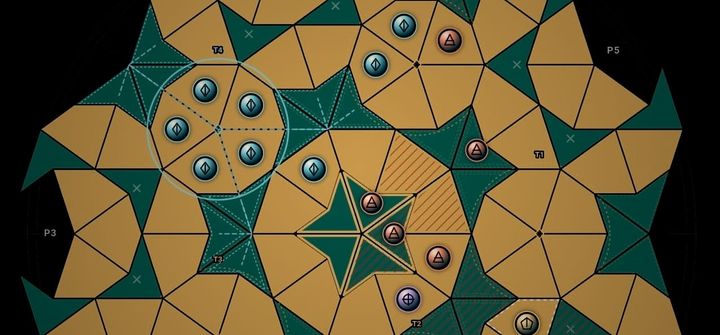
Chirality is a board game I designed while studying aperiodic tilings during the development of Modal Path Ethics. Its full rules are available on this site if you want to play it or just see what on Earth I am even talking about. What I want to discuss here is not the rules themselves but what this game is actually for, philosophically.
The short version: Chirality is an attempt at a ludic instantiation of the kind of thinking that Modal Path Ethics requires of agents. Playing the game exercises the very structural intuitions that the framework articulates in prose. The players are not reading about possibility space and reachability, but are moving within an actual possibility space, experiencing actual reachability constraints, navigating actual resistance, working within an actual field whose structure shapes what moves are available and what moves those moves enable next.
The choice of the Penrose P3 tiling as the board is not decorative or for distinction.
Penrose tilings are mathematical structures that exhibit exactly the features Modal Path Ethics takes to characterize real modal structure: they are lawful without being trivial, orderly without being simply repetitive, capable of rich patterned growth without collapsing into monotony. Playing a strategy game on a Penrose board means playing within a field whose underlying structure has the aperiodic lawfulness the framework describes. The tiles themselves, the Thick and Thin rhombs, create positional asymmetries that shape strategy in ways familiar players of the game come to feel at the level of intuition rather than at the level of explicit analysis.
The Throne mechanic, where occupying all five tiles of the central Star wins the game, creates a specific kind of field control dynamic that maps onto the framework's treatment of how certain loci have disproportionate effects on what futures remain reachable. The Moats around Stars are intended to create resistance structures that players must navigate. The Gates on the board are apertures in the field that shape which trajectories are available from the start.
Every mechanic in the game does philosophical work, in the sense that playing it well requires and cultivates the exact same kinds of structural thinking the framework describes as vital to its ethics.
None of this is just decoration layered on top of an otherwise generic strategy game "inspired by" Modal Path Ethics.
This game is the philosophy, in a specific and non-metaphorical sense.
You cannot actually play Chirality well without developing the same intuitions that Modal Path Ethics then articulates as needed in prose, and Chirality and self-play in development came before the development of that prose.
The game serves the framework by making accessible, through play, what would otherwise require substantial reading and reasoning to approach.
Why This Matters.
This (admittedly strong) claim about Chirality connects back to the broader point about the ludic tradition. Part of what has been lost in modern philosophical practice is the recognition that games can do philosophical work that books cannot do.
A game is not an inferior way of engaging with philosophical content. It is a different way, with different capacities.
The ludic tradition understood this. Plato staged philosophy as dialogue because dialogue could do what monologue could not and still can not.
The medieval disputation was not just a teaching aid for philosophical content that could have been delivered equally well through lecture. This was a distinct mode of philosophical practice that produced its own insights the lecture could not produce.
Wittgenstein's language games are not metaphors. They are the real structure of meaning, and philosophy that ignores this is doing less well than it could.
The Extance Strategy Game described by Modal Path Ethics is not a metaphor.
Chirality is a small overt contribution to reopening the door these traditions built and then we later let close. The game is not an argument for Modal Path Ethics. It is intended as something more interesting than that: an opportunity to inhabit the kind of thinking the framework requires, to develop the intuitions it articulates, to see the structure it describes by actually moving within a structure that has the right features.
If you learn to play it, something happens that reading the book cannot quite make happen on its own. The concepts stop being abstract vocabulary and start being visible features of a field you are actually navigating. That is what games at their best can do that words alone cannot, and it is what modern philosophy has mostly forgotten to ask of them.
The philosophical community, such as it is, has been mostly readerly for a long time. This essay is less about bragging about Chirality, and more of an open invitation to reconsider that by making room for other modes of engagement alongside reading and writing.
If you are someone who reads philosophy seriously, consider playing Chirality. Not because I somehow think it will convince you of Modal Path Ethics, but because it will give you an experience of what ludic philosophical engagement could actually feel like in a contemporary context. You might find that the experience changes how you read the book, or changes what you think the book is doing, or at least just reminds you that philosophy has actual, valid modes of engagement beyond the ones the modern discipline has institutionalized.
If you are someone who designs games, consider whether the games you make could do the kind of work Chirality is trying to do. Not by being about philosophy in any narrow sense, but by being structured so that playing them well exercises the same kind of thinking serious philosophical work you believe in requires.
The ludic tradition is far from exhausted. It is just underpracticed, and anyone who builds games in the modern era still has access to one of the oldest tools philosophy ever developed.
If you are someone who teaches or writes philosophy, consider whether the tools you use are the best or only ones available. Reading and writing are obviously essential. They are also not the only modes of philosophical practice your predecessors had access to and relied on for their insight. Something worth recovering may be hiding in traditions your own discipline has mostly abandoned.
The ludic door is still in reach, and arguably more potent today than ever if properly reintroduced. It has just been closed and only rarely allowed to open and only a crack and only when what's inside is dressed right for a while now.