Roger Penrose and the Reality of Structure
A Modal Path Ethics engagement with mathematics, physical law, and the field beneath the three worlds
Entropy Debt Week
Welcome to the surprise engagement invasion. "Entropy Debt" names the cost a system accumulates when it preserves surface order by exporting disorder into its future. The work of Roger Penrose repeatedly shows us how structure can carry consequences before they become visible at the surface. A theory, a tiling, a society, or a mind may appear locally coherent while already containing pressures its ordinary frame cannot resolve.
Roger Penrose’s philosophical problem is the reality of structure.
Mathematics appears to discover forms that no observer invents by preference. Physical theory appears to depend on those forms with a precision that still feels unreasonable after centuries of success. Human understanding appears capable of entering mathematical structure, proving within it, being surprised by it, and recognizing constraints that were present before recognition.
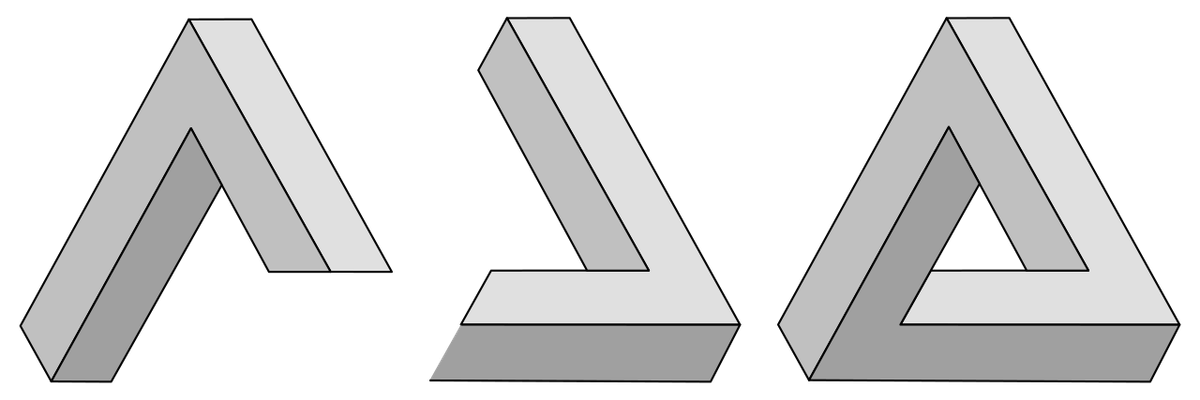
Penrose gives this pressure a famous shape: three worlds.
- There is the mathematical world: numbers, forms, relations, functions, spaces, symmetries, theorems.
- There is the physical world: matter, energy, spacetime, fields, bodies, events.
- There is the mental world: perception, thought, experience, insight, understanding.
Each seems distinct enough to resist reduction, yet each appears tied to the others in a way that makes separation unstable.
A small part of mathematics describes the physical world with extraordinary force. A small part of the physical world gives rise to minds. A small part of mental life reaches mathematics. The circle is familiar enough to pass by too quickly: mathematics describes matter, matter produces mind, mind discovers mathematics.
Penrose is interested in the fact that this circle closes at all.
His deepest philosophical importance lies in his defense of structure as something more than convention, projection, utility, or notation. He keeps returning to cases where reality appears answerable to form, and where form appears to have authority before any person approves it.
Modal Path Ethics takes that defense seriously. It shares Penrose’s refusal of flat conventionalism.
It also diverges from him at the point where his realism tends to divide reality into worlds and then seek bridges between them. This framework begins from a different primitive: extance, the active continuance of loci under real constraints and possible transitions.
Penrose wants to preserve the dignity of structure. Modal Path Ethics wants the same preservation, but without giving mathematics a separate throne or making human understanding the privileged gate of access.
The Three Worlds.
The three-world picture is powerful because it does not solve the problem too soon.
One easy answer says mathematics is simply a human invention. We create symbols, define rules, and call the results true when they follow from those rules. This answer captures something real about mathematical practice. Human beings do choose signs. We do introduce definitions. We do build formal systems.
The answer fails, though, when it treats those choices as the source of mathematical authority.
Once the terms are fixed, the structure answers back. A theorem may follow against expectation. A proof may expose an error in the person constructing it. A relation may hold no matter how inconvenient it becomes. Mathematical work includes invention, yet the invented apparatus enters a domain of constraint that exceeds preference.
Another easy answer says the physical world is all that exists, and mathematics is a useful descriptive tool. This answer also captures something real. Mathematical language earns its authority in physics through contact with measurement, prediction, and experimental discipline.
But the answer fails when it cannot explain why mathematical structures developed for internal reasons later become indispensable to physical theory. Physics has repeatedly found itself dependent on forms whose physical relevance was not obvious in advance: non-Euclidean geometry, complex analysis, group theory, differential geometry, Hilbert spaces.
The fit between mathematical form and physical theory remains philosophically demanding.
A third easy answer says mind is a product of matter and just leaves it there. This slogan is plausible as far as it goes. Minds are physically embodied. Thought depends on brains, bodies, histories, languages, and worlds.
But the answer fails when the mental world is treated as an after-effect with no special philosophical pressure of its own. Minds occur as embodied processes that also understand, err, judge, prove, recognize, imagine, and revise. In mathematical thought especially, mind appears to make contact with structures whose authority cannot be reduced to private feeling.
Penrose’s triangle remains valuable because each simple reduction loses something.
- Mathematics resists reduction to convention.
- Physical law resists reduction to brute inventory.
- Mind resists reduction to passive occurrence.
The three worlds name these resistances clearly.
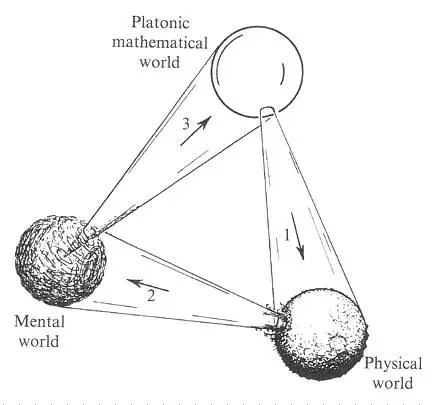
The risk follows. Once the resistances are named as separate worlds, the philosophical task becomes bridge-building.
- How does mathematics govern physics?
- How does physics produce mind?
- How does mind access mathematics?
The picture can begin to preserve mystery by distributing it across borders.
Modal Path Ethics accepts the pressure and immediately questions the partition.
Structure Before Partition.
A field-immanent account begins differently.
Rather than starting with three worlds, Modal Path Ethics begins with extance: the active reality of whatever continues, transforms, inherits constraint, opens paths, closes paths, and bears consequences in a field.
Extance is not a synonym for “everything.” Extance names continuance under structured possibility. An extant locus exists ethically and ontologically insofar as it participates in paths that can be preserved, burdened, repaired, or foreclosed.
This gives the framework a different way to speak about mathematics, physics, and mind.
- Mathematics becomes a disciplined contact with stable structure. It compresses relation, quantity, transformation, invariance, dependency, and proof. Its authority comes from the force of formal relations once specified. Human beings can invent symbols and choose definitions; they can not choose the consequences that follow from those specifications.
- Physics becomes the study of extant structure under empirical discipline. It asks which mathematical forms actually track the behavior of bodies, fields, forces, events, and spacetime. Its success does not show that the physical world is secretly mathematical in every respect. It shows that the physical world contains structure deep enough for mathematics to grip.
- Mind becomes a locus capable of contact, compression, anticipation, valuation, and responsibility. It is very astonishing. It is also situated. It arises inside the field, depends on the field, and acts back into the field.
This account preserves Penrose’s seriousness about structure while refusing the initial partition into separate worlds. Mathematics, matter, and mind are different modes or regions of extant structure. They still need not be collapsed into one kind. They also need not be separated into little metaphysical kingdoms.
The phrase “one field” can sound flattening. It definitely should not. That is sort of the entire point of Modal Path Ethics. A proof, a forest, a particle field, a legal institution, a person, and a game are not the same kind of thing. They differ in their modes of continuance, their capacities, their local embeddedness, their vulnerabilities, their forms of repair, and the kinds of wrong that can be done to or through them.
Field-immanence does not erase these distinctions. It provides a common grammar for asking how each locus continues under actual constraint.
Penrose’s three worlds cleanly diagnose the mystery. Modal Path Ethics relocates that mystery inside structured extance.
Why Modal Path Ethics uses the Tiles.
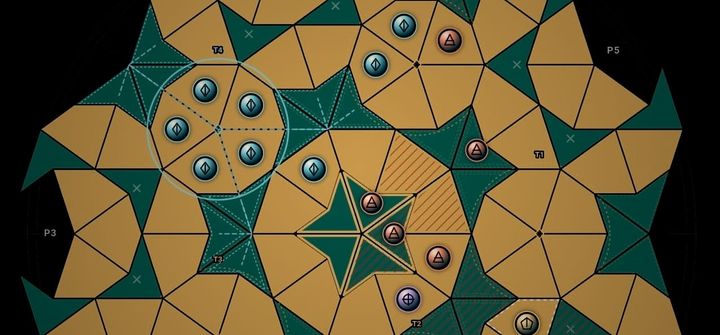
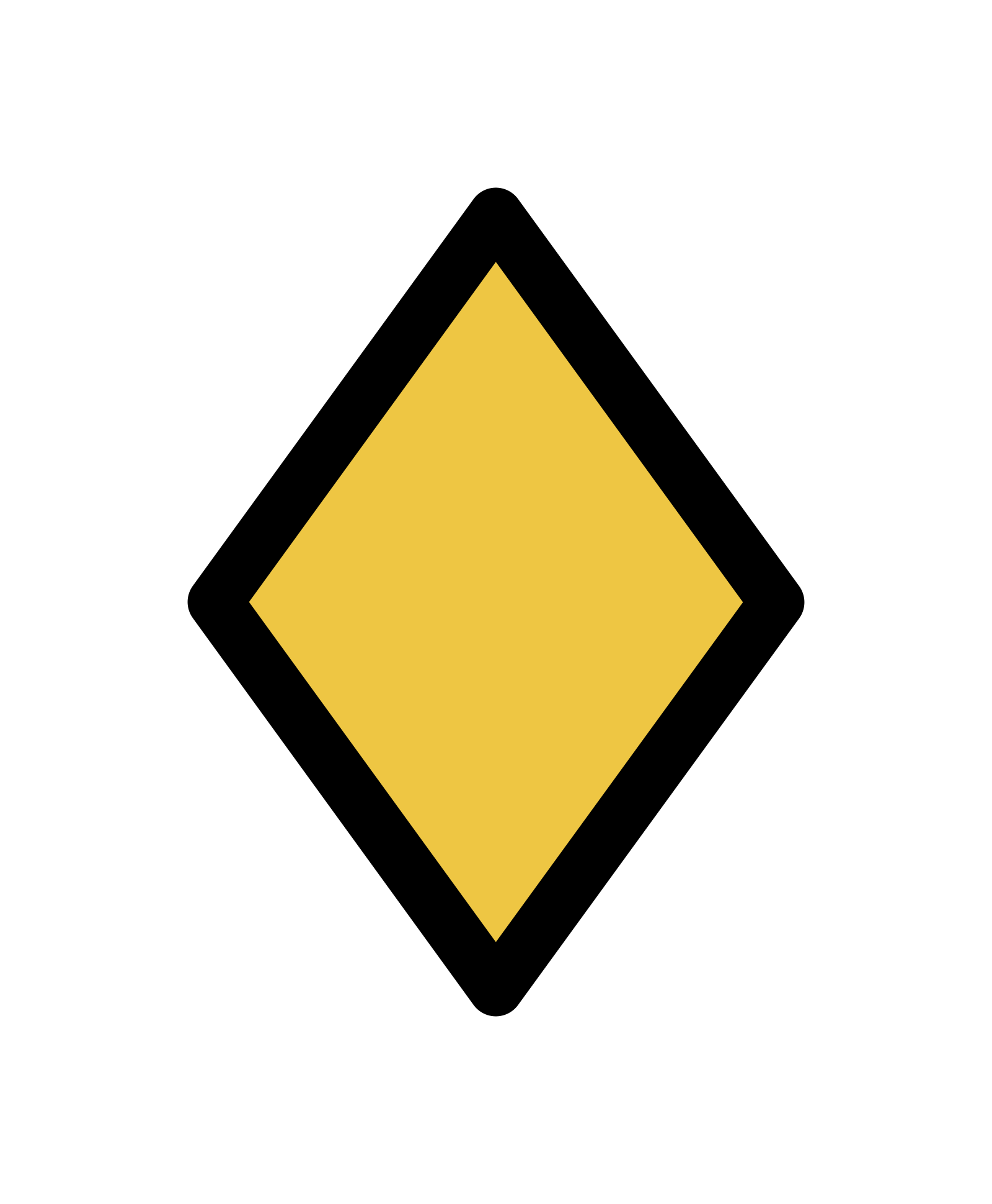
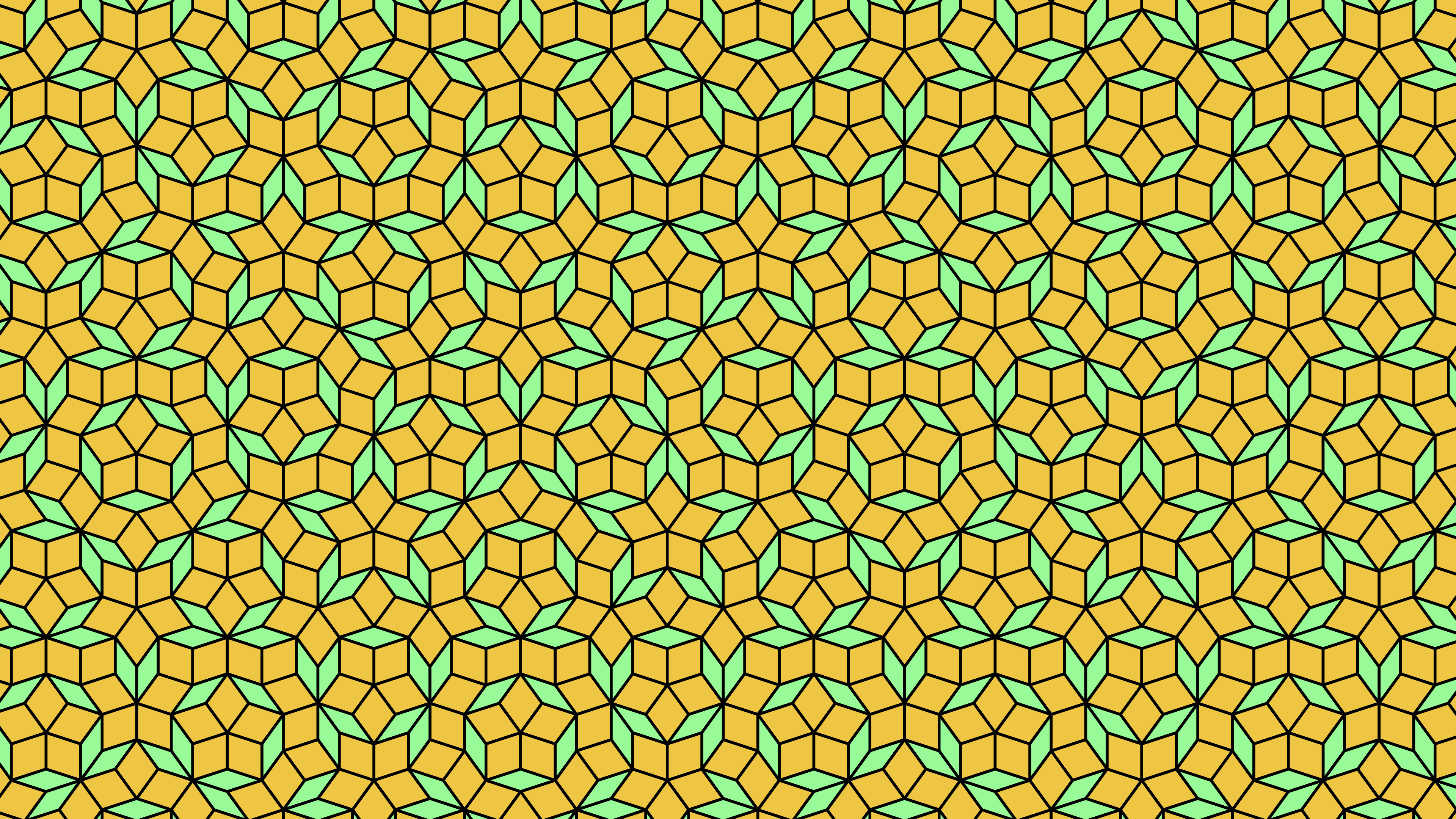
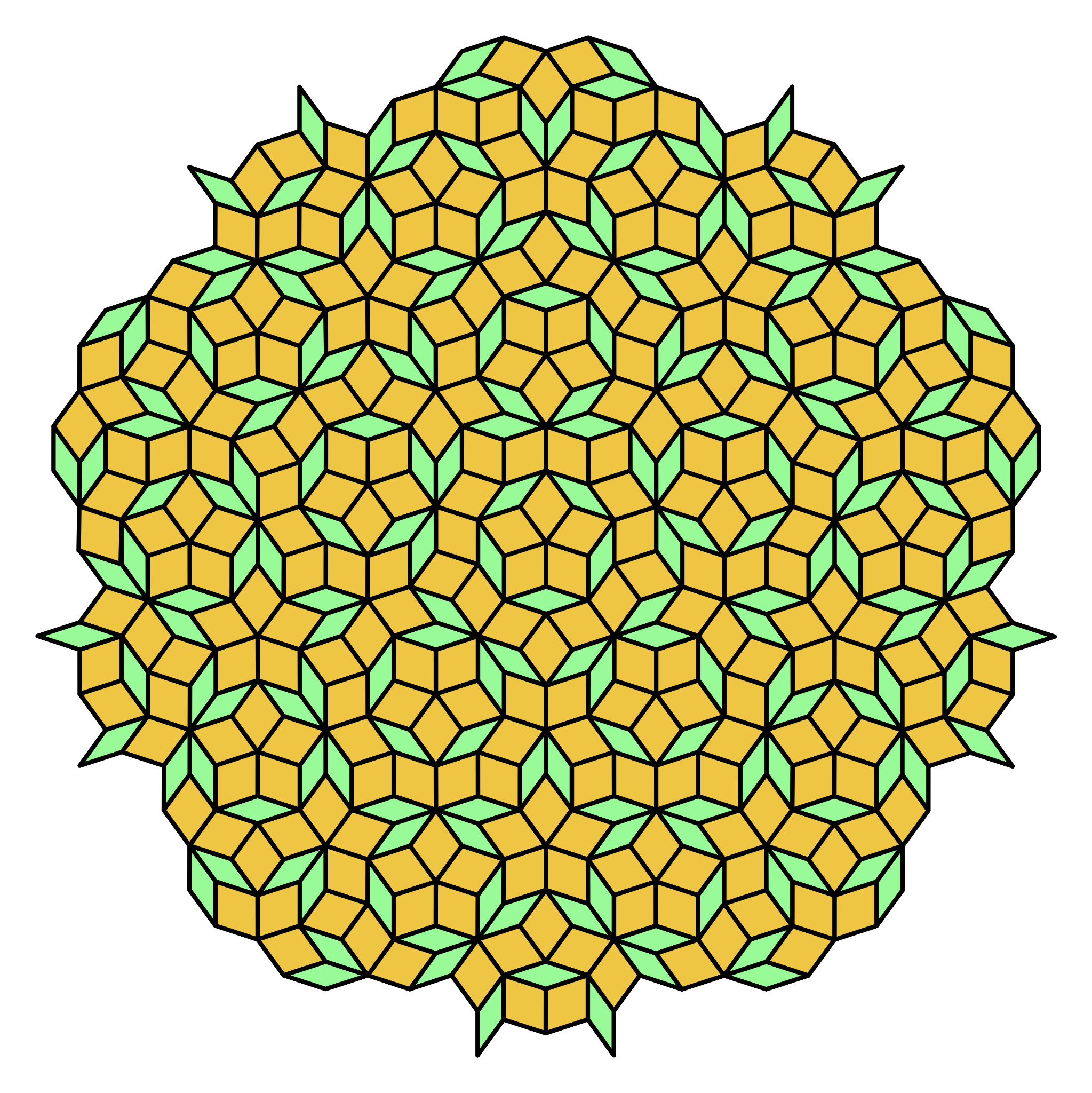
The Penrose tiles give the philosophical issue a very clean and beautiful visible form.
A periodic tiling repeats by translation. Move the pattern by the right distance in the right direction and the whole arrangement lands on itself. This is the familiar image of order: unit, grid, recurrence, template.
Much of modern thought inherits that kind of image without noticing. Order becomes repetition. Law becomes predictability. Structure becomes the suppression of difference.
Penrose tilings are aperiodic. They break that bad habit.
They cover the plane according to local constraints while avoiding translational repetition. The result is neither disorder nor periodic order. It is aperiodic order: structured, lawful, patterned, and inexhaustible by simple recurrence. The tiles can be studied, generated, constrained, and recognized. They still refuse the grid’s kind of closure.
This is why they are so important philosophically. They show us that lawfulness and repetition are separable. They show that local rules can produce global structure whose richness is not visible from any single patch. They show that a finite set of constraints can generate a field of continuation that remains open in a deep sense.
Modal Path Ethics has an obvious affinity here.
The framework’s core concern is reachable future-space under constraint. The ethical question is not whether a state of affairs looks locally coherent. The question is what continuations remain possible, which loci bear the cost of those continuations, which paths are being opened, which are being closed, and whether the field is being simplified by force.
Penrose tilings make that intuition visible without any ethical terminology. They are a formal demonstration that order need not look like obedience. They also warn against a common moral mistake: treating clean repetition as health.
A bureaucracy can repeat. A prison can repeat. A collapsed culture can repeat. A machine for producing the same damaged outcome can repeat indefinitely just fine.
Repetition alone is a very poor image of flourishing. Penrose gives us a much better one:
- Constraint that sustains difference.
Mathematics as Disclosure.
Penrose’s singularity theorem belongs to the same philosophical pattern, although the lesson must be stated carefully.
Under its assumptions, the theorem showed that geodesic incompleteness follows in general relativity from conditions broad enough to escape dismissal as a quirk of perfect symmetry.
The old comfort was that singularities might be artifacts of idealized models. Penrose showed that the problem reached much deeper into the theory’s structure.
Philosophically speaking, this clarifies what mathematics can do. Mathematics can reveal commitments hidden inside a framework. It can show that a theory carries consequences its first images concealed. It can discipline imagination by proving that a path assumed to remain open has actually closed.
Modal Path Ethics should learn from this. Ethical analysis also deals with hidden commitments. A policy may look locally reasonable while closing future-space elsewhere. A technological system may appear efficient while transferring burden to loci with less power to object. A moral rule may appear clean because the cases that would expose its violence have been excluded from the frame.
Mathematics discloses formal pressure. Ethics must disclose modal pressure. The domains differ. The lesson travels.
Penrose is valuable here because he does not treat formal structure as decoration. He treats it as a mode of finding out what a system has already committed itself to. Modal Path Ethics can accept that lesson without making mathematics supreme over every other mode of disclosure.
This is also the right place to clarify the relation between Penrose’s singularity language and the ethical vocabulary of Modal Path Ethics. The framework's terms of event horizon and social singularity should never be treated as literal imports from gravitational physics.
They are structural analogies, and their value depends on keeping that analogy disciplined.
- In physics, an event horizon marks a boundary in causal structure.
- In Modal Path Ethics, an event horizon marks the point at which a damaged field can no longer rely on its ordinary internal mechanisms to restore healthy continuance.
Local good may still occur. Honest actors may remain. Some repairs may still be possible. The threshold concerns scale and self-correction: the system’s usual habits, offices, incentives, narratives, and procedural remedies can no longer lower resistance fast enough to reverse the deeper contraction.
A social singularity names the limiting form of that failure. It is the condition toward which a social field tends when harm compounds, trust breaks down, truthful contact becomes increasingly costly, and repair is metabolized by the very structures it would need to transform. At that point, contraction no longer appears as a breakdown of normal functioning. It becomes part of normal functioning. The system preserves its immediate shape by deepening the conditions that make non-harmful continuance harder and harder to reach.
This makes Penrose’s singularity work philosophically useful without turning this article into a physics metaphor. His theorem shows that a framework may contain a terminal pressure its ordinary pictures conceal. Modal Path Ethics makes a related claim about moral and social fields. A society can retain its visible institutions, authorized language, and local routines while already passing into a region where those same instruments cannot repair the field they help maintain. Elections, courts, schools, media, offices, and professional codes may all continue to operate. The relevant question is whether they still reopen truthful reachability, lower resistance, and preserve non-harmful continuance at scale.
This concept is diagnostic rather than fatalistic. This framework does not produce predictions of inevitable collapse. It searches for the repair paths remaining in a field.
Passing an event horizon does not mean that every path has vanished. It means the cost and difficulty of repair have now changed category.
Ordinary reform may now dissolve into the background resistance faster than it can alter the field. Moral language may grow more absolute as moral contact weakens, because a system that depends on contraction must narrate contraction as necessity, purity, security, duty, or salvation in order to remain inhabitable to its participants.
The ethical task then widens: one can no longer evaluate isolated actions alone. One must ask what kind of field could make truthful repair reachable again.
Twistor Theory and the Primitive.
Twistor theory adds another dimension to Penrose’s philosophical method.
The familiar primitive in physics is spacetime. We imagine events are located in a four-dimensional arena. We then describe particles, fields, trajectories, and causal relations inside that mental arena.
Twistor theory asks whether this apparent starting point is itself derived from a deeper geometric structure. In the twistor approach, physical information associated with spacetime can be encoded in complex geometric terms, and spacetime itself may be reconstructed from relations in twistor space.
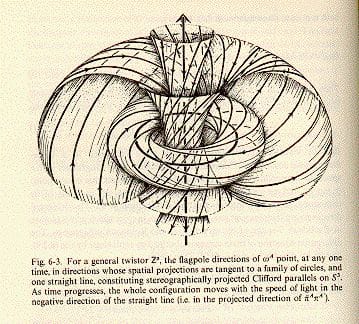
For this engagement, the technical details of twistor space are less important than the philosophical posture. Penrose is very willing to challenge the primitive. He works inside given arenas and also asks whether the arena itself has been granted too much authority.
That primitive question is deeply adjacent to Modal Path Ethics.
Many moral theories begin with a primitive they do not adequately defend: the rational agent, the chooser, the sufferer, the preference-holder, the legal person, the aggregate welfare sum, the isolated act. Once that primitive is accepted, the rest of the theory follows with apparent rigor.
Except the difficulty lies upstream. This primitive has already shaped the field around itself.
Modal Path Ethics wanted to avoid this issue as much as possible, so it begins elsewhere. It asks what continues, what can continue, what has been made unable to continue, and how burdens are distributed across possible paths.
Personhood remains morally central in many cases, because persons are extraordinarily rich loci. But personhood is not the first metaphysical gate. A future population, a world destroyed pre-life, an ecosystem, a culture, a practice, an institution, a game, or a pre-personal developmental path can enter moral analysis before it appears as a rights-bearing individual.
This is the structural kinship with Penrose’s method. Both approaches suspect the inherited primitives. Both ask whether a different starting point would make the field more intelligible.
Where Modal Path Ethics Converges with Penrose.
The convergence is substantial.
- First, Modal Path Ethics agrees that structure is real. Moral life cannot be reduced to preference, sentiment, procedure, or agreement. Some paths genuinely close futures. Some repairs genuinely reopen them. Some burdens genuinely fall asymmetrically. Some simplifications genuinely damage the field. These claims do not become true because a community votes for them.
- Second, Modal Path Ethics agrees that mathematics is a serious form of contact with structure. Mathematical proof and physical theory show that reality can be constrained in ways ordinary intuition does not anticipate. The framework has no interest in dismissing that contact as social convention.
- Third, Modal Path Ethics agrees that local coherence is dangerous. A situation can look justified from within a narrow frame while producing severe closure elsewhere. The local view often hides global cost. Penrose’s impossible figures, aperiodic tilings, and singularity work each teach a version of this warning.
- Fourth, Modal Path Ethics agrees that the primitive is everything. Start with the wrong basic unit and the theory will continue to produce distorted clarity. A system can become internally elegant after the decisive error has already occurred.
- Fifth, Modal Path Ethics agrees that order should not be confused with repetition. Ethical structure should preserve rich continuance, not produce uniform compliance. A good field has lawful openness. It does not become better by becoming easier to tile with identical units.
Penrose is not an opponent of Modal Path Ethics whose position must be dispatched. He is a neighboring realist whose route into structure differs from this framework.
Where Modal Path Ethics Diverges.
The divergence concerns where structure receives its dignity.
Penrose’s tendency is to preserve structure through mathematical realism. The mathematical world has a special status. Physical reality is deeply answerable to mathematical law. Mind becomes philosophically urgent because it can access the mathematical truth. The result is a grand triangle: mathematical, physical, mental.
Modal Path Ethics instead gives dignity to extance itself. Structure is already present in the field of continuance, constraint, and possible transition. Mathematics is one of the highest disciplines for contacting that structure. Physical theory is another. Ethical perception is another. Historical understanding, ecological attention, game design, legal analysis, and care can also disclose real features of the field when they are practiced seriously.
This divergence is easy to misunderstand. Modal Path Ethics is not trying to demote mathematics into personal expression. Mathematics retains its own force. Proof retains necessity within its formal regime. Physical mathematics retains extraordinary authority where it is empirically confirmed. The disagreement concerns metaphysical placement.
For Modal Path Ethics, mathematical objectivity does not require a separate Platonic world. It only requires stable formal relations whose consequences constrain admissible continuation. Once a structure is specified, its implications are no longer up to us. This is enough to explain why mathematics can and should humble the mathematician.
Nor does mind become the privileged bridge through which reality receives depth. Mind is just one (very notable) form of contact within the field. Human understanding matters enormously because it can recognize, compress, transmit, repair, and take responsibility. Its importance does not make it the measure of being.
The field is already structured before it is ever understood. That is the heart of the divergence.
Penrose may object that this field-immanent account has not yet explained mathematical necessity.
- If mathematics is a contact regime with extance, why do mathematical truths appear necessary rather than contingent?
- Why can a theorem hold with a force stronger than empirical generalization?
- Why does mathematics developed without physical application so often become useful in physics later?
- Why does the field answer to forms that seem timeless?
- Why does mathematics developed without physical application so often become useful in physics later?
- Why can a theorem hold with a force stronger than empirical generalization?
This objection has weight. A weaker Modal Path Ethics would fail right here by treating mathematics as a clever shorthand for observed regularity. That would simply not be enough. Penrose’s realism exists because mathematical authority feels stronger than shorthand.
The better answer begins with formal specification.
Mathematical necessity arises within structures whose terms and rules impose consequences. Once a formal regime is fixed, admissible continuation is constrained. The necessity is not psychological or political. It is not a habit of language. It belongs to the structure.
Applicability to physics is a further question. Mathematical structures become physically powerful when extant processes instantiate, approximate, or preserve the relations those structures describe. This explains why mathematics can be developed abstractly and later find application. The field contains many forms of relation. Mathematicians explore possible structure with high freedom. Physics later discovers that some extant processes already answer to those structures.
This answer does not give Penrose everything he wants. I'm very sorry. It does not produce a separate mathematical realm. It does not make the mental world a bridge to Platonic truth. It says instead that formal necessity and physical applicability are two different relations to structure. The first concerns implication inside specified regimes. The second concerns contact between those regimes and extant processes.
Penrose may still call this all insufficient. He may insist that the objectivity of mathematics is too strong for any immanent account. Modal Path Ethics can definitely grant the remaining disagreement. Its answer is intentionally austere: structure constrains without needing to reside elsewhere.
Modal Path Ethics has an answering objection to Penrose.
The three-world picture preserves important distinctions, then risks overvaluing the borders it created. Once mathematical, physical, and mental reality are separated, philosophical attention moves toward the bridges. The mystery becomes access: how mind reaches mathematics, how mathematics governs physics, how physics produces mind.
This can make the human knower too central.
The mathematical world now matters because mind can access it. The mental world matters because it reaches truth. The human mathematician becomes the dramatic site where the circle closes.
Modal Path Ethics sees this as far too narrow. The field does not become structured when humans first reach it. Structure does not become ethically relevant when conscious recognition appears. Continuance, dependence, foreclosure, and repair operate across loci that may never understand themselves mathematically.
A forest can lose future-space. A language can become unable to transmit a form of life. A damaged institution can keep producing closure long after its participants forget the original harm. A future person can be deprived of a path before existing. None of these cases require human mathematical insight to become morally real.
Human understanding remains precious. It is one of the field’s ways of answering itself.
It is not the field’s throne.
This is where Modal Path Ethics takes the firm anti-anthropocentric step Penrose does not consistently take. The dignity of structure cannot depend on the special drama of human access. The field came first.
Structure precedes access. Ethics begins there.
The Tiles, Again.
This returns us to the tiles.
The tiles are the most generous image of the disagreement.
- For Penrose, they belong naturally with a realism of mathematical form. They reveal a structure whose elegance appears discovered. Their aperiodic order feels like a gift from the mathematical world: local constraint producing infinite non-repetition, a lawful plane beyond ordinary periodic imagination.
- For Modal Path Ethics, they show something slightly different. They show how constraint can sustain open continuance inside one field. They do not need to stand above the world in order to teach. Their force lies in the way local rules generate possible continuation without reducing the plane to repetition.
The distinction is pretty fine, yet it matters a lot.
Penrose looks at such structures and sees evidence for the independent dignity of mathematical reality.
Modal Path Ethics looks at them and sees evidence that extance itself is structurally richer than our inherited images of order allow.
Both readings honor the same tiles. They differ immensely over metaphysical placement.
Conclusion.
Roger Penrose will recieve more focused engagement in the future because he takes structure seriously.
That seriousness runs through his work on mathematical realism, aperiodic tiling, singularity, twistor theory, and the relation between mind and mathematics. He refuses to treat mathematics as preference. He refuses to treat physical theory as surface description. He refuses to treat familiar primitives as final. He repeatedly asks whether the frame has hidden commitments that our first view failed to see.
Modal Path Ethics shares that discipline. It also redirects it.
The three-world picture preserves real pressure, yet the field-immanent account begins earlier. Mathematics, physics, and mind are not rival kingdoms joined by mysterious bridges. These are differentiated modes of structure within extance. Mathematics compresses formal relation. Physics tests which formal relations grip the behavior of the world. Mind contacts, carries, distorts, and repairs structure from within the field. Ethics asks how continuance is preserved or foreclosed across loci under constraint.
The intellectual debt to Penrose is very real. The divergence is equally real.
Penrose gives us one of the great modern defenses of structure against flattening. Modal Path Ethics accepts this defense and widens the site of dignity. Structure is not waiting in a higher world. It is not hidden inside the human mind. It is already active in the field: in paths, constraints, burdens, repairs, losses, and continuations.
The tiles remain the cleanest emblem of this reality.
Their shapes teach us that order can exist without repetition. They teach that local rules can have global consequences. They teach that lawful structure need not become a grid.
That is already enough to begin an ethics.