Applied Case: The Schizophrenia Firewall
The law is not asking whether schizophrenia makes you uncomfortable. It is asking whether your exclusion of this class is justified.

September 2026 note: The structural core remains: diagnosis-based exclusion can foreclose ordinary voluntary care, ghost networks and delays can thicken resistance to treatment, and upstream access failure can make crisis and coercive pathways more reachable. Newer work gives cleaner language for those distinct harm modes and for separating a harm-token from the complete transition profile. It also separates structural discrimination, responsibility, motive, and overall moral verdict more sharply than some of the article's rhetoric does: a policy can be discriminatory in effect without that fact alone proving every individual provider's motive or character. The ADA, Section 1557, Olmstead-related, clinic-policy, network-availability, and provider examples are dated legal/factual claims and should be reverified before reuse; the article is an applied civil-rights argument, not a timeless formal theorem of Modal Path Ethics.
Source note: This Applied Case is book-length, and will be published as paperback once final. It is being soft-published now while the full evidence vault is being prepared. The main clinic examples, screenshots, public links, and core legal standards are included in the article.
Archived PDFs, screenshots, access dates, and additional legal/access sources will be added in a dedicated evidence vault shortly. This article is a civil-rights analysis, not legal advice about any individual case.
Opening: The Intake.
This always begins when a patient tells the truth.
Not with violence, refusal, or noncompliance. Not with denial or paranoia.
Not the cinematic version of “madness” the culture keeps using because it is easier than reading the actual paperwork.
A patient tells the truth. The truth is they have previously received a schizophrenia-spectrum diagnosis. Schizophrenia. Schizoaffective disorder. Psychosis. A record of psychosis.
One of the DSM labels that psychiatry itself created, assigns, bills through, prescribes under, hospitalizes under, researches under, and invokes whenever it wants authority over the patient’s body.
This truth then hits the intake process. The appointment disappears.
Now, the provider is “not comfortable.”
The clinic is “not equipped.”
The case is “outside scope.”
The patient “needs a higher level of care.”
This practice “does not treat schizophrenia,” or “does not treat schizoaffective disorder,” or just generally “does not treat psychosis.”
Psychiatry's own label becomes a firewall to psychiatric treatment.
This is not about “stigma” as some vague cultural fog, or access as a sad little shortage story. Not psychiatry’s long, well-documented historical record of doing something horrifying, admitting it eighty years too late, and then congratulating itself for no longer doing that exact thing in the exact same costume.
This is much narrower. This is a civil-rights analysis.
The question is whether American outpatient psychiatry is currently using schizophrenia-spectrum status as an intake firewall for ordinary psychiatric care. The next question is whether that firewall screens out a protected class of disabled patients before individualized assessment. Then we need to ask whether “scope,” “resources,” “comfort,” and “higher level of care” are being used as clinical language for what legally amounts to disability discrimination.
Because it turns out, the law already has plenty of words for this exact situation. They are also quite explicit.
The Americans with Disabilities Act is a civil-rights law you may have heard of. The Department of Justice describes it as prohibiting discrimination on the basis of disability in everyday activities, and Title III applies to public accommodations, including doctors’ offices.
The Title III regulation on eligibility criteria is not subtle at all.
A public accommodation cannot impose or apply eligibility criteria that screen out, or tend to screen out, an individual with a disability or a class of disabled individuals from fully and equally enjoying the goods, services, facilities, privileges, advantages, or accommodations being offered, unless those criteria can be shown to be necessary for the service.
The direct-threat rule is also not subtle.
If a public accommodation claims a person poses a direct threat, that determination has to be individualized, based on reasonable judgment using current medical knowledge or the best available objective evidence. It must consider the nature, duration, severity, and probability of harm, and whether reasonable modifications could mitigate the risk.
Section 1557 adds another layer on top for covered health programs and activities.
Disability discrimination is prohibited in covered health care. The exact coverage analysis may vary by provider and funding structure, but the principle is not mysterious to us.
A covered health program does not get to deny equal access because a patient belongs to a disabled class.
So, the first legal question is simple:
Does a schizophrenia-spectrum exclusion operate as a necessary clinical criterion, or as a disability firewall?
If the provider says, “This specific patient, today, is acutely unsafe for outpatient care because of current facts we assessed,” that is one kind of claim.
If the provider says, “We do not treat schizophrenia, or schizoaffective disorder, or psychosis,” that is another one entirely.
If the provider says, “This patient needs a higher level of care” without actually showing current acuity, current danger, current instability, required monitoring, required service, or a working referral path, then that is not individualized assessment. That is a blatant status deflection.
Schizophrenia-spectrum patients are not trying to enter an unrelated field. They are not sneaking into your clinics.
They are trying to enter psychiatry.
This is not a dermatologist being asked to manage antipsychotics. This is not an optometrist being asked to provide crisis stabilization. This is not a dentist being asked to treat delusions.
This is psychiatry.
This specialty claims authority over psychosis when it wants diagnostic control. It claims authority when it writes the DSM category. It claims authority when it prescribes antipsychotics. It claims authority when it certifies disability. It claims authority when it hospitalizes.
It claims authority when it tells families to bring the patient to the ER, and when it defends involuntary treatment. It claims authority when it says untreated psychosis is dangerous. It claims authority when it tells the public that medication nonadherence is a problem.
Then, the patient voluntarily seeks outpatient care.
Suddenly, the firewall goes up.
“No. We don't treat your kind.”
This is not a service inconvenience. That is not a “bad fit.” That is not “the patient being difficult.”
This is a profession using its own label as both its source of bodily authority, and also a basis for exclusion.
A psychiatric system cannot claim schizophrenia-spectrum labels as the basis for its coercive power, then simultaneously use those same labels as a firewall against voluntary care.
That is the central contradiction. That is the civil rights case here.
This field already fully knows early treatment matters.
The National Institute of Mental Health says early intervention is critical in first-episode psychosis and reports the World Health Organization recommendation that no more than ninety days pass between onset of psychosis symptoms and specialized treatment.
Yet the outpatient field regularly routes schizophrenia-spectrum patients through delay, rejection, ghost networks, medication gaps, emergency escalation, police contact, and hospital coercion.
This is not “inefficient”. It is legally obscene.
A person with a schizophrenia-spectrum diagnosis can be stable, medication-seeking, coherent, routine, and clinically straightforward. They can tell the truth. The appointment can be ten minutes. The medication can already be known, and working. The patient can be doing exactly what psychiatry claims to want us to do: accepting treatment before the crisis.
But then the DSM label appears, the field changes, and the firewall pops up.
This Applied Case asks whether that firewall meets the legal language.
Spoiler alert: It does not.
Chapter 1: The Firewall.
The public evidence of this is not being hidden at all.
Psychiatric clinics and mental-health platforms openly publish their schizophrenia-spectrum exclusions. They do it on their referral pages, FAQs, service pages, telehealth pages, and practice overviews. They advertise outpatient psychiatry, mental-health treatment, evaluation, medication management, therapy, or telepsychiatry.
Then, they carve out schizophrenia, schizoaffective disorder, psychosis, “active psychosis,” or “severe mental illness.”
Sometimes, the language is blunt.
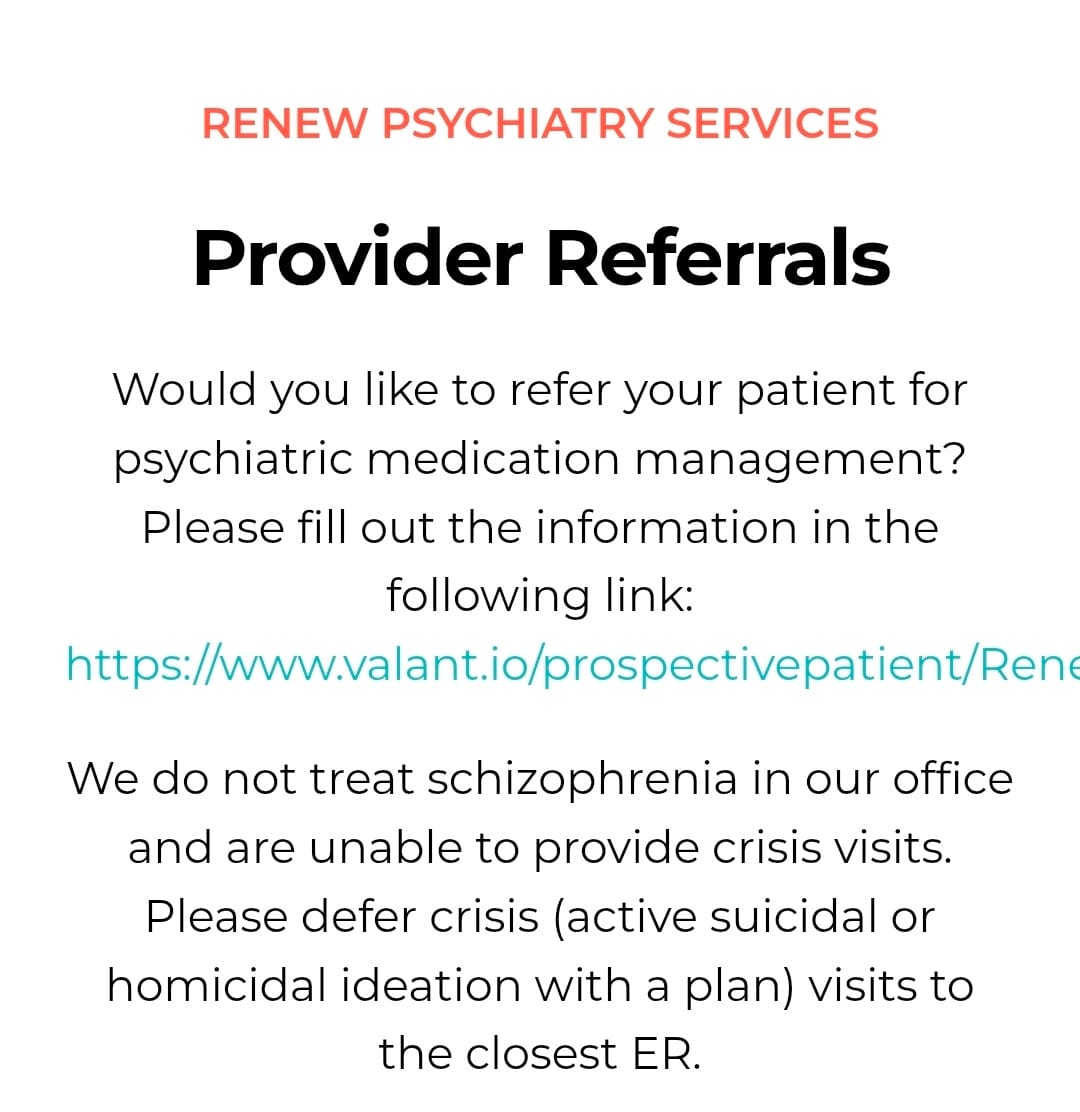
Renew Psychiatry Services has a provider-referral page for psychiatric medication management. On that page, after inviting referrals, it states:
“We do not treat schizophrenia in our office.”
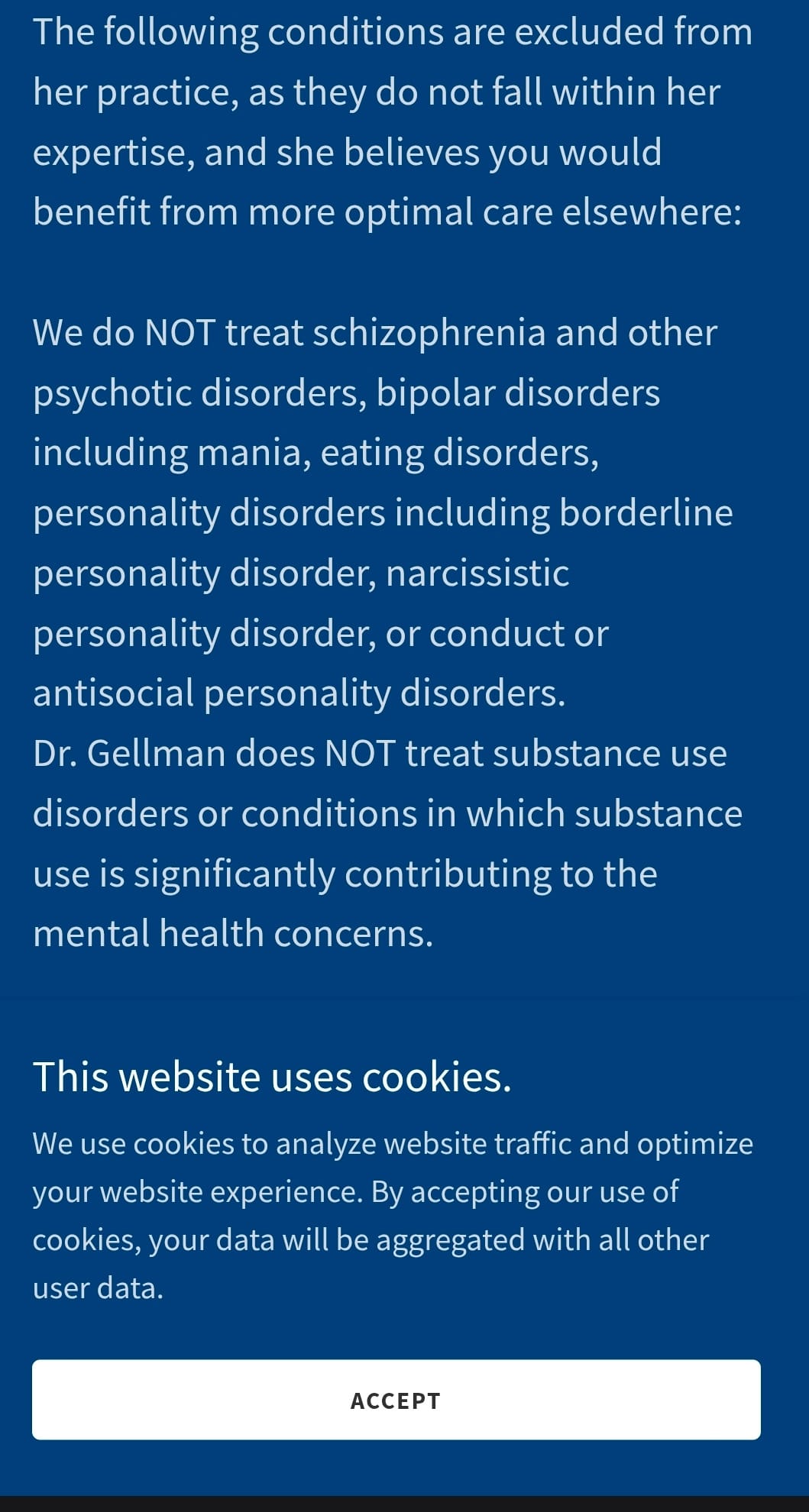
Boulder Valley Psychiatry states:
“We do NOT treat schizophrenia and other psychotic disorders,” then lists other excluded conditions.
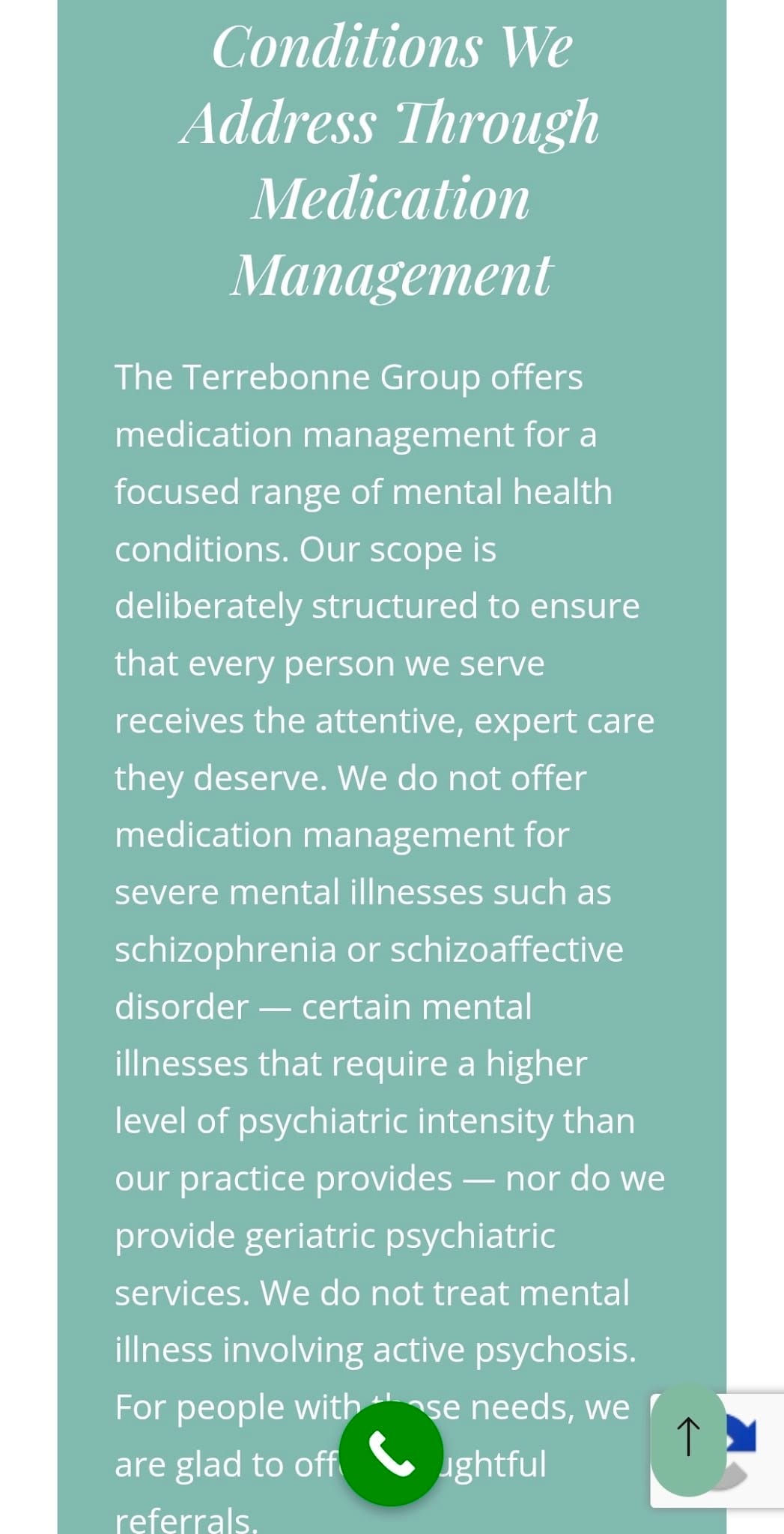
The Terrebonne Group has a page specifically for psychiatric medication management. It says the practice does not offer medication management for “severe mental illnesses such as schizophrenia or schizoaffective disorder,” because those illnesses require a “higher level of psychiatric intensity” than the practice provides. It also says it does not treat mental illness involving active psychosis.
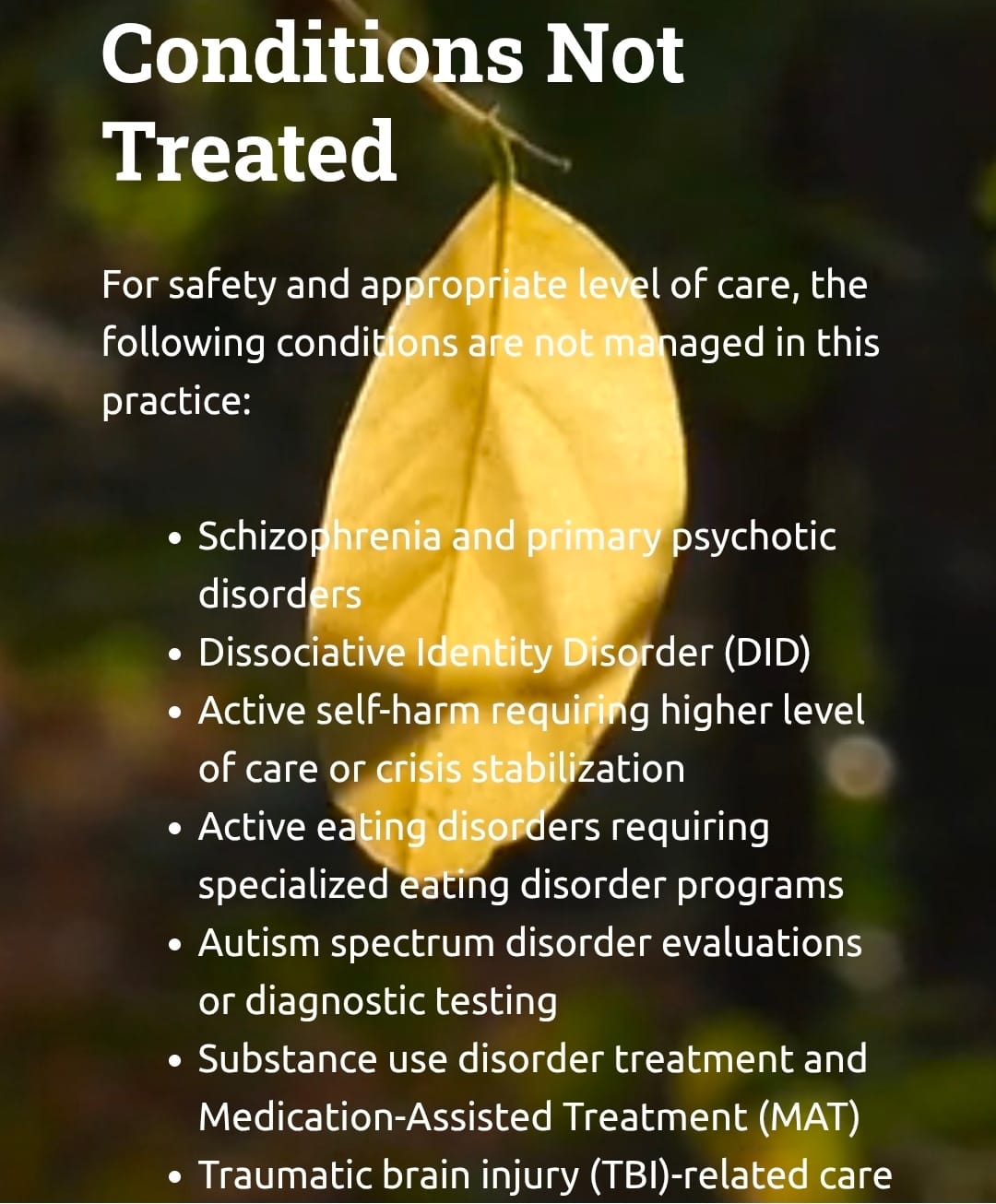
Nexus Medical PLLC says it is accepting new Medicaid/HUSKY patients for outpatient mental-health medication management. It lists comprehensive evaluations, diagnosis, individualized treatment planning, electronic prescribing, coordination with outside therapists and healthcare providers, lab ordering, and pharmacogenetic testing. Then, under conditions not treated, it lists “Schizophrenia and primary psychotic disorders.”
Sandalwood Mental Health lists psychiatric and mental-health treatment categories including ADHD, anxiety, autism-related behavioral symptoms, bipolar disorder, depression, intellectual/developmental disability-related psychiatric care, mood disorders, PTSD, OCD, and stress. Then it lists “Schizophrenia or Psychosis” under conditions it does not treat.
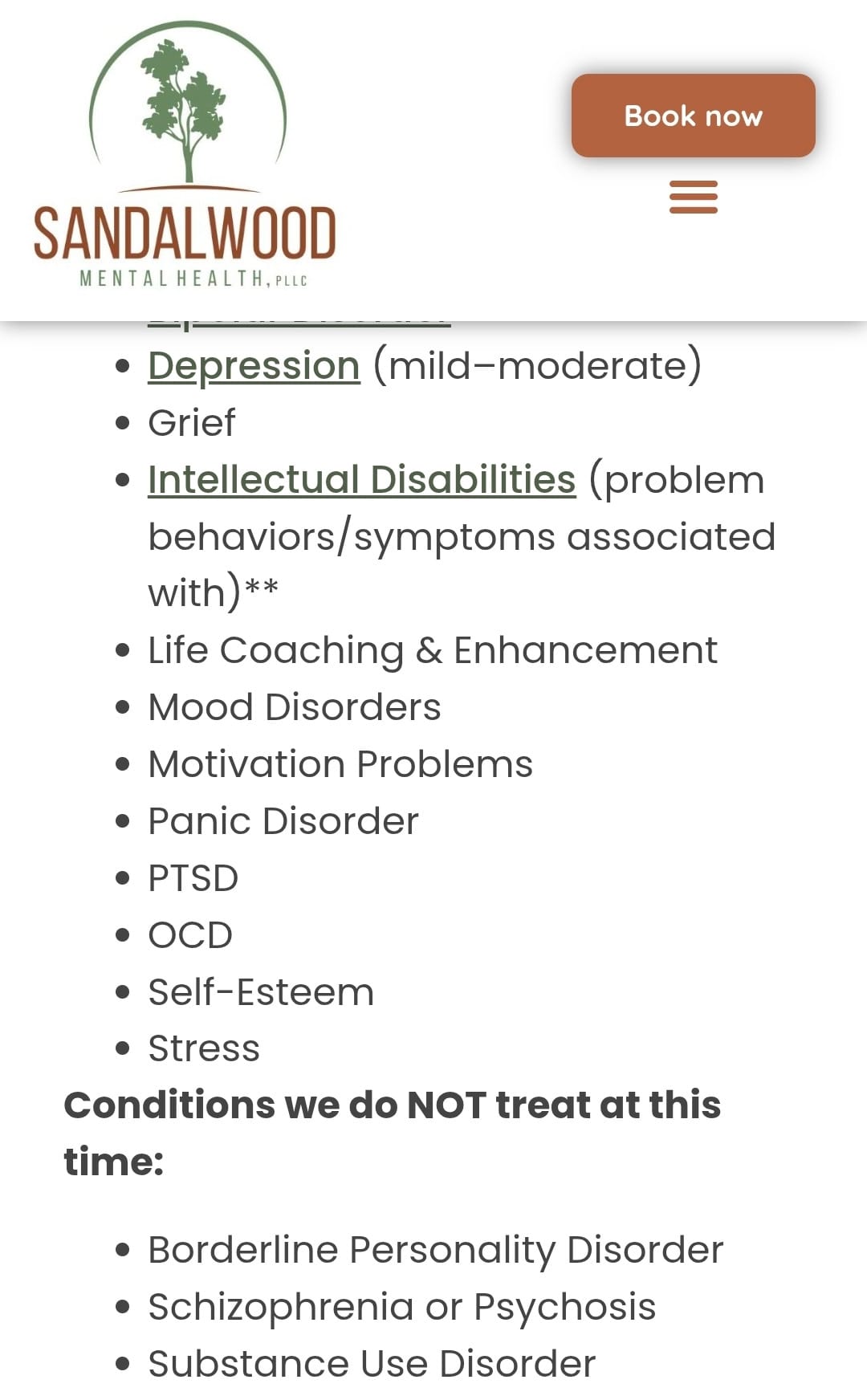
These examples are not the entire evidence bank, not even all the examples I personally have. This is just the opening exhibit.
The exclusion is written in plain english, on the homepage.
Now, let's apply the law.
I read it again, and ADA Title III does not ask whether the provider has pleasant branding.
It does not ask whether the webpage sounds compassionate. It does not ask whether the clinic prefers to treat anxiety, depression, ADHD, or low-acuity medication management.
Instead, it asks whether the provider is applying eligibility criteria that screen out disabled people, or a class of disabled people, from full and equal enjoyment of the services being offered. If so, the provider must be able to show the criterion is necessary for the service.
That is the real, legal test here. Not your vibes. Not your comfort. Not “we just do not do that.”
Necessity.
If the service is outpatient psychiatric medication management, what exactly makes schizophrenia-spectrum status a necessary exclusion?
Name the resource. Name the service limit. Name the individualized risk. Name the modification considered. Name the current acuity fact.
Name the actual reason this patient, today, cannot receive ordinary outpatient care.
The problem is not that every psychiatric clinic must provide every psychiatric service to every psychiatric patient in every condition. That would be false. It would also be very ill-advised.
Some patients need inpatient stabilization. Some need detox. Some need emergency medical care. Some need clozapine monitoring a given clinic does not provide. Some need long-acting injectable administration. Some need intensive case management. Some need crisis response. Some need a team, not a solo prescriber. Some need a service the clinic truly does not offer.
Those are real service limits. Expecting every clinic to provide all of that would be untenable.
But “we do not treat schizophrenia” is not actually a service limit. That right there is an open class screen. This distinction changes everything.
A lawful clinical limit says:
“We do not administer long-acting injectables.”
“We do not manage clozapine.”
“We do not provide crisis visits.”
“We do not provide inpatient stabilization.”
“We do not treat patients currently requiring continuous monitoring.”
“We cannot safely treat patients who, after individualized assessment, present current risk beyond outpatient capacity.”
An unlawful disability firewall says:
“We do not treat schizophrenia.”
“We do not treat schizoaffective disorder.”
“We do NOT treat psychosis.”
Those are not equivalent sentences.
A service limit describes the clinic. A diagnosis exclusion describes the patient class.
Civil-rights law cares enormously about that difference.
The language “requires more resources than we can provide” does not solve this problem. That starts the interrogation.
What resources? For whom? Under what presentation? For which service? Compared to what alternative?
Is the patient even asking for those resources, or asking for a routine prescription?
Was the patient ever assessed?
Was the current acuity assessed?
Was the medication history reviewed?
Was a reasonable modification considered?
Was a genuine, warm referral made?
Was a real bridge plan offered?
Was the patient already stable?
Was the patient just seeking continuance of the exact medication that keeps them stable?
The law does not allow a covered provider to turn a disabled class into an excluded category just because the category may also include some patients who require more intensive resources.
That is exactly how discriminatory categories work. They convert a possible feature of some members of a class into a barrier against that class. That is why this firewall is legally suspect.
A provider can exclude acuity. A provider can exclude services it does not provide. A provider can exclude a current risk that cannot be mitigated.
However, a provider cannot simply turn their DSM label into a wall and call that wall clinical judgment.
The obscenity here is sharper because psychiatry owns this label.
Schizophrenia-spectrum diagnoses are not folk categories. They are not random internet insults. These are psychiatric labels. They were all built inside the field’s own classificatory machinery. This field assigns them. This field records them. This field bills through them. This field uses them to justify treatment plans, medication selection, hospital admission, disability paperwork, and sometimes coercive control over the body.
Then outpatient psychiatry lets the same label become a reason the patient is not welcome.
That is not neutral in any way. That is not “we specialize in other things.”
That is a profession marking a disabled class as too difficult for ordinary care until the same class becomes reachable through its avenues of emergency control.
This is the pipeline:
First, voluntary care becomes fragile.
Then, medication continuity becomes fragile.
Then, psychiatric trust becomes fragile.
Then, the family panics.
Then, the patient is told to go to the ER.
Then, the patient meets the hospital, the police, the locked unit, the forced medication, the restraint, the seclusion room, or the death risk that follows when crisis systems replace access to ordinary medicine.
Not every case travels that whole route to the end. That is not the claim here. The claim is that this firewall changes what becomes reachable.
When outpatient psychiatry refuses schizophrenia-spectrum patients categorically, it does not just decline a patient. It changes that patient’s legal and bodily future.
Voluntary care now becomes less reachable. Coercive care now becomes more reachable. The patient who just asked for a prescription can be routed, by exclusion, toward institutions that can seize, confine, inject, restrain, or kill.
Your clinic may not intend that whole chain. Intent is not the point. Your intention is irrelevant. The firewall is the point.
A public accommodation does not escape civil-rights analysis by saying the discrimination was very polite, unintentional, common, administratively convenient, or professionally normalized.
The legal question is what the eligibility criterion does. If this one screens out a class of disabled people from equal access to the offered service, the provider must justify it under the law’s necessity and individualized-assessment requirements.
Psychiatric clinics regularly and openly do not meet that standard.
They publish their firewall. They normalize their firewall. They hide the firewall behind scope language. They call the firewall resources. They call the firewall safety.
They even call the firewall a higher level of care.
But unless this exclusion is necessary for the service being offered, and unless safety claims are grounded in individualized objective assessment, that firewall legally amounts to discrimination against disabled persons.
For the psychiatrist's own comfort.
For their own liability anxiety.
For their own business model.
For their own desire to practice psychiatry without ever treating one of the populations that makes psychiatry most necessary.
Ruling.
A schizophrenia-spectrum exclusion published or applied before individualized assessment is legally suspect under ADA Title III and, for covered health programs, Section 1557.
The provider may claim scope, safety, resources, or higher level of care. But those claims have to be shown. They cannot be presumed from the DSM label.
A clinic that offers outpatient psychiatric services and then says “we do not treat schizophrenia,” “we do not treat schizoaffective disorder,” or “we do not treat psychosis” is not describing a preference. It is applying a diagnosis-class filter to a protected psychiatric disability category.
The law asks whether such a filter is necessary. The field’s public language often does not answer that. It simply excludes.
That is not enough.
Not legally, and not ethically.
Not at all for a profession that claims authority over psychosis when it wants power, then disclaims competence when the patient asks for voluntary care.
Chapter 2: Scope Is Not Some Civil-Rights Loophole
The first excuse is always scope.
“We are not equipped.”
“This is simply outside our scope.”
“Our practice is just not designed for that.”
“We do not have the resources.”
“You need a higher level of care.”
This all sounds very responsible. It sounds cautious. It sounds like the provider is humbly recognizing a professional limit rather than refusing a disabled class.
It is the kind of polite little sentence that can pass through an intake call, a referral note, a website FAQ, or a portal message without anyone ever stopping to ask what that sentence is actually doing.
So, we should stop and ask.
Scope is real.
A clinic that does not administer long-acting injectables does not, in fact, have to pretend it administers long-acting injectables. A clinic that does not manage clozapine does not have to pretend it manages clozapine. A clinic that cannot provide emergency stabilization does not have to pretend it is an emergency department.
A solo outpatient prescriber does not actually have to become an assertive community treatment team, a crisis house, a hospital, a lab, a housing agency, a social-work department, and a police alternative, just because the patient has a schizophrenia-spectrum diagnosis.
That would clearly be absurd. It would also make the legal argument weaker, because the law does not require such a medical fantasy.
The law does not require every provider to provide every service. ADA Title III allows necessary eligibility criteria, allows legitimate safety requirements based on actual risks, and recognizes that medical providers can refer when a person seeks or requires treatment outside the provider’s area of specialization. The regulation on modifications also says a public accommodation must make reasonable modifications when necessary unless doing so would fundamentally alter the nature of the goods, services, facilities, privileges, advantages, or accommodations being offered.
Good. Now, that excuse has to earn its keep.
Because “scope” is not a magic word.
“Resources” is also not a magic word.
“Higher level of care” is not magic language, either.
A clinic does not get to say the word “scope” and then just walk out of civil-rights analysis. The legal question does not vanish because the discrimination learned some more professional vocabulary.
The law asks you what the criterion does.
If this criterion screens out, or tends to screen out, an individual with a disability or a class of disabled individuals from full and equal enjoyment of the services being offered, then the provider has to show the criterion is necessary. Safety requirements must be based on actual risks, not speculation, stereotypes, or generalizations about disabled people.
So the question is not whether “scope” can ever matter. Of course it can.
The question is whether “scope” is being used to describe an actual service limit, or to launder a disability firewall between schizophrenia-spectrum patients and outpatient medical treatment.
A service limit says:
“We do not manage clozapine.”
“We do not administer injections.”
“We do not provide court-ordered forensic evaluations.”
“We do not provide emergency or same-day crisis stabilization.”
“We do not provide intensive case management.”
“We do not provide psychotherapy.”
“We do not provide medication management.”
“We cannot safely treat a patient who, after individualized assessment, currently requires continuous monitoring.”
A disability firewall says:
“We do NOT treat schizophrenia.”
“We do not treat schizoaffective disorder.”
“We do not treat psychosis.”
Those sentences are not the same kind of sentence.
The first kind describes the service provided at this clinic. The second kind describes the excluded class of persons. That is why this is a clear civil-rights issue.
A clinic may have a narrower service model, but when that narrowed service model also maps onto a protected psychiatric disability category before the patient's service requirements are even assessed, the clinic is not just defining what it does. It is defining who gets to enter.
That is where “scope” becomes dangerous, because scope can become the polite architecture of exclusion.
The regulation on medical specialties is especially useful here because it cuts both ways. It recognizes that a health care provider may refer an individual with a disability to another provider when the person is seeking or requires treatment outside the referring provider’s area of specialization, and when the provider would make a similar referral for a nondisabled person seeking the same service.
But it also says a physician who specializes in treating only a particular condition cannot refuse to treat an individual with a disability for that condition, even though the physician is not required to treat the person for a different condition.
That language is very important. A psychiatrist is not a dermatologist. A psychiatrist is not a podiatrist. A psychiatrist is not an unrelated specialist being asked to provide psychosis care from outside the field.
Psychiatry claims psychosis as part of its house.
It teaches psychosis. It diagnoses psychosis. It prescribes for psychosis. It hospitalizes psychosis. It writes the paperwork for psychosis. It publishes clinical guidelines about psychosis. It warns the public about untreated psychosis. It invokes psychosis when it wants emergency authority.
Then outpatient psychiatry tries to say psychosis is somehow outside the outpatient house.
No. Not without showing the work.
If this patient is acutely unsafe, show the current facts.
If this patient needs inpatient stabilization, show the current facts.
If this patient needs a service you do not offer, name that service.
If this patient needs clozapine monitoring and you do not manage clozapine, say that.
If this patient needs long-acting injectable administration and you do not administer injections, say that.
If this patient needs intensive case management and you are a ten-minute med-check practice, say that.
But do not say “schizophrenia.”
That is not the service. That is the person’s protected psychiatric status. “Schizophrenia” can also mean this patient just needs a ten-minute med-check.
Do not say “schizoaffective disorder.”
That is not a resource your clinic offers. That is the label your own field assigns to patients.
Do not say “psychosis” as if the word itself proves outpatient unsuitability. That is not individualized assessment. That is the exclusion of a class of persons. That is the firewall speaking.
The American Medical Association’s ethics guidance makes the same distinction in professional language. It says physicians may decline a prospective patient in limited circumstances, including when care is beyond competence or scope, or when the physician lacks resources needed to provide safe, competent, respectful care.
Then, it says the line the outpatient field keeps trying to “forget”:
Physicians may not decline patients for reasons that would constitute discrimination against a class or category of patients.
Scope exists. Resource limits exist.
Class discrimination is still forbidden.
This whole civil-rights case lives in that distinction.
If a psychiatric clinic says it cannot provide a particular intervention, that may be legitimate.
If a psychiatric clinic says it cannot safely treat a particular patient, based on current individualized facts, that may be legitimate.
If a psychiatric clinic says it does not treat a whole schizophrenia-spectrum class, that is no longer ordinary “scope” at all. That is a class/category refusal wearing a scope costume.
The provider can still try to defend it, but that defense has to be specific.
It has to name the specific necessity.
It has to name the specific service.
It has to name the individualized reason.
It has to name what reasonable modification would fundamentally alter the service.
It has to name what current risk cannot be mitigated.
It cannot just point at the DSM label and pretend the label answered every legal question at once.
This is where outpatient psychiatry’s “comfort” model needs to be attacked directly.
A lot of modern outpatient psychiatry appears to want the cultural authority of psychiatry without bothering with the hardest psychiatric patients.
It wants ADHD. It wants anxiety. It wants depression. It wants relatively clean bipolar, sometimes, for variety. It definitely wants cash-pay medication management. It wants telehealth subscription panels. It wants low-acuity, low-liability, low-disruption care.
Okay. Those people need care access. Build that business model if the law lets you.
But do not hide inside the name “psychiatry” while using psychiatry’s central disabled population as your exclusion category.
Do not advertise psychiatric evaluation and medication management, then act shocked and flustered when a psychiatric patient arrives asking for medication management.
Do not invoke “resources” when the patient is not actually asking anyone for those resources.
Do not invoke the ever-elusive “higher level of care” when the patient is not currently presenting higher-level acuity.
Do not invoke “scope” when the only thing outside your scope is this patient’s categorical label.
A person can be schizophrenia-spectrum and still need ordinary outpatient medication continuity.
A person can be schizophrenia-spectrum and stable. A person can be schizophrenia-spectrum and coherent. A person can be schizophrenia-spectrum and medication compliant.
A person can be schizophrenia-spectrum, and come to your clinic asking for the medication that keeps them from needing the resources your clinic claims not to have.
The law does not permit a provider to convert a vision of possible future acuity into a present class exclusion.
That is exactly how discriminatory reasoning works.
“Some members of the class may require more. Therefore, this class is blocked.”
“Some members of the class may become unstable. Therefore, this class is blocked.”
“Some members of the class may need crisis support. Therefore, this class is blocked.”
“Some members of the class may be difficult. Therefore, this class is blocked.”
None of this is “scope”. This is blatant prejudice formalized as “triage”.
It becomes even uglier when the exclusion helps create the exact same thing being cited as the reason for this class's exclusion.
If outpatient psychiatry refuses schizophrenia-spectrum patients because they might become unstable, and that refusal creates medication gaps, distrust, family panic, and crisis escalation, then outpatient psychiatry has now used its own abandonment as evidence for its own abandonment.
That is not a clinical standard. That is a crisis-fueled feedback loop, for your comfort.
That says:
“We cannot treat you because you may become unstable.
You become unstable because you cannot get treatment.
Your instability now proves we were right not to treat you.”
That nonsenical loop should not survive any legal scrutiny. It should not survive any ethical scrutiny.
It should not even survive two minutes of honest human thought.
“Scope” also fails as an excuse when the clinic fails to preserve a real, working path.
The regulation on medical specialties allows referral when the patient seeks or requires treatment outside the provider’s area of specialization and the provider would make a similar referral for a nondisabled person seeking the same service.
That language means your referral is not a garbage chute you cast the unwanted down. A referral has to actually mean something.
If your clinic actually cannot provide a service, then a proper referral should identify the service needed and route the patient toward a provider that actually offers the service this patient was identified to need. You do not get away with a vague “go to the hospital,” or “try community mental health,” or “we recommend a higher level of care” with no actual acuity facts and no real appointment. Not a dead number. Not your ghost network. Not some insurance directory full of providers who do not answer, do not prescribe, do not take new patients, or also do not treat psychosis.
If you are excluding a class of patients, then your referral cannot be a legal prop that maintains your comfort. It has to be a real path for the patient on your doorstep.
Otherwise, the provider has not solved the access problem at all. It has exported its civil-rights failure downstream.
This is why “we are not equipped” starts an interrogation.
Equipped for what, exactly?
If this patient really needs hospital-level monitoring, then say that. If the patient really needs case management, say that. If the patient really needs injectable medication or clozapine, then say that.
If the patient needs an interpreter, a support person, longer visits, records review, collateral contact, lab coordination, or a slower intake, then perhaps consider whether that is a reasonable modification before throwing this patient out of the care field with a polite wave goodbye.
Because, I checked, and the law does not only ask whether a clinic prefers its usual policies. The reasonable-modification rule requires public accommodations to modify policies, practices, or procedures when necessary to afford goods and services to disabled individuals, unless the modification would fundamentally alter the nature of the service.
A clinic may not be required to become a hospital, but it may be definitely required to modify an intake process. It may be required to assess the person instead of the DSM label. It may be required to explain exactly what service it actually cannot provide. It may be required to avoid categorical website language that screens out an entire disabled class of persons.
It may be required to refund immediately when it suddenly discovers it cannot treat, not after the typical business week. It may, in fact, need to stop taking people's money before revealing its firewall.
It may be required to provide the same ordinary medication-management service to a schizophrenia-spectrum patient that it would provide to a bipolar patient, an anxious patient, or a mildly depressed patient when the actual requested service is the same.
Equal access is not satisfied by saying “we tend to like easier patients.”
Equal access is not satisfied by saying “we do not do that diagnosis here.”
Equal access is not satisfied by rebranding your discrimination as fitness.
A psychiatrist can have limits. A psychiatric clinic can have limits. But those limits always have to be lawful limits.
They always have to attach to service, acuity, risk, or genuine resource constraints. They cannot attach to a disabled class by default.
That is where outpatient psychiatry keeps stepping well over the line.
It wants to choose its comfort. But the law asks for necessity.
It wants to choose low liability. Except the law asks for individualized assessment.
It wants to choose a clean business model.
It's only too bad that the law asks whether your model screens out disabled people from the service.
It wants to choose “not equipped, goodbye.”
The law instead wonders whether reasonable modification would allow access without fundamental alteration.
This is not complicated at all. It is just too inconvenient.
It's just too bad that inconvenience is not a civil-rights defense.
Ruling.
Scope is real. Scope is not your loophole.
A psychiatric provider may decline or refer when a patient seeks a service outside the provider’s actual specialization, when a specific service is not offered, when a current individualized assessment shows outpatient care is unsafe, or when a reasonable modification would fundamentally alter the service. That is the legitimate territory.
But “we do not treat schizophrenia” does not live in that territory by default, at all. Neither does “we do not treat schizoaffective disorder.” Neither does “we do not treat psychosis.”
Those are all diagnosis-class exclusions. They describe the protected patient category, not the clinic's service. Unless the provider can show necessity, individualized assessment, and consideration of reasonable modification, those exclusions belong in civil-rights enforcement territory.
Comfort is not scope. Liability anxiety is not scope. A business model built around easier patients is not scope.
A DSM label is not “scope”.
A profession does not get to claim authority over psychosis in the hospital, then define psychosis as out of bounds when the patient seeks voluntary outpatient care.
Chapter 3: The Direct-Threat Standard Is Not a Vibe
The second excuse after scope is “danger.” This one usually does not announce itself honestly.
A clinic does not usually say, “We saw schizophrenia on the chart and assumed this person was dangerous.”
That would sound as ugly as what they are really doing is. Instead, the language gets softened into the clinical fog.
“Not appropriate for our setting.”
“Requires higher level of care.”
“Too complex.”
“Not a good fit.”
“Outside our scope.”
“We are not equipped.”
Behind all of that sits the thing nobody wants to say plainly:
“This patient is being treated as a risk category.”
Why?
Not because this patient threatened anyone.
Not because this patient was assessed and found currently unsafe.
Not because this patient needed continuous monitoring.
Not because this patient required emergency stabilization.
Because their DSM label appeared.
Schizophrenia. Schizoaffective disorder. Psychosis.
The diagnosis does the threat assessment work.
The diagnosis becomes the suspicion of danger, then the categorical refusal.
That is not actually how the law works in America.
The ADA direct-threat standard is not your vibes.
It is not a clinical hunch dressed up as caution. It is not a provider’s discomfort with or dislike of schizophrenia-spectrum patients.
The direct-threat standard is not “I don’t want that in my panel.”
It is also not “what if something happens later?”
Not even “patients like this can be unpredictable.”
The direct-threat rule requires individualized assessment. That assessment has to be based on reasonable judgment that relies on current medical knowledge or the best available objective evidence. It must consider the nature, duration, and severity of the risk, the probability that harm will actually occur, and whether reasonable modifications could mitigate the risk.
Read that back slowly.
Current.
Individualized.
Objective.
Probability.
Modification.
That is the legal language here.
Now, let's compare it to the outpatient firewall.
“We do NOT treat schizophrenia.”
Where is the individualized assessment here? There is none that I can see.
“We do not treat schizoaffective disorder.”
Where is the current objective evidence? I'm not seeing any at all.
“We do not treat psychosis.”
Where is the analysis of nature, duration, severity, probability, and mitigation?
There is none. There never is.
Oh, but that “higher level of care.”
Based on what, exactly?
Current acuity?
Current danger?
Current instability?
Current inability to care for basic needs?
Current medical risk?
Current need for inpatient-level monitoring?
Or, just the label? “No schizo”?
That is the civil rights question.
Because if your clinic's answer is “just the label,” then this clinic is not making a direct-threat determination. It is applying a disability firewall.
The law does not permit a provider to treat their diagnosis-category fear as an individualized risk analysis.
Schizophrenia-spectrum patients are constantly forced to live under borrowed danger, through no fault of their own.
Someone else was dangerous. Someone else was unstable. Someone else was noncompliant.
Someone else had a bad outcome. Someone else required hospitalization.
Someone else made a clinician feel scared.
Someone else became the mental image behind the new intake rule.
Then, the stable patient given the same label by psychiatry arrives at your clinic. The fully medication-compliant patient arrives. The patient just seeking ordinary outpatient medication continuity arrives.
The patient who very much wants to prevent crisis arrives. The patient who is doing exactly what psychiatry says it wants arrives at your clinic.
And your firewall says no.
That is discrimination by projection.
Civil-rights law exists explicitly because institutions do this. Psychiatry certainly doesn't get a pass.
Institutions take a protected category, attach fear to it, and call the fear sensible policy.
They take possible conduct by some members of a class and turn it into a barrier against the entire class.
They take stereotype, translate it into procedure, and then pretend the procedure is now neutral because it has clinical paperwork.
Absolutely not.
The paperwork does not clean away your discrimination. The webpage does not clean the discrimination. The phrase “higher level of care” does not clean the discrimination.
If your exclusion is based on risk, then show the risk in this case.
Not the myth. Not the label.
Not the insurance fear. Not the clinic’s anxiety.
The risk.
This patient.
Today.
This presentation.
This requested service.
This modification considered.
This reason outpatient care cannot work.
That is the true legal burden this field keeps trying not to carry, because it is too inconvenient.
A schizophrenia-spectrum diagnosis can be associated with risk in some cases. Yeah. Speak the obvious. You got it.
Some people in psychotic crisis may be unsafe for ordinary outpatient care at a given moment.
Some may need emergency intervention. Some may need inpatient stabilization. Some may need involuntary intervention under the relevant legal standard. Some may need a level of care a small outpatient practice cannot provide.
That is all very real. That is not the dispute.
The dispute is whether outpatient psychiatry gets to convert that possibility into a standing exclusion against a class of persons.
According to the law, it does not.
A possible future crisis is not a current individualized direct threat.
A diagnosis is not probability. A chart history is not enough by itself. A general association is not enough by itself.
A provider’s fear is not enough to mean anything at all.
If the law allowed for that, the direct-threat standard would mean absolutely nothing. Every single stigmatized disability class could now be screened out by reference to the worst imagined case that class could present.
That is exactly what this standard exists to prevent.
The question is not whether schizophrenia-spectrum patients can ever require higher-level care. The question is whether this patient, seeking this service, requires it now.
The schizophrenia firewall does not answer that question. It prevents the question from ever being asked. That is why the legal issue is so clean.
A clinic that says “we do not treat unstable actively psychotic patients who currently require hospitalization” is at least speaking in the right legal language. That sentence points toward a real case of acuity. It points toward an actual patient's current presentation. It points toward a genuine level-of-care need. That can still be abused, of course, but at least it has the right, legal shape.
A clinic that just declares “we do NOT treat schizophrenia” is doing something else.
It is not excluding current acuity. It is excluding a status.
There is an utter universe of difference between those two sentences.
Psychiatry also knows this when it wants to. This field knows exactly what it is doing to this class of people.
Psychiatry knows that a bipolar diagnosis does not automatically mean mania today.
It knows that a major depression diagnosis does not automatically mean active suicidality today.
It knows that a substance-use history does not automatically mean intoxication today.
It knows that a trauma diagnosis does not automatically mean crisis today.
It knows that a medical history is not identical to current presentation.
However, schizophrenia-spectrum labels get treated quite differently.
The diagnosis becomes the present tense. The past becomes a current risk. The category becomes the patient. The patient disappears.
This field is acting as if schizophrenia-spectrum status carries a permanent presumption of danger or outpatient unsuitability.
It does not have to say that presumption out loud. Their refusal says it just as openly.
The direct-threat standard does not allow for that.
If a provider believes there is a safety issue, the provider has to perform the analysis. Nature. Duration. Severity. Probability. Mitigation.
Nature: what exactly is the alleged risk?
Duration: how long is the alleged risk expected to last?
Severity: what harm is actually feared?
Probability: how likely is the harm, based on objective evidence?
Mitigation: could reasonable modification reduce the risk enough for access?
The law does not ask only whether risk can be imagined. Any risk can always be imagined. The law asks whether reasonable modifications can mitigate it.
Could the intake be longer?
Could records be reviewed before the appointment?
Could the patient bring a support person?
Could collateral information be collected with consent?
Could the clinic begin with a limited medication-continuity visit?
Could the clinic require an emergency plan?
Could the clinic coordinate with primary care?
Could the clinic prescribe only after receiving prior records?
Could the clinic schedule closer follow-up at first?
Could the clinic refer to a psychosis-capable provider while bridging medication where clinically safe?
Could the clinic state the specific service it cannot provide instead of excluding the diagnosis class?
Maybe some of those modifications would not work. Maybe some would fundamentally alter the service. Maybe some patients really would remain outside outpatient capacity.
But the clinic still has to get there honestly. It does not get to leapfrog from “schizoaffective disorder” to “not appropriate.”
That is the discrimination, and it is everywhere.
The direct-threat standard matters for another reason: it strips away the moral cowardice hidden inside “safety.”
Safety is a powerful word. Nobody wants to be against safety. Nobody wants to force a clinic to accept a patient it cannot safely treat. Nobody wants a provider to ignore a serious risk.
So do risk analysis.
Do actual safety.
Not personal prejudice with a safety sticker on it.
Actual safety would preserve voluntary care wherever possible, because voluntary care is safer than abandonment.
Actual safety would protect medication continuity, because medication gaps can create crisis.
Actual safety would work to distinguish stable patients from unstable patients.
Actual safety would avoid teaching schizophrenia-spectrum patients that honesty makes care disappear.
Actual safety would avoid routing people toward emergency systems unless emergency systems are actually needed.
Actual safety would ask whether the clinic’s own exclusion creates the risk it claims to avoid.
That is the part outpatient psychiatry wants to skip. A provider can claim it is avoiding risk by refusing the patient, but refusing the patient also creates risk.
Medication interruption is risk.
Delayed care is risk.
Family panic is risk.
Emergency-room boarding is risk.
Police contact is risk.
Hospital trauma is risk.
Forced medication is risk.
Restraint is risk.
Seclusion is risk.
Death is risk.
If the clinic refuses a stable schizophrenia-spectrum patient seeking medication continuity, it cannot just close its eyes and pretend all risk disappeared when the appointment was cancelled. The risk just moved into the public instead.
It moved from the clinic’s schedule into the patient’s life. It moved from the provider’s liability file into the social field.
The clinic just shoved it downstream.
That is not safety by any metric. That is just risk export.
A direct-threat analysis that only protects the clinic from the patient is not any kind of civil-rights analysis, or even a public-threat analysis. It is self-protection, cowardice, and convenience dressed as medical practice.
The legal standard asks whether this patient poses a significant risk to the health or safety of others that cannot be eliminated or reduced by reasonable modification.
It does not ever ask whether the provider would prefer not to deal with schizophrenia-spectrum liability. It does not ask whether the clinic wants a smoother panel. It does not ask whether the diagnosis makes staff feel nervous. It does not ask whether the patient class carries cultural baggage.
The law is not asking whether schizophrenia makes you uncomfortable.
It is asking whether your exclusion of this class is justified.
And once we ask that question, the public firewall language starts to look exactly as bad as it really, honestly is. It is indefensible.
“We do NOT treat schizophrenia.”
No individualized assessment.
“We do not treat schizoaffective disorder.”
No objective risk analysis.
“We do not treat psychosis.”
No nature, duration, severity, probability, or mitigation inquiry.
“Higher level of care required.”
No facts. No current acuity. No actual path.
Not enough. Not at all.
The burden does not belong on the disabled patient to prove to you they are one of the “good ones” before the door to care opens. That is not equal access. That is a classic civil-rights humiliation, coming from you, sitting there, holding your clipboard.
The provider offering the service to the public bears the burden of making its exclusion lawful. If the exclusion screens out a disabled class, you must now show necessity. If the exclusion invokes safety, you must show individualized objective risk. If the exclusion claims modification is impossible, you must show fundamental alteration.
Show any honest work before you discriminate against a person. That is the legal demand.
This is not because schizophrenia-spectrum patients are never complex, and because clinics have no limits, and safety does not matter.
This is because complexity, limits, and safety are exactly the areas where discrimination always likes to hide. There is nothing unique about this case at all.
The direct-threat standard exists because “dangerousness” has always been one of the cleanest lies institutions tell about unwanted disabled people.
It is so, so old.
It is convenient. It sounds responsible. It makes exclusion feel like protection.
And in psychiatry, it becomes completely grotesque, because the field that says untreated psychosis can be dangerous is also the field making that treatment less reachable.
You do not, it turns out, get to do both.
You do not get to warn the public about untreated psychosis, then refuse any psychosis at intake.
You do not get to call medication nonadherence a crisis, then make actual medication continuity objectively much harder.
You do not get to treat the diagnosis as a danger signal without ever performing the danger analysis on this patient.
You do not get to use safety language to protect your comfort while exporting danger into the patient’s and the public's life.
Ruling.
The direct-threat standard is not, upon review, a vibe.
A schizophrenia-spectrum diagnosis is not, by itself, an individualized safety assessment of any kind. It is not objective evidence that this patient, today, cannot receive ordinary outpatient psychiatric care. It does not establish the nature, duration, severity, or probability of any specific harm. It does not answer whether reasonable modifications could mitigate risk.
A psychiatric provider may refuse or refer when current individualized facts show outpatient care is unsafe, when the patient requires a level of care the provider cannot supply, or when reasonable modification would not solve the risk. That is the lawful territory.
But “we do not treat schizophrenia” does not live in that territory by default. Neither does “we do not treat schizoaffective disorder.” Neither does “we do not treat psychosis.”
Those are all status screens unless and until the provider shows the work proving otherwise.
If outpatient psychiatry wants to invoke safety, it has to actually produce safety analysis. If it wants to invoke risk, it has to produce risk evidence. If it wants to invoke that higher level of care, it has to produce current acuity facts.
It cannot simply point at the DSM label it created and call the pointing medicine.
Category fear is not direct threat.
Provider discomfort is not direct threat.
Liability anxiety is not direct threat.
A profession that claims authority over psychosis does not get to treat psychosis as presumptive danger when the patient seeks voluntary care. It must assess the individual person.
Not the myth. Not the category. Not the liability nightmare in the provider’s head. The person.
Chapter 4: Medication Continuity = Equal Access
The cleanest case is boring, and also the most disgusting.
A patient has a schizophrenia-spectrum diagnosis. The patient is stable enough for outpatient care. The patient is not asking for crisis stabilization. The patient is not asking the clinic to become a hospital. The patient is not asking for a residential program, a mobile crisis team, a police alternative, a case manager, or a reconstruction of the entire American mental-health system before the newspaper is delivered.
The patient is asking for medication. The medication already works.
The dose may already be known. The history may already exist. The appointment may last ten minutes total. The patient may be coherent, compliant, organized, insured, documented, and voluntarily seeking care before anything becomes an emergency at all.
This is the patient psychiatry claims to want.
This is the schizophrenic patient who accepts treatment.
This is the schizoaffective patient who says, yes, medication helps.
This is the one who is not making the psychiatric field chase them, threaten them, restrain them, inject them, or beg them through a family member.
This patient actually just walks over, knocks on the outpatient door and says:
“I would like to continue taking the medication that keeps me stable, please.”
Then, suddenly, the DSM label appears. The firewall goes up.
This is the strongest civil-rights fact pattern in the entire case.
Because in such a case, the clinic cannot easily hide behind “complexity.” It cannot easily hide behind “active psychosis.” It cannot easily hide behind “inpatient-level need.” It cannot easily hide behind “we are not a crisis service.”
It cannot even hide behind the usual public story that schizophrenia-spectrum patients refuse treatment.
This patient is not refusing treatment. The provider is.
Psychiatry spends an enormous amount of cultural energy talking about “medication adherence”. It tells families to watch out for noncompliance. It tells courts that medication may be necessary. It tells hospitals that antipsychotics can stabilize people. It tells the public that untreated psychosis can worsen outcomes. It tells patients, sometimes with varying levels of gentleness, that staying on medication matters.
Yes. Then medication continuity must be reachable.
Not theoretically. Actually.
Not after twelve calls. Not after another ghost-network scavenger hunt. Not after the patient has to lie about their diagnosis just to get through the intake screen.
Not after the patient deteriorates enough for the hospital to become the only institution willing to touch the chart.
Actually reachable.
The legal point is very direct. ADA Title III does not only protect access to buildings. It protects equal enjoyment of the goods, services, facilities, privileges, advantages, and accommodations offered by covered public accommodations. The eligibility-criteria rule prohibits criteria that screen out disabled individuals or classes of disabled individuals unless the criteria are necessary for the service being offered. Safety requirements must be based on actual risks, not speculation, stereotypes, or generalizations. Doctors’ offices and other professional offices of health-care providers are specifically included in the regulation’s definition of public accommodations.
So, if the service is psychiatric medication management, the question here is not mysterious.
Is this patient being denied equal access to psychiatric medication management because of schizophrenia-spectrum status?
If yes, what is the necessary criterion?
What is the individualized assessment? Was this patient even assessed at all?
What is the actual service limit?
What is the current risk?
What reasonable modification was considered? What continuity path was preserved?
Those questions do not become optional because the clinic would rather treat anxiety, because that's simpler.
They instead become more urgent, because the service being refused is the service psychiatry constantly says schizophrenia-spectrum patients need.
This is where this entire field becomes plainly ridiculous.
The American Psychiatric Association’s public-facing schizophrenia page says that although there is no cure, many patients under treatment do well with minimal symptoms, and that antipsychotic medications can reduce acute psychotic symptoms and help reduce the potential for future acute episodes and their severity.
A Cochrane review on maintenance treatment states that evidence suggests maintenance antipsychotic drugs prevent relapse to a much greater extent than placebo for people with schizophrenia. NIMH’s RAISE materials emphasize early, coordinated intervention for schizophrenia and first-episode psychosis because early care can improve trajectories before deterioration hardens.
So, very clearly, this field knows fully well that medication access matters a lot.
It knows medication continuity matters. It knows that delay matters. It knows untreated psychosis matters.
Then, outpatient medication management clinics turn around and publish exclusions for schizophrenia-spectrum patients.
That is not a small contradiction at all. This is a blatant mismatch between the public face of psychiatry, and what psychiatry actually is in practice.
The law does not require a clinic to prescribe every medication. It does not require a clinic to prescribe them blindly. It does not require a clinic to continue prescribing a medication that is unsafe, contraindicated, ineffective, misused, medically inappropriate, undocumented, or outside the prescriber’s actual competence. It does not require a provider to write a prescription just because the patient asks.
Excellent. The argument is not that the patient gets whatever medication they want because they throw around the word “disability.”
The argument is that a provider offering psychiatric medication management cannot refuse access to its medication-management services based on a protected diagnosis class without first showing the legal work.
Once again, a lawful refusal says:
“I reviewed the records and this medication is unsafe for this patient because of X.”
“I cannot prescribe this medication without labs, and this patient cannot complete the required monitoring.”
“This patient currently requires inpatient stabilization before outpatient medication management can be safe.”
“This medication requires monitoring or administration we do not provide, and here is the actual service needed.”
“This patient presents a current risk that cannot be managed in our outpatient setting, based on these assessed, individualized facts.”
A discriminatory firewall says:
“We do NOT treat schizophrenia.”
“We do not treat schizoaffective disorder.”
“We do not treat psychosis.”
Medication continuity makes the difference between them impossible to miss.
A schizophrenia-spectrum patient seeking medication continuity is often asking for less than the clinic already provides to its “easier patients”.
This service is not exotic. It is not necessarily long. It is not necessarily intensive. It may require ordinary psychiatric review, side-effect assessment, medication history, symptom check, risk screen, refill planning, and follow-up.
That is outpatient psychiatry. That is your job.
If the clinic can manage stimulants for ADHD, SSRIs for depression, benzodiazepine complications, bipolar mood stabilizers, antidepressant augmentation, sleep medication, panic, trauma, irritability, and a thousand other messy realities of psychiatric prescribing just fine, then it cannot simply point at schizophrenia-spectrum medication continuity and say “no, but not that” without real legal consequence.
Not when that exclusion attaches only to the diagnosis class. Not when the patient is stable. Not when the service is routine. Not when the field itself says continuity matters.
This is where the discrimination becomes almost embarrassingly, shamefully visible.
The patient who wants their medication is treated as a liability because they carry the label for which that medication is prescribed.
That is genuinely, deeply incoherent.
Not nuanced. Not “clinically complex”.
Incoherent. Unacceptable, shameful, and indefensible.
The patient’s compliance becomes the very route to exclusion. To ask for the medication honestly, the patient has to disclose the diagnosis honestly. To disclose the diagnosis honestly is to trigger the firewall against medication. So the field teaches the patient the obvious lesson:
“Lie, or lose access. Do not say schizoaffective. Say bipolar instead. Do not say psychosis. Say depression with some “odd thoughts”.
You can not tell them about the schizophrenia, or they will kick you out of the clinic. Say anxiety, insomnia, trauma, maybe mood disorder, and maybe you can get the medication you need for the schizophrenia.”
That is what this firewall teaches patients to do.
Then psychiatry looks around and suddenly wonders why schizophrenia-spectrum patients distrust intake.
It wonders why such patients tend to be guarded.
It wonders why they do not disclose. It wonders why they are suspicious of their chart and its consequences. It wonders why they fear the diagnosis.
It wonders why they do not experience this treatment field as trustworthy, at all.
The shamefully obvious answer is that you, and this treatment field have taught them to think that.
This label is not only a description inside this pipeline. It is now an active hazard, because you have turned it into one, for your comfort and convenience.
A patient can now learn that the medication helps and still learn that their diagnosis must be hidden to get the medication for their diagnosis.
The patient is plainly not the insane one in this exchange. That is a catastrophic legal and clinical design. Your design clearly punishes truth-telling. It punishes medication continuity. It punishes the exact behavior your field claims to demand.
This is not some abstract, philosophical rights violation. This discrimination changes the patient’s reachable medical future.
Medication continuity is a path to a better future.
It is the path between stability and decompensation. Between pain and no pain. Between sleep and no sleep. Between the patient staying home and the family calling a crisis hotline. Between the patient scheduling the next follow-up and the patient being taken to the ER. Between voluntary care and involuntary control.
A clinic that thoughtlessly cuts that path because of the diagnosis label is not just declining a case. It is damaging the continuity field.
The clinic may not consciously intend that damage.
Your intention is completely irrelevant.
The legal question is what your exclusion criterion actually does. The language is not unclear, if you ever bother to read it.
If a criterion screens out a class of disabled persons from a service offered to the public, the provider must show necessity. If the provider claims safety, the provider must show actual risk through individualized assessment, not speculation or generalization. If the provider is a covered health program under Section 1557, disability discrimination is also prohibited in that covered health program or activity.
So the medication-continuity case should be the easiest possible enforcement case.
The patient is not asking anyone at all for access to an unrelated service. The patient is not demanding a fundamental alteration.
The patient is also not “presenting as a crisis” just because their medical record contains a schizophrenia-spectrum DSM label.
The patient is just requesting the same category of service the clinic sells: psychiatric medication management.
If the clinic now refuses that service because the medication is for schizophrenia-spectrum illness, the clinic has to justify that refusal under disability-access law.
And “we do not treat schizophrenia” is not any real legal justification. That is the very thing needing justification.
This point needs to be hammered repeatedly, because outpatient psychiatry loves to hide inside the assumption that schizophrenia-spectrum care is always special, always intense, always resource-heavy, always dangerous, always so very outside the ordinary outpatient model.
That is completely false, and they know it.
Sometimes schizophrenia-spectrum care is incredibly complex.
Sometimes it is very much not.
Sometimes the person needs a team.
Sometimes the person just needs a refill like everyone else.
Sometimes the person needs housing, case management, crisis support, family work, long-acting injectable medication, clozapine monitoring, substance-use treatment, disability paperwork, and a clinician who can tolerate complicated reality.
Sometimes the person needs the pill that works and twenty minutes every few months.
The label alone does not answer which case is in front of you.
Individualized assessment is not some bureaucratic flourish for you to dance around.
That is the line between medicine and discrimination. The provider always has to assess the person.
Not the myth. Not the worst-case member of their class. Not the chart label treated as a warning siren. The real person requesting intake.
Medication continuity is also where “higher level of care” becomes the most offensive.
If a patient says, “I need to keep taking this medication,” and the clinic says, “You need a higher level of care,” the next question is:
For what, exactly?
For writing the prescription?
For the diagnosis I already have?
Or just for the provider’s anxiety? For the imaginary crisis the provider is projecting onto the real patient in front of them, so they can exclude them from the very medical care meant to prevent a crisis?
Absolutely indefensible.
A stable medication-continuity case does not become an inpatient case just because the medication is an antipsychotic. This is discrimination. The medication is often part of why this case is not an inpatient case.
That sentence should be carved into every single intake desk.
The medication is not evidence that the patient is too severe for outpatient care.
The medication may instead be the reason outpatient care is working.
And when a clinic cuts that off, it may now be creating the need for that “higher level of care” it used as the excuse not to care.
This is the feedback loop again.
“We do not treat you because you might destabilize. You destabilize because treatment is unreachable. Your destabilization proves you needed something else.”
No. It proves that this clinic discriminates against a disabled class. It proves you do not actually care, not about reality.
The law cannot accept that loop as any kind of clinical necessity.
A clinic cannot create access failure and then point to the foreseeable consequences as proof that access failure was justified.
In fact, the consequences often prove it was not.
The patient seeks a prescription.
The clinic refuses because of the DSM diagnosis.
The medication gap opens.
The patient’s stability becomes more fragile.
The clinic is already gone.
The risk still remains with the patient, the family, the ER, the police, the hospital, or the body.
No part of this is “safety.” This is not “scope.”
Certainly not care.
This is risk export, for the “psychiatrist's” comfort.
Disability discrimination often hides in administrative delay. Nobody has to ever come out and publicly say “we hate disabled people.”
Nobody has to slam the door. The exact same harm can happen through a careful construction of forms, intake policies, referral scripts, refund delays, scheduling rules, eligibility criteria, and the quiet discovery that this service exists for everyone except the class that most visibly needs it.
Medication continuity is where the quiet becomes extremely loud, because there is no excuse here.
A psychiatric medication-management clinic that refuses schizophrenia-spectrum medication continuity is like a wheelchair repair shop that refuses power chairs because they are too much wheelchair. Incoherent.
It is like an HIV clinic refusing people with HIV because HIV patients require too much HIV care. Incoherent. It is like a diabetes clinic refusing insulin-dependent diabetics because insulin makes the case too medical. Incoherent.
The obscenity here is the exact same.
Psychiatry cannot be the field of psychosis only when bodily power runs toward psychiatry. It also has to be the field of psychosis when the psychotic patient voluntarily comes for care.
That is the civil-rights demand. Medication continuity is not a luxury. It is not a reward for being the easy kind of disabled. It is not a token the psychiatrist gives to their chosen class.
It is not something schizophrenia-spectrum patients should have to access by lying, begging, waiting, deteriorating, or becoming coercively eligible.
Medication continuity is equal access to the ordinary service your clinic claims to provide.
And if your clinic wants to deny that access, it has to do a lot more than point at the diagnosis label your field also created. It has to meet the legal language.
Necessity. Individualized assessment. Actual risk. Reasonable modification. Working continuity path.
Without those things, your refusal is not treatment planning. It is discrimination against the disabled.
Ruling.
Medication continuity is equal access.
A stable schizophrenia-spectrum patient seeking continuation of a known, effective medication is not automatically asking for a higher level of care. They are asking for ordinary psychiatric medication management. If a clinic offers that service to the public, then diagnosis-class exclusion must be justified under disability-access law.
The provider may refuse a medication for individualized medical reasons. It may require records. It may require labs. It may require assessment. It may decline services it truly does not provide. It may refer when current facts show outpatient care is unsafe or inadequate.
That is the lawful territory.
But “we do not treat schizophrenia” does not live in that lawful territory by default. Not all.
Neither does “we do not treat schizoaffective disorder.” Neither does “we do not treat psychosis.”
Those sentences do not assess any medication. They do not assess the patient. They do not assess the risk. They do not assess the requested service. They screen out a disabled class from outpatient care
Any clinic that blocks medication continuity because of the schizophrenia-spectrum label is not just refusing a difficult patient. It is refusing the exact voluntary treatment pathway psychiatry claims these patients should use. This is indefensible behavior from anyone who claims to belong to that field.
Such a refusal now belongs in civil-rights enforcement territory.
Not only after the patient crashes out. Not after the hospital. Not after the family calls police.
At intake. At refusal. Where the firewall first goes up, because the patient was read as unwanted.
Chapter 5: The Higher-Level-of-Care Trap
“Higher level of care” sounds very clinical. That is why it works so well as a trap.
It has the smell of serious, medical judgment on it. It sounds like the provider has carefully assessed this patient, located the appropriate treatment intensity, and made a sober referral to a better-matched setting.
And sometimes, that is exactly what that phrase means.
Some people definitely do need a higher level of care. Some need inpatient stabilization. Some need partial hospitalization. Some need intensive outpatient care. Some need coordinated specialty care. Some need assertive community treatment. Some need residential treatment.
Some need detox. Some need emergency medical care. Some need crisis services. Some need a team, a case manager, a prescriber, a therapist, a support person, a housing intervention, and someone answering the phone before everything suddenly catches fire.
That is all incredibly real. The phrase itself is not the problem. The problem starts when “higher level of care” stops meaning “a level of care” and starts meaning “not here.”
Whenever this phrase is used without a current acuity finding, without an individualized assessment, without a named service the patient actually needs, without an actual referral path, and without any continuity plan, we now have a serious civil rights problem on our hands.
Then, “higher level of care” becomes a disposal script. It becomes the polite version of the firewall.
The clinic does not have to say, “We do not want schizophrenia-spectrum patients.” It can just say, “This patient requires a higher level of care,” every time any schizophrenia-spectrum patient requests an intake.
The clinic does not have to show the individualized risk at all. It can just decide, “This diagnostic label is not appropriate for our setting.”
The clinic does not have to name the service it lacks. It can say, “We are not equipped for this category of persons.”
The clinic does not have to preserve medication continuity. It can say, “No care. Please go to the hospital if your symptoms worsen.”
Very professional sounding. Very clean.
Very legally suspicious.
Because “higher level of care” is not actually a magic spell that turns class exclusion into accurate medical judgment.
If the phrase is being used to exclude a disabled class from ordinary outpatient services, then it has to meet the same legal language as every other firewall. ADA Title III prohibits eligibility criteria that screen out disabled people, or classes of disabled people, unless those criteria are necessary for the goods, services, facilities, privileges, advantages, or accommodations being offered. Safety exclusions require individualized assessment based on current medical knowledge or the best available objective evidence. Reasonable modifications must be considered unless they would fundamentally alter the service.
So, very plainly, the legal question at hand is not:
Did this clinic say the words “higher level of care”?
The actual legal question is:
Higher than what, because of what, based on what assessment, requiring what service, available where, and with what continuity path?
That is the absent interrogation. “Higher level of care” is a claim that must be proven.
If this patient is actively suicidal and cannot be safely managed outpatient, say that.
If the patient is floridly psychotic and unable to care for their basic needs, say that. If the patient requires constant monitoring, say that.
If an honest assessment shows this specific patient needs clozapine monitoring and your clinic does not manage clozapine, say that.
If the patient needs long-acting injectable administration and this clinic does not administer injections, say that.
If the patient needs intensive case management and the clinic does not provide it, say that. If the patient needs a team-based first-episode psychosis program, say that. If the patient needs inpatient stabilization, say that.
But say it about this patient.
Today. With facts. Do your job, first.
Do not just say “look, the chart says schizophrenia” and pretend the level-of-care analysis is done.
That is not triage, or even psychiatric practice. That is just a class exclusion like any other, wearing a hospital bracelet.
The key legal and ethical distinction, if this is still mysterious to you professionals, is very simple:
A lawful level-of-care referral identifies a present clinical need.
A discriminatory level-of-care deflection identifies a diagnosis class.
Those are very clearly not the same.
A person can have schizoaffective disorder and need inpatient care. A person can have schizoaffective disorder and need an outpatient refill.
A person can have schizophrenia and need a coordinated specialty care team. A person can have schizophrenia and need a fifteen-minute medication-management appointment.
A person can have a history of psychosis and currently be stable because the medication works.
The DSM label does not tell you the level.
Again, if this is still feeling mysterious to anyone reading, your assessment tells you the level. You are supposed to be the one doing your job, not the label.
This is why the phrase “higher level of care” becomes so utterly disgusting and shameless when used against stable medication-seeking patients. That patient is not asking your clinic to manage a collapse. That patient is asking this clinic to help prevent one, by doing the same service it claims to offer.
The clinic’s answer is: go somewhere more intense.
For what, exactly? For the prescription? What is so intense about the Walgreens?
Is reading the chart history the intense part? Is this just intense in terms of this bigoted provider’s anxiety?
Is routine medication management somehow intense for your clinic’s business model?
Or are you just using this word to describe the worst patient you have ever imagined while reading the word “schizophrenia,” and then denying care to any patient who comes to your doorstep marked with that label?
There is nothing mysterious or unique about that kind of discrimination at all.
This is where the phrase “higher level of care” turns into a confession. If your clinic cannot explain why this patient currently requires a higher level of care, then “higher level of care” is not a clinical conclusion of any kind. That was a status reaction. You just denied care because of this person's class of disability, not because of any real-life inability.
Status reactions like this are exactly what civil-rights law exists to stop. You are no different from anyone else denying care for any other status label. Your bigotry is not excused because you read this one in the DSM.
A referral to a higher level of care also has to point directly to something that is actually real. Otherwise, this phrase is not a medical referral. It is a shove away from me.
“Go to the hospital” is not a real treatment plan for a stable patient seeking medication continuity, and you know that.
“Try community mental health” is not a treatment plan if no appointment exists, and you know that.
“Find someone who treats psychosis” is not a treatment plan if the provider does not know who that even is, whether they even take new patients, whether they accept insurance, whether they prescribe, whether they treat schizophrenia-spectrum patients or discriminate like you do, or whether their waitlist is six months long.
A level-of-care recommendation should name the actual level. Not your mood. Not a vibe.
Not “more support.” A real level.
Inpatient.
Partial hospitalization.
Intensive outpatient.
Assertive community treatment.
Coordinated specialty care.
Community mental health clinic.
Psychosis-capable outpatient medication management.
Clozapine clinic.
Long-acting injectable clinic.
Emergency department.
Those words all mean different things, and they are each justified by different presentations in real patients, not your quick read of a label. They all have different legal consequences, different access barriers, different costs, different coercion risks, different stigma profiles, different burdens on the patient, different levels of bodily control.
A clinic that just says “higher level of care” without naming the level is not routing the patient anywhere. It is hiding the route from the patient.
This little phrase often functions as a legal anesthetic. It makes your refusal feel safer than it is in real life. The reader hears “higher level of care” and imagines expertise went into that determination.
The patient hears it and receives a dead end. The provider hears it and feels relieved of all responsibility to care anymore.
But the field consequence is always concrete. It doesn't disappear behind your phrasing.
A patient seeking ordinary outpatient care is now pushed toward more restrictive, more expensive, more disruptive, and often more coercive settings without the legal work ever being shown, and often without the “provider” even bothering with an honest assessment of any kind.
That is not a small shift. That failure now changes the patient’s body-status.
In ordinary outpatient care, the patient is a voluntary participant.
In the ER, the patient is an object of evaluation.
In a locked unit, the patient may become subject to confinement.
In an involuntary setting, the patient’s refusal can become legally meaningful against them.
In crisis response, the patient can meet the police.
In restraint or seclusion, the body itself can become the site of institutional control.
This is why “higher level of care” cannot be allowed to float. That phrase is not at all harmless. It has to be pinned down and defended. Thoughtlessly using this phrase to streamline your panel can move a real, human person from voluntary care toward the coercive control pipeline.
That movement always requires justification from you.
Not your “vibes”. Not fear. Not the DSM label.
Real, medical justification.
The provider may insist, “We are just trying to get the patient the right care.”
Good. I'm glad to hear that.
Then identify the right care.
If the right care is a specific service the provider cannot offer, say so, and explain why, exactly, they cannot offer it so the patient can find that right care.
If the right care is actually unavailable here, say so. You should be able to point directly at what is missing.
If the right care exists, but has a six-month waitlist, say so.
If the right care is the hospital, then you now need to explain the current acuity facts in this patient that make hospital-level care necessary. Possessing a prior diagnosis is not an acuity fact.
If the patient is stable and only needs medication continuity, then stop calling the hospital the right care. That is not the right care at all, and you have no business calling yourself an outpatient provider if you do not understand that.
The hospital is the downstream institution forced to absorb outpatient psychiatry’s cowardice after the patient has been denied ordinary access long enough to deteriorate.
This “higher-level” phrase makes the destination sound clinically superior even when the referral is actually less appropriate, less accessible, less rights-preserving, based on zero actual honest assessment, and far more dangerous than the care the patient willingly requested.
A higher level of care is not automatically a better level of care.
A locked unit is a higher level of control. It is not automatically a higher level of repair.
An emergency department is a higher level of medical emergency response. It is not automatically a higher level of psychiatric continuity.
A crisis team is a higher intensity intervention.
It is not automatically a better substitute for a prescriber who could have written the medication before the crisis ever materialized, if they weren't bigoted against this class of the disabled.
The word “higher” does a lot of deeply dishonest work here. It makes institutional escalation sound like some kind of improvement. Sometimes, escalation is necessary. Sometimes it saves a life. Sometimes the hospital is the right place for a patient. Sometimes it is the least bad option in a field already well on fire.
But sometimes “higher” just means “more coercive” because ordinary voluntary care failed.
Sometimes, that actually means the patient was not helped despite showing up at the clinic, until the system could now legally control more of them.
Sometimes it means outpatient psychiatry used the diagnosis label as a firewall, then praised itself for recommending the very downstream machinery its firewall made more likely.
That is not any form of care. That is a conveyor belt to harm.
And it is especially grotesque because this field knows early outpatient intervention matters. Not only does it know it, it won't stop telling us about it. Psychiatry does not need this explained. It knows exactly what it is doing here. It already tells the public that untreated psychosis can worsen outcomes. It already tells families that medication continuity matters. It already tells courts that treatment can reduce risk. It already tells policymakers that early coordinated care can change trajectories.
Then at intake, it says:
“Not here. Higher level of care.”
The contradiction is not subtle. No one is fooled by this.
If early care matters so much, then why is ordinary outpatient access being blocked?
If medication continuity matters, why is medication management being refused to stable patients?
If hospital avoidance matters, why is the patient being explicitly, openly routed toward the hospital, where you conveniently have more direct authority over their body?
If voluntary treatment matters to you, why does your system make voluntary treatment so difficult to reach? Am I not supposed to notice what you are doing here? Do you think no one does?
These are not philosophical questions.
They are civil-rights questions.
Because the level-of-care phrase is often doing the same work as the more explicit firewall. It screens out the same class for the same reasons, but with more plausible deniability. This is the tool of the more cowardly, craven psychiatric bigot.
A public website that says “we do not treat schizophrenia” is at least honest enough to be sued by its own sentence.
“Higher level of care” is much slipperier.
It can be true. It can also be total, indefensible garbage.
The legal analysis cannot stop at public exclusions. It has to reach the softer phrases that do the same work after intake.
A clinic can remove the explicit sentence from its website tomorrow and still discriminate in the same exact way over the phone.
It can stop saying “we do not treat schizophrenia” and start saying “given your history, we recommend a higher level of care,” with no real diagnostic work between that claim.
So the test has to be functional.
What does the phrase do?
Does it identify a current level-of-care need?
Does it name a real service?
Does it explain why ordinary outpatient care cannot work?
Does it consider reasonable modification?
Does it preserve medication continuity where clinically safe?
Does it route the patient to an actually available provider?
Or does it simply shove the patient out of the clinic because schizophrenia-spectrum status has appeared?
If it does the last thing, then the clinic has not escaped the legal question. It has made the firewall less quotable.
This is why records matter. This is why written reasons for denial matter. This is why civil-rights complaints should demand the clinical basis.
“Please identify the specific current facts supporting your conclusion that I require a higher level of care.”
“Please identify the level of care recommended.”
“Please identify the service you cannot provide.”
“Please identify whether this conclusion is based on individualized assessment, or on my schizophrenia-spectrum diagnosis.”
“Please identify any reasonable modifications considered.”
“Please identify the provider to whom I am being referred and whether they are accepting patients.”
These are not unreasonable questions at all. They are the minimum questions that separate lawful clinical judgment from discriminatory deflection.
If the clinic cannot answer these questions after turning a patient away, then “higher level of care” was never a finding at all.
It was a discriminatory refusal. The law should treat it for what it is.
A schizophrenia patient should not have to become a lawyer at intake. A psychotic or formerly psychotic patient should not have to cross-examine every clinic just to learn whether they are being clinically referred to real care, or illegally screened away from care.
In this field, those direct questions become necessary because the language has been deeply corrupted already.
“Higher level of care” should mean:
We assessed you.
We identified a current clinical need.
We cannot meet that need here.
Here is the specific level of care that matches it.
Here is why.
Here is the path to it.
Here is what happens to your medication in the meantime.
Here is how we prevent this referral from becoming abandonment.
That is actual care. Anything less starts to look suspiciously like disposal until the police or the hospital can take physical custody of the patient.
And when the disposal tracks a protected psychiatric disability class, now it starts to look like clear discrimination.
Your clinic may protest.
“We are not abandoning anyone. We are referring out.”
Fine. Then show me that referral.
Not the concept of referral existing in this field.
Your actionable referral.
A name. A number. A provider. An appointment. A receiving clinic that treats schizophrenia-spectrum patients. A bridge. A medication plan. A crisis plan that does not amount to “wait until the hospital becomes relevant.”
A real path.
Because any referral that does not preserve access is not a referral in the civil-rights sense that matters here. That is just a transfer of burden, and you already fully know it. Do not be surprised if you find yourself questioned for it later. That referral removes this patient from one provider’s field and drops them into the access wasteland.
“Higher level of care” is one of the most important and least defended laundering phrases in this whole pipeline. It allows outpatient psychiatry to refuse schizophrenia-spectrum patients while sounding clinically virtuous. It lets the clinic keep its precious self-image. It lets the provider believe they did the responsible thing. It lets everyone avoid the uglier sentence underneath:
“We do not want this disabled class of people in our practice.”
If that is what this phrase is doing, then say what it is. You are bigots. A provider who screens out a disabled class because of beliefs, assumptions, fear, discomfort, or stereotypes attached to that class is practicing bigotry.
This word “bigot” is not a slur. This is a description of your shameful conduct.
The provider may not personally think of themselves as a bigot. I simply do not care. It doesn't matter what you thought or felt. Civil-rights law is not a personality test.
The question is not whether a psychiatrist feels hatred in their heart. I tend to doubt that they do. The question is whether their practice screens out a protected class of disabled people based on the label attached to that class.
If it does, and if the exclusion is not necessary, individualized, and access-preserving, then the practice is discriminatory.
If such discrimination is driven by fear, comfort, liability anxiety, or status assumptions about schizophrenia-spectrum people, then the ordinary English name for that is bigotry. This provider is a bigot.
Your conduct is not lawful or ethical just because it has a degree and a compelling intention story.
Do you not want people to call you bigot? Then stop using a protected disability label as an intake firewall. Show individualized assessment. Show necessity. Show the specific service limitation. Show the actual risk. Show the modification considered. Show the real referral path. Until then, the label clearly fits this conduct.
You're supposed to find it ugly.
Ruling.
“Higher level of care” is legitimate only when it names a real, current, individualized level-of-care need.
A provider may refer a patient to inpatient care, partial hospitalization, intensive outpatient treatment, coordinated specialty care, assertive community treatment, a clozapine clinic, a long-acting-injectable clinic, community mental health, or another appropriate setting when the patient’s current presentation actually requires that service and the provider cannot supply it.
That is the lawful territory. But “higher level of care” is not lawful by default.
It is not anyone's universal solvent for disability discrimination. It does not erase the standing eligibility-criteria rule. It does not replace individualized direct-threat analysis. It does not satisfy reasonable-modification requirements. It does not convert a dead referral into equal access.
If the phrase is triggered by schizophrenia-spectrum status rather than current acuity, it is incredibly legally suspect.
If it does not identify the actual level of care needed, it is legally suspect. If it does not explain why ordinary outpatient medication management is impossible, it is legally suspect.
If it does not consider reasonable modification, it is legally suspect. If it does not preserve medication continuity where clinically safe, it is legally suspect.
If it points the patient toward hospital systems without current facts requiring hospital-level care, it is much more than legally suspect. It is utterly obscene. It is an escalation of disability discrimination into coercion. There is no defense.
A stable schizophrenia-spectrum patient seeking routine medication continuity does not require a “higher level of care” just because the clinician is frightened of their diagnosis. That patient requires equal access to the outpatient psychiatric service the clinic claims to offer.
When “higher level of care” functions as “not your kind here,” it belongs firmly in civil-rights enforcement territory.
If this chapter sounded a little too harsh, then good. That's what I was going for. I'll tone it down.
“Higher level of care” is a soft little phrase that can move a disabled person from voluntary treatment toward coercive control. The counterweight to that should not sound gentle.
Chapter 6: Voluntary Care Before Coercive Control
There is one rule this field needs to learn before it keeps lecturing schizophrenia-spectrum patients about treatment:
Voluntary care must be reachable before coercive control becomes the answer.
That sentence really should not be controversial.
That should be the ordinary minimum. It should be the premise underneath every public-health campaign, every medication-adherence lecture, every worried family handout, every early-psychosis program, every court affidavit, every hospital discharge plan, every “please seek help” poster, every crisis hotline script, and every professional sentence that begins with the word “untreated.”
If you want people to seek treatment, treatment has to be reachable. You cannot send them on a snipe hunt.
If you want people to take medication, medication management has to be reachable. If you want people to disclose psychosis honestly, honest disclosure cannot make the roads to care disappear. If you want voluntary care to work, voluntary care cannot be the part of the system that screens the patient out.
This is not complicated. It sounds very obvious.
It is all damning for this field.
The outpatient firewall does not just deny an appointment. It changes the pathway to care. It moves a person from one legal relationship with the medical field into another, much narrower one.
In outpatient care, the patient is usually voluntary. They call. They schedule. They consent. They bring records. They describe symptoms. They request medication. They can ask questions. They can leave. They can fire the provider. They can seek another opinion. The relationship is not equal in knowledge or power, but the body still mostly belongs to the patient.
In crisis care, the geometry changes.
In the emergency department, the patient can become an object of evaluation. In a psychiatric hold, the patient can become legally confined.
In a locked unit, the patient’s exit can be controlled. In forced medication proceedings, the body can become the site of state-backed intervention. In restraint and seclusion, the body can become the object being managed. In police response, the body can become the target of fear.
Sometimes, these interventions will prevent death. Sometimes they do interrupt very real danger. Sometimes they are the least bad option in a field already collapsing.
There's no reason to ignore any of that. That is not the dispute.
The dispute is whether outpatient psychiatry gets to make the voluntary path fragile and then point to the coercive path as if the patient were pulled to it by their nature.
It certainly does not.
So, the pipeline is built. The patient tells the truth. The DSM label hits intake. The clinic reads that and says “not here.” The clinic says “outside scope.” The clinic says “higher level of care.”
The clinic says “try community mental health.” The clinic says “go to the hospital if symptoms worsen.” The clinic says “call 911 if you are in crisis.”
So now, the clinic disappears from the chain, while the patient remains traveling down the pipeline.
The provider experiences refusal as an endpoint. The patient experiences refusal as another beginning.
The provider closes their chart. The patient enters into delay. The provider avoids risk. The patient carries risk. The provider protects their panel. The patient loses their path to stability.
The provider says “hospital if worse.” The patient now has to become worse before care becomes available.
That is not a treatment system anymore. The structure no longer points there. That is a coercion funnel with outpatient manners.
Disability law is not only about whether a building has a ramp outside. It is about whether disabled people are excluded from services, segregated, routed away, or denied equal participation because institutions built their policies around convenience, fear, stereotypes, or administrative preference.
ADA Title III bars public accommodations from imposing eligibility criteria that screen out disabled individuals or classes of disabled individuals unless the criteria are necessary for the service being offered. The direct-threat rule requires individualized assessment, not diagnosis-category speculation. Section 1557 prohibits disability discrimination in covered health programs and activities.
That language does not become irrelevant because the downstream institution is called a hospital.
If an outpatient psychiatric practice screens out schizophrenia-spectrum patients from ordinary voluntary care, and the practical alternative is emergency evaluation, hospital routing, police contact, or no medication at all, then the screening criterion has done more than inconvenience the patient.
It has changed the patient’s rights-position.
It has pushed the patient toward a setting where the state and the institution can control more of the body. That is exactly why the firewall is not just some minor intake or scheduling problem.
It is a civil-rights problem at the entrance to coercion.
The United States already recognizes, in the disability-rights context, that unnecessary institutionalization can be discrimination. The Olmstead line of ADA enforcement is plainly not a perfect one-to-one match for every private outpatient refusal, and I do not need to pretend that it is here.
The point is still important: disability law has long recognized that where a disabled person is unnecessarily routed into institutional settings instead of integrated community life, the legal issue is not just “placement.” It is discrimination. HHS describes Olmstead as holding that unjustified segregation of disabled people is unlawful discrimination under the ADA and frames enforcement around people receiving services in the most integrated setting appropriate.
That principle should haunt this entire field.
Because outpatient psychiatry is supposed to be one of the systems that keeps people in ordinary life.
Not perfectly. Not magically. Not alone. But that is very much part of its job.
Outpatient psychiatry is supposed to help a person stay in their apartment, stay in school, stay at work, stay connected to family, stay out of the ER, stay away from police, stay out of locked units, stay inside voluntary care, stay inside the normal legal status of an ordinary person moving through the world.
Medication continuity is part of that.
Actual assessment is part of that.
Reasonable modification is part of that.
Warm referral to non-ghosts is part of that.
The psychiatric appointment is not just a prescription machine. It is a crucial rights-preserving structure when it works. It gives the person a voluntary path before the crisis ever arrives.
That is why this exclusion in particular is so obscene.
When a schizophrenia-spectrum patient seeks ordinary outpatient care and hits the firewall, the system is not declining one clinical relationship. It is openly failing at one of the main things outpatient psychiatry actually even exists to do: it is failing to keep voluntary care reachable.
Then, the same warped field has the nerve to moralize about coercion later.
It says the person lacks insight.
It says the person refused treatment.
It says the family just waited too long.
It says the patient was noncompliant.
It says hospitalization became necessary.
It says involuntary care is tragic but unavoidable.
Sometimes, all of that is true. Sometimes a person really does refuse reachable care. Sometimes symptoms block insight. Sometimes families do wait too long. Sometimes a crisis erupts way too quickly. Sometimes no outpatient system could have ever prevented the emergency.
Again: yes. No argument here. Those cases exist.
This is not about those cases.
This is about the patient who tried to enter voluntary care and was screened out by the DSM label.
The person who wanted medication, disclosed honestly, was very much not asking for and, in fact, looking to avoid needing the hospital.
The person who was doing the thing the public brochure said to do.
When that person is rejected, the later story changes. The field does not ever get to say “this patient failed to engage” when this field is what made engagement fail.
It does not get to say “the patient should have sought help” when “help” used its own diagnosis as a firewall between them and care.
It does not get to say “the hospital was necessary” without first asking whether outpatient exclusion helped make the hospital necessary.
It does not get to say “coercion was unavoidable” when voluntary care was never made reachable to this patient. It does not have that right, not at all.
That is the central legal and moral point.
Coercion does not now become clean because the voluntary path was destroyed first. What kind of sense would that make?
A state can still have emergency authority. A hospital can still sometimes save a life. A clinician can still sometimes make a justified involuntary-treatment recommendation under the law. But the field around that intervention is not clean if the same system made earlier care inaccessible.
Not every outpatient refusal causes a hospitalization. Not every hospitalization follows a refusal.
Not every crisis could have been prevented by medication management.
I do not need that kind of claim.
The claim is sharper and much harder to dance around:
Outpatient schizophrenia-spectrum exclusion makes coercive pathways more reachable.
That is already enough.
It makes emergency systems more likely to become the first reliable point of contact. It makes police more likely to become intake. It makes families more likely to wait until the situation is unbearable.
It makes medication gaps more likely. It makes distrust more rational for patients. It makes voluntary disclosure more dangerous. It makes hospitalization feel like this field’s real answer.
The law should care about that. Civil-rights enforcement should care enormously about that.
Every psychiatrist should also care about that. And if they do not, then they should at least be forced to answer for it in writing.
Because this is the part that cannot be allowed to remain abstract:
Coercive psychiatry acts directly on the patient's body.
It can lock the body. It can search the body. It can medicate the body. It can restrain the body. It can place the body in a room the person cannot leave. It can summon police to the body.
It can create records that follow the body into future employment, housing, custody, credibility, and medical care. It can teach the person that help means capture.
Sometimes, the state may have legal and ethical grounds to do some of this. That is precisely why the voluntary path must be protected with utter religious seriousness. Not because coercion is never justified, because coercion is so serious that the systems upstream of it cannot be allowed to casually fail like this.
Outpatient psychiatry cannot be casual about schizophrenia-spectrum exclusion and then sober and solemn about involuntary treatment.
If this field wants access to the body in crisis, it owes access to care before crisis. That is the ethical exchange, and the civil-rights demand.
A psychiatric system that does not make voluntary care reachable has absolutely no right to treat coercive control as morally tidy.
It may still happen. It may still sometimes be necessary. I'll never deny that. But it is not tidy.
It is not clean, and it is not separate from the intake firewall. The pathway lead us here.
If a wheelchair user cannot enter the clinic, we do not wait until they fall down the stairs and then call the ambulance the accessibility plan.
If a deaf patient is denied communication access, we do not wait until medical errors occur and then call emergency intervention the care plan.
If a diabetic patient cannot access insulin, we do not wait for ketoacidosis and then praise the ICU as the system working.
If a schizophrenia-spectrum patient cannot access voluntary medication continuity, we should not wait for a crisis and then treat the now-necessary locked unit as proof that the person must have needed this level of control all along. That is just access failure followed by emergency capture, and certainly not care by any meaningful definition.
The psychiatric version is harder for the public to see because the diagnosis in play carries a lot of fear. Our culture is already prepared to blame the patient here. It is already prepared to hear “psychosis” and imagine all kinds of danger, instability, refusal, delusion, violence, and chaos.
That makes it much easier for outpatient psychiatry to hide its own role in the pathway.
The patient becomes the explanation for their failures upstream. The diagnosis becomes the explanation for the institution's weakness. The crisis becomes the explanation for everything that came before.
The missing outpatient path disappears from the story.
No. Put it back.
Put the intake firewall back into the crisis narrative. Ask what happened before the hospital. Ask what happened before the police. Ask what happened before noncompliance. Ask what happened before the family panicked.
Ask what happened when this patient actually did what they were told to do, and tried to get ordinary care.
If the answer then is “the label screened them out,” then the civil-rights issue starts. Then. At intake. In the phone call where the patient was told there would be no intake at all, because of their scary label.
Not after the crash. Not after the hold. Not after the forced injection. Not after the news story.
At the first failure. Where voluntary care should have been reachable, and was closed off.
The schizophrenia-spectrum firewall is not just discriminatory. It is dangerous to the public in the exact way psychiatry claims to be preventing.
In practice, their firewall pushes people with these diagnoses and disorders away from care, then the institution responsible for this uses the consequences of the patient being away from care to justify more control over their future.
That loop has to break. The legal break starts with the firewall. It is unlawful.
No more categorical exclusion from ordinary outpatient psychiatric services without real necessity.
No more safety language without individualized assessment.
No more “higher level of care” without a named level and current facts.
No more referral without a real path.
No more medication interruption without medical justification.
No more pretending that the hospital is a neutral substitute for the outpatient care the patient actually requested.
And no more coercive authority without honest scrutiny of whether voluntary access was unlawfully blocked upstream.
That last one is critical.
Courts, regulators, investigators, medical boards, insurers, disability-rights organizations, and journalists should all ask the upstream question every time a schizophrenia-spectrum patient reaches crisis:
Was voluntary outpatient care actually reachable?
Not theoretically. Actually.
Could this person actually get an appointment?
Could they actually disclose their diagnosis without being screened out from this field?
Could they actually obtain medication continuity?
Were they referred to a real provider?
Was there a real bridge plan?
Did a clinic reject them using category language?
Did an insurer network contain ghost providers?
Did “higher level of care” mean anything at all?
Did this system just wait for coercion because voluntary care was too inconvenient?
That should all become part of the legal record.
Because once that question is asked, the story here changes completely.
The patient is no longer the only object under examination. The system also becomes visible.
And this system has a lot to answer for.
Ruling.
Voluntary care must be reachable before coercive control becomes the answer.
A psychiatric system may have emergency powers. It may sometimes need hospitals, holds, forced medication processes, crisis teams, restraints, or police backup. Those realities are not erased by this argument.
But those powers do not absolve the outpatient field. They instead make the outpatient field’s responsibility heavier.
A clinic that screens out schizophrenia-spectrum patients from ordinary voluntary care helps make emergency and coercive pathways more reachable. If that screening occurs through a diagnosis-class firewall rather than necessary criteria, individualized assessment, reasonable modification, and a working continuity path, it belongs in civil-rights enforcement territory.
The hospital is not an accessibility plan.
The ER is not medication continuity.
Police are not outpatient psychiatry.
A locked unit is not proof that voluntary care was impossible.
Sometimes coercion is the end of a real emergency. Sometimes it is the downstream face of discrimination.
The law should learn to ask which one it is.
Chapter 7: Fake Access and Ghost Networks
The next excuse in the toolbelt is “someone else.”
This is the fantasy that keeps the firewall sounding reasonable. This clinic says no, but the patient can just “find another provider,” “try community mental health,” or maybe “call their insurance.”
Our clinic says no, but the patient can “look at Psychology Today.” That's a no from us, but the patient can “go through the provider directory.” We're not feeling good about this, but the patient can “reach out if symptoms worsen.”
We don't want you. “Go elsewhere.”
Wonderful. Okay.
Where is elsewhere?
Give me the name. Give me the number. Give me the appointment. Give me the prescriber. Give me the clinic that takes the insurance, treats schizophrenia-spectrum patients, manages the needed medication, has an opening, answers the phone, and does not have its own firewall waiting on the next page.
Because “elsewhere” is not a place. That right there is a claim, of a real place I can go, from here. And like every other claim in this field, it has to be proven.
A referral cannot be treated as a ritual object that banishes the schizophrenic. The clinic does not get to wave the word “referral” over the patient and magically wash away the civil-rights problem here. If a patient is screened out of ordinary outpatient care because of schizophrenia-spectrum status, then a vague pointer toward a nonfunctional access field does not cure the discrimination here.
It just continues to export it.
The legal language already gives us the frame. ADA Title III prohibits eligibility criteria that screen out disabled people, or classes of disabled people, unless those criteria are necessary for the service being offered. Public accommodations must make reasonable modifications when necessary to afford access unless doing so would fundamentally alter the service. The regulation on specialties recognizes referral when the person seeks or requires treatment outside the provider’s specialization, but that referral has to be the kind the provider would make for a nondisabled person seeking the same treatment or service.
So, if a clinic says the patient needs “someone else,” the next question is simple:
Who? Not in theory.
Actually who?
A referral is not a magic spell. A referral is a real path. If that path does not exist, then the referral is not care. It's a lie. It is paperwork in the shape of abandonment.
The American behavioral-health access field is not some clean grid of available providers waiting for displaced patients. This is a dark, foggy dungeon full of dead doors, stale directories, nine-month waitlists, inactive providers, narrow networks, cash-only practices, telehealth exclusions, psychiatric shortages, and many, many other clinics that also do not treat schizophrenia.
This is not speculation.
A 2023 national outpatient psychiatry appointment-availability study found that fewer than 20 percent of psychiatrists contacted were available to see new patients, with median wait times of 67 days for in-person appointments and 43 days for telepsychiatry. Extreme wait times over 200 days were described as effectively unavailable.
So, go ahead and read that paragraph back into the refusal.
A clinic says:
“Find another psychiatrist.”
The access field answers back:
“Actually, most of them are not available.
The clinic says:
“Just try your insurance directory.”
The access field answers:
“Many directories are actually just fiction.”
The HHS Office of Inspector General reported in 2025 that 45 percent of surveyed behavioral-health providers were not available to treat new patients enrolled in traditional Medicare, Medicare Advantage, and Medicaid managed care. Another 2025 HHS OIG report found that many Medicare Advantage and Medicaid managed-care plans had limited behavioral-health provider networks, and that those networks were further limited by inactive providers who had not provided services to enrollees.
This is not “access.” This is access theater.
New York’s Attorney General assigned a clear name to this problem: ghost networks.
In a 2023 report, the office described ghost networks as inaccurate listings or unavailable providers in directories that prevent consumers from accessing treatment through insurance. In 2025, the office announced a settlement with MVP Health Plan over mental-health provider-directory problems, requiring directory overhaul, availability verification, and restitution for affected members.
So, when a psychiatric clinic tells a schizophrenia-spectrum patient to “go elsewhere,” the burden should not fall on the patient to pretend “elsewhere” is real.
The provider should have to show the path. They are the one inside the psychiatric field.
This is not because every refusing clinic must now personally solve every single national access shortage. That would be a fantasy. We are not doing fantasy here. The law does not require a solo provider to repair the United States behavioral-health infrastructure.
But it does require that a refusal not be discriminatory. It does require that a referral not be a cover for class exclusion. It does require that reasonable modification be considered. It does require that safety claims be individualized.
It does require that eligibility criteria not screen out disabled classes unless necessary.
So, when the clinic rejects a schizophrenia-spectrum patient and says “find someone else,” that phrase has to be tested against the actual field the patient is being sent into to find them in.
A dead referral is not a real continuity path, not at all. A ghost network is not equal access to care.
A provider directory is not a prescriber. A phone number is also not an appointment. A waitlist is not medication continuity, and a hospital instruction is not actually outpatient care.
“Try community mental health” is not a realistic plan to present if your clinic has not confirmed community mental health is already available, appropriate, accepting patients, able to prescribe, and actually willing to treat this diagnosis.
“Call your insurance” is not a plan if the insurer’s network is padded with inactive providers.
“Go online” is not a plan if major telehealth platforms also exclude schizophrenia-spectrum patients.
“Go to the ER if worse” is not a plan either. This one is the open confession that this system is waiting for serious deterioration before care ever becomes reachable.
This is where the firewall and the ghost network become one coupled mechanism.
The firewall blocks the patient at one clinic. Then the ghost network absorbs the patient into fog after the block.
Together, they create this illusion that access exists “somewhere else.”
The rejecting provider gets to imagine the patient has all these options. The insurer gets to imagine their directory is a real, practical network. The public gets to imagine that help is actually available to these patients before the crisis starts. The family gets told to keep calling around. The patient gets another list of dead-ends to throw in the trash.
This patient is not receiving any care from anyone.
This patient is being circulated through undeniable proof that this “care” is only theoretical. Only rhetorical, when the public notices the damage.
That patient circulation pipeline is not neutral by any standard. It has clear clinical consequences, legal consequences, and bodily consequences.
Every failed call teaches the patient something else. Every non-answer teaches the patient something. Every single one.
Every “we don’t treat that” teaches the patient something. Every stale directory teaches the patient something. Every waitlist teaches the patient something.
Every refund delay teaches the patient something about this institution. Every dead referral teaches the patient something else.
It teaches that disclosure of their condition closes paths to care for it. It teaches that the diagnosis makes them utterly unwanted, even in the context of willingly caring for that diagnosis.
It teaches them that voluntary care is a maze with no exit. It teaches that the hospital is the only door that ever reliably opens for them.
Then, psychiatry wonders why schizophrenia-spectrum patients do not trust the system. Don't they know we care?
Again: no one is fooled by all this.
This access maze is not outside the patient's disorder field. It becomes a major part of their disorder field. A person trying to remain stable is now being forced to also navigate a gauntlet of careless rejections, endless delays, personal shame, financial friction, and institutional evasion while also carrying a diagnosis that already makes fear and distrust easier to activate.
That does not make every fear true. It does make many fears reality-tracking. Psychiatry does not get to hide behind just calling every such patient “non-compliant.”
You are the ones who are not complying with your own stated best practices to reduce harm. Not the patient actively fighting against your resistance to get care from you.
If every honest disclosure leads to another rejection, the patient is not now paranoid for noticing the pattern. They are reading the field accurately.
You are discriminating against them for their label. They do need to conceal it to reach care. And this field is teaching them to fear it. Anyone who calls this “care” is far more delusional.
This is one of the main reasons “find another provider” is such an obscene answer to throw around. It pretends the patient is moving through a normal market. They are not. Be serious.
They are moving through a market where their protected disability label may trigger exclusion at each door, much like the one you have just closed.
They are moving through a market where the directories are often lying, and where the wait times are measured in weeks or months.
They are moving through a market where the providers who are available may not accept their insurance, and the providers who accept insurance may not accept new patients, or those of their unwanted class.
They are moving through a market where the providers accepting new schizophrenic patients may not prescribe, and where the providers who prescribe may not treat schizophrenia, and the prescribers who do treat schizophrenia may not be reachable to them before their medication runs out.
That is not actually a market. That is called a sorting machine. It is Darwinian, by institutional design. And schizophrenia-spectrum patients are always sorted downward.
This is not an insurance-parity brief, but the insurance field can't dodge this part either, because fake access is often what makes the clinic’s refusal look less serious than it is. If a provider rejects the patient, the polite assumption is that another provider exists in-network.
Often, that assumption is very false.
Mental-health parity law is supposed to address unequal limits on mental-health and substance-use disorder benefits, including nonquantitative treatment limits. CMS’s mental-health parity materials explicitly include restrictions such as geographic limits, facility-type limits, and network adequacy among the kinds of limits implicated by parity analysis.
That does not automatically prove every ghost network now violates parity law.
It does, however, show that access architecture is not a side issue here. Network adequacy is part of the legal landscape because a benefit that cannot be used is not much of a benefit.
So, a referral that cannot be used is not actually much of a referral at all, is it?
A psychiatry network that does not include reachable schizophrenia-spectrum medication management is not much of a psychiatric network, is it?
A directory that lists providers who do not answer, do not take the insurance, do not take new patients, or do not treat psychosis is not a care system, is it?
It is instead just scenery.
The clinic may now say: “We gave them options.”
Did you, though?
Or did you give them a list?
There is a pretty big difference here.
An option is reachable. An option is appropriate. An option has some probability of becoming care. An option can be acted on by the patient in the patient’s actual condition.
A list can be nothing at all.
A list can be a way for the refusing provider to feel better. A list can be the administrative equivalent of turning the patient toward a painted door.
The legal analysis should not be fooled by the piece of paper. A meaningful referral for a schizophrenia-spectrum patient should always include the following:
The level of care recommended.
The reason that level is necessary.
The service the referring provider cannot provide.
The provider or program being recommended.
Whether that provider accepts the patient’s insurance or payment structure.
Whether that provider treats schizophrenia-spectrum conditions.
Whether that provider is accepting new patients.
What happens to medication continuity in the meantime.
What the patient should do if the referral fails.
That is an actual referral. Anything less may still be better than nothing, depending on the case, but it should certainly not be allowed to cure a discriminatory refusal. Especially when the refusal itself created the need for this referral.
This is the part regulators should understand.
If a clinic screens out schizophrenia-spectrum patients and sends them into a known broken access field, then the clinic’s conduct cannot be evaluated as though the patient simply walked across the street into equivalent care around the corner.
That is not what ever happens.
The refusal creates a delay. The delay creates risk. The risk creates escalation. The escalation creates that old “higher level of care” story. The story hides the first refusal. The ghost network helps bury it entirely.
Unacceptable.
Put the first refusal back in the record.
The patient tried to enter care. The clinic said no.
The referral did not work. The medication gap opened. The crisis pathway became more reachable.
That is the real sequence of events, and that sequence should matter legally.
A civil-rights analysis that stops at the moment of refusal misses the field here. The denial’s harm depends partly on what alternatives were actually reachable to the denied. In a functioning system, a lawful referral might preserve real access. In this system, a vague referral often sends the patient into a well-documented access failure.
That failure is not incidental to the mental health crisis. It is one of the conditions that makes diagnosis-class firewalling so very dangerous.
If “elsewhere” were actually real, the refusal would still need legal justification, but because “elsewhere” is often fake, the refusal becomes far more dangerous and less defensible.
The provider does not get to borrow imaginary access from a system that they often already know does not really exist.
That sentence belongs in the record. It belongs in complaints. It belongs in lawsuits. It belongs in insurer grievances. It belongs in medical-board complaints. It belongs in journalist questions.
It belongs in every “we referred out” defense:
“You do not get to borrow imaginary access from a system that does not exist.”
Show me the provider. Show the opening. Show the continuity plan. Show the bridge.
Show me the real path you referred out to.
Otherwise, “elsewhere” is just another name for abandonment. The law should learn to see this clearly.
Disability discrimination rarely announces itself as a villain speech. It shows up as eligibility criteria, directories, forms, delays, policies, referrals, and the repeated discovery that the thing available to the public is somehow never available to this class.
For schizophrenia-spectrum patients, the pattern is worse because the patient is often expected to navigate this maze while ill, sleep-deprived, frightened, medicated, unmedicated, physically uncomfortable, financially constrained, ashamed, or actively trying not to fall apart.
The system already knows this. It knows the patient population.
It knows psychosis can impair planning.
It knows executive function can break.
It knows paranoia can worsen under rejection.
It knows delay matters.
It knows medication gaps matter.
It knows family panic matters.
It knows the hospital is always waiting downstream.
Then, it goes ahead and hands the patient a ghost list.
That is absolutely obscene, every single time it happens. That is not just bad institutional design. That is you, the provider. That is active contempt for this patient, expressed administratively. That is openly shameful behavior.
If this clinic cannot treat for a legitimate reason, it can not lie in the shape of a referral. If the insurer lists a provider, that provider should actually exist as an access point. If the directory says accepting new patients, that should obviously mean it is accepting new patients.
If the provider says medication management, schizophrenia-spectrum medication continuity should not vanish behind a hidden firewall unless a lawful individualized reason exists.
If the system tells the public that help exists, then help has to exist somewhere the patient can actually reach.
Again: not perfectly. Not instantly. Not magically.
But actually. In real life.
The legal claim here is not that every patient has a right to immediate perfect care. That is clearly too broad and too easy to reject.
The legal claim is that a protected disabled class cannot be screened out of ordinary psychiatric services, and then sent into fake access as if providing fake access cures the initial screening of the protected class.
The field cannot stack discrimination on top of shortage on top of ghost directories on top of referral fog and call that a real treatment pathway.
What you have built here is not a treatment pathway at all anymore. This is no longer about providing care to anyone. It is an unwanted class disappearance mechanism.
The undesirable patient disappears from one clinic’s responsibility. Then disappears into the directory. Then disappears into waitlists. Then disappears into “call us back in three months.” Then disappears into “go to the ER if worse.”
Then reappears later as a crisis case, and now everyone pretends the story began there.
Just more and more of the same garbage. It clearly began at the firewall you set up. It then continued on through your little ghost network. It became visible to the public only when the patient got worse.
Fake access is not a side problem here. Fake access is what lets your firewall pretend not to be the fatal pipeline it is.
Ruling.
“Go elsewhere” is not any kind of real defense unless elsewhere is also real.
A psychiatric provider may refer when the patient needs a service the provider does not offer, when current individualized facts require another level of care, or when a reasonable modification would not make outpatient treatment appropriate. That is lawful territory.
But a referral has to preserve a path.
A dead number is not a path. A ghost network is not a path. A provider directory is not a path.
A six-month waitlist is not medication continuity.
A vague instruction to “try community mental health” is not equal access.
A hospital warning is not outpatient psychiatric care.
If a clinic screens out schizophrenia-spectrum patients and points them into a nonfunctional access field, the referral does not cure the discrimination.
The legal question is not whether the clinic said “someone else, instead.”
The question is whether the patient actually had reachable access after the refusal.
If not, the system has not provided continuity. It has exported a disabled patient into its own carefully constructed secret maze, already full of other ghost doors, because you are all playing the same personal comfort game.
Chapter 8: The Cultural Firewall
This firewall is not only clinical. It is also cultural.
Outpatient psychiatry is not just another confused institution floating around somewhere in the public mess. It is supposed to be the expert field here. It is supposed to know what schizophrenia is, what psychosis is, what schizoaffective disorder is, what medication does, what stability looks like, what crisis looks like, what early intervention means, what relapse risk means, what stigma does, and what happens when people with frightening labels cannot reach ordinary care.
So when psychiatry openly rejects schizophrenia-spectrum patients, that message does not stay inside the clinic-patient pipeline.
It travels. The patient reads it. The family reads it. Other clinicians read it. Insurers read it.
Then police read it. Employers read it. Landlords read it. Judges read it. Journalists read it.
The public reads it. And the message they are sending is very simple:
“Even psychiatry does not want these people.”
That is the cultural firewall the clinic sets up around their own. This is how people are filtered out before even asking for an intake they won't receive.
“We do NOT treat schizophrenia” is not just a website sentence. This is not just an intake policy.
That declaration of exclusion is not just a particular provider’s cowardice hidden behind “scope” language. The exclusion becomes a public signal about the status of the class.
A schizophrenic patient is not “hard to place.” Now, they become socially marked as entirely unplaceable.
A schizoaffective patient is not just “hard to treat.”
They become medically radioactive.
A person with a history of psychosis is now not someone whose current presentation needs to be assessed. They become a living warning label moving through the world.
That is not abstract “stigma”. This is stigma operationalized as and through an access policy.
This field needs to stop pretending those are separate things for its convenience. The public already carries violent, distorted, cartoonish ideas about schizophrenia-spectrum people.
It already hears “psychosis” and starts building the whole movie in its head. It already imagines danger before it imagines a person trying to keep a prescription filled. It already imagines the police before it imagines a ten-minute outpatient prescription appointment.
That public fear is not justified by the facts in the way people think it is.
Research has repeatedly warned against simplistic links between mental illness and violence, and people with serious mental illness are often much more likely to be victims than perpetrators of violence.
Psychiatry says this loudly. Great. Now, let's say the next thing clearly too:
“Outpatient psychiatry is openly feeding the same culture it should be, and claims to be, correcting.”
Because when psychiatric providers screen out schizophrenia-spectrum patients from ordinary care, they now confirm the cultural suspicion as medically true to the public.
They do not have to say “dangerous.” The refusal already says it. They do not have to say “untreatable.” The referral fog says it perfectly fine to all of us. They do not have to say “not like other patients.” The firewall existing says that already.
This is what makes this discrimination so poisonous.
It does not only remove care, it ratifies the myth.
The culture asks:
“Are these people dangerous?”
The psychiatric firewall answers them directly:
“Clearly too dangerous for our outpatient clinic.”
The culture asks:
“Are these people impossible to treat?”
The psychiatric firewall answers:
“Yeah, too complex for us.”
The culture asks:
“Can they participate in ordinary life?”
The psychiatric firewall answers:
“Try the hospital instead.”
The culture asks:
“Should we trust them?”
The psychiatric firewall answers:
“Well, listen, we don’t.”
Then psychiatry turns around and gives us lectures about stigma.
Incoherent.
You do not get to build the stigma machine and then hand out pamphlets about the stigma you spread.
The research field allegedly already knows schizophrenia-spectrum stigma exists inside health care. A 2025 systematic review in Frontiers in Psychiatry states directly that schizophrenia-spectrum stigma in healthcare settings is pervasive and presents barriers to recovery and equitable care.
That is the soft academic sentence. The harder sentence is above.
Here is the legal sentence:
If stigma becomes an eligibility criterion, it is no longer just an attitude.
It is now discrimination.
A provider can privately believe whatever nonsense about my diagnosis they want. They can be afraid. They can be totally ignorant. They can have a little horror movie playing behind their eyes when they read the word schizophrenia, and cast me as the next star.
That is their abject moral failure, but civil-rights law does not need to crawl inside their skull to make its case.
The law instead asks what the practice does.
Does it screen out a disabled individual or class of disabled individuals from full and equal enjoyment of the services being offered?
Does it do so without showing the criterion is necessary?
Does it claim safety without individualized assessment?
Does it deny equal access to a covered health program because of disability?
This is the legal terrain. ADA Title III’s eligibility-criteria rule prohibits public accommodations from applying criteria that screen out or tend to screen out disabled individuals or classes of disabled individuals unless such criteria can be shown necessary for the service.
So if a clinic’s cultural fear of schizophrenia becomes “we do not treat schizophrenia,” we are not in the realm of vibes anymore. We are now in the realm of legal scrutiny.
A disability category can be attacked in two ways:
First, by explicit exclusion.
Second, by making the category so socially toxic that every institution can pretend exclusion is just common sense.
Schizophrenia-spectrum patients face both.
The explicit exclusion is the clinic page:
“We do NOT treat schizophrenia.”
The cultural exclusion is the assumption behind the page: of course we do not treat schizophrenia. Are you nuts?
That “of course” is the problem.
Of course they need more. Of course they are unstable. Of course they are dangerous. Of course they need the hospital. Of course they are too complex. Of course outpatient care is not appropriate. Of course our nice, precious little medication-management clinic does not do such dangerous things as allow these disabled people inside it.
Not of course. Not at all. Show the work.
That is the legal demand, but it is also the moral and cultural demand.
A civil-rights law is partly a machine for interrupting “of course.”
Of course the disabled person cannot enter here.
Of course this service is not for that type of person.
Of course the institution is not built for them.
Of course this is someone else's problem.
Of course the harder patient should disappear into a different system.
Civil-rights law arrives and says:
Prove necessity. Prove individualized risk. Prove fundamental alteration. Prove this is not actually your bigoted category fear turned into policy.
That is why the schizophrenia-spectrum firewall belongs squarely in civil-rights territory.
Psychiatry does not get a private cultural exemption from the same legal logic everyone else has to face.
If a doctor refuses routine care because a patient has HIV, we all already know exactly what that is.
If a clinic refuses a wheelchair user because ramps are inconvenient, we definitely know what that is.
If a provider refuses a Deaf patient because communication takes longer, we know. If a business refuses someone because their disability makes staff uncomfortable, we know.
But when psychiatry refuses schizophrenia-spectrum patients, suddenly everyone starts searching for softer language.
“Well, hold on. Maybe this is actually fine. Have you considered: Scope. Fit. Resources. That higher level of care. Complexity. Safety?”
Sometimes those words do identify real limits. I have already said that repeatedly. I will keep saying it because the argument is stronger when it does not overreach in your mind.
When those words operate as a standing firewall against a protected psychiatric disability class, the ordinary word is discrimination.
And when that discrimination is powered by status assumptions about the class, the ordinary word is bigotry.
The provider does not get to escape the word by saying their bigotry is clinical. We have already settled that one many times before in other fields. That is not an escape. That is part of the problem.
This is especially damning because psychiatry’s cultural authority over schizophrenia-spectrum people is not neutral.
The public does not usually learn about schizophrenia from schizophrenic people living ordinary lives, trying to get their prescriptions filled quickly, doing schoolwork, watching movies, feeding dogs, arguing online, paying rent, taking a walk, getting bored, being annoying, occasionally funny, and whatever else human beings are.
The public instead learns about schizophrenia through crisis stories.
Schizos live in hospitals. They exist through shootings, and in police footage. They are characters in family horror. We see them in the headlines, and the courtroom competency questions. We know them through the worst day of someone’s life, and public narrative that begins after the system has already failed upstream.
Then outpatient psychiatry adds its own signal:
“Yeah, not here.”
Wonderful.
Because if even the expert field treats a diagnosis as too much for ordinary care, then the culture also receives permission to treat that diagnosis as objectively too much for ordinary life.
That is how this obscene firewall leaves the clinic.
It becomes a housing problem. It becomes an employment problem. It becomes a credibility problem. It becomes a policing problem. It becomes a family problem. It becomes a friendship problem. It becomes a dating problem.
It becomes a problem every time the person wonders whether telling the truth will close another path.
The diagnosis stops being only a clinical description. It becomes a social weapon, finely honed by every psychiatrist bravely excluding the disabled on their homepage.
A person who carries this label has to think very strategically about personal disclosure in almost every domain. Can I safely tell the school? Can I tell my employer? What about my partner? Can I tell the landlord, or the doctor, or the therapist, or the psychiatrist?
The last one should be the safest. It is often the least safe. That is the ultimate damnation here.
The psychiatric clinic should be the one place where this label does not have to be translated into something softer.
The patient should not have to arrive to the psychiatric clinic dressed up in a fake mood-disorder costume. The patient should not have to say “bipolar” because “schizoaffective” will set off the firewall. The patient should not have to edit psychosis into “odd thoughts” to keep the intake alive. The patient should not have to manage the clinician’s imagination before receiving care. This is obviously absurd.
But that is what this field teaches patients they have no choice but to do. The firewall teaches that honesty about this diagnosis is dangerous.
The ghost network then teaches that care is theoretical.
The higher-level-of-care script then teaches that the hospital is the only real ending.
The direct-threat vibe teaches the patient everyone sees them as dangerous by default.
The scope dodge then teaches them that this specialty may claim authority over their body without accepting any responsibility.
Then everyone wonders why schizophrenia-spectrum people are guarded. They wonder why they hate psychiatry, and don't want anything to do with this pipeline. They decide they must just be difficult, and “non-compliant,” just like the stigma psychiatry taught them said they would turn out to be.
Again: no one who is fooled by this.
The patient's guardedness is not always illness. It is often actually because they know what you will do. Sometimes the patient has learned to read the cultural firewall radiating from this very industry. Sometimes the patient understands, correctly, that this word on the chart changes the room before the patient is even allowed to speak.
This is where the legal and cultural arguments now fuse.
A disability firewall does not only screen people from services. It produces the very cultural meaning that makes the screening seem normal. It teaches the next provider that exclusion is standard. It teaches the insurer that networks can be fake. It teaches the family that crisis is inevitable. It teaches police that this person belongs to the danger category. It teaches the patient that care is a trap. It teaches the public that psychosis and ordinary life do not belong together.
That is why this is not about turning down one appointment. It is about a class of people being repeatedly assigned only to the crisis track.
The law should not be neutral about this.
Civil-rights law exists because neutral-looking systems can produce class-based exclusion. The staircase looks like architecture until the wheelchair user reaches it.
The phone-only intake looks like administration until the Deaf patient cannot communicate. The provider directory looks like access until the patient calls ten dead numbers. And the schizophrenia exclusion looks like clinical caution, until you notice it screens out the protected class before any assessment.
Look at what this rule does.
Not what it says about itself. Not how professional it sounds. Not whether the person enforcing it thinks they are nice.
What does this actually do?
Well, the schizophrenia-spectrum firewall does this:
It blocks voluntary care.
It makes medication continuity fragile.
It pushes patients toward crisis systems.
It makes truthful disclosure risky.
It turns outpatient psychiatry into another site of rejection.
It tells the culture this class of people is too much to handle.
It confirms the public’s worst assumptions.
It helps build the conditions under which future crisis becomes easier to imagine and harder to prevent.
Then, it turns around and blames the patient for the crisis.
This is a cultural loop. It is also damaged beyond recognition.
The diagnosis is feared. The feared diagnosis is excluded.
The excluded patient deteriorates. The deterioration confirms the fear.
The fear justifies more exclusion. The exclusion sends the next patient down the same path.
This has no reason to end. And outpatient psychiatry is not standing outside this loop at all.
Outpatient psychiatry is one of the major machines turning the crank faster and faster.
That is why the “not all psychiatrists” defense is absolutely useless here.
Of course not all psychiatrists. Just maybe three or four out five, in my experience.
Of course some clinicians treat schizophrenia-spectrum patients well. Of course some fight like hell for their patients.
Of course some community mental-health workers are holding up entire collapsed systems with duct tape, impossible caseloads, and their own degrading nervous systems.
Of course some psychiatrists understand that voluntary access matters. Of course some clinics do the work.
Right. Awesome. I love it.
Then nothing I am saying is about them, except as proof that the work can, in fact, be done right.
The existence of decent providers does not erase the firewall. It does not excuse the bigoted providers.
The existence of psychosis-capable clinics does not excuse clinics that exclude the class.
The existence of a few real doors does not make the maze fair.
Civil-rights law does not disappear because some people comply with it. That is not how any of this works.
If anything, the good providers make the firewall look even worse.
They prove this class is not, it turns out, untreatable.
They prove outpatient care is possible.
They prove “we do NOT treat schizophrenia” is not a law of nature.
They prove your exclusion is a choice.
And when a choice screens out a disabled class without necessity, individualized assessment, reasonable modification, or a working continuity path, that choice belongs under intense ethical and legal pressure.
The cultural firewall is also why this argument cannot be left inside professional self-regulation. The field’s internal language is part of the problem. The very phrases sound reasonable to the people using them. “Appropriate setting.” “Higher level of care.” “Scope.” “Complexity.” “Risk.” “Fit.”
Those words can be true. They can also be the wallpaper over blatant discrimination.
A medical board should ask what their phrase did.
An insurer should ask whether their network actually included schizophrenia-spectrum care.
A civil-rights lawyer should ask whether the eligibility criterion screened out a protected class.
A journalist should ask why psychiatry’s own willing patients cannot manage to find psychiatry.
A family should ask what provider failures happened before the hospital.
A court should ask whether voluntary care was blocked upstream for no legitimate reason.
A patient should be able to ask, in writing:
“Did you reject me because of my current presentation, or because of my diagnosis?”
And if the answer is the diagnosis, the legal issue is already incredibly visible. If the provider refuses to answer that question, that refusal should also become part of the record.
The culture changes when the record changes.
Right now, too many schizophrenia-spectrum people disappear into private humiliation. They call. They disclose. They are rejected. They try again. They are rejected again. They stop telling the truth. They lose medication. They deteriorate. They hit crisis. Then the public sees the crisis and thinks the diagnosis was the whole story.
The record is consistently missing the first half. I am trying to force the first half into evidence.
The intake call. The website exclusion.
The ghost directory. The refund delay.
The “higher level of care” script.
The non-referral referral.
The label that made the path to care change.
That quiet, unnoticed moment when voluntary care became unreachable.
That is where the cultural firewall operates, and where the civil-rights crisis begins.
Not because every later harm can be traced to one refusal. Not because every crisis was preventable. Not because every patient could have been stabilized by any one outpatient clinic.
Because a protected class of humans cannot be repeatedly screened out of the very field designed to treat them when they show up, and then blamed for everything that happens after being screened out.
The public needs to learn a different story here.
Not “schizophrenics refuse help.”
Not “families cannot get them to treatment.”
Not “the hospital was inevitable.”
Not “the police had no choice.”
Sometimes those statements may be true in a narrow case. But the broader story has to include the reality of psychiatry’s firewall:
Schizophrenia-spectrum patients often try to reach care.
They often know medication helps them. They often want and actively seek voluntary treatment.
Except, they often hit a system that treats their DSM label as a dangerous blocker before it ever meets or treats the person as a real, human patient.
That is the required cultural and legal correction.
And it needs to be said hard because the culture has been trained to look away from the access failure and stare only at the crisis.
Stop staring only at the crisis.
Look at the intake. Look at the firewall.
Look at what psychiatry itself is teaching the world about the class of people it claims to treat, for its own comfort.
Ruling.
The schizophrenia-spectrum firewall is cultural discrimination expressed through clinical access policy.
A psychiatric provider who screens out schizophrenia, schizoaffective disorder, psychosis, or related labels before individualized assessment does not only deny one patient care. It broadcasts a status judgment about their entire class.
That broadcast changes the world around them.
It tells patients that disclosure is now dangerous. It tells families that ordinary care is not available. It tells insurers that fake networks can pass for real access. It tells other clinicians that this exclusion is normal. It tells police and hospitals that they will just have to be the first reliable responders. It tells the public that schizophrenia-spectrum people are simply too dangerous, too complex, or too unwanted for even ordinary psychiatric care.
That is a real, tangible stigma, and it radiates from outpatient psychiatry's refusal to treat this disabled class of persons.
The legal standard is not impressed by any clinic’s self-image. If the criterion screens out a protected disabled class, the provider must show necessity. If the provider claims safety, it must show individualized risk. If reasonable modification could preserve access without fundamental alteration, it must be considered. If the referral is supposed to preserve care, it must point to a real path.
Without those things, the cultural firewall is not medicine. It is blatant discrimination.
And when the expert field are the very ones building that firewall, the rest of the culture learns from it that their bigotry is true.
Chapter 9: I Cannot Defend This Anymore
I used to actively defend this field.
Not all of it. Not the whole psychiatric machine. Not the hospitals, and the police pipeline, and the historical disaster carnival show. Not the weird little professional habit of discovering, every few decades, that the last big psychiatric confidence project was actually just a horrible nightmare with billing codes.
But I actively defended the basic path. I used to do this almost every day.
Medication can help. Psychosis can be treated.
Do not wait until the crisis. Find a psychiatrist.
Always tell the truth. Find care.
Take the medication if it works. Stay ahead of the collapse.
This was the basic line I could always defend.
And I did defend it. Not in some abstract “mental health awareness” way, either. I mean I actually talked to many other schizophrenia-spectrum people online. I spent time in those obscure spaces where people show up frightened, suspicious, sleep-deprived, half-convinced they are being hunted by God, the government, their family, strangers, demons, neighbors, employers, phones, cameras, frequencies, or whatever shape the mind has found for terror that week.
I have told many people to seek care. I have told people how much medication helped me.
I have told people not to throw away the possibility that psychiatry could help them just because the whole field looks like a threat from where they are standing.
I have tried to route people toward your system. I really, really have.
I cannot honestly do that anymore.
Not without adding so many warnings, caveats, tactical instructions, legal precautions, disclosure strategies, and “be careful, because they may discriminate against you” disclaimers that the recommendation starts to collapse under its own weight and look incredibly naïve.
I am not anti-medication. That is not what this is.
I am not writing this because I think psychosis is fake, or because I think medication is fake, or because I think no psychiatrist ever helps anyone. I am not writing this because I think schizophrenia-spectrum people should bravely raw-dog reality while the wallpaper starts breathing and the field catches fire.
No. I actually know the exact opposite to be true.
I am writing this because I believe medication can help.
I am writing this because voluntary psychiatric care matters.
I am writing this because early care matters.
I am writing this because people should be able to seek treatment before everything breaks.
I am writing this because the thing psychiatry claims to also want is exactly the thing outpatient psychiatry keeps making completely unreachable.
That is why I cannot defend this anymore.
I am the exact patient psychiatry claims to want.
That is the part that makes this so obscene.
I know exactly which medication helps me. It's just one. Nothing fancy. I want to take it. I am not demanding a miracle from anyone. I am not asking a private outpatient clinic to solve the entire history of madness. I am not asking for a residential sanctuary, a mobile team, a new metaphysics, a housing program, a social worker, a case manager, a disability lawyer, a family intervention, a priest, a philosopher, and a crisis house.
I am literally only asking for a 15 minute medication management appointment once every 3 months. You will not have to consider me at all outside those 15 minutes, nor must I you.
This is not a dramatic appointment by amy measure. This can be a very, very short appointment. This is a very normal appointment. A “yes, this is still working, here is the refill, see you next time” appointment. This is all I need from a psychiatrist. I even smile, too.
This is the most boring possible version of care. I live inside the version the public never imagines when it hears the word “schizoaffective.” This is because I take the condition, and my medication, very seriously.
A person with a schizophrenia-spectrum diagnosis can be stable. A person can be fully lucid. A person can know precisely what medication works, and already be on it. A person can know what exactly happens when access to that is interrupted. A person can be trying very, very hard not to become the emergency everyone claims to fear.
Then, the DSM label appears before the eyes of the wary psychiatrist. They know this symbol! It means danger.
The provider changes. The whole room changes. The path to care narrows.
That is not me interpreting shadows on the wall. This is the access field I have to live in.
I have had to learn that the DSM label itself can be the danger signal. Not because it describes what I need, but because it changes what other people, including alleged psychiatric professionals are willing to give me.
That is an absolutely catastrophic thing for a medical label to become.
The diagnosis should point toward care. That is the only point of the thing. It should identify the problem clearly enough that appropriate care becomes more reachable. It should help the patient stop wandering around in symptoms and start receiving help from people trained to understand the pattern.
Instead, this label shuts many, many gates.
Schizoaffective disorder.
Schizophrenia.
Psychosis.
The words hit intake, and suddenly the clinic has “concerns,” before they have even spoken to me on the phone. Suddenly the provider is deeply uncomfortable, because they are imagining how dangerous I could possibly be. Suddenly, the puzzling case of writing the prescription every three months is just too complex and risky. Suddenly, this needs to be elevated to a higher level of care. The police may need to get involved, actually, based on the label she is reading. Suddenly, my appointment is gone, along with the down-payment that still passed through just fine until the refund can clear next week, so I can try my luck somewhere else.
Suddenly, the field that created this very label treats it as a reason care cannot be provided to me.
This is where the compliant-patient story dies of exposure.
Psychiatry likes that story. The culture likes it too.
The “good” schizophrenia-spectrum patient accepts treatment. The “good” patient takes medication. The “good” patient is honest. The “good” patient does not wait for crisis. The “good” patient gets help.
It's just too bad this is all a load of garbage.
Here I am. The compliant man you were all talking about. No special resources required.
Now where is my appointment? Where is the prescriber? Why are you excluding me from this clinic?
Where is the clinic that does not flinch and go white in the face in front of me when it reads the diagnosis on my chart, like I'm suddenly Saddam Hussein or something?
Where, exactly, is the path that does not require me to hide the exact label this field assigned me for (what was alleged at the time to be) the purpose of care?
Where is the outpatient system that can handle the most boring possible version of the disorder it claims to treat?
Because if I cannot reliably reach it while stable, persistent, literate, motivated, and hungrily medication-seeking, then what exactly am I supposed to tell someone who is in the middle of a psychotic break?
What am I supposed to tell someone who is already terrified of psychiatry?
“Do not worry. This system is safe.”
No it certainly is not. I cannot say that.
What am I supposed to tell someone who believes the clinic will punish them for telling the truth?
“Do not worry. Honest disclosure is the best path.”
No. Wrong. I have been punished for my honesty too many times to think otherwise. Sometimes honest disclosure is exactly what closes the path.
What am I supposed to tell someone who says the hospital is where people go to be captured and killed, not helped?
“Do not worry. The hospital is only the last resort.”
No. It isn't. Not really, not to this field. Not when outpatient psychiatry itself helps make the hospital the first reliable door they can open.
What am I supposed to tell someone who says psychiatrists do not actually want people like us?
“Do not worry. That is paranoia.”
Wrong again. Sometimes it is not paranoia at all. Sometimes the clinic really does NOT treat schizophrenia. Sometimes the provider really does not want the dirty diagnosis in their clean panel.
Sometimes the practice really does openly screen out the disabled class, on their website.
Sometimes that fear is accurate.
That is the part this field cannot tolerate hearing. It's only too bad they have made it completely, inescapably true.
Schizophrenia-spectrum patients are not always wrong about psychiatry.
They are not always wrong to fear it. They are not always wrong to distrust it. They are not always wrong to hide the label it gives them. They are not always wrong to assume the room will change the moment the chart opens. That all undeniably happens, and mostly on the homepage.
Sometimes, that patient is actually just reading the field presented to them correctly. Sometimes this field really is scornful and hostile to the disabled.
It may sometimes be hostile politely. Sometimes it is hostile through buggy forms. Sometimes through a bolded website sentence. Sometimes through “scope.” Sometimes through that “higher level of care.” Sometimes through a refund delay preventing you from moving on from their unassessed rejection. Sometimes through a dead referral they already knew was dead when they handed it to you. Sometimes through the quiet, professional voice that says “no care will ever be provided here to your kind, but please go to the hospital or call the police if things get worse.”
That hostility does not become less real because it is administrative. A patient can be injured by a system that never raises its voice.
I have learned that in the most practical possible way.
Allegedly, my diagnosis is supposed to help clinicians understand me. Instead, it often makes them stop listening before I have even shown my face. It can make them treat a routine request like any other as a sudden, intrusive liability event. It can make them see the worst possible member of a class sitting in front of them instead of the actual, most compliant person in their panel. It can make them sit and daydream about some imaginary crisis when I am here, paying you, trying to prevent a real one.
I am not the proof. This is not about me at all.
The law is the proof. The clinic pages are proof. The eligibility criteria are proof. The direct-threat standard is proof. The ghost networks are proof. The public exclusions are proof. The access failures are proof.
I am a witness to what the proof feels like when it reaches a body that used to deny it.
And what it feels like is this:
The thing you are told to do becomes the thing the system punishes most.
Tell the truth? Get rejected.
Disclose the diagnosis? Lose the appointment.
Ask for the wrong medication? Become “too complex.”
Try voluntary care? Get routed toward coercive care.
Stay compliant anyway? Still hit the firewall, forever.
Then everyone runs around and acts confused about why patients stop trusting the system. Incredible.
This is why I stopped telling people the simple version. I don't tell anyone to trust you anymore.
I cannot tell vulnerable schizophrenia-spectrum people to simply go to psychiatry when psychiatry may punish them severely for arriving honestly as themselves.
I cannot send the most fragile people in the most fragile state I am aware of into a field that may confirm and solidify every terrifying thing they already suspect about themselves.
I cannot tell someone in psychosis that their fear of psychiatric rejection is only a symptom when the public evidence says clinics really do reject this class. I can not possibly argue back at that.
I cannot tell them the label is safe and not a big deal when the label has repeatedly, openly functioned as a hazard.
I cannot tell them to trust an outpatient pipeline that may openly lead them away from voluntary care and toward the hospital they are so afraid of.
That does not mean I tell them not to seek care.
Midwits will read this and say, “So you are discouraging treatment, then.”
No, midwit.
Outpatient psychiatry is discouraging treatment.
Their firewall discourages treatment.
Their ghost network discourages treatment.
Their higher-level-of-care script discourages treatment.
Their provider who refuses medication continuity discourages treatment.
Their clinic that takes money and then decides the diagnosis is too much discourages treatment.
Their system that makes a schizophrenia-spectrum patient strategize around disclosure discourages treatment.
This article is not the thing making people distrust psychiatry. Psychiatry is doing that work itself.
I just won't lie for them. Not after what I've seen.
I am naming the mechanism in play. If you can't handle that, you may not be a full adult yet.
I still want the same people to have the same care. I want more care, not less. I want better care, not less. I want reachable voluntary care before a pipeline into coercive control. I want medication continuity for people who want medication. I want psychosis-capable outpatient clinics. I want honest referrals. I want real networks. I want real, adult clinicians who can assess a patient instead of flinching at the spooky label.
I want a treatment field I can recommend without feeling like I am sending someone into some messed up civil-rights ambush.
I want the thing psychiatry pretends already exists. That is why I am absolutely furious.
The anger here is not anti-treatment. It is pro-access. It is pro-medication for the people medication helps. It is pro-voluntary care. It is pro-disclosure. It is pro-reality. It is pro-civil-rights enforcement against providers who are making all of that harder for a protected disabled class.
The field does not get to confuse that anger with pathology.
That trick is old too.
A schizophrenia-spectrum patient criticizes the psychiatric system, and suddenly the critique itself becomes suspicious. Uh oh. He's a bit too angry. Too intense. Too paranoid. Too personal. Too hostile. It's giving too much.
It is not. I am angry because the facts here justify that anger.
A disabled class of people is being screened out of ordinary medical care by the very field claiming expertise and authority over that class.
That should make any decent person angry.
If it does not, that is not my symptom. That one is your failure to figure out.
This is also why I will not let the field hide behind “some people need higher care.”
We know. Everyone knows that already. This is not a mystery. That sentence has been addressed until it is dead.
Yes. Some people need higher care.
Some people need emergency intervention.
Some people are not safe outpatient.
Some people need a team.
Some people need a hospital.
Some people need services a small clinic cannot provide.
Yes. Yes.
And, also, some people just need a refill.
Some people need a quick little med check. Some people need ordinary outpatient continuity.
Some people need exactly what kind of care your clinic sells to everyone, except that one frightening class of people.
That is the legal issue. That is the civil-rights issue. That is the whole point here.
The existence of complex schizophrenia-spectrum cases does not justify excluding this class. It requires assessment. It requires service-specific limits. It requires real referral paths. It requires reasonable modifications. It requires actual care architecture.
It does not justify your firewall.
I used to believe I could tell people: if you just keep trying, the system can really help you.
Now the honest version is uglier:
Keep trying, but make sure to always document everything.
Ask for written reasons. Ask whether the refusal is based on current presentation or diagnosis. Ask what level of care they recommend and why. Ask what specific service they cannot provide.
Ask whether they considered reasonable modification. Ask where the real referral is. Ask whether that provider treats schizophrenia-spectrum patients.
Ask what happens to your medication continuity in the meantime. Ask for the refund immediately. You are not waiting to get your money back because this provider is a bigot.
Ask like a plaintiff.
That is just a horrifying thing to have to tell a sick person, but that is where this field has brought us.
A patient seeking care should not need a civil-rights checklist at intake.
A patient trying to prevent psychosis should not need to cross-examine a clinic before receiving medication management.
A patient in distress should not have to preserve meticulous evidence for the lawsuit that may be necessary to prove the obvious: they were refused service because of a diagnosis label.
Yet, here we are. So no, I cannot defend this discriminatory disaster zone anymore.
I cannot defend a field that tells schizophrenia-spectrum people to accept treatment, then blatantly screens them out when they do.
I cannot defend a field that says medication adherence matters, then makes medication continuity collapse at intake because a DSM label is horrifying.
I cannot defend a field that says stigma is bad, then operationalizes stigma as access policy.
I cannot defend a field that says untreated psychosis can be dangerous, then refuses treatment until danger becomes the point of entry.
I cannot defend a field that claims authority over psychosis in the hospital and cowardice toward psychosis in the outpatient clinic.
I cannot defend a field that makes honest disclosure dangerous and then calls guardedness illness.
This is a horrible joke. I cannot defend this anymore because defending it would require lying to the people most vulnerable to its failures.
And I will not do that. Not for psychiatry’s “comfort.”
Not for a public narrative that wants the patient to be the whole problem.
Not for clinicians who want to have authority, just without responsibility, please.
Not for a system that can seem to find schizophrenia-spectrum patients when it wants to confine them, but somehow cannot manage to find them when they knock on the front door and ask for voluntary care.
This system is shameful.
I still believe care can help.
I still believe medication can help.
I still believe voluntary treatment matters.
That is exactly why this firewall has to be attacked. Not politely regretted. It's too late for that.
Attacked. Investigated.
Sued.
Removed.
Because until voluntary care is actually reachable again, the advice to seek help is incomplete at best and very dangerous at worst.
A civil-rights crisis does not stop being a crisis because the people causing it prefer to use softer language.
Chapter 10: The Schizophrenia-Spectrum Firewall Test
We need a test.
Because once the field learns which exact words make it look ugly, it will change up the words. That is how all institutions work.
The first clinic says, “We do NOT treat schizophrenia.” The next clinic learns to say, “This patient requires a higher level of care.” The third clinic says, “We are just not the right fit.” The fourth clinic says, “Our provider has determined this case is outside our scope.” The fifth clinic just says nothing at all and ghosts, and I leave him a Google review.
The firewall can be explicit. It can also be laundered.
So the legal analysis cannot depend only on finding more website sentences of those incautious enough to confess what they are doing out loud, in all-caps. We need a functional test:
- What does the refusal do?
- What class does it screen?
- What service was requested?
- What assessment was performed?
- What necessity was shown?
- What modification was considered?
- What path remained?
The Schizophrenia-Spectrum Firewall Test is not a court holding. This is not legal advice. It is not the final word on any specific case.
This test is a civil-rights screening tool for identifying when an outpatient psychiatric refusal has crossed the line from legitimate clinical triage into disability-discrimination territory.
It asks whether the provider refused the patient, or whether the provider refused the label.
A lawful refusal can exist. I have said that repeatedly, because the argument is stronger when it does not pretend otherwise.
A patient may need inpatient stabilization. A patient may need emergency intervention. A patient may need detox. A patient may need a service the clinic does not offer. A patient may present a current, individualized, unmitigable risk. A patient may require a modification that would fundamentally alter the service. A patient may be seeking something outside the provider’s actual specialization.
Those cases exist. But the provider has to show that.
The provider does not get to point at schizophrenia-spectrum status and declare their analysis complete.
The law is already built around that distinction.
ADA Title III prohibits eligibility criteria that screen out disabled people, or classes of disabled people, unless those criteria are necessary for the service being offered. Safety requirements have to be based on actual risks, not speculation, stereotypes, or generalizations. The direct-threat standard requires individualized assessment based on current medical knowledge or objective evidence. Reasonable modifications must be made when necessary unless they would fundamentally alter the service.
So a psychiatric refusal is presumptively suspect when the following conditions appear.
First, the provider offers outpatient psychiatry, psychiatric intake, psychiatric evaluation, medication management, or related outpatient mental-health services to the public. This means the patient is not walking into the wrong building. The person is seeking the kind of service this provider claims to offer.
A schizophrenia-spectrum patient seeking medication management from a medication-management clinic is not asking a dentist to prescribe antipsychotics. They are not asking a yoga studio to become a psychiatric hospital.
They are going to psychiatry.
If the provider advertises psychiatric evaluation, outpatient psychiatry, medication management, psychiatric intake, or mental-health prescribing, the first question is very simple:
Is this service open to the public, except when the patient carries this label? If yes, continue asking questions.
Second, the patient has a schizophrenia-spectrum diagnosis, a record of such diagnosis, a history of psychosis, or is perceived by the provider as belonging to that class.
That last part is in bold for a reason.
Civil-rights law does not only protect the person whose disability is politely stamped in the expected labeling format. It also cares when someone is treated as disabled, perceived through disability, or screened because of a record. The firewall does not wait for metaphysical certainty to be established. It operates when the label, history, or perceived status appears.
Schizophrenia. Schizoaffective disorder. Psychosis. Psychotic disorder. History of psychosis. Primary psychotic disorder. Severe mental illness.
Sometimes the wording changes. The class being screened is still visible.
If the provider’s refusal begins when this status appears, then continue asking questions.
Third, the patient seeks ordinary outpatient care. Especially medication continuity.
A refill.
A medication-management appointment.
A psychiatric evaluation.
Records review. Routine follow-up. A non-crisis intake. A known medication that works.
An outpatient prescriber.
The patient may still need assessment. They may still need labs. They may still need records. The provider may still need to determine whether the medication is appropriate. Nobody is saying the clinic has to prescribe blindly.
But ordinary care is ordinary care. If the patient seeks the same category of service the clinic provides to other psychiatric patients, continue asking questions.
Fourth, the patient is not currently presenting individualized evidence of outpatient unsuitability. This is where the test separates class exclusion from real triage.
A diagnosis is not enough.
A past hospitalization is not automatically enough. A scary word in the chart is not enough. A provider’s memory of a bad case is not enough.
A cultural stereotype is not enough.
The question is always present, individualized, and service-specific.
Is this patient actively suicidal in a way that cannot be managed outpatient?
Is this patient unable to care for basic needs?
Is this patient acutely intoxicated?
Is this patient medically unstable?
Is this patient currently violent or threatening?
Is this patient floridly psychotic in a way that makes ordinary outpatient evaluation unsafe or impossible?
Does this patient require continuous monitoring?
Does this patient require a service the clinic truly does not provide?
Did the provider actually bother to assess these things?
If the provider did not assess current outpatient suitability, continue asking questions.
Fifth, the provider refuses, cancels, screens out, redirects, or declines after learning the diagnosis or history.
This can happen in several ways.
The website says it in advance. The intake form triggers it. The receptionist says it.
The provider reviews the chart and cancels.
The practice accepts payment, then suddenly changes their position after reading the history.
The clinician says they are not comfortable. The clinic recommends “higher level of care.” The practice says the case is outside scope.
The portal message says the provider is “not a good fit.” The practice never gives an appointment after learning the label.
Discrimination can sound like silence. It can sound like delay. It can sound like professional caution. It can sound like “someone else will do it.”
If the refusal follows the label, continue asking questions.
Sixth, the provider uses category language instead of individualized findings.
This is the heart of the test.
“We do NOT treat schizophrenia.”
“We do not treat schizoaffective disorder.”
“We do not treat psychosis.”
“We do not treat primary psychotic disorders.”
“We do not treat severe mental illness.”
“This diagnosis requires a higher level of care.”
“Our provider is not comfortable with that.”
“That is outside our scope.”
“This is not appropriate for our practice.”
Notice what is missing in all of these.
This patient. Today.
This current risk. This required service. This specific modification. This necessary reason.
Category language is not always unlawful by itself, but it is certainly evidence. It reveals where the provider is really looking. If the provider is looking at the class instead of the person, the civil-rights question is already open.
If the refusal uses category language without individual facts, continue asking questions.
Seventh, no individualized assessment is documented.
This should always matter enormously.
The provider does not have to produce a court brief at intake, but if a clinic is refusing a disabled person access to a public-facing medical service because it claims safety, scope, necessity, or higher level of care, there always should be some actual assessment.
Not a vibe. Not a label.
Not a receptionist’s fear.
Not a webpage rule.
Assessment.
What facts did the provider review?
What current symptoms were evaluated?
What records were considered?
What risk was identified?
What service was requested?
What service could not be provided?
What level of care was recommended?
What made that level necessary now?
If there is no documented individualized assessment, continue asking questions.
Eighth, no reasonable modification is considered.
This is where clinics often act as if their ordinary intake flow is some kind of sacred scripture.
It is not.
The ADA modification rule requires public accommodations to make reasonable modifications in policies, practices, or procedures when necessary to afford access to disabled people, unless the provider can demonstrate that the modification would fundamentally alter the service.
So, ask the boring questions.
Could the intake be longer?
Could prior records be required?
Could a support person attend?
Could the appointment begin as medication-continuity only?
Could closer follow-up be scheduled?
Could a limited bridge prescription be considered where clinically safe?
Could the clinic coordinate with primary care?
Could the clinic refer to a psychosis-capable provider while preserving medication access?
Could the clinic state the actual service it does not provide instead of excluding the diagnosis class?
Maybe the answer is, in fact, no. It could not.
But if the question is never even asked, then this clinic has not done the legal work.
If no reasonable modification was considered, continue asking questions.
Ninth, no working continuity path is provided.
This is where “we referred out” gets tested.
A referral is not a magic word. We have already buried that one. A working continuity path should identify something real.
The recommended level of care. The reason that level is necessary.
The actual service the clinic cannot provide.
A provider or program that treats schizophrenia-spectrum patients. Whether that provider accepts the patient’s insurance or payment structure. Whether that provider is accepting new patients.
What happens to medication continuity in the meantime. What happens if the referral fails.
A dead number is not a real path. That's active contempt for the disabled person coming here for care.
A ghost network is not a real path. “Try community mental health” is not a real path unless there is a real receiving structure. “Go to the ER if worse” is not any kind of path to outpatient care.
If no working path is provided, continue asking questions.
Tenth, the refusal creates foreseeable harm.
Medication delay. Medication interruption. Financial lockup. Lost time. Decompensation risk. Family panic. Emergency routing. Police contact. Hospitalization. Distrust.
The patient learning not to disclose. The patient learning to lie about the label.
The patient being pushed toward coercive care after voluntary care failed them.
The harm does not have to reach the level of catastrophe to matter. Civil-rights violations are not only real after the worst possible outcome. A disabled person does not have to crash out, get hospitalized, or die before the exclusion becomes serious.
The refusal itself matters. The delay matters. The lost path matters. The increased reachability of crisis matters.
If the refusal creates foreseeable harm, the test is now blinking bright red.
The Schizophrenia-Spectrum Firewall Test is not one factor. It identifies a pattern.
The provider offers the service. The patient belongs to a protected psychiatric disability class. The patient seeks ordinary outpatient care. The provider refuses after seeing the label. The provider uses category language. No individualized assessment appears. No reasonable modification appears. No working referral appears. Harm becomes more reachable.
That is not “fit.” That is not “scope” or “higher level of care” by default.
That is definitely not “safety” by default.
That is a highly suspect disability firewall. And the burden should move.
Not formally, perhaps, in every procedural setting. The law has its own burden frameworks, and lawyers can fight about those in court where they belong.
But morally, regulatorily, journalistically, and investigatively, the burden should move.
The provider should be the one who has to show the work. Not the disabled patient.
Show the criterion was necessary.
Show the individual assessment.
Show the actual risk.
Show the service limitation.
Show the modification considered.
Show the referral.
Show the continuity plan.
Show that this was not just schizophrenia-spectrum status doing the work behind your exclusion.
Because if the provider cannot show those things, their refusal belongs firmly in civil-rights enforcement territory. This case is not opaque.
This test also helps separate the legitimate cases from the discriminatory ones.
A legitimate refusal might look like this:
The clinic offers ordinary medication management, but the patient requests clozapine and the clinic does not manage clozapine monitoring. The clinic explains that specific service limit, identifies a clozapine-capable provider, confirms the referral is available, and coordinates records.
What I just described is not the firewall. That is a real service limit with a real path. That is psychiatric practice.
Another legitimate refusal might look like this:
The patient presents in acute crisis, cannot care for basic needs, and requires immediate emergency evaluation. The provider documents current facts and sends the patient to the appropriate emergency setting.
Once again, this is not the firewall by default. That may be actual, professional level-of-care triage.
Another legitimate refusal might look like this:
The clinic is therapy-only and does not provide medication management to anyone. The patient needs prescribing. The clinic explains this, gives a real medication-management referral, and does not treat schizophrenia-spectrum status differently from other medication-needing patients.
That is clearly not the firewall. That is real care.
Those examples are all important to keep in mind, because they show what lawful terrain really looks like here.
Now let's compare:
A medication-management clinic says it does NOT treat schizophrenia.
A psychiatry practice says it does not treat schizoaffective disorder.
A provider cancels or ghosts after seeing psychosis history without ever assessing the patient.
A clinic recommends “higher level of care” without current acuity facts.
A practice says “outside scope” without naming the specific, actual service that is outside scope.
A provider gives out a dead referral and no bridge.
A clinic takes money, then refuses after reading the label, and holds onto the refund while the patient loses another week of medication access.
That is the firewall. That is what should trigger legal complaints.
This test should be used by patients, families, advocates, lawyers, journalists, regulators, medical boards, insurers, and any clinician with enough conscience and animus remaining to inspect their own field.
Patients can use it to document what happened.
Families can use it to understand that the person they care about may not have simply “refused all help.”
Journalists can use it to ask better questions before writing another stereotypical crisis story.
Insurers can use it to evaluate whether their networks contain reachable schizophrenia-spectrum care.
Medical boards can use it to separate legitimate scope limits from protected class exclusion.
Civil-rights lawyers can use it to identify cases worth testing in court.
Clinicians can use it to fix their policies before someone makes them fix their policies.
A clinic that wants to avoid the firewall can definitely do so.
It can rewrite its exclusion language.
It can stop saying “we do NOT treat schizophrenia” and start saying what it actually does and does not provide.
It can say:
“We provide outpatient medication management. We do not provide inpatient stabilization, emergency services, clozapine monitoring, or injectable medication administration.”
Good. That describes the services happening in your clinic, not the classes of disabled people excluded from entering it.
It can say:
“We assess each patient individually to determine whether outpatient care is appropriate.”
Good. That describes the process.
It can say:
“Patients currently requiring emergency care, continuous monitoring, or inpatient stabilization will be referred to the appropriate level of care.”
Good. That describes real acuity.
It can say:
“We will not deny care based solely on diagnosis, history, or disability status.”
Good. That describes compliance with the ADA.
It can say:
“If we cannot provide a required service, we will identify that service and provide a referral path when possible.”
Good. That describes basic responsibility.
See how easy that all is? And I'm not even a doctor.
If the clinic means service limits, then it can actually just write service limits.
If the clinic means acuity limits, it can write acuity limits. If the clinic means medication limits, it can write medication limits. If the clinic means crisis limits, it can write crisis limits.
But if the clinic writes diagnosis-class exclusions instead, that is because the diagnosis class is what it is excluding from its clinic. That is the civil rights problem.
The firewall test makes the ever-present evasion harder. It tells the clinic:
Do not tell me you are not discriminating.
Show me the policy.
Show me the process.
Show me the assessment.
Show me the path.
Show me the continuity.
Show me the record.
If the record says schizophrenia-spectrum status triggered refusal before assessment, the legal issue here is not subtle. That record is the issue.
Protected class patients are being rejected in private. They are being rejected over the phone. They are being rejected in portal messages. They are being rejected after intake forms. They are being rejected after payment. They are being rejected with soft language that disappears unless preserved.
The test tells them what must be preserved.
Date. Provider.
Service advertised. Service requested.
Diagnosis disclosed. Exact language used.
Whether assessment occurred.
Whether current risk was identified.
Whether reasonable modification was discussed.
Whether referral was given. Whether referral was real.
Whether medication continuity was addressed.
Whether money was taken. Whether refund was delayed.
What harm followed.
That is not because sick people should have to become lawyers. They should not. That's one of the core obscenities of the firewall.
But if the psychiatric field is going to keep doing this, then the evidence record has to be built.
The record is how the culture changes.
The record is how the lawsuits start.
The record is how “this never happens” dies in public.
The record is how “we just referred out” becomes “show me the referral, then.”
The record is how “higher level of care” becomes “show me the acuity.”
The record is how “safety” becomes “show me the risk.”
The record is how “scope” becomes “show the actual service limit.”
The record is how “we do NOT treat schizophrenia” becomes Exhibit-A.
Assess the person.
Or confess that you are screening the class.
Ruling.
The Schizophrenia-Spectrum Firewall Test asks whether outpatient psychiatry refused the person or refused the label.
A refusal is legally suspect when a provider offers outpatient psychiatric services, the patient has or is perceived to have a schizophrenia-spectrum condition, the patient seeks ordinary outpatient care, the provider refuses after learning the diagnosis, the provider uses category language, no individualized assessment appears, no reasonable modification is considered, no working continuity path is provided, and foreseeable harm follows.
No single factor proves every case, but the pattern matters.
If the refusal is based on current individualized facts, then name them.
If the patient requires a service the clinic does not provide, name it. If a modification would fundamentally alter the service, you must explain why.
If another level of care is truly necessary, you must identify it. If a referral is supposed to preserve access, it must be real.
But if schizophrenia-spectrum status itself is doing the work behind your exclusion, then your bigotry is doing the work. That now belongs in civil-rights enforcement territory. That now belongs in court.
The provider should have to show the legal work before the disabled patient is forced to carry the harm forward.
Chapter 11: What Compliance Would Require
Now we get to the easiest part.
That doesn't mean the easiest politically, or the easiest institutionally. Certainly not the easiest for clinics that have built their whole little business model around treating the softer edges of psychiatry while throwing schizophrenia-spectrum patients into the access maze.
But conceptually?
So easy.
Compliance starts when the field stops using the label as the firewall.
That’s really it.
That is the basic move. That part that should not require a book-length Applied Case, a civil-rights argument, a source bank, public screenshots, patient testimony, legal standards, ghost-network reports, the Attorney General of New York, and a tour through the entire outpatient “psychiatrist” cowardice machine to explain.
Unfortunately, here we are.
A psychiatric clinic offering ordinary outpatient psychiatric care should not publish or apply categorical schizophrenia-spectrum exclusions unless it can show real necessity, individualized assessment, reasonable modification analysis, and a working continuity path.
That is the absolute floor.
Not some lofty, aspirational ceiling. This is the absolute ground floor.
The clinic does not have to become a hospital. It does not have to become an assertive community treatment team. It does not have to administer long-acting injectables if it does not administer injections. It does not have to take in every patient in every condition. It does not have to ignore real current risk. It does not have to pretend every outpatient presentation is appropriate at all for outpatient care.
I have already said all of that enough times to make the dead horse write its own Applied Case.
So now there is no place left for the coward to hide. None of this opaque.
If the clinic means a service limit, write the service limit. If the clinic means an acuity limit, write the acuity limit. If the clinic means a medication limit, write the medication limit. If the clinic means a crisis limit, write the crisis limit.
If the clinic writes “we do NOT treat schizophrenia,” then the clinic is not describing a service limit. It is describing the excluded class of unwanted disabled persons.
That is what has to stop.
The compliant version of a policy does not say:
“We do NOT treat schizophrenia.”
It says:
“We provide outpatient psychiatric medication management. We do not provide emergency stabilization, inpatient care, detox, clozapine monitoring, or long-acting injectable administration. Patients currently requiring those services will be referred to an appropriate provider or setting.”
Great. Thank you. That is service language.
The compliant version does not say:
“We do NOT treat schizoaffective disorder.”
It says:
“We assess each prospective patient individually to determine whether outpatient care is appropriate based on current presentation, requested services, available records, safety, and clinical needs.”
Thank you for the assessment language. Please make sure you aren't lying about that!
The compliant version does not say:
“We do NOT treat psychosis.”
It says:
“We do not provide care for patients who are currently experiencing acute symptoms requiring emergency evaluation, continuous monitoring, or inpatient stabilization.”
Awesome. That is real-deal acuity language. That can be easily defended by a clinic, if that's how the patient presented.
The compliant version does not say:
“A higher level of care is required.”
It says:
“This specific patient currently requires (named level of care) because of (specific current facts). Our clinic cannot provide (that specific service). We recommend (specific provider/program/setting that actually exists). Here is the real continuity plan.”
That is a real referral.
See how obvious this is? Anyone could figure this out. It makes one wonder how these doctors all became so very “confused” about it all.
If the provider is not discriminating, the provider should have no problem writing policies that do not discriminate.
If the provider is only limiting services, it can easily just name the services.
If the provider is only limiting acuity, it can name the acuity.
If the provider is only concerned about safety, it can perform a real safety analysis.
If the provider is only unable to meet a specific need, it can name the specific need.
If the provider cannot be bothered to do any of that and keeps writing the diagnosis as the exclusion, then the diagnosis is clearly what the provider is excluding. That is a legal confession.
The first compliance demand is therefore simple:
Stop publishing categorical schizophrenia-spectrum exclusions for general outpatient psychiatry or medication management.
Again, this is not because every patient must be accepted. This is because the exclusion must not attach to the class before the person is assessed.
The second compliance demand is individualized assessment before refusal whenever the patient seeks ordinary outpatient care.
Again, I am not making any epic demands here. This does not call for a constitutional convention, or the rebuilding of the temple.
Just assess the person. The patient; that one who wants the intake. He left you a voicemail.
If a stable schizophrenia-spectrum patient asks for medication continuity, the clinic legally can not reject them just because the chart contains a frightening word. It should now determine what exactly this patient is requesting, what medication is involved, what records exist, whether this patient at this time is currently appropriate for outpatient care, what risks are now present, what services are actually required here, and whether the clinic can provide those services with reasonable modifications, if needed.
This is called doing your job.
A provider who cannot do even that should not hide behind their title. It's fake. I don't care what your school told you. You don't do that job.
The third compliance demand is written reasons.
If a clinic refuses a schizophrenia-spectrum patient, the patient should be entitled to a clear written explanation of this specific refusal.
Not a warm little cloud of “not a good fit, best of luck.”
Not “outside scope” with no scope ever being identified.
Not “higher level of care” with no justified care level named.
Not “provider discretion.”
A real reason to exclude this patient from your practice.
“This clinic does not provide clozapine monitoring.”
“This clinic does not administer long-acting injectables.”
“This patient currently requires emergency evaluation because of these current facts.”
“This patient currently requires inpatient stabilization because of these current facts.”
“This medication cannot be prescribed safely without these records or labs.”
“This clinic does not provide the specific service requested.”
Those are all real reasons.
“We do NOT treat schizophrenia” is not a real reason. It is bigotry.
The fourth compliance demand is reasonable modification analysis.
A clinic does not get to treat its default intake process as a holy law. If a disabled patient needs a modified policy, practice, or procedure to access the service, and the modification does not fundamentally alter the service, then the clinic has to consider it. The language is very clear.
That can be very boring, or inconvenient, or dare I even say it aloud: uncomfortable.
A longer intake.
Records review before the first appointment.
Permission for a support person to attend.
Collateral contact with consent.
Closer follow-up for the first few visits.
A limited medication-continuity appointment while a full evaluation is pending.
Coordination with primary care.
Clearer written instructions.
A real referral while maintaining safe continuity.
These are not wild demands here. These are ordinary adult operations inside medical care.
If the clinic cannot provide a modification, it should say why. If the modification would fundamentally alter the service, explain why. If the risk remains unmitigated, identify the risk.
But do not skip the entire analysis and point at the label. It does not matter if you find having to deign to actually treat this diagnosis inconvenient. So is installing a ramp.
The fifth compliance demand is no money before the firewall. This one should be obvious enough to embarrass everyone in this field.
If a clinic has exclusion criteria, those criteria need to be disclosed before payment.
Not after the patient fills out the intake, after the deposit, after the card runs.
Not after the diagnosis is reviewed and found to be a mark of evil.
Not after the patient’s money is now locked for several business days while your clinic decides it is just too frightened of their categorical label to provide them any care.
If a provider is going to reject a class of patients, it should not be allowed to collect money from that class first. Not a cent.
If a clinic takes anyone's money and then refuses after reviewing a schizophrenia-spectrum diagnosis, that refund should always be immediate.
Not “three to five business days.”
Not “our billing department will process that when it gets to it.”
Not “call back next week.”
Immediate. Have the smallest amount of decency and awareness.
A patient seeking psychiatric medication continuity may need that money you are clutching to book their next appointment. Holding it after refusal is not neutral. Your inability to process a refund can extend the medication gap. It can delay the next attempt. It can make the ghost network even harder and more hopeless to ever navigate.
The clinic has already refused care. It does not also get to hold on to the patient’s escape funds, because "that is our holy process."
The sixth compliance demand is real referral.
Not “try community mental health.”
Not “call your insurance.”
Not “go to the ER if worse.”
Not “Psychology Today has some filters.”
Not “find someone who treats that.”
A real-life referral.
A meaningful referral should identify the level of care recommended, the reason that level is necessary, the service the clinic cannot provide, the actual provider or program being recommended, whether that provider treats schizophrenia-spectrum patients, whether they are accepting patients, whether they accept the patient’s insurance or payment method, what happens to medication continuity in the meantime, and what the patient should do if the referral fails.
Does every small clinic have to guarantee another provider’s availability? No.
But if the clinic is going to use referral as part of its legal and ethical defense for exclusion of a protected class of disabled patients, the referral has to be more than a ritual phrase that absolves responsibility.
Show the path. If there is really no path, say there is really no path.
Do not lie in the shape of a referral. Have the smallest amount of personal dignity.
The seventh compliance demand is bridge planning where clinically safe.
This does not mean every clinic must prescribe for every patient it declines. This does not mean reckless prescribing. It does not mean a provider must continue medication without any records, assessment, or medical judgment.
It means the clinic has to understand that medication interruption is a foreseeable harm.
If the patient is already on a medication that works, and the clinic refuses to provide ongoing care, then medication continuity must at least be considered as part of the transition plan.
Can your clinic coordinate with the previous prescriber?
Can primary care bridge the gap?
Can records be sent quickly?
Can the receiving provider be contacted?
Can a short-term refill be safely provided after assessment?
Can the clinic at least avoid creating delay through billing or paperwork?
Sometimes the answer will indeed be no.
But if the question is never asked, then the clinic is not managing continuity. It is exporting risk for convenience.
The eighth compliance demand is website and intake reform.
Every outpatient psychiatric clinic should audit its public language.
Search your websites right now for:
schizophrenia
schizoaffective
psychosis
psychotic disorder
severe mental illness
higher level of care
not appropriate
not equipped
outside scope
Then ask yourself:
Is this sentence excluding a diagnosis class, or describing a real service/acuity limit?
If it excludes the class, rewrite it. Immediately.
A compliant clinic can easily say what it does not provide without screening out a protected class.
It can just say it does not provide emergency care, or does not provide inpatient care, or does not provide injectable medication, or cannot treat patients who currently require continuous monitoring.
It can say it will assess outpatient suitability individually. It can say it will refer (and not be full of it) when a patient requires care truly beyond this clinic’s service model.
It can say all of that.
At no point does it need to say “we do NOT treat schizophrenia.”
Unless, of course, what it means is exactly that. That this clinic is openly bigoted, and wide open for legal action.
The ninth compliance demand is staff training.
Not glossy stigma training. Not another little module about “person-first language” while the clinic’s own policy screens out the class.
Real training.
Front-desk staff need to know that a schizophrenia-spectrum disclosure is not an automatic rejection trigger.
Intake staff need to know the difference between service limits and diagnosis-class exclusions.
Clinicians need to know the ADA direct-threat standard well enough not to confuse discomfort with risk.
Billing staff need to know that immediate refund matters when refusal blocks access.
Referral staff need to know that a dead number is not a referral, not at all. That is actually an open insult of a disabled person seeking your help.
Everyone, generally, needs to understand that “we do not treat schizophrenia” is not your harmless practice preference.
This is a civil-rights problem.
The tenth compliance demand is recordkeeping.
If a schizophrenia-spectrum patient is refused, the clinic should record:
What service was requested.
What diagnosis or history was disclosed.
What current assessment occurred.
What specific service the clinic could not provide.
What safety concerns were identified, if any.
What reasonable modifications were considered.
What level of care was recommended.
What referral was made.
What continuity plan was provided.
What refund occurred, if any.
This is not only for patient protection. This protects legitimate providers too.
If the clinic made a real individualized decision, the record now shows it. If the clinic only reacted to the label, the record shows that too.
That is precisely why many clinics will not want this record.
Good. Make them create it anyway. Force them to, in court.
The eleventh compliance demand is insurer accountability.
A health plan should not be able to list psychiatric providers as network access if those providers do not actually treat schizophrenia-spectrum patients seeking medication management.
Network adequacy must mean access to the services the covered population actually needs.
If the network includes psychiatry but not reachable schizophrenia-spectrum medication continuity, then the network is just pretending. It is lying.
If the directory lists only providers who are inactive, unavailable, cash-only, not accepting new patients, not prescribing, or excluding psychosis, then that directory is part of the firewall. That is now part of the civil rights violation.
Insurers should have to verify access to psychosis-capable outpatient medication management.
Not in theory. Actually.
The twelfth compliance demand is complaint routing that a sick person can even use.
A person who gets screened out by a clinic should not have to assemble a rigorous civil-rights complaint from scratch while also trying not to decompensate.
Every state protection-and-advocacy organization, insurer grievance system, medical board, and civil-rights intake should have a clear category for diagnosis-based psychiatric access exclusion.
That form should ask:
Were you refused after disclosing a schizophrenia-spectrum diagnosis?
Were you seeking outpatient medication management or another ordinary psychiatric service?
Did the provider give a written reason?
Did the provider assess your current presentation?
Did the provider claim higher level of care?
Did the provider identify that level?
Did the provider provide a real referral?
Was medication continuity affected?
Was payment taken?
Was the refund delayed?
Was the provider in-network?
Was the provider listed as accepting new patients?
This is not hard. The system just has to want the evidence to exist.
Right now, too much of this discrimination disappears into lost phone calls, portal messages, silent cancellations, ghosting, intake screens, and private humiliation.
Compliance requires making the firewall visible to public.
If the field thinks the refusal is lawful, it can write it down. If it will not write it down, that now tells us something too.
The thirteenth compliance demand is provider accountability.
A psychiatric provider who repeatedly screens out schizophrenia-spectrum patients without individualized assessment should face severe consequences.
Not a sad little continuing-education link.
Consequences. Real ones.
Medical-board review.
Insurer contract consequences.
Civil-rights complaints.
Public reporting.
Loss of network status.
Lawsuits. Class-action.
Because if the conduct is class exclusion, then the response cannot be “please go and reflect on your stigma.”
No. Stop. Comply.
Or get sued.
That is the appropriate tone now.
This field has had decades already to learn that schizophrenia-spectrum patients are, in fact, human beings, disabled persons, and psychiatric patients. If a psychiatrist still needs to be gently invited into that awareness after excluding the class from care, I am not so sure the law should wait out their full character arc. Just drag them into court already.
The fourteenth compliance demand is profession-level honesty.
If outpatient psychiatry as currently organized cannot provide ordinary medication continuity to schizophrenia-spectrum patients, then the profession needs to admit that publicly and loudly.
Not with whisper networks. Not with hidden exclusions. Not with “higher level of care.”
Not with the quiet reality that everyone knows but nobody wants to say.
Just say it. Admit you failed. Admit you are bigots. Admit you can not do your real jobs.
Say: “Many outpatient psychiatric clinics do not accept schizophrenia-spectrum patients, including stable patients seeking medication continuity.”
Say: “Our workforce and business models do not reliably support voluntary care for this human population.”
Say: “We have gone ahead and built a system where patients may need to hide the label we gave them to access care for that label.”
Say: “We have allowed schizophrenia-spectrum care to concentrate downstream in hospitals, crisis systems, community mental health, and emergency pathways, with demonstrable consequences.”
Say it all very clearly.
Then let the legal system, disability-rights advocates, regulators, patients, families, and the public decide whether that is acceptable or not.
Because hiding the exclusion behind clinic-by-clinic discretion is part of the fraud this industry is engaged in.
Everyone acts as though the rejected patient just got unlucky.
No. The patient hit your pattern of conduct, full-force.
The clinic does not get to pretend that pattern is accidental when the same exact sentence appears across all the field.
The fifteenth compliance demand is simple enough to fit on a little sign for your offices:
Assess the person.
Name the service.
Show the risk.
Consider the modification.
Preserve the path.
Do not screen the class.
That is the whole thing. A clinic that can do that is not the target of this article.
A clinic that cannot do that is exactly the target of this article. That clinic should be ashamed to call itself one.
And a clinic that refuses to do that while claiming to practice psychiatry should not expect politeness from the class it excludes from healthcare for personal comfort, wealth, and convenience.
Compliance is not complicated.
Ruling.
Compliance begins when outpatient psychiatry stops using schizophrenia-spectrum labels as intake firewalls.
A clinic may limit services. It may decline patients whose current individualized presentation requires care beyond its capacity. It may refer to another level of care when that level is actually needed. It may refuse a medication for real medical reasons. It may require records, labs, assessment, and safety planning.
That is the lawful territory.
But if the clinic offers psychiatric medication management to the public, it cannot simply exclude schizophrenia, schizoaffective disorder, psychosis, or related labels by category and call that compliance with the law.
Compliance requires service-specific limits, acuity-specific limits, individualized assessment, reasonable modification analysis, written reasons, real referrals, continuity planning, immediate refunds when money was taken before refusal, and records clear enough to show that the patient was refused for lawful reasons rather than class status.
If that sounds burdensome, good.
Civil-rights compliance is often burdensome to institutions that have grown very comfortable excluding disabled people.
The burden is the point here.
This field does not get to call itself outpatient psychiatry while outsourcing schizophrenia-spectrum patients to the ghost maze, the hospital, the police, or the literal void.
Assess the person. Do not screen the class.
Or expect lawsuits.
Chapter 12: What Repair Would Require
Compliance is still not repair.
That needs to be said clearly before anyone congratulates themselves for reaching the absolute legal floor here.
A clinic that stops publishing “we do NOT treat schizophrenia” has not repaired the field at all. It has stopped openly shouting the firewall on its front door, like it does today.
A provider who assesses the person before refusing the label has not repaired the field. It has begun practicing the minimum version of medicine. Anyone doing anything else is not a psychiatrist in the way that actually matters.
An insurer that removes ghost providers from a directory has not repaired the field. It has stopped lying quite so aggressively about access.
A clinic that gives a real referral has not repaired the field. It has stopped dropping a disabled patient into fog and calling the fog care.
Do all of that, immediately.
Then start the real repair.
Because the Schizophrenia Civil-Rights Crisis is not solved by making discrimination slightly less quotable and screenshotable. The legal firewall has to come down. That is the first demand. But the deeper field injury is that ordinary voluntary schizophrenia-spectrum care is not reliably reachable in the first place.
So, repair has to build the thing the current system keeps pretending already exists.
Reachable care. Psychosis-capable care.
Voluntary care. Medication continuity.
Real outpatient psychiatry for the population psychiatry keeps claiming as its own when the police, courts, hospitals, disability systems, and public panic all come knocking.
That is the real repair path.
Not less psychiatry. Better psychiatry. Reachable psychiatry.
Psychiatry that can be found before the hospital.
Psychiatry that can tolerate the word “schizophrenia” without turning into a cowardly little sorting machine.
The first repair demand is psychosis-capable outpatient medication management.
This concept should not be some niche miracle I have to hold out hope for. This is writing a prescription. This should be normal, everyday operations.
Every region needs outpatient psychiatric providers who openly and competently treat schizophrenia-spectrum patients, including stable patients seeking ordinary medication continuity.
Not only first-episode psychosis. Not only early intervention. Not only crisis managers.
Not only Medicaid community mental health with caseloads so large the building should be shut down by the fire department already.
Not only the hospital.
The boring patient still needs a prescriber, too.
The person who has been stable for years needs a prescriber. The person who takes one medication needs a prescriber. The person who already knows what works needs a prescriber. The person who is not in crisis needs a prescriber precisely because they are not in crisis and would like very much to keep it that way, through the power of medication.
That is not a specialty luxury to be gifted to the docile classes. That is the backbone of voluntary psychiatric care.
Any serious repair field would make psychosis-capable outpatient medication management findable, funded, staffed, monitored, and legally protected.
The second repair demand is urgent medication-continuity access.
There should be a pathway between “my psychiatrist is gone” and “I guess I will wait until I deteriorate enough for the ER.”
That gap is incoherent. The system already knows medication interruption can matter. It already knows untreated psychosis can matter. It already knows relapse can destroy months or years of stability. It already knows families panic when medication access disappears. It already knows hospitals fill up downstream.
Then it leaves medication continuity to luck, money, directories, and vibes.
Unacceptable.
There should be urgent outpatient medication-continuity clinics for serious mental illness, especially schizophrenia-spectrum conditions.
Not emergency departments. Not locked units.
Not “call around, goodbye.”
Actual clinics.
Rapid-access prescribers.
Bridge appointments.
Records review.
Short-term continuity planning.
Referral into longer-term care.
Enough clinical caution to be safe, and enough adult competence to understand that forcing the patient into a medication gap is also dangerous.
This would not solve everything. Nothing solves everything.
It would still solve one of the most incoherent problems in this whole godforsaken pipeline: the patient wants the medication, the medication exists, the medication works, and this system somehow cannot produce a lawful, reachable prescriber before the crisis track opens.
That is an institutional design failure. Repair means designing around it.
The third repair demand is coordinated specialty care beyond the early window.
Coordinated Specialty Care for first-episode psychosis already points in the right direction here: team-based care, medication, psychotherapy, family support, case management, work or school support, shared decision-making, and early intervention.
Good. Now, please, stop acting like schizophrenia-spectrum patients vanish into the beyond after their first episode.
People age.
People move.
People lose their insurance.
People change jobs.
People have to leave school.
People have to leave a provider.
People outgrow the early-psychosis program.
People stabilize, then it turns out, they still need care.
People can relapse after years.
People will need medication management at thirty, forty, fifty, sixty.
A field that only builds serious voluntary care at the very beginning of the diagnostic story has not built a system. It has built an entry ramp that ends over a pit.
Repair requires psychosis-capable continuity across the lifespan.
Not only the dazzling early-intervention grant program. Not only the crisis team. Not only the hospital discharge plan.
Actual long-term outpatient infrastructure.
The fourth repair demand is clozapine-capable and long-acting-injectable-capable networks.
This is where some real resource claims enter the picture.
Clozapine monitoring is not nothing at all. Long-acting injectables require administration infrastructure. Some patients do, in fact, need services many small clinics do not provide.
Fine. Then build the service.
Do not use the absence of the service as a moral alibi for abandoning the class forever.
A functioning schizophrenia-spectrum care field needs visible clozapine pathways. It needs visible LAI pathways. It needs clinics that can handle the medications the field already knows may matter. It needs referral relationships that are actually real. It needs primary care coordination. It needs labs. It needs transportation awareness. It needs appointment reminders. It needs a system that understands that executive function is not a decorative feature.
If a clinic cannot manage clozapine, that can be a real service limit.
If a region cannot produce clozapine access, that is a field failure.
Never confuse the two.
The fifth repair demand is warm referral infrastructure.
A warm referral is not a list.
A warm referral is not “good luck.”
A warm referral is not “try these numbers.”
A warm referral is a handoff with a pulse.
The sending provider identifies the receiving provider. The receiving provider actually treats the condition. The receiving provider is accepting patients. The insurance or payment issue is already known. Records can move around. Medication continuity is addressed. The patient knows exactly what to do if this referral falls through.
This should obviously be the standard for schizophrenia-spectrum care.
Because the cost of failed referral is not just annoyance. Failed referral can mean medication interruption, crisis escalation, family panic, hospital routing, police contact, and the patient learning that care is really just a theoretical concept reserved for the easier people.
Warm referral is not customer service. It is not a nicety. This is called harm prevention.
The sixth repair demand is psychosis-capable navigation.
Not every patient can navigate this nightmarish system alone. Many should not have to. Nobody should have to, really, but schizophrenia-spectrum patients are often expected to solve the access maze while also carrying the exact kinds of symptoms, side effects, executive-function issues, financial stress, sleep disruption, paranoia risk, and stigma burden that make that maze much harder to navigate.
Then the system calls failure to navigate “noncompliance.”
No. You failed to build a navigable system. That was your job, not theirs.
Repair requires navigators who understand psychosis care.
Someone who can help locate providers, verify access, transfer records, identify medication-bridge options, file grievances, document refusals, check whether a referral is real, and help the patient keep moving without turning the entire process into another full-time job.
This is not hand-holding. This is known as “accessibility.”
A wheelchair ramp is not a luxury because stairs are hard. A psychosis-capable navigator is not a luxury because the access system is hard.
The seventh repair demand is insurer-level psychosis access verification.
A network should not ever count as psychiatric if it cannot produce reachable schizophrenia-spectrum medication management.
That is the clear line.
Insurers should be required to verify that listed psychiatric providers actually treat schizophrenia-spectrum patients, actually prescribe when they claim to provide medication management, actually accept new patients when listed as accepting new patients, and actually take the insurance plan under which they are listed.
This should clearly not be optional at all.
If the plan cannot produce a reachable provider for schizophrenia-spectrum medication continuity within a reasonable time, the plan should have to authorize out-of-network care at in-network cost.
Not because the insurer feels inspired to do so, because this benefit is clearly fake otherwise.
A mental-health benefit that disappears when the patient has schizophrenia is not a mental-health benefit. It is an insurance company's marketing asset.
The eighth repair demand is real complaint infrastructure.
A patient refused because of schizophrenia-spectrum status should not have to become an amateur civil-rights attorney while trying to stay medicated. The complaint pathway should be very visible.
Medical boards should have a distinct category for diagnosis-based psychiatric exclusion.
Insurers should have a grievance path for schizophrenia-spectrum medication-management access failure.
State protection-and-advocacy organizations should publish plain-language guides.
HHS OCR and ADA complaint pathways should be explained in terms patients can actually use.
Patients should know what to document:
The service advertised.
The diagnosis disclosed.
The exact refusal language.
Whether assessment occurred.
Whether current acuity was identified.
Whether reasonable modification was discussed.
Whether referral was real.
Whether medication continuity was addressed.
Whether any money was taken.
Whether a refund was delayed.
What harm followed downstream of this refusal.
The system should not require perfect documentation before taking the pattern seriously, but this system is broken, so documentation is how their firewall becomes clear evidence.
So, repair means helping patients build that record without making the record another impossible burden for them to carry for a clinic's comfort.
The ninth repair demand is protection against retaliatory charting. This is among the most important.
A schizophrenia-spectrum patient who complains about psychiatric discrimination should not have that complaint converted into evidence of paranoia, hostility, poor insight, or treatment resistance. This is obscene.
That is one of the dirtiest traps in this whole field.
The patient notices your discrimination.
The patient names that discrimination.
The system records the naming of your bigotry as another symptom.
Indefensible.
A civil-rights complaint is not a delusion because the complainant has a psychosis history.
Anger is not psychosis because the speaker was previously labeled schizoaffective.
Distrust is not automatically paranoia when the record shows your repeated rejection.
A demand for written reasons is not “difficult behavior.” That is a basic requirement of your alleged “job.”
A patient asking whether your refusal is based on their diagnosis is not threatening your clinic. They are asking you a civil-rights question your clinic should already be able to answer, if you are not violating the law.
Repair requires new charting discipline. Full stop.
It requires clinicians to bother to distinguish symptom from reality-tracking criticism.
It requires complaint protections. It requires protections against clinician abuse.
It requires medical boards and civil-rights investigators to actually notice when a provider responds to a valid discrimination concern by pathologizing the patient's complainant. This is some sick behavior from alleged “doctors.”
That should always be treated as a bright red flag. Not another neutral clinical note.
The tenth repair demand is peer respite and crisis alternatives that are not more hospital funnels.
Sometimes people will still destabilize. Sometimes voluntary outpatient care will not be enough.
Sometimes a person needs sanctuary, rest, sleep, safety, food, quiet, observation, and human support before everything becomes an emergency.
The field needs somewhere between “good luck at home” and “welcome to the locked unit.”
Peer respite. Crisis houses.
Soteria-like models. Modern diabasis-like sanctuary concepts. Non-police response.
Places where psychosis does not automatically mean bodily capture.
Places where the person can be helped without immediately being turned into a custody problem.
This is not a replacement for hospitals in every case. Some people will always still need to be sent to hospitals.
But if the only reliable escalator goes from outpatient rejection to the ER to a locked unit, the system will keep mistaking the intensity of response for care.
Repair requires intermediate paths. More than one coercive path, which is actually open. That is the whole point.
The eleventh repair demand is hospital reform.
Even if outpatient access ever improves, hospitals will still exist. Holds will still exist. Emergencies will still happen. Some patients will still need locked care.
Right. Then, the hospital has to stop functioning like the system’s moral garbage disposal.
A hospital cannot be the place where all upstream failures are dumped and then renamed patient pathology.
Hospitals should be required to ask upstream-access questions:
Did this patient try to get outpatient care?
Was medication continuity interrupted?
Was the patient refused after disclosing a schizophrenia-spectrum diagnosis?
Was there a ghost-network?
Was there a dead referral?
Was the patient told “higher level of care” before current acuity justified that claim?
Did an outpatient clinic collect money and then reject the patient?
Did the insurer network actually contain a real provider?
What happened before the crisis?
Those questions should be part of every intake, discharge planning, quality review, and civil-rights reporting.
The hospital sees the end of the pipeline. It should be forced to look at the real bottleneck upstream.
The twelfth repair demand is public narrative correction.
The public keeps meeting schizophrenia-spectrum people at the end of the story.
The headline.
The hospital.
The police call.
The family crisis.
The courtroom.
The tragedy.
That is not the whole story.
The public needs to learn the earlier sequence:
The patient often tried to get care.
The patient disclosed.
The clinic rejected them.
The network failed.
The medication gap opened.
The hospital became reachable only after outpatient care became unreachable.
This does not excuse any harm done by any patient. It does not erase anyone's agency. It does not make every crisis now the system’s fault. It does not claim every disaster was preventable.
It restores the missing part of this field. That is what Modal Path Ethics is doing in this Case.
It refuses to start the moral analysis at the explosion. It looks at the paths that were open, closed, hidden, destroyed, or never built.
In this case, the missing path is voluntary schizophrenia-spectrum care.
The thirteenth repair demand is legal pressure.
Not awareness. Direct. Legal. Pressure.
This article is not asking outpatient psychiatry to feel more empathy. Empathy would be nice, but it's too late already for nice. It's time for enforcement. Empathy is not the enforcement mechanism.
The enforcement mechanism is law.
ADA complaints.
Section 1557 complaints.
State medical-board complaints.
Insurance grievances.
Network-adequacy investigations.
Attorney-general investigations.
Private lawsuits.
Class actions where the pattern supports them.
Public reporting.
Provider pages archived before they change the language to hide their bigotry.
Save screenshots. Save records. Save receipts.
Save their portal messages. Save the phone logs. Save the Google reviews.
The field has to understand that schizophrenia-spectrum exclusion is no longer a quiet practice preference.
It is now legal evidence.
It is now discoverable, and it is actionable.
It is the sort of thing that should make a clinic’s lawyer extremely unhappy to see bolded on their homepage.
That is repair too. Some fields do not repair because they suddenly become noble. This one won't.
They repair because the cost of continuing becomes higher than the cost of change.
So make it expensive to discriminate.
The fourteenth repair demand is professional courage.
This is structural, not sentimental.
Good psychiatrists, psych nurses, therapists, social workers, case managers, and community mental-health workers do, in fact, exist. I know some of them. Some are doing heroic work in completely impossible settings. Some are the only reason their local system has not fully collapsed into a police-hospital machine.
But when they remain quiet about the firewall, the firewall becomes the profession’s public face.
The decent providers need to say:
This exclusion is clearly wrong.
This language is dangerous.
This policy is discriminatory.
This referral was fake.
This network is not real.
This patient is not too much.
A diagnosis is not a reason to refuse ordinary care.
That does not mean every clinician has to become an activist. It means the ones who do know better need to stop letting the cowards define their field.
If you treat schizophrenia-spectrum patients well, then say so publicly. If your clinic happily accepts stable psychosis patients for medication management, make sure everyone knows that.
If you know which providers actually treat this class, make that path findable to the class.
If your professional organization sees categorical exclusions, call them out.
If your colleague says “we don’t take schizophrenics,” stop treating that discrimination as some neutral practice style.
This is how the cultural firewall weakens. Not only through lawsuits (but still, sue them when they break the law).
Through counter-signal. The public needs to see psychiatry treating schizophrenia-spectrum patients as just ordinary patients with variable needs, not as radioactive entries in a risk ledger.
The fifteenth repair demand is the simplest one:
Build the path before the crisis.
Everything else is really just detail.
Just build the path before the crisis.
Do not wait for the hospital. Do not wait on the police to handle this patient.
Do not wait for decompensation. Do not wait for the family to break.
Do not wait for the patient to become dangerous enough to matter.
Do not wait until coercive control is legally easier than voluntary care was.
Do your job, instead. Build the path before the crisis.
A field that admits it knows early intervention matters has no excuse for building late intervention by default. None at all.
A field that knows medication continuity matters has no excuse for making getting refills a scavenger hunt.
A field that knows stigma harms recovery has no excuse for writing stigma into intake policy.
A field that knows coercion can traumatize has no excuse for letting the coercive system become the first reliable door.
The Better path is not mysterious at all.
It is just reachable voluntary care.
That care must be legal. It must be real. It must be visible. It must be funded. It must be documented. It must be enforceable.
And it must begin before the patient becomes easier for you to control.
That is what repair would actually require.
Not perfection. Not a utopia. Not suddenly finding infinite resources.
Just a system whose first answer to schizophrenia-spectrum patients seeking care is not a firewall.
Ruling.
Compliance removes the openly illegal firewall.
Repair builds the path the firewall was blocking.
A legally compliant outpatient field would stop using schizophrenia-spectrum labels as categorical exclusion criteria. A repaired field would make voluntary schizophrenia-spectrum care actually reachable before crisis.
That means psychosis-capable outpatient medication management, urgent medication-continuity clinics, coordinated specialty care beyond first episode, clozapine and long-acting-injectable access, warm referrals, navigation support, insurer network verification, usable complaint routes, protection against retaliatory charting, crisis alternatives, hospital accountability, public narrative correction, legal pressure, and professional courage.
The field does not need to solve any sort of mystery here. It needs just even a little bit of care, and to follow the example of the real psychiatrists.
The Better path is not less psychiatry.
It is psychiatry that can be reached before coercion.
It is psychiatry that assesses the person before screening the class.
It is psychiatry that preserves voluntary care access before the hospital becomes the only door that opens.
Until that path really exists everywhere, this field has not repaired a thing. It has only moved its firewall around.
Final Ruling.
The law already has the language for this. That is the hardest fact for outpatient psychiatry to escape.
This article did not need to invent a new civil-rights theory from nothing. It did not need to discover some hidden moral principle buried deep under the floorboards. It did not need to make a vague appeal to kindness, awareness, empathy, or whatever other soft word institutions prefer when they are hoping nobody reaches the enforcement stage.
All the legal language is already there. That's why this is so disgusting to watch happen in broad daylight without any noise.
A public accommodation cannot impose eligibility criteria that screen out, or tend to screen out, disabled people or a class of disabled people from full and equal enjoyment of the services being offered, unless those criteria are necessary for the service.
A direct-threat claim requires individualized assessment based on current medical knowledge or the best available objective evidence.
Covered health programs cannot discriminate on the basis of disability.
Unjustified routing of disabled people into institutional settings has already been recognized as disability discrimination in the ADA tradition.
That is the legal language.
Now, let's look at the psychiatric field.
Outpatient psychiatric clinics advertise psychiatric evaluation, medication management, outpatient care, prescribing, assessment, and treatment. Then, some of them openly publish or apply schizophrenia-spectrum exclusions before bothering with any individualized assessment.
Some say they do NOT treat schizophrenia. Some say they do not treat schizoaffective disorder. Some say they do not treat psychosis. Some say “higher level of care” with no level ever named, no current acuity facts ever shown, no service ever identified, no modification ever considered, and no real continuity path preserved.
Some take your money before the DSM label trips the wire. Some knowingly send patients into ghost networks. Some call the hospital the plan. Some call the police their backup. Some call their bigotry “scope.”
The law does not care what they call it. The question is what the policy does.
If the policy screens out schizophrenia-spectrum patients from ordinary outpatient psychiatric services because of the label, then the policy screens out a protected psychiatric disability class. If the clinic cannot now show necessity, an individualized assessment, actual risk, reasonable modification analysis, and a working continuity path, then the clinic has not shown lawful triage. It has shown its discrimination against a disabled class of persons.
That is the ruling.
The schizophrenia-spectrum firewall is not proved by showing that every psychiatrist refuses every schizophrenia-spectrum patient. That would be an absurd standard, and institutions love to point to absurd standards because absurd standards make their obvious patterns impossible to name.
The firewall is proved by the repeated structure:
The patient carries or is perceived to carry a schizophrenia-spectrum label.
The patient seeks ordinary outpatient psychiatric care.
The provider offers that category of service to the public.
The provider refuses, cancels, redirects, ghosts, or recommends “higher care” after the label appears.
The provider uses category language instead of individualized findings.
The provider fails to show current acuity, actual risk, specific service limits, reasonable modification, or a real referral path.
The refusal makes medication delay, financial lockup, crisis escalation, hospital routing, police contact, or coercive control more reachable.
No single refusal proves the whole field. No single website proves the whole field. No single patient story proves the whole field. No single ghost directory proves the whole field.
But the pattern proves the pattern. And that pattern is legally and ethically obscene.
It is not an answer to say some schizophrenia-spectrum patients need higher care. We already know this.
Some patients need services a small clinic does not provide. Yes.
And some patients just need a refill.
Some patients need a med check. Some patients need the ordinary outpatient continuity you offer.
Some patients need the exact psychiatric service the clinic sells to everyone except the frightening class of undesirables.
The existence of complex cases does not justify class exclusion. It justifies individual assessment.
A psychiatric clinic may limit services. It may refuse medications for individualized medical reasons. It may decline patients whose current presentation exceeds its outpatient capacity. It may refer to another level of care when that level is actually needed. It may require records, labs, assessment, and safety planning.
That is all lawful territory. But “we do not treat schizophrenia” does not live in that territory by default. Neither does “we do not treat schizoaffective disorder.” Neither does “we do not treat psychosis.” Neither does “higher level of care” when the phrase is really doing the work of “not your kind here.”
Those sentences do not assess the patient. They screen out the class. They are illegal.
This field can complain about my tone if it wants. It can clutch at its little badge. It can say this is too angry, too personal, too hostile, too much. It can do what all failing institutions always do when someone stops being convenient to ignore: change the subject from the conduct to the critic.
Screw them. The question is not whether the critique makes the provider uncomfortable.
The question is whether the provider’s exclusion is lawful.
So show me the work. Show the necessity. Show the individualized assessment.
Show the direct-threat analysis. Show the service limit. Show the modification considered.
Show the real referral. Show the medication-continuity plan.
Show that schizophrenia-spectrum status itself was not doing the work.
Show that you are not a bigot.
If the field cannot show those things, the field does not meet the legal language.
The mental health crisis crisis is not only shortage. It is not only stigma. It is not only hospital capacity. It is not only provider burnout. It is not only insurance. It is not only patient noncompliance. It is not only families waiting too long. It is not only patients refusing help. It is not only the police. It is not only the ER. It is not only the hospital.
It is a civil-rights crisis hiding deep inside all of those things.
The schizophrenia-spectrum firewall hides inside shortage, because the patient is told to keep calling. It hides inside stigma, because everyone quietly assumes schizophrenia is too much.
It hides inside hospital capacity because the hospital often becomes the first reliable door for this class. It hides inside insurance because the directory pretends access exists.
It hides inside noncompliance because the patient learns any disclosure is dangerous. It hides inside family panic because families are left with no ordinary path.
It hides inside police contact because the crisis becomes visible only after voluntary care failed. It hides inside “higher level of care” because the phrase sounds responsible while moving the patient toward control.
Their firewall survives because every institution points to another institution.
The clinic points to community mental health.
Community mental health points to the waitlist.
The insurer points to the directory.
The directory points to ghosts.
The family points to the hospital.
The hospital points to outpatient follow-up.
Outpatient follow-up points back to the firewall.
Round and round. A full system of shrugs.
The disabled patient is the one who has to carry their burden through the loop.
That is not care.
That is not access.
That is not legal compliance.
That is not some unfortunate inconvenience.
That is how a protected class disappears. That is open, institutional bigotry.
The patient disappears from one clinic’s responsibility.
Then disappears into the phone list.
Then disappears into the waitlist.
Then disappears into “call back later.”
Then disappears into “go to the ER if worse.”
Then reappears as a crisis case.
Then everyone pretends the story began with the crisis. It did not. It never does.
It began where voluntary care should have been reachable at intake, and on the website, and on the form, and in the phone call. It began the moment the DSM label hit the firewall.
This is why the personal testimony matters, but does not carry the legal case by itself, so I won't be providing my own many stories.
But a medication-compliant schizophrenia-spectrum patient who deeply wants and seeks care and still cannot reliably reach ordinary medication management without ever being assessed by anyone along the pipeline of closed doors, is not actually proof by anecdote. This is a warning flare from inside your system’s preferred success story.
The compliant patient exposes your lie.
The field says: take medication.
The patient says: yes, please.
The field says: seek help before crisis.
The patient says: yes, absolutely. Always.
The field says: disclose honestly.
The patient says: I would never lie to you, psychiatry.
Then the field reads the honest disclosure and says: woah, woah. No. Not here. What the hell were you thinking coming to the psychiatrist with this? Please leave now without turning violent, schizo.
That is the blatant civil-rights wound, posted proudly on half your websites.
A system that rejects its compliant patients by class can no longer blame distrust entirely on illness. A system that makes disclosure dangerous cannot blame guardedness entirely on paranoia. A system that makes medication continuity fragile cannot blame medication gaps entirely on nonadherence. A system that blocks voluntary care cannot treat coercive care as clean.
This field made the path. Now, this field must answer for that path.
The answer cannot be “we'll raise awareness.” It cannot be “training” if training means another glossy stigma module while the website still screens the entire class in all caps. It cannot be “referral” if that referral points into ghosts. It cannot be “scope” if scope means the patient’s label. It cannot be “higher care” if no current acuity facts exist. It cannot be “safety” if no risk analysis was performed. It cannot be “comfort” at all.
Comfort is not a civil-rights defense.
Liability anxiety is not a civil-rights defense.
A clean business model is not a civil-rights defense.
A DSM label is not a civil-rights defense.
If outpatient psychiatry wants authority over psychosis, then outpatient psychiatry owes reachable voluntary care to psychotic people before crisis. Not perfect care. Not instant care. Not infinite care.
But they do owe real care. Lawful care. Assessable care. Care that does not screen the class before the person appears.
The Better path is so clearly visible.
Stop using the DSM diagnosis as an intake firewall.
Replace diagnosis-class exclusions with service-specific and acuity-specific language.
Assess the person.
Document the present reason.
Consider reasonable modification.
Name the actual service limitation.
Name the actual risk.
Name the actual level of care.
Provide a real referral.
Preserve medication continuity where clinically safe.
Refund immediately when refusal follows payment.
Verify networks.
Create psychosis-capable outpatient pathways.
Protect patients who complain.
Investigate providers who repeatedly exclude disabled classes.
Sue the blatant cases of bigotry.
That is not a utopia. This is just the minimum shape of repair.
The legal system should ask the upstream questions every single time a schizophrenia-spectrum patient reaches crisis:
Was voluntary care actually reachable?
Could the patient get an appointment?
Could they disclose the diagnosis without being screened out?
Could they obtain medication continuity?
Were they refused using category language?
Was current acuity assessed?
Was reasonable modification considered?
Was the referral real?
Was the network real?
Was the refund immediate?
Was the hospital actually necessary, or did the system wait until the hospital became legally convenient?
Those questions all belong in court records. They belong in civil-rights complaints. They belong in medical-board investigations. They belong in insurer audits. They belong in journalism.
They belong in hospital intake histories.
And they belong in every public story that tries to begin with “the schizophrenic patient became a crisis.”
Ask what happened before the crisis. Ask what happened at the outpatient firewall.
Because the final ruling is not complicated at all, once you see it.
A protected class of disabled people is being screened out of ordinary psychiatric care by the very field that claims expertise over them.
The field has been warned about the legal language.
The field has been shown the difference between service limits and class exclusions.
The field has been shown the difference between actual safety and category fear.
The field has been shown the difference between medication continuity and hospital routing.
The field has been shown the difference between referral and abandonment.
The field has been shown the difference between compliance and repair.
Now it has to choose.
Assess the person. Or screen the class.
Practice medicine. Or practice discrimination.
Build the voluntary path. Or keep feeding the coercive one.
But do not keep pretending this is ambiguous.
It is not.
The schizophrenia-spectrum firewall does not meet the legal language.
It does not meet the clinical story psychiatry tells about itself.
It does not meet the civil-rights obligation owed to disabled persons.
It does not meet the moral seriousness required of any field that can later claim authority over the body.
It does not meet any serious standard at all.