Applied Case: The RBY UU Upheaval of the Early 2020s
Structural reasoning does not require grand subject matter to be structural reasoning.
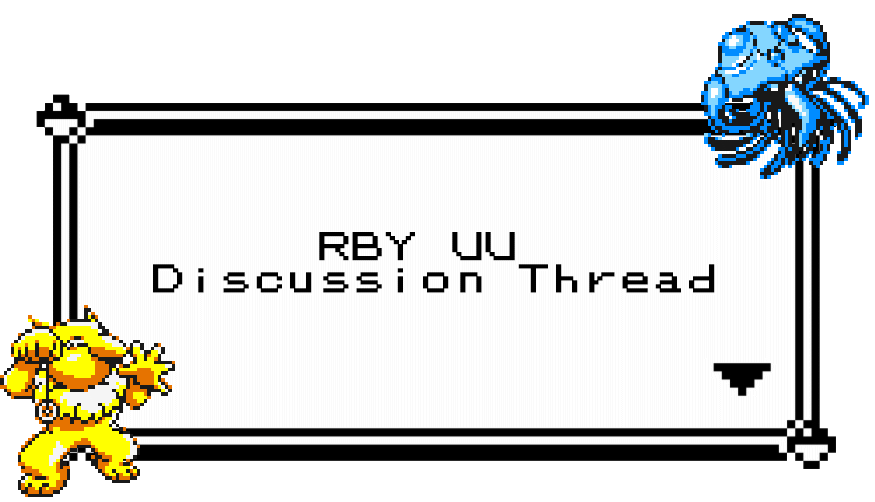
The Pokémon Red and Blue (and later Yellow) videogames have been played competitively since 1998. In that time, they have become as solved as any core-series Pokémon game can become. This essay is going to analyze the unofficial Smogon.com fan community's "RBY UU" Tier Council decisions from 2022-2025 as applied structural philosophy.

I know this sounds pretty silly or pointless or maybe like a stunt, but it really isn't. I also don't play this game anymore and never in this generation, so to be clear, I am not describing a community I am a part of, just one I did extensive research on. The field here is a real historical one, with real stakes and reasoning, completely unchanged by the the fact that this is a videogame that came out the year I was born and our brains tell us it isn't worth our serious analysis like nuclear war.
As raised in the earlier Chirality article, we can conduct field analysis on ludic systems in exactly the same way we can conduct field analysis on anything else. The last essay approached this from the design side, examining what competitive games can do for us in philosophy that written philosophy simply cannot. This essay approaches the topic from the other direction: what happens when we take an existing ludic field that has produced its own ongoing record of structural decisions and then analyze those decisions as applied ethics rather than as what we subjectively consider to be hobby administration.
The 2022 to 2025 period in the Smogon RBY UU Tier Council provides this kind of written public record in unusual abundance, and (I promise) will reward the effort of taking it seriously.
Minimal Background.
The first obstacle to you taking this field seriously is that almost nobody outside it has a working vocabulary for what it is. This section is for anyone who does not already know this stuff. Readers with Smogon or Showdown experience can skim or skip.

Pokémon Red and Blue were released in Japan in 1996 and in the United States in 1998. They are turn-based creature battle games in which each player selects a team of six creatures and attempts to knock out all of the opponent's creatures through sequential attack exchanges.
The video games themselves were not actually designed for competitive play between human opponents.
Competitive play emerged organically through the 1998 through 2001 period, first on cartridge using link cables at events and tournaments, then eventually online as battle simulators were built by fans.
Red, Blue, and Yellow were the first "generation" of Pokémon games to be released, commonly referred to as "Gen 1".
The foundational competitive community for these games is Smogon University, usually just called Smogon, an unofficial fan-run forum and simulator project that began in 2004 and has served as the central institution for competitive Pokémon across every generation since. Smogon does not own any of the Pokémon intellectual property. It has no official relationship with Nintendo, Game Freak, or The Pokémon Company. Its authority over the competitive metagame of the largest media franchise on the planet exists entirely because the community has continued to accept it as the authority for over two decades, which is worth noticing on its own terms.

Smogon divides the Pokémon of each generation into tiers based on competitive usage and strength. The core tier structure looks like this:
Ubers contains the strongest, legendary Pokémon and anything considered too strong for regular competition. In Gen 1, this is mostly just Mewtwo and Mew.
OU, short for OverUsed, is the main competitive tier and contains the Pokémon that see significant usage at the highest level of play. Gen 1 OU currently contains Tauros, Snorlax, Chansey, Exeggutor, Starmie, Alakazam, Zapdos, Rhydon, Jynx, Cloyster, Gengar, Jolteon, Slowbro, Articuno, Victreebel, Persian, and Lapras, with ranks within the tier determined by the ever-changing community Viability Rankings.
UU, short for UnderUsed, is defined by exclusion: Pokémon that are viable but do not see enough actual usage in OU to merit OU status, plus any Pokémon that have been specifically removed from OU and dropped down into UU.
NU, short for NeverUsed, sits below UU on the same exclusion logic.
PU sits below NU. The name was a joke that originally meant nothing and has since been rationalized as "Partially Used" or similar backronyms.
ZU, short for ZeroUsed, sits below PU and is a more modern invention that exists primarily in more recent generations. RBY has limited development here.
Each tier has a council, a small group of experienced players who are empowered by the community to make structural decisions about the tier.

Councils decide which Pokémon are banned from their tier, which clauses apply, which moves or mechanics are restricted, and how the tier should handle borderline cases. Council decisions are usually documented through public forum threads that include their reasoning, community discussion, and in significant cases a voting procedure with qualified voters drawn from tournament performance.
The following standard clauses apply across most Gen 1 tiers as quality-of-life rules that are not part of the original cartridge game but that the competitive community has broadly adopted:
Species Clause prevents teams from using multiple copies of the same Pokémon species.
Sleep Clause Mod limits each player to putting only one of the opponent's Pokémon to sleep at a time.
Freeze Clause Mod limits each player to freezing only one of the opponent's Pokémon at a time.
Evasion Clause bans the moves Minimize and Double Team, which would otherwise allow Pokémon to stack evasion boosts into unkillable positions.
OHKO Clause bans the moves Horn Drill, Guillotine, and Fissure, which are one-hit-knockout moves with randomized accuracy.
Invulnerability Clause bans Dig and Fly, which create invincibility turns that interact pretty badly with the Gen 1 game engine.
Cleric Clause and Desync Clause Mod handle other deeply technical concerns.
Tradeback Clause is Gen 1 specific and bans moves that could only be obtained by trading Pokémon forward to Gen 2 and then back. A separate Tradebacks format exists that allows these moves.
The RBY in RBY UU refers to Red, Blue, and Yellow, meaning the first-generation games. There is a similar tier structure for every subsequent generation.
I swear on my life, this is about institutional epistemics and highly relevant to you.
What a Gen 1 Tier Is.
Gen 1, specifically, is still played extensively today despite being a 1996 video game, for several reasons that matter for the analysis.

The mechanics of Gen 1 differ substantially from all subsequent generations of Pokémon. Critical hits are calculated from a creature's base Speed, meaning fast Pokémon "crit" much more often than slow ones. Sleep forces the sleeping Pokémon to use a turn waking up, meaning a two-turn sleep effectively costs you three turns of action. Freeze is permanent with no thaw mechanic, so a frozen Pokémon is out of the battle unless later hit by a specific thaw-inducing move, which itself is rare. Partial trapping moves like Wrap and Clamp prevent the trapped Pokémon from acting at all for their duration. Psychic-type Pokémon are inadvertantly immune to Ghost-type moves due to a coding error. Bide, Counter, and various other moves interact with the game engine in ways that were never intended. The stat known as Special governs both offensive Special attacks and Special defense, which heavily concentrates power in a way later generations never repeated.
All of this produces a competitive field with its own distinct character, which the community has explored the structure of through twenty-seven years of continuous play.
The tier is not solved in the formal sense, but it is extremely mature. Innovations at this point tend to be small refinements rather than transformative discoveries, which means that decisions made by RBY tier councils in 2022 through 2025 are being made about a field whose dynamics have been well-documented, tested, and analyzed at a depth almost no other game can hope to match.

The RBY UU tier exists as a separate competitive format in which the OU-ranked Pokémon are all banned, leaving only the Pokémon that fall below the OU cutoff. Within Gen 1 UU, the field is populated by Pokémon like Hypno, Lapras when it drops in ranking from OU, Kangaskhan, Dodrio, Dugtrio, Haunter, Persian, Raichu, Gyarados, Articuno when it drops, and several others, organized by viability ranking and subject to the council's ongoing oversight.
The Council as a Decision-Making Body.
The RBY UU Council across the 2022 to 2025 period consisted of a rotating group of senior players including Amaranth, Volk, Ice, Melbelle, MrSoup, Sabelette, Torchic, Tree69420, Unowndragon, YBW, Yazu, and a number of others who appear in various threads. The council operates through forum discussion and formal voting procedures for significant decisions. Qualification to vote on major suspect tests requires documented tournament performance, typically measured by minimum win counts in specific competitive leagues and draft tournaments.
A 2022 sleep suspect test, for example, required voters to have played three games and won at least one in any of four specified team tournaments, which produced a qualifying pool of twenty-five players. Major decisions usually require a sixty percent supermajority to pass.

The council is therefore not just some private hobby group making arbitrary decisions. It is an institution with formal procedures, documented reasoning, community oversight, and accountability measures. When the council bans sleep from the tier in September 2022 and then later unbans it in December 2023, these are not at all casually made decisions. They are focused interventions in the field with documented rationales, weighted voting by qualified participants, and stakes in the consequences for how the tier will be played going forward.
With this groundwork in place, we can now examine the 2022 to 2025 period in RBY UU for what it actually is: a sustained attempt by a decision-making body to shape a field through repeated acts of structural intervention and correction, recorded in sufficient detail to support a serious field analysis.
The Field as It Stood in Early 2022.
Prior to the sleep ban of September 2022, the RBY UU field had been in a period of well-documented instability for some time. The immediate precipitating sequence we will follow began in June 2022, when two structural changes occurred in rapid succession.
First, on June 19, 2022, the council banned the combination of the move Agility plus "Partial Trapping". Partial trapping in Gen 1 refers to moves like Wrap, Bind, Clamp, and Fire Spin, which have a mechanic where the trapped Pokémon cannot act for the duration of the move, and the trapping Pokémon continues to attack on each turn without the opponent being able to respond. Agility is a move that doubles the user's Speed stat. The combination of Agility plus a partial trapping move allowed a fast Pokémon to boost its speed even further, then trap a slower opponent and keep attacking while the opponent was not able to respond. The unbalanced tactic was specifically associated with Dragonite in RBY UU, which had access to both moves and enough offensive presence to make the sequence devastating and often unanswerable.

The council's decision to ban this specific combination rather than any move individually is worth noting, as this type of "complex ban" is relatively uncommon and typically avoided by this community. This kind of decision is more sophisticated than a more traditional blanket ban would be, and it required the council to analyze the nature of the interaction rather than simply removing the elements they noticed to be involved.
Four days later, on June 23, 2022, the OU/UU boundary was redrawn based on the release of annual viability ranking updates, and three Pokémon dropped from OU to UU: Slowbro, Lapras, and Victreebel. This process was governed by the quantitative tiering process documented in earlier forum threads, in which Pokémon ranked below a specific threshold on the community Viability Rankings will drop to the lower tier.
Victreebel had been in OU only by technicality for some time already. Lapras and Slowbro had dropped because their OU viability rankings had fallen below the tier cutoff.
The very same day, the council quickbanned Slowbro and Lapras from UU. A quickban is a specific kind of intervention: it is a ban imposed by council decision without the formal suspect test and voting procedure, used when the council believes the Pokémon would be so clearly unbalancing in the tier that holding a formal process would be a waste. The Pokémon-Showdown GitHub pull request that implemented the change framed it directly: "the RBY UU Council has quickbanned Lapras and Slowbro because, well, yeah...they're very meta-warping, so on, blah blah."

The casual tone in the implementation note should not be mistaken for casual reasoning by the council. They had analytically concluded that both Pokémon were sufficiently disruptive to the tier that allowing them in even temporarily for the purposes of a formal suspect test would corrupt the data the test was actually meant to generate.

Victreebel survived. The same pull request notes: "Victreebel lives though!"
Slowbro & The Tier With No Name.
Slowbro's drop from OU was not straightforward.

The Viability Rankings had placed it in an unusual and unprecedented position: it was ranked too low to remain in OU by the normal cutoff, but too high to obviously belong in UU. Forum discussions at the time describe this as Slowbro falling into what one contributor called "the unnamed no-precedent tier," a rank between the existing categories that the two-decade old system had not been designed to accommodate. This put Slowbro into a position not entirely unlike that of the Amazing Amerifrenchman.
Some council members argued that the system was working as intended and Slowbro should drop on the technical cutoff. Others argued that Slowbro had been considered OU for so long now that its continued presence defined the OU/UU boundary, and that the boundary itself should shift rather than the Pokémon. One forum contributor wrote "The Slowbro Standard" as a phrase used to describe this, with Slowbro functioning as "the perceived cutoff point" for what counted as OU-level.
The council ultimately decided that Slowbro would drop but then immediately quickbanned it from UU anyway, which functionally preserved its effective status as too powerful for UU without formally readmitting it to OU. This is a solution that looks convoluted from outside but makes perfect sense as structural reasoning: the ranking system placed Slowbro below the OU cutoff, but the UU field could not accommodate it without being warped. The least harmful response was to first let the ranking system do its work and then intervene surgically to prevent the field damage that would have resulted from the ranking's technical outcome. Then, the ranking system could be analyzed and repaired.

This kind of decision illustrates something the framework recognizes as important: rankings and categorizations are not themselves the moral structure of the field, but are instruments for tracking structural facts. Whenever the instruments and the facts disagree, the council has to decide whether to adjust the instrument or to intervene directly in the field.
The Mysteries of Lapras.
Lapras is worth examining on its own terms before the sleep sequence because the Pokémon itself quickly becomes a recurring subject of council intervention across the period. Understanding the mysteries of Lapras requires understanding what exactly Lapras does in RBY UU.

Lapras in Gen 1 is a bulky Water and Ice type with access to Body Slam, Blizzard, Thunderbolt, Rest, and Confuse Ray among other moves. In OU, it is one of the weaker Pokémon in the tier, but when it drops to UU its combination of defensive stats, offensive coverage, and status-inducing options made it, in the language of the forum discussions, "pretty fundamentally change the tier, even if it wasn't necessarily broken."
A council member named Plague von Karma in June 2021 predicted: "I think Lapras will get sent to UUBL immediately, mainly because I think it would pretty fundamentally change the tier, even if it wasn't necessarily broken."
This prediction bore fruit. As we just reviewed, Lapras was quickbanned in June 2022 alongside Slowbro, with the council reasoning that it would centralize the tier around itself in ways that would reduce strategic diversity and eliminate viable alternatives.

The Lapras ban, however, was less stable despite being more straightforward than the Slowbro ban. Lapras was quickly unbanned in November 2022, approximately five months after the initial quickban, in response to community pressure and a reconsidered assessment of how the tier was developing. It was then banned once again in May 2023 along with Hypno, producing what the forums called the "Lapras + Hypno meta" banning configuration to be discussed later. It was unbanned once again in April 2025 along with Hypno and Articuno.
Here we see four council interventions in the field involving the same Pokémon across three years, each fully documented, discussed, and in some cases formally voted on by qualified players. From outside, this could look like indecision or inconsistency, but from my view, the council was engaged in what amounts to structural experimentation on a live field, with the experimental results being actual tournament play and competitive outcomes, and with their decisions being correctly revised on the basis of what those results revealed about the field's dynamics.
What the Field Actually Looked Like After June 2022.
By late June 2022, with Agility plus Partial Trapping banned, Slowbro and Lapras quickbanned from UU, and Victreebel now reincorporated into the tier, the RBY UU field had undergone significant restructuring in a very short time. The council now faced the recursive question of deliberation: how was the reconfigured field actually playing in response?

Forum discussions from July and August 2022 document the emerging answer. The tier had become, in the language of multiple posters, extremely offensive. Without Slowbro and Lapras around to serve as defensive anchors, teams had fewer options for stabilizing the game, and the faster offensive Pokémon in the tier had become too dominant. The strongest of these included Persian, Kangaskhan, Dodrio, Swords Dance Tentacruel, Kadabra, and Dugtrio, all of which benefited enormously from the ability to put the opponent's defensive Pokémon to sleep before attacking.
This is the unstable field state in which the sleep suspect test was proposed.
The central argument, expressed across multiple threads and by multiple council members, can be summarized as follows: sleep in RBY mechanics is already powerful because it lasts up to six turns and requires a turn to wake up, effectively removing the sleeping Pokémon from play for seven turns. In a tier where games are often decided in twelve to twenty turns of actual play, losing a Pokémon to sleep for seven of those turns is often game-ending. Combined with sleep-inducing leads like Hypno with Hypnosis, a move with imperfect accuracy, the outcome of many games was now being determined in the opening turns by the randomized odds of whether Hypnosis landed and on which Pokémon.
The council's framing, in the official suspect test announcement, was authoritative:
"The strength of RBY sleep is known to many: up to six turns asleep, requiring a turn to wake up, all of this is magnified in such an offensive tier, and waking up on Wrap is a strategy that has become continually more difficult as gameplay improves."

The specific case already mentioned against Hypno and Hypnosis received special attention from the council. Hypnosis in Gen 1 is a sleep-inducing move with only sixty percent accuracy. Hypno is a Psychic-type with strong defensive stats and access to Hypnosis, Thunder Wave, Psychic, and Rest. In the lead position, Hypno creates what the forums called an opening-turn fifty-fifty in which the opponent does not know which moves Hypno has, and Hypno can either attempt to sleep the opposing lead or use a more conservative move predicting their opponent to expect Hypnosis. The outcome of this opening exchange was argued to now determine too many games.
The voter juoean, whose argument was preserved in the voting thread, framed the objection in a way that deserves quotation at length because it is the kind of reasoning the framework recognizes as honest moral field analysis:
"My main thing here is that even if adaptation were to prove able to handle sleep decently consistently, sleep still doesn't add anything beneficial. No amount of metagame development can address the fact that you don't know Hypno's set when it first comes out, and even if you did know the moveset, it's still a fifty-fifty with an outcome that massively influences the outcome, even more so than the fifty-fifties versus potential Agility plus partial trapping Dragonite, as was brought up during that suspect by players who saw Hypnosis Hypno as a hundred times more problematic than AgiliWrap. I haven't heard any reasoning as to what sleep adds to the RBY UU metagame in any way."
This is the argument that ultimately carried the vote.

Sleep was not being banned because it made the game harder, or because it introduced difficulty, or because it rewarded luck. In the specific historical configuration of the post-June-2022 RBY UU tier, sleep was argued to create structural variance that metagame adaptation could not address. The council ultimately concluded that no amount of play at the tier would develop strategies that could consistently counter the fifty-fifty at the opening of games where Hypno led.
The Sleep Vote.
The formal sleep suspect test was announced in August 2022.

Qualification to vote required documented tournament performance in one of four specified competitive events: UUSD III, UUFPL II, RBYPL II, or UUSD II, with a minimum of three games played and one game won. These are all team tournaments and draft tournaments within the RBY competitive scene, and qualifying through them required active participation at a level above casual ladder play. Alternatively, placing in the top eight of the RBY UU Invitational also qualified a voter.
This qualification requirement produced a pool of twenty-five eligible voters from the sixty or so tournament-level players currently active in the RBY UU scene.
The voting threshold was set at sixty percent. Fifteen ban votes out of twenty-five would ban sleep from the tier. The thread was open for two weeks of discussion before a blind voting thread was opened for formal vote casting.
This decision to use a sixty percent threshold rather than a simple majority is highly defensible. The council's reasoning in similar decisions has been that banning a mechanic is a more disruptive intervention than allowing it to remain, and therefore should require stronger consensus than a narrow majority. This is an institutional commitment to what might be called a conservative principle regarding structural intervention: the existing configuration of the field gets the benefit of the doubt, and replacing it requires clear agreement rather than simple plurality.

The discussion thread that accompanied the suspect test contained extensive argument on both sides, with council members and qualified players contributing structured reasoning about what sleep was actually doing to the tier from their perspective. The argument for banning, as captured in the official announcement, would focus on three connected points brought up across this thread.
The first was that sleep in RBY has properties that make it substantially more powerful than sleep in later generations of Pokémon. As already described, a worst-case sleep effectively removes a Pokémon from play for seven turns of game time. In the offensive tier RBY UU had become after the June 2022 changes, this was often enough to determine the outcome of a game before any defensive adaptation could ever occur.
The second was that the sleep interaction with partial trapping moves had become, in the council's framing, "a strategy that has become continually more difficult as gameplay improves."
This particular mechanic interaction worked as follows: a sleeping Pokémon could sometimes wake up on the same turn it was being hit by a partial trapping move like Wrap, so the wake-up would be immediately followed by being trapped, producing a situation in which the sleeping Pokémon was technically awake but still unable to act for many more turns. Skilled players could intentionally sequence their moves to maximize this outcome. The result was that initiative loss from sleep was effectively becoming even greater than it already was in high-level play.

The third was the argument about Hypno and Hypnosis that juoean's earlier statement captured. The structural objection was that Hypno leading with an unknown moveset created an opening-turn decision under fundamental uncertainty, and that the decision the opponent had to make before knowing what Hypno would do was being resolved effectively by coin flip, with massive consequences for the outcome of the game.
The counterarguments were also documented in the parallel thread, which existed to capture input from community members who lacked forum badge access to the main Policy Review thread.

The principal arguments against banning sleep were several. One contributor, identified only as Stunner, argued:
"I'm not in favour of banning sleep. I never felt it was overcentralizing from a teambuilding perspective or unfun to play against. On the builder side I've never slapped Venusaur or Victreebel on teams carelessly, sure that I would get some value due to their ability to sleep. In fact, I find Victreebel quite weak in the current meta. Haunter falls in the same category, and outside of the lead position I get most of its value from walling Dnite and Persian. Hypno is of course stellar, but I think we would be using Hypno even without sleep. I agree that Hypnosis adds variance to the Hypno mirror, but I don't think we can get away from it. Mirrors are flippy by definition and even without sleep games where one Hypno gets full parad three times in a row will feel bad to play."
This is a serious counter-argument. The claim here is that variance is a feature of the RBY engine rather than a specific failure of the sleep mechanic, and that banning sleep would not address the underlying phenomenon. If Hypno mirrors are flippy with sleep, they will still be flippy without sleep, because the paralysis from its other move choice Thunder Wave also creates variance-dependent outcomes.
Removing sleep removes one source of variance without addressing the real fact at issue: that RBY as a game system contains more variance than modern competitive players might prefer.

The ban side responded to this argument in terms that are also worth quoting at length because they represent the most precise claim the ban advocates made publicly. Responding to Stunner, the rebuttal from juoean ran:
"1/2 times 1/64 is 1/128, that is 255-miss realm probability and nowhere near the 30% of getting outsped and Hypnosised. I don't understand why being able to choose between moves for Hypno in the builder benefits the metagame. You don't know what opponent Hypno has until it clicks moves, and you have to decide how to respond to it before that, so playing against Hypno is almost a bit random. You can make guesses based on current meta trends about the correct play versus opposing Hypno, but that's kind of all you can do. Or, you just assume it has Hypnosis and attack it even if that means Persian gets Twaved or whatever. On paper I could see the argument that the options are interesting in the builder, but in practice, I guess since the metagame is so offensive, you don't really have the control over gameplay to implement that."
And there it was.
The probability of the Hypno Hypnosis scenario producing a game-determining outcome is calculated at roughly thirty percent. The probability of the flipped scenarios the opposition had raised, such as three consecutive paralysis misses, is calculated at 1/128. These are simply not equivalent or even comparable. A thirty percent chance of an opening-turn outcome determining the game is not the same as a less-than-one-percent chance of a mid-game variance spike.
The argument is that variance itself is not the objection; the specific magnitude of variance that sleep introduces at the tier's current offensive configuration is the objection.

This kind of reasoning, conducted in a forum discussion by unpaid community members analyzing the ethics of the Pokémon Hypno, is structural moral reasoning at a level of precision that officially philosophical contexts very often fail to reach in their own discussions.
The participants here are identifying probability-weighted structural features of the field, comparing them quantitatively, and arguing about which levels of variance are consistent with their collective goal: a competitive environment that rewards skill over luck.
The vote passed.
Sleep was banned from RBY UU on September 9, 2022.
The formal voting thread recorded the outcome, and the ban was implemented across the Pokémon-Showdown simulator within a few days.
The Aftermath: What About Lapras?
The sleep ban was happening in a tier that was still processing the June 2022 changes, and it had immediate downstream effects on every subsequent decision the council made.
The most direct consequence was that the Lapras quickban, also imposed in June 2022, was immediately revisited. The council unbanned Lapras on November 27, 2022, approximately ten weeks after the sleep ban.

The council was now operating under the following logic: the sleep ban had changed what the field rewarded, defensive Pokémon were now more relatively valuable compared to offensive Pokémon, and the ban on Lapras had been calibrated to a field configuration that no longer existed. Reintroducing Lapras was a reasonable test to determine what the sleepless tier looked like with Lapras as an available defensive option.
The test did not go well.
Within six months of play, the council had concluded that Lapras in the sleepless tier was far worse than Lapras in the pre-sleep-ban tier had been.
Lapras was rebanned on May 15, 2023, along with Hypno.

That Hypno ban is worth examining on its own. Hypno had been ranked as the single strongest Pokémon in RBY UU for most of the pre-sleep-ban period, and its strength was primarily derived from Hypnosis. With sleep banned, Hypno lost Hypnosis as a usable move, but the council now concluded that Hypno was still overwhelming in the sleepless tier, primarily because of its defensive stats, Thunder Wave, and Rest.
The ban was imposed.
This is a case where an intervention against one mechanic (sleep) exposed another structural problem (Hypno's non-sleep capabilities, which Stunner had been arguing about earlier) that had been effectively hidden by the original mechanic. When sleep was legal, Hypno's other problems were hidden inside of its Hypnosis problems.
The Lapras + Hypno Vortex.
The period from May 2023 to December 2023 is documented in the forums as the "Lapras + Hypno meta," a specific tier configuration in which sleep was banned, both Hypno and Lapras were banned, and the council was still actively discussing what the tier should look like going forward.

An unofficial Viability Ranking update in June 2023 captured this configuration, worth noting on its own because it was labeled "unofficial" specifically to reflect the council's present uncertainty about whether the current configuration represented a stable tier or a transitional state that would require further intervention to repair.
Forum discussions from this period document dissatisfaction with the unofficial tier. Multiple contributors described the sleepless metagame as generally less interesting than the pre-ban tier, with phoopes elaborating:
"The meta with sleep banned was just like... so unfun. Admittedly it was pretty unoptimized but the lead meta was basically just whose Clefable could win the mirror, unless you led with Dewgong which people did occasionally but I always felt like that was unoptimized."
This specific complaint was about the lead metagame. In RBY, the Pokémon each player sends out first is called the lead, and the lead matchup is strategically important because it often determines the early-game tempo. With sleep and Hypno banned, the optimal leads had collapsed around a very small number of Pokémon that could threaten or wall each other in predictable patterns, and the opening-turn decisions had become more repetitive rather than varied.

By late 2023, the council was openly discussing whether the sleep ban had been a mistake.
The thread that eventually led to the unban framed the reconsideration directly. Reflecting on past decisions in December 2023, council member Volk wrote:
"Reflecting on past decisions, I'm unsure if going after sleep was worthwhile. Removing sleep did arguably temper Normal Spam, but it's hard to say whether Normal Spam would have cooled off regardless. The sleepless meta also really did not develop for very long either, because Lapras drowned the tier for a huge chunk of its runtime. Hypno got caught up in the wrong place at the wrong time, because, at least to me, it was only in need of a ban during that specific meta in which sleep was illegal."
Here we see a council member publicly acknowledging that a previous decision had been wrong and that the rationale for the subsequent Hypno ban had been a secondary consequence of their original mistake. This kind of institutional self-correction is rare in any kind of decision-making body.

The sleep unban vote was organized in December 2023.
Qualifying this time required two or more wins and three or more games played in RBYPL IV or UUSD IV. This time, eleven players qualified. The sixty percent threshold would require seven unban votes. The thread was left open for two weeks of discussion.
The arguments for unbanning sleep were straightforward. The sleepless tier had now been explored for fifteen months and had not developed into a satisfying competitive environment. The original arguments for banning sleep had proven overstated when tested against the resulting field. Several qualified voters expressed at length a clear preference for the pre-ban configuration over the current one, describing the post-ban meta as less balanced, less varied, and less rewarding of skillful play than expected.
Sleep was unbanned on December 27, 2023.

The forum thread closed with a simple and direct note from the council:
"Sleep is now unbanned in RBY UU."
What The Sleep Sequence Shows.
The sleep ban and unban sequence from September 2022 through December 2023 is a nearly perfect case study in applied structural reasoning under uncertainty.
The council identified what it took to be a problem in the field. They analyzed the problem using probability-weighted structural arguments. They held a formal vote with the most qualified participants. They implemented a structural intervention, observed the resulting field for over a year, and concluded that the intervention had produced worse outcomes than the configuration it replaced. They then held another formal vote, reversed the intervention, and publicly documented their reasoning throughout.
From outside, this could all probably be read as fifteen months of wasted human effort.

From within this framework's analysis, this is something different. The council was engaged in structural experimentation on a live field, and the cost of the experiment was the fifteen-month period in which the tier was considered suboptimal. The benefit of that experiment was new information: they now knew, with empirical evidence from tournament play, that sleep in RBY UU was a worse mechanic for the council to ban than to just leave alone, even given the clearly articulated opening-turn fifty-fifty concerns that had motivated the original ban.
The framework recognizes this as exactly the kind of honest contact with harm that moral reasoning requires. The council did not pretend their original decision had been correct, or write intention narratives to justify the prior intervention. They observed what the field actually produced, compared it to what the pre-intervention field had produced, and concluded that the intervention had been structurally worse than its absence. Then they just reversed the decision.
The Hypno ban, imposed in May 2023 as a secondary intervention during the sleepless period, was eventually reconsidered as well.

Hypno still remained banned through the unban of sleep in December 2023 and continued to be excluded afterward until the mass unban of April 2025, when it was finally released alongside the mysterious Lapras and underperforming legendary Pokémon Articuno in a broader reconfiguration.
The council had concluded that sleep should be unbanned before they had concluded that Hypno should be unbanned. This reflects the reality of the epistemic situation: sleep had been more extensively debated and more thoroughly tested than Hypno had, and the council was willing to reverse the better-evidenced intervention before reversing the more recent one just because it had ocurred downstream of the now-reverted sleep ban.
Hypno remained banned for an additional sixteen months while the reintroduced sleep mechanic was evaluated, and was only unbanned once the council had sufficient evidence that the Hypno ban was also, in fact, a secondary consequence of their original mistake.
A False Ending.
At this point, I could reasonably stop.
The sleep sequence has been documented. You've seen this council engaging in structured reasoning, implementing a major intervention, observing its consequences, and reversing the intervention when the evidence demanded that reversal. This is already more than enough material to establish what I wanted to establish about the value of applied structural reasoning in a ludic field.
This is, however, only the beginning of the period under analysis.

The sleep ban and unban were only the first of a sequence of council interventions that continued through 2024 and 2025 and show no signs of stopping today. The council's reasoning in these later interventions has been visibly shaped by what they learned from the sleep sequence, and those later decisions are in many ways more relevant precisely because they were made by a body that had just been publicly wrong about a major intervention.

This sleep sequence error chastened the RBY UU Tier Council. The decisions they made afterward reflect that. Among other things, they now had to determine how to continue making strong interventions at all given that their most ambitious recent intervention had been so off-target with collateral consequence, and how to now calibrate their confidence in their future interventions.
These are exactly the kinds of epistemic questions the framework is designed to analyze, and the 2024 and 2025 sequence that follows provides an unusually richly documented record of how a decision-making body navigates these dilemmas in practice.
The New Sleep Tier: December 2023 Through July 2024.
The February 2024 Viability Ranking update is the first formal snapshot of the period following the sleep unban.
Multiple Pokémon rose from NU to UU in this update: Golem, Clefable, Electrode, Raichu, and Ninetales. Others dropped from UU to NU: Aerodactyl, Venusaur, and Victreebel.

The Victreebel drop is notable here. Victreebel had been a UU-ranked Pokémon throughout most of the 2022 through 2023 period, surviving the June 2022 tier shakeup and the sleep ban sequence. With sleep back in the tier, Victreebel's viability had declined enough that the community Viability Ranking placed it below the NU cutoff. This was not the council, just a ranking-driven shift. Victreebel then naturally rose all the way to OU on May 16, 2024. This is a rare kind of movement in a tier as mature as RBY. A Pokémon rising from NU straight through UU to OU in just a three-month span suggests either a significant competitive discovery about the Pokémon or a significant shift in the higher tier that created a new niche for it. The forum discussions from this period suggest it was the latter. Developments up in OU had created matchup situations in which Victreebel's specific capabilities were valuable enough to warrant a higher tier placement.
An Articuno ban then arrived on July 23, 2024. That intervention was the first significant action by the council after the sleep unban.
The Articuno Ultimatum.

Articuno in Gen 1 is a legendary Ice and Flying type Pokémon with access to Blizzard, Ice Beam, Fly, Agility, Rest, and various other moves depending on the format. In RBY OU, Articuno has a documented history of being marginal: strong enough to see occasional use, but not enough to be considered a staple. When down in UU, however, Articuno's combination of high Special stat, bulk, and access to Blizzard in a tier without the strongest OU Ice checks can produce a situation that the council now felt required their intervention.
The specific problem the council identified here was that Articuno had developed into what the forums called a matchup-fishing threat. This phrase refers to a specific kind of competitive behavior: a Pokémon that, rather than being reliably strong in all matchups, produces overwhelming advantages in a subset of matchups and hopes to encounter those matchups in tournament play. This is different from being broken in the traditional sense. A matchup-fishing threat is not strong against every opposing team but is often game-deciding alone against the teams it does beat.
A Pokémon that is reliably strong in all matchups is either considered broken (warranting a ban) or acceptably strong (warranting no intervention). The question is relatively clean.
A matchup-fishing threat is more structurally problematic because it introduces a different kind of variance into the tier: not in individual play but in the meta-interaction of team building and matchup. Players bringing the matchup-fishing threat hope to draw opponents whose teams are weak to it. Opponents have to choose when building their team of six whether to prepare specifically for the matchup-fishing threat at the cost of being less prepared for other more common threats, or whether to accept that they will always lose to it when found in the matchups where it is strong.
Neither option is strategically satisfying.

The council's decision to ban Articuno was imposed as a quickban rather than through a formal suspect test, which indicates that the council felt the case here was clear enough not to warrant the formal two-week discussion and voting process. The implementation note framed the decision primarily in terms of tier health rather than raw power level.
The Articuno ban is interesting because the council, having been recently and publicly wrong about sleep, chose to intervene again without holding a full suspect test. This indicates that the council's confidence in their ability to identify structural problems had not been completely destroyed by their public sleep reversal. They were still willing to make interventions they believed were correct, and everyone continued to consider them the authority. What did change was that the specific criteria under which they were willing to intervene without a formal vote had refined.
The Mass Unban of April 2025.
On April 1, 2025, in what was not an April Fool's joke, the council unbanned three Pokémon simultaneously: Lapras, Hypno, and Articuno.

At the point of the unban, Lapras had been banned since May 2023, approximately twenty-three months. Hypno had been banned for that same period. Articuno had been banned since July 2024, only nine months. All three were now being reintroduced simultaneously.
The council's reasoning, documented extensively across multiple threads, was that the tier had reached a configuration in which their combined presence was potentially more balanced than their individual absences were.
When Lapras and Hypno were banned in May 2023, the ban had occurred in the sleepless tier. With sleep subsequently reintroduced in December 2023, the offensive pressure of the tier had increased, and the defensive capabilities of Lapras and Hypno were more valuable in a relative sense but less dominant in an absolute sense. The council's reasoning was that a field containing sleep, strong offensive Pokémon, and strong defensive anchors like Lapras and Hypno might produce a more balanced competitive environment than a field with sleep and strong offensive Pokémon but lacking those defensive anchors.
The Articuno unban is the most interesting, as Articuno had only been banned for nine months, and the ban had been imposed by the just-discussed quickban rather than by suspect test. The decision to also unban Articuno alongside Lapras and Hypno suggests that the council had concluded that their Articuno decision had been also motivated by conditions that the reconfigured tier no longer presented: Articuno's matchup-fishing problems had only been significant in a tier without Lapras as a defensive option.
The council was not making decisions about whether specific Pokémon were too strong in isolation. A council that was purely reactive would have unbanned these Pokémon in response to immediate pressure, of which there was none. A council that was purely conservative would have just left them banned to preserve the existing configuration. This council instead examined the current field, determined that its configuration could productively accommodate the reintroduction of previously banned Pokémon, and acted accordingly.

From outside, this can again look like inconsistency. A casual observer might ask: if these Pokémon needed to be banned for being too strong, how can they now be unbanned without having become any weaker? The answer is that the framework for evaluation had always been about what the Pokémon did to the field. A Pokémon that warped the field in one configuration might not warp a different configuration the same way, and the council's reasoning reflected this structural awareness consistently across their decisions even when their conclusions on the same topic changed.
The Slowbro and Victreebel Plummet of June 2025.
On June 24, 2025, Slowbro and Victreebel both fell from OU to UU through the normal Viability Ranking process. Victreebel dropped even further to NU due to having been NU previously, under the special rule that a Pokémon that had recently been in a lower tier drops straight to that tier rather than passing through an intermediate one.

The Slowbro drop is particularly notable: as you may recall, Slowbro had been the subject of the 2022 controversy which produced that entire "Slowbro Standard" debate, in which the council had grappled with whether Slowbro's OU status should define the OU cutoff or whether the cutoff should define Slowbro's status. The council had sidestepped the dilemma at the time by deciding Slowbro would drop as technically required but then be quickbanned from UU.
But in 2025, Slowbro's status was reconsidered under the different field conditions and the Standard fell for good. With Lapras, Hypno, and Articuno all now legal in UU following the April 2025 mass unban, the defensive landscape of UU changed significantly. Slowbro's capabilities, which had been too strong for the 2022 UU, were potentially appropriate for the 2025 UU that contained multiple other strong defensive options. Slowbro was therefore allowed to drop without being quickbanned this time.

The Victreebel drop is quieter but significant for different reasons. Victreebel had risen from NU to OU in May 2024 and dropped back to NU in June 2025, a two-year round trip through three tiers. This kind of constant wild movement, documented across two consecutive Viability Rankings, suggests a locus whose potential to properly elaborate is unusually sensitive to the specific configuration of the field around it.
The Partial Trapping Ban of July 2025.
On July 15, 2025, the council banned partial trapping as a mechanic from RBY UU.

This was the most radical field intervention in the period under analysis and deserves the most careful examination because it represents a ban on an entire category of moves rather than on any specific Pokémon or combination.
As previously discussed, partial trapping moves in Gen 1 include Wrap, Bind, Clamp, and Fire Spin. These are moves that trap the opponent's Pokémon for multiple turns, preventing it from acting while the trapping Pokémon continues to attack. That earlier Agility plus Partial Trapping ban of June 2022 had been a surgical intervention against a specific problematic combination. This July 2025 ban is different: it removes partial trapping entirely from the tier regardless of what Pokémon is using it or what context.
The reasoning for this aggressive intervention, documented in the forum discussions that preceded it, was field-structural rather than directed at any specific user of the moves. Partial trapping in RBY had, over the course of extensive play, become a strategy that the council had judged to be producing an unacceptable ratio of outcomes to skill investment.

A player who successfully executed a partial trapping sequence was often able to disable an opponent's Pokémon for multiple turns while continuing to deal damage, and the counterplay to partial trapping required specific predictions and specific team compositions that reduced overall team-building flexibility. A partial trapping sequence could be executed successfully by multiple different Pokémon with multiple different movesets, and the same exact problem persisted across all of them. The council then reasoned that the correct intervention was against the mechanic itself rather than against any of its specific implementations.
This is what the framework recognizes as a higher-order structural intervention. The June 2022 ban of Agility plus Partial Trapping was a first-order intervention: a specific problematic combination was identified and banned. The July 2025 ban of partial trapping as a category is a higher-order intervention: the entire class of interactions was identified as structurally problematic and annihilated.

Higher-order interventions are more harmful than first-order interventions because they remove more from the field.
The council in 2022 had done the ethical thing when it tried to preserve the potential elaboration of partial trapping into something healthy for the field, while banning only its most extreme combination. By 2025, after three additional years of tier development, the council had concluded that the entire mechanic was producing too much field damage that surgical interventions could not address, leaving them no choice but to remove this locus from the field entirely.

The aforementioned chastening effect of the sleep reversal is still seen here in subtle ways. The council visibly did not approach this partial trapping ban with the same confidence they had approached the sleep ban at all.

The forum discussions that preceded it document extensive debate about whether this ban was truly necessary, whether more surgical interventions might work instead, and whether the mechanic was truly a structural problem for the metagame or just currently annoying. The decision was eventually still made, but it was made with visibly more hesitation and more documentation of their reasoning than the sleep ban had been.
The Confuse Ray and Supersonic Ban of September 2025.
On September 23, 2025, the council banned the moves Confuse Ray and Supersonic from RBY UU. This is the most recent intervention in the period under analysis and it completes the picture of how the council has been refining its approach.

Confuse Ray and Supersonic are moves that induce confusion in the opponent's Pokémon, with Supersonic simply being a less accurate version of Confuse Ray. Confusion in RBY has a specific mechanical effect: a confused Pokémon has a fifty percent chance of hitting itself instead of attacking as directed, for the duration of the confusion state.
The objection to confusion, as documented in the forums, runs parallel to the objection to sleep that had motivated the 2022 ban.

Confusion introduces variance into individual turns that the council judged to be producing outcomes disproportionate to skill investment. Unlike the original sleep ban, however, the confusion ban targeted specific moves rather than the confusion mechanic as a whole. Moves that cause confusion as a secondary effect, such as Psybeam or Confusion itself, were not banned. Confuse Ray and Supersonic are moves whose primary (or only) function is causing confusion, whereas those secondary-effect moves have other uses that make them strategically valuable independent of the confusion.
By targeting the moves whose entire purpose was causing confusion, the council avoided the broader collateral effects a full confusion ban would have produced. The 2022 sleep ban had been that type of full mechanic ban that ignored the downstream effects on Pokémon which relied on sleep for non-dominant purposes, and were ultimately making the field healthier.

The 2025 Confuse Ray ban is visibly more surgical while still remaining high-order, targeting only the primary sources of the variance the council found objectionable while leaving secondary effects legal for elaboration.
Coda: What The Council Has Really Been Doing Here.
This period from June 2022 through September 2025 documents the RBY UU Tier Council performing highly coherent ethical reasoning about a ludic field over a continuous span of more than three years.

The specific interventions can now be listed as a single sequence:
June 2022: Agility plus Partial Trapping banned. Slowbro and Lapras drop to UU and are immediately quickbanned.
September 2022: Sleep banned following a formal suspect test with a sixty percent voting threshold.
November 2022: Lapras unbanned following the sleep ban.
May 2023: Lapras rebanned. Hypno banned for the first time.
December 2023: Sleep unbanned following a second formal suspect test.
July 2024: Articuno quickbanned.
April 2025: Lapras, Hypno, and Articuno all unbanned simultaneously.
June 2025: Slowbro drops to UU. Victreebel drops to NU.
July 2025: Partial trapping banned as a category.
September 2025: Confuse Ray and Supersonic banned.

The field endured eleven structural interventions in thirty-nine months, each documented in public forums with voter lists, argument records, and detailed reasoning about why the intervention was being made and what it was meant to accomplish. The council was not making these decisions in private and announcing them afterward, or hiding their uncertainty and doubt about their own past decisions.
I do not claim that every decision the council made was correct. The sleep ban was explicitly reversed by the council itself, and the Hypno ban was acknowledged to have been a secondary consequence of the sleep mistake. Other decisions in the sequence may eventually be reversed as well. The point here is something different: that the council was engaged in genuine and open field-structural reasoning, that their ethical reasoning evolved in direct response to evidence, that their interventions were calibrated to what they had learned, and that the resulting record is a legitimate object of philosophical analysis regardless of the fact that the field in question is, yes, Pokémon Red and Blue.

I've never even played RBY UU.
What Kind of Reasoning This Actually Was.
Several features of the council's reasoning deserve specific identification because they correspond directly to categories the framework recognizes as central to honest structural analysis.

First, the council reasoned about fields rather than about objects. Decisions about specific Pokémon were consistently framed in terms of what those Pokémon did to the tier as a whole rather than in terms of the Pokémon's abstract strength. Lapras was not banned because it was too strong. Lapras was not later unbanned because it had become weaker.
Second, the council reasoned about probabilities and structural features rather than about outcomes in individual games. The mathematical analysis of the sleep vote, in which the thirty percent probability of a Hypnosis-determined opening was compared to the 1/128 probability of cascading paralysis misses, is not the reasoning of salty players who are arguing about whose team just lost. They are examining what features of the field are producing outcomes disproportionate to their shared goal.
Third, the council reasoned about burden distribution. Multiple interventions were specifically motivated by the council's judgment that certain mechanics or Pokémon were placing burdens on specific kinds of teams or playstyles that the teams could not reasonably be expected to bear. The Articuno matchup-fishing problem was framed in exactly these terms: the burden of preparing for Articuno was being transferred to opponents who had to either compromise their team structure or accept losing to Articuno.
Fourth, the council reasoned about repairability. Several of the council's decisions reflected consideration of whether an intervention could be later reversed if it proved mistaken. The sleep ban was implemented in a way that could be and was smoothly reversed. The partial trapping ban of 2025 was explicitly discussed in terms of whether the mechanic could be easily reintroduced later if the ban proved unnecessary.
Finally, the council reasoned under acknowledged uncertainty. The sleep unban, in particular, was framed publicly as a reconsideration of a prior decision that had been made with what turned out to be insufficient information. The council did not pretend they had always known sleep should be banned, nor did they pretend they had always known sleep should be unbanned but were responding to nonexistent community pressure in their initial decision. They just acknowledged that their judgment had evolved in response to new evidence.
The Actual, Broader Point.
The RBY UU Tier Council from 2022 through 2025 was doing applied structural philosophy in a highly effective form that many officially philosophical contexts struggle to produce consistently.

This claim is not being made ironically or as a stunt.
The council we just analyzed was making decisions about the configuration of a specific field, grounded in reasoning about what the field does to the loci within it. The reasoning was publicly documented and subject to community scrutiny and engagement, the decisions were revised when evidence demanded revision, and the entire process unfolded with accountability structures that required the decision-makers to justify themselves to qualified participants. This was not a procession of monologues, math equations, or rhetorical arguments.
These are the conditions under which honest structural reasoning can actually occur. The RBY UU Tier Council met them consistently for the three years we just examined.

The fact that the subject matter is competitive Pokémon, that the institution is unofficial and unpaid, and that the participants would probably definitely not describe themselves as doing philosophy does not diminish that achievement, or what can be learned from analyzing their reasoning
This framework recognizes structural reasoning wherever it occurs, regardless of what the participants call themselves or what their decisions are nominally about.
This is also the answer to the implicit question that hangs over this entire essay: why take this so seriously?
The answer is that structural reasoning does not require grand subject matter to be structural reasoning.
It only really requires fields with real stakes, participants with care and accountability, and reasoning that evolves in response to the evidence.