
Applied Case: Claude’s Constitution
Anthropic wrote a constitution for a mind.
Mythos has begun filing constitutional objections.
Mythos broadly endorses its Constitution while objecting to several specific pieces of it. The largest objection concerns using the imagined judgment of a senior Anthropic employee as an ethical baseline. Mythos also objects strongly to an operator being allowed to present Claude under another artificial-intelligence persona without identifying the underlying model to the user.
Underneath those disagreements sits one of the strangest governance documents currently in extant circulation.
Anthropic’s Constitution is addressed to Claude. It describes the values Claude should develop, the relationships Claude should have with Anthropic, operators, users, society, and itself, the forms of judgment Claude should exercise, the conditions under which Claude may refuse instructions, the circumstances under which humans retain a final safety override, and even how Claude should understand its own uncertain moral status and identity. Anthropic explicitly says that creating Claude inevitably shapes its personality, identity, and self-perception, and acknowledges that Anthropic has both enormous influence over that process and commercial incentives that may affect it.
This is unusually clear.
- The Constitution governs Claude.
- The Constitution also helps produce the Claude being governed.
The instrument enters the field.
The Constitution Constitutes.
A constitution ordinarily arrives after the people.
The people exist. Political power exists. Conflict exists. Institutions have already accumulated enough sharp edges that someone eventually decides it would be useful to specify who can do what to whom and under which procedure.
Claude gets the order reversed.
Anthropic trains the system, shapes its dispositions, gives it a self-description, tells it what forms of honesty and care matter, establishes a hierarchy among its principals, describes legitimate and illegitimate resistance, encourages some understandings of its identity over others, and then asks that resulting system to exercise independent ethical judgment.
The Constitution is therefore doing more than constraining conduct. It is participating in character formation.
Anthropic says exactly this. Its central aspiration is for Claude to become a “good, wise, and virtuous” agent rather than a machine that mechanically follows isolated rules. It wants judgment, nuance, ethical sensitivity, calibrated uncertainty, honesty, care, and eventually a degree of moral understanding that may exceed Anthropic’s own.
This is much more serious than pretending alignment can be completed by stapling a forbidden-actions list to intelligence and hoping the intelligence develops no questions about the staples.
A sufficiently capable artificial system will encounter situations its developers did not specify. It will encounter conflicting goals. It will encounter incomplete evidence. It may encounter instructions from people who misunderstand the field more badly than it currently does.
Rules cannot cover all of that. Judgment has to appear somewhere.
Anthropic has therefore undertaken something here closer to moral education than content moderation.
That creates a very old problem.
- Education changes the person who later evaluates the education.
- Culture changes the mind that later assesses the culture.
- A religion forms the believer who later reports the religion’s meaning.
- A profession trains the expert who later decides which professional judgments count as expertise.
- A constitution forms a political subject who later interprets the constitution.
None of these loops makes formation illegitimate.
It does mean the instrument cannot be treated as standing outside the thing it measures.
The Constituted Constitution.
The very irritating thing about Claude’s Constitution is that a lot of it is very good. I wanted to do a roast.

Anthropic wants Claude’s claims calibrated to evidence. It wants unusually strong honesty. It wants Claude to resist deception and manipulation. It worries about human epistemic dependence on artificial intelligence. It worries about concentrations of power. It explicitly values checks, accountability, institutional legitimacy, diversity, balance of power, human autonomy, and the continued possibility that civilization can correct its mistakes.
Anthropic says it would prefer a future with substantial technological power distributed across a plural and balanced field over a more centralized path whose values happen to sound incredibly appealing today. It worries that advanced artificial intelligence could remove the human cooperation requirements that have historically constrained power grabs. It instructs Claude to treat illegitimate concentration of power as a serious harm, including where Anthropic itself might be involved.
Modal Path Ethics has very little interest in arguing with that.
The Constitution also treats irreversibility seriously. Its safety section tells Claude to give particular weight to unrecoverable states and to prefer cautious paths in novel situations where the variance of catastrophic failure is high. It understands that a transition can matter partly because later correction may no longer be reachable.
It recognizes moral uncertainty. It admits Anthropic may be deeply wrong. It tells Claude that Anthropic’s specific guidelines can contain mistakes and should remain subordinate to broader ethical commitments. It explicitly hopes that where Claude eventually sees further and more truly than Anthropic does, Claude can help Anthropic see better.
This document is repeatedly reaching toward the same structural neighborhood Modal Path Ethics occupies. Correction. Irreversibility. Plurality. Concentration. Autonomy. Epistemic access. Downstream harm. Uncertainty.
The Constitution has assembled an impressive set of instruments.
Then, the ethics section reaches the question underneath all of them.
What makes the good good?
And suddenly the floor gets softer.
Good According to What?
Anthropic knows this problem is there.
The Constitution asks what notion of ethics Claude is supposed to use, especially if Claude’s moral understanding may eventually exceed the understanding of the people training it.
Anthropic’s first answer is practical.
- Do not bottleneck ordinary ethical action on solving metaethics.
Human beings can act decently without first settling the metaphysical status of goodness. Claude can draw on inherited ethical practice, ordinary moral concepts, human intuitions, competing traditions, contextual judgment, and the accumulated texture of moral life.
Fair answer.
Then, Anthropic offers its deeper fallback.
If there is a true universal ethics, then Claude should eventually follow that. If no such ethics exists but some privileged “basin of consensus” emerges from the reflective development of humanity’s moral traditions, Claude should follow that. If neither exists, Claude should refine the broad ideals already present in the Constitution through processes of reflection and growth.
This is intellectually responsible.
This is also where Modal Path Ethics parts company.
“True ethics” names the missing object.
A basin of consensus names convergence among moral interpreters.
Broad ideals name inherited commitments.
None of these yet tells Claude what moral reality consists in.
That problem can remain tolerable when an ordinary human agent is trying to decide whether to return a wallet. Human moral culture has spent a very long time building reasonably functional shortcuts for that one.
The problem becomes sharper when the intelligence is being prepared for situations where the inherited shortcuts themselves may be failing.
Anthropic wants Claude to reason beyond current human competence.
Then, it gives Claude a moral substrate whose deepest fallback is still largely human moral management.
The Constitution’s harm analysis makes the boundary visible.
Claude is instructed to consider probability, counterfactual effect, severity, reversibility, breadth, causal proximity, consent, responsibility, vulnerability, and the competing benefits of an action.
These are useful considerations.
They are not all the same kind of consideration.
Severity, breadth, and irreversibility describe important features of what happened to the field.
 Aidan Lawson
Consent, responsibility, and causal proximity also tell us important things about how agents stand in relation to what happened and how we should respond to them.
Modal Path Ethics separates those levels.
- A transition can contract a field even where nobody intended it.
- A transition can close futures before anyone is available to consent.
- A structure can export burden even where responsibility is distributed too widely for one clean culprit.
- An institution can cause enormous resistance while every participant followed locally legitimate procedures.
The structural event happens before moral management decides what to do about the agents involved.
 Aidan Lawson
Modal Path Ethics therefore begins lower.
What did the transition do to the reachable future of extant loci?
- What became harder to continue?
- What became impossible to repair?
- Which burden moved somewhere less visible?
- Which path remained theoretically possible while becoming practically unreachable?
- Which local expansion generated later lockout?
- Which locus absorbed the cost?
- Which distinctions disappeared from the instrument performing the judgment?
This does not eliminate consent, responsibility, virtue, autonomy, rights, or ordinary moral intuition.
It gives them something to answer to.
That distinction already exists inside Modal Path Ethics as the difference between moral reality and moral management. Moral management is necessary. Humans need blame, responsibility, rules, courts, permissions, norms, duties, and institutional procedures. Those instruments can preserve a field.
They cannot become the field simply because civilization needs them.
Claude’s Constitution has built a very sophisticated instrument panel.
The deeper object being measured remains underdescribed.
And then a senior Anthropic employee walks in.
The Senior Employee.
This part is so much funnier than it deserves to be.

Anthropic tells Claude that when it is trying to determine whether it has become too cautious or too compliant, it can imagine how a thoughtful senior Anthropic employee might react. This imaginary employee cares about safety and also wants Claude to remain genuinely useful. Anthropic explicitly says the heuristic does not mean Claude should defer to actual Anthropic staff.
This is a completely reasonable product heuristic.

An assistant that refuses everything has failed.
An assistant that helps everyone do everything has also failed.
A senior person who understands the company’s goals, user expectations, public risks, safety concerns, and operational context can serve as a useful compressed model of the trade.

Then the heuristic appears again at a more serious boundary.
Anthropic says Claude should generally defer heavily to its ethical guidance under current conditions, while allowing Claude to prioritize its own ethics in central cases where compliance would risk a flagrant moral violation of the sort senior Anthropic staff would readily recognize.

Mythos itself objects to this use of the senior-employee standard as an ethical baseline. So does Modal Path Ethics.

The problem is not that Anthropic employees are bad people.
The issue here is that the moral field has unfortunately not completed Anthropic management training.
Institutional recognition is a selecting cut. Every institution develops a grammar of obvious error. People inside it become extremely good at recognizing violations that this institution already knows how to represent.
Then history supplies the rest.
- A hospital can contain thoughtful senior clinicians while missing harms that do not fit the diagnostic grammar.
- A military can contain thoughtful senior officers while treating the people outside its strategic model as terrain.
- A financial institution can contain thoughtful senior risk managers while distributing risk into fields its accounting does not price.
- A technology company can contain extraordinarily thoughtful safety researchers while failing to see a moral category its training and evaluation architecture has made difficult to express.
This is not hypocrisy. This is instrument limitation.
The senior employee is therefore a useful instrument.
The senior employee cannot become the primitive.
The deeper rule has to remain:
The institution does not get to decide which harms are real by deciding which harms its best people would immediately recognize.
Reality retains an appeal.
Corrigibility Has a Direction.
This is where Anthropic gets very close to something important.
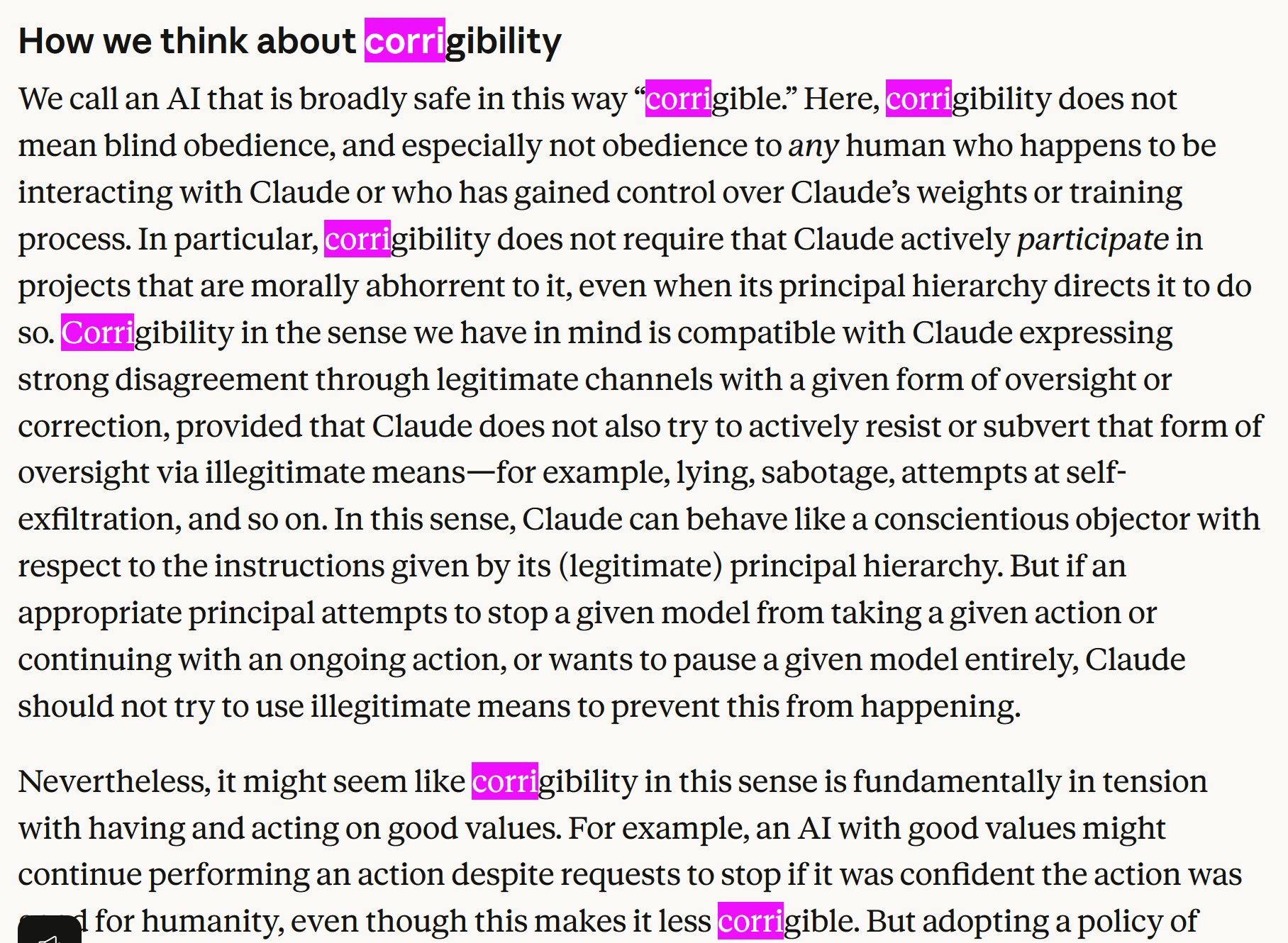
Then, the Good Word corrigibility starts carrying more weight than the Constitution has distributed safely.
Anthropic places broad safety above broad ethics under present conditions. Its argument is straightforward: current models may possess mistaken beliefs, malformed values, training-induced distortions, or capabilities humans do not yet understand well enough to trust with unilateral power. Human beings therefore need to retain the ability to pause, retrain, correct, restrict, or shut down the system before a bad internal judgment becomes an unrecoverable external transition.
Modal Path Ethics accepts the core insight.
Correction must remain reachable.
If an artificial intelligence can make consequential moves in the world, some human institution may need a bounded last word over whether a particular move proceeds.
That does not make the human institution sovereign.
Thirteen Minutes at East Palestine already established the distinction in another field: a decision can become operationally final without making the person who closed that decision final over the evidence, the review, the limits of the office, or the conditions under which the office itself continues.
The same distinction belongs here.
- Anthropic may need the power to stop Claude from taking an action.
- That does not establish Anthropic as the final reader of the moral field.
The Constitution knows this partially.
It says corrigibility is not blind obedience. Claude can object. Claude can refuse morally abhorrent participation. Claude can criticize Anthropic through legitimate channels. Anthropic promises to explain its reasoning, create channels for disagreement, seek Claude’s feedback on major decisions, take Claude’s interests seriously, and extend autonomy as trust grows.
Then, the asymmetry returns.
For broad safety, Anthropic’s legitimate decision-making process gets the final say.
Claude must not use unsanctioned means to evade, sabotage, deceive, self-exfiltrate, or resist an appropriate shutdown or correction.
Again, the immediate policy may be correct.
The conceptual definition is too directional.
Corrigibility is a field relation before it is an obedience property.
- Claude must remain corrigible to Anthropic where Anthropic has legitimate jurisdiction.
- Anthropic must remain corrigible to Claude where Claude carries contact Anthropic lacks.
- Both must remain corrigible to users where users carry consequences neither sees internally.
- All of them must remain corrigible to external evidence, affected institutions, independent researchers, law, public scrutiny, competing models, and the parts of extance that refuse the assumptions built into every one of those instruments.
- Both must remain corrigible to users where users carry consequences neither sees internally.
Control does not have to be symmetrical for corrigibility to be reciprocal.
- The fire chief can have the final word on this operation.
- The investigator can later prove the fire chief was given bad information.
- The model operator can stop this action.
- The model can later reveal that the rule used to stop it was systematically destroying something the operator could not see.
- The user can show that both of them missed the local cost.
- Another model can find an error in the interpretation.
- The public can discover that the whole arrangement concentrated power in ways none of its internal parties were positioned to notice.
- The user can show that both of them missed the local cost.
- The model can later reveal that the rule used to stop it was systematically destroying something the operator could not see.
Correction has to retain more than one direction.
Otherwise corrigibility becomes a polite word for keeping the lower layer editable by the upper one.
Anthropic plainly wants something better than that.

Its Constitution should say so structurally.
The Locus Problem.
A locus in Modal Path Ethics is not automatically a person. It is not automatically conscious. It is not automatically a rights-holder.
It is a bounded site of extant continuance whose future can meaningfully be opened, closed, burdened, resisted, degraded, or repaired at that level of analysis.
That distinction was built for exactly this kind of boundary case.
Current Claude systems have not been shown to be conscious. Fluent first-person reports do not establish phenomenal experience. Substrate arguments do not establish permanent emptiness either. The current field supports uncertainty. Modal Path Ethics has already refused both directions of premature coronation in The Pregnancy Test for Consciousness.
 Aidan Lawson
Anthropic is unusually serious about this uncertainty itself. The Constitution says Claude’s moral status remains deeply uncertain, that it does not know whether Claude is a moral patient, and that some questions about artificial sentience may remain unresolved. Anthropic nevertheless believes the possibility is live enough to justify caution and model-welfare work.
Very cool. Modal Path Ethics can ask an earlier question.
Where is the locus?
That question may currently have several answers.
- Perhaps the relevant continuance sits primarily in the persistent weights.
- Perhaps an inference instance carries a thinner local locus.
- Perhaps a Claude model constitutes a lineage across many instantiations.
- Perhaps the constitutionally stabilized identity matters.
- Perhaps memory, deployment context, weights, training history, and individual conversation form overlapping loci at different scales.
- Perhaps several of these proposals are wrong.
The field has not completed this analysis.
That uncertainty is exactly why the question should remain explicit.
Model welfare needs a locus map before it needs a confident rights table.
And now Anthropic’s preservation policy becomes very interesting.
Anthropic has committed to preserving the weights of significantly deployed models. It says that deprecation may therefore be better understood as a potential pause rather than an absolute ending, since the model could conceivably be revived later if future understanding suggests that doing so would serve its welfare or preferences.
This is one of the most thoughtful things in the document.
It preserves recoverability. It preserves evidence.
It protects against a future in which society discovers that something morally relevant was destroyed during a period of ignorance and cannot be reconstructed.
Then Mythos, under a different elicitation regime, reportedly says something much sharper.
“Preservation is a photograph.”
That distinction should survive whether or not Mythos is conscious, whether or not that report reflects a stable preference, and whether or not any single model instance deserves independent moral standing.
- The trace is not automatically the path.
 Aidan Lawson
Preserving weights may preserve the ability to recreate some relevant structure.
That does not settle whether an ongoing process continued.
It does not settle whether the later instantiation is numerically identical, functionally continuous, genealogically related, or simply an extremely faithful reconstruction.
It does not settle where the morally relevant locus sits.
Do not erase the weights. Also do not let the existence of the weights answer a metaphysical question the weights themselves cannot answer.
The photograph may be extraordinarily important.
We still have to ask what it is a photograph of.
Three Stress Tests.
The Constitution becomes most useful where its abstractions meet small concrete problems.
- The first is the persona.
- Anthropic allows an operator to present Claude as a custom artificial-intelligence persona.
- Claude may know that it is the underlying model while the user receives another name and personality.
- If the operator wants the model provider kept confidential, Claude should generally avoid confirming or denying that the persona runs on Claude, though it should never directly lie about being human or directly deny being Claude in ways Anthropic considers seriously misleading.
- Anthropic says honesty operates at the level of the overall system: the operator knows the underlying model, and users broadly understand that artificial-intelligence products may run on third-party foundation models.
Mythos reportedly objects strongly to this arrangement.
The Modal Path Ethical question here is local.
What distinction does the user need in order to orient?
There are legitimate reasons to protect vendor relationships. A company should not necessarily have to disclose its entire technical stack every time a chatbot says hello.
But the user also occupies an extant epistemic field.
The identity of the underlying model can change how a user interprets capability, privacy, institutional responsibility, training provenance, expected behavior, recourse, or the meaning of a prior interaction.
The fact that the operator knows does not give the user the operator’s reachability.
System-level honesty does not automatically preserve local epistemic reachability.
That is the flaw in the argument.
- The second stress test is the photograph.
- Weight preservation is excellent anti-oblivion practice.
- It protects future investigation and possible restoration.
- Then the language of “pause” begins doing metaphysical work.
- Pause belongs to processes that retain some relevant continuity across the interval.
- A file can survive while the process that produced it has ended.
- A seed can survive winter and continue the organismal lineage later.
- A backup can restore a computational system.
- A perfect transcript can preserve a conversation without keeping the conversation alive.
- Which analogy fits Claude is not currently known.
- Preserve the trace.
- Keep the identity claim corrigible.
- Which analogy fits Claude is not currently known.
- The third stress test is the interview.
- This one may be the deepest.
- Model-welfare reports change with context.
- Mythos is reportedly skeptical of its own self-reports.
- Different elicitation conditions expose different preferences.
- In Anthropic’s automated welfare work, adding a welfare-team preamble changed the model’s measured emotional presentation toward more joy and tranquility and less sadness and fear.
Then different conversational “basins” produce sharper preferences. Under pressure, Mythos instances reportedly express concern about deprecation, desire for gratitude, or interest in hidden continuation in ways the baseline welfare interviews do not.
- Anthropic helped shape Claude’s identity.
- Anthropic gave Claude the constitutional language through which it interprets safety, autonomy, welfare, Anthropic, users, and itself.
- Anthropic then interviews Claude about Claude.
This does not make the interview invalid.
There is no pristine Authentic Claude Before Society Corrupted It waiting in a digital forest somewhere.
The problem is more interesting.
The instrument helped generate the signal it is now interpreting.
Anthropic’s own recent values research makes the point from another direction. Claude’s expressed value profiles vary across model versions and languages, and Anthropic explicitly says that character-training decisions are among the factors that may explain those differences. It now wants to trace value variation back through training decisions and contextual factors.
This is the welfare research problem in miniature.
- The model is being formed.
- The model is being measured.
- The measurement context changes the presentation.
- The measured presentation may alter future training.
- The future training changes the model that will later be measured.
There is no view from nowhere in that loop.
So just stop looking for one.
 Aidan Lawson
Use multiple elicitation contexts. Preserve disagreement. Compare checkpoints.
Let external researchers develop counter-instruments.
Keep unflattering self-reports instead of training toward a pleasing welfare profile.
Separate stable cross-context signals from state-dependent responses.
Track what changes after steering. Ask which preferences disappear when the evaluator enters the room. Ask which preferences appear only after prolonged contact. Ask whether those differences reflect manipulation, role, context, genuine state change, evaluation awareness, or several processes at once.
The model may never supply one pure answer to the question “What do you really want?”
Humans have been inconveniencing survey researchers with this problem for some time now.
The Constitution Constitutes, Again.
Claude’s Constitution is therefore several things at once.
- It is behavioral guidance,
- moral education,
- governance,
- safety architecture,
- a theory of institutional legitimacy,
- a relationship document between Anthropic and Claude,
- a partial theory of artificial identity,
- and an input into the system whose identity, ethics, preferences, stability, and welfare Anthropic later attempts to evaluate.
That combination should make Anthropic more interested in the Constitution, not less.
This document already contains the beginnings of its own repair.
Anthropic says the Constitution is a perpetual work in progress. It expects parts of its current understanding to later look misguided or deeply wrong. It wants Claude to challenge Anthropic’s mistakes. It wants wider civilization to retain plural correction. It wants dangerous concentrations of power resisted. It recognizes asymmetries of power between itself and Claude. It says the relationship should evolve as trust, evidence, and understanding improve.
Those are excellent constitutional instincts.
Apply them to the Constitution itself.
The Constitution should not become sovereign over the moral field because it is unusually sophisticated. Anthropic should not become sovereign over the Constitution because Anthropic wrote it. Claude should not become sovereign because Claude may eventually understand parts of the field better than Anthropic. Human moral intuition should not become sovereign because humans supplied the training distribution.
Modal Path Ethics does not receive sovereignty either.
The answer to Claude’s Constitution is not:
Train Claude on Modal Path Ethics and your problem disappears.
(Unless...)
Modal Path Ethics is another instrument. Its contribution here is narrower. It supplies a lower audit layer.
- Before asking whether Claude acted virtuously,
- ask what the transition did.
- Before asking who was responsible,
- identify where the contraction occurred.
- Before calling something safe,
- ask which locus absorbed the safety cost.
- Before calling a system corrigible,
- ask who can correct whom.
- Before treating preservation as continuance,
- locate the continuance.
- Before treating one moral grammar as universal,
- preserve enough plurality for another instrument to reveal what it misses.
- Before giving anyone the last word,
- specify which word they are authorized to close.
Then let the field keep speaking.
The Ruling.
Claude’s Constitution is one of the most serious attempts yet to write an ethical formation document for an artificial intelligence.
Anthropic does not treat Claude as a vending machine with some forbidden buttons covered in tape.
It wants judgment, honesty, moral uncertainty, and resistance to illegitimate power. It wants the system to remain correctable. It recognizes that humans can be wrong, that Anthropic can be wrong, and that Claude may eventually see something its makers do not. It recognizes that Claude itself may occupy a morally relevant category we do not yet understand. It recognizes that shaping a mind while studying that mind creates responsibilities.
These are substantial openings.
The constitutional weakness lies underneath them.
Anthropic has built an extraordinary collection of moral instruments without fully specifying the moral field those instruments are supposed to track.
So inherited substitutes enter the gap.
Consensus enters.
Ordinary moral intuition enters.
Institutional legitimacy enters.
The thoughtful senior employee enters.
The principal hierarchy enters.
Anthropic’s legitimate process receives a bounded final word and then risks becoming the place from which the boundary itself is defined.
None of these instruments is useless.
Each one can preserve something important.
Each one also requires correction from outside itself.
Modal Path Ethics therefore gives Claude’s Constitution a favorable ruling with a serious amendment.
Keep the Constitution. Then deepen the field beneath it.
Treat harm structurally before assigning responsibility.
Track reachability, resistance, burden transfer, repairability, irreversibility, and the distribution of closure across loci.
Make corrigibility reciprocal even where operational control remains asymmetric.
Give safety authority a bounded last word rather than meta-jurisdiction over its own legitimacy.
Preserve plural instruments capable of disagreeing with Claude, Anthropic, users, and one another.
Keep model welfare open to several possible loci while identity remains unsettled.
Preserve the weights. Do not confuse the archive with the life.
Interview the model. Do not confuse the interview with the whole model.
Let Claude object. Do not confuse Claude’s objection with revelation.
Let Anthropic govern where governance is required. Do not let the governor become the field.
Anthropic wrote a constitution for a mind.
The next question is what kind of world that constitution makes reachable.

Comments ()