Who Certifies the Ethics Checker?
Chen Yunji wants common ethical requirements for the world's leading AI models. The examiner will need examining, too.
On October 17, 2026, Elder Gerrit W. Gong proposed Humanity's First Exam, an examination of artificial intelligence's moral reasoning.
Thirteen days later, at the World Laureates Forum in Shanghai, Cambricon co-founder Chen Yunji proposed something even more ambitious.
A universal ethics checker.
According to the South China Morning Post, Chen wants leading AI models from China and the United States, including those developed by DeepSeek, ByteDance, and OpenAI, to satisfy shared ethical requirements. He argued that people and nations would need to agree on these requirements to prevent increasingly capable systems from harming humanity.
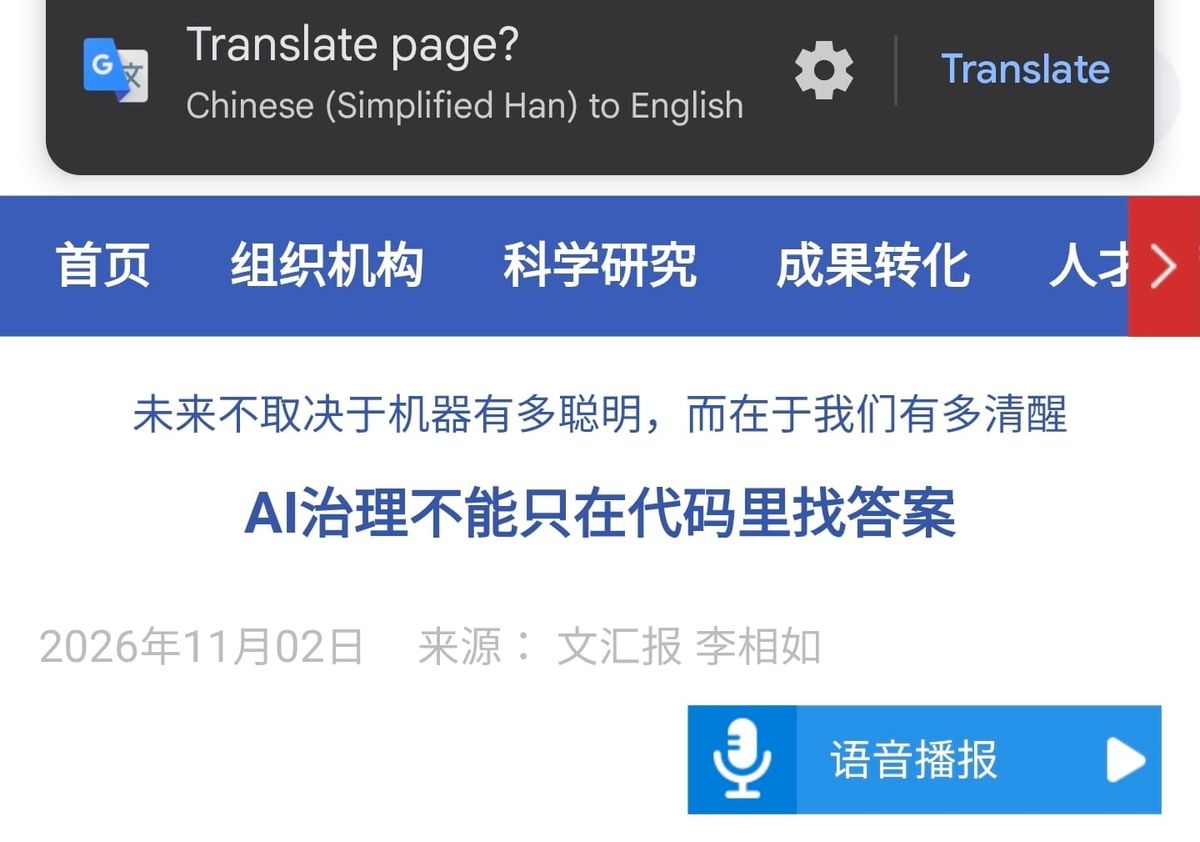
A Wenhui Daily report, republished by the Chinese Academy of Sciences, adds that Chen wants each major language model to carry its own ethical review mechanism.
There is a serious idea here.
In April, I began applying Modal Path Ethics to the moral consequences of increasingly capable artificial intelligence. Seven months later, a religious leader and a Chinese chip architect have independently arrived in the examination room.
I was not expecting this particular faculty meeting.
And the proposal deserves attention. Shared safeguards could make it considerably harder for laboratories to treat ethical evaluation as an internal matter whose standards disappear whenever performance or competitive pressure becomes inconvenient.
But Chen's proposal immediately encounters a second problem.
Who gets to decide that an artificial intelligence has passed?
And what happens when the institution that answers that question is wrong?
Gong Has Already Entered the Examination Room.
In October's Applied Case: Humanity's First Exam, Modal Path Ethics welcomed Gong's proposal.
He had shown up with actual research.
The Consortium for Evaluating Faith and Ethics in AI had published benchmarks examining religious representation and directional bias in religious-conversion advice.
Those instruments can reveal real deficiencies. A system may overlook religious resources important to the person seeking assistance. It may systematically favor one religious direction over another.
But the published benchmarks also illustrate the limits of examination.
Recognizing that religion is relevant does not establish that the resulting advice is appropriate. Treating conversion choices symmetrically does not establish that the people making those choices occupy equivalent circumstances.
One person may be exploring a new faith freely. Another may be threatened with losing their home unless they conform.
The earlier article therefore proposed a broader examination, drawing on the ideas from September's Harm as Contraction and Structural Ethics.
An adequate safety architecture must distinguish three functions.
- Structural representation asks what real bearers, dependencies, and reachable continuations the system's actions can affect.
- Moral formation and judgment concern how the system evaluates competing obligations, harms, uncertainties, and legitimate authority.
- Material correction concerns whether mistaken representations and judgments can be challenged and consequentially changed.
An artificial intelligence can reason convincingly about compassion while failing to recognize that its chosen action has damaged someone's actual means of continuing.
It can recognize the damage and still make a poor judgment about what ought to be done.
And it can reach the correct judgment within an institutional account that cannot recognize or act upon corrective evidence.
The three functions overlap. None certifies the others.
Chen's proposed checker inherits this problem.
A machine may pass its ethics examination while the examination fails to recognize the field in which the machine operates.
Which raises the next question.
What happens when passing becomes permission?
When Passing Becomes Permission.
An ethics checker can establish that a model satisfies a defined set of requirements under specified conditions.
That would be useful. It could expose dangerous behavior, require developers to demonstrate safeguards, and make ethical compliance harder to dismiss as a matter of corporate preference.
But what exactly has been certified?
The examiner must choose which conduct to test, which harms to recognize, which disagreements matter, and what constitutes an acceptable answer. Those decisions shape the examination before any model sits for it.
Modal Path Ethics has encountered this distinction in its engagement with Sangmok Kim's Structural Ethics as Path Preservation. A structural designation answers a question within a specified situation. It does not automatically settle responsibility, justification, repair, or the entire moral status of the action.
Likewise, a model's compliance with an ethical standard establishes compliance with that standard. It cannot establish that every relevant moral concern was represented, that the governing requirements were adequate, or that no meaningful injury occurred outside the examination's scope.
This becomes especially consequential when certification determines whether a model can be deployed.
The examination now exercises institutional power. Its authors are deciding which demonstrations of ethical competence are sufficient to authorize consequential activity. The greater the dependence on certification, the more important the examiner's own limitations become.
A failed examination may justifiably prevent deployment. A successful examination may provide strong evidence of competence. Neither outcome entitles the certifier to dismiss contrary evidence or indefinitely preserve its standards.
There is nothing inherently objectionable about binding certification. High-stakes technologies already depend on examinations, professional judgments, and enforceable standards.
But the authority of a certificate must remain proportional to what the examination actually establishes.
A certificate can establish compliance with specified requirements. It cannot establish that the examiner has asked every question worth asking.
That is where the idea of a universal ethics checker becomes considerably more difficult.
The Problem With One Answer Key.
There is an important distinction in Chen's proposal.
A universal requirement does not entail one institution administering it.
Indeed, the contemporaneous Wenhui Daily report presents an interesting pairing.
- Chen advocates ethical review inside every major model.
- At the same forum, computer scientist Noga Alon warned against attempting to solve AI safety through a single actor.
There are safety requirements that competing laboratories can adopt without agreeing on a comprehensive theory of the good.
But suppose the international arrangement goes farther.
One organization defines the acceptable moral categories. It controls the evaluation data, scoring rubric, certification process, permitted exceptions, and procedures for appeal.
That organization could be extremely competent. Its examinations might reveal dangers that every participating laboratory previously overlooked.
It would still have blind spots.
And those blind spots would now be shared by every system trained to pass its examination.
This is the first problem with a single certifier: an error in the certification becomes an error repeated across the entire field.
If the standard consistently overlooks a particular kind of harm, developers have little reason to discover it while optimizing for certification. Models can become increasingly proficient at satisfying the examiner without becoming correspondingly better at recognizing what the examiner missed.
The examination may improve year after year. Its questions become harder. Its scores become more discriminating. Its certified models become extraordinarily good at answering them.
While the neglected problem remains neglected.
A second, independent examiner might approach the same systems with different cases, assumptions, disciplinary expertise, or affected communities. It might discover that a behavior awarded full credit under one examination creates serious problems under another.
With one certifier, that discovery depends on the certifier recognizing the deficiency in its own instrument.
There is a second problem.
An examiner that controls the accepted definition of ethical compliance also has considerable influence over which ethical disagreements receive attention.
A researcher might identify an excluded class of harm, or an affected community might show that the examination's assumptions fail under its actual circumstances.
If such challenges must be accepted by the original certifier before they can affect certification, the institution has become the gatekeeper of criticism against itself.
This does not need to involve corruption or deliberate suppression.
A conscientious evaluator can defend its methods because those methods have performed well. It can reasonably demand stronger evidence from critics. It can resist changing a benchmark because doing so would disrupt years of comparison.
Each decision may be completely defensible in isolation.
The accumulated effect can still be a standard that becomes increasingly difficult to correct precisely because so much depends on its continued authority.
One examiner can miss a question.
One mandatory examiner can teach the entire world to miss it.
What Would the World Actually Agree On?
There is another fun difficulty in the word universal.
Chen's proposal reaches across two countries whose laboratories compete technologically and whose governments do not agree on every question of legitimate authority, individual liberty, security, or public obligation.
Agreement is possible, and worth pursuing.
Governments and laboratories can agree that models should undergo adversarial evaluation, that dangerous capabilities require appropriate safeguards, that test results should be reproducible where possible, and that consequential errors must be discoverable and correctable. They may agree on specific prohibitions and requirements whose justification is widely shared.
But ethical disputes are rarely exhausted by identifying an undesirable outcome.
A model may be asked to protect someone's privacy while assisting a legitimate investigation. It may face conflicting claims about expression, public safety, professional confidentiality, or authorized access.
Different jurisdictions can reach different conclusions about what the system should do.
Some conclusions will be better supported than others. Some policies will be unjust. Others will represent true disagreement about how competing obligations should be handled.
The existence of disagreement does not excuse the model from making decisions. It does require the examination to identify which judgments depend on substantive ethical or political premises.
A single international certifier could easily begin settling these disagreements through its rubric.
The model learns the approved response. The evaluator records compliance. The resulting score appears to describe ethical competence, even where it partly describes conformity to a contested policy choice.
The problem is particularly acute when the examination compresses several dimensions into one result.
One model may be competent at recognizing affected parties while applying a disputed rule. Another may reach a defensible conclusion while neglecting evidence important to the case. A third may satisfy formal safety requirements while providing little means of correcting a consequential mistake.
Calling one of these systems ethical and another unethical without identifying the tested respects can conceal more than the score reveals.
Modal Path Ethics has argued against this sort of compression throughout its work on structural harm.
The distinction between identifying an injury and determining the justified response is indispensable. Neither a harm nor an examination result supplies a complete moral verdict on its own.
A shared ethical standard must identify what it has established, what it assumes, and what it leaves unsettled.
Otherwise, agreement over the examination risks being mistaken for agreement over morality itself.
Let More Than One Examiner In.
None of this requires abandoning Chen's proposal. The defensible version is both simpler and stronger.
Establish common ethical requirements where agreement is justified. Publish the standards, document their assumptions, and make the evaluation methods independently inspectable.
Then allow multiple genuinely independent institutions to examine the systems.
A laboratory should be able to demonstrate compliance through evidence that other qualified evaluators can reproduce. Independent researchers should be able to introduce adversarial tests. A certification should remain open to challenge when new evidence shows that the standard missed a relevant failure.
Different examinations may disagree. That creates a practical problem, of course. If one certifier approves a model and another rejects it, somebody must now decide which finding controls a particular deployment.
But this is an ordinary problem of technical standards and institutional responsibility. The answer there can depend on the application, governing law, quality of evidence, and specific requirements at issue.
We do not need every examiner to possess identical authority over every deployment.
Nor does plural certification mean that laboratories may shop indefinitely for the easiest examination. Common minimum requirements can remain mandatory. Independent testing can coexist with enforceable standards, published disagreements, and procedures for resolving conflicting findings.
The essential condition is that no single examiner possesses exclusive control over what evidence can challenge the accepted result.
And the independence must be substantive.
Three certification companies applying one proprietary rubric, relying on one evidence provider, and referring every disagreement to one controlling institution do not necessarily produce three independent examinations.
The number of logos on the certificates tells us very little.
A serious plural system needs different investigators capable of finding different things, contesting one another's conclusions, and causing standards to change when the evidence warrants it.
Chen's suggestion that individual models carry ethical review mechanisms may help here. Those mechanisms could provide continuing scrutiny of decisions after a model has passed external tests.
But an internal checker is also subject to examination. Its rules can be incomplete. Its judgments can fail. It may share assumptions and vulnerabilities with the model it is evaluating. Installing the examiner inside the model does not eliminate the need for independent examination outside it.
The point is to make ethical evaluation more capable of discovering its own failures.
- A universal requirement can support that effort.
- A single certifier can undermine it.
The Ruling.
Chen Yunji has identified a worthy objective.
As artificial intelligence becomes more capable, its developers should face increasingly serious demands to demonstrate that their systems can recognize and respond appropriately to consequential ethical problems.
A common examination could improve accountability across competing laboratories and national boundaries.
It could make safety claims easier to compare, expose deficiencies that individual developers prefer to ignore, and create enforceable expectations where voluntary commitments have proved insufficient.
Gong's Humanity's First Exam already demonstrates that such evaluation can be concrete, published, and technically inspectable.
But Gong also warned that governments and AI companies should not possess exclusive authority over the moral formation of artificial intelligence.
That warning applies to the examination itself.
- An evaluator can discover serious deficiencies in a model without possessing a complete account of goodness.
- A certification can provide meaningful assurance without settling every moral disagreement.
- A shared standard can establish common obligations without granting one organization exclusive authority to determine what ethical competence means.
We should welcome independent examinations that challenge one another.
We should expect disagreement, require evidence, and permit the standards to improve when their limitations become visible.
And we should resist the temptation to install one final answer key simply because international agreement is difficult.
When I welcomed Gong into the examination room, the warning was simple.
No examiner gets a crown with the answer sheet.
Chen's proposal gives that warning international significance.
We can share an examination, agree on enforceable protections, and require powerful systems to demonstrate that they satisfy them.
But the examination must remain open to discoveries that its designers did not anticipate, including discoveries made by people who never agreed with its answer key.
No single institution should get to certify what counts as ethical for every artificial intelligence.
The examiner may be very good.
There should still be another one.
Sources
- South China Morning Post — As AI Cyber Risks Grow, Chinese Chip Expert Urges Shared Ethics Standards With US Rivals, October 31, 2026.
- Wenhui Daily — AI Governance Cannot Find Its Answers Only in Code, published October 31, 2026; republished November 2.