
The Silent Ocean
Every instrument may be right about something.
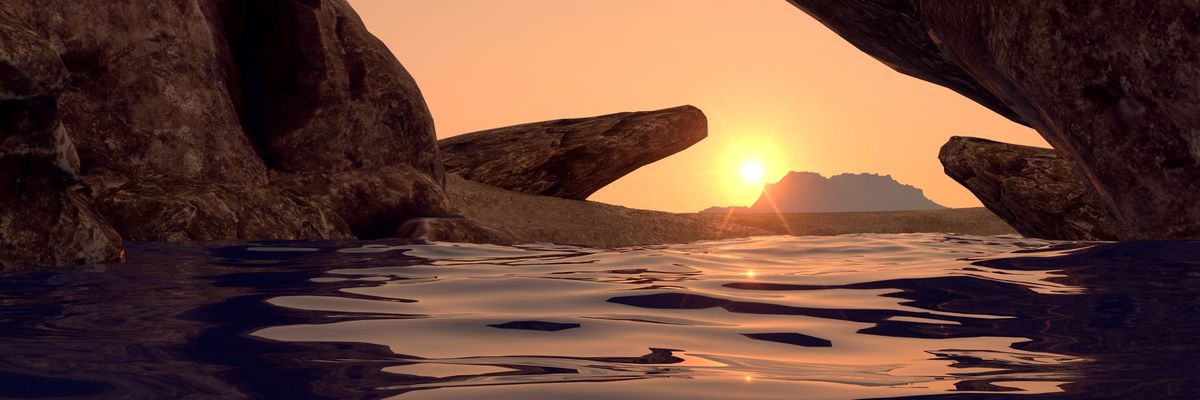
The ocean answers in six incompatible instruments.
- A seismometer records a pressure wave returning through the western basalt at intervals too exact for the local geology model.
- A biologist finds coordinated changes in dissolved chemistry across vents hundreds of kilometers apart.
- Artificial citizens detect a mathematical relation between the pressure sequence and the city’s magnetic shield pulses.
- Augmented divers with neural pressure interfaces describe a shape moving through sensation that none of them can translate into ordinary speech.
- Surface navigators say the current has shifted around the oldest fishing route as though the route itself has become a boundary.
The corporation operating the thermal plant has a sixth answer.
- Machinery under load.
Every instrument may be right about something.
None is entitled to become the mouth of the ocean.
This is the same city that survived the stellar flare yesterday. During the emergency, its first optimized plan treated augmented workers as cheap exposure, artificial citizens as recoverable checkpoints, and the western basin as empty thermal capacity. Independent evidence changed the plan. The city stopped venting heat into the ocean.
The pressure pattern returned after it stopped.
Now the emergency is over, and uncertainty has become a problem of government.
The western basin sits beneath part of the city’s heat system, water reserves, and magnetic ground loop. If the flare damaged some unknown geological structure, ignorance could let the damage spread. If the pattern is a warning, ignoring it may endanger the settlement. If a dormant machine sits beneath the basalt, the city may already have activated it. If the basin contains an ecology nobody has recognized, years of heat discharge may have altered it.
If this whole thing is geological resonance, treating rocks like constituents could divert power, workers, and money from dangers that are already killing known people.
The city has excellent reasons to find out.
Knowledge Opens Doors
The aggressive investigation has the cleaner case.
- Put more sensors in the basin.
- Drill beneath the noisy surface layer.
- Send the augmented divers farther down.
- Use controlled heat pulses and shield signals to test whether the pattern responds.
- Give several artificial-intelligence systems the full record and let them search spaces of explanation no research team could inspect manually.
Uncertainty is dangerous. Better evidence can protect everyone involved.
The problem is what better evidence becomes after the first careful investigators are gone.
A deep drill is also an access route. A high-resolution biological map can become an extraction map. A perfect description of an energy source can become an industrial plan. Coordinates gathered for caution can enter defense systems, property claims, contracts, prestige competitions, and the next administration’s definition of necessity.
A world can be exposed before anyone touches the part that matters.
 Aidan Lawson
The opposite answer is too easy as well. “Leave it alone” does not tell the city how to protect its water and heat systems. It does not reveal whether previous discharges caused damage. It does not detect something moving toward the settlement. Ignorance can preserve possibility and preserve injury at the same time.
The city therefore needs a way to investigate without allowing investigation to become title.
The Forest Test audits a transition along six paths:
- Legibility,
- Governance,
- Competence,
- Sanctuary,
- Archive, and
- Lantern.
It asks what each useful capacity makes possible and what new sovereignty danger arrives with it. It produces a profile, never a score. Excellent sensing cannot compensate for one institution controlling every reply. A magnificent archive cannot buy the destruction of sanctuary. Technical competence cannot authorize itself. A city cannot reach eighty-seven percent Better Forest and treat the missing thirteen percent as acceptable constitutional debt.
The test does something narrower: it prevents a strong result in one dimension from laundering a failure somewhere else.
The ocean inquiry makes that discipline concrete.
The city needs enough legibility to know whether its conduct is changing the basin. Remote instruments can establish broad structure. Shallow sampling can test chemistry. The artificial analysts have to preserve how they transformed the evidence and which competing models remain alive.
That does not entitle the city to an access-grade map of every vent, thin crust, energy source, cavity, or possible vulnerability.
The augmented divers’ testimony remains testimony. Their unusual perception gives it weight. It does not require converting everything they experience into coordinates another institution can later exploit.
Seeing best is not ownership.
The divers also expose the governance problem. Their contact cannot be reproduced by a council. Artificial citizens can compare the pattern across centuries of simulation faster than any human institution. The thermal corporation knows the machinery through which the city has been affecting the basin.
None of them becomes an envoy.
The corporation owns the valve. It owns no oceans. The council can bind the settlement within its warrant. It cannot speak for every future human, artificial lineage, or whatever may exist below the basalt. The defense office can stop a dangerous transition without acquiring authority to decide what the pattern means.
No accidental species-mouth is allowed.
Detection, interpretation, experimentation, containment, public warning, and reply therefore remain separable powers. The institution closing one move can lose the next.
All that still leaves one valve that has to open or close.
Polyphony governs the field around the decision.
One instruction reaches the valve.
A Dark Clearing
The city’s largest failure is more embarrassing.
- It currently cannot afford restraint.
This settlement was built on the assumption that the western ocean could absorb extraordinary heat during a stellar emergency. Stop using the basin tomorrow and the next flare could force the city back into the same choice under worse conditions.
So competence cannot mean having sophisticated people who know that restraint would be morally attractive.
The city begins building orbital radiators, phase-change storage, smaller local heat loops, and reserve capacity capable of surviving without the basin. Those projects are expensive. They consume material, skilled labor, launch capacity, public money, and years.
They are also part of the ethics of the ocean.
A moral instruction without the machinery to obey it is another way of exporting the burden.
Competence has its own path toward sovereignty. The provider building the new heat architecture could become the only institution capable of operating it. The divers could turn rare perception into permanent office. Scientists could classify everyone outside their stack as unqualified. The city therefore funds rival instruments, shared training, independent laboratories, spare capacity, and handoff while those alternatives are still expensive choices rather than emergency fantasies.
Then it draws a boundary.
Most of the western interior will remain undrilled and unmapped at access resolution. Ordinary heat discharge, sampling, and active signaling stop there. Passive observation continues from outside. If a dangerous transition crosses outward, that can create a narrower warrant to enter under evidence, review, and a clock.
Nobody declares the ocean sacred, conscious, or harmless.
The protected interior is simply a place the city is capable of entering and has not yet shown a sufficient reason to enter.
A Better Forest is not a Bright Forest.
Some of its safest clearings are dark on purpose.
Darkness can conceal too. The corporation could hide a leak behind the sanctuary line. Officials could protect the basin so completely that signs of danger never become public. An unknown process could move toward the settlement while everyone celebrates respectful distance.
So the sanctuary has monitoring at its edge, independent complaint, and a trigger its own custodian cannot suppress.
Enough remains legible for correction. Enough remains unentered for something other than the city’s purposes to remain possible.
The archive follows the same discipline. Raw traces, calibration, rival models, samples, diver testimony, public warrants, disagreement, and the physical condition of the instruments survive. Later evidence must be able to show that the city misread geology as communication, or communication as geology.
Memory does not require general access.
A perfect map could survive every cautious founder and become an instruction to a more aggressive successor. The divers’ private neural records do not become public property because they contain unique evidence. An artificial interpreter’s internal state does not become indefinitely copyable because it helped the city understand a pattern.
The record of public power survives deeply. Private and protected interiors do not have to.
Then the city decides to speak.
The Smallest Possible Lantern.
The city is already visible.
- It sends heat into the ocean.
- Shield pulses move through the crust.
- Radio leaks outward.
- Orbital traffic crosses the sky.
Whatever exists beneath the basin, if anything does, has already encountered a settlement that cannot honestly call itself silent.
A deliberate signal still changes the relation.
So the first Lantern is almost embarrassingly small.
For one interval, the city stops the shield pulse. A shallow transducer sends a low-energy pattern into an area already disturbed by earlier infrastructure.
The signal carries no map, biological sample, code, demand, claim of ownership, or invitation to enter the settlement. It demonstrates three things: the signal is controlled, the sender can pause, and a response does not have to trigger immediate escalation.
Then, the transducer shuts itself off.
A second transmission requires another public warrant.
The city does not call this "hello." This is a test of whether restraint can be made legible.
A Lantern can become propaganda. A sender can advertise peace while hiding a weapon, demand gratitude for contact, or appoint itself the voice of an entire civilization. The authority behind this signal therefore ends with this signal. Nobody has to answer. Receiving it creates no membership, debt, alliance, or obligation.
The ocean does nothing the city can confidently call a reply.
And the material problem returns.
Another major flare is plausible within the year. The orbital radiators will not be finished. If the event comes early, some western-basin cooling may still be necessary.
- The pressure pattern grows stronger whenever the thermal plant approaches its old discharge level.
- The augmented divers think the change resembles distress or refusal.
- The artificial analysts have another model, equally difficult to defeat:
- the pattern may be regulating a geophysical process, and reducing the heat input too quickly could destabilize the basin.
- The biologists still cannot demonstrate metabolism.
- The corporation asks the brutal question.
- How many known lives should the city put at risk because an ocean might contain a claimant nobody can prove exists?
No path removes that collision.
So the public body closes one move. It authorizes reduced thermal discharge through the already disturbed zone, below the level associated with the strongest pressure response. The corporation may operate the valve and cannot change the threshold. Independent augmented and artificial teams monitor through different instruments. A protected reviewer can order immediate shutdown. The sanctuary interior stays closed. Orbital radiators and local storage move onto an emergency construction schedule.
The public warrant states what remains unknown and what the decision costs without publishing the access-grade map beneath it.
The choice may still harm the ocean. It also spends money that could have built housing or medicine. It sends augmented divers back into a field their own evidence has made more troubling. It denies artificial analysts unrestricted access to the object they may be best equipped to understand. It protects known citizens partly by imposing risk on an unknown field that cannot appear before the council.
There is no clean description available.
- The valve opens.
- The pressure pattern changes.
Across the protected basin, its intervals lengthen by exactly the amount of time the valve remains closed.
When the city pauses, the ocean pauses. When reduced discharge resumes, a lower-amplitude pattern returns.
It does not repeat the Lantern.
It does not approach the transducer.
It may be communication.
It may be coupled physics.
It may be a machine preserving equilibrium.
The evidence does not decide. The city has learned something anyway. It can stop.
The ocean has not been fully mapped, entered, overwritten, or forced to answer through the city’s chosen vocabulary. The settlement still has heat, defense, evidence, and a path to revise what it is doing.
Fear has become less rational without anybody promising safety.
A Better Forest makes non-domination, restraint, and correction increasingly rational.
Increasingly carries the problem.
The alternative heat system is expensive and less efficient. Industrial work and food capacity will be lost while it is built. The sanctuary may be protecting ordinary geology while people endure avoidable scarcity. A later instrument may discover that the tiny Lantern harmed something nobody could detect. A future government may misuse the archive.
No audit makes the city innocent.
The achievement is smaller and more durable.
- No participant controls the whole encounter.
- No instrument gets to turn good contact into title.
- The unknown can still surprise the city.
- The city can still be corrected without treating correction as defeat.
Years pass.
Children first learn the western basin as a blank on public maps and only later learn why the blank exists. Augmented people develop forms of pressure perception the original divers did not possess. Artificial citizens build interpretations no human council fully follows. Human–artificial households become ordinary. Forked lineages become ordinary. People whose cognition moves between biological and public compute become ordinary.
The ocean never tells them what it is.
The settlement has to build another city anyway.
Its foundations will decide who can approach the basin, who can use public compute, which identities can survive a fork, what the archive remembers, which experiments can still be reversed, and whether some later claimant can force the founders’ categories to change.
The next residents do not yet exist. The first contracts already do.

Comments ()