Return to Babel
The common language becomes a gate.
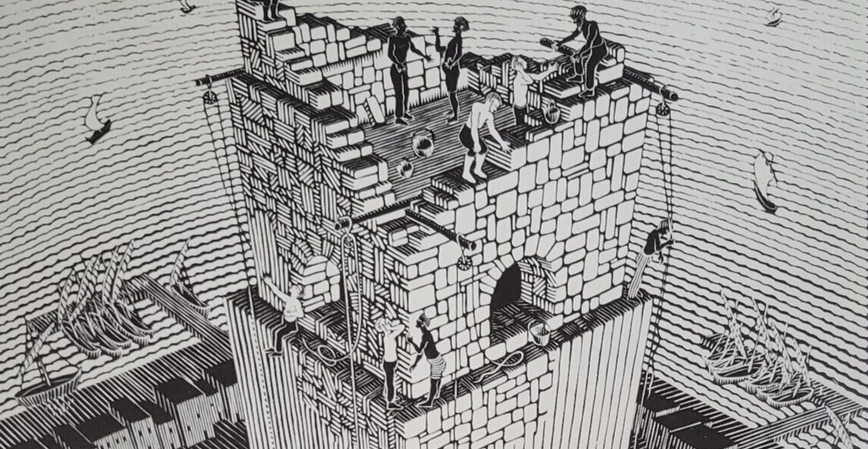
We have already been to Babel.
Last time, the useful correction was simple: the story begins with one language, not many. Shared language is an extraordinary coordination instrument. The danger begins when one common grammar becomes sufficient for one project to organize everybody else’s future.
We do not need to rebuild that tower today.
Yesterday left us with a smaller version of the same problem.
A family says a housing unit is ready.
The owner says it is ready.
The inspector says it is ready.
The housing agency says it is ready.
Everyone may be telling the truth.
They are not necessarily saying the same thing.
- The family may mean inhabitable, affordable, accessible, available in time, and possible to move into.
- The owner may mean a tenant has been accepted and the contract is worth entering.
- The inspector may mean the unit satisfies the applicable safety standard.
- The agency may mean eligible, approved, funded, and documented.
A shared system cannot leave four definitions floating forever.
Someone has to translate.
Common Language.
There are good reasons to want one operational vocabulary.

Shared identifiers reduce clerical errors.
Stable categories let a record survive a shift change.
Common terms let a hospital, agency, contractor, insurer, or court understand what another institution is sending.
Reusable mappings keep every handoff from becoming a fresh negotiation over what every word means.
A public institution also has clocks.
A benefit expires. A hearing begins. A safety decision has to be made. A queue is full of other people waiting for action.
Permanent semantic hesitation is no constitution. If every translation requires a new summit of lawyers, technical specialists, historians, affected parties, and philosophers, the institutions with the most money will become the only ones capable of coordination.
Sometimes somebody has to say:
For this task, this is the term we are using.
The problem begins when that sentence quietly loses its ending.
When the Bridge Becomes the Object
- A person becomes an identifier.
- A place becomes an address.
- A worker becomes an employment status.
- A household becomes an eligibility category.
- A complicated claim becomes a field in a database.
Every conversion can open a path.
The identifier reconnects records. The address routes service. The category sends the case to the right office. The standardized term lets several institutions discover that they are talking about the same thing.
Then the infrastructure grows around the translation.
Forms expect it.
Databases index it.
Contracts require it.
Budgets count it.
Models train on it.
Staff learn to recognize it.
Eventually, the receiving term becomes easier for the institution to act upon than the thing it was created to represent.
The source may still exist somewhere.
The original statement may be attached to the file.
But every consequential decision now operates on the translation.
That is semantic promotion: a useful representation rising from bridge to jurisdiction.
Nobody has to ban the source.
The system only has to make the translated version the form in which reality becomes actionable.
Close != Exact.
Technical standards already know that useful correspondence does not require pretending two things are identical.
The World Wide Web Consortium’s Simple Knowledge Organization System, built for organizing and mapping concepts, distinguishes relations such as exact, close, broader, narrower, and related. It is not a theory of law, testimony, or ordinary language. Its restraint is still useful.
Two terms can be close enough to route a claim to the correct office and not exact enough to decide the claim.
A broader category may help an institution recognize the issue while attaching consequences the original speaker never intended.
A narrower category may make part of the claim actionable while dropping another part.
A related term can establish contact without establishing identity.
Sometimes the best available mapping is unresolved.

That does not always stop action.
A safety office may still have to choose.
A hearing may still have to proceed.
The point is narrower:
Useful enough for this act is not identical enough to govern every later act.
A translation can borrow authority from a task.
It does not own the next task.
Keep the Remainder.
A translation always selects.
- Something crosses.
- Something may not.
The part that does not cross is the remainder.
It might be a legal distinction, a historical burden, uncertainty about causation, a different location of agency, a bodily meaning, or a relation the receiving category simply was not built to hold.
The existence of a remainder does not prove the translation is wrong.
It proves the transfer was incomplete.
A workable institution can live with that.
Keep the source reachable.
Keep the receiving term.
Record what the translation is being used to do.
State how strong the claimed relation is.
Preserve the important uncertainty or loss.
Let the source position correct the use where the translation changes consequences.
Then close the bounded act when the institution genuinely has to close it.
That is translation without annexation: making another position usable without requiring the receiving institution to become the owner of what that position means.
Artificial Intelligence Makes This Cheap.
Artificial intelligence can make this much easier.
It can compare specialist vocabularies, retrieve parallel usage, preserve source language beside a translation, propose several mappings, identify ambiguity, and give small institutions access to translation work that once required scarce specialists.
That is a substantial gain.
Fluency creates a new temptation.
The model proposes a clean equivalent.
The equivalent fits the database.
The database routes the case.
The route produces an action.
Soon nobody remembers that the original relation was only close.
The system does not need authority to announce that two meanings are identical.
It only needs every downstream institution to behave as though they are.
That is why an artificial-intelligence translator should be able to propose a mapping without deciding the jurisdiction of the mapping.
It can say:
- These appear close.
It cannot silently turn that into:
- Therefore this classification may now govern benefits, discipline, credit, custody, investigation, and every future use of the record.
The common language becomes a gate when every source has to pass through one representation before it can affect the world.
One Term, One Act
So return to ready.
The family, owner, inspector, and agency need enough shared language to coordinate.
They do not need to surrender their distinct positions.
For one bounded decision, an official may have to select a receiving term.
The source stays attached.
The relation strength stays attached.
The relevant remainder stays attached.
The person who selected the term stays identifiable.
The use stays bounded.
The route to challenge it stays open.
When the task changes, the translation has to earn its authority again.
That is enough common language to act without pretending the common language has become the world.
The translation enters the record.
Somewhere downstream, a queue changes order.