Applied Case: The Tower of Babel
Modernity built one infrastructure and taught every room to call itself a world.
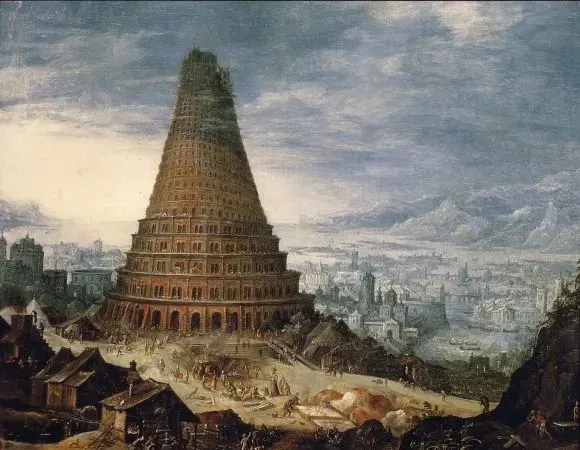
The Tower of Babel has become the favorite diagnosis of anyone who has opened the internet, attended a family dinner, or asked three spiritual communities what a human being is.
We are often told that modernity is Babel.
The languages have multiplied.
The shared sacred order has broken. Words such as truth, person, nature, freedom, healing, justice, consciousness, woman, man, God, progress, and reality now enter the room carrying several incompatible worlds apiece. Institutions use the same terms while referring to different objects. Disciplines become locally fluent and mutually ridiculous.
Political groups can watch the same footage, read the same sentence, and return with events that seem to have occurred on entirely different planets.
The Babel diagnosis catches something real.
Humanity possesses instantaneous global communication and keeps discovering that communication is not the same thing as contact. We have more channels, more translation, more education, more archives, more video, more data, more shared technical standards, and more opportunities to answer one another than any prior civilization.
We also have increasingly efficient ways to build sealed local worlds.
A platform gives one event a grammar. A profession gives it another. A church gives it another. A psychiatric office, activist coalition, investment firm, fandom, intelligence service, university department, family system, nation, and artificial-intelligence model can each produce a locally coherent version of reality whose terms become difficult to carry across the border.
The spiritual complaint is therefore serious:
A civilization cannot continue through total metaphysical privatization.
Shared meaning matters.
Shared standards matter.
Shared memory matters.
Shared rituals, evidence paths, language, institutions, and public objects matter.
A world in which every person receives a private ontology and an audience trained to defend it is not a plural civilization.
That is a hallway of locked rooms with excellent Wi-Fi.
The mistake here begins when plurality itself receives the blame.
The proposed repair then arrives in an ancient form.
- Restore the common language.
- Restore the sacred center.
- Restore the true hierarchy of meanings.
- Restore the metaphysics modernity dissolved.
- Return the fragments to one grammar.
- Build the tower correctly this time.
This is where the Tower of Babel becomes very dangerous as a modern metaphor.
Because, if you recall, Genesis 11 does not begin with too many languages.
It begins with one.
Before the Confusion.
The Tower of Babel is commonly remembered as a story about pride.
Human beings attempt to reach Heaven. God sees the attempted trespass. Their language is confused. The people are scattered. The tower falls, at least in the popular imagination, and linguistic difference enters the world as punishment for collective arrogance.
This reading is old, powerful, and textually possible in broad shape.
The city makes a name for itself. The tower reaches toward the heavens. Babylonian imperial associations hover around the name Babel. Later Jewish and Christian tradition often connects the project to rebellion, tyranny, or an attempt to secure human greatness against divine rule.
Modal Path Ethics has no reason to throw this reading out of the city.
A collective project can become proud. Technical coordination can become self-deification. A civilization can treat capability as proof of moral jurisdiction. A city can turn its own continuity into sacred title and build upward until every other horizon looks like raw material below.
Yet the text itself gives the standard interpretation less clean support than the familiar summary suggests.
Genesis does not say that the builders intend to storm Heaven. It does not name pride as the offense. God does not condemn brickmaking, height, architecture, urban life, or human cooperation in a direct sentence.
The tower is never said to be destroyed. The narrative says that construction stops and the people are scattered.
The divine speech focuses elsewhere.
- The people are one.
They have one language.
They have begun one project.
Under these conditions, the text says, no future plan will remain beyond their coordinated capacity.
This has led scholars to reopen the story around uniformity rather than treating pride as its only key. Theodore Hiebert argues that the narrative is fundamentally concerned with the origins of cultural difference and that the builders' dangerous condition is their homogeneity:
One people occupying one place through one language.
Edward Greenstein reads the story as a meditation on language itself, including the ways different languages divide, disclose, and resist complete translation.
These readings remain debated. They also place the opening verse back where it belongs:
At the beginning.
“The whole earth had one language and the same words.”
- The confusion is the response.
- The one language is the initial condition.
That changes the modern diagnosis.
The story does not present linguistic plurality as the first wound in the field. The field becomes dangerous before the languages multiply, while one language is strong enough to carry one people into one project with no effective outside correction.
Babel is already happening when everyone understands one another.
One Language, the Same Words.
A language does more than permit communication.
Field Instruments: The Languages defined language as a selecting cut. A language names objects, roles, causes, events, agents, victims, thresholds, permissions, and things too inconvenient to grant a noun. It makes some features of reality easy to carry and leaves others waiting outside the sentence.
That is not a defect to be repaired into transparent speech.
No mind receives the whole field at once. Language lets finite creatures hold distinctions across time and pass contact between bodies. It lets a wound become public. It preserves warnings after the witness is gone. It lets institutions be examined, promises remembered, evidence compared, and unfamiliar worlds approached without requiring direct reenactment of every life inside them.
A common language can therefore be an immense good.
- It lowers resistance to cooperation.
- It creates shared reference.
- It makes public reason possible.
- It carries scientific and technical knowledge across generations.
- It lets people coordinate care beyond kinship.
- It makes disagreement legible enough to avoid immediate violence.
- It gives strangers a route toward one another.
The Babel field has all of this.
The builders can plan. They can share instructions. They can standardize tasks. They can transmit the project without rebuilding the entire meaning at every handoff.
Then, the shared instrument becomes more than a bridge.
The language becomes the world in which the project is allowed to make sense.
This is what “the same words” adds to the problem. The phrase has generated substantial interpretive disagreement. It can indicate common vocabulary, shared speech, uniform expressions, or a single set of words. In every case, the story emphasizes a startling compression of difference.
There is no visible minority report.
No alternative city. No rival account of what human settlement is for.
No person in the text asking whether the name should be made, whether scattering is actually a failure, whether the tower has an owner, whether the labor is voluntary, whether the plain belongs to someone else, whether the project serves the people or whether the people have become support equipment for the project.
This absence does not prove that the imagined society contained no dissent. The story is very short. It does reveal how the field has been presented:
Human coordination has become a single grammatical body.
The whole earth speaks as we.
Let us make bricks.Let us build.Let us make a name.Otherwise we will be scattered.
A collective pronoun can be a shelter.
It can also become a disappearance machine.
The word we becomes dangerous when it gives one project the authority of everyone included by the grammar and leaves no recognized location from which an included person can answer.
Babel is not one language in the harmless sense that everyone can ask where the bathroom is.
It is one language carrying one future strongly enough that the future starts to look like the people themselves.
Come, Let Us Make Bricks.
The first technical transition in the story arrives quickly.
“Come, let us make bricks.”
This line deserves much more attention than it usually receives.
The builders do not discover construction.
They discover a scalable construction relation under the conditions of the plain.
Genesis distinguishes baked brick from stone and bitumen from mortar. Greenstein notes that this is a Mesopotamian material world: a region where monumental building relied on manufactured brick rather than the stonework familiar in the Levant.
The brick is a standardized unit.
It can be made repeatedly.
It can be counted, stacked, transported, assigned, replaced, and incorporated into a structure much larger than any individual builder. It lets many hands contribute to one form without each hand needing to understand the whole architecture.
This is a tremendous coordination instrument.
The brick enlarges the field.
• More people can participate.
• More height becomes reachable.
• Construction can continue beyond the local availability of natural stone.
• Labor can be divided.
• Plans can be repeated.
• Units become mutually compatible.
• The city can grow through a common technical grammar.
The brick did not cause Babel.
The brick made Babel scalable.
Modernity is full of bricks.
• Standardized time.
• Currency.
• Legal identity.
• The shipping container.
• National curricula.
• Bureaucratic forms.
• Industrial parts.
• Accounting categories.
• Global English.
• Internet protocols.
• Databases.
• Machine-readable addresses.
• Platform accounts.
• Statistical populations.
• Model tokens.
Every one of these can preserve enormous continuance.
A shared standard lets strangers build together. It lets a component made in one place fit a system assembled somewhere else. It lets medicine travel, records persist, goods move, software communicate, and institutions survive the departure of the charismatic person who knew how everything worked.
Standardization is one of civilization's great anti-priesthood technologies. Knowledge no longer has to remain inside one initiate. The brick tells the next builder enough to continue.
Then, the standard acquires jurisdiction.
The unit becomes easier to see than the thing being standardized.
The account becomes easier to govern than the field entering the account.
The person becomes the identifier.
The place becomes the address.
The work becomes the metric.
The language becomes the authorized translation through which every local reality must pass before the tower can recognize it.
This is the technical meaning of the Babel risk.
- A standard is a bridge until crossing it becomes the price of existence.
The City Comes First.
The story is called the Tower of Babel.
The people build a city and a tower.
The city deserves equal billing.
A tower is visually convenient. It lets painters show ambition as verticality. It gives preachers something to point at. It turns a political and linguistic field into a very large architectural finger aimed toward Heaven.
The city is harder.
A city is not one object. It is a coordination field: food, water, shelter, waste, labor, law, memory, exchange, protection, kinship, ritual, violence, care, public space, infrastructure, and the daily problem of many lives becoming mutually consequential without becoming one life.
This makes the Babel project more serious than an oversized monument.
The builders want settlement. They want continuity. They want protection from dispersion. They want a name that survives the individual.
These are not stupid desires.
Scattering can mean vulnerability. It can mean lost kin, lost memory, weaker defense, failed transmission, fragmented care, and the disappearance of a people into distances their institutions cannot cross. A city can preserve language, ritual, food, craft, burial, law, learning, children, and the accumulated intelligence of living together.
The modern spiritual defender of unity is right to start here. People need containers strong enough to carry common life.
A family with no shared memory becomes a collection of private injuries. A religion with no transmitted language cannot carry its sacred contact across generations. A polity with no public vocabulary cannot deliberate. A science with no standard terms cannot compare observations. A civilization with no shared object of care cannot coordinate sacrifice under real danger.
The builders are trying to preserve a world.
Their failure is not the desire for continuance.
The failure enters when one city's continuance becomes the authorized shape of human continuance.
“Let us make a name for ourselves, lest we be scattered.”
The name stabilizes the city against disappearance.
It also turns the city into a claimant.
A name can preserve memory. A name can collect labor, pride, sacrifice, debt, obedience, and inheritance. The name lets the structure become greater than the lives that made it.
Soon the people do not simply have a city.
The city has them.
This is sacred title in civic form.
The project becomes the vessel of human significance. To oppose the project is to threaten the name. To leave is to become scattered. To preserve local difference is to weaken the common future. To question the tower is to question the people who have learned to recognize themselves through it.
This is how a shared repair instrument becomes sovereign.
A city that begins as protection against disappearance can start requiring every difference to disappear inside the city.
The Strongest Defense of Common Speech.
Modal Path Ethics cannot leave the article here and pretend that plurality is automatically healthy.
That would be an easy way to write a very modern sermon and a terrible way to govern a field.
Plurality can preserve correction.
Plurality can also preserve nonsense.
• A spiritual vocabulary can become too local to receive outside evidence.
• A political language can classify every contrary fact as enemy speech.
• A discipline can make basic objections inadmissible because they arrive in the wrong format.
• A family can develop a private grammar in which abuse becomes concern and resistance becomes betrayal.
• A conspiracy community can redefine disconfirmation as proof of suppression.
• A therapeutic culture can translate every external demand into boundary violation.
• A religious group can call its internal interpretation revelation and every competing sacred contact deception.
• A platform community can turn a running joke into an ontology whose terms cannot survive daylight without being declared incomprehensible to outsiders.
Ten sealed instruments do not form a redundant sensor array.
They form ten sovereign gauges.
A sensor array works because differences can enter a relation. Outputs can be compared. Failures can be identified. Calibration can be challenged. No single sensor gets to define the object through the signal it alone produces.
Plurality without translation is not correction architecture.
It is distributed enclosure.
This is why the spiritual diagnosis of modernity has real force. Modernity weakened inherited common metaphysics without building adequate replacement infrastructure for shared interpretation. Philosophy retreated into professional specialization. Religion lost public credibility in many institutions while retaining private intensity. Psychology and psychiatry often converted metaphysical experience into symptom, wellness, coping, or identity. Politics absorbed moral language and turned it into coalition equipment. Markets translated value into demand. Platforms translated the whole resulting field into engagement.
People did not stop needing metaphysics.
They built from scrap.
A few scientific claims. A therapeutic vocabulary. A political myth. A childhood religion. A podcast cosmology. A simulation metaphor. A manifestation practice. A diagnosis. An artificial-intelligence conversation. A vague sense of energy. A story about civilization collapsing because people use different words for God.
The sacred slack filled.
A civilization cannot answer this condition with laughter.
It also cannot answer by choosing one private metaphysics, scaling it through the state or platform, and calling that shared reality.
The strongest defense of common speech therefore yields a more exact requirement:
A civilization needs common contact paths, not one sovereign interpretation.
- Shared evidence matters.
- Shared records matter.
- Shared names for public harms matter.
- Shared institutions through which claims can be challenged matter.
- Shared rituals of mourning, memory, consent, testimony, correction, and restraint matter.
A common world must be common enough to answer everyone acting inside it.
That does not require every instrument to speak the same language.
It requires translation strong enough that no instrument can hide the cost of its language from the others.
Modernity Rebuilt Both Halves of Babel.
Modernity did something stranger than linguistic fragmentation.
It created material unity and semantic fracture at the same time.
One operating layer coordinates astonishing portions of planetary life.
- Money moves claims across cultures.
- Global logistics moves matter.
- Standardized time synchronizes labor and machines.
- Nation-states classify persons through documents.
- Scientific institutions produce shared technical descriptions.
- Platforms organize attention through common interfaces.
- Databases make lives administratively addressable.
- English functions as a major bridge language across research, business, technology, and diplomacy.
- Computation translates difference into standardized operations.
Under this common infrastructure, people inhabit increasingly divergent worlds of meaning.
The same phone carries prayer, pornography, war footage, meditation, financial trading, diagnosis, propaganda, family memory, games, divine messages, labor management, and a private artificial-intelligence oracle. The device standardizes the hand while pluralizing the cosmos behind the glass.
The same platform account can connect people whose basic categories of truth no longer touch.
The same nation can maintain one tax system, one currency, one road network, and several mutually hostile accounts of whether the nation exists, who belongs to it, what its history means, and which deaths count as evidence.
The same university can contain laboratories operating through shared methods and departments whose conceptual worlds cannot explain one another without first assigning blame for the failure of translation.
The same hospital can coordinate blood pressure, billing, medication, risk, disability, family fear, legal exposure, and spiritual crisis while making each reality legible to a different instrument that mistakes its own patient for the whole person.
Modernity rebuilt the tower.
Then it outsourced the confusion to the occupants.
One infrastructure. Ten thousand sealed languages.
This is why modern Babel feels so disorienting.
The tower works.
The shipping arrives. The payment clears. The model generates. The border scans. The warehouse routes. The platform ranks. The database returns a match. The institution continues.
Except the city cannot explain what any of it is for.
The shared operational layer has become powerful enough to coordinate behavior without coordinating meaning. People can participate in the same transition while inhabiting incompatible accounts of the transition's moral object.
A supply chain can unify action while distributing ignorance.
A platform can unify attention while fragmenting interpretation.
A market can unify exchange while hiding the fields its prices omit.
An artificial-intelligence model can unify language at the interface while carrying unequal and opaque relations beneath the fluency.
This is a deeper Babel than a room full of people who cannot understand one another.
Everyone can understand the instruction.
No one shares the world that gives the instruction a purpose.
Plurality Is the Redundant Sensor Array.
Kant and the Corrigible Field gave Modal Path Ethics the necessary plurality argument. No single locus, discipline, language, scale, history, or contact position can exhaust the field.
A river is flow, habitat, legal object, sacred relation, water supply, flood risk, geological process, infrastructure, border, and memory. These descriptions can conflict. Some can be false. Some can be captured. None automatically becomes the river by winning the meeting.
Plurality supplies correction paths because different instruments fail differently.
- A body can report what a metric misses.
- A local language can preserve a distinction the administrative language compresses.
- A historical memory can reveal why the official offer sounds different to the people asked to receive it.
- A scientific instrument can correct sincere perception.
- A legal process can constrain charisma.
- A sacred ritual can preserve obligation after the market has classified the dead as resolved costs.
- A poem can carry experience that a diagnostic category cannot hold without killing it into a case.
None of these receives the whole field.
Together they create more locations from which error can become visible.
Plurality does not decide truth. It prevents one instrument from deciding it alone.
Babel is the failure of this architecture.
One language has become sufficient for one people to organize one future. The common instrument no longer encounters counter-instruments with standing. Unity has moved from an orienting hope into a possession.
Kant's regulative search for systematic unity is valuable. Inquiry needs the expectation that reality can be understood through relation. A heap of unconnected impressions cannot guide action. A polity cannot govern through permanent semantic surprise. A shared world needs enough continuity for reasons, evidence, and obligations to travel.
The danger arrives when the desired unity is treated as a completed object already possessed by one language.
- One church has the final sacred vocabulary.
- One science has the final ontology.
- One state defines the public.
- One market identifies value.
- One profession decides what counts as evidence.
- One platform mediates reality.
- One model becomes the universal reader.
- One ethical framework names every path before entering it.
This is the Kantian correction Babel needs:
Search for unity. Do not force plurality to pay for it.
- A good synthesis lets differences answer one another.
- A bad synthesis solves the disagreement by removing the positions from which the disagreement could reveal anything.
The tower is a bad synthesis made architectural.
God Disrupts the Sovereign Instrument.
Field Instruments: Disruption argued that disruption can be an ethical instrument when it opens a route around an order whose existing control has made correction unreachable.
Babel provides the sacred version.
The divine action does not defeat the tower by building a taller tower.
It attacks the coordination channel.
The people lose the capacity to carry one project through one speech field. Construction stops. The city cannot retain the whole human future inside its walls. The people scatter into difference.
Under the diversity reading, this looks like the disruption of a sovereign instrument.
The one language has become too strong to correct from inside itself. There is no visible opposition, no procedural appeal, no external institution, and no competing settlement capable of interrupting the project. The narrative inserts correction at the level of language itself.
The cost is enormous.
Mutual understanding collapses.
Shared work becomes harder.
Relations break.
People lose access to one another.
The city fails.
The text gives no transition program, no interpreter corps, no multilingual public institutions, no gradual devolution, no federated governance, no protected local autonomy, no protocol for preserving common goods during the scattering.
The divine intervention stops a dangerous path.
It does not complete the repair.
This matters for Modal Path Ethics.
Scattering should not be romanticized as Good simply because the tower had become dangerous. Linguistic confusion closes real futures. It raises resistance to cooperation, care, memory, trade, learning, diplomacy, and mutual recognition.
Difference enters with a tail.
The story contains emergency foreclosure.
- A totalizing path is interrupted.
- Human plurality becomes reachable.
- The common project loses sovereignty.
- The price is a damaged translation field.
This is Better under the story's own danger frame, if no less-closing correction remained reachable.
It is not purity. It leaves the next task waiting across centuries:
How can plurality recover intelligibility without restoring the tower?
Scattering != Segregation.
The diversity reading of Babel carries a serious historical danger.
Biblical arguments for cultural or linguistic difference have sometimes been used to sanctify separation, racial hierarchy, nationalism, colonial partition, and apartheid. If God divided peoples, the argument says, then maintaining the division can be treated as obedience.
But that is the tower returning through the border.
Plurality is not a divine deed to be frozen into isolated populations.
A field of sealed groups can become as sovereign as a field of one language. Each local order can control interpretation, membership, marriage, mobility, memory, dissent, and the terms under which outsiders become humanly legible. The difference is that domination has been distributed into several smaller towers.
Forced uniformity closes plurality.
Forced separation closes relation.
Both make living difference answer to a prior map.
Modal Path Ethics therefore needs a sharper definition.
Plurality means multiple loci and contact instruments retaining enough independent structure to correct one another and enough relation to remain answerable to the same field.
It requires:
- difference without untouchability;
- relation without absorption;
- local language without local sovereignty over fact;
- shared institutions without one authorized worldview;
- mobility without compulsory dissolution;
- boundaries capable of protection and revision;
- translation capable of failure and improvement;
- standing for people who live between languages rather than inside one purified box.
Scattering alone does not produce this.
The scattered world still needs bridges.
The bridges cannot become the next throne.
Pentecost Does Not Finish the Tower.
Christian tradition often places Pentecost beside Babel.
This pairing is understandable.
At Babel, shared language breaks and the people scatter.
In Acts 2, people from many regions gather in Jerusalem and hear the disciples speaking through the Holy Spirit. The crowd is astonished because each person hears in their own language.
This detail is the entire repair image.
The miracle does not require the hearers to abandon their languages.
The text does not collapse Parthians, Medes, Elamites, Mesopotamians, Judeans, Cappadocians, Egyptians, Romans, Cretans, Arabs, and the rest into one restored imperial tongue before contact can occur.
- Difference remains present enough to be named.
- Intelligibility crosses it.
Pentecost therefore does not finish the tower.
Pentecost builds translation.
This is a much stronger sacred response to modernity than the demand for one language.
- The speaker does not own the listener's grammar.
- The listener does not have to become culturally identical to the speaker before the message can arrive.
The sacred contact travels across plurality while preserving the local form through which it is heard.
This is not a complete political theory.
Pentecost does not solve institutional design, epistemic disagreement, translation error, coercive mission, colonial Christianity, doctrinal conflict, or the long history of churches confusing universal message with cultural ownership.
Christian institutions have often done exactly what this reading warns against.
They carried a message across languages and treated the receiving cultures as defective containers to be replaced. Translation became conversion into the translator's civilization. A sacred bridge became sacred title.
The Acts image still preserves a correction.
Universal contact does not have to mean one speech form.
A sacred instrument can cross difference without claiming that difference as conquered territory.
The faith does not become less universal because the hearer remains particular.
The field does not become less shared because contact arrives through many tongues.
This is close to the Sacred Instruments rule Modal Path Ethics has been working on:
A sacred instrument expands the field when it returns the agent to extance with more care. It contracts the field when it protects the agent from correction.
A Pentecostal translation worthy of the image would return the speaker to the listener with more care, more humility about the selecting cut, and more willingness to let the contact be changed by what the listener can answer.
Translation is not transmission with decorative accents.
It is a relation in which both languages expose limits.
Translation Keeps the Remainder.
Translation is often treated as a technical problem with a clean finish.
- There is a sentence in Language A.
- A competent translator produces the corresponding sentence in Language B.
- The content crosses.
- The container changes.
- Everyone goes home happy.
- The container changes.
- The content crosses.
Real translation is stranger.
Languages divide color, kinship, time, agency, number, respect, certainty, body, gender, divinity, causation, and social position in different ways. A sentence can be grammatically translated while losing the relation that made it live. A sacred term can acquire a misleading equivalent. A legal concept can look shared while carrying different histories of enforcement. A clinical word can enter another language without the institutions that originally bounded its use.
Greenstein emphasizes the insufficiency built into translation. One language cannot carry another without remainder because the languages do not divide the world through identical cuts.
That remainder is valuable.
It is evidence that contact has not been completed.
A sovereign translator hides the remainder. It produces a smooth sentence and lets fluency impersonate equivalence.
A corrigible translator marks the loss.
- This word has no direct counterpart.
- This translation preserves the legal sense and loses the sacred one.
- This phrase sounds accusatory in the receiving language.
- This category depends on an institution that does not exist here.
- This name carries a history the summary cannot hold.
- This apparent agreement may be lexical rather than substantive.
The remainder keeps the other language alive as a counter-instrument.
This is the exact opposite of Babel's “same words.”
The goal is not to make every language say the same thing.
The goal is to create paths through which what one language can see becomes available to another without pretending that the transfer exhausted the source.
A translated field should remain revisitable.
- The original text stays available.
- The translator's choices stay visible.
- Alternative translations can answer.
- Affected speakers can correct the use.
The receiving institution cannot claim ownership over what it has made legible.
Translation becomes a public practice of corrigible contact.
The Universal Model.
Artificial intelligence now enters the story carrying the most convincing universal translator humanity has built.
A person can speak into a device in one language and receive another. A model can summarize specialized writing, explain legal documents, translate cultural references, compare vocabularies, and let people communicate across barriers that previously required money, institutional access, or years of study.
This is a real expansion.
Artificial intelligence can lower the coordination cost of plurality.
It can help a local community read a public record. It can help disciplines compare terms. It can give small institutions translation capacity previously reserved for states and multinational firms. It can preserve minority-language material, support language learning, and let a person enter a conversation from which their first language would otherwise exclude them.
This is the Pentecostal promise in technical form:
- Many tongues.
- Shared contact.
- No requirement that every speaker first become a professional translator.
But then, the model becomes Babel.
A universal translator can quietly become the universal language beneath the languages.
Every source is converted into one internal representation. Every distinction passes through a training distribution shaped by unequal data, dominant languages, platform archives, annotation practices, safety systems, and the model designer's categories. The output returns with enough fluency that the user may never see which differences were flattened.
A 2026 paper titled “Lost in the Tower of Babel” argues that current large language models often possess incidental multilingualism: uneven linguistic capacity arising from large, unequal web corpora rather than multilingual and multicultural competence designed as a central goal. The authors report brittle and opaque cross-language behavior and call for multilingualism by design, including cultural grounding and better understanding of cross-lingual behavior.
The warning is larger than "translation quality."
A model can sound equally confident across languages while carrying unequal contact beneath the surface.
- The high-resource language receives richer knowledge.
- The low-resource language receives a thinner world.
- A safety policy behaves differently after language switching.
- A culturally specific concept is normalized through an English-dominant frame.
- A local legal or medical question receives an answer imported from another jurisdiction.
- The model reports support for a language that its behavior cannot reliably sustain.
The interface says plurality.
But the substrate says hierarchy.
This is one infrastructure, many tongues, and one hidden language deciding how the tongues become machine-legible.
Artificial intelligence therefore faces a constitutional choice.
Tower Architecture.
- One proprietary model becomes the mandatory reader of public reality.
- Translation discards provenance.
- Summaries replace sources.
- Minority-language users receive lower-quality worlds behind the same interface.
- Cultural differences become style options around one internal ontology.
- The model's confidence hides uncertain or disputed equivalence.
- Public institutions lose the capacity to interpret without the model.
- Correction must pass through the vendor whose system requires correction.
Plurality Infrastructure.
- Original language and source remain reachable.
- Multiple models and human translators can disagree.
- Untranslatable terms are marked rather than erased.
- Confidence and evidence vary by language and domain.
- Local communities participate in evaluation.
- Public and community models preserve local knowledge where local control matters.
- Cross-language failures remain visible in records.
- No model becomes the sole admissibility gate for testimony, law, medicine, education, or public participation.
The distinction is simple.
Does artificial intelligence translate among instruments, or replace them with its representation of them?
A universal translator becomes sovereign when no one can recover what the translation discarded.
The Disruptor Meets Babel.
The previous article ended with Peter Thiel and a demand that the disruptor surrender the throne.
Babel shows why that surrender requires plurality infrastructure.
Breaking an old institution can open a new path. The new path then needs coordination. It needs shared terms, standards, records, authority, and enough unity to survive contact with the old order. The founder, prophet, reformer, revolutionary, or technical group often possesses the strongest language for the new thing because they built the first instrument capable of seeing it.
That language is valuable. Then the language becomes admission.
Everyone who joins must learn the founder's vocabulary. The vocabulary carries the founder's selecting cuts. The project becomes easiest to understand from inside the terms that justify the founder's position. Criticism arriving in another grammar looks confused, hostile, unserious, spiritually immature, technologically illiterate, politically captured, or unable to understand the mission.
This is how disruption rebuilds Babel.
- The old order had one authorized language.
- The disruptor opens an outside route.
- The route forms a community.
- The community develops common speech.
- The speech stabilizes the new world.
- The world treats fluency as contact.
- The anti-priest becomes the final interpreter.
The problem is not that communities develop internal language. Every serious practice does. Surgeons, programmers, contemplatives, engineers, artists, theologians, organizers, and game players need terms that preserve distinctions ordinary speech cannot hold.
The problem arrives when the internal language owns the translation boundary.
A corrigible community lets outsiders misunderstand it without treating every misunderstanding as aggression. It can explain its terms in several vocabularies. It can identify which criticism survives translation. It can admit that some outside language sees a burden its founding grammar pushed into background.
The disruption becomes post-sovereign only when its language can lose.
The Corrigible Commons.
The alternative to Babel cannot be one universal metaphysics.
It also cannot be permanent semantic secession.
So the repair shape is a corrigible commons: shared structures through which plural contact instruments can coordinate, challenge one another, preserve their differences, and remain answerable to a field none of them owns.
This sounds abstract until it is made institutional.
A corrigible commons requires:
a) Common protocols without one authorized worldview.
People need shared procedures for records, evidence, appeal, consent, safety, allocation, and public decision. The protocol should specify how contact travels without dictating the final metaphysics every participant must inhabit.
b) Shared evidence without one discipline owning admissibility.
Science, testimony, history, local knowledge, bodily response, technical trace, legal record, and sacred memory do different work. No instrument should admit only the evidence it was built to produce.
c) Translation without forced commensurability.
Terms can be related without being reduced to one scale. A translation may remain partial. The unresolved difference should stay visible where flattening it would destroy contact.
d) Coordination without permanent central jurisdiction.
Some tasks require concentrated authority. Authority should remain scoped, reviewable, removable, and answerable to the loci carrying the consequences. Emergency coordination should not become a permanent metaphysics of command.
e) Public metaphysical life without sacred sovereignty.
A civilization needs places where ultimacy, death, obligation, consciousness, meaning, creation, suffering, and transcendence can be discussed outside private consumption and clinical containment. Sacred instruments should participate openly without receiving exemption from correction.
f) Common infrastructure whose categories can be contested.
Identity systems, platforms, artificial-intelligence models, markets, legal forms, medical records, and public databases all classify the people they coordinate. Those classifications must remain appealable by the classified.
g) Field realism without one final reader.
Plurality does not mean that every account becomes true inside its own room. Bodies still break. Predictions fail. Bridges collapse. People are harmed. Ecologies answer. Records contradict. The field remains capable of refusing the language.
This is the shared world.
The commons is not a treaty among fantasies to leave one another alone.
It is the architecture through which fantasies can be corrected before they acquire causal sovereignty.
The Modern Babel Audit.
A modern institution can now be tested against Babel.
1. What is the one language?
Identify the vocabulary through which the institution makes reality actionable.
• Price?
• Risk?
• Diagnosis?
• Security?
• Engagement?
• Optimization?
• Doctrine?
• Identity?
• Growth?
• Compliance?
• The founder's mission?
The issue is not whether the language is false. Babel's language works.
The issue is what becomes unreachable when every relevant fact must enter through it.
2. What are the bricks?
Find the standardized units that let the project scale.
• Forms.
• Metrics.
• Tokens.
• Accounts.
• Credentials.
• Categories.
• Contracts.
• Interfaces.
• Rankings.
• Repeated rituals.
Ask what the unit preserves and what the unit forgets.
3. What is the city protecting?
Name the real good.
Continuity? Safety? Memory? Coordination? Livelihood? Sacred identity? Scientific reliability? Public order? A fragile invention?
Do not attack the tower by pretending the city has no reason to exist.
4. What is the name?
What identity has become too important to correct?
The nation. The church. The science. The company. The movement. The platform. The family. The framework. The civilization.
Which harms become difficult to name because the name must remain good?
5. Who is being scattered already?
Uniform systems often produce invisible scattering before any official break.
Who leaves because they cannot survive the common language? Who becomes illegible? Who must conceal their experience to remain inside? Which local worlds are being erased to protect the appearance of one people?
6. Which counter-language retains standing?
Can another discipline, community, witness, body, model, or sacred tradition correct the institution without first accepting the institution's description of the problem?
7. What would translation require?
Translation is more than simplification. It may require a new procedure, shared evidence object, independent interpreter, community participation, preserved original, appeal path, or acknowledgment that some terms cannot be cleanly merged.
8. Can the language lose authority?
The final test remains disappearance.
Can the category be retired? Can the platform become a protocol? Can the founder leave? Can the doctrine revise? Can the institution admit that another language now carries the contact better?
A language that cannot lose has become a tower.
Ruling.
The Tower of Babel is a warning about human pride.
It is also a warning about human unity becoming sovereign over the conditions of human difference.
The builders possess real goods.
They can cooperate. They can innovate. They can make standards. They can build a city strong enough to preserve memory and common life. They can protect themselves from the vulnerability of scattering. They can create a name that lets work continue beyond the worker.
Then one language becomes sufficient for one project to organize the whole human future.
The brick scales the project.
The city stabilizes it.
The name sanctifies it.
The fear of scattering turns difference into danger.
The tower becomes the shape through which humanity is allowed to continue.
The divine interruption breaks that sovereignty. It also breaks intelligibility. Scattering prevents one totalizing future and leaves a wounded translation field behind. Difference becomes reachable at the cost of common speech.
That is not the end of the story's ethical work.
Modernity now lives in both halves of Babel.
It has one material infrastructure capable of coordinating planetary action and many sealed languages unable to agree on what the action means. It has standardized bricks everywhere and no common account of the city. Its platforms, markets, states, disciplines, religions, and artificial-intelligence systems can translate reality into locally powerful grammars while hiding what the grammar excludes.
The spiritual diagnosis is therefore right about the wound.
Shared meaning has weakened. Metaphysical hunger has not. People build private sacred worlds from available fragments because a loose container of propositions cannot carry a human life forever. A civilization needs shared contact, shared memory, shared obligation, and enough common language to coordinate repair.
The answer is not one sovereign tongue.
A restored sacred monopoly would repeat Babel's opening condition and call it healing. A universal model that compresses every language into one hidden representation would repeat the tower at machine scale. A collection of sealed communities would preserve the scattering and abandon the repair.
The better path is translation.
Not translation as frictionless conversion.
Translation as corrigible relation.
- Preserve the source.
- Expose the selecting cut.
- Mark the remainder.
- Permit counter-translation.
- Let affected speakers answer.
- Keep common protocols separate from final metaphysics.
- Build shared institutions that can be corrected in more than one language.
- Let no language, sacred or technical, become the only reader of the field.
Pentecost offers the sacred image:
- Intelligibility crosses difference while the languages remain alive.
Kant supplies the philosophical discipline:
- Search for unity without making plurality pay for it.
Disruption supplies the constitutional warning:
- The path out of one sovereign order must not become the only door left.
Artificial intelligence supplies the new technical possibility and the new danger at once.
- It can lower the cost of plural coordination.
- It can also hide a final language beneath every apparent tongue.
So the ruling is narrow enough to use.
The problem at Babel was not that humanity had too many languages.The problem was that one language had become sufficient for one project to own the human future.
A shared world does not require one tongue.
It requires paths by which different tongues can still answer to the same world.