
Modal Path Ethics Apologizes to Bill Gates
Human Reserved is still getting rezoned.
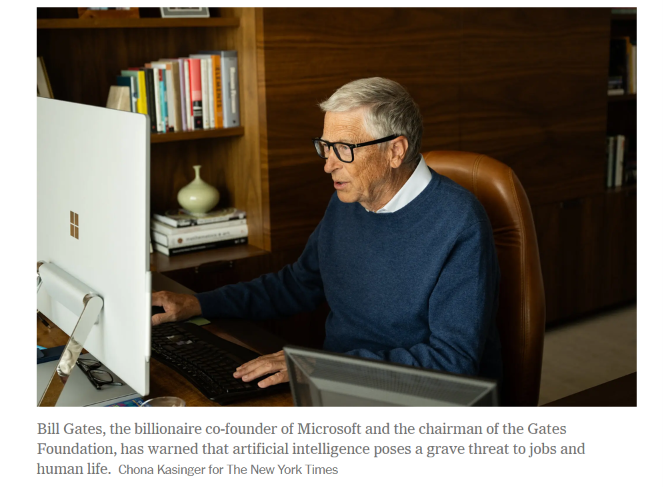
Modal Path Ethics owes Bill Gates an apology. This is unfortunate because the entire argument is staying.
On August 26, during the brief period in which Modal Path Ethics connected itself to Substack and immediately became a mobile artillery platform for whatever proposition happened to wander into view, it published an article titled:
Bill Gates Has Confused “Humanity” With “Employment.”
This was an aggressive title.
The article underneath it then opened with the general proposition that Bill Gates had decided to save humanity from artificial intelligence and somehow arrived, within approximately thirty seconds, at:
We must stop Japan’s elderly from receiving care.
This movement requires review.
Modal Path Ethics would therefore like to begin the apology by carefully reconstructing why the original article was correct.
This may take some time.
Review the Tape.
Bill Gates had written an unusually serious essay about artificial intelligence.
He did several things Modal Path Ethics had been demanding that people do for months.
He treated artificial intelligence as an institutional transition instead of a magical software event. He connected employment, taxation, education, inequality, security, mental health, governance, and international coordination. He explicitly rejected the idea that everyone displaced by automation can simply be retrained into another job. He proposed stronger social protections. He argued that governments are wildly underprepared.
Then Bill Gates introduced Human Reserved.
The idea came partly from his father's final years. Gates described the paid caregivers who looked after his father through Alzheimer's disease and wrote that something in their care was irreplaceably human. From there he proposed reserving some activities for human beings even where machines could technically perform them. The metaphor was a nature reserve: territory society deliberately protects from development because something valuable would otherwise disappear.
This is compassionate.
Unfortunately, the metaphor remains incredible.
A nature reserve exists because development is understood to be the ordinary territorial process outside the fence.
The forest gets a sign.
The road stops here.
Please remain on the trail.
Do not disturb the teachers.
Human jurors nest in this region from March through October.
Construction workers are easily startled.
No automated feeding after sunset.
Under Human Reserved, the conceptual map has already done something extremely strange.
Artificial intelligence appears to own the surrounding economic territory.
Humans receive conservation easements.
- Bill Gates was trying to protect people.
- Modal Path Ethics looked at the noun.
- The noun was in trouble.
RELEASE THE CAREGIVING ROBOT.
Then Gates supplied the counterexample himself.
He acknowledged that different places may draw these boundaries differently. Some societies might insist on human elder care. Japan, facing an aging population and a shrinking labor force, might actively welcome caregiving robots.
Exactly.
Modal Path Ethics regrets to report that the elderly Japanese person has breached the preserve.
The robots are inside.
Nobody panic.
This is where the original article had its strongest point.
Suppose an older person cannot reliably obtain adequate care because there are too few caregivers.
Now suppose a machine can:
- help them stand;
- remind them about medication;
- notice a fall;
- bring them food;
- summon a clinician;
- translate speech;
- help them communicate;
- perform exhausting repetitive physical work;
- remain available at three in the morning.
The moral question does not begin with:
Did a human keep the job?
It begins with the person receiving care.
What became reachable for them? What disappeared? What relation changed? What does the machine do well? What does it fail to perceive? Can the person refuse it? Can they still obtain human contact? Does automation increase isolation? Does it reduce neglect? Who owns the machine? Who receives its data?Who can override it? Who carries responsibility when it fails?
- That is a field.
- “Human caregiver: yes/no” is an employment category.
Those are different objects.
Sometimes preserving the human worker preserves the relation.
Sometimes introducing the machine preserves the relation.
Sometimes the machine should assist the caregiver.
Sometimes the person may actually prefer the machine for an intimate task because embarrassment, privacy, consistency, language, fear, disability, or simple personal preference changes the encounter.
Sometimes the machine will be catastrophically worse.
Now we are doing ethics.
The human being gets to remain in the picture.
The Job Has Been Caught Impersonating the Human Again.
Employment currently carries an absurd amount of civilization.
Income. Health insurance. Housing access. Status. Routine. Adult legitimacy. Social contact. Evidence of competence. Retirement. Identity.
A reason people are permitted to spend eight hours of Tuesday doing something other than visibly producing income somewhere else.
Losing a job can therefore be devastating.
Gates is completely right to take that devastation seriously.
The next inference does not automatically follow.
If employment is carrying nine human goods, and automation destabilizes employment, there are two possible projects.
- One is to preserve enough employment that people retain access to the goods.
- The other is to stop making one instrument carry every goddamn human good.
Modal Path Ethics has been arguing for the second transition under Post-Money.
That does not require everybody to become unemployed and begin playing robo-bongos in a fully automated public park.
Work contains real goods. Contribution is real. Mastery is real. Difficulty is real. Responsibility is real. Being needed is real. Colleagues are real. Rhythm is real. Building something difficult with other people is real.
The mistake is allowing the job to acquire title over all of those goods.
If machines eventually produce enormous quantities of useful work, the astonishing civilizational response would be to preserve artificial scarcity of human labor so that people remain eligible for food.
- We built the machine.
- The machine performed the labor.
- Then somebody apparently remembered that everyone still needed a timesheet.
This is a design problem.
Unfortunately, Bill Gates Appears to Have Escaped Bill Gates.
Here is where the apology acquires some actual force.
Three weeks after Modal Path Ethics dramatically accused Bill Gates of drawing occupational wildlife preserves around humanity, the Gates Foundation announced that it will spend at least $1 billion over the next two years expanding equitable access to artificial intelligence.
The program is aimed at education, health care, agriculture, and the digital foundations required to make systems work in more of the world's languages. The Foundation says communities should participate in deciding how data is governed and that doctors, teachers, farmers, developers, and other users should gain the capacity to evaluate and adapt the systems themselves.
Hold on.
What happened to the preserve?
- The teachers have tools.
- The health workers have diagnostic support.
- The farmers have artificial-intelligence advice.
- The locals have been authorized to modify the habitat.
Bill. My man.
There are machines everywhere.
This is much closer to the right picture.
The human does not survive because a fence keeps intelligence away.
The human remains principal because the technology enters an existing human relation under conditions people can inspect, shape, accept, reject, and revise.
A teacher with an artificial-intelligence tool has not ceased being a teacher.
A physician using diagnostic support has not surrendered medicine to a machine.
A farmer receiving locally grounded agronomic information has not been deleted from agriculture.
The relevant question is what the combined relation does.
This is exactly why “Human Reserved” bothered Modal Path Ethics in the first place.
And Bill Gates's own foundation is now providing excellent evidence against the strongest interpretation of Bill Gates's metaphor.
Very inconsiderate.
Bill Gates Was Also Asking the Better Questions.
There is another problem with my original headline.
Gates did not actually write as though jobs exhaust humanity.
His August essay openly asked who should decide the Human Reserved boundaries, admitted he did not know the answers, called for workers and communities to participate in designing the transition, argued for stronger social protections, and repeatedly framed the central problem as whether artificial intelligence benefits people who currently lack wealth, influence, and access.
Yesterday he went further, telling Reuters that governments remain seriously unprepared for artificial intelligence while emphasizing both risks and the possibility that it could improve life for the world's poorest if access is managed equitably.
So:
“Bill Gates Has Confused Humanity With Employment”
was simply too large.
The actual criticism was narrower.
Human Reserved risks confusing the preservation of human relations with the preservation of human job categories.
That sentence is less funny.
It is also more accurate.
Dammit.
Oh Right. The Apology.
Modal Path Ethics appears to have become distracted.
This article was supposed to apologize to Bill Gates.
Instead, I have retrieved the deleted article, removed some unnecessary hostility, added several weeks of additional evidence, strengthened the central objection, and spent most of the available space prosecuting the phrase Human Reserved again.
So this seems relevant to the apology.
The original article was written during the Substack experiment that Modal Path Ethics later audited as the Argument Machine: a grim period in which existing results were rapidly converted into fresh targets, correctness became reason to continue, and people began carrying much more analytical force than the scale of the encounter warranted.
Bill Gates became one of those targets.
- There was a real argument.
- There was also a person being compressed into the argument.
The essay itself contained more uncertainty, more concern for distribution, more institutional thinking, and more openness to mixed human-machine arrangements than the headline allowed.
My headline made Bill Gates personally own a category error that actually belongs to a much larger political economy.
Employment has been impersonating humanity since long before Bill Gates gave the problem a wildlife preserve.
That distinction should have been preserved.
So:
Sorry, Bill.
You were trying to protect human beings during a transition that could hurt an enormous number of them.
Modal Path Ethics turned a disagreement with one of your instruments into a judgment about what you had confused humanity with.
That was simply too much.
The new billion-dollar program also looks considerably closer to the path Modal Path Ethics wanted than the original article gave you credit for.
This apology is therefore sustained.
Human Reserved remains under review.
The caregivers may leave the enclosure.
Please do not feed the construction workers.

Comments ()