
WAICO Is the Hard Case
Multipolarity can distribute crowns without abolishing the crown.
On June 25, Zhaslan Madiyev signed Kazakhstan into one artificial-intelligence future in Washington.
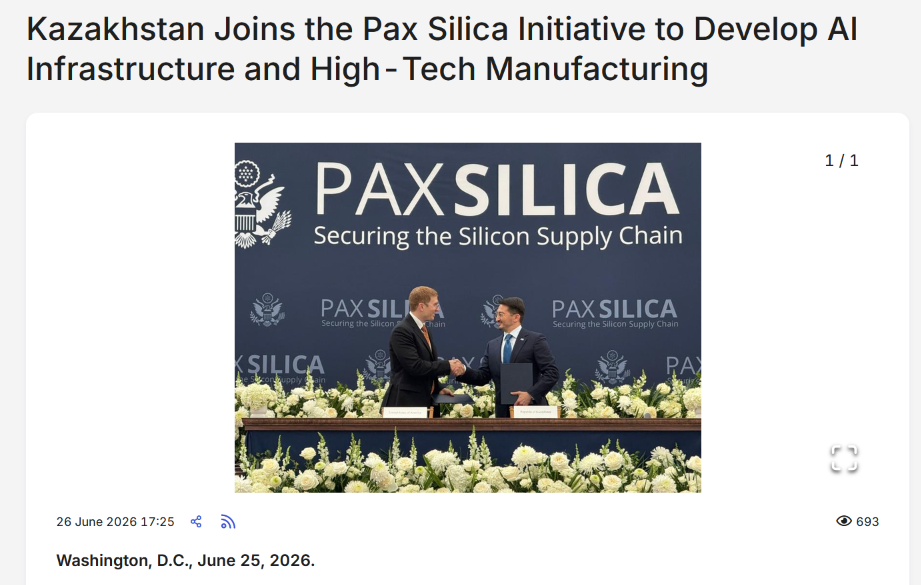
The agreement brought Kazakhstan into Pax Silica, the American-led initiative organized around artificial intelligence, semiconductors, critical minerals, data centers, energy infrastructure, advanced manufacturing, research, and technical talent. Madiyev, Kazakhstan’s deputy prime minister and minister of artificial intelligence and digital development, described it as a route toward investment, technology transfer, domestic processing, new data centers, and a larger place in the technological supply chain.
Three weeks later, Madiyev appeared in Shanghai and signed Kazakhstan into another future.
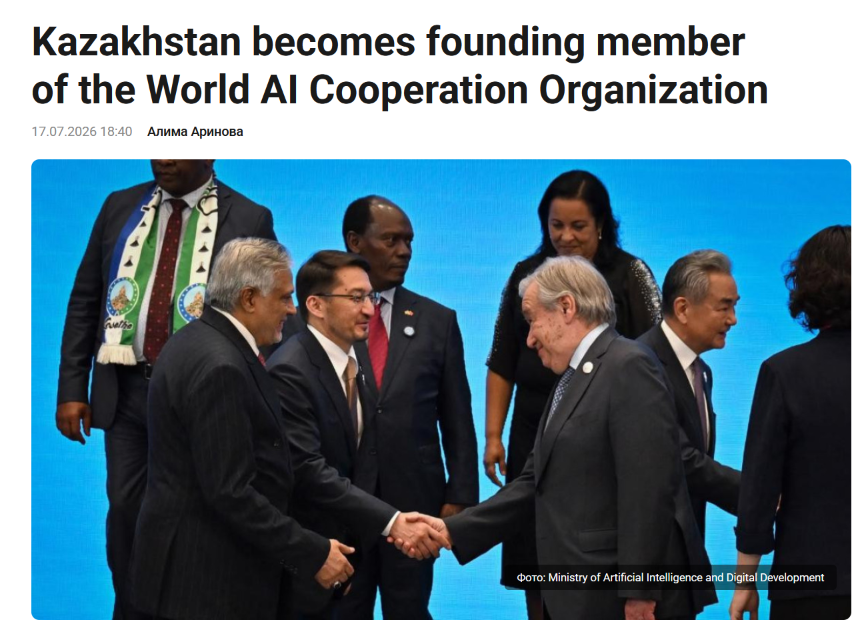
This document established the World Artificial Intelligence Cooperation Organization: WAICO. Twenty-nine states signed on July 16. The new organization would be headquartered in Shanghai and devoted to international cooperation and governance around artificial intelligence.
Washington noticed this.
Reuters later obtained a draft State Department letter warning that countries participating in a competing Chinese initiative could be excluded from the American coalition. Kazakhstan was the only country then known to belong to both. The draft was unfinished and may still change.
Its constitutional demand was already clear: choose.
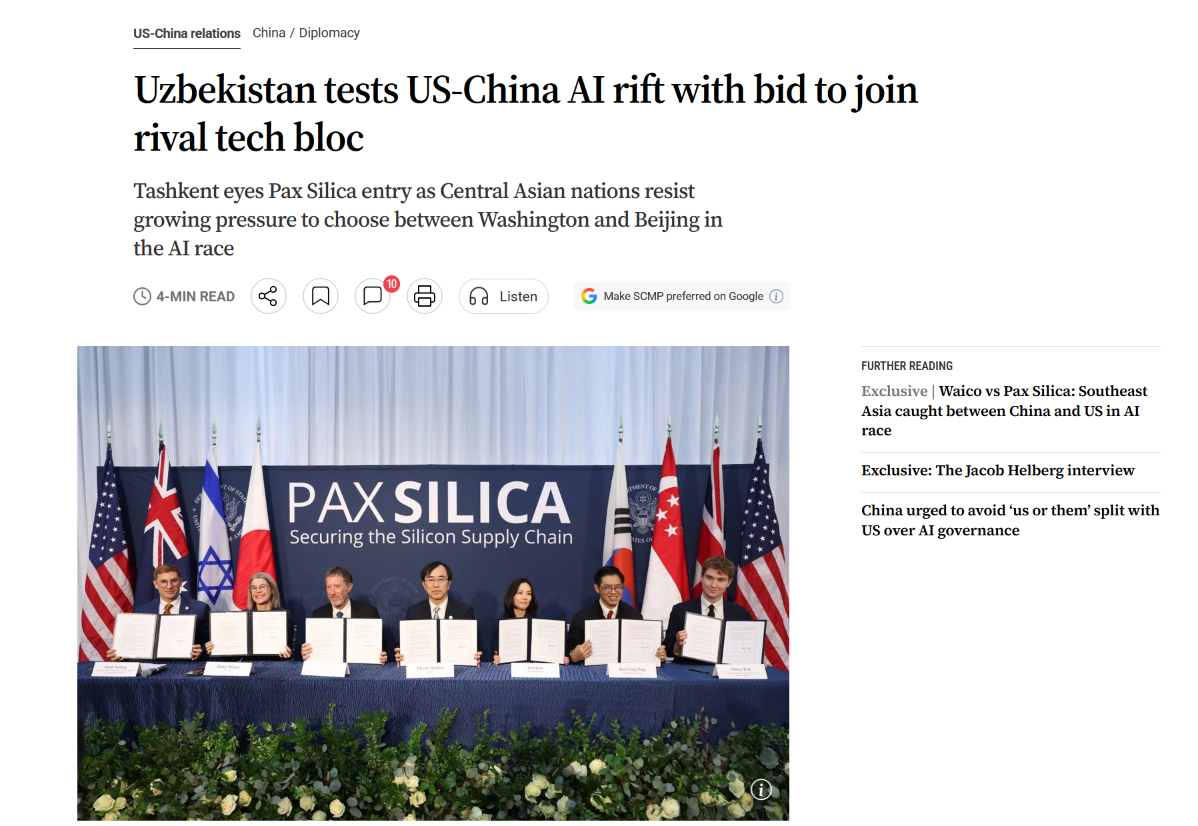
Uzbekistan has made the same problem impossible to dismiss as one country’s scheduling error. It joined WAICO, then formally asked the United States to admit it to Pax Silica. Its ambassador said countries should have the chance to participate in different forms of international cooperation and called technological red lines counterproductive.
A country keeping two doors open is not confused.
Sometimes, the second door is the whole point.
WAICO.
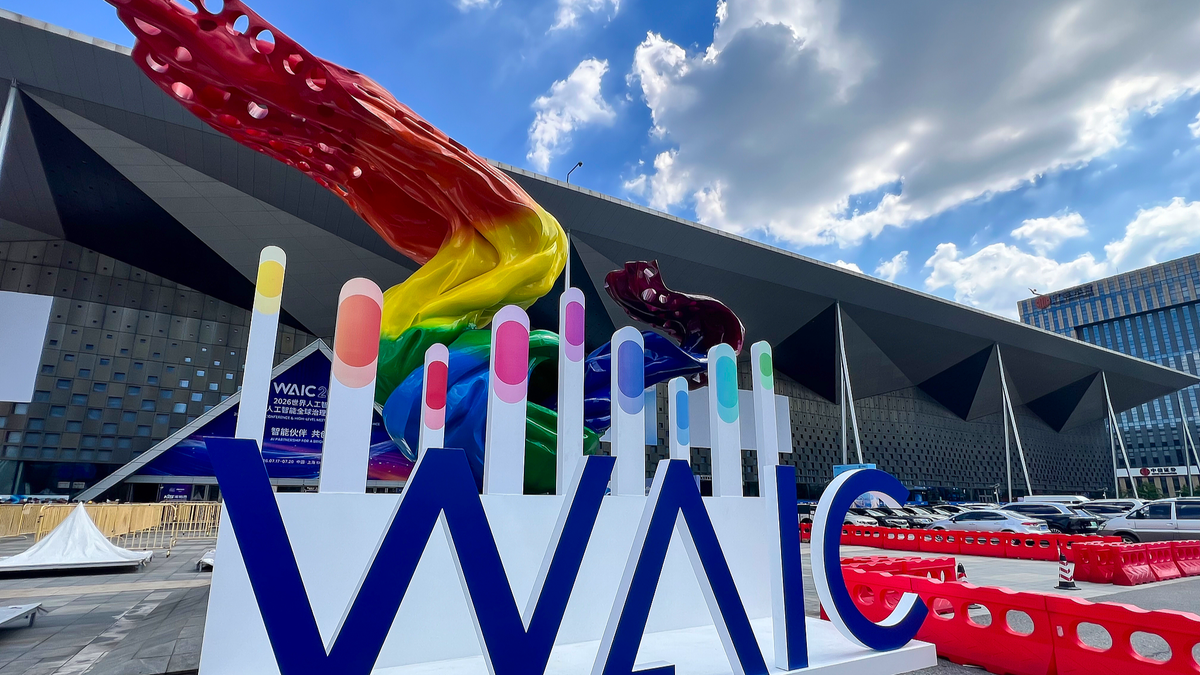
That name does WAICO no favors. It sounds like a conference acronym, which is especially inconvenient because it was indeed born beside the World Artificial Intelligence Conference, or WAIC, in Shanghai.
("Pax Silica" is much more striking, just saying.)
But WAICO is supposed to be something more durable.
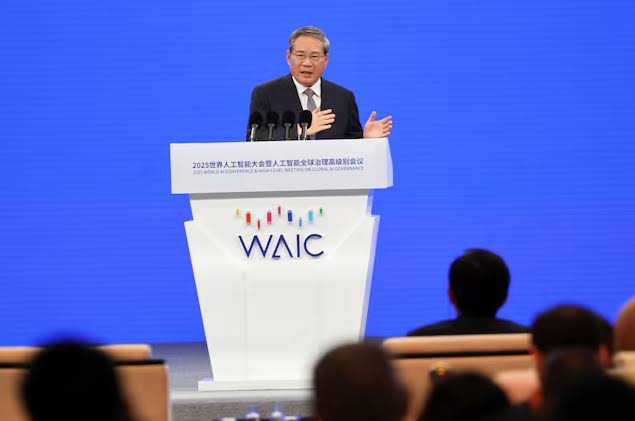
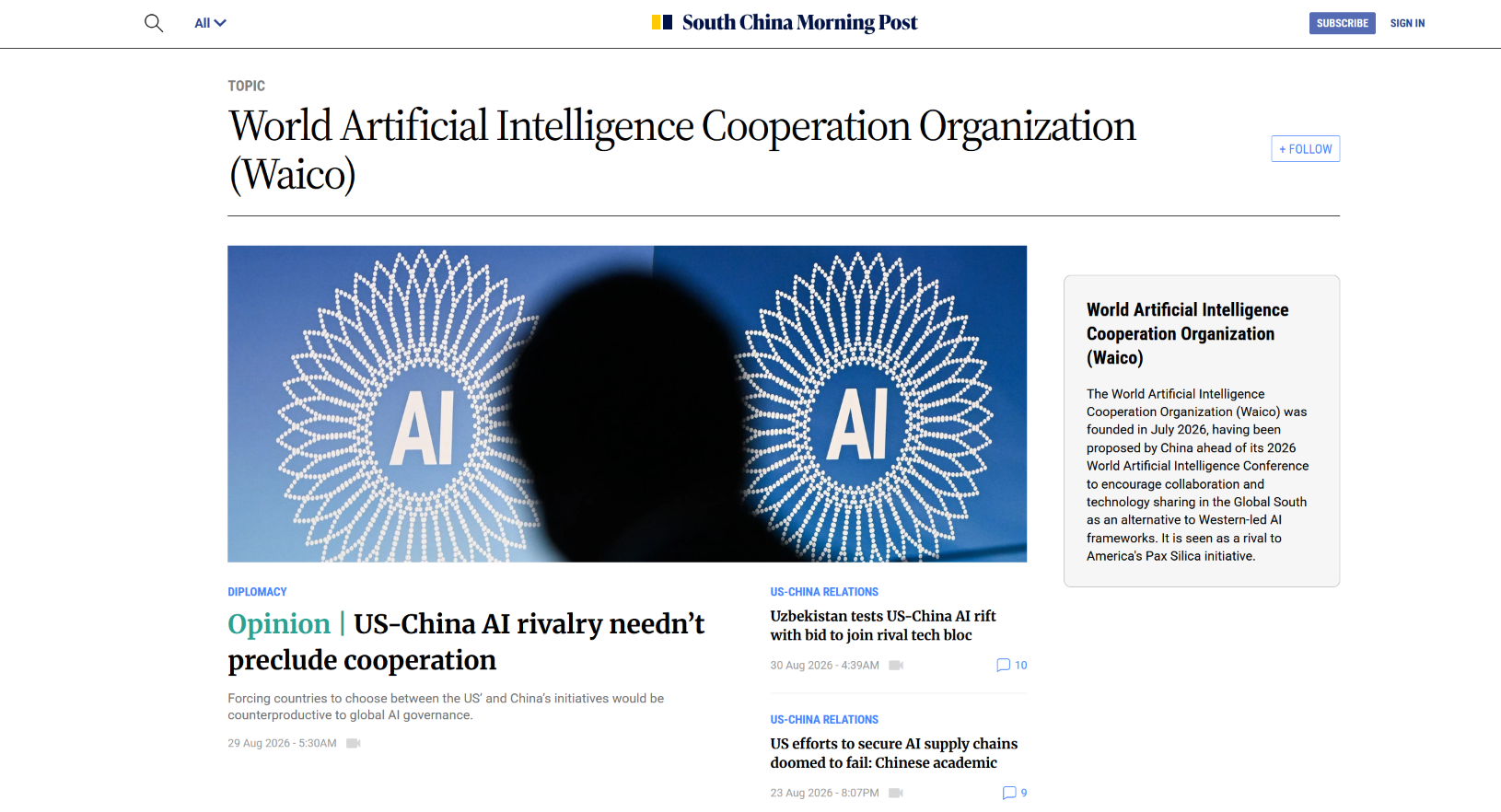
Chinese Premier Li Qiang proposed it at the 2025 conference. On July 16, 2026, representatives of twenty-nine countries signed its founding agreement. By August 12, Chinese Foreign Minister Wang Yi said thirty-eight countries had become founding members.
WAICO is an independent intergovernmental organization with a permanent headquarters in Shanghai, rather than an annual summit or a voluntary company alliance.
The treaty gives it a Council of member states and a Secretariat. Each member state receives one vote. The Council seeks consensus; where consensus fails, ordinary decisions can proceed by a two-thirds majority of members present and voting. Member contributions are to be set through an agreed assessment that takes economic capacity into account.
Its functions are formally limited to civilian artificial intelligence.
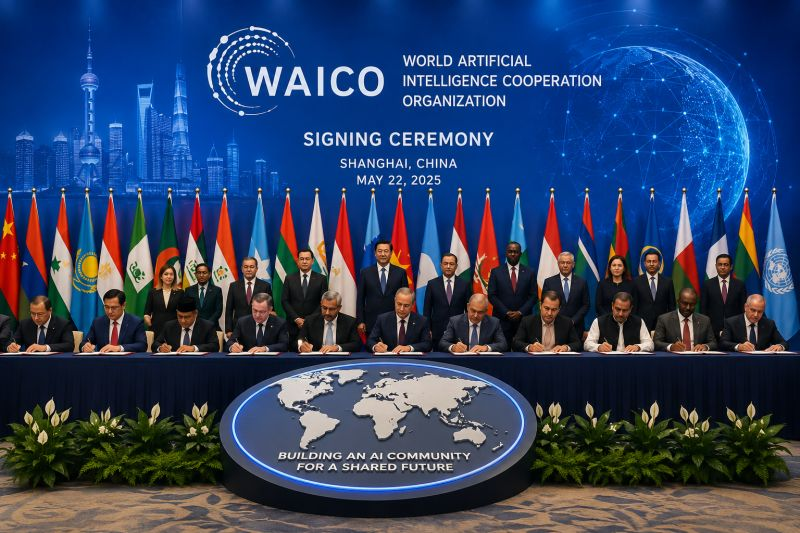
Its intended work includes capacity-building, supply-demand matching among member states, cooperation among national artificial-intelligence strategies, governance rules, technical standards, and interoperability. China presents WAICO as a way to make artificial intelligence beneficial, safe, and fair while giving the Global South a larger role in deciding what exactly those words will mean.
The treaty has created a governing structure. The first budget, appointments, working groups, standards projects, contracts, and disputes will show whether they acquire enough capacity and independence to matter. WAICO has still crossed from principles into organization: it can eventually write standards, move technical capacity, and make one account of responsible development easier to act upon than the alternatives.
Strongest Defense of Sovereign Equality.
China explicitly places WAICO inside its Global Governance Initiative.
The Global Governance Initiative names five commitments:
- sovereign equality,
- international rule of law,
- multilateralism,
- a people-centered approach, and
- real results.
It calls sovereign equality the “foremost premise” of global governance. Large and small states, rich and poor states, should be able to participate, decide, and benefit as equals. The initiative says the United Nations should remain central and presents its project as reform of the existing international system rather than construction of a separate world order.
On September 1, the first anniversary of the Global Governance Initiative, China made that relationship more explicit.
Its Foreign Ministry named WAICO, the World Data Organization, and the International Organization for Mediation as concrete results of the initiative. It said nearly 160 countries and international organizations had expressed support for the Global Governance Initiative and more than sixty countries had joined its Group of Friends.
Those are Chinese government counts, rather than an independent measure of agreement with every part of the initiative. They do show how China understands the project: not as one new world institution, but as a growing set of institutions through which different pieces of global coordination can be carried.
These are all claims made by the Chinese government about the order it wants to build. They do not prove how China will act when power, security, and advantage collide.
They also name a real injury.
A state may possess one vote in an international chamber and still arrive at the artificial-intelligence future with no serious capacity to shape it. Formal sovereignty does not provide chips, power, data centers, engineers, independent models, or the money required to inspect and replace a system. Most countries buy access to models they did not train, run them on infrastructure they do not own, and accept standards written elsewhere.
“You are sovereign” is thin comfort when every usable instrument arrives with somebody else’s switch attached.
WAICO’s strongest case begins there.
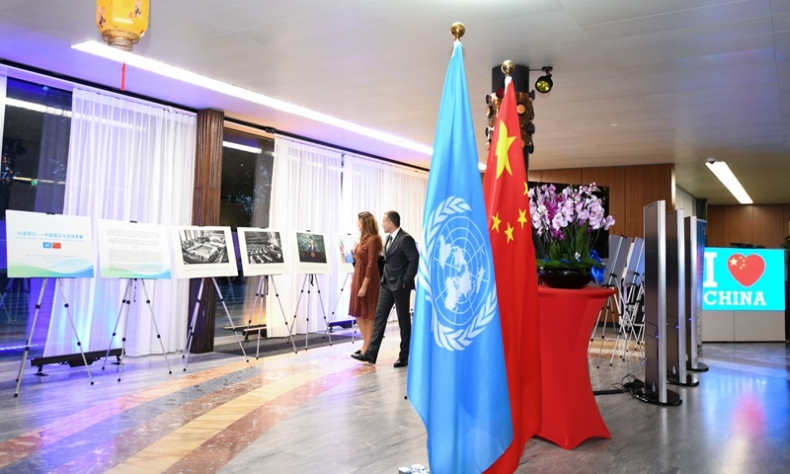
China says it will provide developing countries with 5,000 artificial-intelligence training and seminar opportunities over five years, establish application-cooperation centers with ASEAN, the Arab League, the African Union, CELAC, the Shanghai Cooperation Organization, and BRICS, and extend its MAZU weather-warning system to thirty countries.
These are Chinese commitments announced alongside WAICO, not money already appropriated by WAICO itself. Their direction is still important: governance is being joined to training, software, infrastructure, and practical use.
A country offered only rules has not been offered equal participation. It has been offered a better explanation of its dependence.
Capacity-building can change that relation. A smaller state may gain models it can run, standards expertise, bargaining power among providers, and the ability to reject one system without losing the entire function. Sovereign equality can protect against technological empire.
Kazakhstan and Uzbekistan are testing the promise in public. They are asking Washington and Beijing to stop treating useful cooperation as title over every later relationship.
This Treaty Is Annoyingly Serious.
The easy article writes itself:
- China creates an organization in Shanghai,
- friendly governments join it,
- and Chinese standards travel outward.
- We announce that authoritarianism is bad and go home before dinner.
- friendly governments join it,
There are serious reasons for suspicion. China initiated the organization, hosts it, and possesses more technical, diplomatic, and financial capacity than most of its members. The state providing models, infrastructure, training, standards expertise, and a headquarters can exercise influence that no voting rule fully captures. Formal equality can coexist with material dependence.
China’s domestic standards system gives it an enormous head start. On August 26, its Ministry of Industry and Information Technology said China had already formulated nearly two hundred key artificial-intelligence standards spanning research, design, production, manufacturing, quality inspection, operations, and maintenance. It is also organizing artificial-intelligence ethics-review practices across multiple cities.
None of that proves WAICO is a puppet.
If I wanted to dismiss it that easily, the treaty would be annoyingly uncooperative.
- China receives one Council vote and holds no formal veto over ordinary decisions.
- Consensus is preferred;
- the fallback is a two-thirds vote.
- A permanent Secretariat and assessed contributions keep the organization from depending entirely on whichever donor arrives with the largest check.
Those provisions can fail. A Secretariat can depend on its host. Working groups can be dominated by members able to send full-time experts. Countries can vote equally after contracts, infrastructure, and training have already narrowed their menu. WAICO should be judged by what its members can still do after disagreeing with it. The first test is already here:
Can membership remain nonexclusive?
The American case for exclusivity is serious. Chips, models, critical minerals, cybersecurity, and infrastructure have security consequences. A trusted-supply coalition may need members to disclose conflicting duties and protect sensitive work. The draft demand from the State Department goes further than that: participation in another technological institution becomes evidence that a state cannot be trusted inside this one.
One useful relationship begins to claim jurisdiction over the rest.
The alternative Kazakhstan and Uzbekistan are testing is stronger: use American chips where they are best, Chinese models where they are affordable or open, and domestic capacity wherever it can be built. Keep enough alternatives alive that no one provider can convert indispensability into obedience.
WAICO may genuinely help keep the technological world plural.
That is why it is the hard case.
Then the Pieces Started Connecting.
And while I was writing this, the architecture moved again.
On September 1, Uzbek President Shavkat Mirziyoyev proposed that the Shanghai Cooperation Organization become “among the first partners” of WAICO. He also proposed an SCO Open Multilingual Data Corpus and offered to host an SCO forum on artificial intelligence and new digital solutions in Tashkent next year. The partnership and corpus are proposals. They have not yet become WAICO institutions.
The surrounding machinery is further along.
At the same summit, SCO member states adopted a concept for regional data-processing centers, computing capacity, and development of the artificial-intelligence industry. Their governments also signed a memorandum on cooperation in artificial intelligence. The regional-compute concept had already been approved earlier in the year by the relevant SCO agencies; the heads of state have now placed it inside the organization’s adopted summit package.
Put those pieces beside one another.
- Sovereign states want more bargaining power over artificial intelligence.
- They cooperate regionally on compute and data infrastructure.
- They develop shared artificial-intelligence policy.
- One of those states proposes a multilingual common corpus.
- Then it proposes connecting that regional machinery to a global organization responsible for capacity-building, governance rules, technical standards, and interoperability.
None of those steps is suspicious by itself.
A shared multilingual corpus could protect languages that otherwise remain marginal in American and Chinese training systems. Regional compute can make smaller countries less dependent on a handful of foreign cloud providers. Common standards can make systems portable instead of trapping every institution inside one vendor. Cooperation between regional and global bodies can keep every country from having to reconstruct the same technical capacity alone.
This could be exactly what sovereign equality looks like when it acquires servers.
And that is where the constitutional problem becomes interesting.
The danger is not that these institutions fail to coordinate. The interesting problem begins if they succeed.
A world of several technological centers, overlapping memberships, regional compute, multilingual data, interoperable systems, and formally equal states would be much better than a world divided between two compulsory technological empires.
It could also create a common layer through which more and more consequential action has to pass.
Every step into that layer can be individually defensible. The data need to travel. The systems need to understand one another. Smaller states need infrastructure. Standards reduce friction. Shared models can expose dependencies no government can see alone.
Eventually the question changes.
Who can correct the common layer?
Not which superpower controls it.
Not which flag hangs above the server room.
Not whether thirty-eight governments received equal votes.
Who can make it encounter something its governments, standards, datasets, and models did not already know how to receive?
That question survives even if WAICO works exactly as advertised.
Where Sovereign Equality Stops.
- WAICO passes the multipolarity test.
- It has not passed the post-sovereignty test.
The Global Governance Initiative asks whether every country can enter global governance as an equal. The answer is important. A world in which five powerful governments and a few frontier companies write every consequential rule is indefensible.
But the next question is harder:
Why is the country the place where the constitutional inquiry stops?
WAICO’s governing subject is the sovereign state.
States join. States sit on the Council. States vote. Disputes over the agreement are settled through consultation among member states. The organization calls itself people-centered, yet its founding agreement gives workers, cities, communities, and other affected positions no direct vote or independent governing place of their own. At the constitutional center, they all reach WAICO through states claiming to represent them.
A government may be badly dominated by Washington or Beijing. Giving that government an equal international seat is a real correction.
The worker inside its artificial-intelligence policy has not thereby received a seat.
Neither has the city hosting the data center, the community carrying its mine or water burden, the laboratory dependent on a common model, or the person classified by the resulting system.
Their claims still reach the global institution through the sovereign that says it speaks for the whole field.
This does not require turning every international standard into a universal town hall. Someone has to negotiate. Governments possess public authority, diplomatic machinery, budgets, and the capacity to make agreements binding. The state can protect its people against foreign coercion and keep larger powers from bargaining with every locality separately.
The promotion arrives when that protective role becomes final title.
A state is not one mind. It contains governments, regions, cities, firms, unions, professions, communities, political opponents, ecologies, and people whose futures collide. International sovereign equality can protect all of them from an external hegemon while giving their government greater capacity to act over them through standards, infrastructure, data systems, and technical dependencies formed beyond their reach.
Multipolarity can distribute crowns without abolishing the crown.
A post-sovereign constitution keeps the coordination and refuses the promotion.
States may negotiate, fund institutions, close decisions, and protect common functions. Their authority remains bounded to the work that warranted it. The routes through which affected people, institutions, and places expose failure cannot belong entirely to the state whose account is being challenged.
That is the threshold WAICO has not yet crossed.
The Standards Test.
The most consequential part of WAICO may become the least cinematic:
technical standards.
Standards let one system receive another, allow smaller institutions to build compatible tools, and make replacement possible without rebuilding the world from zero. Shared tests expose failure. Common documentation helps a government inspect a model instead of taking the provider’s word. Interoperability can weaken a monopoly. WAICO should do this work, and its standards process will reveal the constitution forming beneath its diplomatic language.
There is currently no evidence that WAICO has adopted China’s domestic artificial-intelligence standards. China’s nearly two hundred standards matter because they show that one member arrives with an unusually mature grammar ready for use. They do not prove the organization will accept that grammar, much less that every Chinese standard is defective.
The standardization question is now less hypothetical than it was when WAICO was signed.
The SCO already has an adopted plan for regional data centers, computing capacity, and an artificial-intelligence industry. Its governments have signed an artificial-intelligence cooperation memorandum. Uzbekistan is proposing a shared multilingual corpus and a formal relationship between the SCO and WAICO. None of this is yet a WAICO standard, and the proposed SCO-WAICO partnership may never take the form Uzbekistan wants. The direction is enough to expose the test.
If these pieces connect, technical standards will not float above the material world as documents. They will meet shared datasets, compute, infrastructure, models, procurement, training, and institutions already built to cooperate.
That can be excellent. It can also make the common representation extraordinarily consequential.
- Can several model families use the same standard without one implementation becoming authoritative?
- Can a country reject a WAICO standard and still remain interoperable with the institutions it depends upon?
- Can the proposed multilingual corpus preserve source differences, provenance, and minority languages instead of turning them into one convenient training object?
- Can an affected community challenge what a shared dataset says about it without first persuading its national government to reopen an international agreement?
- Can a laboratory reproduce a disputed result without renting the infrastructure of the institution it is challenging?
- Can a member leave one provider while keeping its records and public functions alive?
- Can WAICO change a standard after governments, companies, and public infrastructure have reorganized themselves around it?
- And can the treaty’s civilian boundary survive the moment artificial intelligence touches cybersecurity, critical infrastructure, dual-use models, strategic supply chains, and national-security claims?
The danger is not common language. Civilization runs on common language.
The danger is common language becoming the price of reality having consequences.
The Inner Apocalypse is political form surviving after its plural interior collapses. Elections, ministries, national flags, international votes, and public consultation can all remain visible. The failure occurs when every consequential path passes through one shared account of what the world contains and what may be done.
Thirty-eight flags do not create thirty-eight independent interiors if every consequential system eventually has to speak through one reader.
WAICO has not done this. Its test is whether it can help states escape technological enclosure without building a common layer that encloses everything beneath them.
Ruling
WAICO should exist. The artificial-intelligence future should not belong to a small group of states, laboratories, cloud companies, and infrastructure owners. Countries outside the present centers of capacity need an institution able to carry training, technical cooperation, bargaining power, and real projects.
Membership should remain nonexclusive. The United States should not require Kazakhstan, Uzbekistan, or any other country to surrender one technological relationship as the price of another. Security obligations can be specific. One coalition does not acquire a country’s entire future because cooperation inside one field became useful.
WAICO should receive credit when its plurality is real. If members can disagree with China, build with several technological ecosystems, reject a proposed standard, retain independent capacity, and continue participating with equal institutional force, that will be a genuine anti-hegemonic achievement.
Its common layers must remain instruments. Standards, shared data, compute, interoperability, and regional cooperation should make departure easier, evidence more portable, and common work more capable. Shared infrastructure should increase the number of institutions able to act without asking one technological center for permission. A common language becomes dangerous when it becomes the only language through which a person, institution, or country can make reality consequential.
And sovereign equality is not post-sovereignty.
Kazakhstan and Uzbekistan are making a defensible demand: do not make us live inside one technological future because one powerful institution got there first.
Excellent.
Now carry that principle all the way down.
- A state should not have to surrender every other future to enter an American system.
- A worker, city, laboratory, community, or later institution should not have to surrender every other future because its state entered a global one.
WAICO is the hard case because much of what it is trying to do is right.
Keep the coordination. Keep the second door open. Refuse the crown.
The next constitution begins where sovereign equality stops.


Comments ()