Applied Case: The Streets Have Standing
India, France, Spain, Serbia, and the Democratic Republic of the Congo are confronting different failures and disputes in public authority. The question connecting them is what an answer from the public can still make an institution do.
On Saturday, October 10, Indian authorities detained thousands of protesters and severely restricted movement through New Delhi. Demonstrators wanted the resignation of the country's chief election commissioner. Their central grievance concerned an electoral-roll revision that removed approximately 130 million names. The Election Commission says it is correcting defective records; critics allege that eligible voters have been excluded. Those are different claims requiring evidence about actual voters, not a bolded number large enough to win any argument by itself.
On Sunday, India's Supreme Court told authorities to allow lawful peaceful assembly and normal transport and internet services, subject to public-order conditions. The court's intervention addressed the state's response to the protests. It did not decide whether the names had been lawfully removed from the electoral rolls.
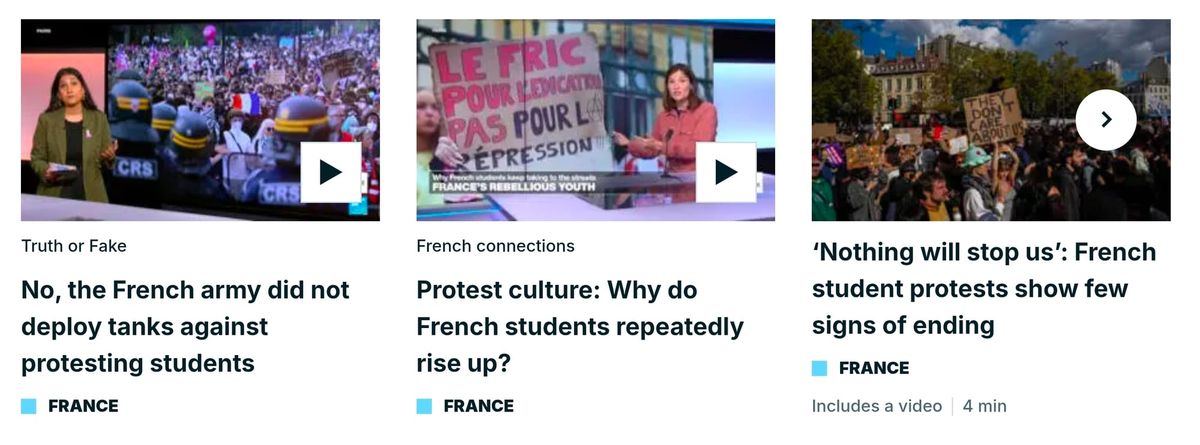
Meanwhile, an estimated 266,000 people had marched in France on October 6, according to the Interior Ministry; organizers put the turnout at 450,000. Students were demanding teachers and usable schools. Spain was preparing for an early election after parliament rejected two emergency housing decrees in a crisis accelerated by the eviction of an 87-year-old woman. She died in hospital on October 7.
Serbia is approaching an October 25 parliamentary election after sustained student-led protests. In the Democratic Republic of the Congo, opposition demonstrators have contested discussion of constitutional changes that they fear could permit a further presidential term.
Five countries. Different histories, institutions, demands, and legal routes. This is not one organized global uprising. Nor is every protest a constitutional crisis, every police action unlawful, or every popular demand correct. The evidence also does not show that artificial intelligence caused these events.
What the collisions expose is narrower, and more useful. The Inner Apocalypse asks what happens when institutions retain their recognizable forms after independent voices lose the material ability to change the decisions being made around them.
What can an answer from outside an institution still make that institution do?
India: Who Gets On the Board?
The vote is an excellent democratic instrument. But the thing is considerably less useful to the person who cannot get onto the list of people entitled to cast one.
Articles 324–326 of India's Constitution constitute electoral administration, prohibit exclusion from electoral rolls on specified discriminatory grounds, and provide for adult suffrage. They do not make every existing voter-roll entry permanently valid. People, it turned out, die, move, appear in duplicate, and become subject to lawful verification. Records need maintenance.
They also need correction.
The Election Commission defends its Special Intensive Revision as an effort to remove invalid entries. Opposition parties and the youth-led Cockroach Janta Party allege that the revision has wrongly excluded eligible voters, with disproportionate effects on minority communities. The approximately 130 million deleted entries must not be converted, without verification, into a claim that 130 million eligible individuals were unlawfully disenfranchised. That would replace the disputed object with a slogan.
Then the route for challenging the dispute encountered another set of gates.
Delhi police and other authorities restricted public movement, detained demonstrators and some political figures, and interrupted transport and internet access. The government cited public-order concerns and the denial of permission for the planned demonstration. Protesters and rights advocates contested the scale and legality of the restrictions. Reporting on the number of detainees has varied, so there is no reason to force the reports into one falsely exact total.
On October 11, a special sitting of the Supreme Court instructed authorities not to detain peaceful, unarmed people outside lawfully restricted areas except through established legal procedure, which is a good rule in general. It directed normal metro and rail operations, undisturbed internet services, and access to the courts, with stated public-order qualifications. Several movement leaders were separately released through judicial proceedings.
The state is not one sealed machine. One constituted authority has issued consequential directions concerning another's restrictions. Whether those directions are carried out is a further question, not an automatic consequence of the words being entered.
And the underlying electoral issue remains separate. Protecting a demonstration does not itself restore a wrongly removed voter, if one has been wrongly removed. For that correction, a person needs notice, usable evidence, an appeal that can reach an independent decision, and an operative remedy before the relevant election.
The constitution can protect both roads. A court reopening one does not establish that the other is open.
France: School Is Open.
France's 1946 constitutional preamble, incorporated into the contemporary constitutional order, guarantees equal access to education and makes the organization of free, secular public education a duty of the state.
A school can have a name, an entrance, an enrollment register, and a timetable while the teacher needed to deliver that timetable is absent.
The current movement grew from grievances about staffing, overcrowded classes, and deteriorating facilities. On October 6 the Interior Ministry counted roughly 266,000 demonstrators nationwide; high school and university organizers estimated 450,000. Thousands of people were protesting circumstances encountered in ordinary classrooms, not demanding one coherent constitutional amendment.
The response has included violent confrontations and serious injuries. A 15-year-old lost a hand in an incident involving a police grenade in Lens. Interior Minister Laurent Nuñez suspended the use of stun grenades during the student protests while that incident was investigated. Police officials have defended the broader public-order operation; rights groups and student organizations have challenged the use of force. These claims require close assessment of the actual encounters, including the injuries suffered by demonstrators, school staff, and officers.
The government has also made material commitments. On October 9 it pledged the deployment of 3,000 qualified educators to schools with acute shortages. The Education Ministry opened a national student consultation through October 23 and set out work on staffing, timetables, buildings, admissions, and representation. Those are two different interventions. The ministry can organize teaching; the regional councils are responsible for public high school buildings.
This is evidence of a response, including a staffing commitment that student unions have described as an initial gain. The work is not completed by announcing it. Those teachers must arrive where needed; the buildings must become usable; the proposed funding and administrative handoffs must survive actual budgets and delivery.
An online consultation can help reveal what the ministry missed. It cannot teach the missing lesson.
The constitutional claim is only as strong as the practical route through which it reaches the classroom.
Spain: The House Was Still There.
María del Carmen Abascal lived in her Madrid apartment for about seventy years. After the building was purchased by an investment company, a dispute over her tenancy culminated in a judicially authorized eviction on September 23. She was 87. The images of her removal brought an existing housing movement into wider public view; encampments and demonstrations followed in Madrid and other Spanish cities.
A negotiated agreement was eventually reached that could have allowed her to return. Abascal died in hospital on October 7 before she could do so. Her death and eviction belong in the chronology; their medical causal relation should not be established by metaphor.
Article 47 of Spain's Constitution establishes the right to decent and adequate housing and charges public authorities with promoting the conditions required for it. The legal route is a little more complicated than the slogan. Article 47 belongs among the Constitution's guiding social and economic principles; Article 53.3 governs their invocation through implementing law. The Constitutional Court's Judgment 17/2026 reiterates that Article 47 does not itself create a directly enforceable fundamental right to a particular dwelling and upholds the statutory formulation of a subjective housing right under Law 12/2023. Dissenting judges disputed the majority's analysis. That disagreement can not be edited out.
Nor can the existence of the constitutional promise alone determine whether Abascal's particular eviction complied with tenancy law. The relevant facts include the lease, ownership, judicial process, statutory protections, and the real alternatives available to the tenant.
The political sequence is equally concrete. Spain's government approved two urgent housing decrees; the Congress of Deputies rejected them on October 2. Prime Minister Pedro Sánchez announced early elections for November 29, and parliament was dissolved. On October 6 the government approved revised decree-laws containing 21 measures. Because parliament had been dissolved, the texts required ratification by the Permanent Deputation of the lower house. The government describes the measures as an answer to the housing crisis; parliamentary opponents challenged the original decrees, and their legal fate remained open.
There is no honest way to describe all this as a state incapable of answering protest. Legislators defeated measures. The executive responded. Voters are scheduled to choose another parliament. Other institutions may enforce, modify, or reject the proposed protections.
There is also no honest way to describe the housing injury as repaired by those events. An electoral date is not a tenancy. An emergency decree is just not a dwelling. An agreement to return can come after the person who needed it has run out of time.
The house was still there.
That was not enough.
Serbia: The Office Has Already Changed Hands.
The Serbian protests began after the collapse of a railway-station canopy in Novi Sad in November 2024, which killed sixteen people. Students and their supporters demanded accountability, challenged corruption, and pressed for an election. The country is now scheduled to vote for a new parliament on October 25, with observers deployed by the Organization for Security and Co-operation in Europe.
Here the chronology itself tests the theory. Aleksandar Vučić resigned as president on September 27 to contest the parliamentary election as a prospective prime minister. Ana Brnabić assumed interim presidential duties. The former president's political organization seeks to retain power; a student-backed electoral platform seeks to contest it. None of this determines the vote in advance.
A real election requires more than a date. On October 6, election authorities came under criticism for rules tying overseas polling-station hours to Serbian local time, complicating voting in distant time zones. The authorities' arrangements and their critics' concerns are part of the election's evidentiary field. The observation mission will examine voting, counting, and the wider electoral environment; it cannot certify the outcome before the election takes place.
The constitutional question remains whether an election can produce an operative change in government when voters demand one: ballot access, reliable counting, independent contest, acceptance of binding results, and functioning succession. An incumbent leaving one office while seeking another is a political fact. Whether the public retains an effective path to remove the governing arrangement remains a live test.
Congo: Who May Change the Last Word?
The Democratic Republic of the Congo presents the constitutional dispute in unusually explicit terms.
Article 220 of its Constitution prohibits amendment of specified foundations, including the number and duration of presidential terms, judicial independence, and political and trade-union pluralism. Article 218 provides ordinary procedures for constitutional revision. The two articles have different jobs. Procedure cannot be used as a substitute for examining the scope of the protected limit.
On September 15, opposition demonstrations in Kinshasa and elsewhere challenged discussion of constitutional changes that critics say could permit President Félix Tshisekedi to seek a third term. Reuters reported that the authorized Kinshasa demonstration began peacefully, then clashes broke out between protesters and pro-government supporters; people on both sides threw stones and brandished machetes, and police used tear gas and warning shots.
Tshisekedi has presented a proposed national dialogue as a way to address political challenges. Parliament also adopted a June bill allowing constitutional changes to be submitted to a referendum. Neither a dialogue nor a referendum settles on its own whether a proposed change may touch a limit protected by Article 220. The reporting establishes a contested constitutional direction and a dangerous confrontation; it does not establish that a third term has been authorized or that a final amendment text has been adjudicated.
A constitution must have ways to change. It must also be possible to ask whether an office may change the limitation designed to bind that office. Calling a process a referendum does not answer whether the constitution authorizes the proposed subject of revision.
In this case the public dispute has reached the rules around the last word itself. What the legally available amendment paths permit, and who can independently judge that question, are part of the constitutional conflict.
The Protest: Not the Constitution.
It would be easy to arrange these events into the familiar picture: young people against governments, streets against palaces, crowds against constitutions.
But that picture would destroy most of the information.
A public demonstration is an instrument. This one can expose an injury, coordinate neglected voices, compel disclosure, or change an official decision. It can also be mistaken, exclude people, escalate conflict, or demand an outcome that should not prevail. Crowd size does not establish legal authority. The state's obligation to maintain public safety is real; so are limits on force, detention, secrecy, and the suppression of lawful expression.
A protest does not earn the result it demands by happening. A constitution does not discharge its responsibilities by accepting the petition and sending a very sympathetic reply.
Look instead at what actually moved.
- In India, a court issued orders protecting access to public space and justice while the underlying voter-roll grievance remained contested.
- In France, police tactics were restricted and the government promised teachers, leaving a measurable delivery obligation.
- In Spain, urgent measures were rejected, rewritten, and sent toward another constitutional gate while an early election was called.
- In Serbia, a president resigned and an election was scheduled, without settling the fairness or outcome of the vote.
- In Congo, the boundary around constitutional amendment itself became an object of protest.
These are different correction profiles. Some paths are demonstrably operating. Others remain open as legal forms while their effectiveness is disputed. None should be declared closed simply because people are angry, or healthy simply because an institution has responded.
Nepal supplies a warning from the other side of the transition. Its 2025 youth-led uprising helped bring down a fullblown government. A year later, the Kathmandu Post documented injured demonstrators still struggling to obtain promised treatment and support. Authorities described assistance schemes and procedural constraints; affected people described the costs those schemes left with them. Removing an office and repairing what the field suffered during its removal are different tasks.
A revolution can win the last word and fail to build the next sentence.
The Inner Apocalypse Has a Stricter Test.
The Inner Apocalypse describes a particular danger: recognizable plural institutions surviving after the independent interior needed to make their different judgments consequential has collapsed. Parties still compete, courts still sit, people still object, and a shared architecture increasingly decides which alternatives can enter the practical future.
It is a warning about a possible failure of causal plurality, especially as artificial intelligence and common technical systems become embedded in public life.
These demonstrations do not establish that the failure has occurred. They do not establish one shared mechanism behind five countries' unrest. They certainly do not turn every dispute over schooling, housing, voting, or presidential terms into evidence that artificial intelligence caused it.
The cases reveal places where the question can be tested.
Who can correct a record before an election? Who can supply a teacher instead of recording a student's frustration? Who can make housing protection arrive before eviction? Who can remove a government and preserve the state's work under a successor? Who can prevent a constitutional amendment procedure from rewriting the limitation that gives it legitimacy?
These tests are not solved by placing every grievance under one pleasant heading called participation. A new universal consultation system could record every complaint, generate a conscientious reply, identify every point of agreement, and still lack an effective mechanism for stopping an unlawful removal, changing a budget, or admitting a rival constitutional interpretation.
That is one possible future. We have not proved it is today's world.
Today's world is less tidy and more instructive. A court can resist another part of the state. A cabinet can propose a measure a parliament rejects. A student movement can win an actual staffing commitment. An election can be scheduled without settling whether the electorate trusts the route. Public institutions can disagree in ways that actually change the next move.
Those disagreements and corrections are evidence of surviving plurality. Their material limits are evidence of the work that remains.
The street is filing an appeal.
The constitution must be capable of receiving evidence, issuing answers that change conduct, and continuing after the authority being challenged loses. It also has to be capable of telling the street no, for reasons that remain answerable to reality and review.
Otherwise the public has been given a microphone attached to an institution that cannot hear anything capable of changing it.
Reporting cutoff: October 11, 2026. The accounts of ongoing protests, court proceedings, proposed legislation, and forthcoming elections are provisional. Allegations are attributed; constitutional holdings and reported actions are distinguished from this article's structural analysis.