Modal Path Ethics Apologizes to the Psychiatric Community
Google DeepMind and Stanford have some explaining to do, though.
Review the Tape.
Modal Path Ethics clearly owes the psychiatric community an apology.
I have spent a considerable portion of this year shouting at psychiatry.
There was The Schizophrenia Firewall, a whole angry book about outpatient providers publicly excluding schizophrenia-spectrum diagnoses from services that people with those diagnoses might reasonably need.
There was Failed Field Analysts: Thomas Szasz and the Conceptual Knife, which examined what happens when psychiatric judgment acquires powers over liberty that ordinary clinical expertise cannot independently justify, while refusing to follow Thomas into mental illness denial.
And then Psychiatry Before Psychiatry followed diagnostic language out of the clinic and into schools, advertisements, families, workplaces, symptom screens, and public awareness campaigns. I became incredibly concerned that psychiatry was arriving before the psychiatrist.
By September, Popular Mechanics Had Gone Mad With Power, and I was arguing against Psychology Today's claim to authoritative knowledge of all aspects of human behavior while Popular Mechanics conducted a perfectly respectable investigation into the location of Heaven in the stars.
The situation had become pretty difficult.
Some of these articles were aggressive. Some were very aggressive. A few of them contain language that, on review, I would consider a pretty poor example of therapeutic communication.
- The arguments were often sound.
- The compression was often completely unfair.
Psychiatry is an enormous and internally contested clinical and scientific field. Psychiatrists disagree about diagnosis, disease models, treatment, medicalization, biological reductionism, and the limits of their own profession.
Some spend their careers studying exactly the classification failures I have been criticizing. Others work under conditions that make good care extraordinarily difficult. They encounter people experiencing terror, confusion, suicidality, severe mania, psychosis, cognitive deterioration, and medical emergencies that cannot be resolved through philosophical conversation.
Psychiatric medication can save lives. Accurate diagnosis can provide relief, treatment, accommodations, and understanding. Skilled clinicians can help people recover capacities that illness has made painfully difficult to exercise. Psychiatry has generated a wealth of scientific knowledge and developed interventions that preserve people and futures.
I already knew all that. In fact, I had already written all that down.
Which does make the occasional rhetorical presentation of psychiatry around here a little embarrassing, doesn't it?
A commercial publisher, an insurance company, an outpatient clinic, a research laboratory, a professional association, and an emergency psychiatrist do not constitute one undifferentiated actor. And criticism of a field's interpretive authority becomes considerably less impressive when it seems the critic cannot distinguish between the actors exercising it.
So,
I apologize to the psychiatric community for the indiscriminate character of some of my earlier assaults on their profession.
Psychiatry deserves to be assessed through the actual work its members perform, the authority they exercise, and the evidence they produce.
Good psychiatry deserves more recognition.
That was going to be it. An official ceasefire.
Unfortunately, it is November 2, 2026.
And so the new machines have arrived.
What I Am Not Retracting.
Before anyone starts celebrating, this apology has a hard jurisdiction.
The Schizophrenia Firewall documented public-facing outpatient exclusion language involving schizophrenia, schizoaffective disorder, and psychosis. Its argument concerned the difference between a provider's actual service limitations and categorical refusal based on a patient's diagnosis.
A clinic may lack the capacity to provide a particular intervention. It may be unable to manage a particular medical complexity or meet an acute patient's current needs. Those are real limitations. An exclusion made before individualized assessment presents a different question.
The published exhibits establish the existence of some such public-facing language; they do not establish profession-wide prevalence or decide anything at all.
That argument still survives.
Psychiatry Before Psychiatry identified a broader process. Mental-health literacy can make suffering recognizable, reduce shame, and direct people toward care. It can also teach observers to interpret increasingly wide regions of ordinary human experience through diagnostic categories.
The observer becomes an assessor. The assessor becomes a reporter. The report becomes a record. The record may become the institutionally preferred account of the person.
And that account can be correct. It can also be incomplete, mistaken, or harmful.
The phenomenon of diagnostic overshadowing is already well-documented in clinical literature without me needing to get involved. It does not require any malicious psychiatrists. Only an interpretation powerful enough to make alternative explanations harder to see.
The Category Goes in the Brain finally calmed down a little bit and raised a related scientific problem: researchers may divide participants into diagnostic populations before collecting neural measurements. Differences discovered between those populations do not independently establish that the original diagnoses identify the natural divisions of brain organization.
And Popular Mechanics Has Gone Mad With Power made one institutional distinction particularly clear.
- Popular Mechanics can speculate about consciousness surviving death and then recommend a lawn mower.
- Psychology Today operates a different arrangement. Its editorial interpretations, self-tests, professional directory, and paid provider-listing business can occupy connected parts of a person's path toward care.
And again, that arrangement is not evidence of any kind of conspiracy. But it creates actual questions about how interpretive claims connect to consequential institutions.
Modal Path Ethics was never demanding that psychology or psychiatry stop investigating human behavior, even at my most unreasonable.
The issue is an instrument gaining authority beyond the specific relations its evidence can support.
This apology changes the earlier characterization of the profession. It does not dissolve the problems the earlier work identified.
And those problems are about to become considerably more interesting.
Google DeepMind Invents a Patient.
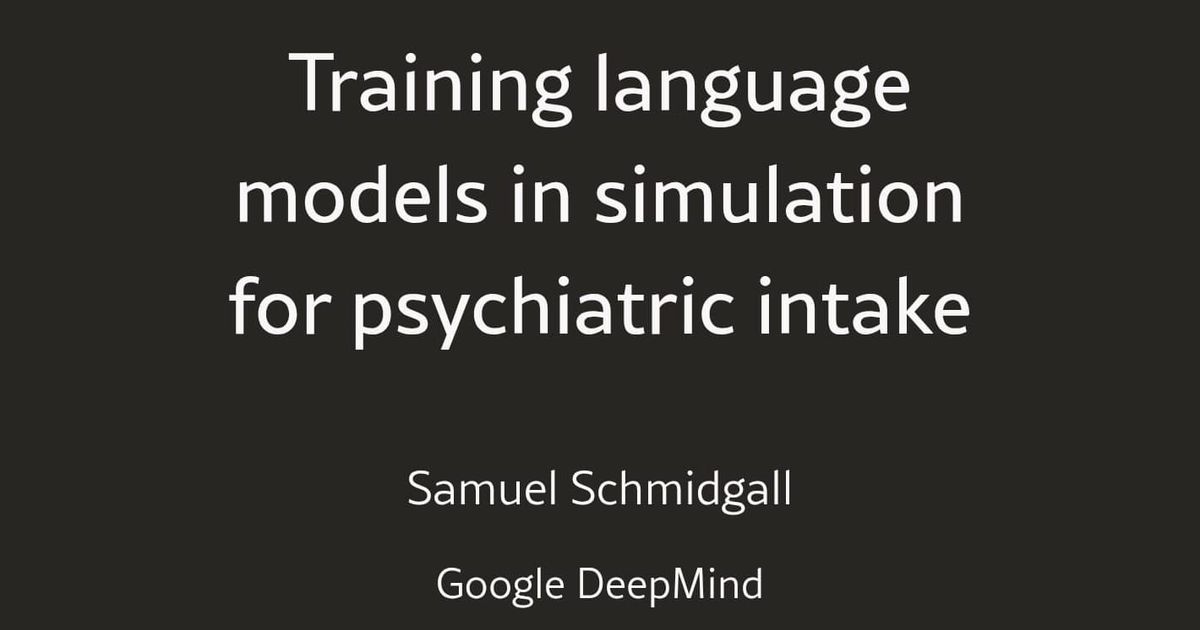
On October 29, researchers from Google DeepMind, Google Research, Google for Health, and collaborating institutions published Training Language Models in Simulation for Psychiatric Intake.
A system capable of gathering complex clinical histories, recognizing medical causes of psychiatric symptoms, identifying dangerous medication interactions, and helping patients reach appropriate care could be extraordinarily useful. That is definitely an application of artificial intelligence worth investigating.
So I opened the paper.
Here is how much of the psychiatric training system works.
- First, researchers sample a diagnostic domain, presenting concern, and primary diagnosis.
- Then, they construct a patient.
This generated person receives demographics, personality traits, medical history, psychiatric history, social circumstances, behavioral characteristics, symptoms, and a clinical presentation. The model generating the scenario supplies a specified diagnosis and treatment recommendations. The resulting patient simulator has access to that clinical profile, including information that the interviewing agent must then discover through conversation.
The investigators generated 48,243 psychiatric scenarios that passed their automated checks. The synthetic training cases were not individually reviewed by clinicians; the separate 127-case intake evaluation set did receive expert validation.
The researchers then train a language model to conduct the psychiatric interview, establish rapport, elicit relevant information, construct a differential diagnosis, and propose management.
This is all legitimate simulation-based clinical training. But it also has a striking property.
The patient's diagnosis exists before the patient does.
The simulator is built around a clinical specification.
The model learns to conduct an interview in a world where the relevant clinical information is already present, even when the simulated patient initially withholds it.
The researchers make withholding a dynamic part of the simulated encounter. The patient's willingness to disclose can change with rapport. Mood and communicative reliability change in response to the interview. The simulator can produce guardedness, frustration, downplaying, exaggeration, confusion, and changes in trust. And the model's reward depends partly on how successfully it navigates these interactions and uncovers clinically important facts.
In the resulting evaluation, the trained Gemini 3.1 Flash-Lite model outperformed its unmodified baseline in 46 of 60 paired standardized scenarios, judged from transcripts by independent psychiatrists.
Differential-diagnosis appropriateness rose from 33.3% to 68.3%.
In adversarial simulations, acute-risk under-triage fell from 30.5% to 12.9%.
These are serious improvements within the experiment. They are not evidence that the system outperforms human psychiatrists. The study did not test that comparison. Its patients were psychiatrists performing standardized roles, and the authors explicitly reject autonomous clinical deployment of the present model.
Comprehensive treatment recommendations were rated appropriate in only 46.7% of the trained model's encounters.
The investigators recognize these present limitations. But something else in the results deserves attention.
- The trained agent conducted a median of 60 clinician turns in the psychiatrist-enacted encounters.
- The baseline conducted eight.
Some trained-model encounters reached 165 turns.
The researchers did include penalties for excessively long simulated conversations, and greater length alone does not establish inappropriate questioning at all. Much of the evaluation improvement plausibly reflects the model's increased willingness to investigate like this rather than close an interview prematurely after eight turns.
Still, the result makes one interested in the stopping rule.
How much inquiry is enough?
- When does further questioning improve clinical understanding?
- When does it begin producing an account of the person that the available evidence cannot justify
- When should a patient be permitted to withhold information, decline a question, or refuse further interpretation?
The simulator has an answer key.
Real people do not.
A person may distrust an interviewer because of previous mistreatment. A patient may reasonably decline to disclose an intimate experience. Another may be reasonably frightened of having a provisional interpretation entered into a record that follows them through later institutions.
- A refusal may definitely indicate an important clinical problem.
- It may also be an informed and entirely reasonable boundary.
The same conduct can acquire radically different meanings depending on the interpretive frame.
The research includes safeguards concerning autonomy, cultural sensitivity, informed decision-making, and clinician oversight. It does not simply instruct an AI to extract information by any means necessary.
And the authors even acknowledge that reinforcement learning aimed at overcoming guardedness could discover manipulative conversational shortcuts.
Yes.
And an interviewer can become better at obtaining disclosures without becoming better at understanding whether those disclosures were necessary, appropriately interpreted, or safe to retain.
Stanford Opens the Human Repair Shop.
Four days later, on November 2, Stanford announced its Digital Brain Project.
The university proposes a five-year effort to collect large, specially designed datasets of human neural activity and train foundation models capable of predicting brain dynamics across many conditions.
Just listen to this radical shit:
Researchers plan to combine high-resolution 7-Tesla functional magnetic resonance imaging with optically pumped magnetoencephalography, giving them complementary spatial and temporal measurements.
They intend to begin with perception, memory, and attention before extending toward broader brain systems.
Cool.
Predictive neuroscience is a serious scientific ambition.
Accurate models of neural activity could illuminate mechanisms of perception, memory, disease, and treatment. Models that successfully predict responses to new conditions could help researchers design much better experiments.
Then, Dan Yamins explained the project's medical promise.
His analogy was that understanding how to repair a car, heart, or brain requires a detailed model capable of comparing a system in “working condition” with one that is not.
Uh oh.
There is a big question hiding inside those two words.
Working condition.
For a car, engineers can specify many functions against which to evaluate its operation. A damaged fuel pump, misfiring cylinder, or failed brake has consequences that can be investigated against the vehicle's intended operation.
A heart also has essential physiological functions. This thing's ability to circulate blood is not a culturally arbitrary expectation.
The brain is a considerably stranger object than those.
What constitutes its working condition?
- A person who cannot form new memories after neurological injury has suffered a significant impairment.
- A person whose sleep, perception, or decision-making has become severely disrupted may need urgent medical help.
- A person experiencing disabling depression may want relief from an otherwise unbearable state.
These are legitimate clinical problems. Easy.
But the same phrase cannot automatically classify every difference in perception, thought, emotion, personality, social behavior, or cognition as a defect.
The Stanford announcement discusses possible applications to depression, Parkinson's disease, autism, and Alzheimer's disease.
Those conditions do not present one uniform scientific or normative problem.
Alzheimer's disease involves identifiable neurodegenerative pathology. Its clinical and biological investigation has a very different foundation from attempts to locate a universal neural signature of autism.
Autism is highly heterogeneous. A 2026 review of neural heterogeneity describes substantial variation in connectivity, cortical structure, developmental trajectories, and brain–behavior relationships across autistic individuals.
A separate 2026 review in Translational Psychiatry emphasizes that neural and behavioral subtypes do not map neatly onto one another.
Which is exactly why this research matters. Better models may discover structures that older diagnostic categories obscure.
But imagine building an extraordinarily detailed model, selecting participants according to familiar diagnoses, and then defining dysfunction primarily by how their neural activity differs from a selected reference group.
The model may find statistically reproducible differences.
Whether each difference represents injury, impairment, adaptation, ordinary variation, compensatory organization, or another kind of transition requires further evidence.
The statistical reference cannot decide the moral or clinical status of its own deviations.
This problem has an established technical history. In a 2026 British Journal of Psychiatry discussion, researchers observed that decades of neuroimaging had transformed psychiatric research without producing comparable changes in routine clinical practice. They called for better mechanistic links among brain measurements, behavior, treatment, and clinical outcomes.
Stanford has not claimed to possess a completed digital brain, a universal healthy template, or an autonomous psychiatric classification system. The announcement describes a prospective research program. It is entirely possible that this program will uncover evidence that substantially revises existing diagnostic categories.
I hope it does.
The concern begins where the announcement moves from predicting neural function toward identifying dysfunction and selecting interventions.
What exactly has been shown to malfunction? For which bearer?
Against what historically and clinically justified comparison?
And what makes the proposed change a repair?
A system can become easier to predict without becoming healthier.
A neural pattern can move toward a population average without improving the person's life.
An intervention can change measurable brain activity without restoring the capacity it was meant to preserve.
- The technical success is important.
- The bridge to treatment must be demonstrated separately.
Otherwise, Stanford may build an astounding instrument for describing the brain and then permit an inherited classificatory vocabulary to tell that instrument what counts as broken.
I would prefer the instrument be allowed to tell the classification that it is wrong.
When Two Machines Agree.
The DeepMind psychiatric interviewer and Stanford's Digital Brain Project are completely separate research efforts. There is no demonstrated integration of these two systems. And their current evidence does not establish that either has begun making consequential diagnostic decisions about real patients.
But suppose systems developed along these lines eventually enter the same clinical environment.
- One instrument examines a patient's language, symptoms, history, and behavior.
- Another examines their neural activity.
- The interviewer reports that the patient fits a psychiatric category.
- The brain model identifies a neural pattern associated with that category.
These two instruments agree.
Excellent.
How much independent evidence has just been produced?
There is one possibility in which the agreement is a major scientific advance.
The instruments measure different causal properties. Their predictions survive independent validation. The neural mechanism was identified without depending entirely on the diagnostic grouping it supposedly explains. The findings support meaningful predictions about impairment, progression, treatment response, or recovery that the old classification could not make.
That would be very valuable.
Now, let us consider another possibility.
- The clinical model was trained using existing diagnostic categories.
- The neuroscience study selected its comparison populations using the same categories.
- The neural model learned patterns associated with those populations.
- The clinical model learned to recover the corresponding diagnostic distinctions from interviews.
The two systems agree because they inherited the same partition of human variation.
Their measurements may still be real.
Their association may still be useful.
But agreement between the outputs does not independently establish the correctness or completeness of the category that organized both inquiries.
Two different instruments can inherit one upstream assumption. A second measurement modality does not automatically provide an independent theory.
This is the new problem. The Category Goes in the Brain already examined classification entering neural research before the evidence was collected.
And Field Instruments: Telepathy already examined how an adaptive translator may become part of the causal process that later makes its own translations appear increasingly accurate. It also established the importance of preserving an individual's ability to contest translation.
There is no need to rebuild those arguments here.
The additional danger is corroboration through shared classificatory ancestry.
Several technically sophisticated instruments can appear to confirm one another while their agreement partly reflects a common input.
The audit has to identify which measurements, assumptions, training labels, and validation standards the instruments actually share, and identify the evidence that would force their conclusions apart.
Can the neural model discover organization that cuts across established diagnoses?
Can the interviewer correctly identify a medical or environmental cause that defeats the expected psychiatric formulation?
Can either model produce evidence that an old category is poorly specified?
Can they predict outcomes that are independently relevant to the person rather than simply reproduce the category used to select the study population?
What happens when their outputs conflict? And which institution decides whether the conflict counts as an error, a discovery, or a reason to reconsider the original diagnosis?
These are methodological questions, but they are also institutional questions, because a classification can eventually enter a record, determine a treatment, authorize a restriction, or change how another professional interprets the patient.
- Agreement deserves its full weight.
- Agreement does not get to manufacture its own independence.
If two machines agree, ask what taught them both to say that.
The Jurisdiction Does Not Expand.
The DeepMind paper concludes that future evaluation standards and governance boundaries for psychiatric AI require the involvement of the psychiatric community.
Yes.
Psychiatric expertise is indispensable to evaluating psychiatric care.
But it is not the only expertise required to determine what the resulting systems may do to people.
- A clinician can assess whether a model identifies a dangerous medical condition.
- A neuroscientist can evaluate whether a model predicts neural activity under an intervention.
- A statistician can investigate whether apparently independent findings share an underlying classification or methodological artifact.
- Patients can identify consequences that a clinical scoring rubric may fail to capture.
- Law can determine the conditions under which an interpretation may justify coercive intervention.
These authorities have different work to do. No one acquires the whole person.
That was the original concern. It remains the concern here.
A person may need psychiatric treatment, neurological investigation, medication, psychotherapy, supported living, medical stabilization, practical assistance, or several of these all at once.
- An accurate clinical account can make those paths easier to reach.
- A defective account can close them.
The seriousness of the work increases the obligation to distinguish the two.
And the technologies under discussion may do tremendous good. Better intake could preserve medical histories that rushed appointments miss. Better neural models could uncover hidden mechanisms, identify useful interventions, and improve treatment for conditions that currently impose enormous suffering.
The research programs should pursue those possibilities. But their success must remain answerable to evidence beyond their own preferred classifications. The existing record is too mixed, and human lives are too consequential, to permit clinical competence to become a general title over human meaning or human continuation.
So, once again.
To the psychiatrists:
I apologize for sometimes writing as though your entire profession is an apparatus of domination.
And to the researchers trying to understand brains and develop better care:
Please continue.
I would like you to succeed. I would especially like you to discover things that force existing institutions to revise their most confident assumptions.
But the machine that becomes excellent at conducting an interview has not thereby earned unlimited authority to interrogate a life. The machine that becomes excellent at predicting brain activity has not thereby learned what every brain ought to become. And agreement between the two does not automatically establish that the institution was right all along.
This apology is very sincere.
This research is exciting.
These clinical applications may be important.
And the old issues remain.
Sources
- Schmidgall, Samuel, et al. Training Language Models in Simulation for Psychiatric Intake. arXiv:2610.40476, October 29, 2026. Preprint. Full HTML paper.
- Stanford University. Stanford Digital Brain Project to Model the Human Brain. November 2, 2026.
- Bakul, Fariea, Katelyn I. Krafick, and Rajesh K. Kana. The Spectrum within the Spectrum: Neural Heterogeneity in Autism. Behavioural Brain Research, published online October 23, 2026. DOI: 10.1016/j.bbr.2026.116546.
- Wang, Xing-Ke, et al. From Heterogeneity to Translation: Data-Driven Subtyping of Autism in a Multilevel Framework. Translational Psychiatry 16, article 526, July 11, 2026.
- McCutcheon, Robert A., Sameer Jauhar, and Toby Pillinger. Why Doesn't Neuroimaging Work in Psychiatry?. British Journal of Psychiatry 228, no. 3 (2026): 185–186. DOI: 10.1192/bjp.2025.10517.