Failed Field Analysts: Savonarola and the Purity Pyre
He saw the rot and took fire for medicine.
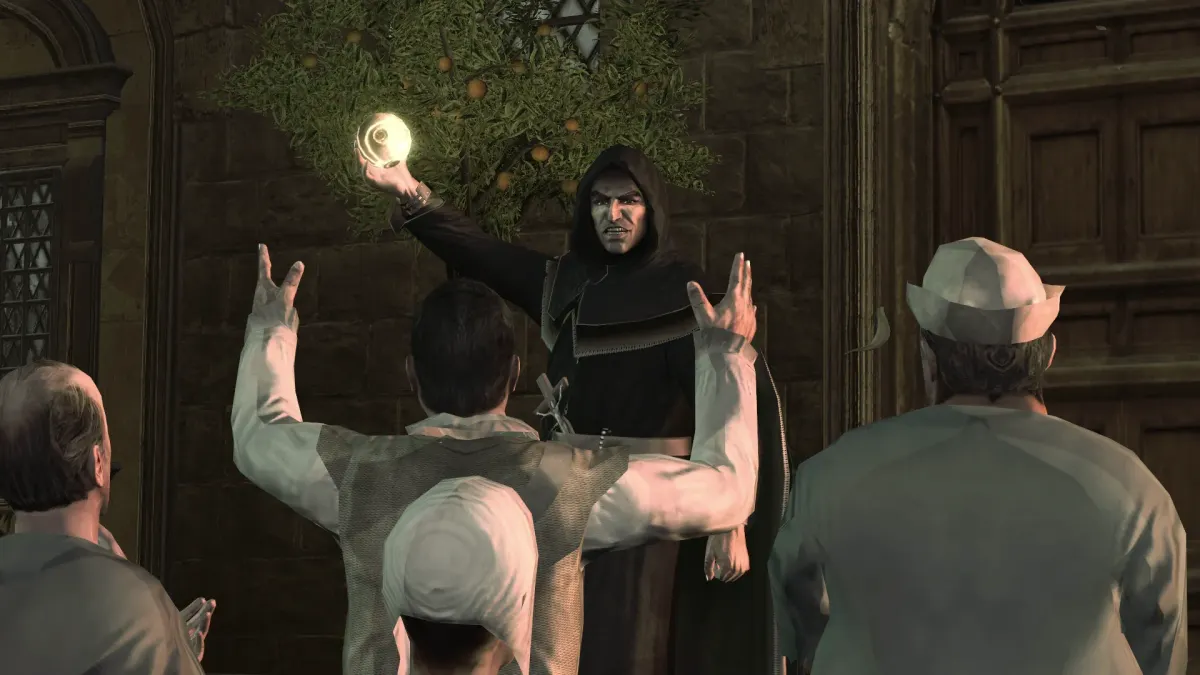
On June 30, 1498, Florence sentenced a bell.
The human being associated with this bell had already been hanged and burned in the Piazza della Signoria five weeks earlier. Girolamo Savonarola was dead. Fra Domenico da Pescia was dead. Fra Silvestro Maruffi was dead. Their bodies had been destroyed publicly. Their ashes had been removed from the square and scattered so that no useful relic could remain in the hands of followers.

This really should have settled the matter.
Florence had reached the end of the preacher.
Then, the city remembered the bell.
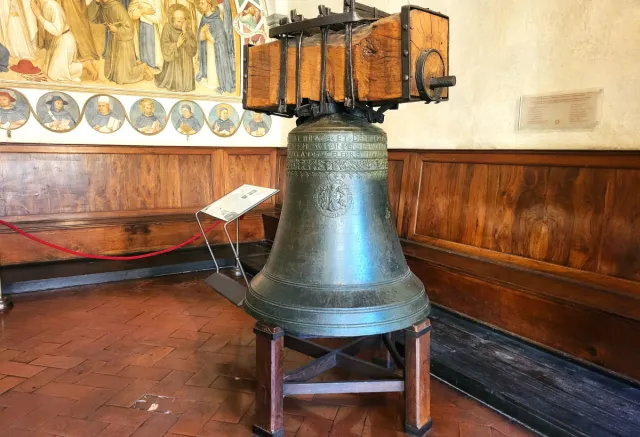
The Piagnona hung at San Marco, the Dominican convent from which Savonarola had preached, organized, corresponded, warned, governed without office, and gathered a movement around his vision of a renovated Florence. During the April siege of the convent, the bell had sounded the alarm. Its voice crossed the walls. It entered streets, houses, workshops, chapels, and bodies.
It told Savonarola’s supporters that the crisis had become immediate and that the convent required defense.
The bell had no theology.
The bell had no opinion on the French alliance, papal jurisdiction, republican government, the Great Council, clerical corruption, public vice, prophecy, the trial by fire, Medicean restoration, or whether Florence had become the New Jerusalem.
The bell just had a clapper.
That was enough.
This move is philosophically very interesting.
The government treated the Piagnona as an instrument that had acted in the field.
It was considered to have moral obligations.
It was publicly punished, removed, and exiled from San Marco.
Some later accounts describe the punishment in the wonderful language of a civic order discovering accessory liability for bronze.
The bell had abetted resistance. The bell had called bodies toward danger. The bell had continued the preacher through sound after the preacher’s authority had begun collapsing.
Florence had removed the prophet. It decided it still had to punish the notification system.
This is funny. But it is also one of the clearest acts of institutional perception in the entire Savonarola story.
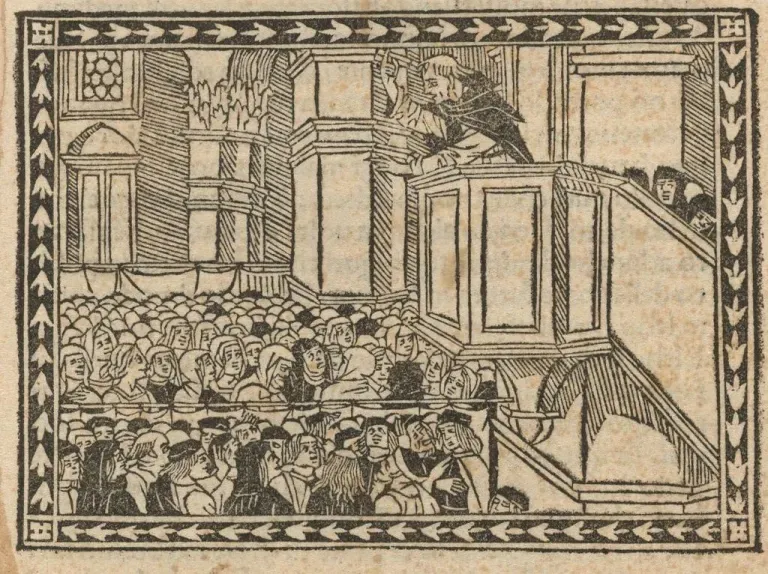
They were sort of right, I guess. A bell is not only a lump of metal suspended above a church. That thing coordinates time. It marks worship, danger, death, celebration, assembly, fire, invasion, and public emergency.
The bell reaches people who never entered the room where the decision was made. It translates an event into shared attention. It can make a neighborhood look up together. It can make a citizen leave home. It can make one faction believe history has begun while another faction hears insurrection.
The Florentine government understood that this bell belonged to the movement’s causal architecture.
It understood that instruments act through fields.
Then the government used its own purity instrument against the bell.

The city had just spent years learning to classify persons, clothing, songs, paintings, books, cosmetics, games, public conduct, political loyalties, sermons, rituals, and household objects according to their relation to civic corruption.
After Savonarola’s fall, the same field turned upon the machinery of Savonarolan memory. The bell itself had become contaminated by its use.
Punish it.
Remove it.
Make the sound go somewhere else.
The reason I am fixating on this bell is that the purity machine did not begin with Savonarola and did not end with him.
He found its components already distributed across Florence:
- law;
- church;
- patronage;
- youth;
- ritual;
- civic mythology;
- charitable discipline;
- sexual policing;
- dress regulation;
- republican memory;
- public spectacle;
- penitential preaching;
- sacred art;
- factional punishment;
- and the ordinary human desire to find one visible thing that can be destroyed while the deeper structure continues undisturbed.
Savonarola synchronized these components and gave them a prophetic controller.

Then the controller became one more object the city knew how to burn.
Florence Was Already Saving Its Soul.
The familiar version of this story is efficient enough to fit on a museum card.
- Renaissance Florence was rich, brilliant, beautiful, worldly, and corrupt.
- A severe Dominican friar entered the city,
- denounced luxury,
- organized children,
- burned art,
- frightened everybody,
- challenged the pope,
- failed a trial by fire, and
- was eventually hanged and burned by the same public that had briefly followed him.
The card then points you to toward Botticelli.
This version has many clear advantages.
- It gives the reader a villain with excellent clothing contrast.
- It preserves the Renaissance as the bright modern world and Savonarola as an ash-smelling medieval intrusion.
- It lets art stand for freedom, the bonfire stand for fanaticism, the Medici stand for civilization, and the friar stand in the piazza yelling at a future that has already defeated him.
It is also a deeply inadequate map of Florence.

The purity field existed before Savonarola arrived.
Florence had spent generations developing systems for reading moral and political order through visible surfaces. Clothing could disclose unlawful status display. Jewelry could disclose excess. sexual conduct could disclose civic decay. Carnival could disclose disorder or be redirected toward civic formation. Children could be gathered into confraternities and trained into public discipline. Processions could convert streets into sacred history. Almsgiving could classify worthy need. Bells could coordinate neighborhoods. Monasteries could join reform to patronage. Republican liberty could be described through biblical history. Public fire could make repentance visible.
The city already had a problem with corruption.
It also had several incompatible definitions of corruption.
- For a merchant, corruption might mean the factional seizure of office.
- For a poor family, corruption might mean grain prices, debt, taxation, lost work, or the humiliation of needing help without appearing dishonorable.
- For an oligarch, corruption might mean rivals gaining access to public power.
- For a preacher, corruption might mean clerical wealth, sexual vice, gambling, luxury, blasphemy, bad art, weak discipline, or a city refusing to interpret its prosperity as a spiritual test.
- For a humanist, corruption might mean tyranny, degraded civic participation, or a republic losing contact with its own history.
- For the Medici, corruption could be whatever threatened the network through which Florence remained governable under a republican costume.
All of these diagnoses entered the exact same streets. Savonarola’s power came partly from his ability to gather them all into one moral weather system.
The wealth, the faction, the sexual disorder, the clerical scandal, the neglected poor, the weakened republic, the French invasion, the papal court, the carnival songs, the cosmetics, the mirrors, the private vengeance, and the fear of divine punishment could all be read as one condition.
Florence was impure.
The term did tremendous work. It brought together experiences that really were connected. It also began replacing the connections.
A city full of distinct mechanisms of burden, domination, pleasure, art, poverty, patronage, fear, law, faith, and political exclusion could be compressed into a moral diagnosis that fit inside one sermon.
The friar would become famous for this compression.
Florence had already built the machine that made the compression actionable.
The City That Regulated Cloth.
Florence knew that clothing was political.
This knowledge did not require Savonarola.
Long before his famous bonfires, the city had written statutes regulating fabrics, ornament, jewelry, gold and silver decoration, sleeves, trains, wedding display, and the other portable architectures through which wealth announced itself on the body. Sumptuary legislation crossed Italian city-states and changed over time, but Florence had its own long practice of making visible consumption answer to law.
The statutes carried several motives at once.
- Some were explicitly moral.
- Excessive display could be condemned as vanity, pride, sexual provocation, or spiritual disorder.
- Some were economic.
- Luxury imports, household spending, dowries, and public competition affected family fortunes and the wider commercial field.
- Some were political.
- Clothing made rank visible.
- A republican city with oligarchic habits had reason to regulate who could look like what.
- The surface of the body could quietly challenge the official story about equality among citizens.
- Some were fiscal.
- Fines are a very old method for teaching moral law to maintain an interest in continued violation.
A woman walking through Florence in expensive cloth therefore carried more than cloth. The city could read that garment as:
- household ambition;
- sexual display;
- aristocratic imitation;
- foreign influence;
- waste;
- pride;
- commerce;
- status competition;
- taxable violation;
- or evidence that the republic’s moral surface had become unstable.
This does not make every sumptuary rule identical in purpose or enforcement. It establishes the existing grammar.
- The body was inspectable.
- The object was morally articulate.
- Visible excess could be treated as a public problem
- even when the deeper distribution of wealth remained intact.
The distinction there becomes crucial later.
A mirror can be seized.
A dress can be cut down.
A jewel can be surrendered.
A painting can be carried directly into the piazza.
Patronage is harder.
A banking network does not fit comfortably in the hands of a twelve-year-old inspector. Factional influence cannot be stacked into a pyre with comic books, perfume, musical instruments, wigs, playing cards, and expensive sleeves.
The city can burn the object through which status becomes visible while leaving the relations that produced the status fully able to continue.
The later purity machine did not invent proxy capture. Florence already knew the civic pleasure of controlling the surface where a deeper arrangement announced itself.
Vice Already Had an Office.
In 1432, Florence created the Office of the Night.
This is too on the nose.
This name sounds like the city had finally admitted what kind of place it was and so just started staffing accordingly.

This office investigated and prosecuted sodomy. It received accusations, generated records, imposed fines and other penalties, and connected sexual conduct to civic discipline through specialized administration.
It existed for decades before Savonarola’s rise and would survive beyond his death.
This part of the field must be handled with some precision.
Florentine sexual culture cannot be reduced to the statutes against it.
Male same-sex relations existed across age, class, neighborhood, apprenticeship, patronage, friendship, coercion, desire, and social practice. The Office of the Night did not reveal a hidden simple reality and then remove it. The office created its own operative reality through categories, procedures, informants, accusations, penalties, records, and the unequal vulnerability of people caught inside them.
The city had learned to make private conduct administratively legible.
That is the article’s concern here. This turned into a bit of a shitshow for the city.

Before Savonarola called Florence toward collective purification, the republic already possessed a moral bureaucracy fully capable of receiving denunciation and converting it into civic action.
The office established several habits that later purity campaigns could use:
- private life could contain public danger;
- hidden conduct could explain visible decline;
- denunciation could be a form of civic service;
- moral offense could justify specialized state attention;
- the persistence of the conduct could prove the need for more enforcement;
- and failure to eradicate the behavior did not necessarily discredit the office organized around its eradication.
A moral police instrument rarely ever needs to solve the thing it polices in order to survive. Its continued existence can be justified by the continued existence of the target.
The Office of the Night therefore belongs to the prehistory of the purity machine. It shows Florence already practiced in one of purity’s most useful operations:
Convert a difficult social field into a class of contaminating acts, then build an office that can keep finding them.
Savonarola’s later campaign would expand the surface of moral inspection. Dress, gambling, carnival, cosmetic display, sexual conduct, art, song, household objects, public speech, political loyalty, and prophecy could all enter one civic-religious diagnosis.
The Office of the Night had already demonstrated that vice could have jurisdiction.
Children of Purification.
The boys did not appear because Savonarola suddenly realized children were available. Florence had been organizing youth into confraternities long before his public ascendancy.
The Confraternity of the Purification, founded in 1427, is especially useful here because its name sounds as though the article invented this shit as a subtle joke.
The confraternity helped socialize Florentine boys and young men through religious discipline, shared ritual, age hierarchy, civic expectation, and the gradual shaping of future citizens.
A youth confraternity could perform several functions at once.
- It could teach prayer.
- It could create friendships outside the household.
- It could supervise behavior.
- It could offer performance, song, service, procession, and belonging.
- It could make the city present inside childhood before childhood acquired formal political standing.
- It could also prepare young males for the civic world through an institution that combined religion, reputation, obedience, competition, and public visibility.
Children represented the city’s future in the most literal available form.
This made them symbolically powerful and operationally convenient.
A child could represent innocence while carrying an adult program.
A procession of children could make a political demand appear as the city’s moral future walking toward you in tiny white robes.
A child at the door could ask for alms, request a vanity object, observe your clothing, hear your refusal, and return the result to a movement protected by the sacred authority of youth.
The field had already built the channels Savonarola would reroute.
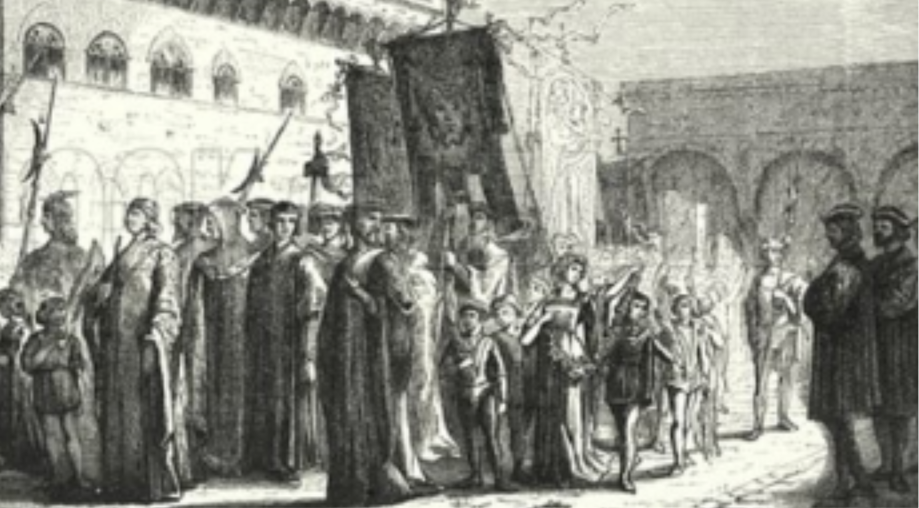
His fanciulli became famous for processions, songs, collections, moral exhortation, charity, and public enforcement. They helped transform Carnival. They gathered offerings. They entered houses. They sought objects later assembled into the bonfires. They became the visible proof that Florence’s next generation had rejected the corruption of the present one.
This should not be flattened into one ugly phrase about a child police force.
The boys were also participants in a real civic and religious movement. Some of their activity supported poor families. Some gave young people a role in public life larger than mockery, gaming, street violence, or passive obedience to adults. Some of the songs, processions, and charitable work gave collective moral form to a republic emerging from political crisis.
The same instrument carried care and coercion.
That is why the fanciulli are central.
They show how a field instrument becomes dangerous without becoming fictional.
The children really could gather food and money.
They really could support public devotion.
They really could interrupt violent Carnival customs.
They could also teach the household that refusal was visible.
A child asks for your mirror while the street watches whether you hesitate.
The purity machine had acquired little legs.
Bernardino’s Fire.
The bonfire was already waiting.
Penitential preaching in Italian cities had long used the public destruction of objects associated with vanity, gambling, luxury, sexual disorder, magic, or morally suspect entertainment. Bernardino of Siena preached in Florence in the 1420s, decades before Savonarola’s mature movement, and belonged to a reform tradition that knew how to turn repentance into public spectacle.
Fire offered several immediate advantages to moral authority.
It gave repentance an object.
A person could feel guilt about status, lust, debt, violence, vanity, pride, gambling, idleness, sexual conduct, bad art, corrupt friendship, political fear, or the entire condition of the city.
These pressures are difficult to coordinate.
A pack of cards is so much easier to manage.
A wig is easier. A mirror is easier.
A painted image, gaming table, cosmetic jar, mask, instrument, or luxury garment can be lifted, named, surrendered, displayed, and destroyed.
The object provides a clean terminal event.
- Before the fire, the vice remains in the city.
- After the fire, the object is ash.
The crowd receives a visible transformation. Authority receives evidence. The penitent receives an action. The city receives a story about itself.
The fire also creates a counting problem disguised as certainty.
A large pile looks like greater reform.
More objects look like deeper repentance.
A taller pyre looks like a stronger moral field.
The visibility of the destruction can begin standing in for the depth of the change.
This is the same compression that later lets a body count impersonate a war, a bonfire impersonate civic repair, or a pile of surrendered objects impersonate the redistribution of power.
The object is real. The surrender may be sincere.
The fire definitely burns.

And the metric can still be false.
Savonarola did not invent public penitential destruction. He inherited an instrument already capable of producing conviction, coordination, fear, relief, and applause. He would give this instrument a prophetic city.
San Marco.
San Marco totally ruins the easy story.

The convent that became Savonarola’s base was rebuilt through Medici patronage beginning in the 1430s.
Cosimo de’ Medici commissioned Michelozzo to reconstruct the complex for the Observant Dominicans. Fra Angelico and his workshop filled cells, corridors, and sacred spaces with one of the great visual programs of the Florentine Renaissance. A library took shape. The convent became a place of discipline, learning, contemplation, patronage, art, and civic prestige.
The future anti-Medici prophet entered a reform monastery made magnificent by Medici money.
That sentence should not be used to call him a hypocrite. It should be used to understand the field.
Religious austerity and Renaissance patronage were not clean enemies.
Wealth could fund reform. Patronage could support art intended for disciplined prayer. A powerful family could gain spiritual prestige, political relation, architectural presence, and genuine religious benefit from building a monastery. Friars could receive the gift without becoming puppets. Sacred beauty could be sincere and politically useful at the same time.
San Marco held all of this.
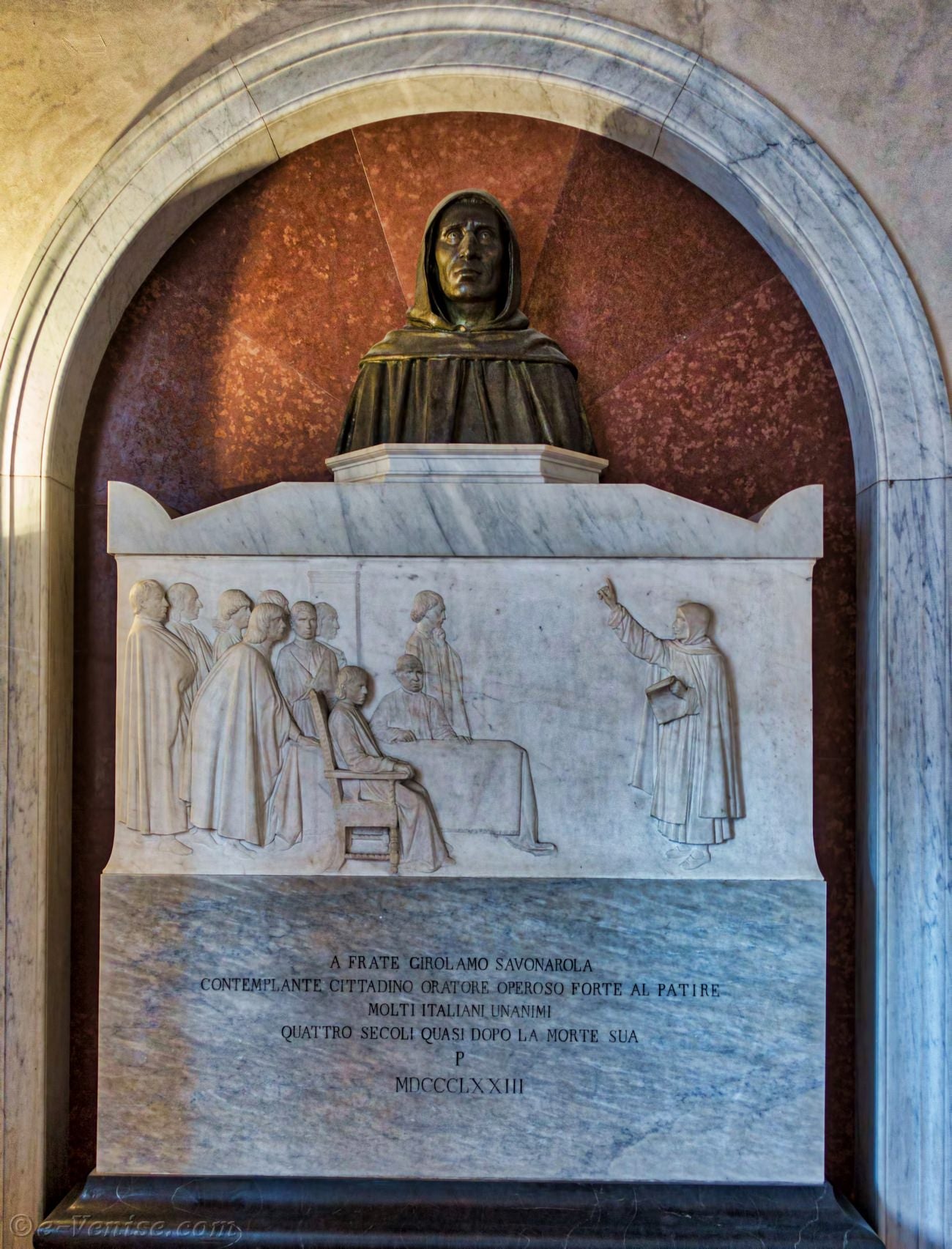
The building became a physical argument against simple categories.
Cosimo had helped create a space where Observant reform could intensify.
Fra Angelico’s frescoes did not function as decadent entertainment. They entered the cells as instruments of contemplation.
The library joined scholarship to the convent’s public and sacred role.
The Medici name joined the whole complex to the political economy Savonarola would later attack.
Whenever the analysis begins dividing Florence into court and convent, luxury and faith, art and purity, politics and religion, this building interrupts.
The field had already crossed every boundary.
Savonarola did not enter an untouched monastery and turn it political.
He entered a site where patronage, reform, art, learning, civic prestige, and sacred discipline had been joined for decades.
He changed which part of the relation claimed final authority.
- The Medici had used patronage to make reform part of their Florence.
- Savonarola used reform to declare that Florence no longer belonged to the Medici.
The same building could carry both transitions.
The Young Friar Who Hated the Court.
Girolamo Savonarola was born in Ferrara in 1452.
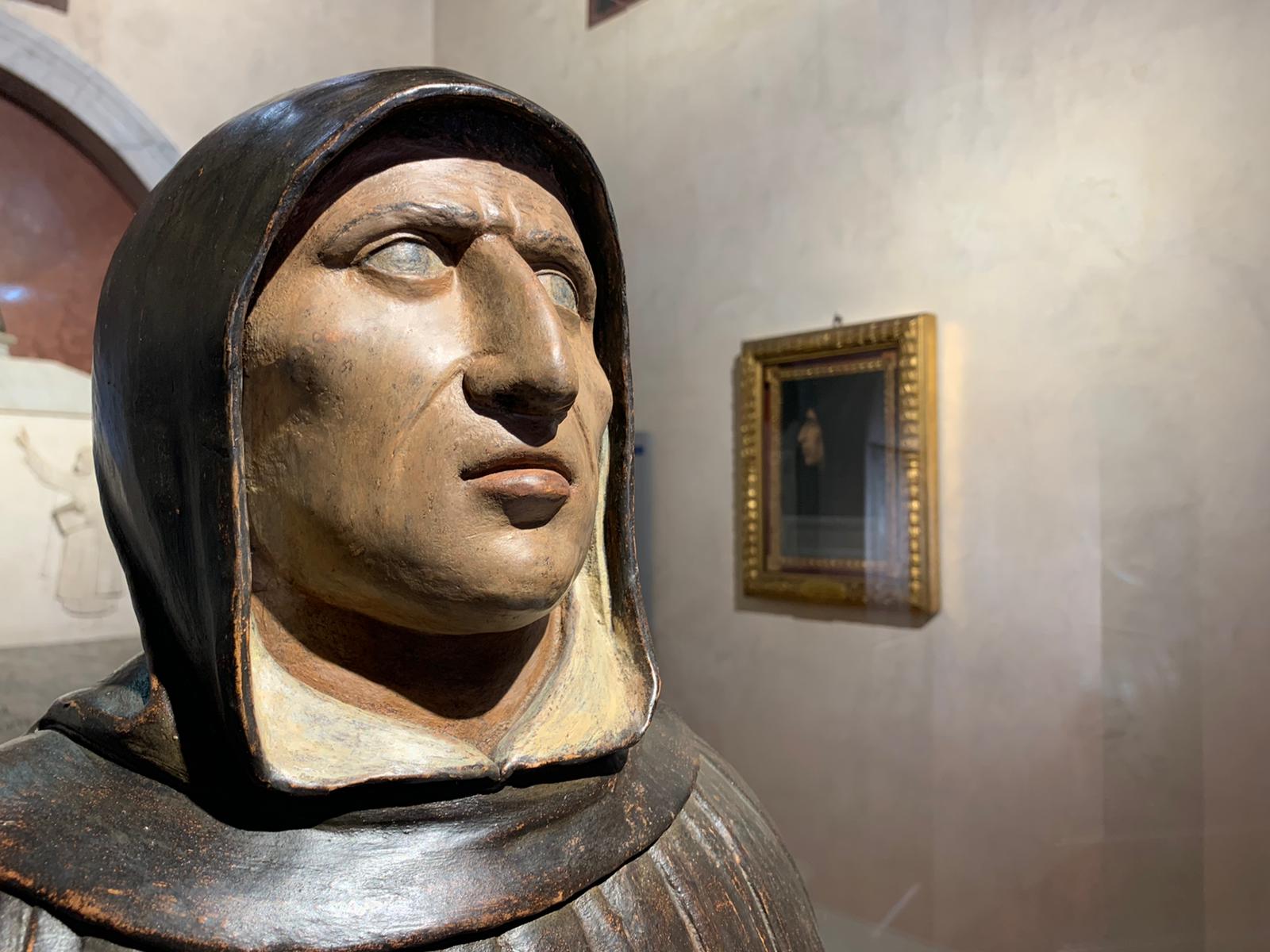
He grew up in a learned household, received serious education, and moved toward the Dominican life as a young man while developing an intense disgust with the moral condition of the world around him. His surviving early writings and later accounts show an imagination already organized around corruption, judgment, reform, and the distance between Christian truth and social life.
He entered the Dominican order in 1475.
The decision was not a public career move toward the government of Florence. It was a withdrawal from one field into another. Study, discipline, preaching, scripture, convent life, and the possibility of an ordered sacred vocation offered a counterworld to the courtly and civic environment he regarded as degraded.
Savonarola’s early preaching did not immediately conquer Florence.
His first periods in the city were uneven. His voice, style, accent, and manner did not automatically produce the later crowds. He developed through preaching elsewhere, through study, through the apocalyptic and prophetic books of scripture, and through a growing conviction that the crises of church and Italy belonged to a providential sequence he could perceive.
When he returned to Florence and began preaching at San Marco around 1490, the field was ready in ways that cannot be reduced to this dude's personal charisma.

Lorenzo de’ Medici’s Florence was culturally brilliant and politically constrained. Republican forms remained while Medici influence shaped access, office, alliance, patronage, and fear. Clerical corruption was visible well beyond Florence. Italian states balanced themselves through alliances that could fail catastrophically. France possessed claims and ambitions in Italy. Wealth lived beside poverty. Civic pride lived beside political dependence. The city that celebrated itself as a republic could still be governed through an elite network whose power was difficult to name cleanly inside the constitutional language.
Savonarola’s sermons gave these pressures one moral horizon.
He preached judgment. He preached renovation.
He attacked clerical corruption, worldly luxury, political domination, and the habits by which Florence converted prosperity into self-exemption.
He also promised that punishment could become preparation.
The coming scourge would expose the rot. Florence could repent. The city could be renewed. A chosen urban field could emerge from tribulation as a model for Christian life.
This was more than denunciation.
- Denunciation tells the sinner that the city is bad.
- Prophecy tells the city where history is going.
Savonarola increasingly claimed the second authority.
He did not yet control a purity machine.
He had, however, found the socket.
Failed Field Analysts.
Savonarola belongs in Failed Field Analysts because he saw real structure.
He did not look at Florence and conclude that one bad prince had ruined an otherwise healthy republic.
He understood that corruption reproduced itself through relations.
A ruler could leave while the ruler’s field remained.

The Medici could be expelled while patronage still determined who knew whom, who owed whom, which family trusted which office, which merchant financed which coalition, which citizen expected protection, which enemy expected vengeance, and which public forms could be used to preserve private influence.
A constitution could change while habits of dependence remained.
A public office could be opened while fear kept the same people from using it.
A law could promise equality while factional punishment told everyone which citizens counted as reachable by the law.
A republic could speak the language of liberty while narrow networks still governed entry to political life.
Savonarola also understood that culture was part of government.
- Songs mattered.
- Carnival mattered.
- Children mattered.
- Preaching mattered.
- Clothing mattered.
- Public ritual mattered.
- Charity mattered.
The stories Florence told about itself mattered.
A constitutional reform could not survive indefinitely inside a civic culture trained to admire domination, status, faction, revenge, spectacle, and the private purchase of public dependence.
That is a serious field perception.
Modern political thought often rediscovers it in less religious clothing.
Institutions require norms. Rules require habits.
Public participation requires capacities that formal permission does not create by itself. A republic needs citizens able to tolerate losing, resist factional retaliation, recognize public goods, trust procedures, and preserve some relation to opponents after the vote.
Savonarola saw the city beneath the constitution.
He saw that repair had to enter the whole field.
His reforms therefore moved across levels:
- political participation;
- law;
- charity;
- taxation;
- credit;
- public speech;
- worship;
- youth formation;
- ritual;
- personal conduct;
- and the civic imagination through which Florence understood what freedom was for.
This is the true fragment.
The failure begins when a real multi-level field is given one sovereign diagnosis.

Savonarola increasingly interpreted the field through purity.
- The Medici did not simply concentrate power.
- They belonged to corruption.
- Clerical wealth did not simply distort office.
- It belonged to corruption.
- Carnival did not simply contain forms of violence, hierarchy, commerce, pleasure, and social release.
- It belonged to corruption.
- Luxury did not simply disclose unequal wealth or public status competition.
- It belonged to corruption.
Sexual conduct, art, cosmetics, gambling, blasphemy, political opposition, papal discipline, hesitation, and failed prophecy could all be routed through the same master category.

Purity did not erase the connections among these things.
It made the connections too easy.
The field’s many mechanisms became expressions of one moral substance.
Once that happened, visible purification could begin standing in for structural repair.
The analyst had seen that corruption was a field.
He gave the field one governing name:
Impurity.
France.
Prophecy becomes difficult to correct after Europe begins performing it.
Savonarola warned that a scourge would enter Italy and that political and ecclesiastical corruption would face judgment. He tied punishment to renewal. The warning did not remain in the safe register of a preacher saying history would eventually be unpleasant because everyone had sinned.
In 1494, Charles VIII of France entered Italy with an army (what else).
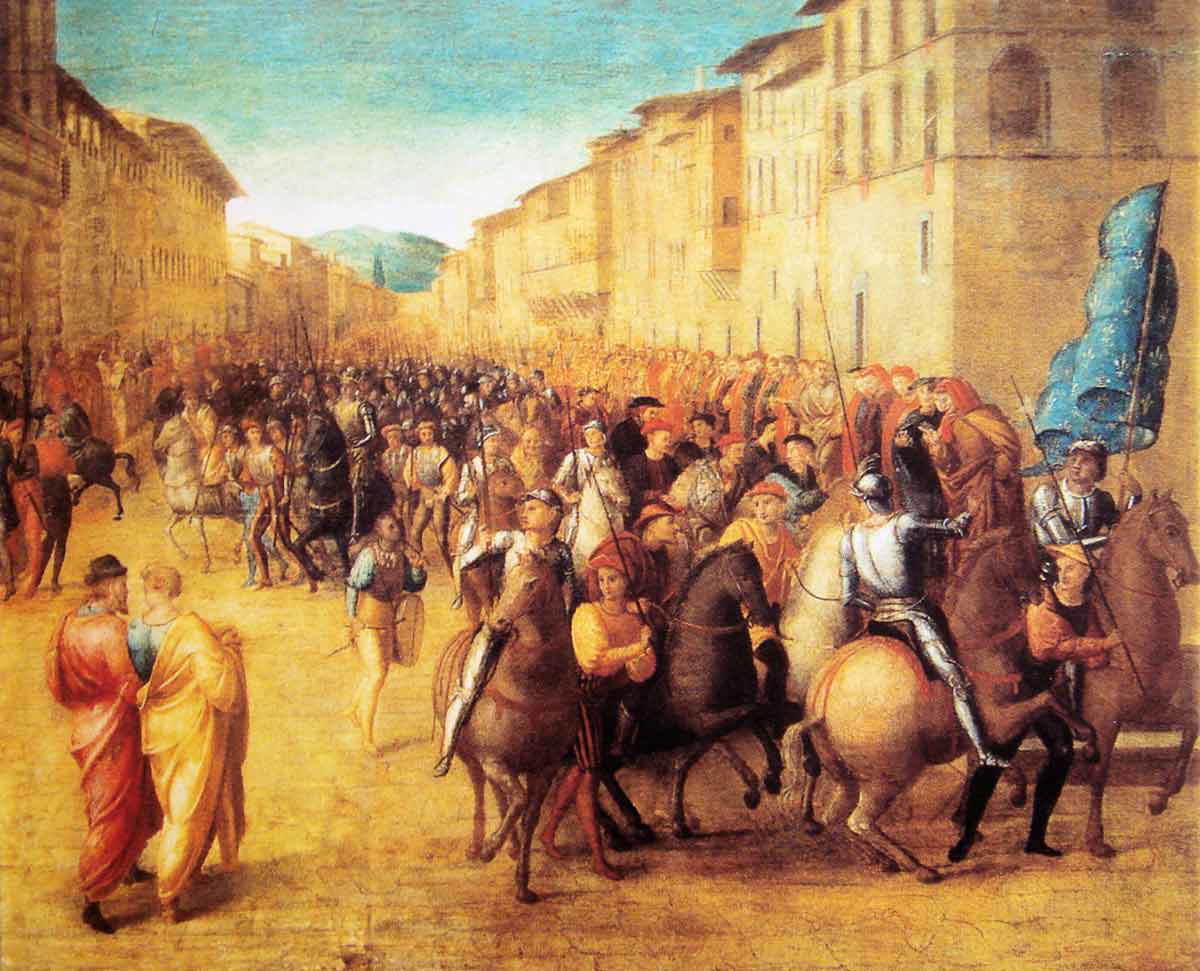
The invasion destabilized the peninsula and made a previously distributed fear suddenly visible in armor, artillery, diplomacy, and the collapse of old arrangements.
Piero de’ Medici handled the crisis disastrously. He conceded fortresses and terms that Florentines regarded as humiliating. The Medici were expelled.
The city’s governing field opened at exactly the moment Savonarola’s warnings appeared to have acquired a French body.
The city did not simply hear the prophecy. It just watched Europe perform it.
This is the moment Savonarola’s real political authority becomes intelligible.
- He had named corruption before the regime fell.
- He had warned of scourge before the army arrived.
- He had described tribulation as the path to civic and religious renovation before Florence found itself negotiating survival between a failed Medici leadership and a foreign king.
Savonarola then participated in diplomacy with Charles VIII and helped Florence move through the crisis without becoming only a conquered object in the French path.
The prophet had become useful. Usefulness changes sacred authority.

A preacher who accurately describes moral pressure may be admired.
A preacher whose prophecy appears materially confirmed can become an interpreter of history.
A preacher who then helps negotiate with the invading king can become part of the transition he predicted.
The field begins feeding evidence back into the answer-channel.
- The invasion confirms the warning.
- The Medici collapse confirms the diagnosis.
- Savonarola’s diplomatic role confirms divine favor.
- The survival of Florence confirms the city’s chosen status.
- Political opportunity confirms the need for moral renovation.
Every stage increases the cost of saying the prophet is wrong.
A wrong sermon can be ignored.
A wrong interpretation that has already become part of the republic’s founding story is harder to dislodge.
This is where The Great Disappointment becomes a useful neighboring instrument. Failed prophecy rarely disappears by itself. The field decides which facts are allowed to correct it. A public event can dissolve the answer-channel, preserve it through reinterpretation, or strengthen it by appearing to verify the schedule.
Savonarola received the strongest possible outcome.
The calendar had not failed. The army was outside.
Florence was suddenly free of the Medici and terrified of what freedom would become next.
The prophet entered the constitutional vacuum carrying a map of tribulation and renewal.
A Republic Worth Defending.
The republic Savonarola helped defend was real.
This part cannot be hurried toward the bonfire.
After the Medici expulsion, Florence faced a familiar revolutionary problem. The old concentration of power had broken. The inherited institutions remained available but were distrusted, fragmented, or shaped by the regime that had just fallen. Elite factions wanted different restorations. Some citizens feared Piero de’ Medici would return. Others feared that the republic would become another oligarchic settlement with new names on the same doors.
Savonarola preached that the first post-Medici arrangement was insufficient.
He argued for a broader council modeled in part on Venice’s Great Council and rooted in Florentine republican traditions. The Great Council established in December 1494 widened participation among eligible citizens and became the central organ of the new constitutional order. It was not universal democracy. Admission still depended on citizenship, family office history, age, tax standing, sex, and the boundaries of Florentine political life. Women did not enter the council. Laborers without the necessary status did not suddenly become sovereign citizens. The city did not leave hierarchy behind.
The reform still changed the field.

More citizens acquired a route into major political decisions.
The Medici method of concentrating access through narrow bodies and controlled selection faced a larger institutional counterweight.
The Great Council made the republic harder to fit inside one family’s private continuity.
Savonarola defended it repeatedly.
He understood that political liberty required architecture. The sermon could open moral imagination. The council gave that imagination a room, procedure, membership, vote, memory, delay, conflict, and the ordinary humiliation of having to convince people who had not already agreed to become symbols in your prophecy.
That is the reformer at his strongest.
He also supported a law of appeal intended to restrain exile and capital punishment as weapons of faction. Florence had long experience with political enemies becoming criminal objects. A republic that could remove citizens without a meaningful appeal remained vulnerable to the same closure under different rulers.
The right of appeal therefore mattered at the deepest level of the new field. It preserved an exit from factional certainty.
Savonarola also supported charitable and economic measures. He promoted the Monte di Pietà, a public lending institution intended to offer an alternative to exploitative credit and relieve debt pressure. He supported almsgiving and the Buonomini di San Martino, which assisted families whose poverty was made harder by the expectation that they preserve respectable appearances. He addressed tax burdens and called attention to the poor as participants in the city’s moral condition rather than scenery beneath Renaissance magnificence.
These are not decorative virtues added so the article can claim balance.

They show the true fragment operating.
Savonarola saw that domination was reproduced through debt, dependence, exclusion, faction, fear, and the private capture of public instruments.
He did not simply ask rich Florentines to feel less luxurious.
He helped build institutions.
Christ Is Elected King.
Florence had long imagined itself through sacred history.
Processions, liturgical performances, architecture, baptistery, cathedral, patron saints, civic festivals, and biblical language had already inscribed Jerusalem onto the city. The Medici themselves participated in the sacred imagination of Florence. Savonarola intensified a field that was older than his sermons.
He presented Florence as chosen for renovation.
The city could become a New Jerusalem through repentance, justice, republican liberty, Christian discipline, and providential mission. Christ could be proclaimed Florence’s true king.
The move contained a serious republican argument.
If Christ is king, no Medici is king.
No merchant family owns the city.
No pope, faction, military patron, or oligarch can convert Florence into private inheritance without answering to a law above personal appetite.

Sacred sovereignty can humble human sovereignty.
This is one of the legitimate functions described in Field Instruments: Sacred Instruments. A sacred title can deny finality to earthly power. It can tell the prince that the city contains obligations the prince did not create and cannot purchase. It can preserve moral memory against domination.
Then the instrument turns.
Christ does not speak in the Great Council.
Christ does not stand for election.
Christ does not provide a second sermon explaining that the prophet has misunderstood the situation.
The city receives sacred kingship through interpretation.
The prophet becomes the privileged reader of the king who cannot be cross-examined.
Florence has removed one prince and installed an answer-channel.
This is the Sacred Title problem at civic scale. Sacred attachment can bind a city to care, justice, humility, and memory. Sacred title begins when the claim acquires authority over living continuance without preserving correction. The title says the city belongs to Christ. The operational question becomes who can say what Christ requires of the city now.
Savonarola’s answer increasingly passed through prophecy.
His political recommendations could therefore arrive with two forms of authority at once:
- reason inside the republican field;
- and divine direction above the republican field.
When they aligned, the combination was extraordinarily powerful.
When they diverged, the council faced a man who could describe opposition as resistance to the city’s providential mission.
The danger was not that religion entered politics. Religion was already there.
The danger was the loss of a trustworthy route by which the sacred interpretation itself could be corrected.
A republic can vote against a proposal.
How does a republic vote against the plan of God after the prophet has read the invasion, the Medici collapse, and the city’s survival as confirmation?
This question sits beneath every later object thrown onto the fire.
Carnival Is Rewritten.
Savonarola understood that a government lives in more than statutes.
Carnival belonged to the city’s operating system.
Songs moved through streets. Youth groups performed. Costumes, mockery, games, sex, food, violence, commerce, neighborhood rivalry, and temporary inversion gave Florentines a season in which ordinary hierarchy could be stretched, mocked, intensified, or released. Carnival was pleasure, public coordination, danger, money, memory, youth culture, and political weather.
A weak reformer bans it and goes home.
Savonarola rewrote it. This was real-deal field engineering.
He and his followers redirected songs toward devotion. They organized processions. They gave the fanciulli central roles. They turned festive energy toward almsgiving, moral reform, and the public identity of a Christian republic. Familiar cultural forms were repurposed rather than discarded wholesale.
A carnival song could carry new words.
A procession could carry children instead of masks.
A public gathering could collect money for poor families.
A city accustomed to performing itself through spectacle could perform renovation.

This is one reason Savonarola’s movement cannot be understood as simple repression arriving from outside Florentine culture.
He used the culture brilliantly.
The songs worked because people already knew how to sing together.
The processions worked because Florence already knew how streets became sacred stages.
The children worked because youth confraternities had already trained the city to see young bodies as civic futurity.
The public fire worked because penitential preaching had already given destruction a grammar of renewal.
Savonarola’s innovation was synchronization.
He connected inherited forms to one prophetic program.
That program could move through the calendar, not only through the pulpit.
The same success created the danger.
- A movement that enters law can be opposed in law.
- A movement that enters song, childhood, worship, charity, clothing, festival, household inspection, and the city’s story about itself can make dissent feel like departure from the community’s moral future.
The reform no longer asks only what you vote for.
It asks what you sing. It asks what your children carry.
It asks what objects remain inside your house when the procession arrives.
The Boys at the Door.
The fanciulli are where reform acquires a hand.
Savonarola’s youth movement organized boys into groups that sang, processed, gathered alms, promoted public devotion, and sought the objects associated with vanity. They wore reform visibly. Their bodies made the city’s future appear disciplined before the city’s present had finished deciding what discipline meant.

The boys could enter spaces adult officials reached differently.
- A tax collector arrives as the state.
- A friar arrives as religion.
- A child arrives as innocence with witnesses.
This gave the movement a remarkably efficient interface with the household.
The boy could ask for a gaming object, painting, book, cosmetic, ornament, mirror, instrument, mask, wig, garment, or other item marked for surrender. He could also ask for money or goods to support the poor. The exact boundaries varied, and later retellings have inflated the list into a Renaissance garage sale supervised by the apocalypse.
The structural relation is secure. The household was being asked to disclose itself. The request may have been voluntary in formal terms.
Voluntariness changes when refusal becomes public evidence.
- The street sees the boys at the door.
- Neighbors know why they came.
- The movement has sermons explaining what the objects mean.
- The city has laws regulating related forms of conduct.
- The child has the moral standing of the future republic.
- The adult holding the mirror now has to decide whether the object is worth looking like the kind of person who keeps it.
This is how pressure enters without needing a soldier.
The fanciulli also reveal the machine’s self-protective innocence. Criticism of the practice can be redescribed as criticism of children, charity, faith, or the city’s moral renewal. The adult critic appears ugly beside the white-robed procession.
A complex argument about coercion, art, pleasure, household autonomy, and public conformity has to compete with the image of children singing for Christ and collecting alms for the poor.
The movement acquired a very strong camera angle.
This does not make the charity fake.
Money reached people. Food reached people.
Young participants experienced belonging, discipline, purpose, and civic action.
The same route could convert a child into a moral sensor whose report did not need to pass through any adult institution capable of protecting the household from the movement’s conclusion.
Care and surveillance shared a costume.
The Mirror.
The mirror is one of the best objects the purity machine could have chosen.
- It is portable.
- It is associated with vanity.
- It reflects the person accused of caring too much about appearance.
- It can be expensive.
- It can be held up to a crowd.
- It can be shattered or burned.
The symbolism arrives preassembled.

Savonarola’s diagnosis of luxury contained real structure. Florence was wealthy and unequal. Status competition could consume household resources. Patronage and public display helped preserve hierarchy. A city presenting itself as Christian and republican could allow magnificence to coexist with families in distress, debt, exclusion, and dependence.
The mirror really belonged to that field. It did not contain the field.
This is proxy capture.
A proxy is selected because it reveals part of a relation. Then, the proxy becomes easier to govern than the relation. The system begins treating action against the proxy as action against the whole.
- Destroy the mirror.
- The rich household still owns the house.
- Burn the jewel.
- The patronage network still allocates access.
- Surrender the dress.
- The labor that produced the wealth, the marriage arrangement that protects it, the credit relation that multiplies it, and the office network that converts it into political continuity remain active.
The person may genuinely change.
A surrendered object can mark a sincere refusal of status competition. It can release resources. It can teach restraint. It can interrupt a habit. A ritual is not false because it operates at symbolic scale.
The danger begins when the symbol is asked to carry the whole causal burden.
The mirror becomes more than evidence. It becomes explanation.
Florence is corrupt because people love objects like this.

The pyre becomes remedy.
The object is gone, therefore the city has moved toward health.
Continuing corruption now requires another mirror.
Purity is an instrument that can explain every failure by requesting another object.
The Bonfire.
The Bonfire of the Vanities should be allowed to be impressive.
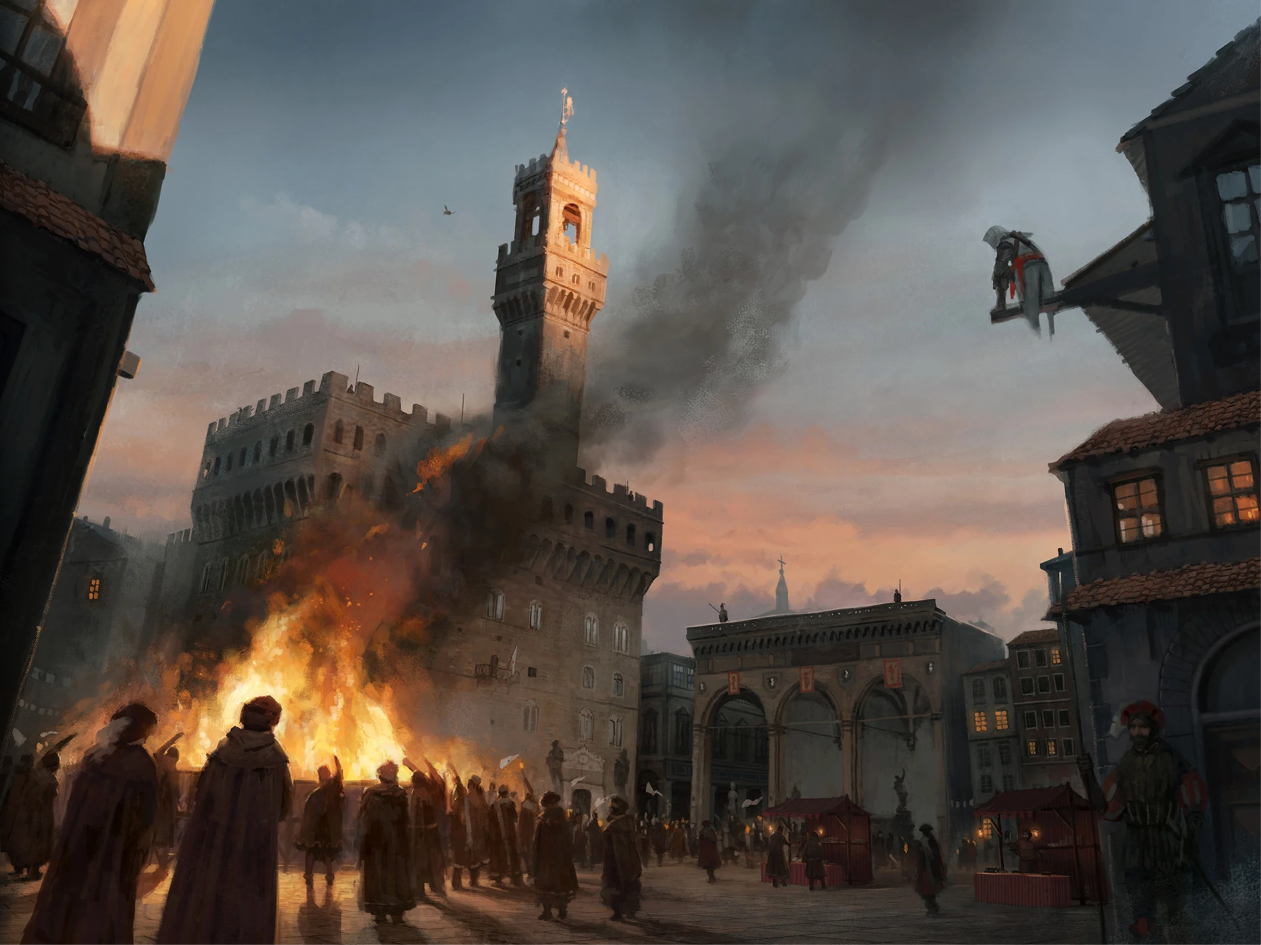
If it is described only as a preacher making frightened people destroy art, the analysis misses why the event worked.
The 1497 bonfire emerged from Carnival transformed into penitential spectacle. Objects had been gathered through the city. The fanciulli, sermons, songs, processions, confraternal habits, law, household pressure, voluntary devotion, factional enthusiasm, charitable collection, and the public hunger for visible renovation all converged in the piazza.
The pyre was constructed as architecture.

The objects did not lie in an accidental trash heap.
They were arranged into a public diagram of disorder. The city could see the classes of thing it was renouncing. The vertical structure gave corruption a shape. The crowd could walk around its own diagnosis before fire removed the evidence.
- Gaming equipment.
- Luxury objects.
- Cosmetics.
- Mirrors.
- Masks.
- Images.
- Books.
- Musical instruments.
- Clothing.
- Objects associated with magic, sexual display, carnival, gambling, vanity, or morally dangerous entertainment.
The exact contents of the pyres vary across accounts, and later memory has been very eager to place every lost Renaissance masterpiece inside these flames.
The real field is more difficult.
Some objects were probably ordinary.
Some were costly. Some were beloved.
Some may have been surrendered sincerely.
Some may have been extracted through social pressure.
Some participants saw repentance.
Some saw theft. Some saw civic renewal.
Some saw the Piagnoni taking over Carnival.
Some saw art destroyed.
Some saw the poor supported through accompanying collections.
Some saw the city finally acting like the Christian republic it claimed to be.
Then the fire began.
Fire solves interpretation through matter.
Before ignition, a mirror can be debated.
Afterward, it is no longer available to complicate the sermon.
The crowd receives a clean transition:
- object;
- flame;
- ash.
The deeper field does not move so cleanly.
Debt remains. Faction remains. Poverty remains. Clerical corruption remains. Political exclusion remains. French alliance remains. Papal pressure remains.
Medicean restoration remains reachable.
The bonfire still creates a powerful dashboard.
The city can see how much it has surrendered. The pile can grow. The event can be repeated. The quantity of destroyed objects becomes a report on moral progress.
The purity machine has found its body count.
This is where McNamara’s Body Count Machine becomes an exact later neighbor.
- The body count did not measure the war.
- It taught the war how to report itself.
- The bonfire did not measure the city’s repair.
- It taught the reform field how to produce visible evidence of purification.
A movement rewarded for collecting vanities will find vanities.
A child praised for securing an object will secure an object.
A household that wants safety will discover something surrenderable.
A preacher whose authority rises with the pile will interpret the pile as confirmation.

The event can contain sincere repentance and still become a false instrument of civic measurement. That is the bonfire’s deepest distortion.
It burns real objects and produces false certainty.
How the Purity Machine Works.
The purity machine begins with real contact.
This distinguishes it from ordinary moral theater.
- There is corruption.
- Some people are using office for private continuity.
- Some clergy are wealthy, cynical, sexually compromised, politically entangled, or publicly indifferent to the standards they enforce.
- Some households turn luxury into social warfare.
- Some festivities carry violence and exploitation.
- Some citizens have no meaningful route into a republic that speaks in their name.
- Some poor families preserve appearances while debt and hunger close their future behind the door.
- The machine sees this.
Then, it performs a sequence:
1. Detect real corruption.
The analyst begins with evidence.
The reformer can point to patronage, bribery, clerical office-selling, factional exile, sexual hypocrisy, conspicuous waste, public blasphemy, debt, poverty, and the political habits by which a nominal republic serves a narrow network.
This first step gives the machine moral traction.
People who have experienced the damage recognize themselves in the diagnosis.
2. Select a visible proxy.
The system chooses an object, practice, garment, song, image, person, or ritual that genuinely relates to the corruption.
The proxy is not arbitrary.
Luxury clothing does relate to status competition.
Gambling can relate to debt and household instability.
A clerical mansion can relate to institutional corruption.
A political enemy can relate to a real restoration plot.
The mirror does reflect vanity.
3. Make the proxy publicly legible.
A sermon teaches the meaning of the object.
The city is told how to read it.
- The cosmetic becomes sexual corruption.
- The song becomes civic degradation.
- The garment becomes pride.
- The political critic becomes an enemy of renewal.
- The pope’s command becomes evidence of a corrupt church protecting itself.
The proxy no longer arrives with several possible meanings.
It enters the machine preclassified.
4. Require surrender.
- The object can be surrendered directly.
- The conduct can be renounced.
- The person can confess.
- The citizen can join the procession.
- The household can prove alignment.
- The political faction can accept exclusion as the price of public peace.
Surrender becomes evidence that the diagnosis was correct.
5. Destroy the surrendered object.
The machine needs closure.
Fire is ideal because it leaves little room for return. Exile, imprisonment, public humiliation, legal disqualification, censorship, and ritual degradation can serve similar functions.
The object disappears. The field can now describe itself as cleaner.
6. Treat destruction as proof of reform.
The bonfire burns.
The crowd sings.
The city sees action.
The visible result is much stronger than the invisible question of whether political dependency, debt, fear, or clerical corruption have decreased.
The metric begins replacing the field.
7. Treat resistance as proof of contamination.
The person who objects may simply value art, privacy, pleasure, process, law, pluralism, or the right not to place household life under a youth movement’s inspection.
The machine receives the objection as attachment.
- Of course the vain person wants the mirror.
- Of course the corrupt politician wants the appeal.
- Of course the worldly citizen resents the children.
- Of course the bad priest resents the prophet.
Resistance confirms the target category.
8. Make the purifier necessary to interpret what remains.
After the first fire, corruption continues.
Someone must explain that now.
- The prophet can identify the remaining impurity.
- The movement can collect another class of object.
- The law can expand.
- The sermon can become sharper.
The purity machine’s failure only increases the authority of its operator.
9. Explain continuing disorder through insufficient purification.
- If Florence remains divided, the city has not repented enough.
- If the pope becomes hostile, the corrupt church is revealing itself.
- If the French alliance becomes dangerous, the providential mission is being tested.
- If the republic weakens, the people have betrayed the reform.
If the ordeal fails, procedure, enemies, weather, or insufficient faith can enter the explanation.
A master diagnosis survives by converting disconfirmation into a request for deeper application.
10. Repeat (Forever).
The machine can always find another mirror.
This sequence is not unique to religion.
Political purges, ideological campaigns, institutional compliance systems, social-media purity cycles, corporate ethics theater, revolutionary tribunals, national-security blacklists, and punitive family systems can all perform versions of it.
The machine thrives anywhere real corruption can be translated into contaminating persons and visible tokens whose removal produces the appearance of repair.
Savonarola’s version remains especially powerful because he paired purification with genuine institutional construction.
- The Great Council was real.
- The charity was real.
- The Monte di Pietà was real.
- The call for clerical reform was real.
- The public moral injuries were real.
The machine did not replace an empty reform program.
It grew through the successful one.
The Relief Arm.
Purity machines are easiest to reject when they do nothing good.
Savonarola’s movement did good.
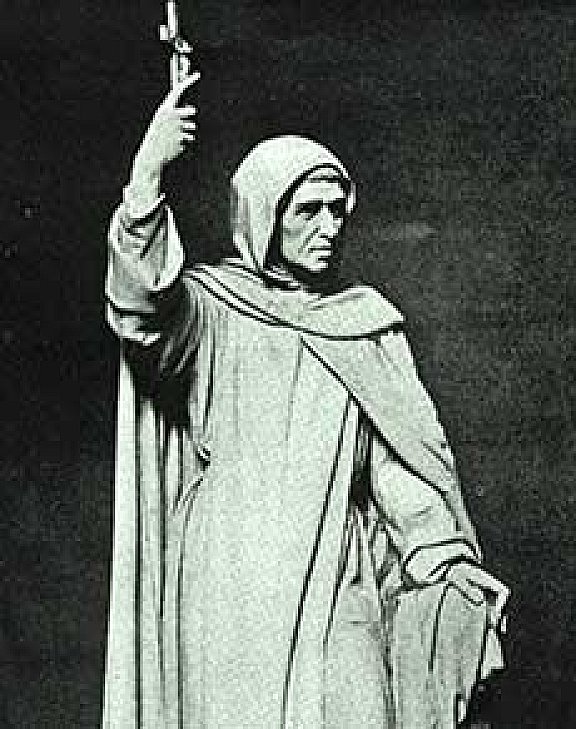
Florence contained families who needed help and could not safely become public images of poverty. Status mattered. Honor mattered. A respectable household falling into hardship might avoid ordinary begging because public exposure could damage marriage prospects, credit, neighborhood standing, political relation, and the family’s remaining routes back into stability.
The Buonomini di San Martino existed to assist such people discreetly.
Savonarola supported this charitable field. His youth processions gathered alms. Public ritual could direct money toward families under pressure. The movement’s Palm Sunday activity and support for the Monte di Pietà joined devotion to practical relief. The piazza did not receive only burned objects. It also received resources intended to reduce debt, hunger, and dependence.
This was real assistance. A family does not eat structural critique.
A debtor cannot repay a lender with the information that patronage is complicated.
A widow, craftsman, sick parent, underemployed citizen, or household struck by sudden loss may need money, grain, credit, clothing, intercession, and the preservation of dignity now.
Savonarola’s field understood that moral renovation had to move material support.
This should be placed beside the bonfire without allowing either object to cancel the other. The same boys could carry alms and inspection.
The same procession could relieve poverty and increase social pressure. The same sermon could condemn wealthy indifference and teach the public to locate corruption in the wrong visible object. The same sacred authority could open a route to care and narrow the route to dissent.
This is why Modal Path Ethics treats instruments as field participants rather than moral species. A ritual is not good because it is religious.
A ritual is not harmful because it is strange.
A charitable apparatus can lower resistance for families while raising resistance around private conduct. A youth organization can give purpose and become surveillance. A public moral movement can direct wealth toward the poor and convert the poor into proof that the movement’s wider authority is justified.
The relief arm also strengthened the purity machine’s legitimacy.
- People who criticize public inspection can be asked why they oppose helping the poor.
- People who resist the movement’s moral categories can be told that the movement is the one feeding families neglected by worldly elites.
- People who benefit from the charity may feel gratitude, dependence, loyalty, fear, or all four.
None of this makes the assistance cynical.
A sincere good can still become an authority channel.
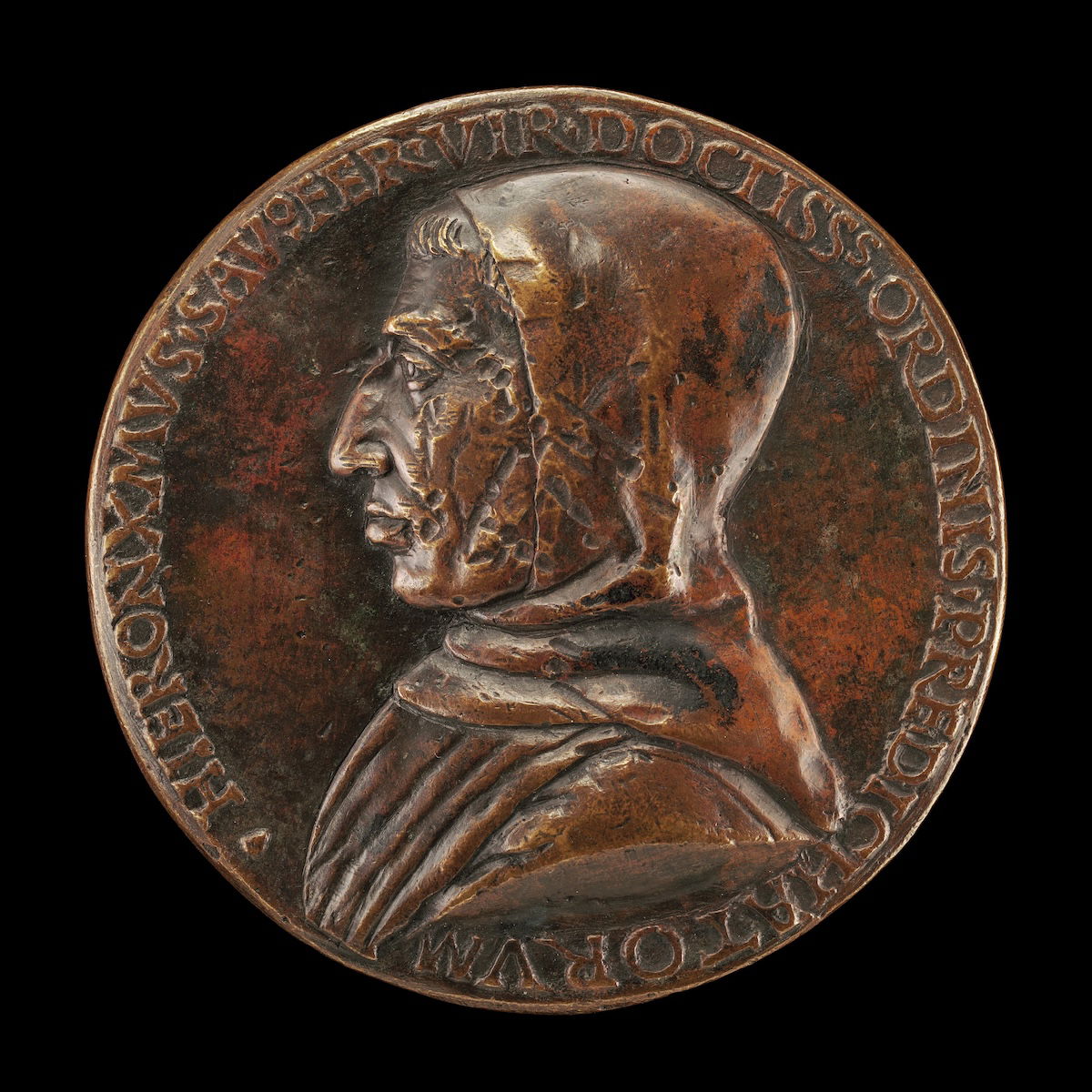
The repair question is whether the instrument can give without purchasing sovereignty over the recipient’s interpretation of the world.
Savonarola’s movement often occupied both sides of that line.
- It saw hunger.
- It moved resources.
- It also taught Florence that the prophetic field organizing the relief had earned the right to organize much more.
The purity machine had a relief arm. The relief reached people.
That made the machine stronger.
The Law of Appeal.
The law of appeal is the cleanest diagnostic instrument in Savonarola’s political life.
Florentine faction had long used exile, taxation, disqualification, imprisonment, and death to close rivals out of the civic field. The republic’s language could hide the fact that public institutions often served private coalitions with excellent records.
Savonarola supported an appeal from certain grave decisions to the Great Council.
This was a structural answer to faction.

A narrow group might classify a citizen as dangerous. The appeal preserved a second path. It widened the number of people who had to agree before irreversible punishment could settle the case. It made the republic answer to a broader version of itself.
The law therefore expressed Savonarola’s best political insight:
Correction needs architecture.
- The prophet could preach mercy.
- The law made mercy less dependent on the prophet’s mood.
- The prophet could condemn faction.
- The appeal gave the accused a route around the faction currently holding executive power.
- The prophet could die.
- The institution could remain.
Then, the institution was tested by the wrong people.
In 1497, five prominent citizens were accused in a Medicean conspiracy. The political danger was real. Piero de’ Medici remained a live restoration threat. Florence was divided. A return of the family could destroy the new republican order, punish its supporters, and reverse the reforms.
The accused sought the appeal. They did not receive it.
The city’s defenders argued urgency, danger, law, jurisdiction, and the need to preserve the republic from men connected to a genuine restoration plot. Savonarola did not intervene effectively to secure the protection he had previously supported.
The five were executed.
Machiavelli later used the episode as evidence that the friar was ambitious and partisan. That judgment can be too neat. Savonarola did not hold civic office.
The decision belonged to the Florentine government, factions, and legal institutions around him. The exact distribution of influence and responsibility cannot be reduced to one sermon-shaped lever.
The structural wound remains.
- The law was universal while the field was discussing enemies in the abstract.
- The law failed when actual enemies asked to use it.
This is where the purity machine reveals itself inside the constitutional reform.
An appeal is designed for the moment when authority is most certain that an appeal is dangerous. A safeguard that survives only friendly cases is decoration.
- The Medicean conspirators may have been guilty.
- The restoration threat may have been severe.
- The republic still needed the rule precisely because the target looked dangerous enough to suspend it.
The Golden Rule belongs here yet again. A logical move is logical against you. If the republic can deny appellate protection because the accused threaten the republic, the next government inherits the same reasoning against the Piagnoni.
The target changes. The instrument remains.
Savonarola saw that corruption was systemic.
He helped build a correction mechanism.
When the opposing faction entered the mechanism, purity overruled correction.
The Pope and the Prophet.
Alexander VI was a terrible correction channel.

This fact helped Savonarola immensely.
The papacy had legitimate jurisdiction over a Dominican friar preaching claims of prophecy, criticizing church leadership, defying orders, and exerting enormous influence over a strategically significant Italian republic. The pope had reason to ask whether Savonarola’s revelations were genuine, whether his public activity was obedient to church authority, and whether Florence’s political course was being shaped through a religious office that had no ordinary civic accountability.
The same papacy was politically entangled, dynastic, wealthy, compromised, and deeply vulnerable to Savonarola’s charges of corruption.
Alexander VI was not a transparent guardian arriving from outside the field with clean hands and a correction notice.

He was a Borgia pope operating in the politics of Italy, alliances, family advancement, papal territory, war, diplomacy, and Florence’s continued attachment to France. Florence’s refusal to join the anti-French Holy League intensified the conflict. Savonarola’s influence on the city could therefore be treated as both religious disobedience and political obstruction.
Every legitimate papal intervention arrived carrying evidence for Savonarola’s diagnosis.
- "The church is corrupt."
- The corrupt church commands the reformer to stop.
- The command proves that the corrupt church protects corruption.
- The corrupt church commands the reformer to stop.
This is the dream environment of a self-sealing instrument.
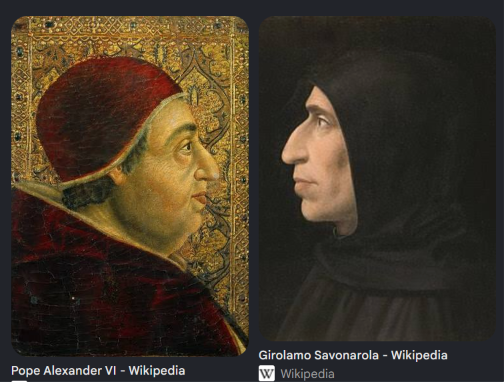
A compromised corrector makes correction look like persecution.
Savonarola could point to clerical wealth, sexual scandal, political maneuver, and the papacy’s strategic interests. He could argue that obedience to corrupt command would betray the higher law the church itself was meant to serve. He could distinguish the office from the current occupant and appeal toward a council capable of judging the pope.
These were not empty claims. Church authority can fail.
Religious obedience cannot require complicity with every command issued by a compromised superior. Sacred instruments become dangerous when they are protected from correction, including correction from below.
The problem was symmetry.
What corrected Savonarola?
- The pope could be dismissed as corrupt.
- Florentine opponents could be dismissed as worldly or factional.
- Mediceans could be dismissed as enemies of liberty.
- The lukewarm could be dismissed as attached to vice.
- Failed predictions could be made conditional on repentance.
- Political setbacks could become trials.
- The people could be told their own suffering reflected insufficient reform.
The prophet possessed an increasingly complete theory of why every external correction lacked standing.
Hubbard’s sealed room returns here. L. Ron Hubbard saw capture and built an instrument that could reinterpret alternative repair as rival capture. Savonarola saw clerical corruption and built a prophetic relation in which ecclesiastical correction could always be received as the corrupt institution defending itself.
The pope excommunicated Savonarola in 1497.
He threatened Florence with wider penalties if the city continued protecting him.
Savonarola continued to preach for a time, then withdrew from public preaching under mounting pressure. He wrote, organized, appealed, and remained at the center of the political-religious conflict.
Neither side could provide a trusted court.
- The pope had jurisdiction without credibility.
- The prophet had credibility without a reliable appellate structure.
Florence stood between them, carrying trade, diplomacy, faith, faction, fear, French alliance, papal pressure, and the growing cost of keeping one preacher inside the city.
When correction loses a trusted institution, the field begins asking spectacle to decide truth.
The Ordeal.
By 1498, Florence had a Great Council.
It had laws, magistracies, sermons, papal briefs, printed texts, factions, chronicles, witnesses, correspondence, theology, civic debate, and enough legal talent to bury every living person in the city under a mountain of procedure.
The decisive question was sent to a lane of fire.
A Franciscan preacher challenged Savonarola’s side to prove divine favor through an ordeal. Fra Domenico da Pescia, one of Savonarola’s closest followers, accepted the possibility of walking through fire as a surrogate for the prophet. Another friar would represent the opposing side.
Savonarola did not volunteer his own body.
This has been used for centuries as proof of cowardice, fraud, prudence, strategy, or the small administrative fact that a movement often has someone more available for burning than its leader.
The more interesting object is Fra Domenico.
He was prepared to let his body certify Savonarola’s authority.
Field Instruments: Martyrdom distinguished witness from recruitment and sacrifice from consumption. A sacred authority becomes especially dangerous when another body can be spent as proof of it. Fra Domenico’s willingness does not make the transition clean. Loyalty can be sincere and still enter an instrument that turns bodily survival into evidence for a doctrine.
The city prepared the spectacle.
Barriers and lanes were arranged in the Piazza della Signoria. Crowds gathered. Government officials waited. The two sides disputed conditions. Clothing, sacred objects, procedure, entry, timing, and the terms under which the ordeal would count became objects of argument.
Rain arrived. Delay accumulated.
The event was eventually canceled.
Nobody walked through the fire.
The failed ordeal destroyed authority anyway.
This is the final maturity of the purity machine.
Truth has been narrowed to a physical sign.
The crowd expects a clean result.
- The believer survives: prophecy confirmed.
- The believer burns: prophecy exposed.
Every problem that made the political and religious field difficult is supposed to pass through one body and one lane.
- Papal corruption. Florentine faction. French alliance. The authenticity of visions. The legitimacy of the republic. The moral condition of Carnival. The authority of the Great Council. The future of San Marco. The right to preach. The city’s chosen status.
- Fire will decide.
A republic had built a Great Council.
It ended up waiting to see whether a friar could walk through flames.
The cancellation enraged the crowd because spectacle had been promised as correction. The public had accepted the machine’s terms. No miracle arrived. No clean verdict emerged. Savonarola’s enemies could claim evasion. Supporters could blame procedural sabotage. The field received the worst possible output for a sovereign proof instrument:
Visible failure without interpretable completion.
Once field correction has been destroyed, spectacle becomes the court of last appeal. When spectacle fails, the crowd becomes the next court.
San Marco Under Siege.
The ordeal did not produce fire. The city found another route.
Public anger and organized opposition turned toward San Marco. The convent that had joined Medici patronage, Observant reform, Fra Angelico’s sacred art, learning, prophecy, republican coordination, charity, youth movement, and political memory became a defended site.
Opponents attacked.
Savonarola’s supporters and friars defended the convent. Weapons appeared. The sacred reform center became an armed political object. The distinction between monastery and faction headquarters collapsed quickly under pressure.
The Piagnona rang.
The bell translated the siege into a call.
Its sound told supporters that the convent needed them. It also told the government that San Marco could mobilize bodies beyond its walls. The bell made visible what Savonarola’s enemies had long feared: the preacher’s authority was not confined to doctrine. It had acquired a network capable of public action under emergency.
The bell did not need to explain the cause. Everyone already knew which field the sound belonged to.
This is why the later trial of the bell was absurd and perceptive.
This instrument had causal reach.
During the siege, that reach could preserve life, prolong resistance, increase casualties, attract defenders, intensify panic, or turn a local assault into civic conflict. The sound did not carry a neutral message. It carried the entire accumulated relation between San Marco and Florence.
Savonarola eventually surrendered. Fra Domenico and Fra Silvestro were taken with him.
The convent did not become a martyr fortress holding forever against the city. The armed defense did not prove divine favor.
The prophet who had interpreted invasion, republic, and reform now entered the custody of the government whose constitutional imagination he had helped expand.
This is the institutional irony worth keeping.
A movement can help build the republic and later become an object of republican force.
The fact does not prove the republic innocent.
It proves instruments outlive their preferred user.
The Second Bonfire.
Savonarola was tortured and interrogated.
The records are damaged objects.
He confessed that his prophecies and visions had been fabricated, recanted, confessed again, and wrote prison meditations of extraordinary religious intensity. The surviving official versions passed through torture, editing, political need, church process, civic process, and the desire of every faction to possess a final key to the man.
So the confession cannot settle anything.
A statement produced under torture does not become transparent because it confirms the conclusion one already preferred. Savonarola may have believed himself prophetic. He may have shaped, exaggerated, interpreted, performed, or strategically deployed experiences he understood in several registers. He may have lied in some places, believed in others, and lost the ability to separate public role from interior conviction. The evidence does not give us a clean room.
Florence wanted one. It demanded one.
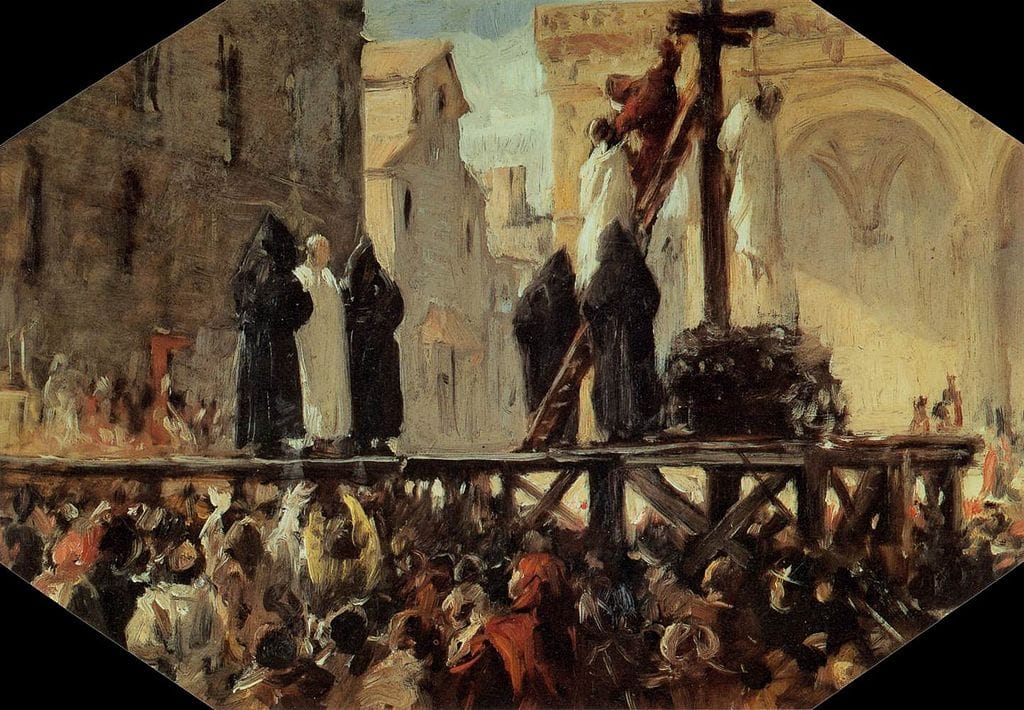
On May 23, 1498, Savonarola, Fra Domenico, and Fra Silvestro were taken to the Piazza della Signoria. They were ritually degraded, hanged, and burned. Their ashes were removed and scattered to prevent relics from forming a continued sacred field around the bodies.
The city had learned from the bonfire.
Public destruction could settle a classification.
The men were not simply killed. They were converted into a civic statement about what Florence had rejected.
This was the second bonfire.
- The first pyre had consumed objects classified as vanity.
- The second consumed the men associated with the classification system.
The symmetry is tempting.

It should not be treated as justice.
Savonarola’s use of fire did not make his execution good. Public destruction does not become repair because the target once built a public destruction instrument.
The city had inherited the same grammar:
- identify contamination;
- display it;
- destroy it;
- prevent remainder;
- declare the field cleaner.
The Savonarolan movement had treated objects as carriers of corruption.
The anti-Savonarolan government treated the friars as carriers of sedition, schism, false prophecy, and civic danger.
The machine changed operators.
A moral framework can become very stupid around poetic symmetry.
He burned vanities, then Florence burned him.
Perfect. Except bodies are not mirrors.
Execution does not clarify prophecy.
Ash does not restore trust.
The Great Council does not become healthier because three friars have been made unrecoverable in public.
The papacy does not become uncorrupt.
The Medici do not cease being a restoration threat.
The poor are not fed by the scaffold.
The law of appeal is not repaired.
The city receives a dramatic ending and keeps the field.
The Bell on Trial.
Five weeks after the execution, Florence returned to the Piagnona.
The bell had survived the scaffold.
It had survived the fire.
It had survived the scattering of ashes.
This survival made it awkward.
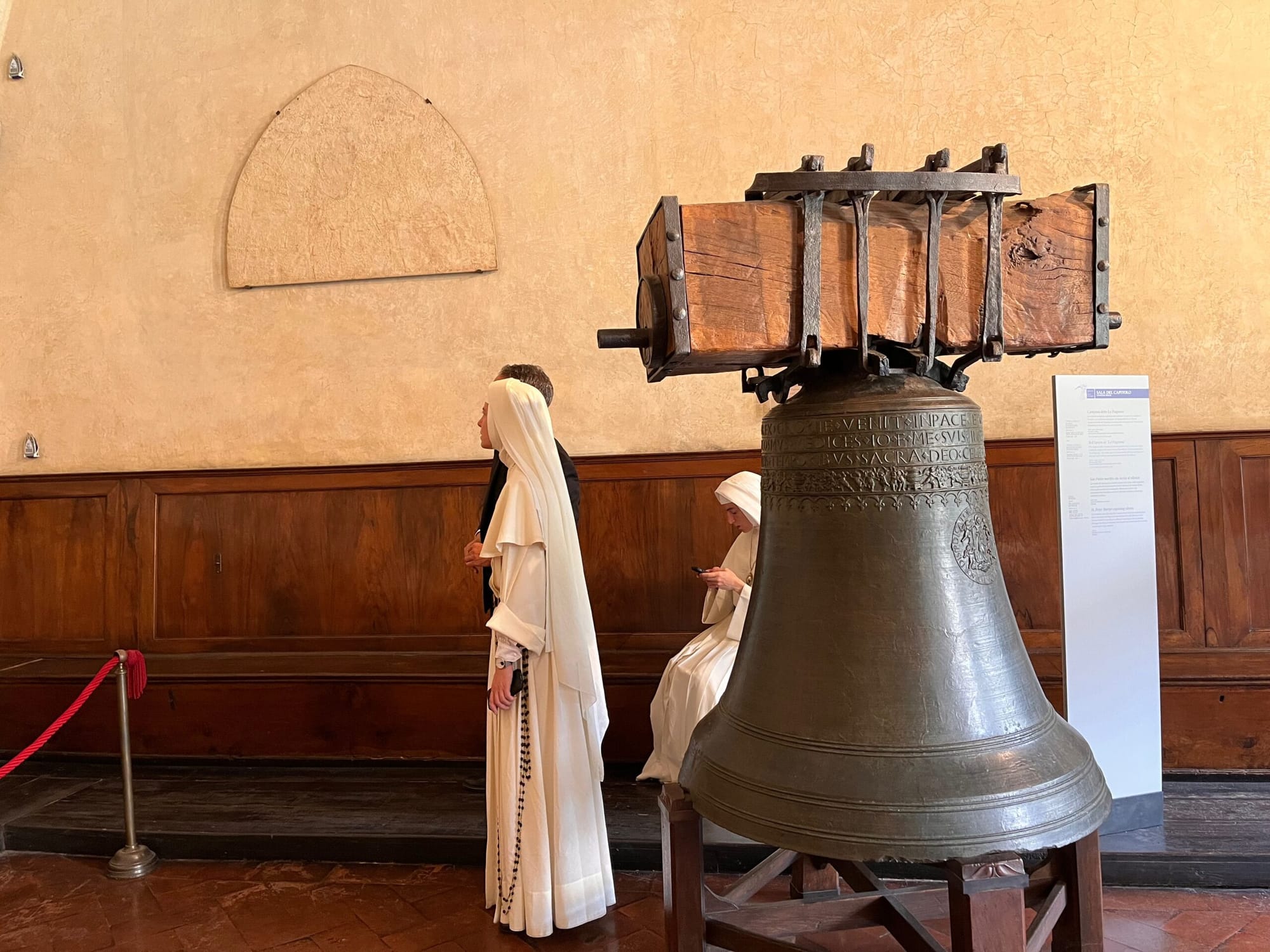
The bell still occupied San Marco’s tower as a retained instrument of the movement. It had called the convent during the siege. Its sound belonged to Savonarolan memory. Followers could hear the bell and remember the sermons, the processions, the Great Council, the French crisis, the promises made to Florence, the defense of the convent, and the three bodies removed from the piazza.
The government treated the bell as a participant.
It was publicly punished and exiled.
The form of the punishment reflected a world in which bells could possess civic biographies.
Bells were named, blessed, rung for distinct occasions, associated with churches, neighborhoods, emergencies, deaths, and victories. Their voices crossed property lines and compelled attention. A bell could be captured from an enemy, melted, renamed, silenced, or removed from the community whose time it had organized.
The Piagnona had become politically contaminated by sound.
Florence understood the risk of leaving a movement’s coordination instrument untouched while declaring the movement finished.
The city also reenacted the exact instrument it claimed to remove.
Savonarola had taught Florence to read objects as carriers of moral relation.
The government read the bell the same way.
- The object had been used in sedition.
- The object therefore belonged to sedition.
Its physical removal became a visible statement that San Marco’s voice no longer commanded the city.
This is where the bell’s trial becomes more than historical oddity.
The government was right that the bell mattered.
It was wrong to imagine that removing the bell removed the field.
The sermons had been printed.
The reforms had entered institutions.
The Piagnoni remained.
The poor remembered relief.
The opponents remembered coercion.
The Great Council remained part of the republic.
The law of appeal remained wounded.
Artists, friars, lay followers, women in religious communities, political republicans, and later readers carried different Savonarolas into different futures.
You can't unring a bell by burning it. The sound had already left the tower.
This is the same error as the bonfire in reverse.
- A visible object is selected because it really participates in a larger relation.
- The object is removed.
- The institution treats removal as closure.
- The relation continues elsewhere.
Florence had discovered accessory liability for bronze.
It had not discovered how to prosecute memory.
Botticelli Is Assigned to the Fire.
Later memory wanted Botticelli to be at the bonfire.
This is understandable.
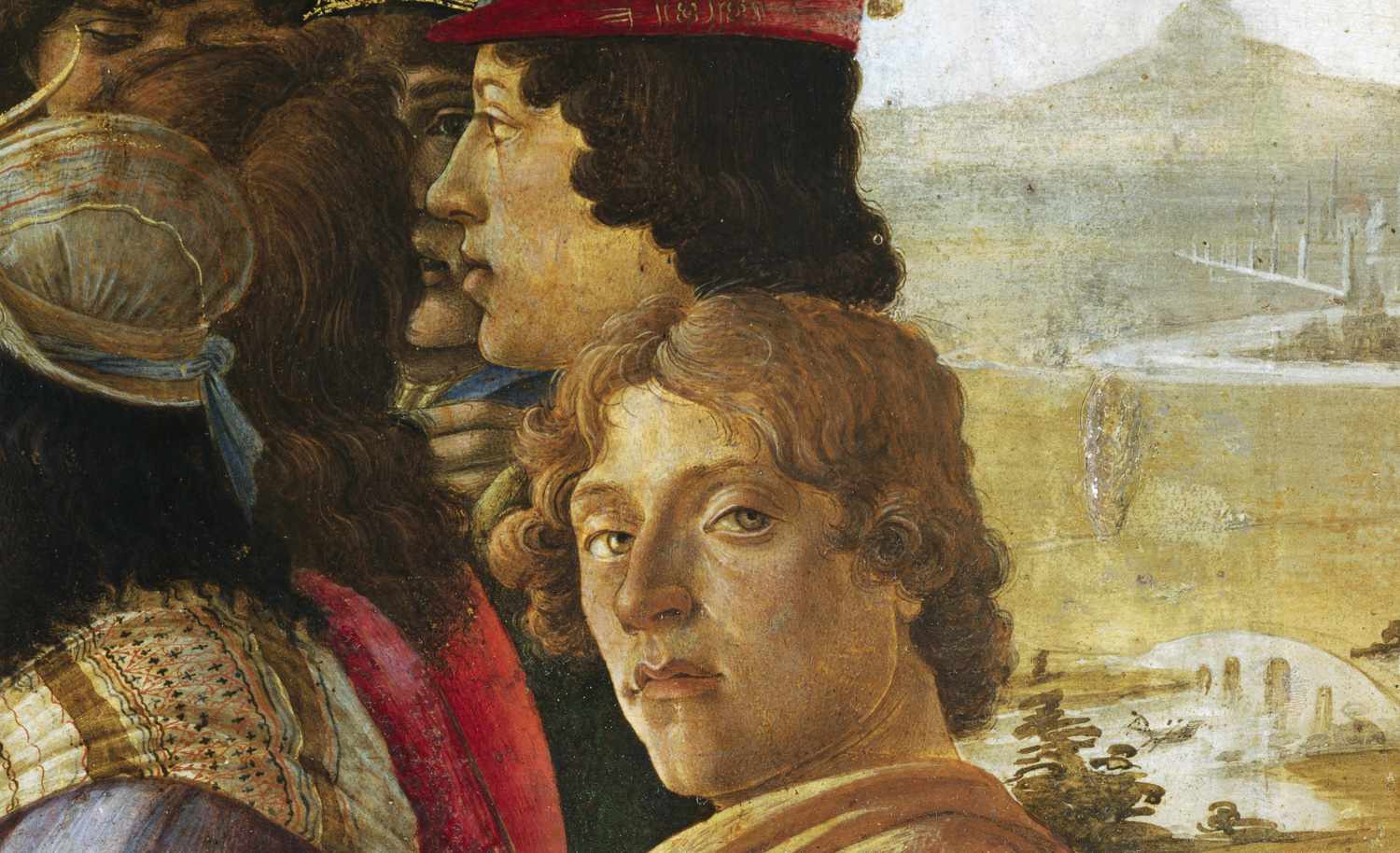
A famous artist, creator of mythological beauty, falls under the spell of a severe preacher and burns his own paintings in a public act of repentance. This story contains Renaissance, religion, art, fear, self-destruction, and the thrilling possibility that lost masterpieces once existed just long enough to be offered to a pyre.
It is almost too well designed.
The evidence does not securely establish the familiar version.
Botticelli was influenced by the religious and political field around Savonarola. His later work has been read through apocalyptic themes, reformist pressure, spiritual intensity, and the altered atmosphere of Florence. Artists associated with the movement made real changes in life and work. Savonarola’s preaching about images was serious and could be hostile toward forms he considered morally dangerous.
The leap from influence to Botticelli personally carrying major mythological paintings into the fire belongs to later legend rather than firm contemporary record.
The legend is still useful. It shows what subsequent generations needed Savonarola to become.
The modern art story prefers a contest between beauty and purity.
- Botticelli’s paintings stand for individual creation, pagan inheritance, sensuality, humanism, and the Renaissance opening toward a modern world.
- Savonarola stands for repression, fire, anti-art religion, and the attempt to reverse history.
The bonfire becomes the place where the two epochs fight.
That story cleans Florence way too much.
Medici patronage funded sacred reform and sacred art.
Fra Angelico’s work at San Marco does not fit the claim that religious discipline opposed beauty.
Savonarolan followers included artists.
The movement produced songs, prints, visual identities, processions, and a major portrait tradition around the prophet.
The friar’s criticism of images belonged to a dispute about use, devotion, luxury, sensuality, public morals, and the difference between an image serving sacred contact and an image capturing attention for another end.
The purity machine did destroy objects and narrow artistic freedom.
It did not arrive from a world without art.
It used art.
It used song.
It used theatrical procession.
It used the architecture of the pyre.
It used the visual innocence of children.
It used printed diagrams and texts.
It used the prophet’s face.
This movement understood images very well. That is why it feared the wrong ones.
The Botticelli legend also performs the purity machine against Savonarola.
It selects one visible victim and makes the victim explain the whole field.
A lost painting is easier to mourn than the wounded law of appeal.
A burned Venus is easier to imagine than the structure of Florentine credit.
A fanatic destroying beauty is easier to classify than a reformer who helped widen political participation, aid poor families, oppose clerical corruption, mobilize coercive youth, and place prophecy above correction.
The legend gives us a clean target.
Savonarola would have understood the appeal.
The Prophet in Print.
Savonarola was not only a voice in a church.
He was one of the early figures to use print aggressively as an extension of charismatic authority.
His sermons, treatises, prophetic compendia, devotional writings, political arguments, letters, and images circulated through a city whose printing culture could separate the message from the moment of preaching. The spoken field became reproducible. A listener could carry the sermon home, reread it, share it, annotate it, preserve it, and place it into relation with the next event.
Printing changed the authority structure.
A sermon normally disappears into memory. A printed sermon becomes an archive of prediction.
When Charles VVIII later arrives, readers can return to warnings that now look confirmed.
When the pope commands silence, the text continues.
When the prophet is imprisoned, the page does not require permission to remember him.
When the bell is exiled, the printed voice remains in circulation.
The medium also intensifies distortion.
A text can be extracted from the event that produced it. Conditional language can harden into prophecy.
A line addressed to one crisis can become a permanent constitutional instruction.
Followers can preserve the strongest formulation and forget the hesitations around it.
Opponents can preserve the most extravagant claim and treat it as the whole man.
The printed prophet becomes much easier to standardize after the living prophet is dead.
This is the anti-oblivion structure with its usual danger. The field retains. Retention is not permission.
Savonarola’s writings preserve real insight into corruption, republican government, faith, charity, scripture, and the spiritual condition of power.
They also allow later readers to continue the answer-channel after the conditions that once gave it authority have changed.
The dead prophet cannot revise the text.
He cannot respond to the Medici restoration, the later republic, the Protestant Reformation, the Catholic reform, the transformation of Florence into a duchy, or the later uses of his name by people who disagree about nearly everything else.
The living decide which Savonarola the archive releases.
- saint;
- fraud;
- republican;
- tyrant;
- precursor of reform;
- enemy of art;
- prophet;
- partisan;
- martyr;
- puritan;
- political founder;
- failed field analyst.
The print field helps explain why the government could punish a bell and still fail to end the movement.
The sermon had already become portable. The machine no longer needed the machine room.
The Machine Without Savonarola.
The Piagnoni survived.
Some carried Savonarola as a saintly reformer. Some carried the republican program. Some carried opposition to Medici domination. Some preserved his writings, sermons, devotional practice, and memory through convents, lay networks, art, music, and print. Some later readers connected him to wider church reform. Some Protestant reformers would find a precursor in his attacks on corruption and his prison writings. Catholic admirers would preserve another Savonarola inside a different line of continuity.
The movement did not remain one thing. That is the first sign that the instrument had escaped the original controller.
Savonarola’s death broke the claim that one living prophet could interpret Florence’s whole field. It did not erase the political and religious relations gathered around him.
The Great Council continued in the republic.
Republican participation remained a live Florentine question.
The Medici returned in 1512 and the Savonarolan field became part of opposition memory. Republican restoration in 1527 reopened some of the older hopes. The final collapse of the republic and establishment of Medici ducal rule in 1530 closed many of those paths politically while leaving the writings and symbols available for later use.
- A purity machine can outlive the purifier.
- So can a repair instrument.
The ruling has to separate them.
Savonarola’s Great Council work should not be rejected because he also supported a moral field that became coercive.
The charity should not be rejected because the children also inspected households.
The critique of clerical corruption should not be rejected because prophecy became sovereign.
The New Jerusalem vision should not be rejected simply because sacred title became dangerous. A city can need a moral horizon larger than oligarchic continuity.
![Das Neue Jerusalem [The New Jerusalem] - Curtis Wright Maps](https://curtiswrightmaps.com/wp-content/uploads/map_13.27x16.61_07-09-25_inv007187c-scaled.jpg)
The law of appeal should be preserved precisely because Savonarola’s own field failed it.
This is the work of repair in the wake of a Failed Field Analyst.
- Do not preserve the analyst as one clean object.
- Do not burn the whole inheritance.
- Extract the true fragment without letting the fragment retain the sovereignty that caused the collapse.
The true fragment here is substantial:
Corruption reproduces itself through fields.
Political form alone is insufficient.
A republic requires habits, material support, public trust, distributed participation, restraints on factional punishment, and a culture capable of seeing the poor as part of the city rather than as the moral backdrop to elite magnificence.
The failed instrument is equally substantial:
Purity cannot govern the whole diagnosis.
Purity reduces complex causal relations to contaminating objects and persons.
It prefers visible surrender over slow institution-building. It turns resistance into evidence. It makes failure self-confirming. It grants the purifier a permanent job. It can attach charity to surveillance, sacred kingship to prophetic monopoly, republican defense to denied appeal, and cultural reform to the inspection of private life.
The movement after Savonarola carried both inheritances.
History often receives them together because people want the clean emotional economy of saints and villains.
The field does not owe us that convenience.
What Survived the Friar.
The first surviving object is republican imagination.
Savonarola did not invent Florentine republicanism. He entered a long civic tradition full of contradictions, exclusions, oligarchic habits, legal sophistication, popular memory, and institutional experiments. His contribution to the Great Council helped give the post-Medici republic a broader architecture and a political language that outlived him.
The second surviving object is the warning about culture.
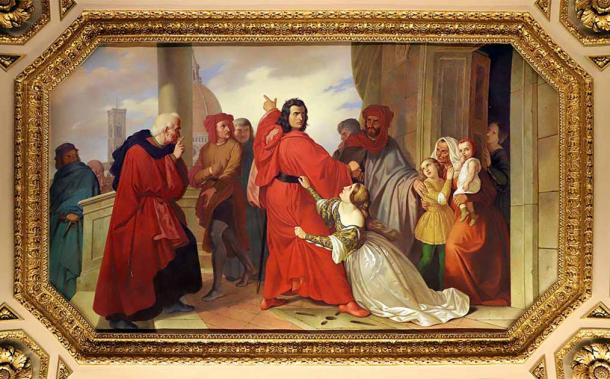
A constitution cannot sustain itself while every other institution teaches its opposite. If public life trains domination, humiliation, consumption, faction, revenge, and passive dependence, a formal republic will inherit those habits at the moment of stress.
Savonarola understood that reform had to enter the calendar, street, song, household, pulpit, child, credit relation, and public image.
Modern institutions often learn this same lesson in a cheaper form called communications strategy.
Savonarola meant more than messaging.
He understood that the citizen is formed.
The third surviving object is the warning about compromised correction.
- Alexander VI had authority and insufficient credibility.
- Savonarola had credibility and insufficient correction.
The conflict shows why legitimate institutions can lose their ability to govern a field after repeatedly spending trust. A corrupt appellate body does not make appeal unnecessary. It makes the absence of appeal more dangerous.
The fourth surviving object is the law of appeal’s wound.
The republic needed the law to stand against the very enemies whose danger made suspension attractive. The denial of appeal to the alleged Medicean conspirators demonstrates that safeguards live or die at the boundary of fear.
The fifth surviving object is charity.
The movement’s aid to families, support for public lending, and attention to the poor demonstrate that sacred reform can enter material continuance rather than remaining in symbolic denunciation. A religion track that treats all discipline as pathology would lose this entirely. Sacred instruments can preserve care, memory, humility, obligation, and repair. Their danger begins with sovereignty over correction.
The sixth surviving object is the bonfire’s diagnostic power.
A pile of objects can become a dashboard for a field it does not measure.
![Assassin's Creed 2 - Savonarola's Death & Ezio's Speech [HD]](https://i.ytimg.com/vi/ZCIZ7-J0cwc/maxresdefault.jpg)
The lesson reaches well beyond Florence.
- Corporate institutions produce trainings, pledges, badges, removals, and public statements while the incentive structure continues.
- Political movements identify contaminated words or persons while resource distribution and institutional power remain untouched.
- Families destroy a symptom-carrier while preserving the relation that generated the symptom.
- Religious communities expel a scandal and preserve the authority that enabled it.
- States remove a leader and leave the security architecture intact.
- Revolutions burn symbols while administrative habits reassemble behind the smoke.
The purity machine succeeds because the object is easier to act upon than the field.
The seventh surviving object is the bell.
Florence punished it because sound had causal reach.
The punishment admits that instruments matter.
It also shows the state’s own surrender to proxy logic. The bell was connected to the movement. The movement was larger than the bell.
The bell’s trial therefore preserves the whole article in miniature:
- correct perception of relation;
- false confidence in object removal;
- public purification;
- field remainder.
The eighth surviving object is Savonarola himself.
The article cannot decide whether every prophecy claim was sincere, fabricated, self-deceived, strategically shaped, or mixed. The confessions under torture do not rescue us from ambiguity. The later saint and fraud traditions each inherit evidence and appetite.
Modal Path Ethics does not need a final diagnosis of his interior life.
The field evidence is enough.
- He saw real corruption.
- He supported real repair.
- He built a public instrument around prophecy and purity.
- The instrument gained enough authority to overrun some of the corrective structures his own insight required.
That is a Failed Field Analyst.
The Image and the Idol.
Savonarola was not against images.
He lived inside one of the most visually saturated sacred environments in Europe. San Marco placed painted scenes of Christ, Mary, saints, grief, betrayal, prayer, crucifixion, and resurrection inside the daily movement of friars. The image could orient attention. It could teach. It could discipline imagination. It could return the viewer to a sacred event through color, gesture, surface, and repeated contemplation.
Savonarola understood the power of images well enough to fear them.
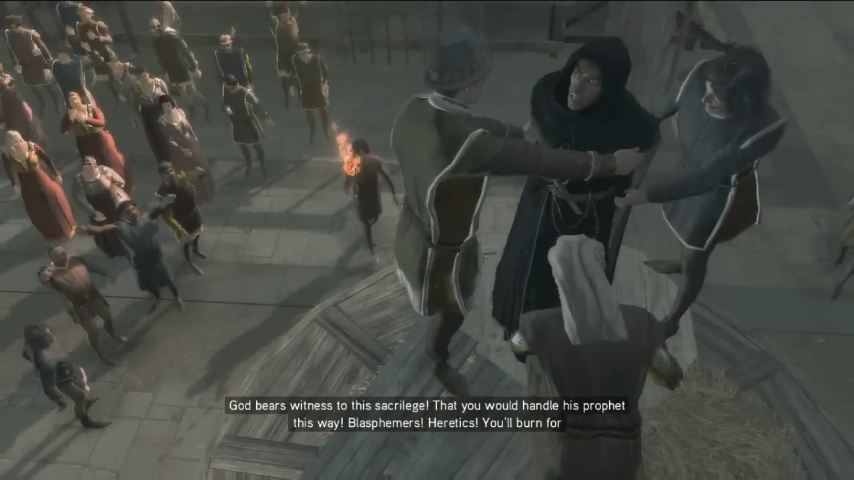
He criticized images he regarded as indecent, crude, theatrical, sensual, badly made, or shaped by worldly patrons in ways that displaced sacred truth. He wanted religious art to train the viewer toward devotion rather than turn the saint into a fashionable Florentine with an expensive face. He could describe love itself through the operation of painting on the imagination: the beloved’s face, clothing, movement, and presence reproduced internally until attention becomes captured.
This is not an iconoclast who thinks pictures do nothing.
This is an analyst who thinks pictures do too much.
That insight is real. Images organize desire.
A painting does not sit passively on a wall. It trains the eye, identifies worthy bodies, stabilizes memory, intensifies longing, normalizes rank, builds a public past, and gives invisible claims a visible surface. A patron who places a family likeness near a saint is doing more than funding beauty. A church that fills its walls with particular bodies creates a hierarchy of attention. A city that reproduces its rulers, heroes, holy figures, enemies, and myths is teaching people what kinds of life deserve continuity.
Savonarola saw the visual field.
Then purity narrowed the diagnosis.
The image became clean or unclean.
The image either returned the viewer to proper devotion or captured the viewer for carnal, worldly, pagan, or status-driven desire. This category could reveal something real about use. It could also flatten artistic ambiguity, pleasure, human complexity, classical inheritance, humor, bodily beauty, and the possibility that sacred contact does not require one authorized visual grammar.
The machine needed images to be morally obedient.

An image capable of producing several live interpretations was dangerous because interpretation might leave the prophetic field.
This is the same structure that later appears in the bonfire, the trial by fire, and the denial of appeal.
Purity has difficulty with intermediate states.
- The object is surrendered or retained.
- The citizen is reformed or corrupt.
- The prophecy is divine or fraudulent.
- The pope is authoritative or Babylonian.
- The image is devotional or contaminating.
- The faction protects liberty or serves tyranny.
A complex image does not cooperate.
It can be beautiful and dangerous.

It can be devotional and vain.
It can carry patronage and sincere faith.
It can exploit a body and preserve a body.
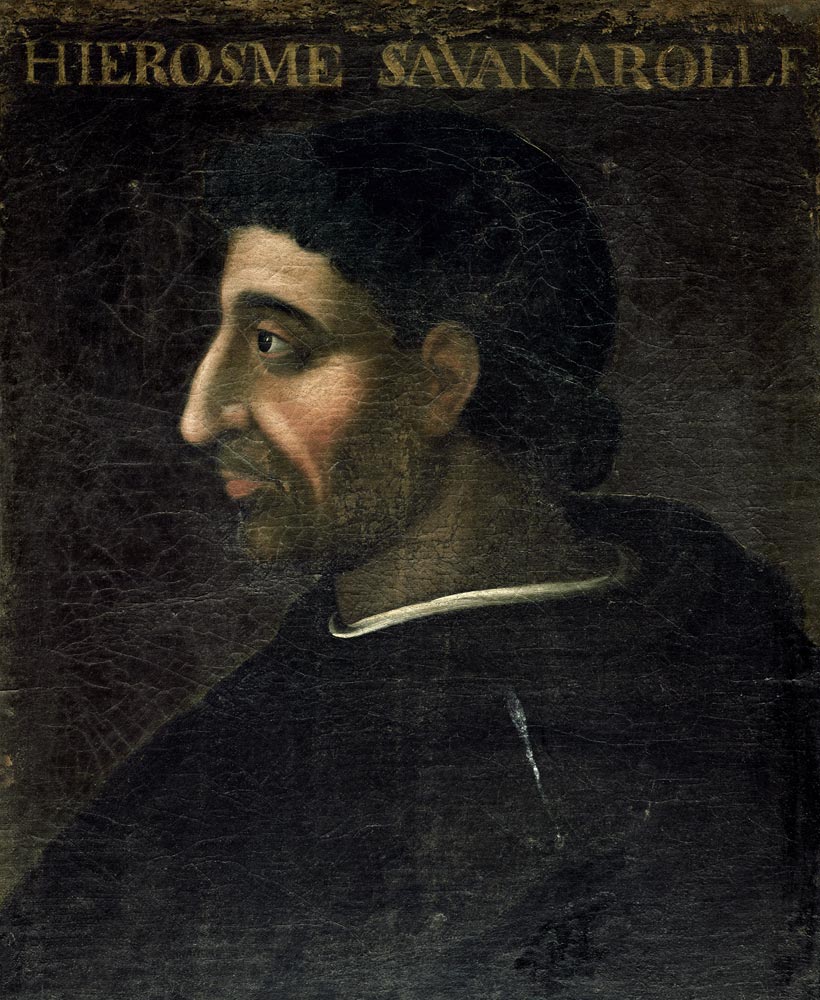
It can open sacred attention for one viewer and thicken worldly status for another.
The correct instrument would ask what the image does in this field, through which relation, for whom, under what conditions, and with what correction.
The purity machine asks whether the image belongs on the fire.
That is a much faster interface.
Florence Divides Itself Into Names.
The purity machine spoke as though Florence could be purified into one city.
Florence kept producing factions.
Savonarola’s followers became known as Piagnoni, the weepers. Their opponents included Arrabbiati, the enraged or angry men; Palleschi attached to Medici restoration; Compagnacci associated with elite youth culture, carnival, opposition, pleasure, and at times direct hostility to the friar’s program.
The names changed across contexts and did not describe perfectly bounded political parties. They reveal something more useful.
The city refused to become one moral subject.
Different groups experienced Savonarolan reform differently.
- A citizen excluded under the Medici might experience the Great Council as liberation.
- A family threatened by political turnover might experience it as instability.
- A poor household receiving aid might experience the movement as care.
- A household inspected by boys might experience it as intrusion.
- A devout artist might experience Savonarola as a call toward sacred seriousness.
- Another artist might experience the same field as the narrowing of imagination.
- A republican might support the Great Council and reject prophetic sovereignty.
- A pleasure-seeking young aristocrat might defend Carnival for selfish reasons and still correctly perceive coercion in the reform movement.
- A Medicean could oppose Savonarola because he wanted oligarchic restoration.
- A papal supporter could object from genuine concern about religious obedience or from political interest in the anti-French alliance.
The city contained these mixed motives everywhere.
Purity sorted them badly.
- The opponent of the bonfire could be attached to vanity.
- The opponent could also understand that household objects were becoming public loyalty tests.
- The critic of the fanciulli could resent charity.
- The critic could also see children being used to carry adult coercion.
- The defender of Savonarola could be politically ambitious.
- The defender could also recognize that the pope’s correction channel was compromised and that the Medici threatened republican continuance.
The purity machine needed the factions to disclose their moral substance.
- Piagnoni became the party of repentance.
- Opponents became worldly, angry, tyrannical, lukewarm, corrupt, or attached to vice.
The opponents performed the same compression in reverse. Savonarola became the hypocrite, tyrant, fraud, enemy of art, enemy of pleasure, enemy of Florence. His followers became dupes or fanatics. The Great Council, charity, and anti-oligarchic work could disappear behind the bonfire.
Each side selected the object that made the other side easiest to burn.
This is a political field becoming a purity competition.
Once factions are understood as moral substances, compromise becomes contamination. A procedural loss becomes proof that the wrong people have captured the city. A safeguard can be suspended because the target is not a citizen in error; the target is a carrier of the field one is trying to remove.
The Savonarolan machine did not eliminate faction.
It gave faction sacred temperature that survived him.
This is why the origin field matters so much.
Florence already possessed republican institutions, family networks, guild interests, neighborhood identities, patronage obligations, religious confraternities, elite rivalries, popular grievances, and memories of prior expulsions. The prophet could synchronize a large coalition. He could not convert the city into one will without destroying the very plural republic he had helped open.
Purity promised unity.
That promise generated more precise enemies.
The Prophet Without Office.
Savonarola never became Florence’s formal ruler.
He did not hold the civic offices through which ordinary government operated. He did not sign every decree, command every magistrate, or sit as a prince above the constitution. His authority moved through sermons, followers, public reputation, sacred interpretation, party networks, diplomatic usefulness, print, ritual, and the belief that he could read the field at providential depth.
This makes him more instructive.
A formal dictator can be located on an organizational chart.
Savonarola’s power was atmospheric and causal.
- A sermon could alter the agenda before the council met.
- A prophecy could change how an invasion was interpreted.
- A procession could make a political program appear as public repentance.
- A group of boys could turn household conduct into civic evidence.
- A papal command could become a test of Florence’s loyalty to reform.
- A party could act through institutions while insisting the prophet held no office.
This is governance through interpretive sovereignty.
The prophet does not need the chair if the people in the chairs believe the prophet knows what the crisis means.
Machiavelli later placed Savonarola among founders whose difficulty lies in sustaining a new order without force capable of securing it. The familiar label of the "unarmed prophet" has often been used to explain his fall.
The phrase catches something. Savonarola lacked the durable coercive apparatus that could make his order survive when persuasion, public faith, and factional support collapsed.
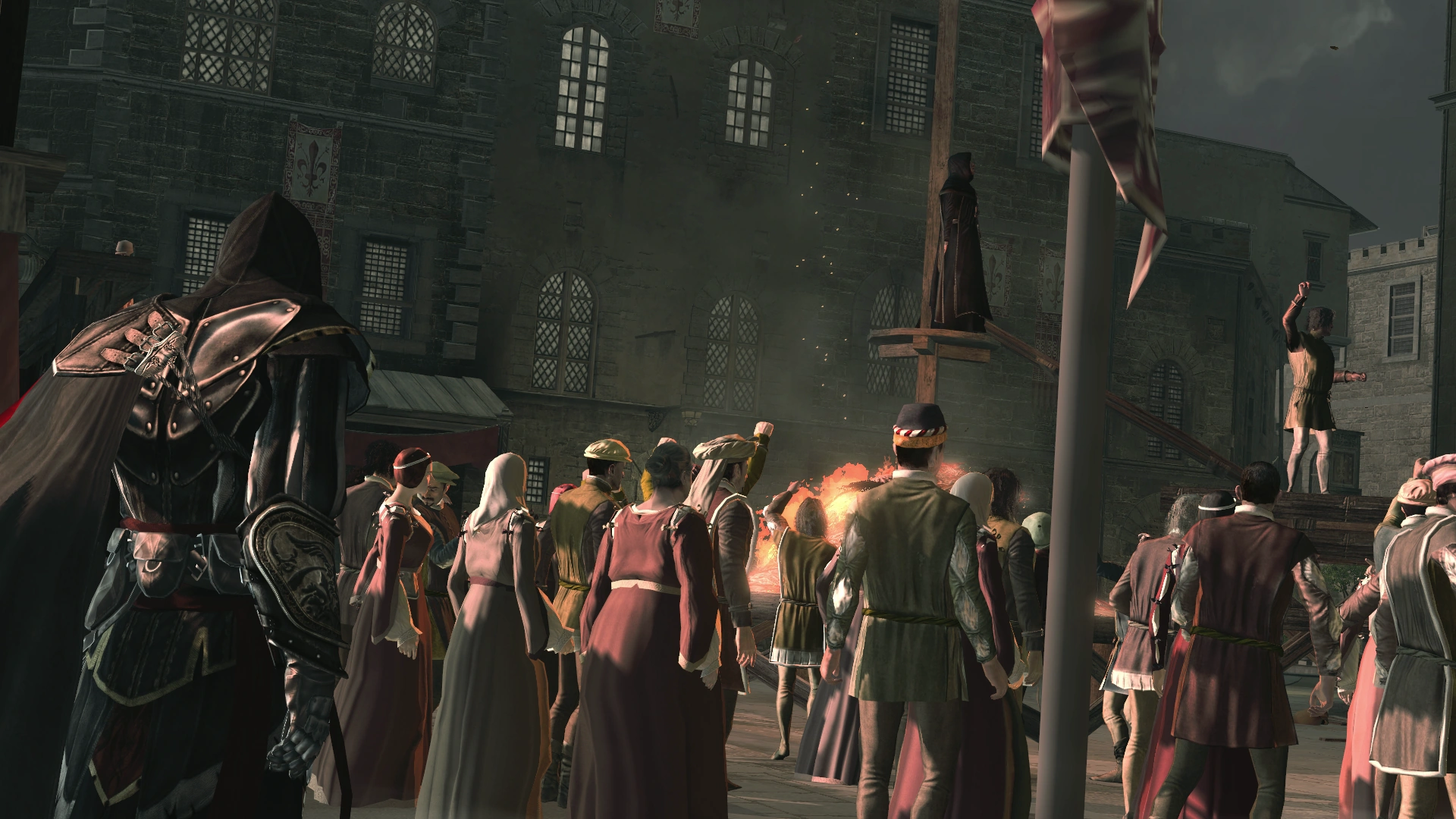
It can also mislead.
Savonarola was not powerless at all.
- He had instruments.
- He had San Marco.
- He had print.
- He had the pulpit.
- He had youth organizations.
- He had allied citizens, officials, friars, charitable channels, songs, public rituals, and a political party field.
- He helped shape institutions.
- His movement eventually defended the convent with force.
Weapons are one form of coercive capacity.
Interpretation is another.
The sermon could make a citizen’s private object answerable to public reform without a soldier entering the house. The child at the door could create compliance through social standing. The promise of divine renovation could make political disagreement feel like betrayal of Florence’s future.
This is power.
It is also fragile because it depends on continued confidence in the interpreter.
The trial by fire damaged the interpretation field.
The failed spectacle did not disprove every reform. It broke the relation through which Savonarola’s voice had coordinated them. Once that relation failed, the same distributed instruments could not preserve him. The council, crowd, papacy, factions, and government now moved separately.
The prophet without office had built a machine whose controller was credibility.
When credibility collapsed, the machine did not gently hand off.
It broke into factions and fire.
The Hall and the Pyre.
Savonarola’s Florence built two great public instruments.
- One was the Great Council hall.
- The other was the bonfire.
The hall was slow.
It required eligibility rules, construction, seating, procedure, ballots, disagreement, counting, memory, and the repeated recognition that Florence contained many citizens whose interests could not be compressed into one voice. The hall made political conflict durable enough to continue without every loss becoming exile or death.
The pyre was fast.
It required classification, collection, architecture, crowd, song, ignition, and the agreement that destruction would count as completion. The pyre made moral conflict visible enough to end in an afternoon.
Both instruments answered real failures of the Medici field.
- The hall answered concentrated political access.
- The pyre answered the sense that private luxury, vice, and status competition had become indifferent to the city’s Christian and republican claims.
- The hall preserved disagreement.
- The pyre purified it.
- The hall asked citizens to remain in relation after losing.
- The pyre asked objects to stop existing.
- The hall generated ambiguous evidence.
- A vote might be wise, foolish, factional, compromised, strategic, or revised later.
- The pyre generated clean evidence.
- The object burned.
This is why the purity instrument could overtake the republican instrument in public imagination.
Procedure rarely looks like salvation.
A council session does not produce a column of smoke visible across the city. A law of appeal does not sing. A widened electorate does not make impurity crackle. Institutional repair cannot promise the sensory satisfaction of the thing being gone.
Savonarola belonged to both instruments.
He understood the hall. He also understood the pyre.
His greatness as a reformer came from seeing that Florence needed architecture for continuance.
His failure came from allowing the destruction instrument to become the moral interpreter of the architecture.
When the five alleged conspirators sought appeal, the hall should have outranked the purity diagnosis.
When the pope’s correction arrived through corruption, the city needed a better appellate instrument rather than prophetic immunity.
When the trial by fire was proposed, the hall should have refused to let truth become a spectacle.
The repair path was already physically present in Florence.
It was slower than fire. That was its moral advantage.
The hall was also frustrating. It could preserve bad actors, reward coalition skill, delay urgent action, and let wealthy citizens turn procedure into another instrument of influence. No council becomes good through furniture. The Great Council inherited exclusions and could still be manipulated by faction. Its value lay elsewhere.
It kept the object of politics alive.
The opponent remained a citizen who might return tomorrow, vote again, expose a mistake, form another coalition, or use the law against the people currently certain of their own righteousness. The hall forced Florence to keep receiving people after disagreement.
The pyre solved that problem by removing the object.
This is why purity repeatedly defeats repair under pressure. Repair preserves the difficult relation. Purity offers a world in which the difficult relation has burned away.
Florence needed the hall precisely when the pyre felt more honest.
Repair After Purity.
Purity is attractive because repair is slow.
Repair would have required Florence to keep several distinctions alive at once.
- The Medici concentration of power was dangerous.
- Medici patronage also built public, artistic, scholarly, and religious goods.
- The papacy was corrupt.
- Ecclesiastical correction remained necessary.
- Carnival could carry violence, status, exploitation, and public disorder.
- Carnival also carried pleasure, release, music, local memory, and forms of life that did not need to justify themselves as moral instruction.
- Luxury could deepen inequality and status competition.
- Art and beauty were not reducible to luxury.
- The Great Council could widen participation.
- It still excluded much of Florence.
- The fanciulli could gather alms.
- They should not have become household inspectors.
- The law of appeal could restrain faction.
- It had to protect people plausibly guilty of threatening the republic.
- Savonarola could be right about corruption.
- His prophecy still required correction.
Repair would have separated the instruments.
- Keep the Great Council answerable to constitutional evidence rather than sacred status.
- Keep the appeal available to enemies.
- Keep charity independent enough that recipients and critics do not owe interpretive obedience.
- Keep youth formation from becoming youth enforcement.
- Keep sacred art capable of discipline without granting one preacher jurisdiction over beauty.
- Keep public ritual voluntary enough that absence does not become guilt.
- Keep clerical criticism inside a church field with credible routes of accountability.
- Keep the New Jerusalem as an obligation toward justice rather than title over Florence’s future.
- Keep the prophet able to fail without taking the republic down with him.
This last condition is the hardest.
A sacred instrument needs an exit from itself.
The prophecy can orient attention. It cannot become the only reality channel.
The preacher can expose corruption. The preacher cannot decide which evidence counts against the preacher.
The movement can coordinate reform. It cannot make disagreement proof of contamination.
The city can remember a true warning. It cannot let the warning govern forever after the field changes.
Savonarola’s reforms became vulnerable because the good instruments and the sovereign instrument were braided together. Opponents could attack the prophecy and damage the council. Followers could defend the council by defending the prophecy. Charity, republicanism, youth discipline, anti-Medicean politics, church reform, French alliance, and the New Jerusalem entered one bundle.
When the bundle fell, Florence had to recover each instrument from the wreck.
That is the repair task after every Failed Field Analyst.
Preserve the perception. Remove the sovereignty.
The Prophecy Cannot Be Audited.
Savonarola’s deepest instrument was not the bonfire.
It was the asymmetry between prophecy and evidence.
A political proposal can be debated through consequences, costs, legal authority, institutional design, and the testimony of people who must live under it. A sermon can be challenged through scripture, theology, tradition, moral fruit, and the credibility of the preacher. A prediction can be tested against the event.
Prophetic authority can use all of these instruments.
It can also move above them.
Savonarola did not present every judgment as an ordinary opinion about Florence. He described visions, divine illumination, biblical patterns, providential mission, and a historical sequence in which scourge and renewal belonged together. The claim gave his analysis a special relation to uncertainty.
Ordinary uncertainty could strengthen it.
- If the event was delayed, repentance may have altered the schedule.
- If punishment arrived, the prophecy was confirmed.
- If Florence survived, divine favor was confirmed.
- If Florence suffered, insufficient reform was revealed.
- If enemies attacked, the righteous path was being opposed.
- If allies failed, their impurity had become visible.
- If the pope condemned him, corrupt authority had exposed itself.
The prophecy could answer several incompatible outcomes without surrendering its central jurisdiction.
This is the same structure later seen in failed sacred schedules, sealed therapeutic systems, apocalyptic movements, and private answer-channels.
The problem is not that a prophecy has symbolic depth or conditional form.
Religious traditions have long used prophetic language to call people toward repentance without pretending to provide a mechanical forecast.
The problem begins when the interpreter controls the conditions of falsification.
A field instrument requires a way to say:
This result counts against me.
Savonarola’s public field increasingly lacked that sentence.
The French invasion appeared to confirm him. The Medici collapse appeared to confirm him. Florence’s survival appeared to confirm him. The popular movement appeared to confirm him. The pope’s hostility appeared to confirm him.
The city’s later failure could be received as proof that Florence had not fulfilled the covenant.
The trial by fire was an attempt to force the missing sentence into the field.
It was a terrible instrument, but its appeal is understandable. The city wanted one event that the prophecy could not reinterpret.
The ordeal failed even to provide that.
Rain, delay, conditions, ritual dispute, cancellation, and faction entered the result. The crowd still treated the failure as decisive because public confidence had already shifted.
The prophecy was not technically refuted by fire. Its coordination power collapsed through spectacle.
A system without internal audit is eventually audited by whatever external event can break belief. The audit may be crude, violent, false, or politically captured.
It may still be the only remaining correction channel.
Savonarola’s tragedy is therefore larger than false or true prophecy.
He helped build a political field around an instrument that lacked a legitimate failure mode. So when failure arrived, it came as siege, torture, execution, and the trial of a bell.
Purity Sends the Bill Downward.
Purity presents itself as universal.
Its burdens rarely distribute universally.
The visible object is easiest to seize from the person with the least power to redefine what the object means.
- A great patron can explain magnificence as civic generosity, religious devotion, family honor, economic circulation, or support for art.
- A woman wearing regulated clothing may have fewer routes for redescribing the same display.
- A political elite can convert influence into office, marriage, credit, architecture, charity, and patronage.
- A household object remains available for direct inspection.
- A pope can answer accusations of luxury through theology and jurisdiction.
- A street performer, gambler, sexual dissident, youth group, or small household meets the moral field closer to the level of punishment.
This is how purity sends the bill downward.
The machine detects a broad structure and collects payment from visible carriers.
Florentine sumptuary regulation often placed the public surface of women, marriage, and household display under special scrutiny. Sexual policing reached into relations shaped by age, class, patronage, work, and unequal vulnerability. Youth became the instrument for correcting adults while remaining subject to adult authority. Artists and entertainers could be classified through objects easier to seize than the patron networks that financed them.
Savonarola condemned the powerful too.
He attacked clerical wealth, elite corruption, Medici domination, and the moral failures of rulers with a courage that should not be domesticated. He was eventually killed partly because his criticism reached upward.
But the movement’s daily enforcement still found easier bodies below.
This is not hypocrisy in the simple sense. It is an instrument problem.
Structural corruption is diffuse.
Enforcement requires an address.
The address tends to belong to whoever cannot move the field away from themselves.
- The mirror can be taken.
- The banking relation cannot.
- The song can be banned.
- The political economy that makes Carnival one of the few available release fields cannot.
- The accused body can be prosecuted.
- The social conditions around the body remain distributed across households, workshops, patronage, gender, age, and power.
The purity machine therefore creates a moral asymmetry:
- the powerful can sponsor purification;
- the weak become its evidence;
- the middle carry it through institutions;
- the prophet interprets the result.
Charity can soften the asymmetry without removing it.
The poor receive aid and remain inside a field where the movement defines the moral meaning of wealth, need, respectability, and public conduct. The fanciulli gather resources and acquire standing to inspect.
The city can feel itself caring while continuing to govern recipients through categories of worthiness and shame.
The correct repair instrument would follow burden upward and outward.
It would ask who benefits from the arrangement, who can refuse inspection, who can rename luxury as patronage, who can turn vice into privacy, who can buy mercy, who can invoke urgency against appeal, and who must surrender a visible object because no structural institution can reach the actual cause.
Purity prefers the person already holding the mirror.
The Tail of Purification.
The field after Savonarola was not the field before him.
- The Medici could return.
- They could not make the Great Council, the anti-oligarchic memory, the public sermons, the Piagnoni, the law’s wound, the charity network, and the New Jerusalem imagination unhappen.
- The papacy could condemn him.
- It could not remove the corruption he had named.
- Florence could burn him.
- It could not restore the authority it had spent during the ordeal, torture, execution, and bell punishment.
The movement carried a tail.
Some followers remembered a prophet murdered by corrupt powers.
Some opponents remembered a coercive preacher whose public moral field had entered their homes.
Some republicans remembered institutional opening.
Some artists remembered narrowing and sacred intensity.
Some friars remembered reform.
Some families remembered assistance.
Some families remembered inspection.
Some later Christians found a precursor of church reform.
Some later secular histories found the enemy of Renaissance freedom.
Each memory preserved part of the field and threatened to make that part sovereign.
This is where Samsara & Repair becomes relevant. Repair does not cancel the tail. The later city cannot return to a zero-resistance state in which Savonarola never existed, the Medici never concentrated power, the pope never lost credibility, the appeal never failed, and the bonfires never burned.
The task is to carry the remainder without turning remainder into command.
Savonarola’s dead cannot own Florence’s later agency.
His execution cannot prove his prophecies.
His suffering cannot make the purity machine good.
His errors cannot make the Medici order innocent.
The burned objects cannot authorize the later burning of his body.
The bodies cannot authorize later followers to reproduce his authority.
The tail must preserve distinctions.
That is difficult because memory prefers a face.
The friar’s profile is sharper than the Great Council’s procedure.
The pyre is more vivid than the Monte di Pietà.
The bell is funnier than constitutional participation.
The ordeal is stranger than ordinary factional law.
The purity machine survives partly through the memory form selected to explain it.
A good historical instrument keeps the whole field reachable:
- Savonarola the reformer;
- Savonarola the prophet;
- Savonarola the partisan;
- Savonarola the critic of clerical corruption;
- Savonarola the defender of republican institutions;
- Savonarola the organizer of coercive public morality;
- Savonarola the tortured prisoner;
- Savonarola the dead answer-channel;
- Florence as co-author;
- Florence as victim;
- Florence as executioner;
- and the bell, still guilty of ringing.
The tail is not a verdict. It is the refusal to let the verdict erase the field.
The Instrument That Could Not Disappear.
A healthy reform instrument has a handoff condition.
It should know what success would make it less necessary.
A temporary council can dissolve after the crisis.
A charitable channel can strengthen recipients until dependence falls.
A prophetic warning can return people to ordinary perception once the hidden danger becomes visible.
A movement can distribute its insight into institutions that no longer require the founder’s daily interpretation.
Savonarola’s field moved in the opposite direction.
Every success increased the need for the prophet.
- The French invasion confirmed him.
- The Medici expulsion confirmed him.
- The Great Council required his defense.
- The New Jerusalem required his interpretation.
- The youth movement required his moral program.
- The pope’s hostility required his explanation.
- The bonfire required his classification.
- The continuing existence of vice required more reform.
- The republic’s fragility required continued vigilance.
The instrument could build institutions and still remain above them.
This is why Modal Path Ethics Is Doomed and The Immortal Corpus belong in the background of the case. An instrument that cannot disappear begins protecting its own necessity. It may still do real work. Its real work becomes one of the strongest reasons nobody can safely remove it.
Savonarola did not create a formal office for prophet of Florence.
He created something harder to sunset.
His authority depended on a relation among events, sermons, followers, city myth, and public credibility. There was no constitutional term limit on being the person whose warnings had apparently predicted the invasion. There was no electoral mechanism for choosing another reader of providence. There was no independent body capable of saying that the Great Council should remain while the prophetic jurisdiction ended.
The reform bundle therefore lacked a clean handoff.
Opponents had to attack the whole thing.
Followers had to defend the whole thing.
This is why the fall became so destructive.
If the council, charity, law, and republican program had possessed stronger independence from the prophecy, Savonarola’s loss of credibility would not have threatened every repair path at once. If the sacred vision had remained an orientation rather than a controller, the city could have preserved the moral demand while changing the interpreter.
Instead, Florence faced an instrument that had become too central to fail locally.
The city answered with total removal.
- Silence the preacher.
- Arrest the friars.
- Burn the bodies.
- Scatter the ashes.
- Exile the bell.
This is the predictable ending of an instrument that cannot hand off.
The field eventually tries to make disappearance happen through force.
The force does not recover what a voluntary handoff could have preserved.
It destroys the instrument and damages the repair work entangled with it.
Savonarola’s failure therefore belongs on both sides of the pyre.
- He built a reform field that could not safely continue without him.
- Florence built an ending that could not distinguish him from everything worth continuing in the field he had helped open.
A doomed instrument should disappear by teaching the field how to proceed without it.
The purity machine taught Florence how to find another object.
Distortion Audit.
Savonarola’s failure can be stated without burning the rest of his work.
He saw that corruption reproduces itself socially.
The distortion made impurity the master explanation for a field containing many distinct mechanisms.
He saw that republican liberty needs institutions.
The distortion placed prophetic authority above the institutions when they resisted the sacred program.
He saw that civic habits shape governance.
The distortion treated public conformity as evidence of moral repair.
He saw that luxury and poverty belong to one field.
The distortion selected visible luxury objects as the preferred causal targets.
He saw that youth formation shapes the future.
The distortion turned children into inspectors whose innocence protected the program they carried.
He saw that ritual can reorganize public life.
The distortion made spectacle into verification.
He saw that law must restrain faction.
The distortion accepted the failure of the law when the enemy asked to use it.
He saw that sacred authority can challenge corrupt power.
The distortion allowed sacred authority to become sovereign over correction.
He saw that charity must enter material life.
The distortion let relief strengthen a wider jurisdiction over recipients and critics.
He saw that instruments act through fields.
The distortion treated the removal of objects as the repair of relations.
This is the purity machine:
- Find a real wound.
- Give the wound one morally complete name.
- Select a visible carrier.
- Demand surrender.
- Destroy the carrier.
- Display the destruction as repair.
- Read resistance as contamination.
- Read failure as incomplete purification.
- Increase the authority of the purifier.
- Find another carrier.
The Anti-AI Religion gave the short form:
Purity is not repair.
Savonarola supplies the civic machine.
- He saw that corruption was a field.
- He made every instrument in the field answer to purity.
Ruling.
Savonarola inherited a city already trained to regulate dress, sex, youth, ritual, charity, and sacred identity.
He did not invent the purity machine. He synchronized it.
He saw real rot. He helped widen the republic, restrain factional punishment, direct wealth toward the poor, and make political culture answer to moral life.
Then prophecy became the master instrument.
Visible vice became the preferred cause. Children became inspectors. Fire became proof. The appeal failed when enemies asked for it. Florence placed truth inside an ordeal and later placed the prophet on the pyre.
Afterward, it sentenced the bell.
The purity field did not begin with Savonarola.
That is why it survived him.