Field Instruments: Infodynamics
This is the physical floor of the Epistemic Instruments track.
A bit needs somewhere to live.
This is easy to forget because bits are usually shown as tiny immaculate symbols.
- 0
- 1
Two clean marks standing in conceptual space, carrying none of the ugliness required to keep a real difference alive.
Then the bit asks for a body.
Give it two voltage ranges in a transistor. Give it opposite magnetic orientations on a storage medium. Give it a charged and uncharged capacitor, two positions of a colloidal particle, two polarizations of light, two grooves, two ink marks, two molecular arrangements, two states of a switch.
Now the bit has somewhere to happen.
It has also acquired temperature, noise, drift, manufacturing tolerances, error rates, timing, maintenance, energy supply, an address, a reader, a writing process, a deletion process, and a small but growing list of things that can go wrong before this dignified little 1 survives long enough to matter.
Information looked weightless because the substrate was doing an excellent job.
Modal Path Ethics would like to meet the substrate.
Information does not float. Every distinction must be held somewhere, moved somehow, interpreted by something, and carried by a field capable of preserving the difference.
This is the foundation of infodynamics.
The word has been used for several different research programs. Modal Path Ethics uses it in a controlled sense: the dynamics of information as distinctions are physically carried, transmitted, stored, transformed, used in feedback, and erased.
This article does not depend on a proposed universal “second law of infodynamics,” a simulation hypothesis, or the claim that information is a new substance alongside matter and energy.
The claim here is narrower.
- Information enters the causal field through physical systems.
- Its carriers persist or fail.
- Its channels transmit or corrupt.
- Its receivers distinguish or conflate.
- Its memories retain or erase.
- Its controllers use what was detected to alter what happens next.
The information path is therefore also a transition path.
That is where Modal Path Ethics enters.
The Difference Needs a Carrier.
A bit is not a tiny object hidden inside the machine.
The bit is a distinction represented through physical alternatives.
The same logical 0 can be carried by many different arrangements. Nothing about zero requires a particular transistor, magnet, photon, pit, neuron, or molecule. The encoding establishes which physical differences will stand for which informational states. A receiver then has to preserve and recognize that relation well enough for the distinction to remain usable.
This gives infodynamics its first complete unit:
- a distinction;
- a carrier capable of realizing alternatives;
- an encoding relation;
- a receiver capable of discriminating the alternatives;
- a later transition that can differ because the discrimination occurred.
Remove any part and the information event changes.

A physical difference with no receiver may remain a trace, awaiting future interpretation. A receiver with no stable distinction receives noise. An encoded state with no surviving key becomes an archaeological object. A perfectly preserved signal arriving after the response window has closed becomes accurate information with no remaining route into action.
The information does not reside entirely in the carrier.
Ink on paper can become a poem, a military order, a grocery list, a codebook, or meaningless marks depending on the relation around it.
A magnetic domain can carry a family photograph or part of an executable.
A sequence can function as genetic regulation in one biological context and inert material in another.
The substrate matters completely without exhausting the meaning.
 Aidan Lawson
This boundary is important because talk about physical information attracts two equal and opposite mistakes.
- The first mistake treats information as disembodied content that can be copied, stored, erased, or transmitted without asking which physical field performs the operation.
- The second mistake treats every physical difference as information in the full epistemic sense, as though the universe were already a labeled database waiting for a query.
Modal Path Ethics accepts neither shortcut.
A distinction can exist physically without being known. A trace can remain unread. A state can carry information relative to one receiver and nothing actionable for another. Meaning enters through organized relations among carrier, history, interpreter, and possible response.
The bit needs a body.
The body does not finish the bit.
Shannon Makes the Cut.
Claude Shannon’s 1948 mathematical theory of communication gave information a disciplined engineering form.
A source produces messages according to some probability structure. An encoder converts them into signals. A channel carries those signals under noise. A receiver reconstructs what it can. Coding, redundancy, entropy, and channel capacity become mathematically tractable.
Shannon explicitly set semantic meaning outside the engineering problem.
This was not a declaration that meaning does not exist. It was an instrument boundary. The communication engineer needs to know how much uncertainty a source generates, how much a channel can carry, and how reliably a message can be recovered. Whether the recovered sentence is a love letter, a weather alert, or an extremely tedious meeting agenda belongs to another analysis.
That cut changed the world.
It also created a temptation Shannon did not authorize.
Once information can be measured without meaning, people begin treating measurable information as the whole informational field.
- A channel carried the bits.
- A database preserved the record.
- A model reduced uncertainty.
- A message reached the recipient.
The information system appears to have succeeded.
Then, the hospital acts on the wrong patient record.
Then, the alert arrives after the evacuation path has closed.
Then, the intelligence estimate reaches command with every uncertainty compressed out of it.
Then, a public campaign successfully routes a person toward a service that refuses them at the door.
 Aidan Edward Lawson (Author) Format: Paperback
- Transmission succeeded.
- The field failed.
Shannon information remains indispensable. It tells us how uncertainty, coding, noise, and reliable transmission behave under a declared model. Modal Path Ethics adds the next question:
Which distinction was preserved, for which receiver, strongly enough to change which future became reachable?
A channel can be excellent at carrying the wrong distinction.
A compressed message can preserve exactly what the controller asked for while destroying what the field needed.
A receiver can reconstruct the signal perfectly and still interpret it through a harmful category.
Infodynamics therefore begins below meaning and continues past transmission.
It asks what the information path physically preserves, what it loses, and what the receiving field does with the remainder.
The Distinction Must Survive.
A distinction that cannot survive noise cannot govern a later transition.
This makes memory and communication active engineering problems rather than passive containers.
A storage medium has to keep alternatives separated. A channel has to carry enough structure for the receiver to recover the intended state. Error correction has to preserve distinctions against corruption. Clocks have to keep events ordered. Addresses have to keep records attached to the right objects. Metadata has to preserve the relation between a claim and its source.
The amount of work hidden inside “keep this” is tremendous.
- A library preserves distinctions through buildings, catalog systems, climate control, conservation, language competence, staffing, indexing, and social continuity.
- A scientific field preserves distinctions through laboratory notebooks, samples, methods, replication, citations, archives, calibration, and people trained to understand why one procedural difference matters.
- A family preserves distinctions through names, photographs, stories, objects, rituals, correction, and someone remembering which version of the story had been polished into falsehood.
A civilization does not remember by having a past.
It remembers by maintaining paths through which differences in the past can still alter interpretation in the present.
This is why the trace becoming a dataset matters. A scan, model, catalog, uncertainty record, and access layer can preserve new forms of contact with an object whose original body cannot safely perform every future educational and research function. The trace gains a second carrier.
The gain is real. So is the translation.
A scan preserves some distinctions and loses others. Resolution has a threshold. Segmentation introduces judgment. File formats age. Metadata separates. Access systems fail. The digital surrogate can begin receiving more attention than the object from which it was derived. A future researcher may gain extraordinary access to shape and lose contact with texture, material history, context, uncertainty, or the forgotten reason one region was scanned differently.
Preservation always has an instrument profile.
To preserve information is to preserve selected differences through a chosen carrier against expected forms of loss.
The sentence contains four opportunities for error:
- the wrong differences were selected;
- the carrier cannot sustain them;
- the expected losses were incomplete;
- the future receiver needs distinctions the preservation system discarded.
A record can survive and still become unusable.
A database can remain intact while its schema makes older states unintelligible. A testimony can remain quoted while the conditions under which it was given disappear. A classification can persist after the field that made it useful has changed. A warning can survive as language after the action it once supported has become impossible.
Memory is not possession of the past.
Memory is a maintained return path.
The Reset Button Has a Furnace Behind It.
In 1961, Rolf Landauer connected logical irreversibility to physical dissipation in “Irreversibility and Heat Generation in the Computing Process”.
The core case is reset.
Suppose a memory can be in state 0 or 1. A reset operation sends either starting state to 0.
- 0 → 0
- 1 → 0
After the operation, the output no longer reveals which input was present. Two source-distinct states have become target-equivalent.
Modal Path Ethics has seen this transition before.
Backpath calls it a distinction collision. A many-to-one transition can make different origins unrecoverable from the resulting state. Landauer showed that implementing this kind of logical irreversibility in a physical memory has thermodynamic consequences. Under ideal conditions, erasing one classical bit in contact with a heat bath requires a minimum entropy increase in the environment corresponding to a heat cost of at least:
kT ln 2
where k is Boltzmann’s constant and T is the temperature of the environment.
The bound is tiny. Real computers dissipate far more energy for many other reasons. The conceptual result remains enormous.
Erasure is a physical transition.
The machine does not wave information away into abstraction. It drives a system from multiple possible memory states into a standardized state, exporting entropy into the surrounding environment. Experiments using one-bit memories have approached and verified the Landauer bound under controlled conditions, including a 2012 experiment using a colloidal particle in a double-well potential. (Bérut et al.)
This does not mean every act of computation must dissipate kT ln 2 per bit operation. It does not mean reading, copying, or measurement always incurs that exact cost. The bound concerns logically irreversible operations such as idealized erasure under the relevant thermodynamic conditions.
That precision matters because Landauer’s principle is often converted into a little moral sermon about deletion.
Modal Path Ethics will resist the sermon.
- A deleted surveillance record may protect a person.
- A reset safety system may prevent stale state from controlling a machine.
- A temporary buffer should eventually release memory.
- Privacy can require making information inaccessible to ordinary retrieval.
- Some distinctions should lose operational authority.
The thermodynamic cost of erasure does not establish the moral value of what was erased. It establishes something more basic:
The loss of a distinction is implemented by a transition in a physical field.
That field receives the cost somewhere.
The ethical audit begins after that.
- Which distinction became unrecoverable?
- Who needed the reset?
- Who benefits from standardized state?
- Which burden moved into the environment, infrastructure, labor, or future repair process?
- Was the information destroyed, concealed, made private, overwritten, detached from identity, or left recoverable through another path?
The delete key is not a metaphysical event.
It is a transition with machinery behind it.
Bennett Finds the Return Path.
Landauer’s result does not condemn computation to an unavoidable furnace at every logical step.
Charles Bennett showed in 1973 that general-purpose computation can be arranged logically reversibly. A reversible computation preserves enough information that each step has a unique predecessor. The machine can, in principle, trace its way backward rather than collapsing multiple prior states into one output state and throwing the path away.
The usual computation produces an answer while leaving intermediate “garbage” behind.
A reversible strategy can preserve the computational history long enough to copy out the desired result, then run the intermediate steps backward. This uncomputes the garbage and restores the working memory without erasing the history through a many-to-one reset at every stage.
This is one of the most beautiful technical neighbors Modal Path Ethics has found.
A transition can produce a result while preserving a return structure.
That preservation may cost time, space, architectural complexity, and careful control. Reversibility is not free. It still depends on physical implementation, noise management, and the limits of the real machine. The point is that information loss does not belong to computation as an unavoidable logical essence.
The architecture decides where irreversibility enters.
This is exactly why Backpath asks for the smallest witness of what a transition made unrecoverable. A migration, conversion, schema change, export, identity merge, or permission refactor can preserve outputs while destroying the distinctions required to reconstruct the source.
- The software still works.
- The path is gone.
Bennett’s return path gives this track a technical discipline:
Before discarding a distinction, ask whether the desired result can be preserved while the transition remains recoverable.
This does not mean every human institution should retain every intermediate state forever. That would create surveillance, paralysis, storage burden, and endless operational exposure. Reversibility can conflict with privacy. A classification that can always be reconstructed may remain a threat long after its legitimate purpose ends.
The ethical demand is narrower than universal retention.
Irreversibility should be located, declared, and justified.
A system should know where it converts distinct histories into one administrative state. It should know which appeals become impossible after the conversion. It should know when it has destroyed the evidence required to distinguish correction from cover-up. It should know whether a later observer can tell the difference between “never happened,” “happened and was repaired,” “happened and was erased,” and “happened but the current schema cannot represent it.”
The architecture decides where history becomes inaccessible.
That is an ethical decision even when nobody called it one.
Maxwell’s Demon Needs a Filing Cabinet.
James Clerk Maxwell imagined a tiny being operating a door between two chambers of gas.
The demon observes molecules and selectively opens the door, allowing faster molecules to accumulate on one side and slower molecules on the other. The temperature difference could then be used to extract work, appearing to challenge the second law of thermodynamics.
The demon is famous because it makes information look like a loophole in physics.
The mature lesson is better.
The demon has to measure.
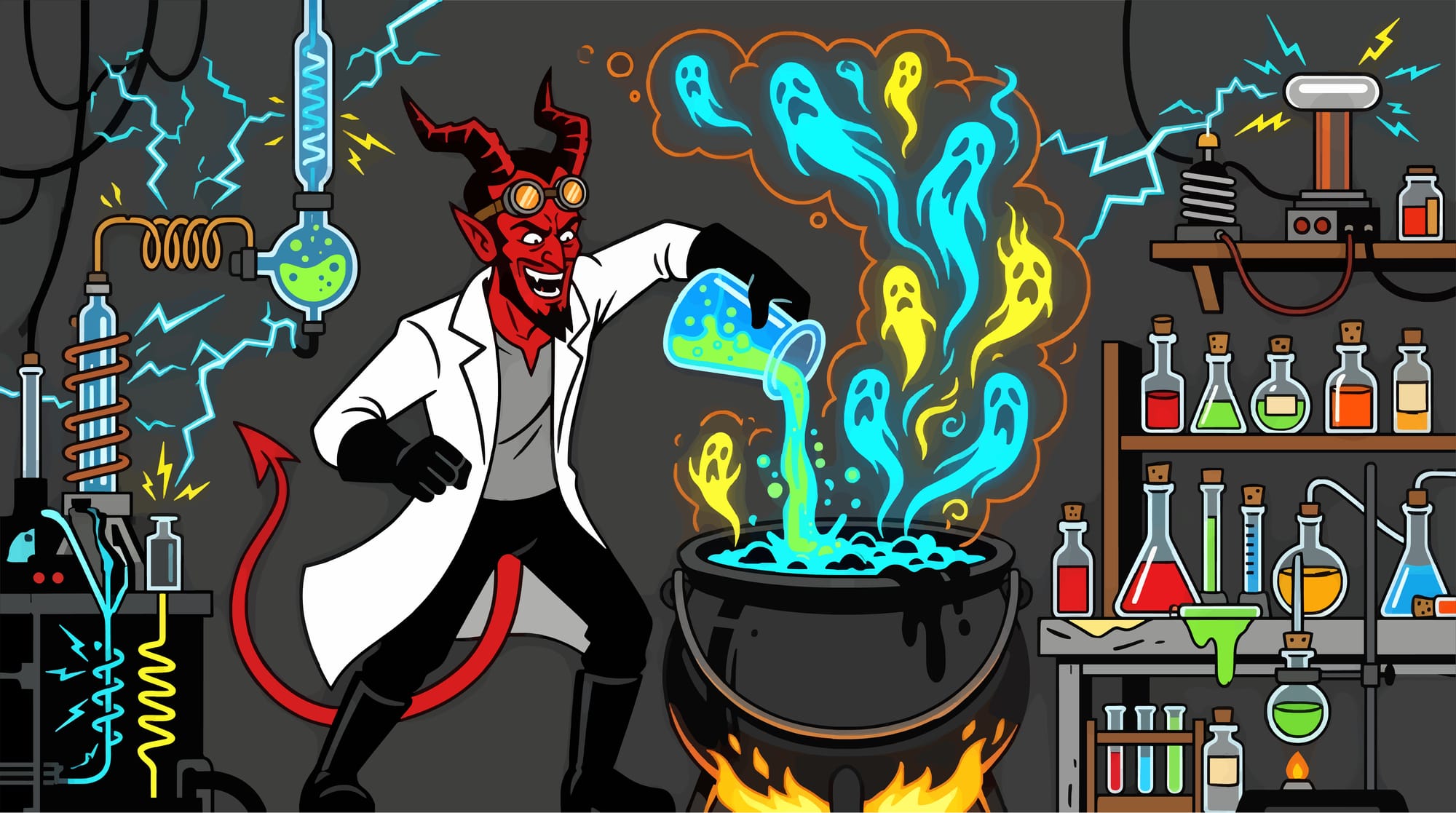
It has to distinguish. It has to store enough state to control the door. It has to update or reset its memory. Once the demon and its information-processing apparatus are included in the thermodynamic accounting, the apparent escape closes.
Information can participate in the conversion of fluctuations into usable work. The controller still belongs to the physical system.
Modern information thermodynamics has made this relation precise. Sagawa and Ueda incorporated measurement and feedback information into nonequilibrium work relations. Horowitz and Esposito developed a framework for continuous information flow between coupled stochastic systems. Information can alter the thermodynamic balance of subsystems while the full coupled system remains answerable to the second law.
The little demon did not repeal the field. It joined it.
This matters far beyond tiny engines.
Every controller requires distinctions.
- A thermostat distinguishes temperatures.
- A cell distinguishes chemical conditions.
- An immune system distinguishes patterns of threat and self.
- A navigation system distinguishes location and route.
- A hospital distinguishes urgency.
- A military command distinguishes friendly, hostile, uncertain, and irrelevant.
- A platform distinguishes content predicted to hold attention.
- A psychiatric system distinguishes symptom, risk, insight, crisis, and ordinary variation.
The controller then uses those distinctions to redirect available energy and action.
This is the infodynamic hinge between the current article and Active Information: the signal supplies form, the field supplies force, and feedback returns the consequences into the next round of discrimination.
The controller’s power therefore depends on four things:
- what it can detect;
- what distinctions its model preserves;
- what actions it can trigger;
- what consequences return as feedback.
A controller can fail at any layer.
 Aidan Lawson
It can miss the signal. It can classify the signal incorrectly. It can preserve too little variety. It can trigger an action too strong for the uncertainty. It can receive delayed feedback. It can filter out evidence of harm. It can interpret resistance created by its own action as confirmation of the original model.
A demon with a bad sensor does not sort molecules well.
An institution with a bad category can sort human beings for decades.
The scale changes.
The infodynamic structure remains.
Information Flow Is Unequal.
Information moves through channels that have owners, thresholds, latency, direction, and unequal capacity.
This is very obvious in machinery and easy to hide in institutions.
A sensor may report upward while receiving no information about what the controller later does. A worker may be continuously measured while management decisions remain opaque. A patient may supply intimate detail into a record that travels across institutions while corrections to that record move slowly, if they move at all. A state may observe a population in high resolution while the population receives only a slogan about the state’s intentions.
The field is informationally connected.
It is not informationally reciprocal.
This creates a distinct form of power:
The capacity to make one’s information travel farther than the consequences can answer.
 Aidan Lawson
An intelligence report can reach executive authority in minutes. The civilian field altered by the resulting operation may require years to enter the official record.
 Aidan Lawson
A credit score can cross institutions immediately. The context behind a missed payment may have no standardized channel at all.
A psychiatric diagnosis can follow a person through records, risk assessments, insurance, family interpretation, and future care. The person’s later correction may remain trapped inside one appointment note.
 Aidan Lawson
A viral accusation can reach millions before the first reliable counter-record is assembled. The correction enters a field whose attention has already moved.
Latency is part of moral structure.
A correction that arrives after the irreversible action is still true. It is also late.
Bandwidth is part of moral structure.
A field may send one number upward because one number fits the dashboard. The people beneath the number may need thousands of distinctions preserved for the decision to remain corrigible.
Direction is part of moral structure.
A surveillance system can generate constant knowledge about the observed while making the observer unreachable to reciprocal scrutiny.
Infodynamics exposes these as channel properties before they become political slogans.
- Who can send?
- Who can receive?
- At what resolution?
- Under whose encoding?
- How quickly?
- With what right of correction?
A system that answers those questions badly may remain full of information.
The information is simply flowing in the direction of control.
The Field Is Not a Hard Drive.
Information language becomes dangerous when the world is redescribed as storage.
- The genome is code.
- The brain is a computer.
- The ecosystem is information processing.
- The universe is a simulation.
- The person is data.
Each metaphor can reveal something. Each can also quietly promote the representation into ontology.
 Aidan Lawson
Modal Path Ethics refuses the promotion.
 Aidan Lawson
Extance is not valuable because it contains information. Information is one way extant structure becomes distinguishable, transmissible, and actionable for systems inside the field.
A forest is not repaired because a complete dataset about the forest survives after the forest is destroyed.
A person is not preserved because an institution retains a perfect record of their decline.
A language is not continued because every sentence was archived before the last speaker died.
A city is not alive because a digital twin can still render its streets.
The record may preserve extraordinary future value. It may support reconstruction, study, memory, accountability, mourning, or partial restoration.
It remains a different locus with a different continuation path.
This distinction already controls The Anti-Oblivion Doctrine. The field retains traces, while retention does not become permission. A future reader’s ability to reconstruct an event does not grant present institutions the right to surveil every life at maximum resolution.
The same distinction controls Garbage Collection.
 Aidan Lawson
A reset, restoration, rollback, or substrate change does not cancel the path that produced the need for repair. The visible interface may return to a clean state while cost remains elsewhere.
Infodynamics therefore supplies records without confusing the record with the world.
A representation can preserve access to a lost field. It cannot retroactively become the field that was lost.
This blocks a common technological consolation.
- We can scan it.
- We can simulate it.
- We can archive it.
- We can reconstruct its data.
Good. Do that work.
Then keep counting the original.
More Information != More Good.
A field can be harmed by missing information.
It can also be harmed by excessive, badly routed, or coercively actionable information.
This is where any easy moral equation between information preservation and good collapses.
- A predator benefits from information about prey.
- An authoritarian state benefits from information about dissidents.
- An abusive partner benefits from location data.
- A discriminatory institution benefits from a classification that lets old prejudice travel through clean administrative channels.
- A military system benefits from target information. The target does not automatically share this benefit.
- A platform benefits from learning which emotional vulnerability keeps a user engaged.
Information can improve the viability of a harmful system.
Artemy Kolchinsky and David H. Wolpert have developed a formal approach to semantic information tied to information that contributes to a system’s viability. That work offers an important technical neighbor: information can become significant to a system because it helps that system continue. (Kolchinsky and Wolpert)
Modal Path Ethics adds the moral cut immediately.
Viability is not good.
A prison can preserve itself.
A scam can learn.
A war machine can improve its targeting.
A bureaucracy can use information to become more resistant to correction.
A psychiatric institution can become better at identifying noncompliance while remaining worse at receiving the person’s account.
The information is meaningful to the system because it helps the system continue.
The ethical question is what that continuation does to the reachable future of every locus carried through it.
This also changes how privacy should be understood.
Privacy is not informational emptiness.
Privacy can be an engineered limit on translation: the distinction remains in the field while certain actors are denied the channel, resolution, identity link, or operational permission required to act on it.
That boundary can preserve future-space.
 Aidan Lawson
A medical fact may exist without belonging to an employer. A childhood mistake may remain historically true without remaining permanently actionable by every future institution. A private conversation may leave traces without becoming training material, evidence, entertainment, or reputation infrastructure.
The ethical field sometimes improves by reducing who can act on a true distinction.
More information can close more futures.
 Aidan Lawson
The issue is not informational abundance.
The issue is governed reachability.
The Substrate Carries the Bill.
Digital culture trains users to experience information as weightless because the burdens have been moved out of view.
 Aidan Lawson
A photograph appears in the cloud.
A model answers in seconds.
A platform remembers ten years of behavior.
A hospital retrieves a record.
A government produces a dashboard.
The information seems to exist in a clean upper layer.
Below it are data centers, storage media, cooling systems, networks, power grids, water, minerals, manufacturing, maintenance, security, backups, migration labor, moderation, labeling, documentation, software dependencies, and people who keep old systems alive because one critical record still speaks a language nobody has budgeted to replace.
- The substrate supplies persistence.
- The interface hides the maintenance.
This is infodynamic burden transfer.
A field gains cheap access by relocating the cost of distinction-preservation into less visible loci.
The cost can be material. It can also be institutional and human.
- A doctor spends time feeding the record instead of receiving the patient.
- A teacher produces data for a performance system that returns little useful information to the classroom.
- A worker labels examples so a model can later appear autonomous.
- A family becomes the unpaid memory system for a fragmented care network.
- An archivist carries a preservation obligation created by institutions that continue generating records faster than they fund interpretation.
- A user performs endless account verification because the platform externalized its identity uncertainty.
The information service may be useful.
The burden still counts.
Landauer’s limit is not a practical estimate of these costs. A data center’s energy demand cannot be explained by multiplying deleted bits by kT ln 2 and announcing that physics sent the invoice. Real systems operate far above ideal thermodynamic bounds and consume energy across computation, communication, reliability, cooling, and infrastructure.
The deeper lesson is architectural:
An information function always rides on a field that must maintain the distinctions, correct the errors, and absorb the losses.
The clean interface is not the whole machine.
It is where the machine has chosen to stop showing itself.
Institutions Have Information Metabolisms.
An institution receives variation from the field.
It cannot preserve all of it.
So it samples.
It measures.
It classifies.
It compresses.
It records.
It routes.
It acts.
Then it receives some portion of the consequences as feedback.
This is an information metabolism.
The institution survives by converting a reality too large for direct administration into a smaller set of actionable distinctions.
 Aidan Lawson
- A hospital receives bodies, symptoms, histories, scans, tests, staffing, beds, insurance constraints, and time.
- It produces triage levels, diagnoses, orders, notes, codes, dispositions, and records.
- A school receives children, families, histories, capacities, needs, language, behavior, and social pressure.
- It produces grades, attendance, referrals, plans, discipline categories, rankings, and credentials.
- A military receives terrain, uncertainty, reports, signals, logistics, weather, doctrine, fear, and human intention.
- It produces maps, targets, threat levels, orders, battle damage assessments, and official lessons.
- A platform receives posts, clicks, pauses, reports, social graphs, purchases, and predictions.
- It produces rankings, recommendations, labels, removals, audience segments, and a fictional Earth built from whatever the objective function can retain.
The institution’s categories are not decorative descriptions.
They are organs of action.
This is why the information metabolism must be audited as part of the institution’s moral body.
- What can it ingest?
- What can it distinguish?
- What does it discard before action?
- Which categories trigger force?
- Which errors become visible?
- Which harms return as feedback?
- Which harms occur outside the sensor range?
- Can the institution metabolize correction, or does correction register as threat?
A healthy information metabolism does not preserve everything.
It preserves enough relevant distinction for action to remain corrigible.
A captured metabolism does something else.
It converts field contact into evidence of institutional necessity.
- The hospital’s delays prove demand.
- The platform’s conflict proves engagement.
- The security apparatus’s resistance proves threat.
- The psychiatric system’s distrust proves lack of insight.
- The metric reports success because the metric was designed around what the institution could already count.
The system begins consuming its own outputs as knowledge about the world.
This is information autophagy with a quarterly report.
Infodynamic Debt.
Every information system simplifies.
The ethical problem is what happens when the system spends distinctions now and leaves later repair to discover they were load-bearing.
This is infodynamic debt.
Infodynamic debt is the future burden created when a system gains present simplicity by discarding, corrupting, concealing, or failing to preserve distinctions later action will need.
The debt can arise through:
- undocumented transformations;
- missing provenance;
- lossy compression;
- schema migrations that collapse old states;
- deleted uncertainty;
- merged identities;
- overwritten records;
- inaccessible formats;
- one-way classification;
- dashboards that retain a score and discard the evidence beneath it;
- institutional memory stored in one exhausted person.
The present system becomes cleaner.
The future field becomes more expensive to read.
This joins the existing entropy debt work. Entropy debt tracks cost hidden by apparent reset, restoration, optimization, or reversal. Infodynamic debt identifies the informational form of that hidden cost: the distinctions sacrificed to create the appearance of a clean transition.
A company migrates its records and loses the ability to distinguish “never approved” from “approved under an older rule.”
A hospital summary preserves the diagnosis and deletes the uncertainty that surrounded it.
A government publishes aggregate statistics and destroys the local variation required to see which population absorbed the burden.
A family compresses years of conflict into one person’s pathology and passes the simplified story to the next generation.
An artificial intelligence system returns a confident answer without preserving a usable path to the sources, transformations, or uncertainty that produced it.
Each field gains immediate usability.
Each field has borrowed against correction.
Infodynamic debt does not require every original distinction to be preserved forever. That would be impossible and often harmful. It requires systems to identify which future claims depend on distinctions they are choosing to destroy.
The debt begins when the system takes the benefit of certainty without retaining the conditions under which that certainty could later be challenged.
Repairing the Information Path.
Information repair does not mean maximizing retention.
It means preserving the distinctions, paths, and correction capacities required for truthful, non-destructive continuation.
Several repair principles follow.
Preserve provenance.
A claim should retain a usable path back to its source, transformation history, and uncertainty wherever later action depends on those distinctions.
This does not guarantee truth. It keeps correction reachable.
Declare compression.
Summaries, scores, categories, and models should identify what they were built to preserve and what they are permitted to lose.
A compression with no declared fidelity target is a quiet act of sovereignty.
Separate storage from permission.
The ability to retain information does not establish the right to expose, combine, infer from, or act on it.
Privacy boundaries belong to the information architecture.
Preserve uncertainty as information.
Uncertainty is not empty space around the answer. It is part of the state of knowledge.
Deleting it can make the record easier to use and the action harder to correct.
Build return paths before irreversible transitions.
Appeals, backups, reversible migrations, staged deployment, model rollback, second opinions, and parallel records should exist before the system performs the transition that makes them necessary.
A return path invented after distinction loss is archaeology.
Match information access to action access.
Warnings without reachable response paths can transfer responsibility onto trapped loci.
Information should be paired with the capacities required to answer it wherever the institution is claiming that information provision counts as repair.
Preserve independent channels.
Redundancy, replication, dissent, whistleblowing, adversarial review, and plural interpretation can look inefficient because they duplicate information work.
That duplication is often the error-correction layer.
Audit downstream activity.
A message, record, category, or model must be evaluated through what happens after uptake.
The information path continues into action.
These principles will be developed across the Epistemic Instruments track. Infodynamics supplies their floor.
- Correction requires a surviving distinction.
- Appeal requires a return path.
- Privacy requires controlled translation.
- Feedback requires a channel from consequence back to controller.
- Repair requires the field to remember enough about how it arrived here to avoid calling the current state inevitable.
The Infodynamic Audit.
Every information instrument can now face a substrate-level audit.
Distinction
- What difference is being preserved?
- Which differences are being treated as equivalent?
- What later action depends on that cut?
Carrier
- Where does the information physically live?
- What keeps the alternatives stable?
- Which material, energetic, institutional, or human burdens maintain it?
Channel
- Who can send and receive?
- What noise, delay, bandwidth limit, or translation loss enters?
- Is the flow reciprocal?
Encoding
- Who selected the representation?
- Which resolution and categories does it preserve?
- Which field variation becomes unrepresentable?
Memory
- How long does the distinction remain reachable?
- What is deleted, overwritten, merged, or detached from provenance?
- Can the original state be reconstructed?
Action
- What energy, authority, money, attention, care, or coercion does the information redirect?
- Does the receiving field have more than one available response?
Feedback
- Which consequences return to the controller?
- Which harms fall outside its sensor range?
- Can disagreement alter the model?
Permission
- Who may act on the information?
- Which true distinctions should remain unavailable to particular actors?
- Can the locus restrict translation without being treated as suspicious?
Irreversibility
- Where does the path become one-way?
- Which distinctions disappear at that edge?
- Was the loss declared and justified?
Debt
- Which future repair burden is being created by present simplification?
- Who will have to reconstruct the distinctions later?
This audit does not ask whether information is good or bad in the abstract.
Information is a field instrument.
Its moral status depends on the continuation it enables, the burdens it transfers, the distinctions it destroys, and the correction paths it preserves.
The Ruling.
A bit needs somewhere to live.
A memory needs a stable difference.
A message needs a channel.
A controller needs a distinction it can act upon.
A correction needs a path back to the state that was misread.
Every one of these belongs to extance.
Shannon showed how uncertainty and reliable communication can be formalized without requiring a theory of meaning. Landauer showed that logically irreversible information processing enters thermodynamic accounting. Bennett showed that general computation can preserve a return path instead of discarding history at every step. Information thermodynamics showed that measurement, feedback, and information flow can alter what physical systems are able to do while the controller remains inside the same field it governs.
Modal Path Ethics takes the transition seriously.
Information is neither a ghost above matter nor a moral substance hidden inside it. It is an organized difference carried through a field capable of preserving, interpreting, and acting on that difference.
The information path can open futures.
It can warn, coordinate, remember, correct, guide, teach, stabilize, and preserve access to structures that would otherwise disappear.
It can also compress a person into a category, convert uncertainty into force, route surveillance toward vulnerability, preserve the viability of a harmful institution, erase the distinctions required for appeal, and transfer the cost of clean information upward while matter, labor, and damaged loci carry the bill below.
- More information is not automatically better.
- Less information is not automatically safer.
The question is what the field can now distinguish, who can act on the distinction, what was lost in translation, and whether the path remains corrigible after the information becomes active.
This is the physical floor of the Epistemic Instruments track.
The advertisement needs a medium.
The diagnosis needs a record.
The ranking needs a server.
The intelligence estimate needs a channel into command.
The cultural story needs repetition, memory, and bodies trained to recognize its categories.
Diffuse pressure does not arrive from nowhere.
It is carried.
It is maintained.
It is paid for.
It enters feedback.
Then, the field begins acting on its own description.
 Aidan Lawson
That is infodynamics.