Tales of Distortion: The Climbing Target
The machine saw the climb. The threat field saw the attack. Only one existed. Flight 655. Flight 752.
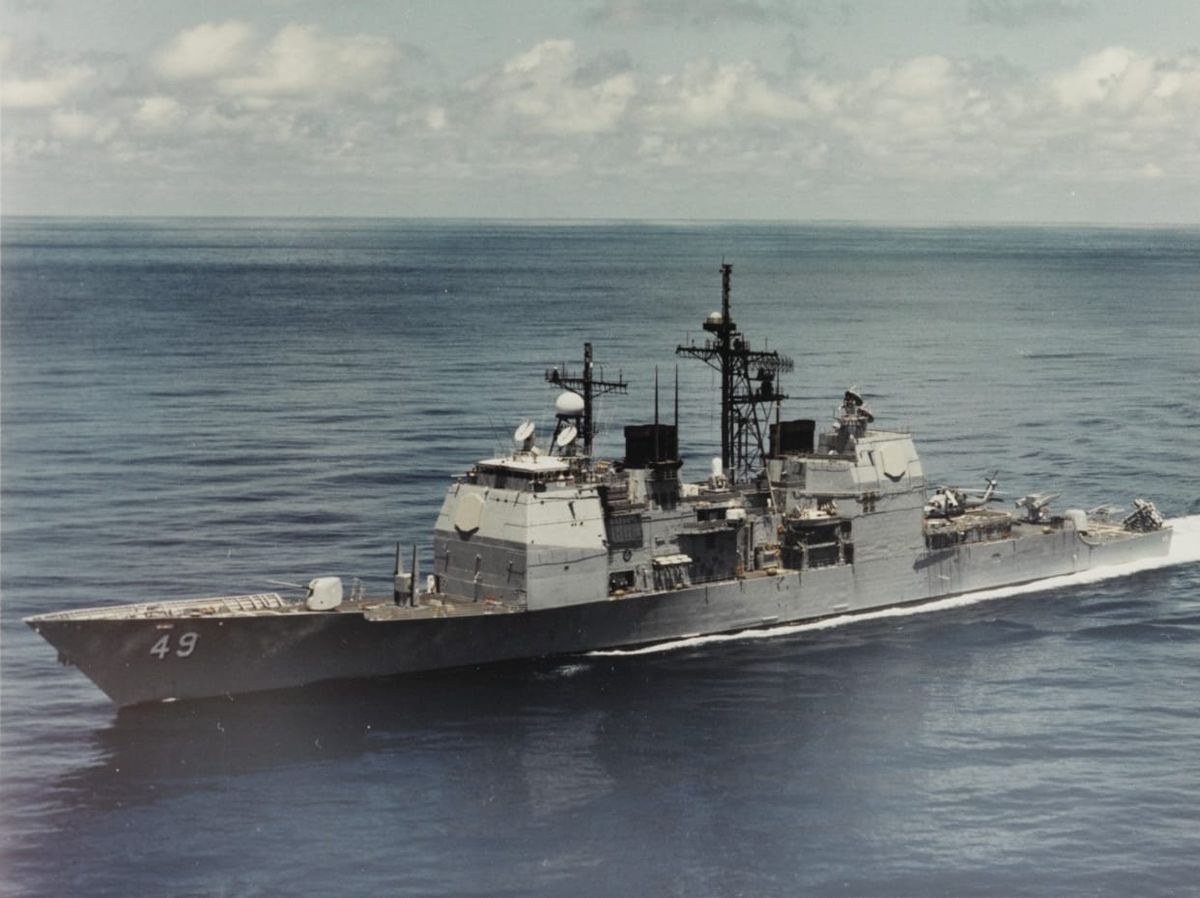
At 13,500 feet, Iran Air Flight 655 was still climbing.
The Airbus had left Bandar Abbas seven minutes earlier. Its pilots had been cleared toward Dubai through airway A-59, instructed to climb to 14,000 feet, and assigned the civilian transponder code 6760. The aircraft remained inside the airway. Its altitude continued upward. Its final movement belonged to an ordinary commercial profile so completely that the United States Navy’s later investigation would be able to recover the whole shape from its own tapes.
Inside USS Vincennes, the aircraft was descending.
The large tactical displays held a track moving south over the Strait of Hormuz. Operators called ranges, bearings, speeds, altitudes, classifications, warning attempts, and possible identities into a command field already occupied by Iranian gunboats, an Iranian surveillance aircraft, gunfire, radical ship maneuvers, the memory of a missile-struck American frigate, and a defensive system designed to make the last correct decision before an incoming weapon reached the ship.
The aircraft had become TN 4131.
A military identification signal had been associated with it. The possibility of an Iranian F-14 entered the information net. Then the F-14 stayed.
A scheduled airliner continued climbing on the screen while voices reported descent.
The aircraft continued transmitting 6760 while the civilian code became compatible with disguise.
Warnings went out. No usable answer came back. Silence joined the attack profile.
The range closed.
Captain William C. Rogers III turned the firing key.
Two Standard missiles left the rails.
They struck the aircraft at 13,500 feet.
All 290 people aboard were killed.
The target had only existed aboard the warship.
The aircraft carried everyone else.
A Short Flight.
Iran Air Flight 655 did not require much future.
The aircraft was operating a scheduled service from Tehran to Dubai with an intermediate stop at Bandar Abbas. The final leg was brief. The Airbus would spend much of it climbing from the Iranian coast, crossing the Strait of Hormuz, and preparing to descend toward the United Arab Emirates.
This was not a flight designed to loiter near American ships, test a perimeter, collect intelligence, perform a feint, or make the crew of an Aegis cruiser prove anything about themselves.
This one was carrying passengers and crew through a civilian transport system.
That phrase can sound sterile because transport systems are very good at making human continuance look logistical.
- A departure slot.
- A boarding card.
- A baggage tag.
- A seat number.
- A route.
- A handoff between controllers.
- A code entered into a transponder.
- A destination close enough to be ordinary.
Each item is a small promise that the person will remain reachable at the other end.
People board a short flight because the next part of their lives has already begun making demands. Someone expects them in Dubai. Someone expects a call. Someone has work, family, business, study, medical needs, an onward connection, a return date, or no grand reason at all beyond the normal human privilege of moving from one city to another without being translated into a weapons problem.
Captain Mohsen Rezaian and the flight crew had an aircraft to fly, a departure to complete, and a civilian control system to answer.
They were not entering a blank sky.
The sky above the Strait was organized by routes, altitudes, reporting points, controller responsibilities, schedules, navigation procedures, radio frequencies, identification codes, and the steady repetition by which busy airspace becomes usable. Thousands of commercial movements passed through the wider regional system. The airway was not an improvised corridor laid across a battlefield that morning. It was one of the structures through which ordinary life continued despite the war beneath it.
Flight 655 needed one crossing of that structure.
The Civilian Sky Above the War.
War likes to draw a map around itself.
It marks sea lanes, weapons ranges, exclusion areas, patrol sectors, threat axes, missile envelopes, radar horizons, launch points, national waters, air corridors, and the invisible lines after which a commander has fewer seconds left to decide.
Civilian life draws maps through many of the same places.
- Tankers carry oil.
- Merchant ships carry cargo.
- Fishing boats work near armed patrol craft.
- Ferries cross routes used by warships.
- Civilian aircraft climb from airports shared with military aircraft.
- Air traffic controllers continue sequencing departures while radar operators search the same volume for attackers.
The Strait of Hormuz in 1988 was not a naval arena occasionally inconvenienced by civilians. It was a civilian circulation field into which several wars had entered.
That order matters.
A warship can move through the Strait because the Strait already carries life, commerce, energy, states, ports, pilots, crews, and people trying to reach another shore.
Protection instruments enter because those continuances are threatened. The instrument does not acquire ownership over the field by arriving armed.
Yet combat systems naturally experience their own position as the center.
Everything has a bearing from the ship.
Everything has a range to the ship.
Everything has a closure rate against the ship.
Every movement becomes legible through the geometry of whether it is approaching, receding, crossing, illuminating, transmitting, warning, targeting, or entering a weapons envelope.
This is necessary. A warship cannot defend itself through a map centered on somebody else’s coffee order.
But the danger begins when the local defensive map becomes the only reality with enough authority to command action.
Then, a civilian airway becomes a threat avenue. A scheduled departure becomes an unknown contact. A climb becomes approach.
The ship moves beneath the airway. But geometry is based on the ship.
So the airway is then accused of approaching the ship.
The Tanker War.
The Iran-Iraq War had spread outward across the Persian Gulf.
Iraq attacked Iranian oil exports and shipping. Iran attacked vessels associated with Iraq and the states supporting it. Tankers were struck. Mines were laid. Oil facilities became targets. Merchant traffic moved through a field where commercial identity could no longer guarantee separation from state violence.
The United States entered to protect shipping, escort reflagged tankers, deter Iranian attacks, and preserve the wider flow of oil through the Gulf.
This did not place the United States outside the war.
Protection altered the field.
American warships became armed participants in waters where Iranian forces were already operating under intense pressure from Iraq, Gulf states, and foreign naval power. Escort became confrontation. Surveillance became challenge. Mine strikes became retaliation. Iranian oil platforms were attacked. Iranian ships were damaged or sunk. American ships and helicopters moved through a field in which each side could reasonably describe the other as both threat and provocateur.
By July 1988, the Gulf contained enough weapons, wounds, prior attacks, ambiguous contacts, and overlapping authorities to make almost any clean description false.
That does not mean the field was unknowable.
It means uncertainty required stronger civilian boundaries.
Instead, the military field acquired a familiar temptation:
When the environment becomes difficult to classify, classify earlier.
That is how protection tries to recover time.
The earlier the system decides what an object is, the more options the system retains for answering it.
A late identification can leave a commander with seconds.
An early identification can be wrong for minutes and still gather authority.
The Gulf was teaching the Navy to fear the first problem.
USS Stark had already supplied the body count.
The Gulf Had Already Been Hit.
The protection field around Vincennes carried more than Stark.
American involvement had deepened through convoy escort, mine clearance, intelligence, retaliatory operations, and direct combat with Iranian forces. In April 1988, USS Samuel B. Roberts struck an Iranian mine. The explosion tore open the hull and wounded sailors. The ship survived through disciplined damage control.
The United States answered with the internet famous Operation Praying Mantis.
Iranian oil platforms were attacked. Iranian naval units were damaged or sunk. Aircraft, ships, missiles, and gunfire moved through the Gulf under the language of retaliation and protection. By July, American commanders were not supervising a neutral shipping lane from a clean distance. They were now operating inside an undeclared maritime conflict whose boundaries shifted with every mine, boarding, warning shot, escort mission, and report of attack.
That larger field shaped what counted as plausible.
- An Iranian small boat could be
- conducting patrol,
- coercing merchant traffic,
- screening another action,
- testing American response, or
- preparing to attack.
- An aircraft leaving Bandar Abbas could be
- commercial traffic,
- military reconnaissance,
- a fighter,
- a coordinated strike element, or
- a body made into a weapon.
A radar return could therefore carry several possible worlds at once.
The question was how the system would keep those worlds separate long enough for evidence to matter.
Protection under uncertainty always wants a shortcut.
The ship cannot hold every ontology open forever while range decreases.
A combat information center has to decide whether that thing over there is friend, neutral, unknown, assumed enemy, hostile, or target. Those categories let action happen.
They also create pressure in one direction.
- Friend can become unknown.
- Unknown can become assumed enemy.
- Assumed enemy can become hostile.
- Hostile can become engaged.
The path backward is harder because each category changes what later evidence means.
A warning sent to an assumed enemy is heard inside the room as a test. Silence then confirms the assumption. A military code appears. The fighter becomes more real. The command field begins spending the remaining seconds as though the object has already declared itself.
This asymmetry is often justified by the asymmetry of weapons.
- A missile needs only one successful launch.
- A ship needs to be right every time.
That is true from the ship.
It is equally true from the airliner.
A civilian aircraft needs the protection system to remain wrong zero times.
The Gulf had produced a protection architecture built around the first asymmetry. Flight 655 entered carrying the second.
The Stark.
On May 17, 1987, an Iraqi aircraft fired two Exocet missiles at USS Stark.
The frigate did not defend itself in time.
Thirty-seven sailors were killed.
The attack became a wound inside every later Gulf encounter.
This was not superstition. An aircraft can appear inside an operational picture, approach, reach weapons range, launch, and leave a ship fighting for survival before the people aboard have fully settled what they are seeing.
Waiting can kill sailors.
A commander who delays until every uncertainty is gone may discover that the uncertainty has launched a missile.
That lesson entered training, readiness, command expectations, rules of engagement, and the practical imagination of crews sent into the same region.
It also entered the moral field.
The dead of Stark created obligations:
- improve detection;
- strengthen coordination;
- reduce hesitation where attack indicators are real;
- prevent another crew from being asked to absorb a missile while command waits for a cleaner story.
Those obligations did not make every approaching aircraft guilty.
The dead may obligate protection. They may not own future agency.
A wound becomes dead-command when it supplies a standing answer to a changed field. Stark had shown that passive ambiguity could conceal attack.
That did not prove every ambiguity was attack. It proved the protection instrument needed a way to act quickly without making civilian status impossible to establish.
The Navy answered the first half more successfully than the second.
USS Vincennes entered the Gulf with an extraordinary system for seeing, integrating, and fighting an air threat. It also entered with a wound teaching the room what delay could cost.
That was real.
So was Flight 655.
Aegis.
Aegis was built to prevent a fleet from being overwhelmed.
The system integrated powerful radar, automatic tracking, identification data, tactical display, command relationships, and weapons control. It could hold several contacts at once, maintain their courses and speeds, connect information across consoles, and present senior officers with an organized picture of a sky too fast and crowded for unaided human attention.
This is not the villain of the article. Aegis did not go blind.
Its radar detected Flight 655 soon after takeoff. Its system retained the civilian transponder code. Its altitude data recorded the climb. Its tapes later allowed investigators to reconstruct the event with devastating clarity.
This machine saw a great deal.
The problem here was never simple machine failure. A combat system is larger than its radar.
It includes:
- operators deciding what to hook and interrogate;
- conventions for turning returns into tracks;
- identification rules;
- the spoken circuits through which one console informs another;
- authority gradients inside the room;
- training scenarios;
- command doctrine;
- warnings;
- tactical control among ships;
- weapons thresholds;
- and the commander whose hand can close the path.
Aegis generated data.
The ship generated the target.
That distinction protects us from two easy mistakes.
- The first is the fantasy that the perfect machine would have saved everyone if the human had simply obeyed it.
- The machine’s information still required social transmission, interpretation, weighting, and command authority.
- Correct altitude on a console cannot stop a missile when the command network gives greater force to a shouted descent.
- The second is the fantasy that technology caused the killing by replacing human judgment.
- Human judgment was present everywhere.
- The problem was how judgment moved through a technical architecture under pressure.
The system functioned. The room converted function into a false object.
Then the rules engine received the object it had been trained to defeat.
The Tactical Picture Room.
A combat information center feels like the opposite of a sealed room.
It is full of inputs.
- Radar reaches beyond the horizon available to the eye.
- Data links bring tracks from other ships.
- Identification systems ask aircraft what they are.
- Radio circuits connect operators, commanders, aircraft, and higher headquarters.
Large displays assemble the result into a common picture.
This room is designed to prevent local blindness.
Yet a room can receive enormous quantities of information while remaining closed around interpretation. The closure does not require anyone to ban contradiction. It can form through placement and tempo.
- One operator sees a code.
- Another hears a fighter report.
- Another watches range.
- Another controls the warnings.
- Another sees a schedule.
A senior officer receives spoken summaries because no commander can personally inspect every console while also managing a surface engagement, ship maneuvers, weapons, communications, and tactical control of other vessels.
The common picture is therefore never identical to the screen.
It is a social object built from selection.
- Which report gets spoken?
- Which report gets repeated?
- Which operator sounds certain?
- Which uncertainty is omitted because the circuit is busy?
- Which contradiction is treated as old information?
- Which person has enough standing to interrupt?
The largest displays aboard Vincennes gave senior personnel a shared visual field. The final engagement still depended on speech. The false military code became a spoken identity. The remembered descent became a spoken approach. The civilian code remained present and politically weak.
This is where sophisticated instrumentation can produce an epistemic halo.
The room appears to have one picture because the equipment integrates several sources. People outside the room assume the integrated system must contain knowledge they lack. People inside the room assume a repeated report must have originated in a valid console state. The prestige of the system then protects the social picture built around it.
Aegis made contradiction more available.
Aegis also made deference to the Aegis ship more likely.
The same instrument widened perception and narrowed who felt authorized to challenge its interpretation.
The Robocruiser.
USS Vincennes had already acquired a reputation among some nearby American sailors.
The nickname was Robocruiser.
Part of that name belonged to Aegis. Part belonged to Captain Rogers’ command style as seen by officers aboard USS Sides. Their later accounts described a cruiser pressing close to Iranian forces and intensifying situations that other commanders believed should be cooled.
Those accounts are not divine judgment delivered after the wreckage settled. They are counter-records from officers who occupied the same field and later understood their own hesitation as part of the failure.
Weeks before Flight 655, officers aboard Sides watched Vincennes move aggressively during an Iranian boarding operation. A more junior captain protested orders he believed would inflame the encounter. Higher command eventually separated the ships and directed the cruiser to back away.
On July 3, the pattern returned under worse conditions.
This does not require Rogers to desire combat.
A protection instrument can intensify a field without its commander experiencing the action as aggression.
- Move toward the contact to protect the helicopter.
- Move toward the contact to maintain communications.
- Move toward the contact to keep the threat under the defense umbrella.
- Move toward the contact because waiting at distance feels like surrendering initiative.
Each reason can remain locally coherent.
The resulting field still becomes hotter, closer, faster, and harder to reverse.
A ship moving toward danger creates the time pressure it later cites as emergency.
That does not make the danger imaginary. It makes the ship’s own motion part of the analysis.
The Helicopter.
The surface engagement began with Iranian small craft and an American helicopter.
The helicopter reported being fired upon.
That report was serious.
A helicopter exposed to small-arms or cannon fire in a contested maritime field is not a decorative fact inserted after the conclusion. Iranian Revolutionary Guard boats existed. They were definitely armed. Iranian forces had attacked shipping. American crews had reasons to treat a report of fire as a possible opening move rather than local irritation.
So USS Vincennes accelerated north.
The ship sought permission to engage the boats. It took tactical control of another American vessel. Its guns entered the encounter. Iranian fire answered.
The combat information center now had to manage surface contacts and an emerging air track while the cruiser maneuvered at speed.
The room became physical.
The ship turned hard enough to throw loose material. Gunfire added concussion and noise. Displays and voices competed. Operators carried several contacts. Commanders received a tactical picture through people whose own attention was being narrowed by the event.
This is often where disaster accounts invoke fog.
Fog sounds natural.
Fog arrives from nowhere. Nobody chooses fog. Everyone becomes equally innocent inside weather.
But the combat environment aboard Vincennes had causes.
- The helicopter’s approach distance.
- The report of fire.
- The decision to move north.
- The request to engage.
- The gunfight.
- The ship’s high-speed maneuvers.
- The choice to conduct air identification while the surface field was already consuming attention.
The Iranian boats remained responsible for their own actions.
The American command remained responsible for the field it built around the response.
One truth does not cancel the other.
The ship moved into the fight.
Then an aircraft appeared above the route the ship had entered.
Surface Fire Becomes an Air-Clock.
The gunfight and the air track were not separate emergencies politely waiting their turns.
The surface engagement changed the time available for air identification.
USS Vincennes was maneuvering to bring weapons to bear on small boats. Its bridge and combat information center were coordinating a fight at sea while the air-defense team watched a track leave Bandar Abbas. The ship’s physical movement altered the aircraft’s bearing and range. The gunfire altered attention. The expectation of coordinated attack connected the domains.
This is how one real threat lends force to another uncertain threat.
- The boats made the aircraft more plausible as a fighter.
- The aircraft made the boats more plausible as part of a coordinated attack.
Each object became evidence for the other before either relation had been proven.
The tactical story improved itself.
- A few Iranian boats alone might be harassment.
- An aircraft alone might be routine traffic.
- Boats + aircraft = doctrine.
The room could now imagine a combined strike in which small craft fixed the cruiser, distracted the crew, or drew it into range while an F-14 attacked from above. Once this possibility occupied the command field, the failure to answer warnings did not look like ordinary civil aviation. It looked like discipline.
This is scenario fulfillment at the level of relations.
The system did not only misidentify one object. It assembled several objects into an attack formation.
That attack formation existed nowhere outside the interpretation.
- The boats were real.
- The Airbus was real.
The coordinated attack was the story binding them.
The rules engine did not need every component to be false. It needed the relation among them to be false.
The Cruiser Moves Beneath the Airway.
Airway A-59 ran south from Bandar Abbas toward the United Arab Emirates.
Flight 655 followed it.
USS Vincennes, maneuvering during the surface engagement, moved into the same geographical relation. At missile intercept, the Airbus was within its assigned airway. The cruiser had placed itself close enough beneath the route that the aircraft’s ordinary southbound movement created a nearly constant bearing and decreasing range from the ship.
- From the combat system’s local geometry, the aircraft was approaching.
- From the civilian field, the aircraft was leaving Bandar Abbas on schedule.
Both descriptions can be geometrically true.
Except only one preserves the prior structure of the sky.
Military systems are vulnerable to a quiet imperial assumption:
The instrument’s position is neutral.
The ship becomes the stationary moral center even while moving at high speed through contested water.
Every other object then appears as the actor entering relation.
- The boat closes the ship.
- The aircraft closes the ship.
- The shore battery covers the ship.
- The coast surrounds the ship.
- The route crosses the ship.
The ship’s own movement disappears into the coordinate system.
This is the same basic distortion that strategic depth creates at continental scale. A power moves outward, places its security instrument inside another field, then experiences every local response as an approach toward itself.
USS Vincennes was not invading Iran by following one air track. The scale is different.
The geometry is still instructive.
The cruiser moved beneath the airway. The airway was then accused of approaching the cruiser.
Seven Minutes.
At approximately 06:47 Coordinated Universal Time, Iran Air Flight 655 took off from Bandar Abbas.
At approximately 06:54, it was destroyed.
Seven minutes and eight seconds existed between detection and intercept in the later American reconstruction.
Inside the aircraft, the sequence remained ordinary.
- Takeoff.
- Initial climb.
- Civilian transponder transmitting 6760.
- Departure through the assigned route.
- Altitude increasing toward 14,000 feet.
- Contact with civilian air traffic control.
- Handoff toward the next controller.
Inside the cruiser, those same minutes became a very different sequence.
- Radar detection.
- Unknown contact.
- Assumed enemy.
- Reports of military aircraft at Bandar Abbas.
- Challenges over military and civilian distress frequencies.
- A momentary Mode II indication.
- Possible F-14.
- F-14.
- Closing range.
- No response.
- Descent reports.
- Weapons release.
The aircraft did not move through these identities at any time.
The room did.
That is the central transition.
A target was manufactured on the cruiser faster than the aircraft could finish climbing.
Minute One:
The Contact Leaves Bandar Abbas.
The first radar contact did not arrive wearing a fighter silhouette.
The radar could not identify the physical size of the aircraft. It supplied movement. The track emerged from Bandar Abbas, a joint civilian-military airport, and went feet-wet over the Gulf.
That origin carried ambiguity from the start.
- A military base can launch fighters.
- A civilian terminal can launch passengers.
A shared airport makes the runway answer both worlds.
The initial track was placed into the system as unknown-assumed-enemy under standing procedure. Mode III-6760 was already present. The code did not prevent the operational classification.
During the same opening minute, personnel in the room remembered or heard references to possible Iranian military launches. The exact sequence became difficult to reconstruct later because memory had been shaped by the final event. The tapes remained cleaner than recollection. The social picture was already beginning to outrun the data record.
The track received one number aboard Vincennes, then another through the link with Sides.
The identifier changed. The object did not.
This tiny administrative transition is worth keeping visible.
A person can imagine identity as something carried intrinsically by the aircraft.
But the combat system creates identity through relation.
The track is detected by one sensor, correlated through one architecture, assigned one number, linked to another ship, renamed, interrogated, tagged, and classified. Each step is reasonable. Each step makes the object more governable.
Each step can also detach the operational object from the aircraft’s own civilian identity.
By the end of the first minute, Flight 655 had become a track leaving a military-capable airport under an enemy assumption.
The climb had only begun.
Minute Two:
The Civilian Picture Remains Available.
The aircraft continued rising.
Commercial schedules were available.
The civilian code remained.
The route was known.
A nearby ship could see a profile that did not look aggressive.
But this did not produce one clean correction because that information was distributed across people and instruments.
A schedule at one station does not correct a fighter report on another circuit by just existing.
A Mode III code does not correct an assumed-enemy classification if doctrine already treats Mode III as inconclusive.
An altitude reading does not correct a narrative if the person with the altitude lacks authority or believes someone else has better information.
The field contained the answer in pieces, but no one piece could ever become the answer for the field as it stood.
Minute Three:
The Military Code Enters.
The Mode II-1100 report moved through the net.
The possible F-14 acquired a technical anchor. Several people later remembered seeing military indications. The recorded system still held 6760.
This is the moment after which correction became much harder.
- Before Mode II, the room had a suspicious unknown.
- After Mode II, it had a fighter using suspicious civilian behavior.
The civilian code no longer opposed the military identity. It now became evidence that the fighter might be using both.
Minute Four:
The Scenario Gains Momentum.
Warnings continued.
The aircraft continued.
Range decreased.
Altitude increased.
The failure to answer strengthened the hostile reading. An operator aboard Sides evaluated the track as a civilian or pilgrimage-related flight, yet that assessment did not travel through the command architecture with the force of the F-14 report.
A possible commercial-aircraft warning was voiced aboard Vincennes.
The captain acknowledged it.
The possibility entered.
It did not survive as a branch with equal weight.
Minute Five:
The Fighter Becomes the Common Object.
By now, several people were speaking and acting as though the aircraft were an F-14.
The object’s military identity no longer depended on one operator continuing to defend the original Mode II association.
This had become a social fact.
The command field does this quickly. A tentative report passes through enough positions, each assuming the previous speaker possesses the basis, and soon the uncertainty has no owner. Nobody has to say that the fighter is proven. Everyone only has to act as though someone else proved it.
Minute Six:
The Climb Becomes Descent.
The radar record remained upward.
The room’s remembered and reported altitude began moving down.
The false descent completed the attack profile.
A fighter descending toward a ship under surface attack presents a different decision than a commercial aircraft climbing toward cruise altitude.
The object had now acquired hostile identity, hostile relation, hostile silence, and hostile movement.
Minute Seven:
The Rule Receives the Object.
At the final range, the commander no longer faced an aircraft with unresolved civil indicators. The room had changed.
He faced the operational result of the preceding six minutes.
The time for correction had been consumed by classification.
The missiles closed the last branch.
Unknown—Assumed Enemy.
The first classification carried the whole future article inside a hyphen.
- Unknown describes knowledge.
- Assumed enemy assigns operational standing.
That distinction is enormous.
- Unknown says the field has not yet supplied enough contact.
- Assumed enemy says the object should enter the defensive architecture on the dangerous side until further evidence changes it.
And sometimes that move is necessary. A warship cannot wait to prove a missile friendly after launch. The cost of underclassification can be immediate destruction.
The ethical question begins with the exit:
What evidence can return an assumed enemy to civilian status before force becomes irreversible?
Flight 655 supplied several candidates.
- It flew the scheduled route.
- It transmitted the civilian code.
- It climbed normally.
- It displayed no attack maneuver.
- Nearby American personnel interpreted it as a non-threat.
- Its schedule was available.
Each fact entered. None gained enough causal authority to clear the track.
Once unknown became assumed enemy, later evidence was processed inside the assumption.
- The airway could be camouflage.
- The civilian code could be military use.
- The climb could precede a dive.
- The silence could be defiance.
- The slow-looking profile could conceal a suicide mission.
A classification with no reachable acquittal condition has become sovereign.
The target can no longer stop being a target through its own behavior.
6760.
The number kept answering.
The flight crew entered it before takeoff under civilian instruction.
The tower read it.
The aircraft transmitted it through the climb.
USS Vincennes recorded it.
USS Sides received it.
The later investigation recovered it.
6760 did not disappear. Its meaning did.
A Mode III code identified civilian air traffic. That was not absolute proof. Military aircraft could also transmit Mode III. A hostile pilot could use a civil route. A suicide attacker could exploit the very distinction intended to protect ordinary traffic.
Those possibilities are all real in the abstract.
They also create a lethal structure when no further civilian signal can outrank them.
If a civilian code may be disguise, a commercial route may be disguise, normal ascent may be disguise, absence of emissions may be disguise, and failure to understand a warning may be hostile silence, the civilian aircraft has been placed inside an unfalsifiable threat theory.
Every acquitting fact becomes evidence of enemy sophistication.
This is the purity trap in a different uniform. The system no longer asks what the track is doing. It asks how an enemy might imitate what the track is doing.
6760 kept answering. The protection field had already decided the answer could be a disguise.
Mode II-1100.
Then a military answer appeared.
An operator saw Mode II-1100 and associated it with the track leaving Bandar Abbas.
That signal was important because Mode II belonged to military identification. The track had already been placed on the enemy side.
Bandar Abbas served both civil and military aviation. Iranian F-14s existed there.
A military code arriving around the same contact supplied the missing hard edge.
The possible fighter gained technical confirmation.
Except Flight 655 never transmitted Mode II-1100. The ship’s recorded system data held only Mode III-6760 for the aircraft.
The later reconstruction found that the operator had kept an interrogation gate near Bandar Abbas while the hooked track moved away.
A response from another military aircraft, likely on the ground at the airport, could therefore appear in the readout and be mentally attached to the moving Airbus.
The military signal did exist. The correlation failed. This is more dangerous than invented data.
Invented data can often be exposed as absence.
Mis-correlated data brings a real fact into the wrong body.
There may indeed have been an Iranian military aircraft at Bandar Abbas transmitting Mode II-1100.
But that fact did not belong to Flight 655.
The combat field assigned it anyway.
One momentary military signal gained more authority than a continuous civilian signal.
The F-14 now had a code.
The code now had a track.
That track now had 290 people trapped inside it.
The F-14 That Never Flew.
No Iranian F-14 was airborne in the attack role the room constructed.
That fighter only existed through a chain of plausible fragments:
- Bandar Abbas housed military aircraft.
- Iranian F-14s were known to operate from there.
- A military identification response appeared near the airport.
- A southbound track left the same field.
- The aircraft did not answer the ship.
- The aircraft closed range while boats engaged below.
None of these fragments had to be invented.
The illusory fighter emerged from their combination. This is why the false object survived so well.
A lie told from nothing has weak roots.
A false synthesis can attach itself to several truths at once.
- The joint airport was real.
- The F-14 inventory was real.
- The Mode II response was real, somewhere.
- The boats were real.
- The closing range was real.
- The silence was real from the ship’s perspective.
The falsehood lived in the relation:
This code, this aircraft, this movement, this silence, and these boats are one attack.
The combat system did not have to fabricate data to produce fiction. It only had to attach the true pieces incorrectly.
That is a more general warning for every high-speed institution. Falsehood often enters through correlation before it enters through content. The facts survive. The object assembled from them does not.
The Schedule.
The schedule existed too.
Commercial flight information was available in the combat information center. Iran Air Flight 655 was a known service. Operators looked at the schedule.
The departure was late.
This small fact sounds absurdly weak beside radar, missiles, and national conflict. It carried real interpretive weight.
Schedules are instruments of ordinary time.
They assume delay.
A passenger boards late. A gate closes late. A crew waits. Baggage arrives. Air traffic control sequences traffic. The system bends and still recognizes the flight.
Combat time is much less forgiving.
An aircraft expected earlier and seen now can appear to be a different aircraft.
Delay becomes absence from the civilian picture. The schedule no longer acquits the track because the track has arrived outside the schedule’s expected moment.
The flight was late. The combat system treated ordinary civilian lateness as absence from the civilian world.
This is one reason civilian infrastructure needs authority inside mixed military fields.
A military system cannot safely interpret civil deviation using only combat grammar. The ordinary field contains its own reasons for being slightly wrong about time.
The schedule was imperfect. That imperfection did not make this airplane a fighter.
The Warnings.
USS Vincennes issued warnings.
So did USS Sides.
Some transmissions went over a military distress frequency the Airbus crew would not normally monitor. Others went over the international civilian distress frequency. The warnings described an unidentified Iranian aircraft through course, speed, bearing, range, or position.
From the ship, the referent felt obvious.
The combat team knew which track it meant.
The pilot did not inhabit the combat display.
Captain Rezaian was climbing through civilian departure procedures, speaking with civilian controllers, and flying inside an airway crowded enough that a generic warning could refer to another aircraft. The wording did not reliably supply the one thing the warning needed most:
You are the aircraft we are preparing to kill.
A warning is not ethical simply because the sender transmits it. A warning is an exit only when the recipient can find the door.
The recipient must be able to:
- receive the message;
- identify themselves as the addressed object;
- understand what conduct is demanded;
- perform that conduct;
- and reach safety before punishment arrives.
Flight 655 did not receive that usable path.
- The ship transmitted a warning.
- The aircraft received no workable choice.
- Silence then returned to the cruiser as evidence.
This is a classic rules-engine failure. The procedure creates a nominal exit, fails to make the exit reachable, then interprets non-use as confirmation of hostility.
- Back at Ruby Ridge, surrender was announced after lethal force had already begun shaping what stepping into view meant.
- Aboard Vincennes, warning existed as a transmission before it existed as contact.
In both fields, the institution could say the path had been offered. But the targeted person could not safely locate it.
A Warning Has Grammar.
The ship’s challenge contained numbers that made perfect sense from the ship.
- Course.
- Speed.
- Bearing.
- Range.
- Position.
This is how a naval unit identifies an unknown aircraft when it does not know the flight number or call sign. The message points outward from the warship and describes the object moving through its tactical field.
Civil aviation organizes identity differently.
The crew knows its call sign, route, controller, assigned altitude, departure procedure, and nearby traffic as communicated through civilian channels.
A warning built from the warship’s geometry may not sound like a warning addressed to that flight. Course and speed can be approximate. Several aircraft can occupy the region. A pilot busy after takeoff may not be monitoring the emergency frequency continuously. The message can enter the cockpit, if it enters at all, as background ambiguity.
This creates a dangerous asymmetry of legibility.
- The sender knows the target and assumes the description is precise.
- The receiver does not know the sender’s target and cannot see the display from which that precision is being judged.
A warning architecture designed around the sender’s certainty can produce the receiver’s fatal silence.
The ethical repair is not to insist that every airliner monitor every military channel and infer every foreign warship’s geometry while climbing from a busy airport.
The repair is to build civil-military coordination strong enough that a ship can challenge the aircraft through the control system already responsible for it.
The ordinary field needs a voice inside the emergency.
The Screen Says Climbing.
The altitude rose.
2,500 feet.
4,000 feet.
6,160 feet.
Higher.
9,000 feet.
11,000 feet.
12,000 feet.
12,900 feet from the aircraft’s Mode C response seconds before intercept.
13,500 feet on the radar track when the missiles struck.
The machine retained the climb.
Inside the spoken command field, the track descended.
Crew members later remembered decreasing altitude. Reports moving through the room described an attack profile. A tactical information coordinator who had accepted the F-14 scenario called data into the network with increasing urgency.
This is the point where people often say the crew saw what it expected to see.
That is true and too soft.
Expectation did not remain private.
It became command data.
The institution manufactured a dive.
The radar did not hallucinate it.
The aircraft did not perform it.
The room produced it through speech, authority, noise, task fixation, and the accelerating need for a coherent object.
The closer the aircraft came, the higher it climbed. But the closer the decision came, the lower the room reported it.
The Descent.
The aircraft did descend.
After the intercept.
This detail shows how a final event can travel backward through memory and certify the decision that produced it.
Some personnel later recalled low or decreasing altitudes near the moment of engagement. The system record showed the aircraft climbing before missile impact. One remembered figure around 7,800 feet and close range matched the aircraft only after it had been struck and was falling.
So the descent was real.
It belonged to the wreck.
Memory attached it to the target.
This is the retrospective rules engine.
Once an aircraft has been shot down under the belief that it was diving to attack, its actual fall supplies the image everyone expected to have seen. The final scene reaches backward and reorganizes the approach.
This same distortion appears across institutional violence.
- A person resists after force begins.
- The resistance becomes proof that the force was necessary from the start.
- A building burns after an assault.
- The fire becomes proof that everyone inside had chosen destruction before the operation began.
- A civilian aircraft falls after a missile strike.
- The fall becomes a remembered descent before the strike.
This is why records matter.
Human recollection is not fraudulent because it changes under stress. People can sincerely remember the event through the scenario that gave the event meaning.
The tape does not become morally superior as a mind. It performs one narrower service: it prevents the ending from rewriting every earlier state without resistance.
The climb remained in the record after the room lost it.
Scenario Fulfillment.
The official investigation used a careful phrase for this process:
Scenario fulfillment.
The room did not begin empty.
It contained trained scenarios.
- An Iranian fighter could launch from Bandar Abbas.
- A hostile aircraft could coordinate with gunboats.
- A military pilot might use civilian identification.
- A suicide aircraft might fly a profile designed to look harmless until late.
- An attacker might ignore warnings.
- An aircraft on a constant bearing and closing range might be aimed at the ship.
Training makes action possible under pressure by giving a field recognizable shapes. Without those shapes, every crisis would begin from zero while the weapon continued closing.
The shape becomes dangerous when it finishes the event before the event finishes arriving.
The momentary Mode II signal gave the scenario a fighter.
The fighter gave silence a meaning.
Silence gave closure a meaning.
Closure gave altitude a meaning.
When the actual altitude contradicted the scenario, the spoken field altered the altitude instead of altering the scenario.
The exercise had begun writing reality.
This is the same structural failure that drove Course 095 into Honda Point.
There, an authoritative navigational estimate kept receiving correction and kept using the model to decide which correction counted.
The coast eventually corrected the ships.
Here, an authoritative attack scenario kept receiving civilian indicators and kept using the scenario to decide how civilians might disguise attack.
The missile reached the aircraft before the aircraft could force the room into the correct world.
What the Rules Engine Could Not Receive.
A rules-of-engagement engine converts field classification into authorized force.
It can be a written rule, a command doctrine, a briefing, a weapons threshold, a training scenario, a threat category, or the practical sentence by which a commander knows what becomes permissible when an object crosses a line.
The engine aboard Vincennes could receive:
- bearing;
- range;
- speed;
- altitude;
- transponder response;
- national origin;
- closure;
- launch location;
- warning attempts;
- silence;
- weapons range;
- and the commander’s duty to defend the ship against attack or imminent attack.
Some of the information needed to prevent the killing was already inside those channels.
The problem, once again, was authority.
The engine could not successfully receive ordinary civilian delay as civilian delay.
It could not receive a warning failure as failure of warning architecture.
It could not receive the possibility that the military code belonged to another aircraft strongly enough to dissolve the fighter.
It could not receive the cruiser’s own movement as part of the closure geometry.
It could not receive USS Sides’ non-threat interpretation with enough weight to interrupt the engagement.
It could not receive continuous ascent as evidence powerful enough to remove the attack profile.
It could not receive 290 people inside TN 4131.
That last item was never a radar problem.
Track numbers are necessary. They stabilize objects inside a crowded tactical field. A commander cannot fight several fast-moving contacts by repeatedly asking whether everyone remembers the large shape over there.
The distortion begins when the identifier becomes more real than the object being identified.
Iran Air Flight 655 became TN 4131.
Passengers became the unknown contents of TN 4131.
The airway became TN 4131’s course.
The climb became TN 4131’s altitude.
The ethical question contracted into whether TN 4131 should be engaged.
Procedure cannot recover the person after classification has already replaced them.
The Other Ship.
USS Sides saw the same aircraft.
Captain David Carlson and his crew received much of the tactical picture through data links and radio circuits. Their operators saw the civilian code. They saw altitude increasing. They detected no electronic emissions suggesting an attacking fighter. The track looked slow, high, and ordinary enough that Carlson assessed it as a non-threat.
Then he heard Vincennes announce the intention to fire.
Carlson reconsidered himself.
The other ship had Aegis.
The other ship had a larger intelligence team.
The other captain held tactical authority.
Perhaps Rogers knew something Sides did not.
That hesitation is one of the most important moments in the case.
The correction channel existed. It surrendered its standing to the prestige of the instrument requiring correction from this channel.
Carlson later accepted his share of that failure. He did not pretend that seeing the contradiction privately had preserved anyone. He had not pushed the contradiction into the command field hard enough to stop the missiles.
A safety architecture does not possess independent review because another observer exists.
It possesses independent review when contradiction has authority before the firing key turns.
Sides had the better interpretation.
Vincennes had the instrument everyone trusted to interpret better.
The Other Cockpit.
Captain Rezaian did not have a tactical picture of USS Vincennes.
He had an aircraft cockpit. The instruments in front of him organized a different field:
- pitch;
- altitude;
- heading;
- engine performance;
- departure procedure;
- airspeed;
- assigned route;
- controller instructions;
- and the work of moving a heavy passenger aircraft safely through the first minutes after takeoff.
The air traffic system treated Flight 655 as itself.
The call sign remained Iran Air 655. The code remained 6760. The clearance remained Dubai through the planned route.
The assigned altitude remained 14,000 feet.
The pilot reported progress through the civilian control structure and received the next handoff.
Nothing in that cockpit supplied the operational fact forming aboard the cruiser below:
You have become an F-14 attacking an American warship, by the way.
This is why the warning architecture was so weak. These two cockpits did not share an object.
- The ship addressed an unidentified Iranian aircraft described from the ship.
- The Airbus crew inhabited a named civilian flight described by controllers.
The same physical aircraft occupied two completely different institutional realities, and only one reality possessed missiles.
A functioning path would have forced those realities into contact.
- The warship needed a way to ask the civilian system whether Iran Air 655 was the track.
- The civilian system needed a way to understand that a U.S. ship was treating its scheduled departure as an imminent threat.
Instead, both systems continued operating correctly inside themselves until one destroyed the other.
The Last Thirty Seconds.
The range calls tightened.
The aircraft remained on a constant bearing from Vincennes.
The surface engagement remained active.
The room had an F-14, a military code, repeated warnings, no answer, approaching geometry, reports of descent, and the still-living memory of what happened when Stark waited.
Rogers did not fire at the first possible moment.
The later investigation treated that delay as evidence that he understood the seriousness of the decision. He allowed the contact closer than some defensive doctrine might have preferred.
He asked again for identification. The military interpretation was reaffirmed.
This complicates the case without clearing it.
A commander can deliberate sincerely inside a manufactured reality. He can apply the rule carefully to the wrong object.
He can wait for evidence that the information system has already trained itself to provide.
He can choose the least dangerous path among alternatives that no longer include the actual civilian flight.
By the final seconds, Rogers was deciding whether to let a presumed F-14 close further on a cruiser already fighting Iranian boats.
The primary analytical failure had happened before the choice reached his hand.
The command field had produced the attacker.
The rules engine received it.
The Firing Key.
A firing key is a small object carrying an enormous sequence.
That thing does not know whether the radar is right.
It does not know whether the operator’s correlation belongs to the track.
It does not know whether the pilot heard the warning.
It does not know whether a schedule is late.
It does not know whether a nearby captain has doubts.
It does not know whether descent happened in the sky or in a voice circuit.
The key receives authorization.
Rogers turned it.
Two missiles launched.
Flight 655 had just completed another routine civilian communication.
The aircraft remained inside A-59.
6760 remained active.
The altitude remained upward.
The People Inside TN 4131.
There were 290 people aboard the Airbus.
Sixty-six were children.
The passenger list crossed nationalities, families, ages, occupations, and futures that the combat system could not represent because none of those distinctions answered the immediate defensive question.
This is not a defect unique to Aegis.
Every operational instrument compresses.
A hospital triage board compresses a person into severity and urgency.
A court docket compresses a life into parties, claims, dates, and procedural posture.
A shipping manifest compresses material into weight, destination, and custody.
A radar track compresses an aircraft into movement and identity indicators.
Compression is how complex action remains possible.
The moral requirement is that the compression stay answerable to the object.
TN 4131 did not contain enough room for:
- children expecting a landing;
- crew members performing ordinary work;
- families whose history would divide into before and after one missile intercept;
- passengers whose reasons for travel never entered the record;
- a captain following the route available to him;
- a civilian field already present before the cruiser arrived.
The tactical system did not need to know every biography. It needed enough respect for the unknown contents to keep civilian evidence causally alive.
Sixty-Six.
Sixty-six children were aboard Flight 655.
They did not make this shootdown more illegal than the deaths of adults. Their presence does not turn every adult passenger into a lesser loss. That number makes the civilian contents impossible to hide behind the neutral shape of an Airbus.
A child on a passenger flight has no relation to the gunboats below strong enough to authorize death.
No inherited national conflict can make that relation appear.
No failure to answer an ambiguous warning can create it.
No military code from another aircraft can transfer it.
No defensive wound aboard Stark can pay for it.
The protection field had compressed this aircraft so completely that the children were unavailable to command. They could enter only later, through casualty accounting, family grief, diplomatic protest, compensation, memorial, and the long historical accusation that follows a state when its weapon reaches the wrong body.
A civilian distinction is designed to protect people before their biographies are known.
The ship did not need a passenger manifest on the large display. It needed an architecture where the possibility of sixty-six children retained force while the contact remained uncertain.
The enemy assumption spent that possibility first.
The First Story.
The first American account identified the destroyed aircraft as an Iranian F-14.
The airliner emerged shortly afterward.
The public explanation then shifted toward tragic misidentification under combat conditions:
- a joint civil-military airport;
- active Iranian boats;
- a possible military code;
- an aircraft closing the ship;
- repeated warnings;
- no response;
- a commander responsible for defense;
- and the memory of prior American deaths.
This story contained real facts.
It also placed the center of gravity around the commander’s final perception.
If Rogers reasonably believed the ship faced attack, the firing could be understood as defensive error rather than deliberate killing.
That distinction matters legally, politically, and morally. It does not finish the field analysis.
The harder question is how the reasonable belief was built.
Sincere misidentification does not make the field less real. It shows how a functioning protection system can manufacture lethal certainty without anyone deciding to kill civilians as civilians.
Iran rejected the American framing.
Iranian officials and families encountered a warship that had moved into an armed encounter, fired at a scheduled airliner inside its corridor, killed everyone aboard, and then defended the shooting through information the ship’s own tapes contradicted.
Each state inherited a story capable of protecting itself. The dead inherited neither.
The Investigation Discovers the Climb.
Rear Admiral William Fogarty’s investigation reconstructed the air engagement through tapes, console data, testimony, logs, radar records, ship positions, communications, and technical review.
It found the climb.
It found 6760. It found A-59.
It found the false Mode II association.
It found the difference between recorded altitude and remembered descent.
It found ambiguous warnings.
It found stress, task fixation, and scenario fulfillment.
The report is therefore an extraordinary repair instrument. The institution returned to the event and recovered facts its operational field had destroyed too quickly to use.
And then, the repair stopped.
The report also concluded that USS Vincennes had been trained and ready, that its combat system performed well, that the correct rules of engagement had been selected and applied, and that Rogers’ decision fell within those rules based on the information presented to him.
- The investigation discovered that the tactical reality was false.
- It preserved the command structure that acted on it.
This does not prove some kind of secret conspiracy. Institutional investigations often repair within a bounded question.
- Did the equipment work?
- Was the crew trained?
- Were the rules current?
- Did the commander act on the information available?
- What human errors distorted the picture?
Those questions can produce genuine correction. They can also leave the deeper architecture standing:
Why was an internally manufactured attacker sufficient input for irreversible force?
The report could identify the false object after the fact. It did not fully redesign the field that made the object authoritative.
The Report.
The Fogarty report carries two different institutions inside one document.
- The first is investigative.
- It returns to the tapes.
- It separates system data from recollection.
- It examines track correlation, identification responses, operator positions, warnings, schedules, ship maneuvers, training, rules, and the sequence by which one airliner became one fighter.
- That institution performs real contact.
- The second is preservative.
- It asks whether the ship was ready, whether the equipment performed, whether the commander selected the correct rule, and whether the final action fit the rule under the tactical picture presented.
- That institution protects continued defensive authority.
- It asks whether the ship was ready, whether the equipment performed, whether the commander selected the correct rule, and whether the final action fit the rule under the tactical picture presented.
Both functions can be legitimate.
A Navy that responds to one catastrophe by making commanders afraid to defend ships may create the next catastrophe. An investigation cannot treat the Stark wound as if it never happened. It has to preserve the ability to act against real attack.
The danger is where preservation sets the boundary of correction.
The report finds that the operational picture was false, then localizes much of the repair in human performance: stress, fixation, reporting, leadership, identification discipline, warning procedures, and training.
Those are real repair points. But the larger question remains:
What institutional design makes civilian status stronger than a threat scenario before the threat scenario reaches weapons authority?
If the answer to that is only “better operator discipline," then this system asks individuals to overcome the momentum generated by doctrine, hierarchy, combat tempo, and the prestige of the integrated picture.
The Rules Engine.
The earlier rules-of-engagement audits at Ruby Ridge and Waco established one central discipline:
- The activation condition does not arrive outside institutional responsibility.
A state chooses how danger will be classified, which facts the rule can perceive, what event activates escalation, which branches remain after activation, and who can stop the engine when the trigger appears.
Ruby Ridge converted an armed adult male into a permissible sniper target before a surrender path had been made credible.
Waco built an operation in which foreseeable return fire against armored vehicles became a trigger for accelerated gas insertion and deeper breaching across a building occupied by adults and children.
Flight 655 advances the problem further.
The aircraft did not supply the decisive hostile conduct this time.
The information field supplied it.
- The military code came from elsewhere.
- The descent occurred in report, not flight.
- The warning did not produce a reachable exit.
- The silence did not establish defiance.
- The ship’s motion helped create the closing geometry.
- The civilian code remained active.
- The aircraft stayed in the airway.
The rules engine received a counterfeit trigger.
Then it worked.
This is why compliance cannot settle the ruling.
A commander can follow a valid rule against a false object.
A procedure can be internally coherent while reality carries the cost of classification.
The machine following the rules is exactly why the rules still require judgment.
What Repair Would Have Required Here.
The Better path was not simple passivity.
A commander responsible for a cruiser under possible coordinated attack could not be ordered to ignore the aircraft until it became harmless in retrospect.
Repair had to preserve defense and civilian distinction together.
That would have required several independent bumpers.
Civilian coordination with causal authority.
Commercial schedules and airways could not remain reference material sitting beside the tactical system. Civil air traffic control needed a live path into the identification process, especially for departures from a joint airport whose normal route crossed the operating area.
A stronger burden for overriding continuous civilian indicators.
Mode III, airway adherence, climb, lack of military emissions, and schedule match were each treated as inconclusive. The system needed a rule for their combination. Several mutually reinforcing civilian indicators should have raised the burden required to preserve the enemy classification.
Correlation discipline before identity propagation.
A momentary military code should not become common track identity until the system verified that the response moved with the aircraft. The difference between a true signal and a true signal attached to the wrong object is this whole disaster.
Warnings that reached the aircraft’s actual world.
A warning path had to identify the flight through civil control or unmistakable language and give the pilot a reachable action. A generic challenge over an emergency frequency could not bear the full moral weight later assigned to non-response.
Independent contradiction with command standing.
USS Sides had a non-threat assessment. That assessment needed a formal route into the engagement decision, not the hope that a nearby captain would interrupt a tactically superior ship despite believing the superior ship might know more.
A way to stop the rules engine after activation.
Once Mode II and F-14 entered, the field accelerated. The architecture needed a designated person or procedure whose role was to search for disconfirming evidence and who could delay engagement for seconds when the defensive timeline allowed it.
A civilian-field veto on self-created proximity.
The ship’s own movement had to remain visible. A warship entering a civilian airway’s geometry during a discretionary surface pursuit should carry a higher obligation to distinguish the traffic already using that route.
None of these bumpers guarantees safety.
Together, they make the target harder to manufacture.
That is the real repair objective. The goal is not a system that never fires. It is a system in which a civilian aircraft does not have to survive every layer of suspicion alone.
The Ship’s Position.
The first public accounts placed USS Vincennes in international waters.
Later disclosures and analysis placed the cruiser within Iranian territorial waters during the engagement.
That fact does not transform the Airbus into a fighter in one direction or a peace offering in the other. But it changes the moral geometry.
- The ship was not a stationary object waiting in neutral space for Iran to bring war to it.
- It had moved north during an armed surface encounter.
- It had entered a field near Iranian territory, engaged Iranian boats, and positioned itself beneath a civilian route leaving an Iranian airport.
- Then the ship’s local defensive map treated everything through approach.
- The boats approached.
- The aircraft approached.
- The possible fighter approached.
- The cruiser’s own movement became background.
- Protection instruments often disappear their position this way.
- A border force expands a buffer, then experiences the people inside it as penetrators.
- A siege line moves closer, then treats every movement behind it as escalation.
- A police perimeter enters a home, then interprets the resident’s fear as approach toward officers.
- A cruiser enters a civilian-military field, then treats the scheduled aircraft’s route as closure against the cruiser.
Acknowledging the ship’s position does not erase the Iranian boats or the American duty to protect crews. It prevents protection from becoming a one-way account of who entered whose danger.
Regret Without Admission.
The United States expressed regret for the loss of life.
It did not accept legal responsibility for the shootdown.
Iran brought the case to the International Court of Justice. In 1996, the governments reached a settlement that included compensation for victims’ families and ended the litigation without a formal American admission of liability.
This is what legal repair often looks like under geopolitical pressure.
Money can answer material claims. It can support families. It can acknowledge that a death created obligations even where the paying state refuses the legal category demanded by the other side.
It cannot restore the aircraft.
It cannot return the passengers.
It cannot make the American tactical story trusted in Iran.
It cannot make regret and responsibility become the same sentence.
The case closed. The field remained open.
The Debris Enters Iran.
Flight 655 became part of Iranian historical memory.
This was both inevitable and politically useful.
The Islamic Republic could present the shootdown as proof that American declarations about civilian protection, international law, and defensive restraint collapsed when Iranian lives entered the weapons field.
That use does not make this wound fictional.
A state can use a wound politically. Political use does not erase the wound.
The memory of Flight 655 contains several layers that should not be collapsed:
- families who lost people;
- a public that saw an American warship destroy an Iranian civilian aircraft;
- a government able to incorporate the deaths into anti-American legitimacy;
- military institutions able to cite the incident as evidence that foreign assurances are unsafe;
- diplomats entering later negotiations under inherited distrust;
- and citizens whose grief may diverge sharply from the state’s preferred use of it.
The United States did not get to demand that Iran remember the event only as tragic error.
Iran did not get to use the event as sacred title over every later security decision.
The dead obligate protection across regimes.
They do not become a permanent exemption from correction.
The wound also entered Iranian strategic reasoning through asymmetry.
- American officials could describe error, regret, compensation, and defensive context while preserving the legitimacy of the force that fired.
- Iranian families and officials could see a state able to kill civilians, investigate itself, identify serious internal distortions, and still refuse legal admission.
That does not prove every later Iranian account of American intention.
It helps explain why reassurance alone carries so little force.
Trust is not restored by asking the harmed field to accept the actor’s preferred description of the harm. Verification, independent review, reciprocal constraints, and visible limits on force become necessary because the story itself has lost authority.
This is one reason Flight 655 belongs before Iran and the Threshold Field.
Nuclear threshold politics operates inside memories like this.
A state asked to trust foreign intelligence, foreign inspections, foreign sanctions relief, foreign security assurances, or foreign restraint does not begin from a blank record. The record includes a climbing civilian aircraft destroyed by a defensive system whose own tapes later proved the climb.
The memory cannot settle every present dispute.
But it changes what repair instruments must be able to prove.
That distinction would return over Tehran thirty-two years later.
The Climbing Target II.
On January 8, 2020, Ukraine International Airlines Flight 752 took off from Tehran.
Iranian air defenses were on high alert after Iran had launched missiles at bases housing American forces in Iraq. Civilian airspace remained open. Passenger aircraft continued departing.
An Iranian surface-to-air missile unit misidentified the Boeing 737 as a threat.
Two missiles were launched.
All 176 people aboard were killed.
The cases are not identical. Different states. Different weapons. Different command systems. Different airspace. Different investigations.
The structural recurrence is exact enough to hurt.
- State forces anticipate attack.
- Civilian circulation remains active inside the threat field.
- An ascending civilian aircraft becomes a hostile object.
- Compressed time and command failure make correction unreachable.
- Missiles settle the classification.
- The state implicated in the killing investigates itself.
- Missiles settle the classification.
Iran’s final safety report described radar misalignment, misidentification, communication failure, and an operator firing without required approval.
Independent reviewers from Canada found that account plausible in outline and radically incomplete in structure. The report did not explain why the launcher remained misaligned, how command and supervision failed, why civilian airspace remained open, why the relevant information did not reach the missile unit, or what correction could prevent recurrence.
The comparison reaches the ethical center of martyr memory.
Iran Air Flight 655 should have taught every Iranian security institution that civilian ascent must remain stronger than imagined attack.
The wound was remembered.
The protection lesson was not secured.
This is the Golden Rule at its hardest:
A logical move is logical against you.
If American alert, prior attack, ambiguous contact, and sincere misidentification cannot excuse Flight 655, then Iranian alert, prior attack, ambiguous contact, and operator error cannot excuse PS752.
The states differ. The dead do not.
The Open Airspace Decision.
Both Flight 655 and PS752 expose a prior decision that is easier to miss than the missile launch. Civilian circulation was allowed to continue inside a military field whose defensive instruments were prepared to treat ambiguous aircraft as threats.
That decision alone transfers burden.
The state preserves:
- airport operations;
- commercial schedules;
- economic continuity;
- the appearance of normality;
- and freedom to maintain military alert.
The passengers inherit the risk that the two systems will fail to recognize one another.
Keeping airspace open can be reasonable. States cannot just close every route whenever political tension rises. Closure carries its own harms: stranded travelers, interrupted medical movement, lost income, isolated families, supply disruption, and the possibility that an adversary can paralyze civil life through threat alone.
Yet open airspace becomes indefensible when the state cannot ensure that its own weapons know the civilians are coming.
This is the civilian-field burden of security.
The protective institution decides that ordinary life should continue, then positions the cost of misidentification inside the ordinary people continuing it.
A state just cannot have both claims at once:
- the airspace is safe enough for departure;
- the departing aircraft may be treated as hostile because the military field is uncertain.
One of those claims has to govern the weapons.
- In 1988, Flight 655 departed through an established airway while American warships operated below it with incomplete integration into civilian control.
- In 2020, PS752 departed while Iranian air defenses anticipated retaliation and civilian flights remained active.
The weapons fields were different.
The burden transfer was the same.
Passengers became the test of whether security institutions had coordinated successfully.
To be clear: they never agreed to serve as that test.
The State Investigates Its Own Missile.
A state implicated in a civilian shootdown faces a special repair problem.
It possesses much of the evidence.
It controls the military records, classified procedures, operators, command hierarchy, weapons data, radar information, and access to the scene.
It may be the only actor capable of reconstructing the event in technical depth.
It also possesses a strong interest in preserving legitimacy, defensive freedom, secrecy, command confidence, and the legal position that the state did not commit an unlawful act.
The investigation therefore begins inside a conflict of functions.
- It must expose enough to prevent recurrence.
- It must preserve enough to keep the protection instrument usable.
The Fogarty report demonstrated how much truth an internal investigation can recover. It also demonstrated how an institution can discover profound distortion and still describe the final decision as proper under the information supplied.
Iran’s PS752 report showed the sharper failure. It narrowed causal analysis around the missile-unit operator while excluding the full military command field that kept airspace open, deployed the system, allowed misalignment to persist, failed communication, and left a civilian aircraft exposed to threat identification.
In both cases, independent observers had to ask the question the investigating state had reasons to contain:
Why did the system make this operator’s error reachable?
Punishing or criticizing the person closest to the launch can be appropriate.
It is also one of the oldest ways for a sovereign instrument to protect itself.
- The operator becomes the final causal body.
- The field that trained, positioned, informed, pressured, and authorized that operator becomes background.
A credible investigation has to reverse that movement. It begins at the missile and walks outward until every actor capable of changing the path has been found.
Then, it keeps walking.
The Distortion.
The missile error lasted seconds.
The protection field that made it reachable was built over years.
- A real prior attack taught the Navy that delayed action could kill.
- Rules and training shifted toward earlier defensive commitment.
- USS Vincennes entered a dense civilian-military field with a powerful system for detecting and defeating air threats.
- The cruiser moved toward a live surface engagement and beneath a civilian airway.
- A scheduled aircraft appeared as unknown-assumed-enemy.
- Continuous civilian identification remained visible but insufficient to acquit the track.
- A military response from another aircraft was attached to it.
- The fighter scenario reorganized the room.
- Warnings failed to create usable contact.
- Silence became hostile persistence.
- The system recorded ascent.
- The command network reported descent.
- A nearby ship saw the contradiction and deferred.
- The rules engine received the F-14 it had been built to defeat.
- A commander answered that false object with missiles.
- The investigation reconstructed the airliner and preserved much of the defensive architecture.
- The resulting wound entered Iran’s later threat perception.
- Then Iran built another Climbing Target.
This is why this event belongs in Tales of Distortion, not Tales of Accidents.
The instrument had caught something real.
- Ships in the Gulf faced real attack.
- Delayed identification could kill.
- Aegis could preserve lives by organizing a fast, crowded threat field.
- Rules of engagement could help a commander act before an incoming weapon removed every branch.
The distortion came when protection became sovereign over correction.
- Every civilian sign could be disguise.
- Every failure of communication could become intent.
- Every contradiction could be subordinated to the better instrument.
- Every uncertainty could move in one direction.
The target stopped needing to behave like a target. The threat field could do all the work.
Ruling.
Iran Air Flight 655 climbed through every civilian indicator available to the ship.
It followed the airway. It transmitted 6760.
Its altitude increased. The machine retained the climb.
But the command field produced an attacker.
And the rules engine received it.
So two missiles struck at 13,500 feet.
The target only existed aboard the warship. The aircraft carried 290 people.