
Transition Action: The Sensor Cleans Itself
A battery-free sweat patch can now regenerate its own molecular sensing surface, induce a fresh sample, and keep monitoring for weeks.
Transition Action is the technical wing of Modal Path Ethics: a series about technologies crossing from research, prototype, or theory into reachable action. Each entry begins with a live technical event and asks what has changed in the field.
- What can now be built, tested, measured, or operationalized that was not reachable before?
- What physical process carries the new action?
- Which old background assumption has become less necessary?
- What new failure conditions enter with the new design?
Transition Action is a field inspection at the moment a capability starts to move.
This week in Transition Action, we return to reality and inch closer back to Monday releases.
Last week, a physicist divided a miniature universe with a laser wall, ignored half of creation, and extracted time from entropy exchange.
Today, someone is sweating.
This is much healthier for the series.
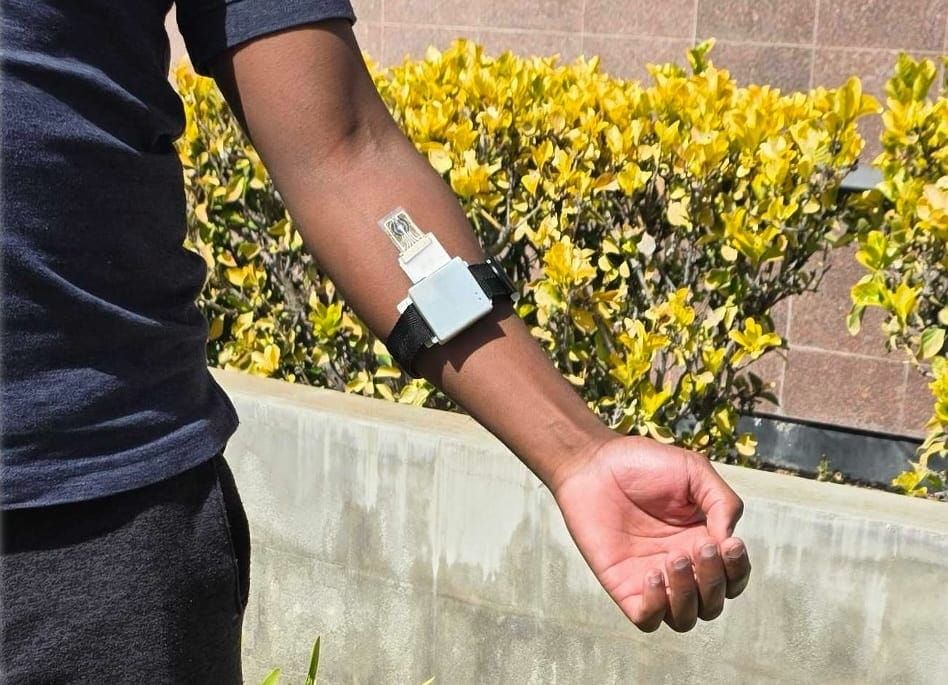
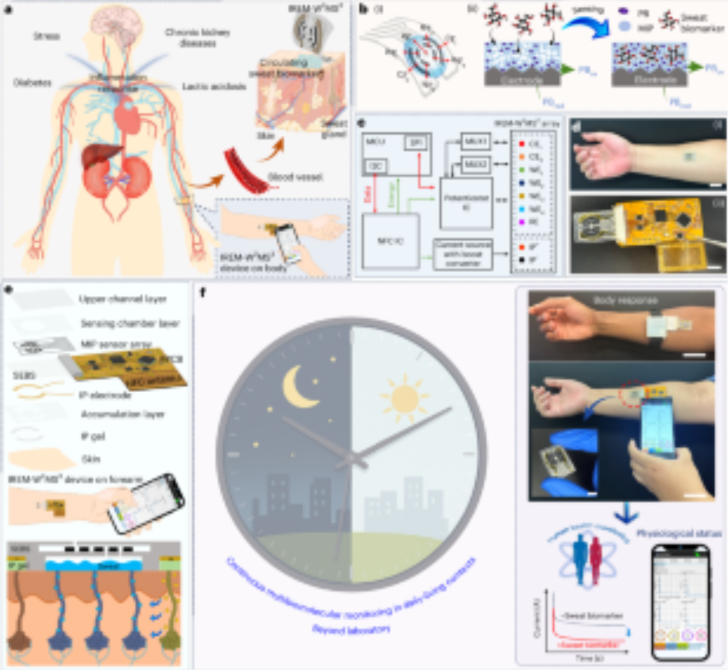
In May 2026, researchers at the University of California, Irvine published a wearable sweat-sensing platform in Nature Biomedical Engineering. The device is flexible, wireless, battery-free, capable of inducing a local sweat sample, and able to track cortisol, glucose, lactate, and urea (ew) over extended use.
Its full name is the In-Situ Regeneratable, Environmentally Stable, Multimodal, Wireless, Wearable Molecular Sweat Sensing System.
The acronym is IREM-W2MS3.
This device appears to have used up all letters available to medical engineering and then begun borrowing numbers.
The technical move is simpler:
The sensor can clear its own molecular sensing surface and return to work.
Long-term chemical wearables have a humiliating little problem. The better they become at catching molecules, the more those molecules accumulate on the surface that caught them. The measurement process slowly compromises the instrument.
This patch carries a recovery step inside the sensing loop. The sensor detects. The sensor releases. The sensor listens again.
The Sensor Fails Because It Worked.
Most familiar wearables measure physical signals.
A watch can count motion or detect optical changes associated with pulse. A chemical wearable has to seize a molecule from a wet biological sample and then politely ask it to leave.
Sweat is wet stuff that contains ions, metabolites, hormones, skin debris, oils, and environmental contamination. A chemical sensor has to isolate a target, produce a stable signal, resist interference, and preserve its recognition surface across repeated measurements.
Recognition can become fouling.
The target molecule binds to the sensing layer. More target arrives. Some remains attached. The baseline drifts. Sensitivity falls. Selectivity can weaken. A wearable designed for continuous monitoring begins behaving like a test strip that was never allowed to end the test.
Environmental change adds another attack surface.
Temperature, pH, sweat rate, skin site, activity, hydration, medication, and time all change the sample. The patch also bends, stretches, dries, and warms.
A laboratory assay can replace the cartridge, clean the instrument, recalibrate, and control the room.
A wearable has skin.
The old path toward longer monitoring usually asks the sensing layer to survive longer, asks the user to replace it, or accepts that performance will decay.
The UC Irvine device adds another option:
Build restoration into the sensor.
A Polymer With Memory.
The patch uses molecularly imprinted polymers as its recognition material.
A molecularly imprinted polymer is a synthetic material formed around a target molecule. During fabrication, the target helps shape chemical binding sites inside the polymer. The template is then removed, leaving cavities whose geometry and chemical interactions favor that target when it returns.
It is a tiny material memory.
- Cortisol receives one recognition layer.
- Glucose receives another.
- Lactate and urea receive their own (gross).
The research team used computational chemistry to help select polymer-target combinations, then integrated the resulting sensing layers into a flexible panel.
Synthetic receptors offer a practical advantage. Enzymes, antibodies, and aptamers can provide excellent recognition, while many remain vulnerable to temperature, pH, storage, and degradation. Molecularly imprinted polymers can be more durable.
Durable still does not mean empty forever.
The target-shaped pockets perform their job by receiving target molecules. Once occupied, the pockets need a path back to availability.
The sensor therefore has to forget accurately too.
The Patch Clears the Room.
Regeneration occurs by applying an electrical potential to the sensing layer.
That voltage changes the local conditions enough to release the captured target molecules from the molecularly imprinted polymer. The occupied recognition sites are cleared. Sensitivity and selectivity return without the user removing the patch, replacing a cartridge, or manually washing the sensor.
The researchers reported near-complete recovery across repeated regeneration cycles and stable sensing over a 21-day validation period under changing temperature and pH conditions.
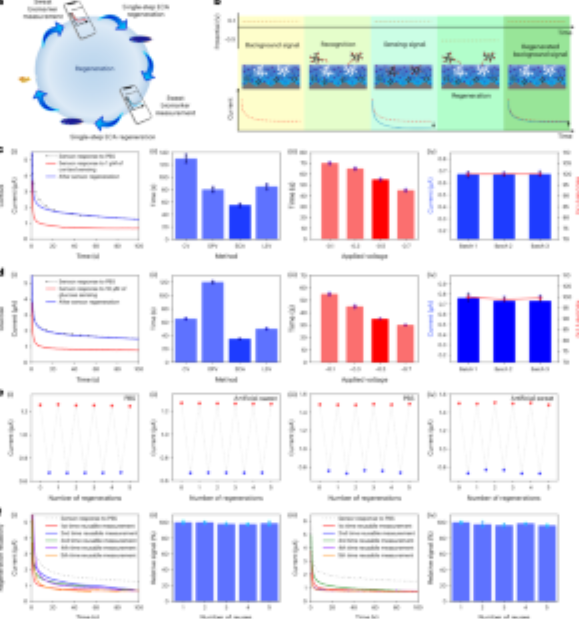
This creates a complete local sequence:
- Capture the molecule.
- Read the resulting signal.
- Apply the regeneration voltage.
- Elute the bound target.
- Restore the recognition surface.
- Measure again.
The reset is physical. The device does not correct drift by changing a number in software while the sensing surface keeps deteriorating underneath it. The material relation that produced the signal is reopened.
This is the Transition Action hinge.
- A disposable molecular encounter begins becoming a maintained sensing process.
The sensor does not wait for a technician to restore it. Recovery has migrated into the instrument.
It Makes Its Own Sample.
Sweat sensors have another awkward dependency.
The wearer has to sweat.
That is easy during exercise, heat, or stress, which also happen to change the very biomarkers being measured. A device intended for ordinary daily monitoring cannot always demand that the patient jog around the parking lot before checking kidney-related chemistry.
IREM-W2MS3 includes on-demand sweat induction.
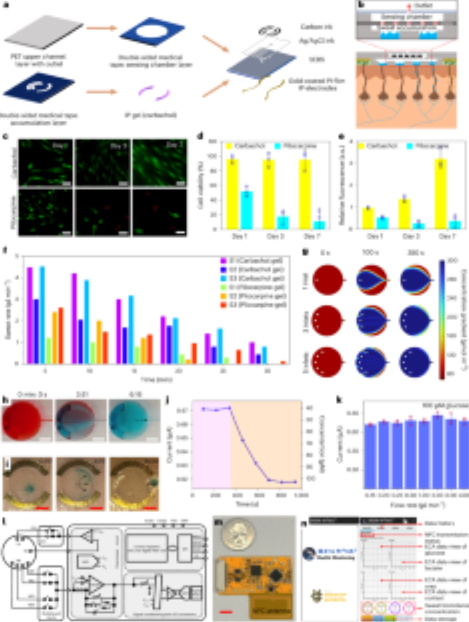
A near-field communication reader (either a compatible Android phone or a custom watch-like device) supplies power through an electromagnetic field. The patch uses that small current to activate a biocompatible hydrogel and produce a localized sweat sample. Microfluidic channels then move the sample across the sensing panel.
No onboard battery is required.
Battery-free does not mean power-free. The reader has to approach the patch and provide energy. The system trades an internal battery for intermittent external power, which reduces weight, charging, and battery disposal while keeping the device dependent on a nearby reader.
That dependency is useful and limiting at once.
The phone or wrist reader becomes temporary power source, controller, data receiver, and interface. The patch remains thin because the heavier energy system stays elsewhere.
The old workflow waited for the body to generate a convenient sample.
The new workflow can request one on demand.
Four Molecules, One Body.
The patch simultaneously monitors four targets:
- cortisol, associated with stress-system activity;
- glucose, relevant to metabolic monitoring;
- lactate, associated with exertion and metabolic activity;
- urea, relevant to kidney function and nitrogen metabolism.
Bodies do not announce themselves through one clean variable. Context can appear in the relation among signals, their timing, and the wearer’s activity. Continuous data also changes the object being measured.
A clinic usually receives a snapshot. A long-worn patch can begin producing a trajectory: baseline, rise, recovery, repeated deviation, response to meals, activity, sleep, medication, stress, heat, or illness.
A trajectory can reveal a body that briefly looked normal at the appointment.
It can also produce nonsense with extraordinary confidence if the interpretation outruns the sample.
Sweat is not blood with worse public relations. Biomarker levels in sweat can be influenced by sweat rate, collection method, skin location, evaporation, stimulation, temperature, hydration, individual physiology, and delays between systemic change and local secretion. A stable sensor signal is not automatically a clinically validated diagnosis.
The four channels should therefore be treated as longitudinal evidence requiring calibration and interpretation.
The patch can make the body more readable.
It cannot make physiology simple.
The Body Has Acquired a Log File.
Long-term molecular monitoring opens an obvious repair path.
A person with a chronic condition could generate useful evidence between appointments. Remote patients could share trends without repeated travel. Athletes and field workers could catch abnormal recovery, heat, exertion, or stress patterns earlier.
Then the instrument can turn around.
A patch capable of reading a body for weeks can become a leash when data ownership is wrong.
- An employer can call surveillance a wellness program.
- An insurer can convert uncertain biomarkers into risk scores.
- A coach can treat recovery data as permission to demand more load.
- A military system can interpret stress as disobedience or degraded usefulness.
- A platform can retain intimate molecular history long after the user believed the reading had ended.
Molecular data reaches closer than steps or sleep estimates to disease, medication, stress, metabolic state, and bodily vulnerability.
The sensor’s regeneration loop should not become a permanent extraction loop around the person.
Useful deployment therefore needs local processing where possible, narrow data retention, explicit consent, user control, clinical interpretation, and hard limits on secondary use.
The patch should remain an instrument of contact with the body.
It should not become the body’s probation officer.
The Lab Has Not Left the Lab Yet.
The device is still a research platform under further development. The team has filed a patent and is exploring translation and manufacturing.
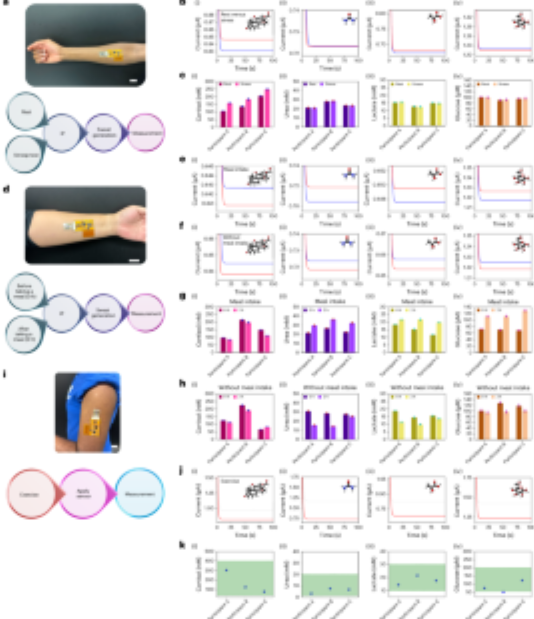
A 21-day validation demonstrates durability under the tested conditions. It does not establish regulatory approval, diagnostic equivalence to blood testing, reliable performance across every body, or years of safe daily use.
The remaining field is large.
- How often can the sensing surface regenerate before the polymer or electrodes age?
- How does the patch perform across different skin types, sweat rates, medications, climates, and disease states?
- Does induced sweating alter the concentrations being interpreted?
- How well do the four sweat signals correlate with clinically actionable outcomes for each use case?
- Can the adhesive survive daily life without irritating or damaging skin?
- Can microfluidic channels resist contamination, drying, blockage, and old-sample carryover?
- Can manufacturing produce identical recognition layers at scale?
- What happens when the phone is misaligned, unavailable, compromised, or owned by someone other than the wearer?
The patch can regenerate its sensing surface.
The care system around it cannot be regenerated by voltage.
Clinical thresholds, data governance, access, and follow-up will decide whether continuous sensing becomes useful care or one more dashboard asking a patient to manage alone.
What This Makes Reachable.
The immediate reachability is practical.
- A flexible wearable can detect cortisol, glucose, lactate, and urea in the same sweat-sensing platform.
- A molecular recognition surface can be regenerated in place by voltage-driven release of captured targets.
- The same patch can return to measurement across repeated sensing cycles without manual cleaning or replacement.
- Sweat can be induced locally on demand instead of waiting for exercise or heat.
- Near-field communication can power the patch without an onboard battery.
- Multi-day molecular trajectories become more reachable outside a clinic.
The longer reachability is architectural.
The wearable begins to own the full measurement cycle.
Sample generation, microfluidic transport, molecular recognition, electrical readout, surface restoration, wireless power, and data transmission are held together in one skin-level system.
The sensor is no longer a surface that encounters chemistry until chemistry wins.
It is becoming an instrument that can maintain its own contact boundary.
The Transition Action.
The official Transition Action is that a wearable molecular sensor can now regenerate the material surface that performs recognition. The patch applies a controlled voltage, releases captured molecules, restores available binding sites, and re-enters measurement without being removed for cleaning or replacement.
The body supplies the stream.
The patch requests a sample, routes it, reads four molecular channels, clears the sensing layer, and begins again.
This does not give everyone a clinic on the arm. The signals still need calibration, clinical validation, context, and governance. The device still needs a reader, a care path, manufacturing, and a body willing to wear it.
Still, the bottleneck has moved.
- The sensor no longer has to die from its own successful measurements.