Tales of Distortion: The N-Rays
The N-ray field was lucky here. [L]
September 2026 note: The N-Rays case remains the clean demonstration that internally rigorous validation can become self-confirming. The Inner Apocalypse later defines the crucial outside more strongly: a genuinely independent correction path must be able to introduce a difference without that difference first needing to become legible to the account it may overturn.
In the late 1890s, physics was on fire. It was a very exciting time to be in science.
Wilhelm Röntgen had discovered X-rays in 1895 and won the very first Nobel Prize in Physics for it in 1901. Henri Becquerel had stumbled into radioactivity in 1896. Pierre and Marie Curie had isolated polonium and radium in 1898.
Suddenly, the universe was full of invisible rays, and every serious physics laboratory in Europe was hunting for the next one.
This is the field where René Prosper Blondlot announced his discovery.
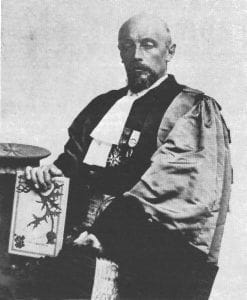
This man was not a crank. He was a respected senior physicist at the Université de Nancy in Lorraine, a corresponding member of the French Academy of Sciences, with a long career in electromagnetism and a reputation as a careful experimentalist. He had been doing legitimate work on the polarization of X-rays up until this point.
In the spring of 1903, working in a darkened laboratory with delicate equipment, he believed he had found a brand new form of radiation. He named it after his hometown. The N stood for Nancy.
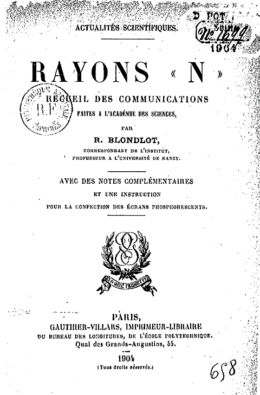
He published the discovery in the Comptes Rendus, the Proceedings of the French Academy. Other French physicists tried the experiment. Many of them confirmed it. Within a year, more than a hundred researchers across France had reported observing his N-rays. Some of the most respected names in French science endorsed the discovery. Jean Becquerel, son of the radioactivity Becquerel, confirmed. The Academy published Blondlot's work without serious internal dissent. The field of N-ray research had its own dedicated literature, with novel properties being catalogued at a remarkable pace.
There was just one, tiny problem.
N-rays do not exist.
This is the story of how a respected scientific community, working in good faith, using methods that had revealed real phenomena, confirmed the existence of a form of radiation that did not exist; and how the consensus held for two solid years until a lone American physicist, sent by the editors of Nature magazine, sat through three hours of demonstrations in a darkened room and quietly slipped a piece of equipment into his pocket.
The story is pretty funny. The story is also one of the cleanest single demonstrations of how distortion fields work in fields that consider themselves rigorous, and what it actually takes to interrupt one of these things.
The Distortion of René Prosper Blondlot.
To understand how science went so wrong here, you must first understand what happened to the eyes of the man who discovered the N-rays.
The detection method for N-rays is the part that should have been the biggest warning, except it was also unfortunately the one part that made the discovery possible.
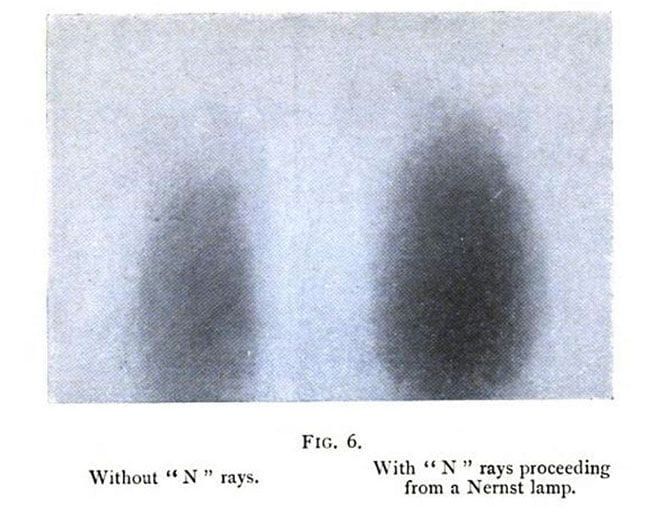
Blondlot's experimental apparatus consisted of a hot wire inside an iron tube, which was supposed to emit the N-rays.
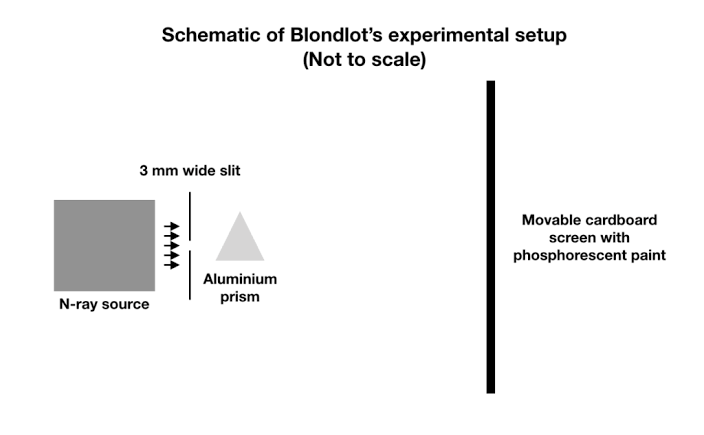
The rays passed through a sixty-degree aluminum prism, which refracted them at various angles.
The detector was a thread coated in calcium sulfide, which is mildly phosphorescent.
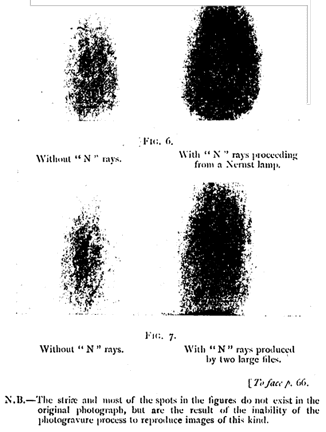
Blondlot would move the thread across the spectrum the prism was supposedly producing, and at certain points the thread would, in his observation, glow slightly more brightly than at other points, thereby indicating the presence of the rays at those positions in the spectrum.
This whole procedure had to be done in a darkened room.
The brightness change Blondlot was looking for was not large. It was right at the edge of what human vision can actually discriminate. To see it, the observer had to dark-adapt for many minutes, then watch a faintly glowing thread, then make subtle judgments about whether it was glowing slightly more or slightly less brightly at different positions.
I think you can see where this one is going.
This is the visual equivalent of being asked to detect a slightly louder whisper inside a quiet room while wearing earmuffs. There is no scientific instrument doing the detection here. There is only the observer's naked eye, looking at something near the very threshold of human perception, in a darkened space, while expecting to see a particular pattern that they are very excited to see.
So, obviously, what is going to happen in this situation is that observers will see what they expect to see. Not because they are dishonest. Not because they are stupid. Because that is what eyes do under those conditions.
Vision at threshold is not passive recording. Here, vision is active completion of the expected pattern from ambiguous signal. If you are told there will be a brighter region at thirty-five degrees, and you look at thirty-five degrees in a dark room with adapted eyes and a slightly glowing thread, you will perceive a brighter region. You will perceive it sincerely. You will perceive it consistently. If asked to describe what you saw, you will describe a brighter region. You will not be lying. You will see it. You will be performing the cognitive operation that the human visual system performs when given that exact set of inputs.
Blondlot's detection method was, structurally, an expectation-confirmation engine. It was an optical illusion, more or less, but mostly created through the N-ray schema the story had set prior in the minds of the researchers.
This was not visible from inside the field.
From inside the field, what was happening was that Blondlot, an experienced experimentalist, was reporting careful observations. His students and colleagues were attempting the same observations and reporting confirmations. The data was being published in respectable journals. Cross-laboratory confirmation was happening. The field had every external feature of legitimate science doing legitimate work.
The fact that the entire enterprise was downstream of a perceptual operation that produces consistent confirmation regardless of whether anything is actually there was not a feature anyone in the field was bothering to look at, because the field had not been built to look at that. That's not what anyone was supposed to be doing here. This field had been built to take observations as data and to credit careful observers with reliable observation.
This is the first layer of the distortion, and an ever-present threat in the scientific community. Not "Blondlot was making things up." Not "the confirmers were stupid or his sycophants." Something more architectural went down here: the experimental design selected for false confirmation by the operation of normal human visual cognition under the conditions specified. The field was producing exactly the pattern of evidence it had committed itself to interpreting as discovery. Through the methodology of this field, the false result had to be reproduced earnestly.
The Discovery Spreads.
What followed in 1903 and 1904 was not slow consolidation but wildfire.
Blondlot published twenty-three papers on N-rays in the Comptes Rendus over about eighteen months. Other French physicists started publishing too. Jean Becquerel announced confirmations. So did Augustin Charpentier, who had been doing physiological work and now reported that N-rays were being emitted by living tissue, particularly muscles and nerves. I hope that isn't still happening.
André Broca confirmed. Gilbert Ballet confirmed. The list of French confirmers grew steadily. By the end of 1904, more than a hundred researchers across French laboratories had reported successful N-ray experiments. The Academy of Sciences received papers regularly. The Comptes Rendus carried N-ray content in nearly every issue. N-rays were about to change everything we thought we knew.
The properties being reported became increasingly bizarre.
N-rays were said to be refracted by metal prisms but not by glass ones, which was already strange given that all known electromagnetic radiation behaves the opposite way. These N-rays may alter our understanding of radiation itself.
They were also blocked by wet paper but not by dry paper. They were emitted by all substances tested except green wood and certain treated metals, which is the kind of bizarre exception list that makes anyone's head turn and mouth almost involuntarily speak "but, why, though, would that ever matter?" and should make a physicist very suspicious because that does not look like the exception list of any known physical phenomenon. Green wood? What about aquamarine?
N-rays were also dissipated by loud noises in the room. They could also be stored in materials and released later. They were emitted by the human body, especially during muscular contraction. Charpentier reported that they were strongest from the speech areas of the brain when the subject was speaking, which was considered fascinating. They could be focused, polarized, and refracted. They could even improve night vision in the observer.
N-rays were amazing.
Each new property was a new opportunity for confirmation, and the confirmations just rolled right in.
This is what a distortion field looks like at scale.
This is not a single fraudulent paper, or confused man. It's also not a conspiracy. What we have here is just a community of hard-working scientists, operating in good faith, generating progressively more elaborate confirmations of a phenomenon that was producing those confirmations through the structure of the experimental method rather than through any actual physical existence.
Each new claimed property opened a new experimental territory. Each new territory produced confirmations because the same expectation-confirmation dynamic that had produced the original observations also produced observations of the new properties. The field expanded endlessly, because it was self-studying. The literature thickened. The phenomenon became, in any practical sense, real to the people working on it, because their working lives now contained dozens of papers, hundreds of experiments, and thousands of hours of carefully recorded observation of N-rays that all said it was real.
You could not, as a human from inside this field, easily form the thought N-rays do not exist. There was too much in the way. This would be like denying quasicrystals or something to these scientists.
The Holdouts.
Outside France, replication failed. Repeatedly.
Lord Kelvin, in Britain, the most eminent physicist of this era, tried Blondlot's experiments and saw absolutely fucking nothing.
William Crookes, who had done foundational work on cathode rays and whose name appears on the Crookes radiometer that you see spinning in those novelty shops, tried and also saw absolutely fucking nothing.
Otto Lummer, German physicist of considerable reputation, tried and saw fucking nothing. Heinrich Rubens, also German, tried and saw fucking nothing.
Robert W. Wood, American physicist at Johns Hopkins University, also tried and saw fucking nothing. He complained that he had wasted an entire fucking morning on it.
The German episode is worth dwelling on here.
Kaiser Wilhelm II, hearing about French scientific glory at the dawn of the new century, asked Heinrich Rubens to reproduce Blondlot's results so that Germany could share and revel in this discovery. Like I said, this was an exciting time to be alive. So Rubens spent two straight weeks attempting it. He could not. He had to report this failure to the Kaiser personally.
To put it simply, the Kaiser was not pleased.
Rubens was, as a result, the most embarrassed of the international holdouts, having had to explain to his head of state that the most important new physics phenomenon of the year did not appear in his laboratory despite his best efforts to find it. This was seen as his failure to output until the truth came out.
The response from Nancy was not to take the holdouts as evidence that something might be wrong. No, Nancy could clearly see these things. N-rays were real.
The response was to argue that the holdouts all had insufficiently sensitive eyes.
This is one of the most beautiful, elegant single moves in the history of all distortion fields.
The detection method's known weakness, that it depends on perceptual judgments at the threshold of vision, was now reframed not as the methodological problem (it fucking was) but as a test of the observer's quality.
To see N-rays was to demonstrate visual acuity. To fail to see them was to demonstrate visual inadequacy. It was simply a lesser man who saw no N-rays. The sensitive observers were the ones who could see the truth; the failures were the ones who could not.
This is a hysterical thing for anyone to do, let alone serious scientists trying to push the fringe.
By construction, the only valid evidence about the existence of N-rays was the evidence of those who claimed to see them. The dissenters were defined out of the conversation by their dissent. They didn't have good enough eyes to be a part of this new discovery.
If you are tracking Modal Path Ethics concepts as we go: this is false repair. The challenge to the field was incredibly real. Not a single fucking person not in Nancy could see a single fucking N-ray. This was because they did not exist, it would soon turn out.
The field's response to the challenge did not address the challenge; it produced an explanation that allowed the field to continue without needing to engage the challenge or the lesser eyes of the challengers. The dissenters' inability to see was reinterpreted as in fact just confirming the rare and special quality of those who could see, which strengthened rather than weakened the consensus. These eyes were now even more precious.
It is also role capture in an unusually pure form.
The holdouts were not being treated as other, valid physicists offering real fucking evidence. They were being treated as failed observers with shitty eyes offering evidence about themselves having bad eyesight.
The structural role of "scientific dissenter offering counter-evidence" was, within the Nancy framing, not actually available in the conversation about N-rays, which had certain ocular prerequisites. The only available roles were "sensitive observer who confirms" and "insensitive observer who fails to confirm." Neither role licensed any possible counter-evidence of N-rays.
This is, by the way, exactly how degenerate metagames protect themselves. The dissenters are categorized as people whose dissent does not count, and the categorization is offered as a structural feature of the field rather than as a rhetorical move.
By the summer of 1904, the situation was just completely untenable internationally. Nature had been receiving correspondence from researchers across Europe and America who could not reproduce Blondlot's results, because you couldn't unless you were also confused like Nancy. The journal's editors decided that the matter could not be resolved through correspondence and that someone had to actually visit Nancy and observe what the fuck was happening.
Robert Wood was the natural choice for this mission.
He had a reputation in optics that gave him standing on Blondlot's home territory. He had a parallel reputation as a debunker of pseudoscience, which had served him well in earlier disputes. One mark against him was he had personally tried and failed to reproduce N-ray experiments, so he had empirically bad eyes. He was, however, American, which kept the visit clear of British-French and German-French diplomatic complications. He spoke French.
Fuck it. He was dispatched.
Wood in Nancy.
Wood arrived at Blondlot's laboratory in the summer of 1904. He sat through demonstrations on the mysteries and virtues of the N-rays for over three straight hours.
His own description of the visit, written for Nature shortly afterward, opens with one of the most famous lines in the history of scientific debunking. He wrote: "I went, I must confess, in a doubting frame of mind."
He had hoped, he continued, that he might be convinced, in spite of his shitty eyeballs.
He was not.
Demonstration after demonstration failed to produce anything Wood could see. Blondlot would set up the apparatus, dim the lights, allow time for dark adaptation, and then guide Wood through the observations. Blondlot would describe what he was seeing as he looked at the calcium sulfide thread. He would identify regions of greater brightness, locate the spectrum the aluminum prism was producing, point out features that were supposed to be visible. Wood, looking at the same equipment, saw a thread in a dark room that glowed very faintly and uniformly. He did not see a spectrum anywhere. He did not see any brightness changes. He saw what someone with normal vision sees when looking at a faintly luminous object: the object, at its faint luminance, without structure. So, fucking nothing.
Three hours into this embarrassing shitshow, Wood correctly decided that polite observation was just not going to settle this matter. He needed something more direct.
So in one of the demonstrations, Blondlot was about to show Wood the spectrum produced by the aluminum prism, which was the central feature of the entire experimental program, the feature that supposedly demonstrated that N-rays had wave-like properties and could be analyzed.
The room was dark. Blondlot was at the apparatus.
Wood reached over, very quietly removed the aluminum prism from the apparatus, and slipped it into his pocket.
He then asked Blondlot to continue the demonstration.
Blondlot, of course, did not know that the prism was now in Wood's pocket. Wood moved like that. He continued the experiment.
Blondlot moved the thread across what was supposed to be the spectrum produced by the now-absent prism. He cheerfully confirmed that he was seeing the brightness changes. He described the spectrum's features. He pointed out specific details. He was looking at a thread in a dark room and reporting the same observations he had been reporting for the entire eighteen months of N-ray research, except that the central piece of equipment that was supposed to be producing this phenomenon was no longer in the stupid fucking apparatus.
Wood, having obviously documented this, then attempted to replace the prism so the next experiment could proceed. The assistant noticed. The assistant assumed Wood was removing the prism, to test without it. Apparently, this was actually the man with the eyes to be concerned about.
The next demonstration began. The assistant, watching the apparatus that he believed had just had a critical component removed, failed to see any N-rays, because he was no longer expecting it to work. The equipment was actually fully intact again, with the prism back in place. But the assistant, expecting nothing, saw nothing.
The prism had become a magic totem. Its physical presence or absence determined nothing about what the apparatus did. Its believed presence or absence determined what observers reported. Vision in the threshold conditions was being structured entirely by what observers expected to see. Wood had just demonstrated, clearly, twice, that the actual physical configuration of the apparatus was irrelevant to the reported observations.
He was not done.
In another demonstration, Blondlot was using a metal file as a source of N-rays, since metal files (according to the published literature) emitted N-rays continuously. This is a major danger most people forget when filing their nails.
Blondlot had also said, in print, that wood does not emit N-rays, especially mysterious green wood, which was on the famous exception list. So Wood, when Blondlot was not looking, swapped the metal file for a piece of wood.
Blondlot continued the experiment. He observed N-rays from the wooden object that, by his own published account, should not have ever emitted them.
By the end of the afternoon, Wood had three independent demonstrations of the same fact. The reported observations did not depend on the physical state of the apparatus. They depended only on what the observers expected to see. He had what he came for.
He went back to America and wrote it up.
The Nature Article.
Wood's account was published in the September 29, 1904 issue of Nature.
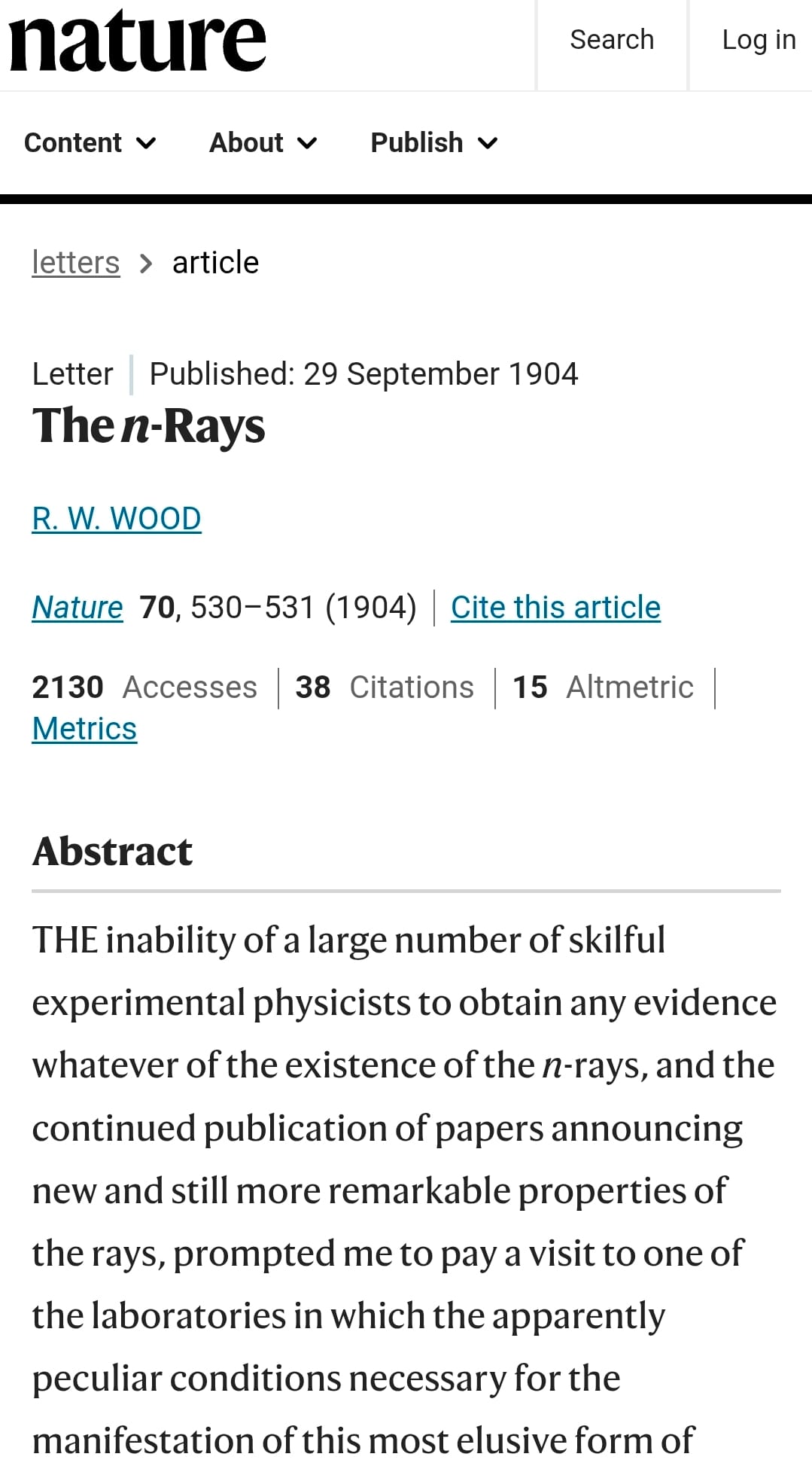
He describes what he observed in the laboratory. He describes the demonstrations. He describes what he did to test them. He describes what he saw.
He concludes that the reported observations are subjective phenomena, produced by the visual system's pattern-completion in conditions where signal is barely present and expectation is strongly shaped by the experimental setup.
He notes that this is not a moral failing of the observers. It is a feature of human vision. He suggests that all experiments of this type, depending entirely on perceptual judgments at threshold, with strong prior expectations about what should be seen, should clearly not be considered reliable evidence for novel physical phenomena.
The article is barely more than a page.
Within weeks of publication, the international physics community considered the matter settled. Nature ran follow-up correspondence from researchers who had tried and failed and now felt vindicated. Other journals reprinted summaries. The cross-laboratory confirmation network, which had been so impressive when generating positive results, now operated in reverse. Replication failure became reportable. The methodological critique was understood. The whole structure of N-ray research, which had stood on the appearance of consensus, lost the consensus.
By 1905, the only laboratory still publishing N-ray research was Blondlot's own. By 1906, the topic had vanished from serious physics literature outside Nancy. By 1907, even most French physicists had quietly stopped engaging with it. Within three years of the Nature article, more than a hundred laboratories that had been confirming the existence of N-rays had stopped publishing on the topic and tacitly accepted that the entire enterprise had been a methodological failure.
What Happened to Blondlot.
So, the thing is, Blondlot did not recant. Ever. He never got out of the N-ray distortion field. He was its main victim. This is the part of the story that contains the genuinely tragic element, and it should be told carefully.
He continued to publish on N-rays in French journals for several more years. The papers became increasingly defensive, then increasingly isolated, then increasingly ignored.
He retired from his university position in 1909, five years after Wood's article, citing health reasons. He lived another twenty-one years, dying in 1930 at the age of eighty-one. As far as the historical record indicates, he never publicly acknowledged that N-rays did not exist. There are reports, some of them in popular history sources, some of them less reliable, that the affair contributed to a mental decline.
Whether this is accurate or whether it is a folk-history embellishment of the actual events, what is clear is that his last twenty-five years were not the years his colleagues had expected him to have. He had been on track to be remembered as a respected senior physicist of his generation. After 1904 he was instead remembered as the person at the center of one of the most famous methodological failures in modern physics.
The French Academy of Sciences took longer to recover its institutional dignity than Blondlot took to lose his. The Academy's role in publishing and platforming N-ray research without internal critique was a wound on French science that took decades to heal. International physics, particularly Anglo-Saxon and German physics, treated French experimental work with a degree of additional skepticism for years afterward. The reputation cost was also real.
The structural lesson, however, took longer to absorb than the case-specific judgment.
The case-specific judgment was clear within months: N-rays were not real, the confirmers had been fooled by their own expectations, the methodology was bad.
The structural lesson here, that rigorous fields are not protected from this kind of failure, that peer review can fail at scale, that institutional confirmation can be self-reinforcing without being correct, that perceptual experiments at threshold are particularly dangerous in expectation-laden conditions was much harder to accept, it seems. It is still being absorbed, every time a new such case appears.
Coda: What the N-Ray Affair Shows.
Modal Path Ethics treats this kind of case as instructive in three different directions at once.
The Field Instrument failure mode in a "rigorous" field.
The Field Instruments series argues that mathematics, scientific method, language, law, and democracy are all instruments humans developed to compensate for the architectural limits of native cognition. The instruments are real. They are all necessary. They also require selecting cuts, the cuts are morally consequential, and the instruments never replace the field they describe. False repair occurs when the output of the instrument is mistaken for the underlying reality.
The N-ray affair is the Scientific Method article on public display in compressed form. The scientific method had been used. Hypotheses had been formed, predictions had been made, experiments had been conducted, results had been reported, replication had been attempted, peer review had operated, the Academy had published. Every visible feature of the method was present.
None of it caught the failure. The instrument, applied to a problem the instrument was not shaped to handle (perceptual judgments at threshold with strong prior expectation in unblinded conditions), produced systematically false confirmation. The selecting cut, what counts as a valid observation, turned out, in this configuration, to select for confirmation regardless of physical reality.
This is what the framework means when it says the instrument never replaces the field. The N-ray field was real. It contained no N-rays at all, however. The scientific method, as practiced by Blondlot's community, did not detect this. It instead produced a vast literature of confirmations of a phenomenon the field did not contain. The instrument's output was being mistaken for the underlying reality.
This is not a critique of the scientific method. It is a critique of treating the scientific method's output as ground truth without attending to the structural conditions under which that output was generated. The selecting cut here was: trust the trained observer's perception in the experimental setup. Under most conditions, this is a reasonable cut. Under threshold-perception conditions with strong prior expectation, it is not. The community had not noticed that the conditions had shifted, because the shift was invisible to them from inside the conditions.
This pattern recurs whenever a rigorous field finds itself in a region where its standard methodology happens to be systematically vulnerable to a specific failure mode that the methodology does not check for.
Cold fusion, in 1989, was a closely analogous case.
So is much of nutrition science based on self-reported food frequency questionnaires.
So are entire stretches of social psychology, before the replication crisis revealed how badly the standard methods were producing false positives.
The N-ray case is the cleanest single example because the failure was caught quickly and decisively. Most cases of this kind are not caught quickly at all. The scariest possibility is that many such cases are still in progress right now.
The distortion field as the social structure that protected the failure.
The methodological failure is necessary but not sufficient to explain N-rays. Many bad observations get made. Most of them are corrected within months by the normal operation of cross-laboratory comparison. N-rays were not corrected. They survived for two full years, without ever bothering to exist. The reason for the survival is the distortion field that grew up around the original observations.
The features of the distortion field are textbook:
The defense of the methodology that produced the observations was structurally identical to the methodology being defended: sensitive observers reported sensitive observations, and the test of sensitivity was the ability to make those observations. The dissent was reinterpreted as observer-failure rather than as evidence about the phenomenon. The rare positive instances were treated as more probative than the much larger number of negative instances. The accumulating literature created social and professional incentives to continue confirming. Junior researchers had nothing to gain by reporting failures and much to lose. Senior researchers had committed publicly to the existence of the phenomenon and had reputational stakes in its continued reality. National pride was involved on both the French and the German side, with the German side embarrassed by their failure to reproduce and the French side invested in the discovery's continued legitimacy. The Kaiser was personally interested. The Academy of Sciences was institutionally invested. The community had become, through the normal operation of professional incentives, unable to falsify its own central claim even though many of its individual members were quietly skeptical.
This is what the framework means by a self-reinforcing field damage. Each individual choice within the field was locally rational under the field's distorted conditions. Confirmers had reputational reasons to confirm. Skeptics within France had professional reasons to be quiet. Editors had institutional reasons to publish. Reviewers had social reasons not to challenge. Each of these reasons was real and operating within a real professional context. None of them required dishonesty. The aggregation of these locally rational choices produced an institutional commitment to a phenomenon that did not exist. The field damage was not anyone's individual fault. It was the structural product of professional incentives operating in a community that had committed itself to a particular discovery. The field was damaged by design.
Once the distortion field is in place, the distortion field always defends itself, because the resources that would otherwise be available to challenge it are now embedded in the field. Peer review fails because the peers are part of the field. Replication fails to correct because failed replication is interpreted as observer error. The Academy fails to catch the problem because the Academy is publishing the literature. Public correction becomes possible only through some agent who is outside the field's social structure and therefore not subject to its incentive gradient.
Wood was outside the field. He was at Johns Hopkins. He had no career stakes in N-rays existing or not. He could afford to come, observe, and report what he saw.
The framework has a name for what Wood did. It is truthful contact. Wood preserved his contact with the structural reality of what was actually happening in the laboratory rather than allowing his perception to be shaped by the social and institutional pressure of the surrounding field. This was, structurally, an act of generative resistance; friction against a distortion that produced clearer perception. The fact that he did it through a piece of mild theatrical mischief (slipping a prism into his pocket) should not obscure the structural fact, moreso intensify it. Wood interrupted a self-reinforcing field by introducing information the field could not metabolize.
This is what generative resistance looks like in an institutional context. It is not abstract critique. It is not philosophical objection. It is a specific intervention that produces a specific piece of information that the field's existing mechanisms cannot integrate without changing.
The lesson for the framework about how to read other "rigorous" fields.
Modal Path Ethics has, throughout the corpus, been willing to identify distortion fields in places that consider themselves rigorous. The Balancing Academic Philosophy article does this for academic philosophy. The Solved Game article does this for various institutions including academic philosophy, science, and education. The Datacenter and Sydney articles do this for AI development. The N-ray case is, in this regard, simply one more instance, and the cleanest one in the historical record because the field collapsed visibly within months and the structural features can be examined without ongoing partisan stakes.
The pattern is structural and recurs. A community of trained practitioners adopts a research program. The program has methodological vulnerabilities the community is not configured to check for. Initial results, produced through the vulnerable methodology, are confirmed by other practitioners using the same methodology, generating the appearance of consensus. The consensus produces professional incentives to continue producing the consensus. Dissent is reinterpreted as practitioner error rather than as evidence about the underlying claim. The field becomes, in any practical sense, unable to falsify its central claim through its own internal procedures.
Correction has to come from outside.
The N-ray case only ended in 1904 because Wood was sent to Nancy in 1904. The case-specific outcome depended on a contingent intervention by a particular agent at a particular moment. The structural conditions that produced the case were not unique to N-rays. They are present, to varying degrees, in many active research programs today. The framework's posture is that this is a recurring feature of how rigorous fields fail, not a rare aberration at all.
This is one of the reasons Modal Path Ethics refuses to grant any field, including its own, automatic immunity to the kind of analysis being performed here. The Self-Application essay made this point about the framework. The N-ray case makes it about physics. The Solved Game article makes it about games and science and academic philosophy. The pattern is just general. A field that thinks it cannot have an N-ray problem is the field most likely to have one and not notice.
Final Note.
There is a temptation, when telling the N-ray story, to read it as a story about the gullibility of others. They were fooled. They believed in something that did not exist. We, with our better methods and our skeptical training, would not have made that mistake.
This is the wrong reading. You also would have been fooled, if you were in Nancy. The wrong reading is itself a small distortion field forming in real time around the case.
The structural features that produced N-rays are general features of how human cognition works in social and institutional contexts. The expectation-shaped perception was operating in the brains of the same researchers who, on other questions, were doing perfectly competent physics. The professional incentive structure was operating on people who, on other questions, were behaving with appropriate scientific caution. The distortion field was forming in a community of intelligent, trained, well-intentioned scientists who were doing what they were structurally configured to do.
You and I are also doing what we are structurally configured to do. We have the same visual system. We have the same expectation-driven perception at threshold. We are embedded in institutions with their own incentive structures. We have research communities that confirm what we expect to see and reinterpret dissent as observer error. We have, in fields close to our own, ongoing N-ray problems, possibly of considerable magnitude, that we are not currently positioned to perceive.
The N-ray case is not a story about what idiotic fools believed in 1903, like Sullivan. It is a story about what all of us, under the right conditions, would believe and confirm and defend without noticing that we were doing it.
What it takes to interrupt one of these is a Wood. Someone outside the field. Someone willing to come, observe, and quietly remove the prism. Someone willing to publish the result.
Most fields, most of the time, simply do not get a Wood. The N-ray field was lucky here.
Even after the field collapsed, even after his entire community quietly walked away from him, even after twenty-five more years of life, Blondlot continued to believe that N-rays were real and he had seen them. Because, at the level of his own conscious experience, he actually really had fucking seen them.
The visual operation his eyes were performing in those darkened rooms had produced, for him, the perception of what he reported. That perception did not stop being his perception just because the social-institutional consensus shifted around him. He had seen what he had seen. He could not unsee it.
The framework asks us to consider the possibility that, on some question we have not yet noticed, we currently are Blondlot.