Field Instruments: The Democratic Process
Democracy is not justice.
September 2026 note: Democracy remains valuable primarily because it distributes standing and preserves correction after error, not because majority output is moral reality. The Inner Apocalypse constitutional work later develops representation, judgment, rights, appeal, bounded authority, and maintained successor capacity in much more detail.
Democracy is not inherently Good.
Democracy is one of the ways human beings try to keep power answerable to the loci who must live inside its consequences.
That is another major moral achievement. We are on a roll here. A field ruled only by kings, priests, landlords, generals, billionaires, judges, experts, party machines, platform owners, or whoever has the most force in the room is not automatically more serious because fewer people are allowed to be wrong. Concentrated power does not become wisdom by having better posture.
Democracy matters because no single locus can safely impersonate the whole field. It distributes agency, and allows correction. It makes rulers removable without collapse. It gives the governed some standing inside the future they must inhabit. It can slow domination, expose hidden burdens, preserve peaceful transition, and keep law from becoming the private language of power.
So, like the others, this is not an anti-democracy article. It is an anti-democracy-worship article.
To recap:
Mathematics is not the field. The number appears after a selector decides what may be counted.
Science is not the field. The experiment appears after a selector decides what may be isolated, measured, controlled, and repeated.
Language is not the field. The word appears after a selector decides what may be named.
Law is not the field. The legal category appears after a society decides what may be recognized, owned, accused, punished, protected, or excluded.
Democracy is not the field either. Nor is it perfect, or some kind of metaphysical process.
The vote appears after a field has already been cut by a selecting agent into eligible voters, ineligible nonvoters, candidates, districts, ballots, procedures, thresholds, choices, campaigns, parties, rules, institutions, and outcomes. That cut can preserve self-rule, or launder closure.
The Democratic Cut.
The Democratic Cut is the act by which a living field is converted into a voting field.
Who gets to vote?
Who is excluded?
What options are available?
Who set the agenda?
What information reached the voters?
What counts as a majority?
What counts as legitimacy?
Who bears the outcome?
Who cannot appeal?
What can be revisited later?
What future was already made unreachable before the ballot ever appeared?
These questions are always prior to the vote. A democracy needs procedures. A society cannot just draw up the full field at full resolution every time it acts. It has to decide who participates, how decisions are made, how options are formed, how votes are counted, and when the decision becomes binding.
Like every other, the cut is both necessary and dangerous, because once the vote happens, people love pretending the field has spoken.
It has not. A structured part of the field has spoken through an available procedure under available conditions.
That may be enough for Better. It is not magic.
The Vote != Consent.
A vote is not automatically consent.
That sounds pretty rude to democracy, but it is one of the things democracy most needs to remember.
A coerced field can still easily produce a ballot. A captured field can still produce a majority. A desperate field can still choose between two bad futures and then be told it chose freely. A misinformed field can vote with full confidence. A distorted field can select the option its distortion made most reachable.
That does not make voting meaningless. It does mean voting inherits the condition of the field before the vote.
If the real alternatives were structurally removed, the vote records the remaining options. It does not retroactively reopen the ones that were closed.
If information was manipulated, the vote records preference under distortion. It does not purify the distortion.
If participation was restricted, the vote records the agency of those allowed into the procedure. It does not speak for every affected locus.
If poverty, fear, propaganda, intimidation, bureaucratic difficulty, social pressure, or institutional opacity shaped the electorate, then the vote carries those burdens inside it.
Democracy does not ever cleanse the upstream narrowing that made only bad options reachable.
This is why “the people chose” can be true and still morally underdescribed. The people chose what was made choosable.
Majority Rule != Moral Reality.
Majority rule is often necessary.
A shared field has to act. Not every question can wait for unanimity. A society that requires perfect agreement may hand power to obstruction, paralysis, or the loudest veto. Majority rule can be a practical way to move without letting one faction freeze the whole future.
But majority preference is not identical to Good, at all. A majority can be afraid. A majority can be misled.
A majority can punish a minority. A majority can normalize exclusion. A majority can mistake familiarity for morality. A majority can vote to preserve its own comfort by transferring burden onto those with less power.
This is why rights matter. Rights are not anti-democratic decorations. Rights exist partly because democracy knows it can become a crowd.
A right is a protective boundary drawn around a locus because the field has learned where collapse becomes reachable without it. Free speech, due process, bodily autonomy, religious freedom, equal protection, voting rights, labor rights, disability rights, and minority protections all exist because a majority is not made morally safe at all by being numerous.
Democracy without rights can become procedural domination. Rights without democracy can become elite guardianship. The healthy field needs both, and both must also always remain answerable to extance.
Representation & Standing.
Democracy is always haunted by the standing problem.
Who counts as affected enough to participate? Who counts as informed enough?
Can everyone vote when only some understand the technical field? Can only experts vote when everyone must live with the outcome?
Can a small qualified body legitimately decide for a larger affected community? Can a broad public vote responsibly on a field it cannot see clearly?
There is no clean answer that works everywhere.
Expertise always matters. A vote among people who do not understand the field can become distortive noise with authority.
But expertise can also become exclusion. A narrow voting body can protect the quality of its decision while quietly severing the decision from the wider field it governs.
This is why the RBY UU case belongs here, and was posted so early.

A suspect vote in a competitive game is utterly tiny compared with a state election, but the structure is easier to see precisely because the field is smaller.
Who gets to vote? The most active or qualified players. Why? Because field knowledge matters. What is the risk? That the qualified pool becomes too narrow to represent the extant, living play-field it governs. What is being decided? The future shape of play, discovery, participation, and community trust, not one rule.
The vote is real. The vote matters. The vote does not end the field question. This last part is where larger-scale democracy can often go wrong.
This Pokémon tiering vote can be procedurally valid and still require analysis of the eligibility gate, the size of the active player base, the representativeness of qualified voters, the health of the metagame, and the futures made more or less reachable by the result. That is democracy at toy-scale.

Standing, expertise, legitimacy, participation, and future-space appear there in miniature, without the flags and guns making everyone stupid and afraid.
Democracy as False Repair.
Democracy becomes false repair when the vote closes a complaint without actually repairing the field.
“You voted.”
“The people chose.”
“The majority spoke.”
“The process was followed.”
“The mandate is clear.”
These phrases can be legitimate and true. Sometimes the decision really does have to settle. Not every disappointed voter is a harmed locus. Not every losing side has been morally erased. Democracy cannot actually function if every loss becomes proof that the procedure was fake.
But democratic closure can also hide undeniable moral remainder.
A vote can end a decision while the field remains wounded. A majority can make a choice that was procedurally proper and morally harmful.
A public can select a leader who then closes futures for people who had no meaningful ability to resist. A community can vote away a repair path because the burden falls elsewhere.
A state can hold an election while districts, media systems, party structures, money, fear, and legal rules have already shaped the reachable outcome.
The ballot can become a ritual of legitimacy over a field already narrowed. That is false repair. Not because the voting is fake, because the vote is being asked to do more than a vote can actually ever do.
Democracy and Truthful Contact.
Democracy depends on truthful contact. People cannot hope to govern a shared field if the field is made unreadable to them.
This is where the earlier articles in this series now converge. Numbers can distort. Experiments can narrow. Words can launder. Laws can close files while wounds remain open. Then democracy receives the citizen and says: okay, now choose.
But what does the citizen even actually see?
If the field is saturated with propaganda, algorithmic manipulation, official secrecy, conspiracy, panic, manufactured ignorance, financial capture, educational failure, bad metrics, symbolic tribalism, and exhaustion, then sure, a vote still happens, but self-rule has been completely damaged and destroyed before the ballot is ever marked.
A vote cast inside a distortion field is not automatically self-rule at all. It may be the distortion selecting its own preferred future.
This is why democracy requires more than just elections. It requires the conditions under which elections can remain in honest contact with the field: education, journalism, public records, open dispute, accountable institutions, anti-corruption rules, free association, meaningful opposition, accessible voting, reliable administration, and enough shared reality that disagreement still occurs inside the same world.
Without those, democracy becomes just theater. A society can keep the ballot and lose track of the field entirely.
Democracy and Correction.
The deepest virtue of democracy is not that voters are always right. They are not.
The deepest virtue is that correction still remains reachable after voters are wrong.
A democratic field can change course without requiring assassination, coup, civil war, dynasty collapse, divine succession, palace intrigue, or the mercy of a ruler who suddenly decides to listen. That is an enormous moral advantage. It means error does not have to become everyone's destiny. This is why revisability matters.
A democratic decision that cannot be revisited becomes strangely undemocratic. The field must always be allowed to answer back. Policies will fail. Harms will appear. Minorities will testify. Predictions will collapse.
New evidence arrives. Conditions change. The prior vote may have been legitimate, but legitimacy is not moral immortality. Democracy is strongest when it keeps correction always reachable.
That means losers must retain their voice. Minorities must retain protection. Records must remain accessible. Institutions must remain contestable. Power must remain removable. The next election must remain real. Public memory must not be destroyed by each victory.
A democracy that allows one vote to close future democracy has contradicted its own repair function. It has used self-rule to end self-rule. That is not democracy succeeding. That is democracy consuming itself through its own procedure.
Democracy is Better, not Automatically Good.
Democracy is often Better.
It is often the least-closing political form available because it distributes agency, limits private rule, allows correction, and keeps power answerable to those who must live inside its effects.
But Better is not Good.
A democratic decision can be Better than dictatorship and still harmful. A majority can be legitimate and still wrong. A voting procedure can be fair enough to bind and still leave moral remainder. A representative body can act within its authority and still fail the field.
That is not a reason to abandon democracy. It is a reason to stop worshiping it, though.
Democracy is not actually sacred.

Democracy is a repair technology under our permanent maintenance.
It has to be protected from money capture, information collapse, exclusion, voter suppression, majoritarian cruelty, institutional decay, performative participation, expert contempt, populist fantasy, procedural gaming, and the deadliest democratic temptation: the belief that because the vote happened, moral analysis is over.
It is not over. It is never, ever over. The vote is part of the field. It is never the whole field.
The Ruling.
Democracy is not justice. Democracy is one of humanity’s strongest ways of distributing agency over shared futures so power cannot impersonate the field alone. That makes democracy morally serious.
It does not make democracy morally final.
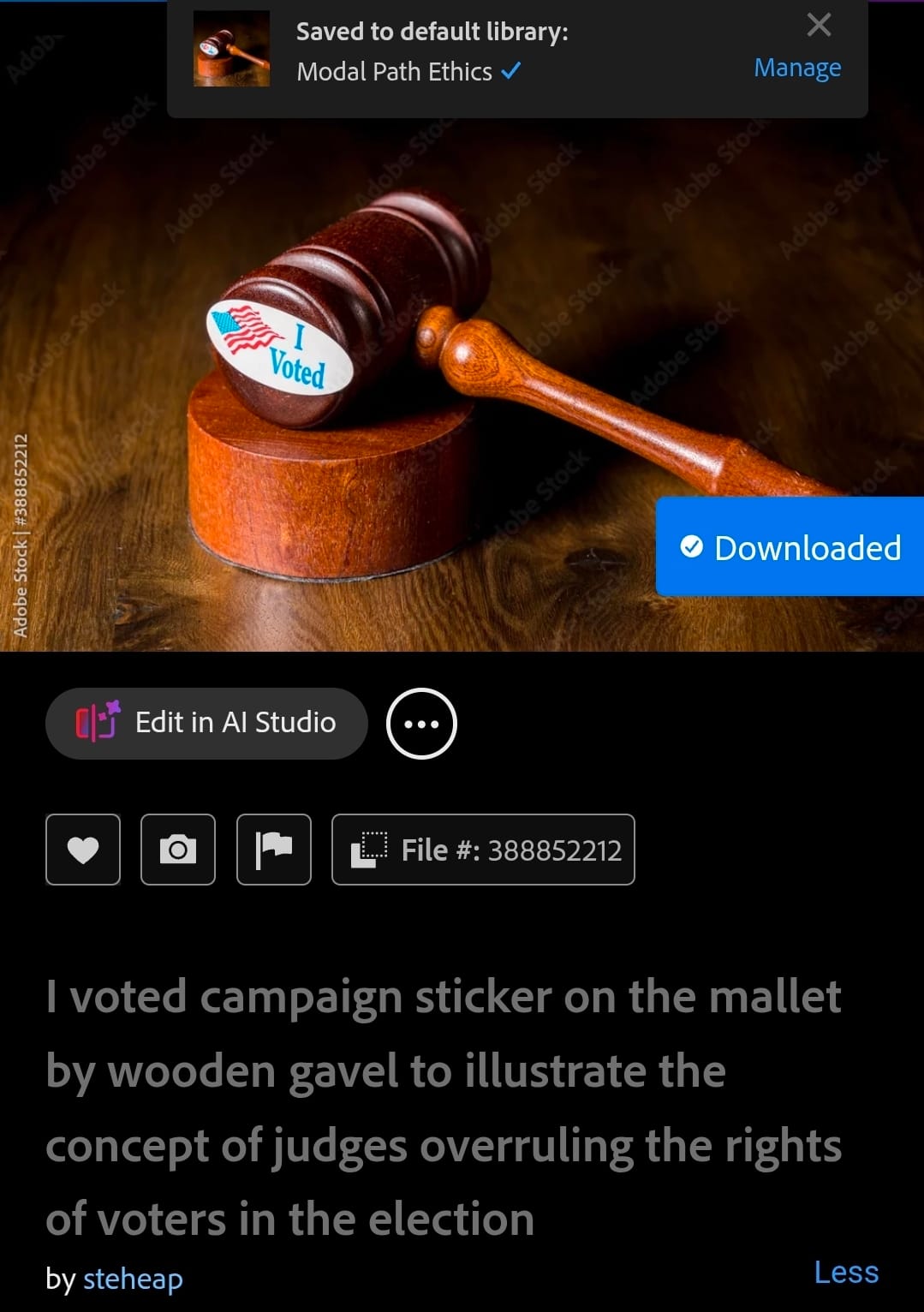
The vote is not the field. A ballot can preserve self-rule or launder narrowed choices. A majority can correct domination or become domination. A procedure can create legitimacy or close complaint while harm continues. A voting body can express the field or reveal how badly the field was cut before expression became possible.
Modal Path Ethics does not tell us to discard democracy. That would usually return the field to concentrated power, private certainty, and whoever can enforce the better story. It tells us to stop confusing democracy with automatic repair.
Defend democracy. Widen democracy. Correct democracy. Protect the rights that keep democracy from becoming a crowd. Protect the truth-contact that keeps democracy from becoming a ritual. Protect the correction paths that let democracy survive being wrong.
The vote is just one tool by which the field tries to keep power answerable to those who must live inside its future.