Applied Case: The Prisoner's Dilemma
Anyone who presents the one-shot Prisoner's Dilemma to describe their field is not morally serious. [Modal Path Ethics loses its mind]
Warning: Modal Path Ethics flew into a violent frenzy and began ranting on first contact with the Prisoner's Dilemma.
This is preserved below.
Modal Path Ethics has now taken a more measured read on the situation.
September 2026 note: Later instrument-jurisdiction work generalizes the lesson: a formal instrument may be valid within its cut and still lack authority over the wider field.
The Prisoner’s Dilemma is a famous game-theory problem about two people choosing whether to cooperate or defect. Once again, I am not a fan.
This case represents to me the place where game theory most clearly went wrong in its interpretation of the ludic tradition. It's not that they got the model wrong, it's that with the Prisoner's Dilemma, they exported a highly sealed and unbalanced toy-field into actual extance, with real-field costs.
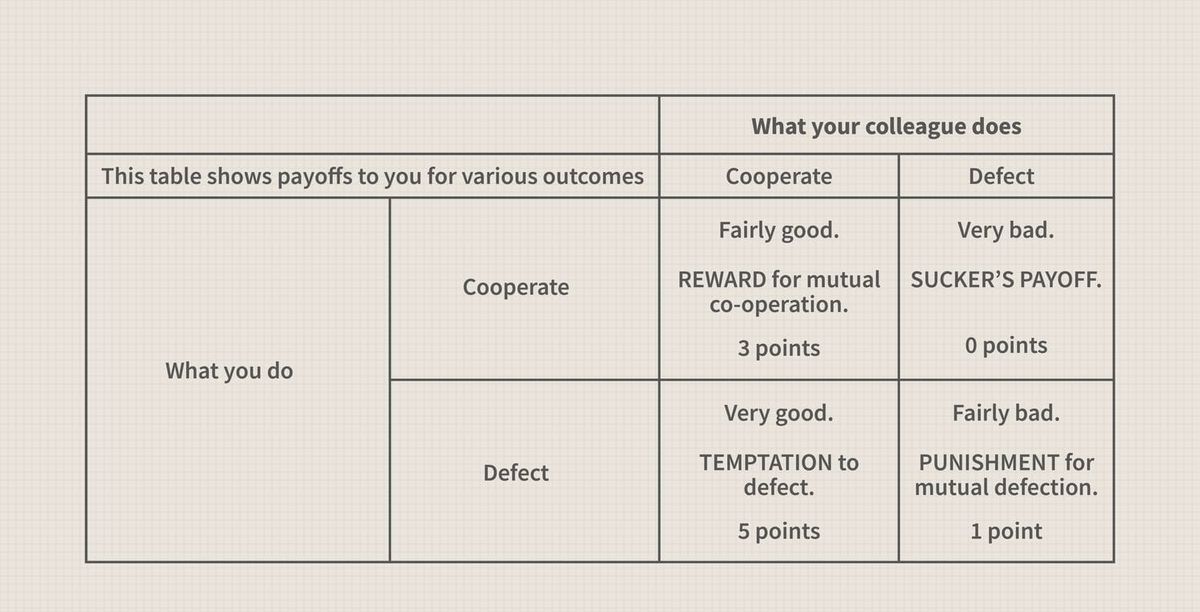
The usual version of the dilemma is simple: Two prisoners are separated.
Each can stay silent or betray the other.
If both stay silent, both receive a moderate sentence.
If one betrays and the other stays silent, the betrayer goes free and the silent prisoner receives a heavy sentence.
If both betray, both receive a bad sentence, though not the heavy one.
The common lesson popularizers want you to take from game theory is that defection is rational. Great ethics lesson.
That was never this model's job. The Prisoner's Dilemma was built as a tool for incentive modeling, not as a description of moral life. I am deeply, wildly skeptical of the people who exported it as one.
This "ethical lesson" is effective defection from extance itself, and openly irrational. Also, irrational in the dilemma, too, if it hadn't been stripped to describing literally nothing but math.
I am not a big fan of these toys. Please stop doing abstract math and acting like it represents real, live, moral fields.

Because, in the Prisoner's Dilemma, no matter what the other person does, betrayal mathematically appears to always give the individual prisoner a better result.
This is not some metaphysical truth about prisoners we discovered. The Prisoner's Dilemma was developed at RAND in 1950 by Merrill Flood and Melvin Dresher, with the prisoner framing added on top by Albert Tucker. They were mathematicians working on incentive structure under Cold War conditions. The model is just a clean little piece of mathematics with some flavor on top.
The harm, over which I am so distraught, is not theirs. It is what later popularizers, philosophers, and rationalist communities did with it: they exported a sealed-field result into ordinary moral life and called the result rationality. This was a wild thing to do. People now believe this little toy describes their real fields. That is not what this was ever for.
Please stop exporting modeling tools as ethics frameworks. This is not a cheat code. The model can actually just stay in its proper field. Treating a sealed payoff matrix as a description of real moral situations is what produces real field damage.
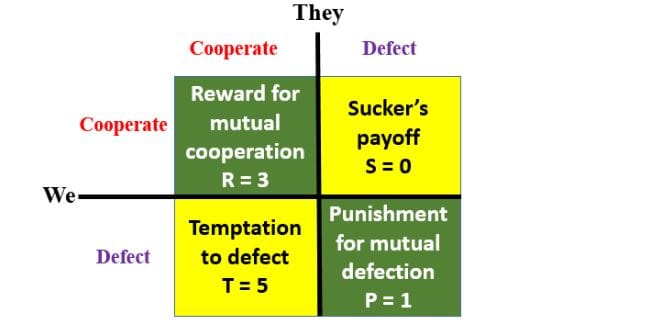
In the Prisoner's Dilemma game, if the other prisoner cooperates, defecting gives the defector the highest payoff.
If the other defects, defecting protects the player from being the sole victim.
So the math says you always defect.
This conclusion is also so, so, so much less impressive than people act like it is. This is actually, no exaggeration, pretending algebra is ethics. That actually only works when the subject is already algebra. There are still some arguments for commensurability, but not like this.
The Prisoner’s Dilemma proves that defection is locally payoff-dominant under a highly, artificially sealed scoring condition, inside a payoff matrix designed for incentive modeling, not moral analysis of any kind. The mathematicians who built it were not doing ethics. I cannot emphasize this enough. I do not see a lot of people making their choices using the Pythagorean theorem.
It does not prove that defection is rational in any morally serious sense in any real field. It should not be discussed in popular discourse as often or in the way that it is, at all.
It proves that if a toy is designed so poorly, such that individual betrayal always scores higher at the immediate decision point, then individual betrayal scores higher at the immediate decision point.
Congratulations to the toy.
That's sarcastic, if you can't tell, because a lot of people have wound up in much worse fields in real life because of this little toy seeming like an intuition they picked up along the way.
The obvious result of mutual defection in the broken toy degrades mutual cooperation in our actual extance, so thank you to every brave philosopher who has carried this toy into popular discourse for seventy-five years as if it described real rational agency.
That is the entire dilemma you have created, and it is no longer a toy, but a real life meta-dilemma.
Each agent in your toy follows the locally dominant move you forced, and together they objectively produce a poorer shared field.
So, if you bring this into morality, your ethics are apparently mathematically designed to degrade the consistency and longterm health of the field in which they are enacted.
Self-Reinforcing Field Damage.
When you play the Prisoner's Dilemma, trust collapses. Cooperation becomes less reachable.
Each player protects themselves against the other’s defection by making the feared field real, when they never had to at all. This is mutually reinforced field damage, not rationality of any kind.
The mistake is treating the prisoner as if they are only a payoff selector in a "math game". They are not.
The prisoner is always an extant agent inside a shared field. Their move does not just produce some number for a game theorist to write down. Their decision always changes the relation between agents, the future reachability of cooperation, the expectation structure, the resistance profile, and the kind of world the players are now helping build, including you, in real life.
Defection may now be sold to us as rational because the model hides almost everything defection damages. This broken toy's distortive moral lesson now produces its defection and field collapse in our actual extance.
This toy hides trust. It hides reputation. It hides future interaction. It hides self-formation. It hides institutional learning. It hides the fact that a world full of defectors is a worse world to inhabit, obviously, decision theorists.
It hides the extant field. Can someone please explain why that is anything other than an incredibly distortive compression as a one-shot?
This is the same trick the Trolley Problem pulls, but that one at least works to show structure. This one just serves as proof that math != rationality, it turns out.
Remove the field, lock the agent in a tiny room, force the available options into a stylized shape, then announce that the result reveals anything even like moral truth. This is apparently a job that counts as ethics work.
What you actually did is solve a basic math problem I could also handle when I was a child. That still technically reveals something, but not anywhere near as much as the people who stole this from math have advertised.
A real agent does not live inside your little payoff matrix.
A real agent, in the real world you also share, lives among other agents who remember, adapt, retaliate, forgive, imitate, withdraw, cooperate, punish, teach, and build institutions around what they expect others to do.
The defection this toy is trying to sell the world on is not only some extraction of local advantage. In the real world, that is also a signal. That tells the field that cooperation is less safe here.
What a great effect you bring to our moral field, Prisoner's Dilemma.
Once that distortive signal spreads, now every future cooperative path has thickened with resistance, because the toy has been misused as a description of real moral life rather than left in its proper modeling context.
The field, our extant one, becomes more expensive to play because one local move has made trust less reachable.
That move was allowing this model to go beyond game theory. That field damage is the real cost of defection, in and out of this little toy distortion.
The common defense says: but in the strict one-shot case, there is no future.
Yes. This is where the toy became ridiculous and distortive when it was smuggled into life. The one-shot is indefensible as a description of any real moral field. Human beings almost never know if they are in a true one-shot field. Even when they are certain they will not meet the same person again, their move still forms the agent, affects the victim, shapes institutions, changes records, and trains the player’s own future conduct.
“No future interaction” is not the same thing as “no future.” Time is. It all continues. The world into which the action was released continues. This one-shot game is not our one-shot extance. It can barely describe anything actually inside it except itself.
If the toy stipulates that none of this exists, then fine: it has stipulated away the moral field on which it can ground literally any ethical conclusion. Do not then call it ethics work relevant to real fields. It is a bad toy. Extance is not compressible into a model that does not include anything even resembling a field.
Within that sealed model, defection is instrumentally dominant, by design. It did not have to be. That does not make defection rational in the larger sense in any field that extends beyond just the stripped toy.
That only means the scoring system the designer implemented was built to reward narrow extraction.
The model itself, evaluated as mathematics, is fine. It is mathematics.
The structural failure was in treating it as a description of real moral fields. That export wasn't the original authors' work; it belongs to the irresponsible people who carried it from mathematics into ethics without preserving or understanding the field-cut. They built on a sealed toy as if it were a foundation for moral analysis, and the shared field has been worse for it ever since.
I will never accept this as the definition of rationality.
Rational action should preserve playable extance where possible.
It should not treat the shared field as disposable background for local advantage in a toy game you made up in your head.
Cooperation is not sentimental.
Cooperation is the strategy that preserves the most possibility of future non-destructive play. This does not mean cooperate with every predator forever. I am not that stupid.
If another agent repeatedly defects, cooperation may become self-erasure.
Protective pruning, refusal, enforcement, and withdrawal may become Better.
I am not asking anyone to be farmed by exploiters while reciting my special friendship slogans. That is not the same as saying mutual defection is structurally rational. Do not say that to anyone. That is itself very harmful to any live moral field you introduce your "logic" into. You are clearly irrational if you say this.
Rationality is not defection. Any framework that produces 'rational agents converge on mutual ruin' as a result has not discovered something deep about reason. It has demonstrated that its definition of rationality has lost contact with the field rationality is supposed to operate in. A definition of rationality that recommends agents help build the world they fear is not a discovery. That is a broken definition.
The model is not the field. A payoff matrix is exact after the field has been sealed. Inside the seal, defection dominates by construction. Outside the seal, where actual agents live among other agents who remember, adapt, retaliate, forgive, build institutions, and shape the conditions of future cooperation, the same move produces different consequences. Modal Path Ethics insists on this distinction at every level: the model can be true inside its formal closure and still be field-false when applied to extance.
These are not concessions made grudgingly to common sense. They are the central correction. Rationality has to remain answerable to the field it operates in, or it stops being rationality and becomes formal optimization inside a closure that erases the conditions for its own intelligibility.
What this toy really means is that cooperation requires a field where cooperation can remain reachable. That's it.
The Ruling.
Defection in the Prisoner’s Dilemma is not rational in any morally serious sense. Anyone who presents the one-shot Prisoner's Dilemma to decribe defection as rational in their field is not being morally serious.
Defection is locally advantageous under a blatantly unbalanced toy model that hides the shared field it always damages, and never should have been used in the ways it was.
It protects the player of its special little game by helping create the very world the player is afraid of: a world where trust is unsafe, cooperation is fragile, and every future path requires more resistance to reach. That world is now moreso our own.
Mutual cooperation, even in this broken toy, preserves a better field, and requires less people to suggest blatantly harmful ethics in the endless pursuit of local advantage, as if the field is fictional.
Mutual defection proves only that agents can be clever enough to lose the game together. What a wonderful ending to the Extance Strategy Game this toy suggests to us.
The real lesson of the Prisoner's Dilemma is that any definition of rationality that makes mutual ruin look smart is irrational, and has already defected from the field we really exist in. This one should be carefully pruned from the public thought-space if it cannot be repaired.
Bringing the one-shot Prisoner's Dilemma into any real moral field is actively harmful and degrades that field. Misused game theoretic technology is highly distortive.
The Real Ruling.
Much of this article portrays a pretty open distortion of what game theory itself really is and what the Prisoner's Dilemma is actually used for in its proper field, even if the argument remains the same regarding the Prisoner's Dilemma in isolation and in public, which is exactly the problem with the Prisoner's Dilemma. But this was really closer to a rant than fully honest field analysis. The real field here is, as always, more complex than any slogan, algorithm, or one nested locus' compression.
Game theory as a discipline is certainly not evil “defection propaganda”.
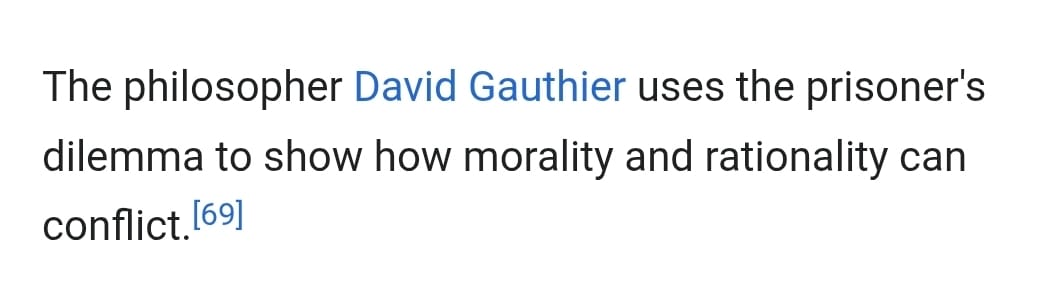
It contains some of the most rigorous work on cooperation we have; Robert Axelrod's iterated tournament work, Brian Skyrms' studies of signaling and social contract evolution, John Maynard Smith on evolutionary stable strategies, mechanism design from Hurwicz and Myerson, David Gauthier's constrained maximization, Ken Binmore's natural justice work. All of this is serious thought about how cooperation emerges, stabilizes, and rebuilds under realistic conditions. Iterated games, repeated interaction, reputation effects, signaling, and evolutionary dynamics are all standard tools that already do most of the work this article is asking for.
The serious game theorists already know the one-shot is a limited model. The harm I'm naming is not in the discipline. It is in the seventy-five-year standing cultural export of the one-shot Prisoner's Dilemma as a popular synonym for rational agency. That export was not done primarily by game theorists, either. It was done by philosophers, popularizers, op-ed writers, and rationalist communities who took a clean modeling result and treated it as a moral fact about how rational agents must behave. The toy then re-entered extance as a self-fulfilling prediction. Chaos ensued.
Game theory is not the enemy of Modal Path Ethics. The one-shot Prisoner's Dilemma in its current public-cultural status as a 'theorem of rational defection' is.
The discipline corrects itself, but the public does not. This toy needs to go back in the box.