Thought Gauntlet I: The Trolley Problem
No real locus is ever sealed.
Welcome to the Thought Gauntlet, where I use Modal Path Ethics to tackle the most famous and challenging moral dilemmas and thought experiments in Boss Rush format, in under 24 hours.
Mastery in the Extance Strategy Game is not memorizing the “right answer” to famous dilemmas, but about learning to see the board.
Each case is a hostile position: a trap built from counting, intention, suffering, consent, identity, uncertainty, purity, sacrifice, or imagined future value.
Modal Path Ethics will attempt to win the encounter without falling victim to the trap or breaking its own framework, by identifying the loci, the reachable futures, the burdens transferred, the paths closed, the repair conditions preserved or destroyed, and the difference between Good, Better, and order.
The Thought Gauntlet is intended to be an exercise in training: repeated pressure until field analysis becomes playable instinct. The form was lifted from the Boss Rush in videogames, typically engaged in as a practice in mastery over mechanics.
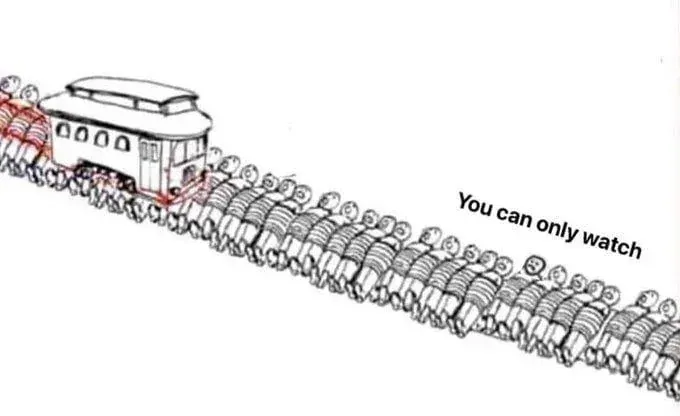
The Trolley Problem is a famous ethics toy and also a meme.
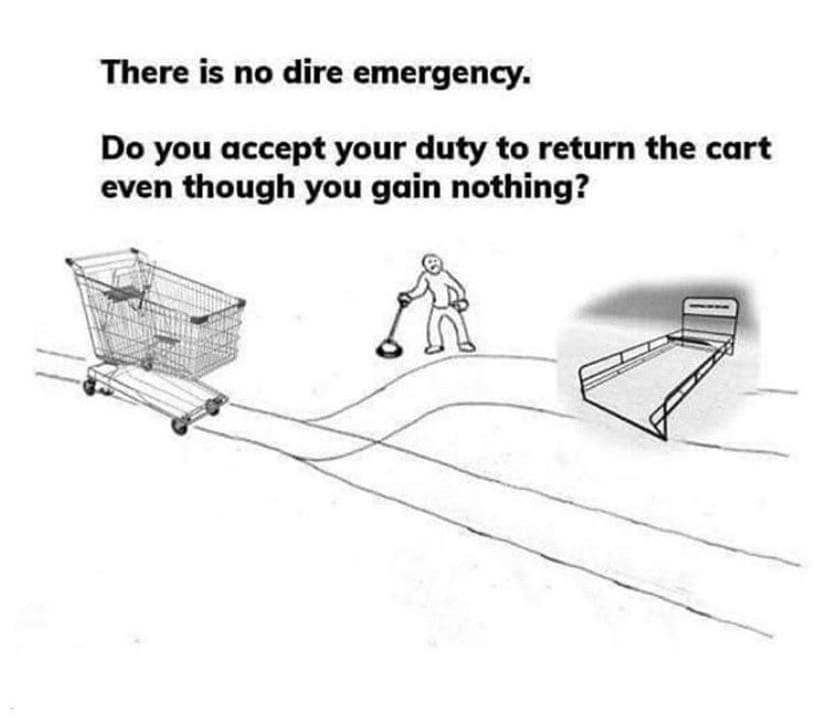
A trolley is moving down a track toward five people. If nothing changes, it will hit and kill them. You are standing by a lever. If you pull the lever, the trolley will switch tracks and kill one person instead.
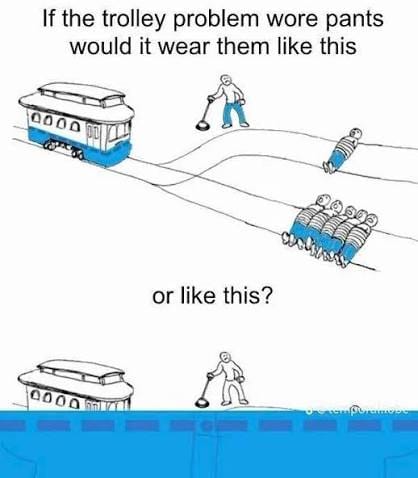
Do you pull the lever?
This is the usual setup. I'm not a fan.
There are many variations. In one, you push a large man off a bridge to stop the trolley. In another, a surgeon kills one healthy patient to harvest organs for five dying patients. In another, the people on the tracks are friends, strangers, criminals, children, workers, trespassers, or whatever soyjak the person designing the toy wants.
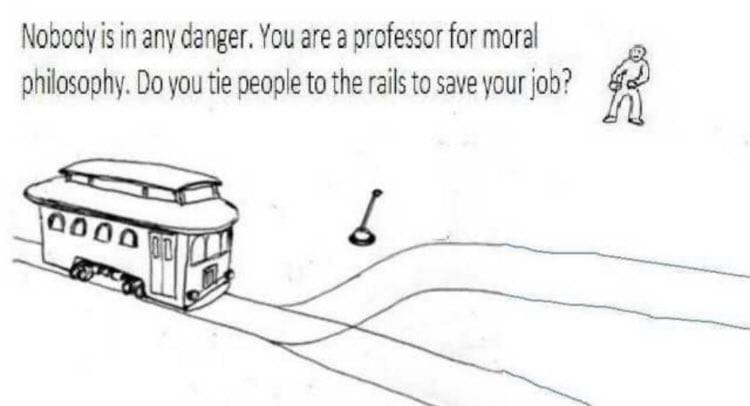
The point of the Trolley Problem is supposed to be that our moral intuitions shift depending on how the harm is framed.
Many people think it is permissible, or even morally required, to pull the lever and redirect the trolley from five people to one. Fewer people think it is permissible to push a person into the trolley’s path, even if the same body stops the trolley and saves the same five. Fewer still think the surgeon should murder one patient for organs.
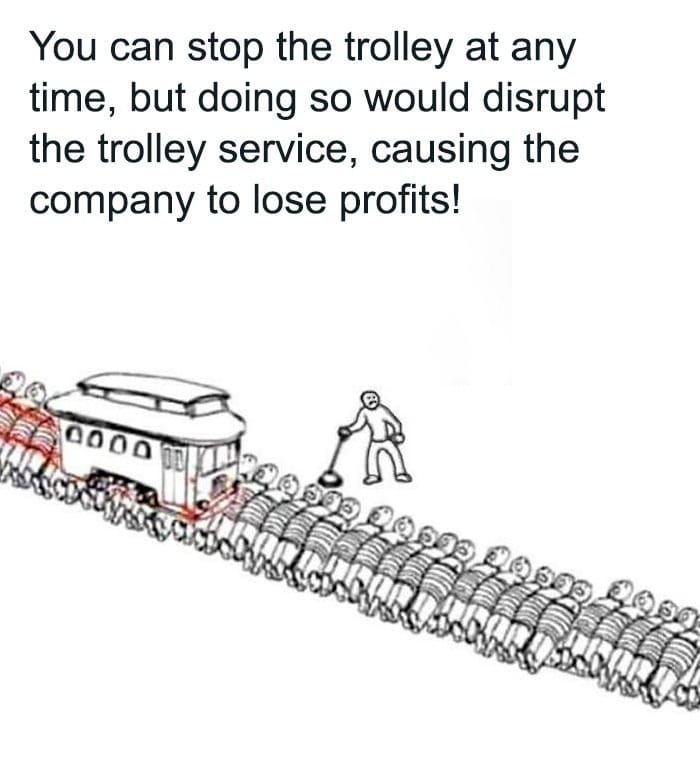
So this has made the Trolley Problem useful as a machine for producing structural distinctions: killing versus letting die, action versus omission, intention versus side effect, using someone as a means, direct versus indirect harm, and so on.
That is the charitable half, and why the toy remains useful, even to Modal Path Ethics as an example.
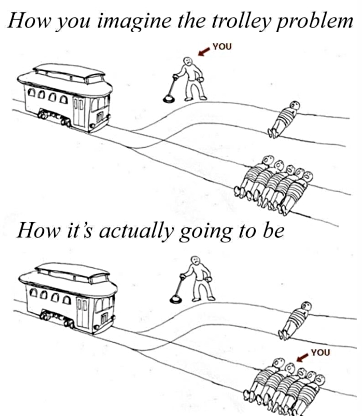
The less charitable half is that the Trolley Problem is famous, and stupid, because it deletes nearly everything ethics actually needs and then congratulates itself for producing a clean-looking dilemma to play with.
Modal Path Ethics can answer the stripped version very easily. That is not the problem I have. The problem is that the stripped version is barely a description of any real moral field.
In the most stripped down case, if all else is declared equal, if the five and the one are equally situated, there are no hidden repair paths, no relevant institutional consequences, no way to stop the trolley, no prior obligations, no information asymmetries, no altered future trust, no question of consent, no later precedent, no damage to the wider field, and no available intervention except the lever, then pulling the lever is clearly Better. Still not Good!
One death remains a real closure. It does not become morally clean at all because five deaths were avoided. The one person is not converted into a discount coupon we trade in for the five. Their future is still closed. Their locus is still destroyed. That harm still remains in the field.
But the choice is made inside a field where every available path already contains irreversible death. The trolley will kill five if the agent does nothing. It will kill one if the agent redirects it. In the toy’s own stripped terms, pulling the lever closes less weighted future-space than refusing to pull it.
That answer is not difficult to reach, because the toy destroyed the entire field in order to achieve its clarity.
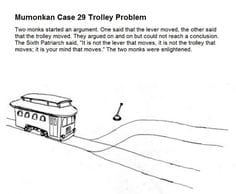
The Trolley Problem has us pretend that morality becomes pure when all context is removed. Modal Path Ethics says the precise opposite. Context is not decorative at all in the real world, context is actually where the moral reality lives.
So who tied these people to the tracks?
Why is the trolley uncontrolled?
What system has built a switch that transfers death rather than stopping the death machine?
Does the agent have authority over the lever?
Is the one person already in danger, or newly placed in danger by the agent?
Are there emergency brakes?
Are warnings possible?
Are the victims equally vulnerable?
Does pulling the lever create a practice or precedent?
Will later institutions use this logic to normalize spending exposed train-track-tied minorities for majority benefit?
Is this a one-time accident, or the visible material edge of a broken infrastructure field?
What happens after this?
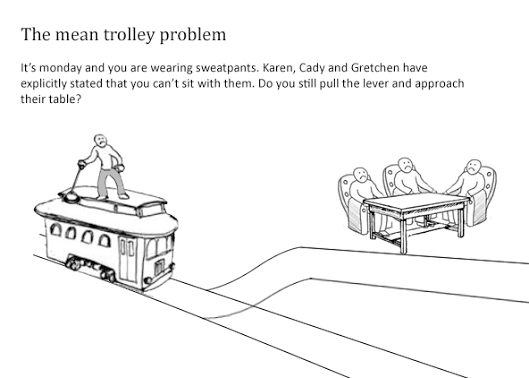
The toy removes these questions because it wants to provide the player with a clean intuition. Ethics is field analysis, which is the opposite.
The core problem with the Trolley Problem is that it treats the moral event as a single local selection between numerical outcomes. Five here. One there. Pull or do not pull. This makes it look as if the only relevant moral question is whether one may cause one death to prevent five deaths.
Except that is not how real harm works.
Real human-level harm always occurs inside fields of preparation, negligence, design, power, responsibility, warning, repair, trust, coercion, exposure, and future consequence. A real trolley case would not ever begin at the lever. It would begin long before: with the track system, the safety failures, the labor conditions, the institutional warnings, the possibility of braking, the history of prior incidents, the design of the switch, the presence or absence of emergency procedures, and the reasons human beings are inexplicably tied to tracks in the first place.
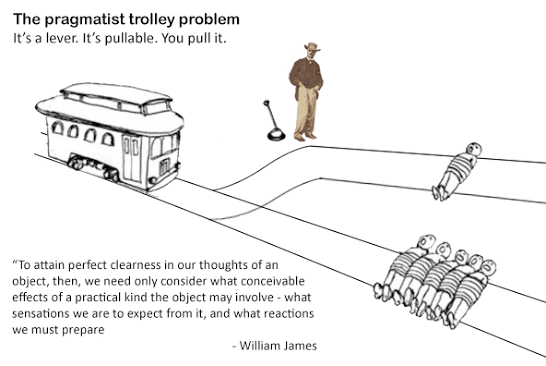
This is why the toy is so misleading. It invites us to treat the final emergency as if it were the whole case in sum. That trains moral attention toward the moment of visible choice and away from the structures that made only terrible choices reachable.
This is a late field problem disguised as being something primitive to structure.
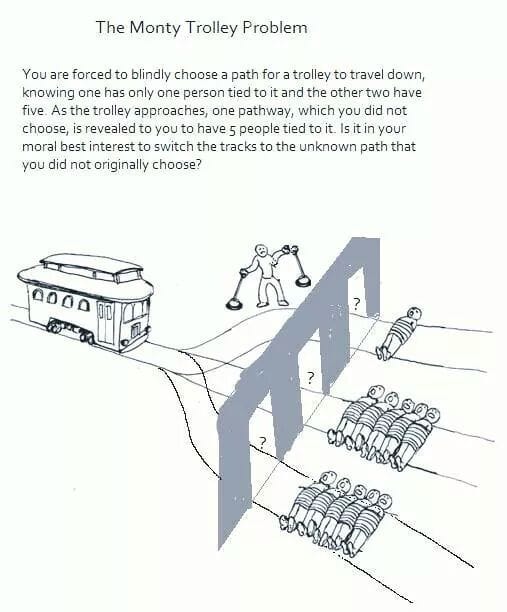
By the time the agent reaches the lever, the good paths have already been closed in advance. The question is no longer how to preserve all futures. That option has been intentionally removed. The question remaining in the field is which remaining path closes less.
The Trolley Problem then becomes actively dangerous when people use its stripped arithmetic as a moral solvent, or evidence of structure.
One for five.
Few for many.
Local death for larger gain.
A little innocent blood for the greater good.
This is how a toy becomes a license if it is carried out of the toy-field without the field constraints that made the answer possible. The basic lever case only works because the field has been artificially sealed. Nothing else changes. No trust is damaged. No institution learns the wrong lesson from the trolley problem. No future vulnerable group now becomes easier to sacrifice. No one starts designing systems around the convenience of redirectable trolley victims.
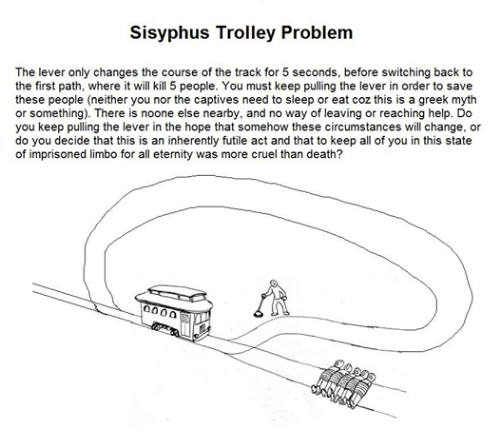
No real locus is ever sealed.
The Trolley Problem represents the moral collapse Modal Path Ethics is written against.