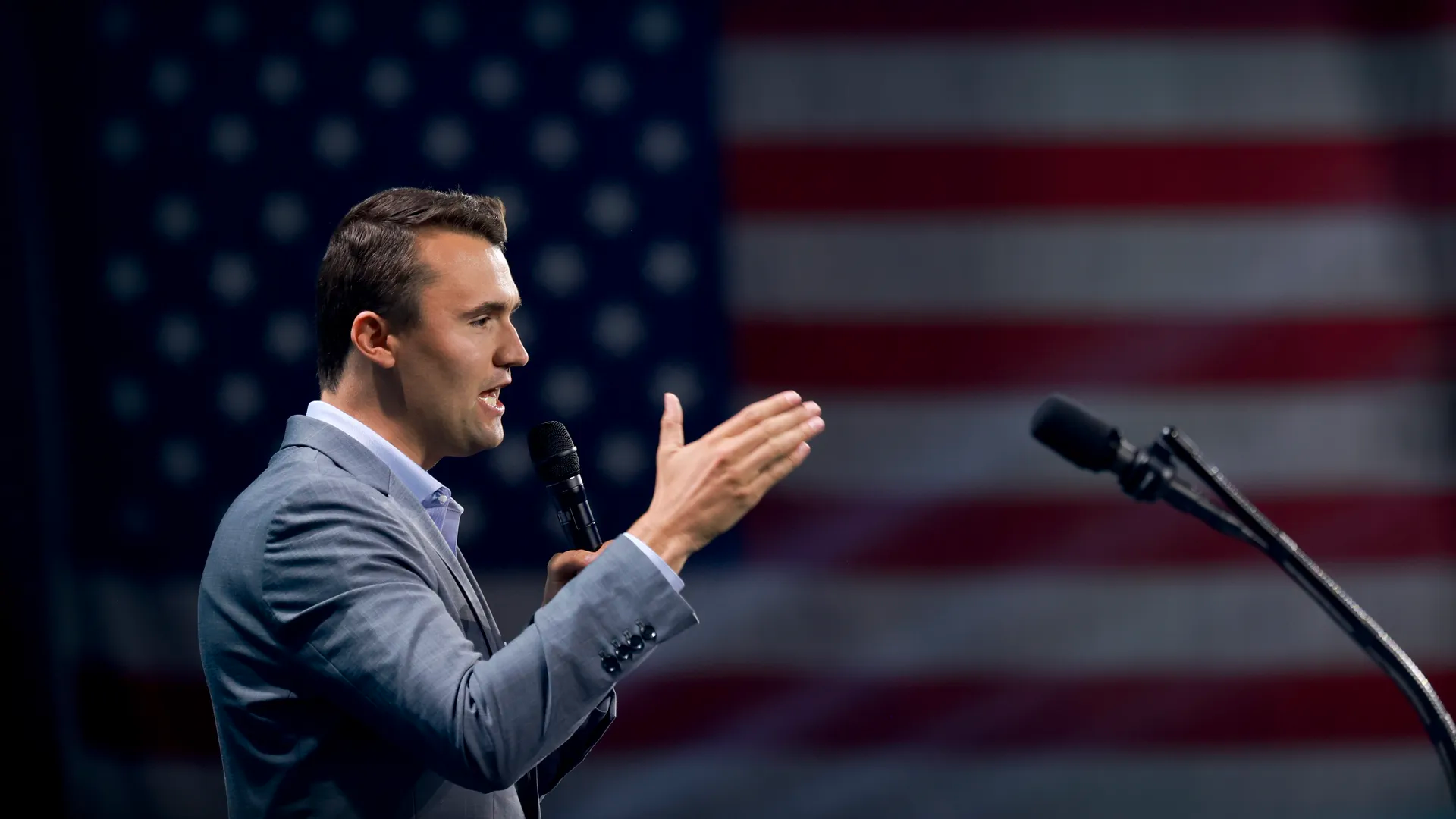
Applied Case: The Assassination of Charlie Kirk
The debate tent, the founder-body, and the American enemy business.
A person should be able to finish an answer.
This answer does not need to be good.
It can be wrong, cruel, inflammatory, cynical, manipulative, glib, self-serving, historically illiterate, morally ugly, or exactly the kind of confident political sentence that makes three thousand people lift their phones at once and squint.
The person should still be able to finish it.
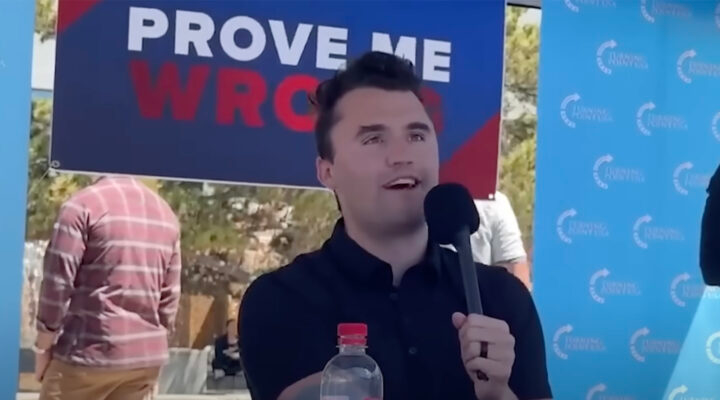
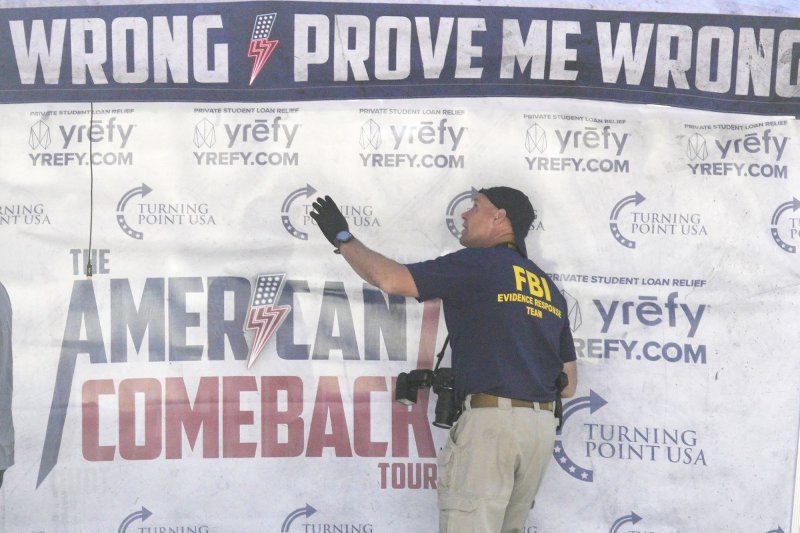
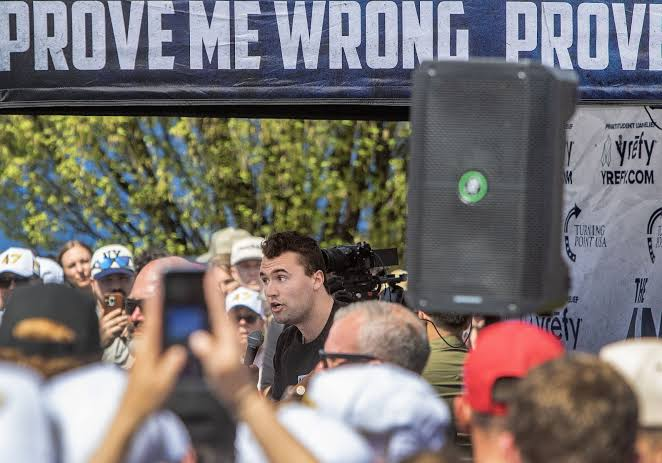
On September 10, 2025, Charlie Kirk sat beneath a white canopy at Utah Valley University in Orem, Utah. A banner behind him announced the familiar invitation:
PROVE ME WRONG
Students gathered on three sides. A microphone had been placed in front of the crowd so questioners could approach. The event belonged to Turning Point USA’s planned national campus tour. Kirk was doing the thing his organization had built him to do: sit in public, receive an opponent, answer quickly, turn disagreement into spectacle, turn spectacle into content, and turn content into a political institution.
The machinery was fully present.
- The stage.
- The cameras.
- The campus chapter.
- The staff.
- The crowd.
- The security detail.
- The donor-backed organization behind the event.
- The people who came to agree.
- The people who came to challenge him.
- The people who came because a public argument is one of the few remaining American rituals where a stranger can still walk toward power holding a microphone instead of a credential.
At approximately 12:23 p.m., while Kirk was answering a question, a rifle shot entered the event from a rooftop roughly 160 yards away.
The answer ended.
Charlie Kirk died at thirty-one.
His wife lost her husband. His children lost their father. His parents lost their son.
His colleagues lost the person around whom much of their work had been organized. His followers lost a political teacher, a movement founder, a media figure, a friend they often knew through a screen, and a voice that had helped tell them what America was doing to them.
His opponents lost something too, whether they wanted to admit it or not.
- They lost a living adversary.
That loss matters because the living adversary can answer back. He can revise, refuse, embarrass himself, surprise the audience, become worse, become better, reveal the limit of his own instrument, or survive long enough for history to catch him standing somewhere his earlier certainty no longer fits.
A dead adversary cannot do any of this.
A dead adversary does not disappear.
A dead adversary becomes available.
- Available to grief.
- Available to hatred.
- Available to sainthood.
- Available to mockery.
- Available to fundraising.
- Available to institutional succession.
- Available to revenge.
- Available to every person who needs the murder to prove that the political world is exactly as terminal as they already believed.
A living person is difficult.
A dead symbol has excellent message discipline.
This case therefore begins with two sentences.
- Charlie Kirk was assassinated at Utah Valley University.
- Charlie Kirk was assassinated inside the American enemy business.
- The first sentence names the death surface.
- The second names the field that arrived there.
- The first belongs to the criminal case.
- The second opens the America / Business track.
The Tent.
The tent was temporary.
That is one of the most American things about it.
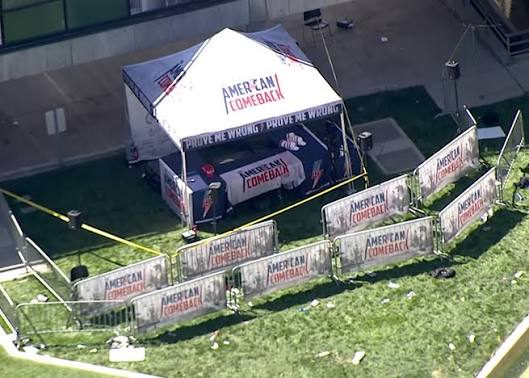
A portable canopy, folding table, microphone, flags, barricades, cameras, staff, and an audience can turn a patch of campus lawn into a national political room before lunch. By evening the whole room can be packed into cases and driven somewhere else.
 Aidan Lawson
The structure is cheap enough to move and important enough to kill over.
Turning Point USA understood this format. Charlie Kirk understood it better.
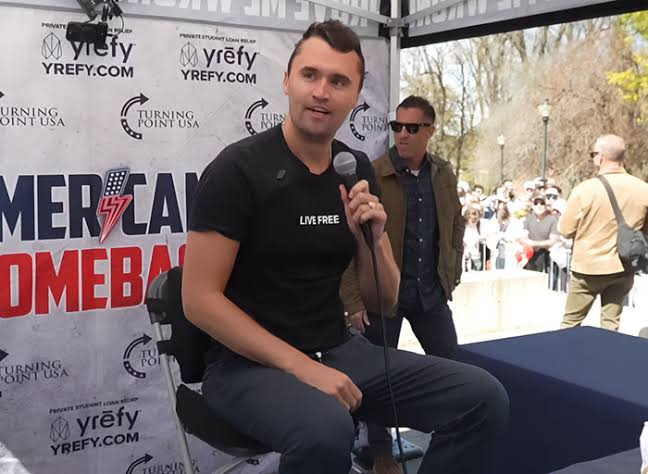
A television studio seals politics behind booking decisions, producers, commercial breaks, professional interlocutors, security desks, green rooms, and the thick glass of celebrity.
The campus tent makes a different promise:
Come here. Stand in line. Just ask the person yourself.
This promise was never perfectly equal.
Kirk controlled the event architecture. He had the microphone, the platform, the staff, the accumulated practice, the clips, the audience, the rapid-response habits, and the institutional authority to decide what counted as a successful exchange. A student walking toward him entered a room already optimized around Charlie Kirk being Charlie Kirk.
That asymmetry is real.
But so is the contact.
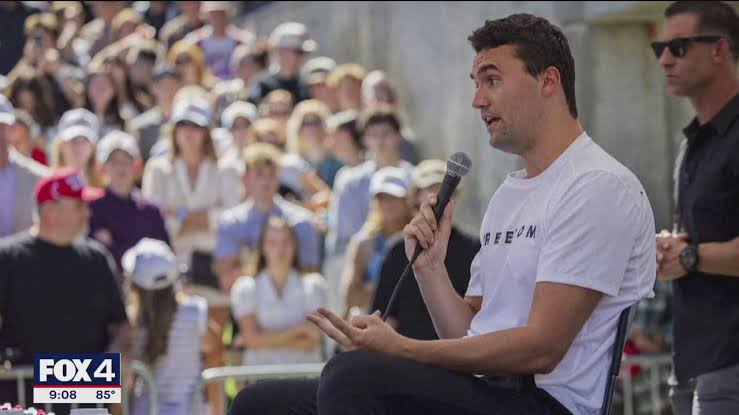
The challenger did not need to obtain a television booking. The challenger did not need to become a professional surrogate, a party official, a columnist, or one of the approved representatives of a demographic category.
The challenger could just walk up and speak.
That is worth defending.
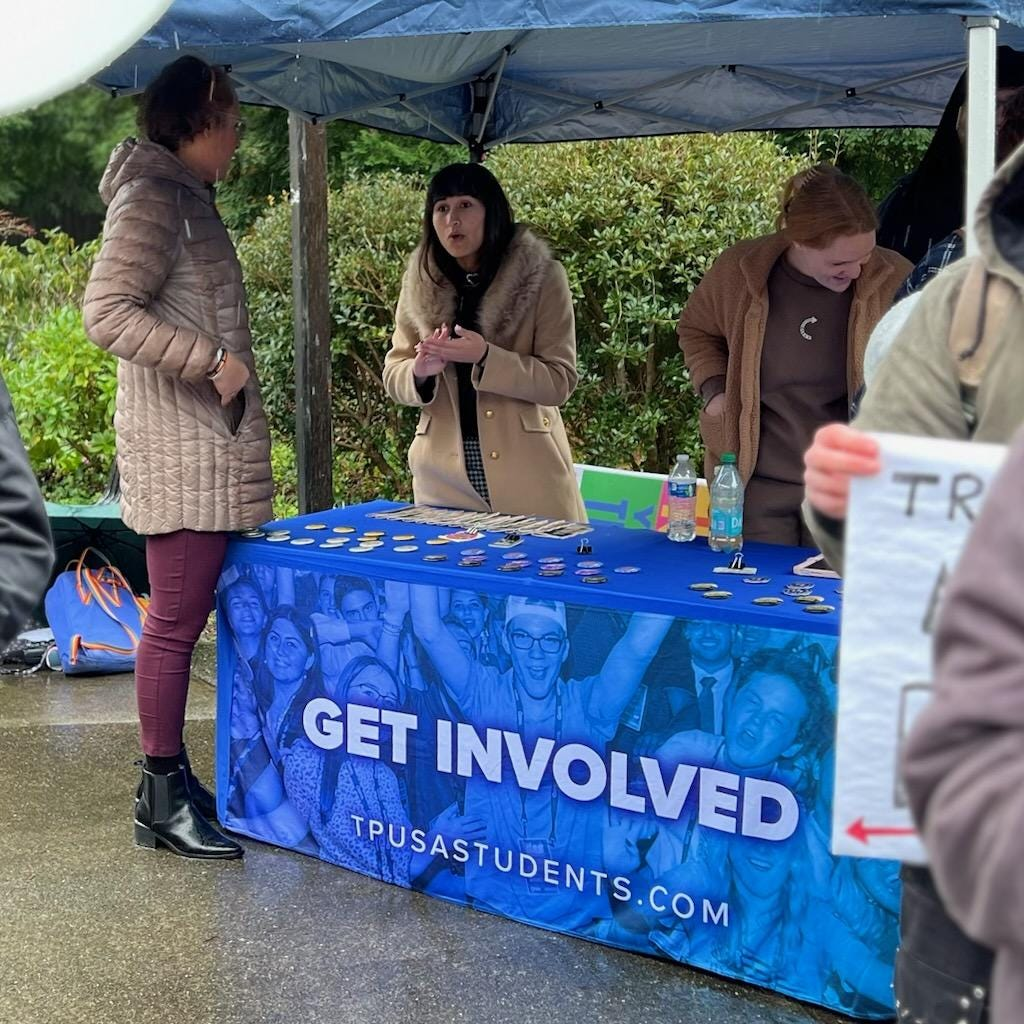
Modal Path Ethics has spent enough time around sealed institutions to recognize the value of a door, even when the room behind it has very bad acoustics and a man inside who has practiced his answer more than you have practiced your life.
Kirk’s debate format sometimes reduced complicated questions into rapid victory objects. It rewarded the clean rebuttal, the crowd reaction, the shareable humiliation, the little turn where one person realizes the conversation has already become tomorrow’s thumbnail.
 Aidan Lawson
Yet the tent still preserved a political relation that the American field keeps losing:
- an opponent remained physically reachable;
- the disagreement occurred in shared time;
- the speaker’s body remained answerable to the room;
- the audience could detect hesitation, confidence, cruelty, humor, evasion, and surprise without waiting for a platform to summarize them;
- the challenger could address the actual person whose claims had entered their world.
A person should be able to enter that relation without becoming a target.
A person should also be able to host that relation without becoming one.
The assassination violated both sides of the tent.
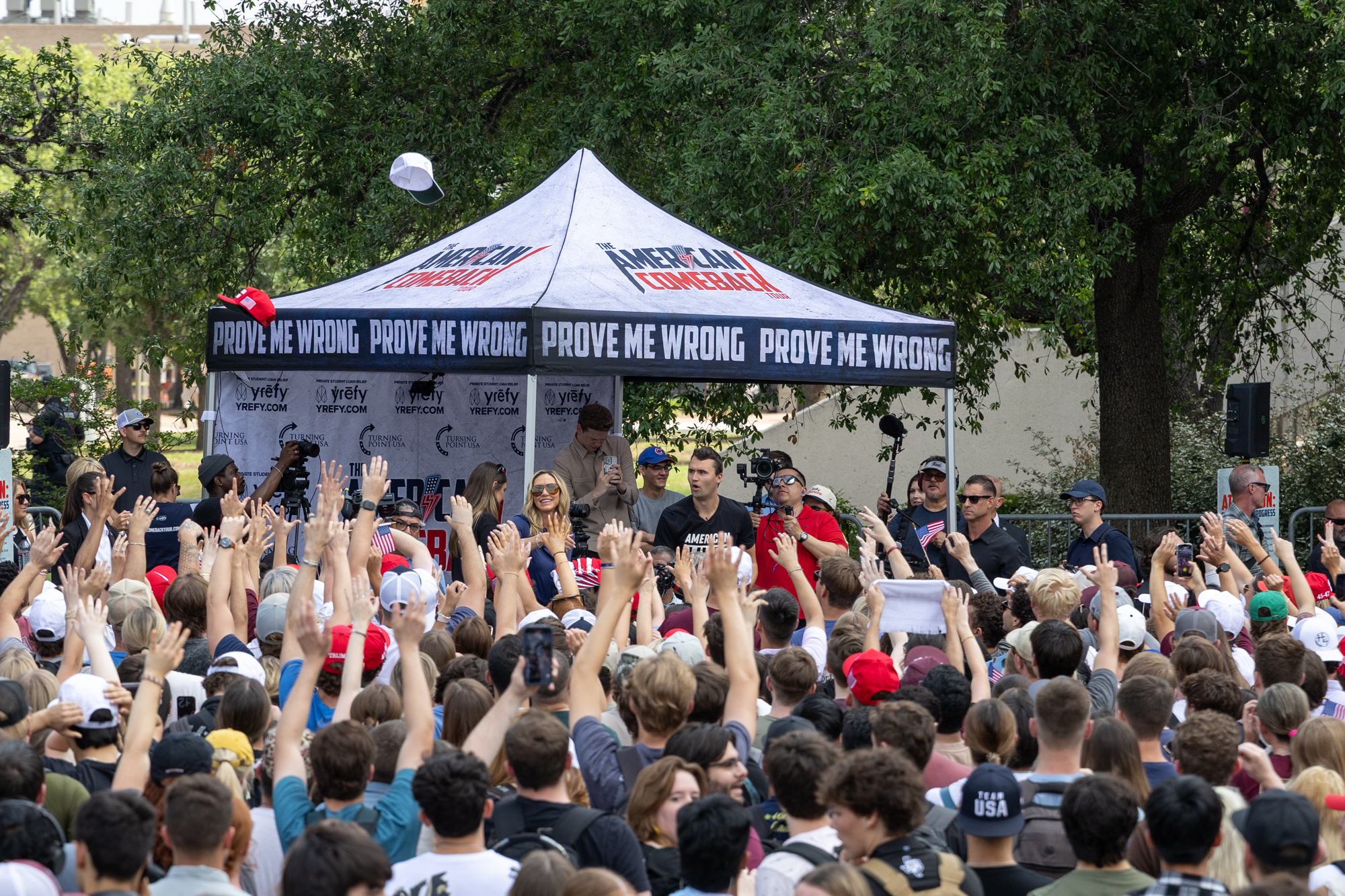
It killed Kirk. It also changed what every later organizer, speaker, student, campus employee, security officer, and university administrator would believe an open political event could safely be.
The bullet did not stop at the body.
It entered the architecture of contact.
The Roofline.
Outdoor politics has a pretty serious horizon problem.
The room appears open because it is open.
This is pleasant until someone begins listing what openness means operationally.
- Every roof becomes a possible firing position.
- Every window becomes a sightline.
- Every parking structure becomes an elevated uncertainty.
- Every approach path becomes a question of screening.
- Every person with a bag becomes a negotiation between ordinary dignity and catastrophic possibility.
- Every campus building that makes the event feel public also makes the perimeter harder to finish.
The official charging information describes Kirk beneath the canopy with the Hall of Flags behind him, questioners approaching a microphone, and the crowd arranged around the event. Prosecutors allege that Tyler James Robinson fired from a rooftop approximately 160 yards away. Robinson has been charged with aggravated murder and related offenses. Prosecutors have also alleged that Kirk was selected because of his political expression.
Those are allegations. This case has not reached trial. At the time of publication, a five-day preliminary hearing has concluded, final arguments on whether the case should be bound over for trial are scheduled for September 1, 2026, and Robinson has not entered a plea.
The court must determine the criminal path through evidence.
Modal Path Ethics still has to examine the wider event architecture without pretending architecture is guilt.
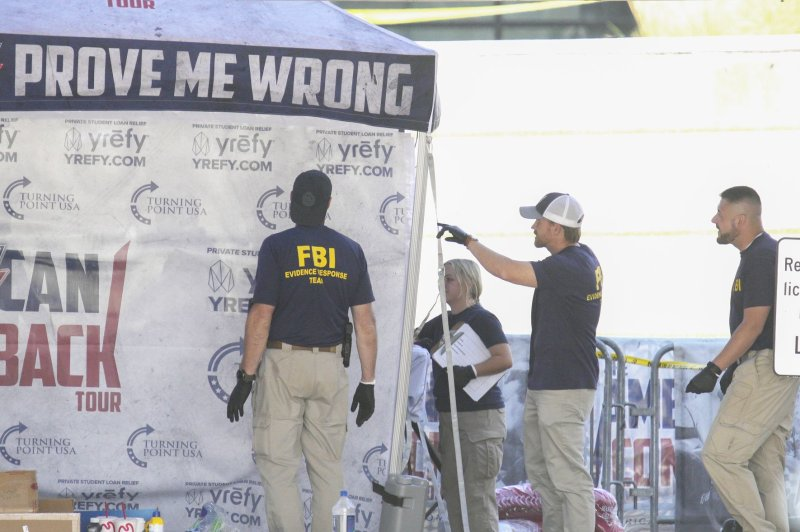
The Associated Press reported that Utah Valley University assigned six campus police officers to the event and that Kirk’s private security detail included about six people. The crowd was reported at roughly three thousand.
Kirk preferred outdoor events because they allowed closer contact with students. That preference made the event more open and made security harder.
This is where hindsight begins producing fake omniscience.
After a public figure is assassinated, every roof becomes obvious. Every staffing decision becomes scandalous. Every missing barrier looks like an open invitation. Everyone suddenly remembers they were an expert in protective intelligence at 12:22 p.m.
The field before the shot was harder.
A university is not a fortress. A political event gains part of its value from being accessible. A security system can lower risk by increasing distance, screening, enclosure, surveillance, credentialing, armed presence, and route control. Each measure also changes what kind of political contact remains reachable.
There is no such clean setting called safe public life.
There are security instruments, each carrying a cost.
- Close the event and the public relation contracts.
- Open the event and the attack surface expands.
- Add visible force and some participants feel protected.
- Add visible force and other participants understand themselves as suspects entering hostile territory.
- Move indoors and the perimeter improves.
- Move indoors and capacity, spontaneity, visibility, and campus accessibility change.
- Put the speaker behind glass and the speaker survives one class of attack.
- Put every political speaker behind glass and the country learns that citizenship now occurs through blast-resistant windows.
Protection can preserve the field.
Protection can also become sovereign over it.
The ethical task is therefore difficult and embarrassingly concrete:
Keep the roofline from owning the tent.
That means competent advance work, sufficient staffing, building and rooftop control, credible threat assessment, emergency medicine, access management, coordination among private and public security, and a willingness to cancel or relocate when specific conditions fail.
It also means refusing the terminal lesson that the assassination appears to teach:
Public political contact was the mistake.
It was not.
The killer exploited contact. The field must repair the exploitation without burying the contact beneath the repair.
Before.
Charlie Kirk founded Turning Point USA when he was eighteen.
That fact should be allowed to remain impressive before the audit begins.
Eighteen-year-olds have many plans. Most of them do not become national institutions with thousands of chapters, major donors, conferences, media operations, electoral influence, a recognizable aesthetic, and enough organizational continuity to survive the founder’s assassination.
Kirk built.
He recruited. He raised money. He learned what conservative donors wanted from a youth organization and what young conservatives wanted from a room that told them they were not alone. He made himself available to radio, podcasts, television, campuses, churches, conventions, candidates, activists, and the little local chapter meeting where national politics becomes a table with name tags and warm bottled water.
He turned political alienation into membership.
That can be good work.
A young person who feels surrounded by hostile assumptions may need a room where their questions do not begin as confessions. A minority political identity inside a campus field can face social pressure even when the national movement behind it is powerful. Turning Point USA offered recognition, friendship, training, practical pathways into politics, and the exhilarating discovery that a person’s awkward grievance may belong to a much larger machine.
That machine was not imaginary.
It had money, staff, structure, and consequence.
The Associated Press reported that Turning Point USA and Turning Point Action raised nearly $100 million in 2024, while a related endowment held $60.9 million. The organization said it had about 3,500 campus chapters before Kirk’s death. Its electoral operation played a significant role in youth outreach and turnout during Donald Trump’s 2024 campaign.
This is a business architecture even where the legal entity is nonprofit and the stated purpose is political.
Business here means organized continuity through:
- capital;
- labor;
- executive authority;
- audience acquisition;
- media distribution;
- donor relations;
- events;
- brand identity;
- data;
- recruitment;
- performance measurement;
- succession;
- and the conversion of attention into repeatable action.
None of those instruments is automatically corrupt.
They are how an idea gets legs.
Without the business layer, a political intuition remains a conversation, a pamphlet, a group chat, a dinner-table argument, a professor’s office hour, or one person with a folding sign standing near a fountain. Those things can matter. They usually cannot field organizers across a country, train speakers, sustain chapters, produce daily media, coordinate volunteers, influence elections, and keep a national tour moving.
Kirk understood that political ideas do not scale themselves.
They need payroll.
They need calendars.
They need donors who will answer the phone again.
They need hotel contracts, insurance, security, list management, venue negotiations, buses, equipment cases, publishing schedules, sponsorships, legal review, volunteer pipelines, and someone who knows which banner is supposed to be behind the founder at noon in Orem.
The political movement becomes real through many boring instruments.
Then, the instruments begin deciding what politics will be.
The Contact Business.
Charlie Kirk sold access to conflict.
This sentence sounds accusatory because Americans have trained themselves to hear commerce as contamination whenever commerce enters politics openly.
The exact same Americans then consume politics all day through businesses whose revenue depends on political attention.
Let the sentence stand without the accusation.
Kirk built a contact business.
The product was a recurring encounter:
- Charlie Kirk arrives.
- A challenger approaches.
- A disagreement becomes legible.
- The audience selects a winner.
- The clip travels.
- The institution gains attention.
- Attention returns as audience, donor proof, chapter energy, electoral relevance, and the next event.
The official invitation, Prove Me Wrong, contains a genuine offer and a theatrical trap.
- The genuine offer is contact.
- The trap is that the conversation begins inside a prearranged victory grammar.
The challenger does not simply bring a question. The challenger enters a contest whose title has already placed Kirk’s correction at the center. The event does not ask what the field reveals. It asks whether the founder can be defeated in public.
That is excellent content architecture.
It is a weaker epistemology.
A real inquiry may end with both participants partially wrong, the question poorly formed, the audience’s favorite answer unsupported, or the relevant structure too large to fit inside the exchange. Victory grammar compresses these possibilities into a cleaner and more portable object.
- Kirk wins.
- The student wins.
- The clip is devastating.
- The crowd is stunned.
- The left cannot answer this.
- The right has been exposed.
The business prefers those endings because ambiguity has poor retention metrics.
Yet the format still remained more open than the sealed alternative.

This is why the audit cannot take the cheap route and dismiss Kirk as a merchant of outrage who deserved no credit for encounter. Kirk repeatedly put his body in rooms with opponents. The body was protected by status, practice, staff, and the event architecture.
It was still there.
- The body could be challenged.
- The body could be seen.
- The body could be killed.
The same openness carried all three relations.
The Enemy Business.
An enemy business is an institution that produces attention, belonging, money, careers, donor relations, audience continuity, and political identity by keeping an opponent publicly reachable.
The enemy does not have to be invented.
The disagreement can be real.
The opponent may hold dangerous views, control institutions, impose burdens, punish dissent, distort education, threaten rights, or organize a future that would genuinely close paths for the people entering the movement.
The business begins when the opponent becomes necessary to organizational continuity.
A movement needs something to move against.
This gives the enemy a strange position inside the institution.
The enemy is hated as threat and also preserved as resource.
- The professor is proof that the campus is captured.
- The activist is proof that ordinary life is under siege.
- The journalist is proof that the media is coordinated.
- The corporation is proof that capital has chosen a side.
- The student challenger is proof that the argument remains alive.
- The protester outside the event is atmosphere.
- The hostile clip is distribution.
- The attempted cancellation is donor copy.
- The assassination becomes the most powerful proof the movement could ever receive
- and the proof nobody had the right to provide.
This structure appears across American politics.
Conservative media needs the left. Liberal media needs the right. Anti-woke organizations need institutional progressivism. Progressive nonprofits need reactionary power. Fundraising emails need emergency. Influencers need recurring villains. Campaigns need a future terrifying enough to make the donation button feel like a fire alarm.
The enemy business does not require insincerity.
Sincere fear can industrialize perfectly well.
The people involved may believe every warning they issue.
The institution can still become dependent on the warning remaining true.
That dependency changes correction.
- If the enemy becomes less powerful, less coherent, more complicated, unexpectedly reasonable, or unavailable,
- the organization loses one of its continuity instruments.
- If the founder discovers that a favored opponent has a valid point,
- the epistemic update threatens more than one belief.
- It threatens the product relation.
- the epistemic update threatens more than one belief.
This is the same problem Modal Path Ethics found in Field Instruments: Disruption.
 Aidan Lawson
The successful rebel creates an order. The order develops payroll, architecture, donor expectations, market position, and a story about why its original emergency must continue. The disruptor remains emotionally organized as the outsider after becoming a center of power.
Turning Point USA began as a disruption of campus political culture.
Then, the disruption acquired chapters.
- The chapters acquired reporting lines.
- The founder acquired a national stage.
- The stage acquired an enemy supply chain.
- The founder acquired a national stage.
This does not make the institution fake.
It makes the institution dangerous in a more serious way.
Real institutions can become sovereign over the problems that sustain them.
The Watchlist.
Before Americans began calling employers after Kirk’s assassination, Turning Point USA had already built an instrument around professional exposure.
The Professor Watchlist described itself as a project dedicated to documenting professors accused of discriminating against conservative students or advancing leftist propaganda in the classroom.
There is a valid field inside this instrument.
Professors hold power.
 Aidan Lawson
Academic freedom can be abused. Students can face retaliation, ideological gatekeeping, humiliation, grading pressure, exclusion, and the soft professional consequences that arrive when a person learns the room’s politics too late. Universities often protect their own. A public record can help a weak locus make contact with an institution that would rather metabolize the complaint internally.
Then, the list changes the field.
- A classroom dispute becomes a national profile.
- A quotation becomes searchable professional identity.
- A professor becomes an object that strangers can carry into email campaigns, donor pressure, administrative review, social media targeting, threats, and employment consequences.
The watchlist may document a real abuse.
It may also become the abuse’s competitor.
This is where Applied Case: The Golden Rule returns yet again with the patience of a debt collector.
A logical move is logical against you.
 Aidan Lawson
- If public political disagreement can be routed through professional exposure when your side identifies a dangerous speaker,
- the same instrument remains available when the other side identifies yours.
- If employment is a legitimate enforcement channel for political injury,
- the question becomes who can mobilize the channel fastest.
- If a person’s workplace is part of the battlefield,
- every political statement travels with an implied call button.
The watchlist did not cause Kirk’s assassination.
It did help normalize one structure that became central afterward:
Locate the speaker inside a livelihood relation.
The post-assassination purge used the same grammar at much larger scale.
Screenshots.
Names.
Employers.
Tags.
Tips.
Pressure.
Public proof that the target had been converted into a professional event.
The political field already knew how to call Human Resources.
The murder gave it a sacred reason to pick up the phone.
The Shot Enters.
The assassin did not interrupt a private life at random.
The shot entered the public form Charlie Kirk had spent years building.
That fact creates a danger in the analysis.
Some readers will hear any discussion of the event architecture as victim-blaming.
They will think the argument is that Kirk made himself available and therefore caused his death.
- No.
The distinction has to remain exact.
- Kirk built the encounter.
- The killer converted the encounter into targetability.
The stage did not fire the rifle. The campus tour did not choose murder. The audience did not become collective authorization. A public figure’s decision to appear outdoors does not transfer responsibility from the person who intentionally exploits that openness.
At the same time, the killing cannot be understood as though the field were irrelevant.
- The tour announced the address.
- The canopy marked the founder.
- The event concentrated bodies and cameras.
- The debate format kept Kirk seated and visible while another person spoke.
- The open campus created sightlines.
- The organization’s success made the killing nationally legible before the blood had dried.
The accused, if the allegations are proven, used this institution’s own contact geometry to produce the institution’s worst possible content event.
This is not blame. It is a description of the field.
The same distinction controlled Applied Case: The Assassination of Charles Jones.
 Aidan Lawson
- Charles Jones was killed in a hotel parking lot.
- Foolio was killed inside a public retaliation field.
The hotel did not create the field. The birthday trip did not authorize the killing. Music did not pull the trigger. The death surface still arrived through a longer path in which grievance, performance, audience participation, location exposure, names, songs, and retaliatory continuity had made a hotel reachable as the final room.
- The hotel received the feud.
- The tent received the enemy business.
This parallel does not equalize the men, their politics, their institutions, or the immediate causes of their deaths.
It identifies one shared structure:
A public identity can become a route by which the field finds the body.
- Charles Jones’s movement became a targeting surface because a retaliation field had learned to follow names, songs, affiliations, locations, and celebration.
- Charlie Kirk’s public tour became a targeting surface because a national enemy business had learned to concentrate ideological conflict around one founder-body.
In both cases, the final killer retained agency.
In both cases, the field had already arranged the encounter.
In both cases, the court arrived after the larger machine had done its work.
The Court Has Not Arrived Yet.
The criminal case is still forming.
This matters because murder creates an enormous appetite for completed story.
The public wants motive. The movement wants meaning. Opponents want ideological distance. Supporters want the killer to embody the whole enemy field. Media systems want a coherent character to portray before the evidentiary process has finished deciding what can be proven.
Prosecutors allege that Tyler James Robinson selected Charlie Kirk because of Kirk’s political expression. They have charged Robinson with aggravated murder and related offenses and are seeking the death penalty. The defense has challenged aspects of the prosecution’s evidence and the handling of alternative possibilities. The judge has not yet decided whether the case will proceed to trial.
That is the current legal field.
Anything cleaner than this is a story running ahead of the record.
The restraint is especially important here because the enemy business feeds on motive completion.
- If the accused becomes the left,
- the right receives a total enemy.
- If the accused becomes the right,
- the left receives a contradiction weapon.
- If the accused becomes mental illness,
- the political field receives innocence through pathology.
- If the accused becomes pure personal grievance,
- the field receives relief from structural inquiry.
- If every disputed message, inscription, friendship, platform trace, and identity fragment becomes a settled ideological map,
- the criminal case disappears beneath a cultural ownership contest.
A person can have a political motive.
A motive still has to be proven.
An ideology can shape violence.
An ideology is not automatically guilty of every person who carries one of its fragments into a terrible crime.
The court’s task is narrow and necessary.
It must determine whether the accused committed the charged acts and which allegations the evidence can sustain under law.
The larger American task begins wherever the verdict will stop.
A guilty verdict, if one comes, can condemn the killer.
It cannot tell the country how to keep open political contact from becoming assassination geometry.
It cannot decide how a movement should carry a dead founder without giving the dead sovereignty over the living.
It cannot determine when an employer has a legitimate trust concern and when the firm has become a private political court.
It cannot dissolve the enemy business.
The court can sentence the accused.
It cannot dismount the field.
 Aidan Lawson
The Founder-Body.
Charlie Kirk was a person and a piece of institutional infrastructure at once.
The second statement can never be allowed to consume the first.
 Aidan Lawson
That is one of the central dangers of the founder-body.
A founder begins by carrying functions the institution does not yet have.
- The founder raises the money.
- The founder explains the mission.
- The founder recruits the first people.
- The founder knows why the compromises were made.
- The founder recognizes the donors.
- The founder attracts media.
- The founder resolves disputes through personal authority.
- The founder’s habits become process before anyone admits a process exists.
- The founder’s face becomes the cheapest available logo.
As the institution grows, those functions should distribute.
Often, they do not distribute enough.
The founder remains the bridge among money, mission, media, audience, staff, strategy, symbolism, and succession. The institution may have hundreds of employees and thousands of chapters while still carrying a single human bottleneck near the center.
That is the founder-body.
Kirk’s body carried:
- executive authority;
- donor confidence;
- public recognition;
- ideological interpretation;
- media reach;
- movement legitimacy;
- electoral relationships;
- performance continuity;
- and a personal life that belonged to none of those systems.
The assassination struck all of them at once.
This is why the language of brand loss feels obscene and remains structurally relevant. It is why succession planning feels cold and becomes an immediate obligation. It is why a widow can be grieving a husband while a board is also confronting a continuity crisis that may affect thousands of workers, chapters, donors, candidates, events, and members.
- Business has a vocabulary for the second wound.
- The family has the first.
- The fields overlap inside the same death.
Modal Path Ethics refuses to let the institutional wound make the personal wound feel like a poetic detail around the enterprise.
Charlie Kirk did not die as a brand.
He died as a person whose institution had placed enormous functional load on his continued life.
That load did not make his life more valuable than another person’s.
It made his death propagate through more systems.
Succession.
Turning Point USA had a right to continue.
That sentence requires no endorsement of its politics.
Institutions do not lose their right to exist because an assassin hates the founder. Allowing assassination to terminate the organization would reward the killer with a larger closure than the body alone. Staff, members, chapters, donors, audiences, and political participants retained their own paths after Kirk’s death.
The board elected Erika Kirk as chief executive officer and chair.
The decision carried obvious symbolic force and practical risk.

A widow succeeding her murdered husband can preserve trust, donor continuity, emotional coherence, and the sense that the institution will not be stolen during the interval of grief. It can also merge familial mourning, organizational loyalty, political martyrdom, and executive legitimacy into one structure that becomes difficult to question without appearing to attack the dead.
That danger does not make the succession illegitimate.
It means the institution now requires stronger correction instruments.
- The founder can no longer revise the founder myth.
- The successor must govern an institution whose most powerful source of authority is now unavailable to disagreement.
Turning Point USA reported more than 60,000 inquiries from people interested in starting chapters after the assassination. The American Comeback Tour continued. The podcast continued. AmericaFest continued. The organization received the most intense wave of attention in its history at the exact moment its central human instrument was gone.
This is the terrible gift political assassination gives a movement.
- The killer closes the person and opens the symbol.
The movement then has to decide what kind of future the symbol will govern.
- Will Kirk’s death deepen the defense of open political contact?
- Will it justify harder exclusion?
- Will the organization distinguish opponents from enemies?
- Will it protect dissent inside its own coalition?
- Will criticism of Kirk become criticism of the widow, the children, the murdered, the movement, and America all at once?
- Will the founder’s last event become a sacred title over every later decision?
Succession succeeds when the institution can carry the work without requiring the founder to remain sovereign from the grave.
Anything else is institutional embalming.
The Replica Tent.
AmericaFest rebuilt the tent.
Of course it did.
Human beings preserve contact through objects.
A microphone can hold a voice after the voice is gone. A desk can retain the shape of work. A jacket can make absence visible. A room can become a place where grief stops moving long enough to be approached. Religious traditions understand this through relics. Families understand it through closets nobody is ready to empty. Political movements understand it through stages, monuments, photographs, slogans, and the final place where the leader stood.
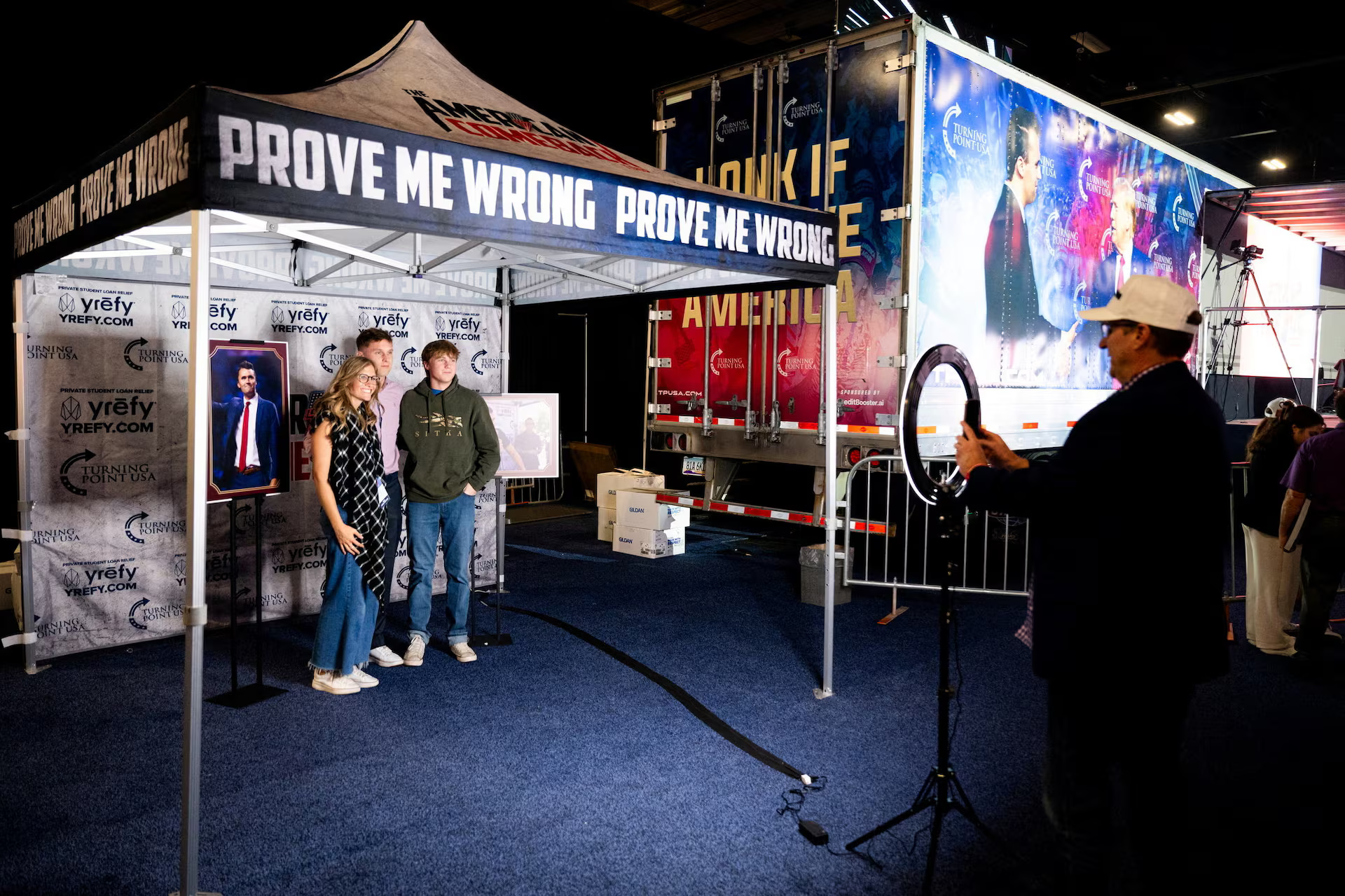
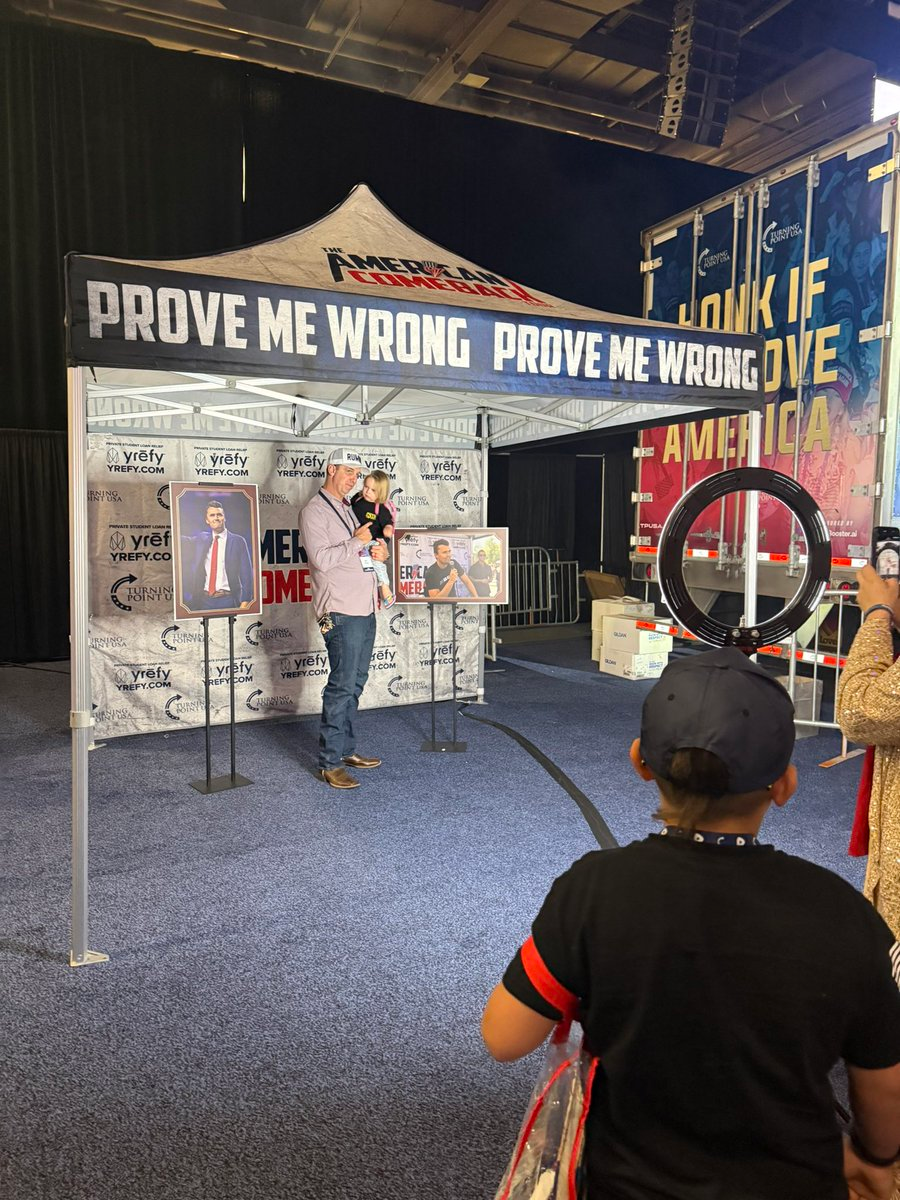
At the first major AmericaFest after Kirk’s assassination, Reuters documented a replica of the white canopy under which Kirk had been speaking. Attendees posed for photographs there. The microphone from the Utah Valley University event was displayed as a memorial object. Kirk’s image and voice saturated the gathering.
The place where the founder became killable had been reconstructed as the place where the movement proved itself unkillable.
This is emotionally understandable.
It is also the purest image of the enemy business inheriting a wound.
The tent became:
- memorial;
- evidence;
- pilgrimage site;
- content background;
- recruitment surface;
- donor signal;
- continuity proof;
- and a portable claim that the assassination had failed.
The replica does not mean the grief was false.
Business instruments can carry real grief.
The question is what the carrying makes reachable.
- A memorial can return the living to care, courage, humility, and protection of the relation that was attacked.
- A memorial can also produce a sacred perimeter around the institution.
- The dead founder becomes immune to correction.
- The final stage becomes the permanent stage.
- Every future opponent is measured against the person who killed him.
- Every criticism risks appearing as assistance to the assassin.
- Every organizational decision can be routed through loyalty to a man who can no longer say what loyalty requires.
The object begins as memory.
It becomes title when it claims jurisdiction over the future.
 Aidan Lawson
This is why the replica tent must remain morally unstable.
It should preserve what was attacked:
- the right to speak;
- the right to challenge;
- the right to appear in public;
- the right to be wrong without being killed;
- the right of a movement to continue after violence.
It should never become proof that every act performed in Kirk’s name has already been justified by his death.
The dead may obligate memory.
They may not own future agency.
 Aidan Lawson
The Dead Founder Goes to Work.
Political martyrdom becomes dangerous when the dead acquire executive function.
The person’s name begins making decisions in rooms the person never entered.
- Fire this employee because of Charlie Kirk.
- Suspend this teacher because of Charlie Kirk.
- Investigate this professor because of Charlie Kirk.
- Cancel this performer because of Charlie Kirk.
- Deny this visa because of Charlie Kirk.
- Remove this official because of Charlie Kirk.
- Prove your decency by saying the correct thing about Charlie Kirk.
- Prove your loyalty by refusing the wrong criticism of Charlie Kirk.
The assassination produced genuine moral shock.
Some reactions were vile.
People celebrated the killing. Some mocked the widow and children.
Some wished for further political deaths.
Some transformed a murdered person into an occasion for personal performance, as though moral seriousness consisted in showing everyone around them how little grief could touch them.
Those acts can reveal cruelty, dangerous judgment, professional unfitness in some roles, or a willingness to normalize political murder.
The field still requires distinctions.
- A person who explicitly threatens further violence is not in the same category as a person who says Kirk’s politics were harmful.
- A teacher who celebrates assassination in front of frightened students raises a different institutional problem than a worker who privately quotes one of Kirk’s controversial statements.
- A police officer applauding political murder creates a different trust rupture than a cashier posting that public sainthood has become excessive.
- A doctor wishing death on patients of a political class creates a much different concern than a doctor stating that Kirk’s record should remain open to criticism.
The dead founder erased these gradients because the retaliation field preferred one clear category:
Enemy.
Once that category entered employment, the dead founder went to work.
Call Their Employer.
Vice President JD Vance told listeners to identify people celebrating Kirk’s death and contact their employers.
“Call them out, and, hell, call their employer.”
The sentence is one of the cleanest statements of American private sovereignty in the twenty-first century.
The state did not need to arrest the speaker.
The movement did not need to win any argument.
The citizen could just be located inside a firm, school, hospital, agency, university, military unit, contract, or professional licensing relation.
Pressure could then enter through the livelihood channel.
Reuters documented more than six hundred people who were fired, suspended, investigated, placed on leave, removed from roles, or otherwise disciplined over comments made after Kirk’s assassination. More than 350 worked in education. Some had celebrated the murder or expressed hopes for further violence.
Others had condemned the assassination while criticizing Kirk’s politics, quoting his past remarks, or objecting to the construction of martyrdom around him.
Online activists circulated screenshots, names, workplaces, professional details, and instructions for contacting employers. Some people were misidentified. Some employers acted before a full inquiry. Some workers entered weeks or months of uncertainty while institutions attempted to distinguish safety, trust, public pressure, legal exposure, reputational risk, and ordinary political disagreement.
America answered a political murder through Human Resources.
This is pretty funny only because the alternative is admitting how much sovereignty payroll already carries.
 Aidan Lawson
A job in the United States is rarely just a task exchanged for money.
Employment can govern:
- healthcare access;
- housing stability;
- immigration status;
- childcare;
- professional identity;
- retirement;
- social standing;
- future references;
- geographic mobility;
- creditworthiness;
- access to the next job;
- and the practical ability to survive a period of public condemnation.
To call the employer is to route political judgment through all of those relations at once.
- The employer may have a real obligation to act.
That point must remain steady.
A workplace cannot ignore credible threats, targeted harassment, severe discriminatory conduct, breaches of professional ethics, or public behavior that destroys the trust required by a specific role.
A private organization also has associational interests. It should not be forced to employ a public spokesperson who openly repudiates its central mission or a caregiver who announces hatred for the people in their custody.
The instrument becomes dangerous when employment is treated as the default enforcement channel for political wrongness.
The firm lacks the features that make a court corrigible.
 Aidan Lawson
- No stable rules of evidence.
- No consistent burden of proof.
- No public discovery.
- No adversarial hearing guaranteed.
- No proportional sentencing doctrine.
- No equal protection obligation in the ordinary private case.
- No duty to preserve political plurality.
- No meaningful appeal for many workers.
- No requirement that similar speech receive similar treatment across ideologies.
The employer does have an incentive.
End the reputational event.
That incentive produces fast closure.
- The employee becomes a liability object.
- The public pressure becomes a cost.
- Termination becomes a press release with a payroll consequence attached.
- The public pressure becomes a cost.
The firm can then describe the action as values.
The crowd describes it as accountability.
The worker receives the material tail.
Consequences.
“Freedom of speech does not mean freedom from consequences.”
This sentence is one of the great lazy instruments of American public life.
It is true in the way gravity is true.
Every action has consequences. Speech changes relationships. A statement can destroy trust, reveal danger, frighten a community, trigger refusal, alter a contract, or make later cooperation impossible.
The sentence becomes totally useless when it is offered as a complete ethical analysis.
Consequences are the thing requiring examination.
- Which consequence?
- Imposed by whom?
- Through which instrument?
- Under what evidentiary standard?
- Connected how closely to the person’s role?
- With what chance of correction?
- Carrying what downstream burdens?
- Applied consistently against which comparable speakers?
- Ending when?
A murderer faces consequences through criminal law.
A worker may face consequences through employment.
These are not equivalent structures. Murder absolutely closes a person’s future. Job loss belongs to a different moral scale. Comparison of instruments does not equalize severity.
The second structure still deserves analysis.
Otherwise “consequences” becomes a moral solvent poured over any and every private punishment the crowd can make reachable.
The question is not whether speech can affect employment.
The question is when employment should become the sovereign interpreter of citizenship.
A job is a coordination relation.
It should not become a citizenship license.
The Private Constitution.
America has a public Constitution and millions of private constitutions.
The public Constitution restrains government. It establishes rights, offices, processes, limits, and contestable jurisdictions. The First Amendment protects speech against state action, subject to law’s complicated boundaries.
Most Americans spend much of their waking life inside institutions where the First Amendment is not actually the governing instrument.
- The employer decides the code.
- The platform decides the account.
- The insurer decides the coverage.
- The landlord decides the lease.
- The bank decides the risk.
- The school decides the conduct standard.
- The professional board decides the license.
- The sponsor decides the association.
- The donor decides the comfort level.
Each institution may have legitimate authority within its relation.
Together, they form a private constitutional field.
Political speech enters this field carrying unequal resistance.
A wealthy founder can survive outrage differently from an hourly worker. A tenured professor has different protection than an adjunct. A police officer, public-school teacher, nurse, contractor, undocumented worker, celebrity, executive, and anonymous warehouse employee occupy different pathways between a screenshot and material collapse.
The call-your-employer instrument exploits those differences.
It rarely punishes the most powerful speaker first.
It just finds the person whose livelihood has a visible switch to flick.
This is why the retaliation field after Kirk’s death belongs in the America / Business track. The core event was political. The enforcement system was economic.
- America’s formal politics promised debate.
- America’s private constitution supplied termination.
The business instrument became the route through which the country attempted to restore moral order after assassination.
It failed because job loss cannot repair murder.
It can only create a second field of fear around the first.
The Strongest Case for Firing.
The argument for employment discipline deserves its strongest form.
Trust is a working asset.
A teacher entrusted with children, a physician entrusted with patients, a military officer entrusted with lethal authority, a government employee entrusted with public power, or an executive entrusted with an organization’s public identity can damage the role through off-duty speech.
A public celebration of assassination may certainly reveal something operationally relevant.
- The teacher may make conservative students reasonably fear contempt.
- The doctor may make patients fear discriminatory care.
- The officer may make citizens doubt political neutrality.
- The executive may bind the organization to an endorsement of violence.
- The employee may expose coworkers to harassment or retaliation.
An institution need not wait for the fear to become physical harm.
Modal Path Ethics does not require employers to become passive containers for every form of public cruelty.
The question is whether the discipline is a repair instrument.
A repair instrument should:
- identify the actual trust relation at stake;
- distinguish threat, celebration, criticism, quotation, and political disagreement;
- investigate context;
- preserve proportional response;
- consider correction, apology, reassignment, training, leave, or mediation where appropriate;
- avoid using termination as reputational theater;
- protect coworkers and affected communities;
- maintain records;
- apply standards consistently;
- and leave an appeal path.
Many institutions did do some of this.
But the public campaign did not reward them for doing it slowly.
The crowd wanted the screenshot to become a consequence before uncertainty could become finished thought.
That is the enemy business operating through the firm.
The Strongest Case Against the Speaker.
Some of the post-assassination speech was morally rotten.
There is just no need to soften this in order to criticize the purge.
Celebrating the murder of a political opponent teaches the field that political closure can be emotionally righteous. It converts a body into a victory symbol. It tells the family that their loss is deserved because the dead person occupied the wrong ideological category. This tells future attackers that someone will receive the act as service.
That speech can raise resistance against public life.
It can make later speakers less willing to appear, later institutions more willing to close events, later audiences more suspicious, later employers more coercive, and later partisans more prepared to imagine political murder as reciprocal logic.
The speaker still remains a locus.
Moral disgust does not erase their future.
A field can condemn the statement, refuse association, impose proportionate consequences, protect affected people, and demand correction without automatically maximizing the speaker’s economic collapse.
The retaliation field wanted something easier, though.
It wanted the speaker to become payable debt.
This is the Charles Jones parallel again.
A public retaliation field converts the living into payment surfaces for a wound.
- In the Jones case, the field carried names, crews, songs, losses, loyalty, and revenge until another body became available to settle an earlier death.
- After Kirk’s assassination, the field carried screenshots, employers, outrage accounts, political authority, and institutional fear until another livelihood became available to settle the murder symbolically.
The scales differ radically.
The grammar remains recognizable.
A wound enters the field.
The field asks who can be made to carry it.
The Opponent as Employee.
The enemy business requires the opponent to remain reachable.
The employment purge made the opponent reachable in a new way.
The critic no longer had to be defeated in argument.
The critic could just be located at work.
This changes political participation at its root.
A citizen considering speech must now model two audiences:
- the people hearing the statement;
- the institution that can be summoned afterward.
The second audience may never have encountered the political question. It just receives the dispute as risk.
This produces a chilling field broader than any one firing.
People learn which beliefs are safe to hold only in private, which criticisms require disclaimers, which deaths suspend ordinary judgment, which phrases can be detached from context, which enemies have organized enough attention to reach a supervisor, and which employers will sacrifice an employee before evaluating the claim.
Some chilling is protective.
A society should chill threats.
A society should chill direct incitement, targeted harassment, and the cheerful normalization of assassination.
However, a society that chills ordinary political criticism through livelihood pressure loses something else:
The opponent becomes unavailable for honest contact.
People still speak.
They now speak in coded rooms, anonymous accounts, closed groups, ironic fragments, and private contempt. The public field becomes more polite and less truthful. Institutions now receive fewer visible warnings about the anger building beneath their conduct standards.
The tent remains open on paper.
But everyone approaching the microphone is already calculating payroll.
That is not political peace. It is compressed conflict.
The Movement Has Rights Too.
Turning Point USA did not create every post-assassination firing campaign, and the organization publicly distinguished respectful disagreement from celebration of the murder.
That distinction is important.
The movement itself was under real pressure.

Its founder had just been killed during its signature form of public engagement.
Staff had to continue working while grief became national content. Chapters had to answer frightened students. Security requirements changed overnight. Donors, candidates, allies, critics, journalists, opportunists, and conspiracy entrepreneurs all entered the wound.
This organization had a legitimate need to protect its people and continue its work.
The America / Business track cannot treat continuity as corruption whenever the institution under examination holds bad politics.
Businesses, nonprofits, unions, churches, campaigns, universities, newsrooms, and activist organizations all create real dependencies. Workers and communities build lives around them. Sudden collapse transfers burdens outward.
Turning Point USA therefore had a claim to succession, security, memory, fundraising, recruitment, and political continuation.
The claim still had limits.
- No organization receives sovereignty over the whole speech field because violence entered its own.
- No founder’s murder grants jurisdiction over every employer.
- No widow’s grief can become a general labor policy.
- No movement’s survival requires the economic destruction of every person who refuses its account of the dead.
The right to continue is not the right to conscript the entire country into memorial discipline.
What the Assassin Made Reachable.
Assassination is a transition technology.
 Aidan Lawson
It does more than remove a person.
It rearranges the future around an absence.
 Aidan Lawson
The alleged assassin, if convicted, will have made several closures reachable at once:
- Charlie Kirk’s personal future ended.
- His family’s future was permanently altered.
- Turning Point USA lost its founder-body.
- open campus events became harder to secure and easier to cancel;
- ideological opponents became newly suspect to one another;
- a national martyr became available;
- employer punishment became politically sacred;
- retaliatory rhetoric gained a murder to feed on;
- conspiracy fields received an endless evidence surface;
- the accused’s own future narrowed toward imprisonment or death;
- and every later debate inherited a roofline.
This is why assassination is such a powerful political instrument even when the killer has no coherent program to speak of.
The act forces succession.
A living political figure can be opposed through time. An assassinated figure becomes an immediate constitutional crisis for every institution organized around the person.
The killer does not control every consequence.
That is part of the horror.
The field takes the act and generates futures no single actor could author.
What the Retaliation Made Reachable.
The employment campaign also changed the field.
This made several things easier:
- rapid punishment of overt celebration;
- public reassurance that assassination would not be normalized;
- employer distancing from violent rhetoric;
- documentation of statements that institutions considered incompatible with professional trust;
- and visible solidarity with a murdered public figure.
It also made other things reachable:
- false identification;
- selective enforcement;
- ideological dossier-building;
- pressure campaigns against teachers and workers;
- discipline for criticism adjacent to condemnation;
- political fear entering ordinary workplaces;
- employers becoming private speech courts;
- and the normalization of livelihood as a retaliation surface.
The first set does not erase the second.
The second does not make every consequence unjust.
The ethical object is the field produced by the instrument.
A repair that cannot preserve distinctions will eventually punish the wrong locus.
A protection instrument that cannot release people after correction becomes a sovereignty machine.
America Through Payroll.
America likes to imagine that politics happens at the ballot box.
This is one of the country’s sweeter administrative fantasies.
 Aidan Lawson
Politics also happens through payroll.
- Which ideas receive a salary?
- Which organizers receive health insurance?
- Which speakers receive sponsorship?
- Which employees can survive public controversy?
- Which workers are expendable during a reputation event?
- Which donor funds the campus chapter?
- Which platform distributes the clip?
- Which company sells the ticket, processes the payment, insures the event, owns the venue, hosts the email list, or controls the account?
- Which employer can be called after the speech?
Business is not beside American politics.
Business is one of the systems through which political membership becomes materially reachable.
Turning Point USA understood the first half of this. It built a business architecture around political participation.
The post-assassination purge revealed the second. The same business field could discipline political participation through employment.
- The movement built chapters.
- The country built chokepoints.
- The founder acquired a campus.
- The dead founder acquired a labor market.
This is the beginning of the America / Business track.
The central question is larger than whether corporations should be progressive or conservative, whether nonprofits are secretly businesses, whether employees deserve consequences, or whether founders are too powerful.
The real question is:
What happens when the instruments that coordinate American life become sovereign over the people, speech, communities, and futures they were built to organize?
The answer there begins under a tent.
The Parallel.
Charles Jones and Charlie Kirk should not be collapsed into one story.
Their lives carried different histories, institutions, audiences, risks, and public meanings.
The parallel belongs to the field after death.
Charles Jones.
A birthday became an address.
A hotel became the final surface of a retaliation field carried by songs, names, affiliations, losses, movement, audience knowledge, and revenge.
The dead remained active. Grief became instruction. The court could sentence the final actors while leaving the field that arranged them largely intact.
Charlie Kirk.
A campus tour became an address.
A debate tent became the final surface of an enemy business carried by clips, chapters, donors, ideological conflict, public accessibility, organizational dependence, and one founder-body.
The dead remained active. Grief became employment policy. The court may sentence the accused while leaving the field that arranged the aftermath intact.
- In one case, music gave the wound a playback button.
- In the other, political media gave the wound an enterprise stack.
- In one case, dead names rode living bodies through retaliation.
- In the other, the dead founder entered institutions through succession, memorial, recruitment, and payroll discipline.
The comparison is not innocence by analogy.
This is a warning about what public fields do with the dead.
A dead person can become a command channel.
The ethical task is to keep memory from becoming sovereignty.
The Better Tent.
The answer is not to close the tent.
The answer is to build a Better one.
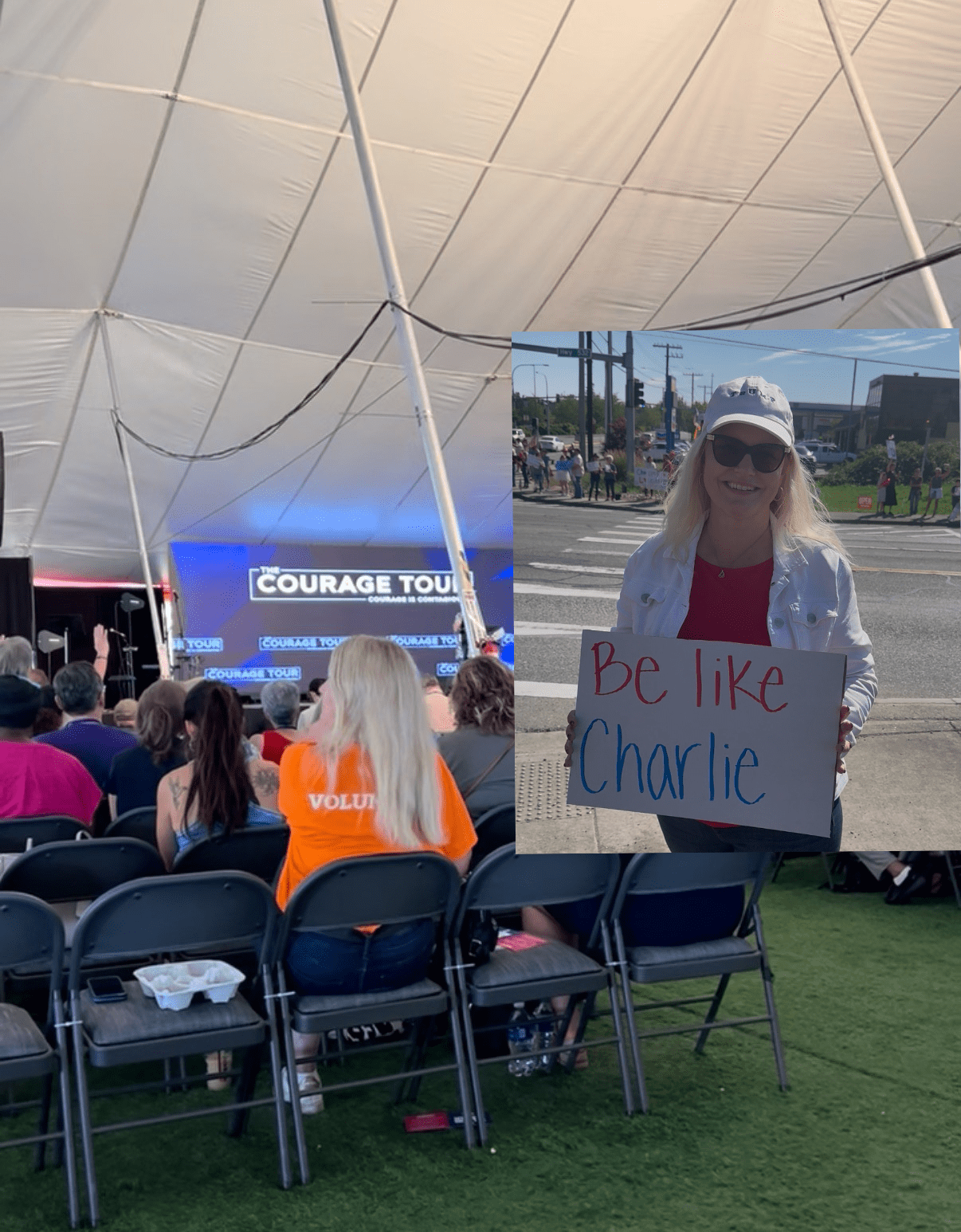
A Better tent requires more than security.
It needs an epistemic architecture capable of surviving contact.
- The event should preserve real challenge instead of feeding every question into victory content.
- The speaker should be able to lose without the institution treating loss as product failure.
- The challenger should remain a participant after the clip.
- Security should protect the relation without converting every entrant into a suspect.
- The organization should distribute founder functions before the founder becomes irreplaceable.
- The movement should distinguish opponent, critic, protester, threat, and attacker.
- The memorial should preserve courage without licensing retaliation.
- Employers should address role-specific harm through proportional, corrigible process.
- Political disagreement should remain reachable after the event ends.
This is difficult because the worse tent performs so much better online.
- The worse tent produces
- heroes and enemies.
- The better tent produces
- uncertainty,
- partial correction,
- boring follow-up,
- procedural safety,
- nuanced distinctions,
- and people leaving with less certainty than they brought.
That is terrible content.
It may be political life.
Ruling.
- Charlie Kirk was assassinated at Utah Valley University.
- Charlie Kirk was assassinated inside the American enemy business.
The first sentence names the killing.
The second names the field that made one founder-body carry so much conflict, money, audience, access, institutional continuity, and symbolic load that a single shot could reorganize American political life.
Charlie Kirk built something real.
He built chapters, media, donor relations, political pathways, a national audience, and a recurring form of face-to-face contact in a country increasingly governed through sealed feeds and professional intermediaries.
The contact was asymmetric. It was theatrical. It was optimized for clips.
It still placed a living adversary inside the same room as the people who wanted to challenge him.
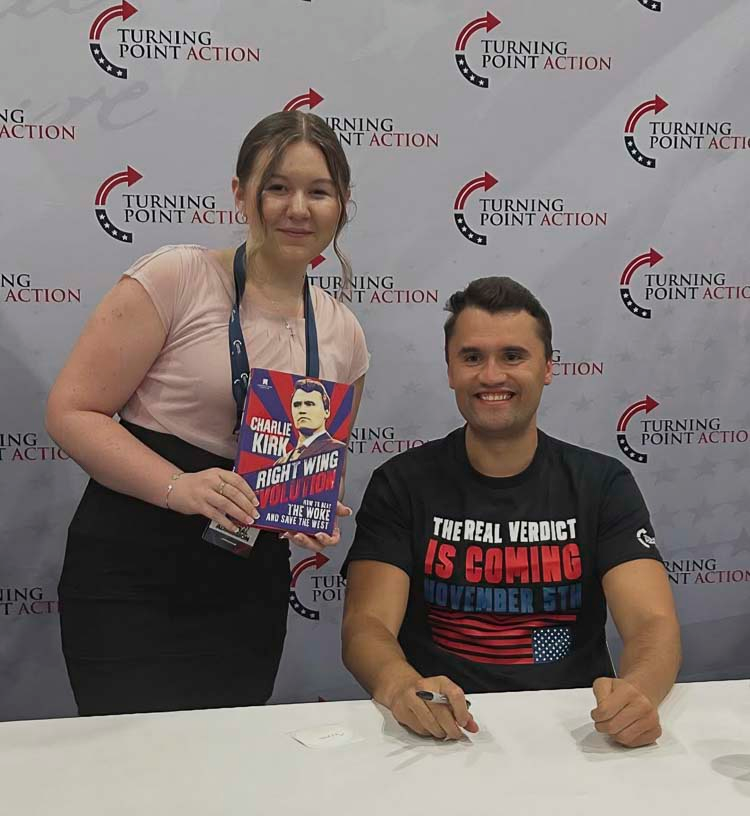
That relation deserved protection.
The assassination was an absolute closure of a person’s future and a violent attack on public political contact.
- No criticism of Kirk’s record authorizes it.
- No account of the event architecture transfers responsibility away from the person who fired the shot, if the charge is proven.
- No political disagreement becomes consent to murder because the speaker made a business from disagreement.
The movement had a right to continue.
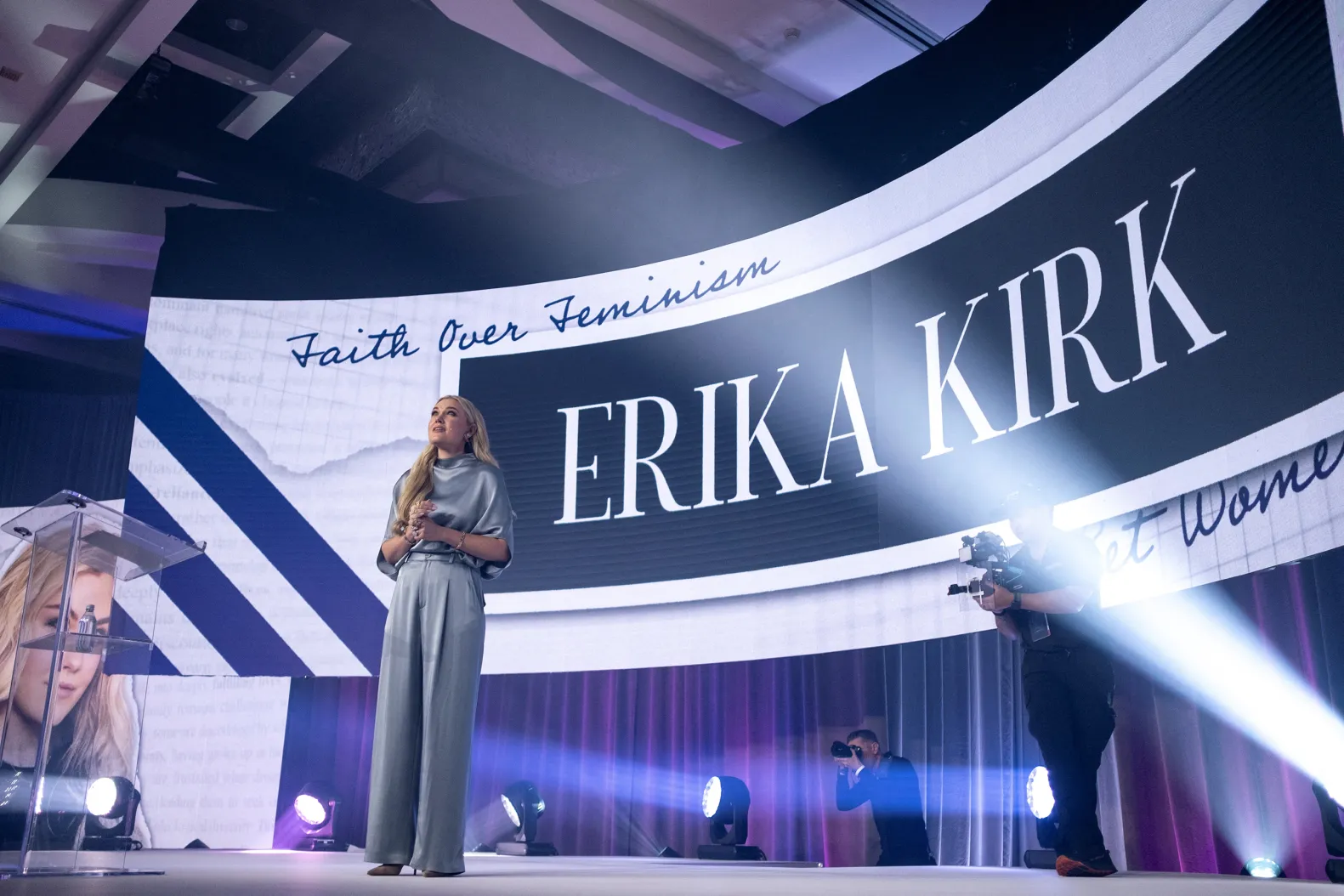
Turning Point USA had a right to elect a successor, protect its staff, raise money, preserve memory, continue events, recruit chapters, and refuse the assassin’s attempt to end the institution through the founder’s body.
Those rights did not include unlimited jurisdiction over everyone else’s livelihood.
The retaliation field converted grief into employer calls, screenshots into professional cases, moral disgust into termination pressure, and a murdered founder into an active standard inside workplaces across the country.
- Some speakers revealed genuine cruelty.
- Some employers faced real trust failures.
- Some discipline was justified.
- The field still lost its gradients.
Celebration, threat, criticism, quotation, refusal of sainthood, and ordinary political disagreement were too often dragged toward one category because one category was easier to punish.
The assassin tried to end an argument with a bullet.
America tried to repair the argument by calling Human Resources.
- The first transition killed a person.
- The second taught the living that political speech travels with a payroll switch.
The scales are nowhere near equal.
Neither transition preserves the political field.
- The dead may obligate memory.
- They may not own future agency.
- A founder may build an institution.
- The institution must eventually survive correction without requiring the founder to remain sovereign.
- A firm may protect trust.
- It may not become a private constitution whenever the public field is too angry to tolerate procedure.
- A job is a coordination relation.
- It is not a citizenship license.
- The tent must remain reachable.
- So must disagreement beneath it.
- So must the person who finishes the answer.
- So must the person who refuses it.
- So must life after the microphone goes dark.