Fictional Earth: Bluesky and the Safe Room
“Better weather” is not the same as Real Earth.
Everyone looked at X and decided to flee the atmosphere of Fictional Earth.
This was a reasonable reaction.
The old fake sky had become rotten. People were tired of the fumes, the sirens, the little daily lottery in which a joke could become a workplace hazard, a political event could become gladiator weather, a quote-post could become a flare shot into the complaint-cloud, and some account with a purchased aura of importance could arrive under every disaster to explain that the real victim here was civilization (as represented by his podcast).
So people left.
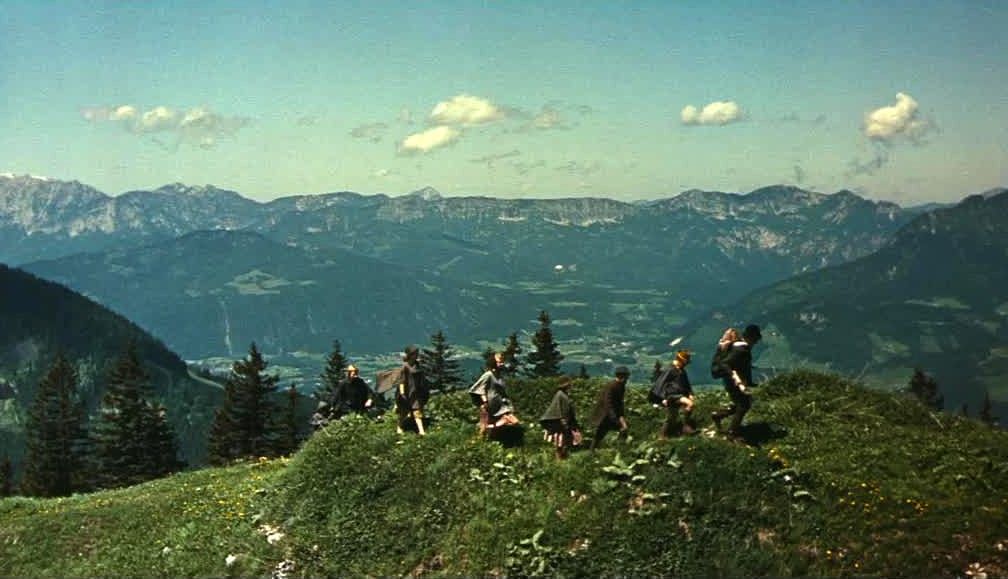
They crossed the mountains in the final act, carrying their handles, their follow lists, their muting habits, their screenshot reflexes, their professional dread, their jokes, their blocklists, their exhaustion, and their small remaining hope that somewhere else online might still feel like air.
The move from X to Bluesky looked like escape from Fictional Earth.
It was, more exactly, movement from one territory of Fictional Earth to another.
The hills were alive, and federated.
The Exit Myth.
The first thing to understand about Bluesky is that it did not enter the culture as a normal social app.
It entered as a way out.

Bluesky began as a repair dream inside Twitter’s own future.
Jack Dorsey kicked off the project while he was Twitter CEO in 2019, chose Jay Graber to lead it, and Twitter paid Bluesky service income to build an open social protocol for public conversation.
Bluesky says it has been an independent company since its 2021 formation, and that in late 2022 Twitter severed its service agreement with Bluesky while Bluesky continued its mission to develop open and decentralized public conversation.
So a platform begins to imagine an escape from platform sovereignty while still inside one of the most platform-sovereign rooms ever built by mankind.

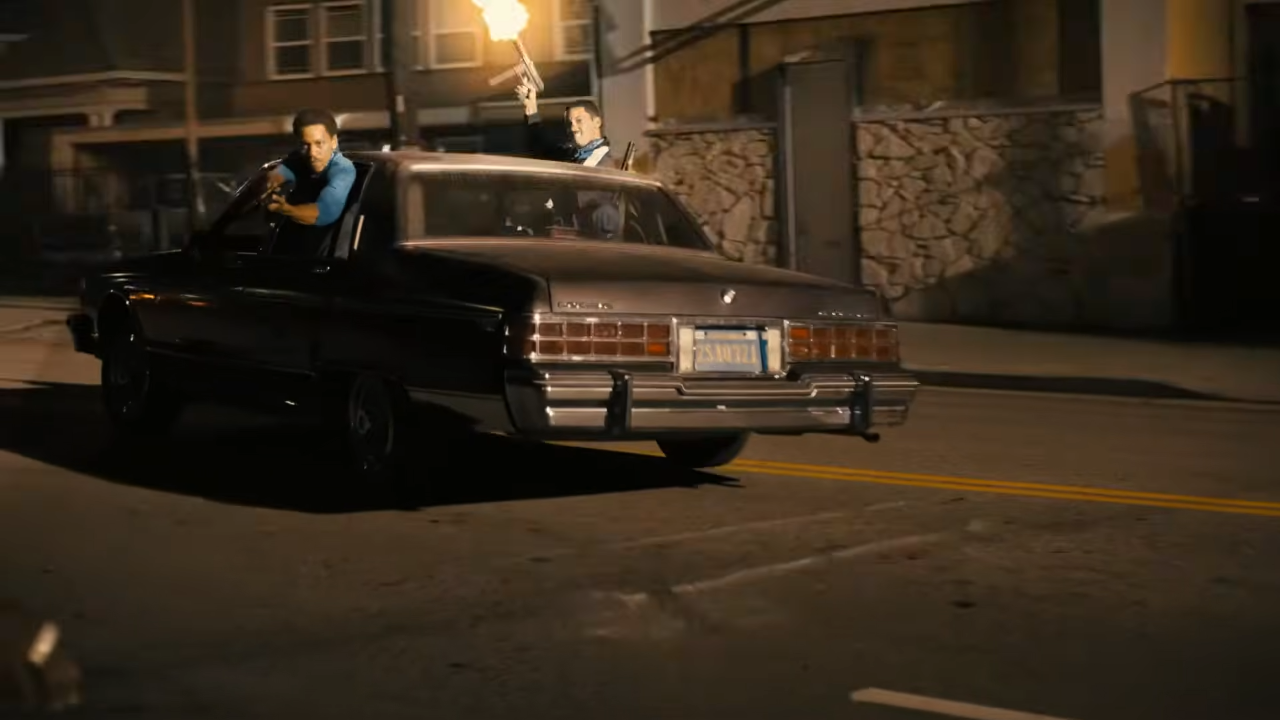
By 2019, Twitter had already become more than a website. It was a newswire with jokes, a professional reputation exchange with bizarre anime avatars, a politics machine with sports fans trapped inside it, surviving on the mold.
Twitter was a live disaster ritual, a celebrity oracle, a journalist habitat, a harassment engine, a public square, a private addiction, and an open-air sewer with excellent search.
This was a terrible design for a platform.
It was also historically important.
By the time people started saying “the discourse,” a large part of public life had already accepted the idea that a human thought had not fully occurred until platform weather had done something to it.
X.
This article is about Bluesky.
Unfortunately, that means we have to talk about X for a while, because Bluesky’s first social reality was atmospheric.
X is what gave Bluesky its founding contrast.
Elon Musk bought Twitter for $44 billion, then followed with a major rebrand from the iconic blue bird to just the letter X in July 2023. The rebrand was not only cosmetic, though cosmetics like this do still matter in symbolic infrastructures because users are mammals.
- The bird became a letter.
- The tweets became posts.
The old Twitter semiotics were dismantled in public, sometimes literally from the side of the building. The platform had fully detached from place-hood. It also entered a period where users could feel the owner as weather.

The blue check system is one good example. Twitter’s old verification system had many problems, but it did at least claim to verify identity or public notability. In 2023, Twitter began removing legacy blue checks from accounts that did not pay a monthly fee, after earlier chaos around paid checkmarks and impersonation.
That move changed the meaning of visibility.
The check no longer meant the same thing. The mark became status, monthly subscription, irony, resentment, algorithmic advantage, brand confusion, and a social sorting object. The symbol stayed familiar while its field function changed completely.
This is one of the classic moves inside Fictional Earth:
- The sign survives the transition.
- The meaning does not.

Now untethered, X's already terrible Twitter-physics became the clearest current example of Retaliation Weather: a field where humiliation, exposure, and combat velocity feel like contact with truth.
- X rewards retaliatory velocity
- Bluesky rewards relief, taste, and civilized mutual recognition.
That clear distinction is the whole entrance to the Bluesky case.
People were fleeing a hostile weather system.
Retaliation Weather.
X trains the body before it trains the argument.
The platform’s central grammar is speed under adversarial visibility.
- A person posts.
- Another person quote-posts.

- A third account screenshots.
- A fourth account adds the missing context.
- A fifth account explains that missing context is actually the propaganda.
- Someone makes a thread about it.
- Someone makes a thread about the thread.

- A journalist embeds the exchange.
- A politician reacts.
- Someone finds an old post from 2014.
- A politician reacts.

- Everyone discovers that the person was once very wrong about pizza toppings.
This is how public reason becomes a tornado made out of little knives.
Retaliation Weather does not require every user to be cruel.
Some users are funny, brave, knowledgeable, generous, careful, and doing real public work.
The field still has its physics.
- It rewards the fast reply.
- It rewards the exposed contradiction.
- It rewards the clip, the ratio, the dunk, the humiliation artifact, the phrase that can travel without its burden.
- It makes moral seriousness feel like speed + aim.
- It also converts fear into literacy.
- Users learn what can get them hit.
- They learn which topics are radioactive,
- which phrases attract the swarm,
- which jokes are safe only from certain accounts,
- which silences will be noticed,
- which affiliations can be used as a spear,
- which replies are invitations to spend the rest of the day inside someone else’s cortisol economy.
- which affiliations can be used as a spear,
- which silences will be noticed,
- which jokes are safe only from certain accounts,
- which phrases attract the swarm,
This produces a specific person.
The X-trained person is not necessarily evil.
The X-trained person is primed.
They enter the public field with shoulders raised.
They scan for attack vectors.
They read tone as threat.
They treat ambiguity as a hostile medium.
They expect disagreement to become evidence.

They expect evidence to become ammunition.
They expect correction to become submission or counterattack.
The platform says:
Stay ready. They're coming.
Eventually readiness becomes your identity.

That is why leaving X felt, for many people, like moral hygiene.
This was reasonable. A bad atmosphere is a real thing.
The trap was thinking the atmosphere had been left behind.
Refuge Reality.
The technical promise of Bluesky is genuinely interesting.
Bluesky says it is designed so social media is not controlled by a single company, and that it uses the AT Protocol as an open-source framework for social apps that can talk to each other.
It describes the protocol as standardizing identity, follows, and data so that apps can interoperate and users can move across them with account portability.
A social graph is not a decoration. It is a form of accumulated social life.
If leaving a platform means losing one’s audience, friends, archive, identity, and practical visibility, then the platform does not need a prison wall to keep you there. It already has a hostage field made of habit and connection.
Bluesky’s technical answer is to reduce that captivity.

The February 2024 federation post puts this point in the language of hosting:
- traditional platforms store user data inside the company’s own service,
- while Bluesky wants users to be able to move data to another provider without losing posts, likes, follows, or identity.
- This frames federation as a move toward social media that is not controlled by any single company.
So yes, Bluesky is partly a protocol project.
It is also a social shelter.
These are two different births.
The protocol birth says:
What if public conversation could survive the platform owner?
The shelter birth says:
What if we could talk somewhere that does not make us feel like we are always about to be punished?
Both births are real.
The second one explains the people there.
Invite Culture.
Bluesky opened publicly on February 6, 2024, after using invite codes for a year to manage growth while building moderation tooling, custom feeds, and other features; at that point it said more than three million people were already using the service.
The invite period matters enormously.
An invite-only network does not first feel like a public square.
It feels like a room.

A room has social temperature. A room has taste. A room has early regulars, local jokes, shared enemies, entry rituals, welcome norms, and the unmistakable sense that somebody opened the door for you to come inside.
This is great. This is also the beginning of local sovereignty.
The old internet had places too. The first Fictional Earth article already named that early shape: forums, message boards, IRC rooms, blogs, mailing lists, and fan sites were unstable places, but they were still recognizably somewhere.
The larger anthropological arc then moved from place, to profile, to network, to feed, to metric, to pocket, to recommendation, to world.
Bluesky is strange because it arrives very late in that arc while trying to recover an earlier feeling.
- It wants the web.
- It wants the room.
- It wants the feed.
- It wants the global conversation.
- It wants account portability.
- It wants community moderation.
- It wants public posting without the awful X atmosphere.
That is a lot to want.
Modal Path Ethics respects ambition.
Modal Path Ethics also asks what the transition makes reachable.
What became reachable was the fantasy of leaving the bad internet while keeping the platform form.
Old Social.
Bluesky’s own public-launch post came with a comic about leaving “old social.”
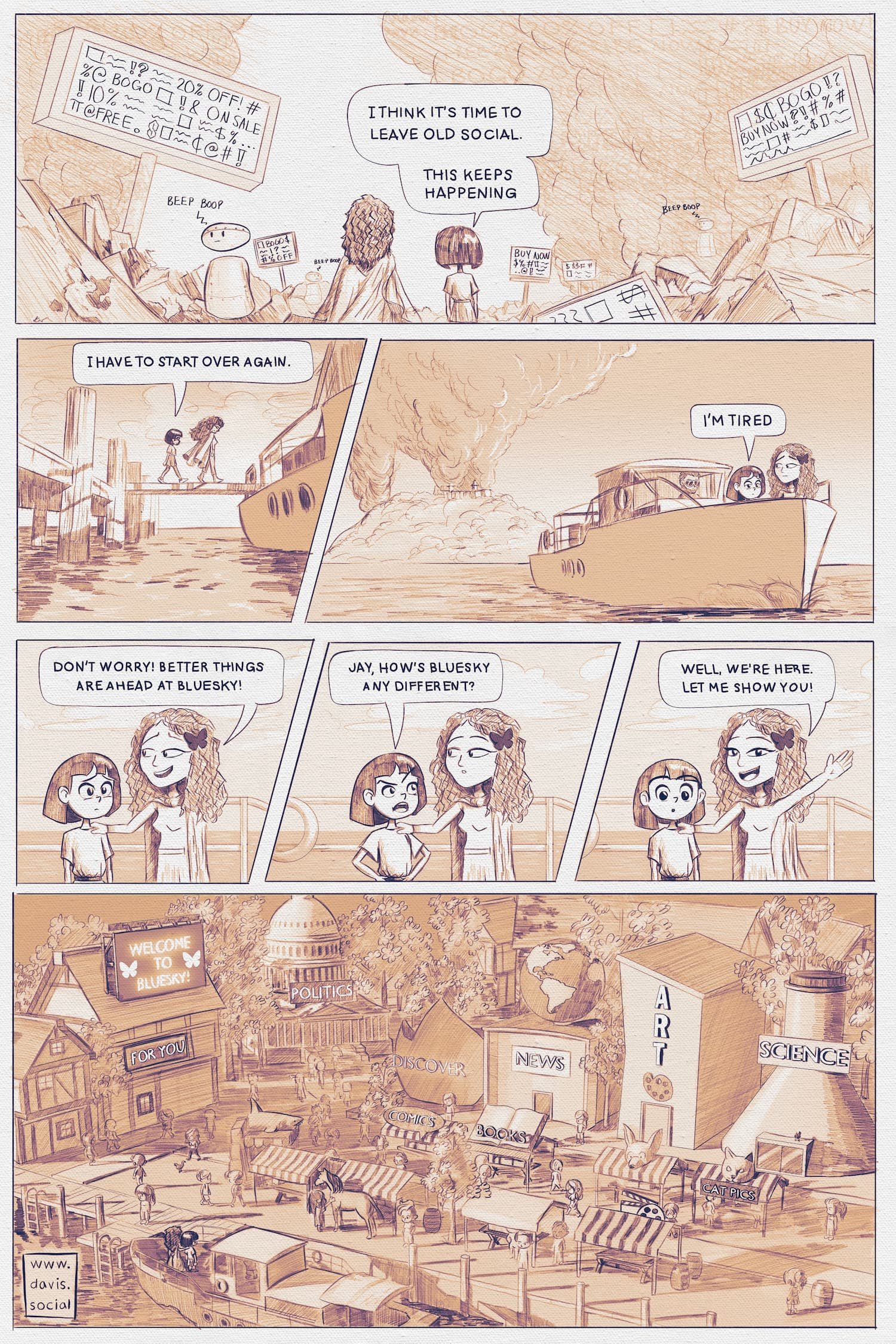
The characters stand amid rubble, board a boat, arrive at a beautiful network with labeled areas such as News, Discover, Art, and Science, then move toward a magical mountainside while being told that Bluesky offers choice, stackable moderation, connection across the network, and a social account that comes with you.
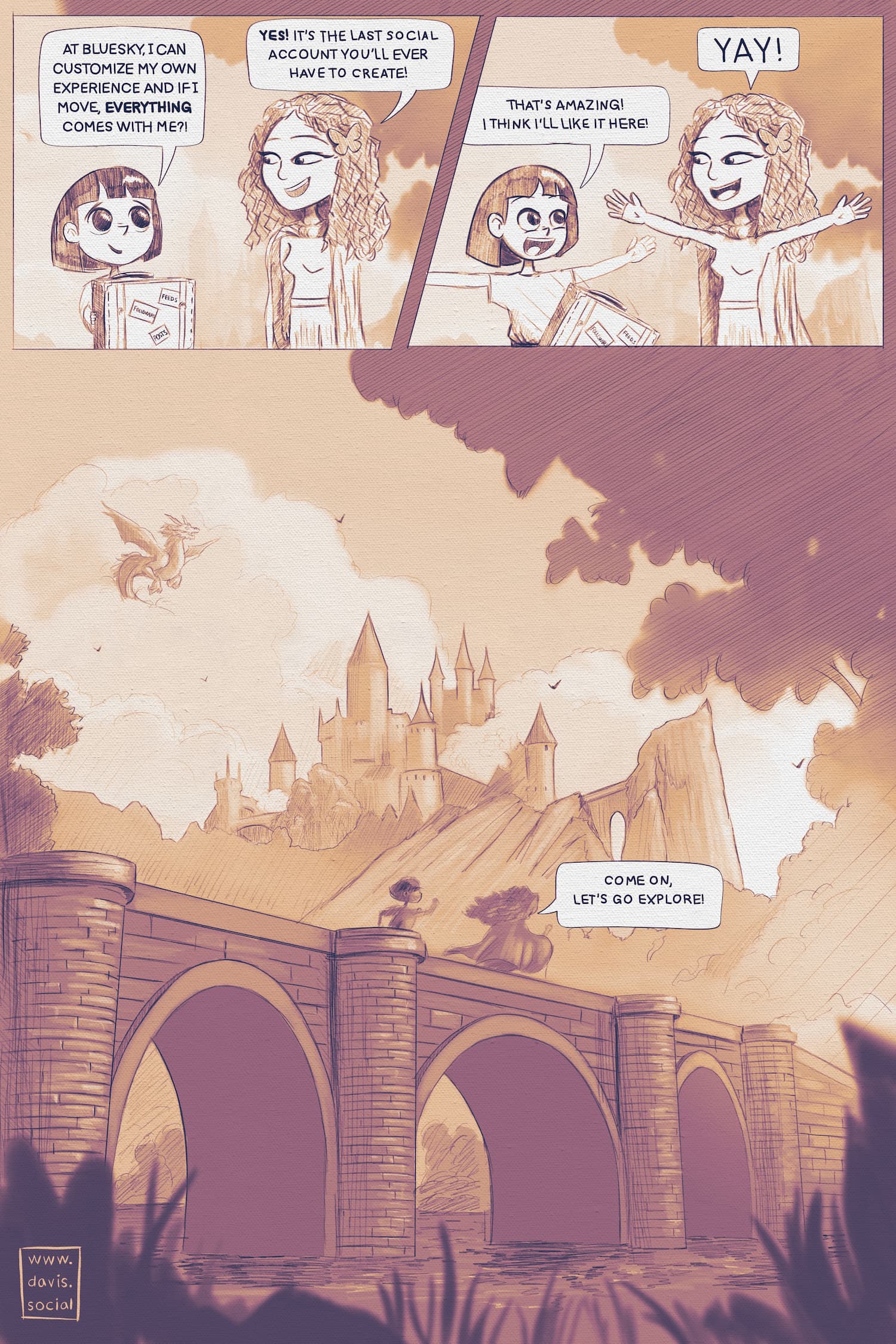
There it is. I called it before I saw this part.

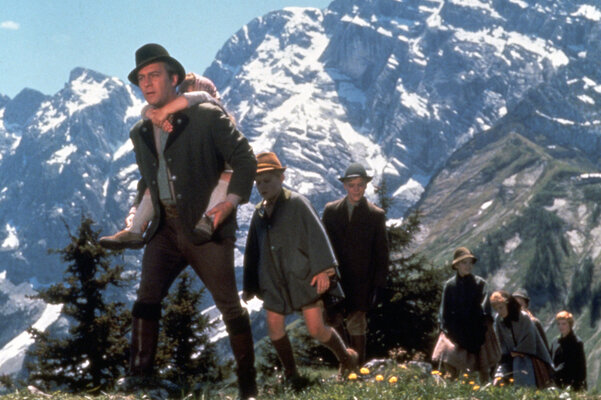
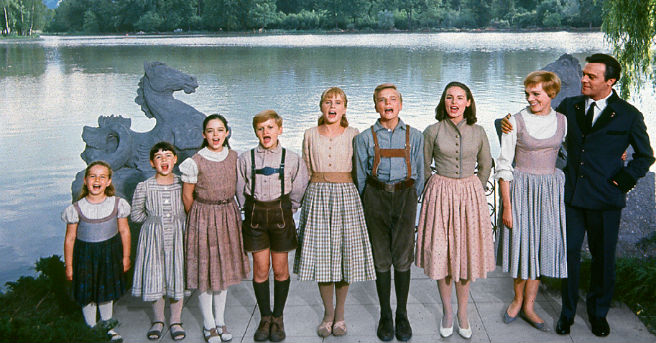
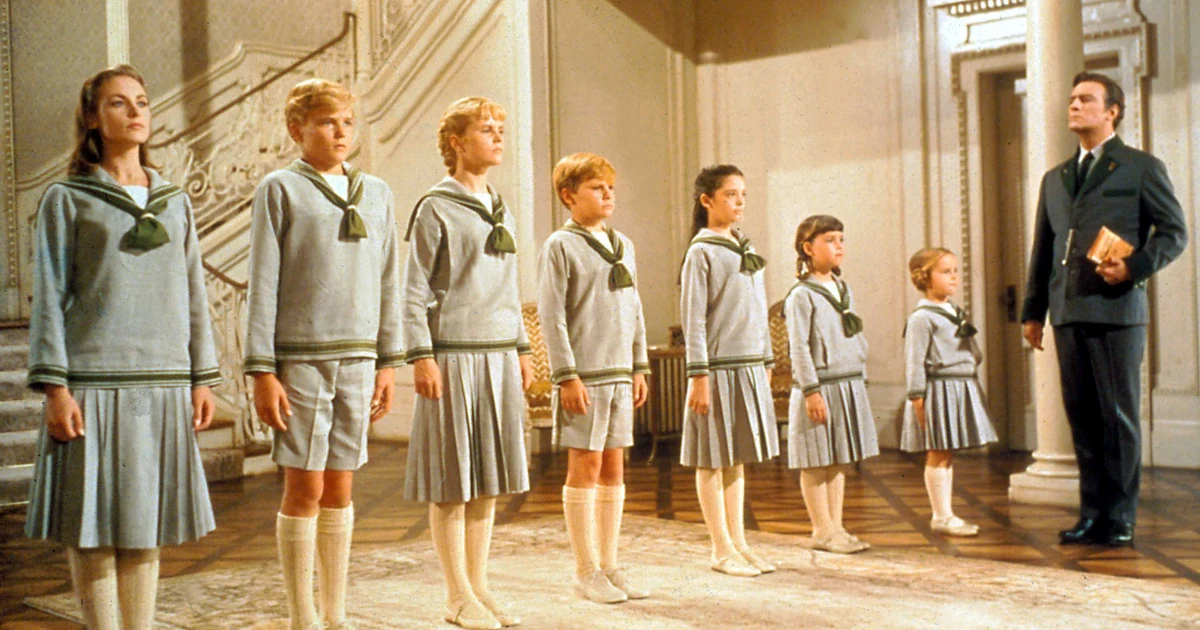
The Sound of Music ending, but for posting.
- Leave the rubble.
- Cross the water.
- Reach the mountainside.
- Everything is connected.
- Your friends come with you.
- Better things are ahead.
- Your friends come with you.
- Everything is connected.
- Reach the mountainside.
- Cross the water.
The myth could not be more visible if Julie Andrews personally handed everyone a moderation labeler.
The old joke about The Sound of Music is that the family does not actually escape into Switzerland.

The film gives us liberation music and mountain air, but the geography shown points them toward Germany.
Hollywood needed the image of exit more than it needed the exit to be real.
That is exactly the Bluesky problem.
The image of escape is not the same thing as exit from Fictional Earth. The hills can be alive and still point deeper into the platform continent.
Starter Packs.
Then came one of Bluesky’s most important social inventions: starter packs.

Bluesky introduced starter packs in June 2024 as personalized invites that let users bring friends directly into “your slice of Bluesky,” with recommended custom feeds and users to help communities find each other.
Starter packs solved the migration problem by letting people carry rooms in with them.

A person did not have to enter Bluesky as a lone organism blinking under a cold public sky. They could arrive through a curated slice: writers, journalists, scientists, labor people, local accounts, artists, historians, shitposters, mutuals, climate people, game designers, disability advocates, book people, politics people, the one who somehow knows every bird.
This reduces cold-start resistance. It helps communities survive the crossing.
It also means the user enters through social selection.

A starter pack is not a neutral map of the world. It is a carried room. It has taste, rank, omission, trust, status, memory, boundary, local authority, and a soft little velvet rope around reality.
Curated discovery is still discovery.
It is also a quiet politics of who gets to arrive already legible.
The Surge.
By the end of 2024, Bluesky said it had grown from an invite-only app with three million people to a public app with more than 25.9 million people, adding more than 13 million in the prior month and a half.
The broader social context was obvious enough that news coverage could simply say it. Associated Press reported in November 2024 that Bluesky gained one million users in the week after the U.S. election, rising to fifteen million users, as some X users sought an alternative platform; AP also described earlier surges after X was banned in Brazil and after changes to X’s block feature.
This is the second birth fully visible.
- Bluesky is a protocol project.
- Bluesky is also an evacuation site.
Evacuation sites have their own morality. They are judged first by whether people can breathe there. That is why criticism of Bluesky often misfires. The correct first sentence is not “Bluesky is also distorted, ha ha, fooled you.”
The correct first sentence is:
The shelter was real.
People need shelters.

A person leaving a worse atmosphere is not performing a silly purity dance. They may be preserving their attention, dignity, safety, employment, sleep, and the ability to think without being electrocuted by every trend.
The question is what the safe room starts doing once the door closes.
Local Physics.
Local physics names the practical laws by which a platform field decides what moves, what stalls, what becomes visible, what becomes rude, what becomes prestigious, what becomes invisible, and what kind of person the user is rewarded for becoming.
Every territory of Fictional Earth has local physics. Each field has its own grammar, history, rewards, traps, and way of replacing our Earth with something locally convincing.
For Bluesky, the local physics are unusually gentle.
- Gravity: relief from worse weather.
Bluesky’s first gravity is relief, not novelty.
The user arrives and thinks:
Thank God, everyone is not screaming in quite the same way.
This feeling is powerful. The whole room is organized around the memory of worse conditions. X supplies the negative theology. The room knows what it is by knowing what it escaped.
- Currency: civilized recognizability.
The rewarding object on Bluesky is often not domination. It is not the clean dunk, the procedural victory, the perfect selfie-proof, or the corporate-safe career statement.
The rewarding object is being good company among decent people.
A post wants to be smart enough, humane enough, tasteful enough, locally legible enough, appropriately tired enough, and free enough of old-platform contamination that the room can recognize it without feeling dragged back into the burning city.
- Boundary instrument: moderation as self-location.
Bluesky’s architecture makes boundary work central. Automated filtering, manual admin actions, community labeling, blocklists, moderation services, custom feeds, account portability, and server-independent participation in the global conversation.
That is both protection and an identity.
Every boundary instrument tells the user precisely who they are safe with, who they are safe from, and what the room becomes after enough people make the same cut.
- Sacred contrast: X.
The old platform becomes the anti-world.
- Do not bring that here.
- Do not talk like that here.
- Do not import that fight here.
- Do not make this place into that place.
This rule is good. It is also dangerous, because eventually “do not bring the old weather here” can start to mean
“Do not bring any truth whose shape reminds us of the old weather.”
- Failure mode: safety becomes local sovereignty.
A safe room begins as relief from harm.
Then the safe room starts deciding which forms of truth are safe enough to count.
That is the shape of the Bluesky distortion.
The Safe Room.
A substitute world of civilized recognition is not hell.
It is much nicer than hell. There are jokes in there. There are clever people. There is art. There are librarians. There are earnest historians. There are people posting about birds, union drives, books, grief, soup, mutual aid, chronic illness, and extremely specific regional transit problems.
Modal Path Ethics is not here to make fun of warmth. Warmth matters.
The danger of the Safe Room is subtler.

The Safe Room can make relief feel like contact.
It can make recognition feel like repair.
It can make being among decent people feel like being answerable to Real Earth.
It can make the civilized local sentence travel farther than the structurally necessary one.
This is where the false exit becomes visible.

- Leaving X can reduce exposure to Retaliation Weather.
- It does not automatically restore contact with the field.
- The user may no longer be trained toward the warrior.
- They may now be trained toward the tasteful exile.
- The user may no longer be trained toward the warrior.
- It does not automatically restore contact with the field.
That is an improvement.
It is also still training.
The Bookstore Test.
This is the field into which the bookstore/Amazon thing entered.
It did not enter a neutral public square. It entered a safe room with a founding memory of worse platforms, a local preference for civilized recognition, and a moral grammar already prepared to honor the humane consumer gesture.
“Buy local” belongs natively to Bluesky.
This phrase is neighborly. It is decent. It is human-scale. It preserves the local bookstore as a place, the clerk as a person, the town as a texture, the author table as an event, the local shelf as something other than a recommendation engine’s little digestive tract.
All of that is real.
Except local bookstores are not simply competing with Amazon as another seller. This is not a "wallet-vote" situation.
The Market Tiering Bug article names the deeper problem: competition cannot produce the goods of markets when one competitor is also part of the market’s operating system. The independent bookstore as potentially already inside Amazon’s loop through listing, pricing, sourcing, review discovery, shipping norms, fallback infrastructure, and general platform weather.
That is a harder thought for the Safe Room to process.

The local script says:
- Support the bookstore.
- :]
The field-structural claim says:
- Yes, support the bookstore.
- :]
- Also, the bookstore may already be coupled upstream to the arena-owner it competes against,
- and so the consumer’s good local choice cannot possibly perform surgical separation at checkout,
- and so you cannot stop thinking there if you want the local bookstore to survive longterm.
- and so the consumer’s good local choice cannot possibly perform surgical separation at checkout,
- Also, the bookstore may already be coupled upstream to the arena-owner it competes against,
- :]
That distinction is exactly where the room’s physics become visible.
The specific person playing the local game is just the local physics speaking through an available script. They are not the point.
- The Safe Room can easily recognize the humane consumer gesture.
- It had more trouble metabolizing the reality of the architecture.
No Motion Weather.
So I went away to try and figure out how you might fix that and wrote the article.
Then the article returned to Bluesky where it came from.
And, more or less, nothing happened next.
This is funny in the usual way, by which I mean spiritually bad. But this is definitely not a verdict of any kind.
The first Fictional Earth article already warned against treating metrics as moral verdicts. A thousand likes do not establish contact with reality. No motion on an account with 13 followers does not establish failure. Weather is not terrain.
So the no-response post should not become a story against the users.
The better diagnosis is narrower:
- Bluesky was useful as a scout for an issue.
- It was very weak as a receiving institution for solutions.
The platform helped surface the structural mismatch. It does not reward repairing it. That's not its physics.
This is exactly what we should expect from the Safe Room. This room is optimized for relief, taste, recognition, and locally habitable speech. It can sometimes receive structural work as part of that game. It can also let structural work pass through as an object that is too heavy for the local game to keep in the air.
- The article was not wrong because the room did not reward it.
- The room was not wicked because the article did not move through it.
False Exits.
The false exit will recur through the whole Fictional Earth series.
People will keep moving between platform territories as though they are moving between reality and unreality.
They are usually just moving between weather systems.
- X to Bluesky.
- Reddit to Discord.
- TikTok to YouTube.
- Instagram to LinkedIn.
- Threads to Mastodon.
- Mastodon to group chats.
- Group chats to newsletters.
Every move changes something. Some moves are much better than others. Some reduce harm, preserve attention, open relation, or protect people from active hostility.
But “better weather” is not the same as Real Earth.

Bluesky improves some weather.
It does not abolish local physics.
The Ruling.
Bluesky is the Safe Room.
It exists because the old room became intolerable and because one serious technical answer to platform sovereignty had already been growing inside the ruins of Twitter.
People fled X for reasons. A field that reduces harassment, humiliation velocity, adversarial visibility, and owner-weather can preserve real human capacities.
People tend to think better when they are not being fed to the reaction machine.
- The Safe Room’s gift is relief from Retaliation Weather.
- Its danger is that relief becomes evidence of reality-contact.
- Its local virtue is civilized recognition.
- Its local trap is mistaking civilized recognition for repair.
- Its favorite sentence is the decent, locally habitable one.
- Its hardest sentence is the structural one that says the humane gesture is real and still entirely insufficient.
The bookstore test showed this part clearly. “Buy local” was true at the level of personal action. The harder field fact was that local bookstores are already being asked to survive inside an arena-owner’s architecture. The Safe Room could honor local goodness faster than it could metabolize the market format.
That is a little concerning, but makes Bluesky a useful scout.
Use it to find irritants, meet people, or test phrases. Use it to share work. Use it to preserve some sanity after X turns public thought into knife-time. Use it to make some readers reachable.
Then leave before the local law becomes conscience.
The hills are very pretty over there.
The sky is much nicer.

It is still Fictional Earth.