Failed Field Analysts: Antonin Scalia and the Frozen Grammar
Law needs rules. Rules need exits.
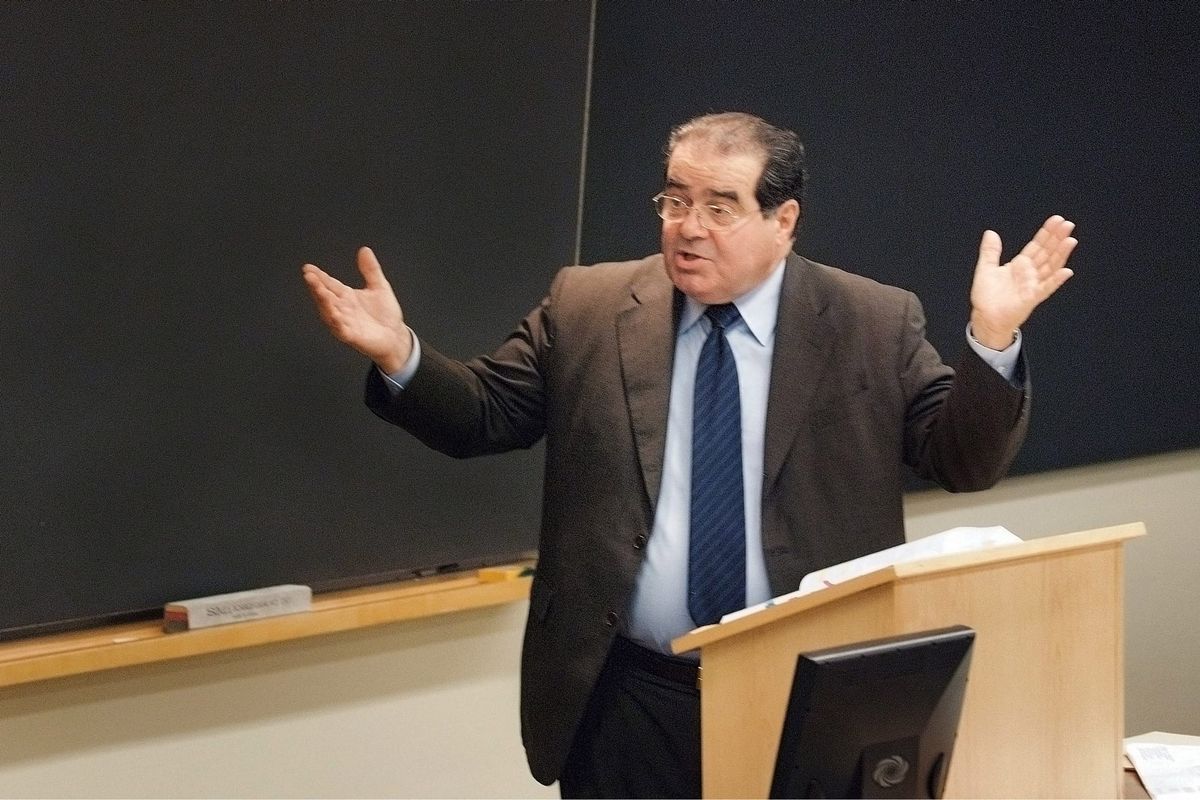
Antonin Scalia had a recurring constitutional nightmare.
Five lawyers discover that the Constitution has changed.
Nobody amended it.
Nobody voted on the change.
Nobody even agrees exactly when the change occurred.
The lawyers simply look at the country, look at the old language, look back at the country, and announce that somewhere during the intervening years the word liberty has learned a new trick.
Then the trick becomes law.
Scalia hated this.
He hated it with the particular intensity of a man who had spent enough time around judges to become deeply suspicious of anything requiring judges to identify the moral spirit of an age.
His objection was serious.
A judge already has one of the strangest jobs available in a republic. A society gives this person an old text, an institutional costume, an enormous amount of coercive authority, and permission to announce which acts of government remain inside the law.
Then someone proposes:
Also, when the text becomes morally outdated, use your best judgment.
Scalia could see the crown from across the room.
His originalism was built partly to keep anyone from putting it on.
The Constitution had meaning. That meaning constrained the interpreter. New technologies and new circumstances could fall under old rules, but the judge could not continuously rewrite the rule to match whichever moral conclusion seemed most enlightened today.
This was the true fragment.
Scalia saw a real sovereignty problem inside constitutional interpretation.
Then he built a very powerful instrument against it.
The instrument was frozen grammar.
And eventually the field began moving underneath the words.
Failed Field Analysts.
A Failed Field Analyst has to see something first.
A person who understands nothing rarely builds an instrument powerful enough to reorganize the field around the mistake.
The dangerous analyst usually begins with contact.
- Robert Moses saw movement.
- McNamara saw systems.
- Kissinger saw stability.
Scalia saw something just as real:
Interpretation can become power pretending to be discovery.
This problem is especially severe in constitutional law because constitutional interpretation does not simply produce an opinion about language.
It authorizes.
It forbids.
It invalidates.
It permits.
It reaches downward into statutes, elections, policing, criminal procedure, property, religion, marriage, speech, guns, schools, administration, imprisonment, and the thousand ordinary places where the state touches a body and says it has permission.
Field Instruments: The Law already gives Modal Path Ethics the necessary warning. Law is one of humanity’s great repair-and-control grammars because justice cannot safely depend on whoever possesses the most force, the strongest memory, or the most persuasive private certainty. Law also performs a Legal Cut: it converts living structure into plaintiff, defendant, property, evidence, standing, right, duty, crime, liability, person. The cut is necessary. The cut is never identical with the field.
Scalia understood half of that problem with unusual clarity.
The judge performs a cut too.
And the judge can begin falling in love with the knife.
A Law of Rules.
Scalia wanted rules.
This sounds less exciting than a theory of justice because rules have terrible marketing.
Nobody carves PREDICTABLE ADMINISTRATION into marble and expects tourists to take unironic photos.
But rules do something civilization desperately needs.
- They bind the next decision to the last one.
- They tell citizens what government claims it can do before government does it.
- They make similar cases answer to similar grammar.
- They preserve an argument across changes in personnel.
- Most importantly for Scalia, a rule can trap the judge inside an earlier commitment.
In his 1989 essay The Rule of Law as a Law of Rules, Scalia argued for general rules over open-ended balancing whenever the law could reasonably sustain them. A judge who announces a governing rule restricts the freedom of the judge who comes later.
Including himself. That was the point.
This is easy to underestimate.
A balancing test sounds humane because it lets the judge see everything.
- Circumstances.
- Interests.
- Consequences.
- Severity.
- Purpose.
- Reasonableness.
- The full mess.
Then, someone has to balance it.
Scalia looks toward the bench.
Ah. Look.
It's the judge again.
How fortunate for the judge.
The rule gives up some perfect responsiveness in exchange for constraint. It accepts that some future case will fit awkwardly because the alternative gives the interpreter continuous permission to decide when awkwardness deserves an exception.
Modal Path Ethics should grant him this argument almost entirely.
Rules preserve reachability.
A person can organize around a rule.
A lawyer can invoke it.
An official can be embarrassed by it.
A dissenter can point to it.
A government that suddenly wants different treatment must explain why the old grammar no longer governs.
A rule can therefore act as stored resistance against power.
Sometimes frozen grammar is exactly what keeps the living field from being eaten.
The Lesser Evil.
Scalia was too intelligent to claim that originalism solved interpretation.
His famous defense was called Originalism: The Lesser Evil.
Not Originalism: We Just Did It Guys, Law Is Finished Forever.
He openly acknowledged that historical inquiry could be difficult enough to resemble a professional ambush. The relevant materials could be enormous. Their meaning could be uncertain. Historical reconstruction could require work better suited to historians than judges. Precedent created complications. A completely consistent originalism could demand results a modern judge found intolerable.
His instrument had visible seams. Scalia saw them.
This gives his position much more force than the cartoon version.
The cartoon says:
People in 1791 did not own thermal cameras, therefore the Fourth Amendment has nothing to say about thermal cameras.
Scalia did not believe this.
His distinction was between meaning and application.
The constitutional grammar could remain stable while new things entered its reach.
A broad rule protecting the home did not need eighteenth-century knowledge of every future surveillance device. The world could produce new objects. The rule could still govern their relation to an old protected boundary.
That is why one of the clearest demonstrations of Scalia’s instrument working involves a machine nobody at the founding could possibly have imagined.
The House Is Still a House.
In 1992, federal agents aimed a thermal imager at Danny Kyllo’s home.
They suspected marijuana cultivation.
The device detected unusual heat patterns associated with the lamps used for growing marijuana indoors. That information contributed to a search warrant. The Ninth Circuit eventually upheld the thermal scan.
The case reached the Supreme Court.
Scalia wrote the opinion holding that the government’s use of sense-enhancing technology unavailable to ordinary public use to obtain information about the interior of a home constituted a search under the Fourth Amendment.
This is Scalia at his strongest.
The old grammar does not stare helplessly at the new machine. It bites it.
The technology changes. The home remains a protected relation. The government cannot escape the constitutional boundary by inventing a better eye.
This is exactly why frozen grammar deserves a defense before Modal Path Ethics starts attacking it.
- A living Constitution can move toward freedom.
- It can also move away.
- Contemporary consensus can widen a right.
- It can also become frightened, furious, militarized, punitive, or very excited about whatever new machine promises to catch the bad people.
Scalia’s rule says:
You still have to go through the door.
The Witness Still Has to Enter the Room.
Then comes Crawford v. Washington.
Michael Crawford was prosecuted after stabbing another man. The state introduced a recorded statement Crawford’s wife had made during police interrogation. She did not testify at trial, and Crawford had no opportunity to cross-examine her.
The existing doctrine allowed testimonial evidence to be admitted when judges determined that it bore sufficient indications of reliability.
Scalia’s Court threw that approach out.
For testimonial statements, the Constitution had already selected the relevant instrument:
- confrontation.
The judicial question was no longer whether the judge found the statement trustworthy enough.
The witness had to be confronted, subject to the historically recognized conditions and exceptions carried by the constitutional right.
The rule refuses a compressed proxy.
Reliability does not become whatever a judge can infer from the document.
The instrument preserves a route back to contact.
- Question the witness.
- Expose contradiction.
- Let the defendant’s side act on the evidence.
- Do not replace the constitutionally selected contact procedure with the court’s confidence that contact would probably have produced the same answer anyway.
Here, Scalia’s frozen grammar prevents the state from converting our evidence seems fine into a substitute for the adversarial path.
This is the true fragment becoming useful.
Then we reach Oregon.
The Neutral Rule.
Alfred Smith and Galen Black were members of the Native American Church.
They used peyote sacramentally.
They lost their jobs and were denied unemployment benefits under Oregon’s rules because the conduct leading to their dismissal involved peyote use. Oregon law contained no religious exemption from its prohibition on possession.
The Supreme Court eventually confronted the Free Exercise question.
Scalia wrote the majority opinion.
His answer was a rule.
A valid, neutral law of general applicability does not ordinarily violate the Free Exercise Clause simply because the law incidentally burdens religious conduct.
You can see exactly why Scalia likes this answer.
The alternative places a remarkable task in the hands of judges.
A person says:
My religion requires an exception.
Now the court has to ask some dangerous questions.
- How important is this practice?
- How sincere is this claimant?
- How much burden counts?
- How central is the practice to the faith?
- How compelling is the state’s interest?
- How narrowly could the law be redesigned?
At the end waits the strange spectacle of the government asking judges to determine which deviations from general law are sufficiently religious to receive constitutional protection.
Scalia does not trust this machine.
Reasonably. The judge is not a theologian. The judge is not the pope.
The judge should probably not acquire a little constitutional clipboard labeled HOW RELIGIOUS IS THIS?
So Scalia reaches for neutrality.
- The rule applies to everyone.
- The judge does not inspect the soul.
- The state does not have to reorganize every generally applicable prohibition around every sincerely claimed religious obligation.
- The judge does not inspect the soul.
Clean. Predictable. General.
And then the rule enters the field.
Neutral Rule, Non-Neutral Field.
- The law applies equally.
- The burden does not.
That distinction is the entire case from the other side.
- For someone who does not use peyote sacramentally, Oregon’s prohibition regulates conduct they may never have intended to perform.
- For Smith and Black, the same prohibition enters a sacred practice.
- The law is formally general.
- The transition is asymmetric.
Congress would later state the problem almost exactly this way when responding to Smith: laws neutral toward religion can burden religious exercise as surely as laws designed to interfere with it.
The rule can be neutral at the level of grammar while becoming highly non-neutral at the level of extance.
This does not prove every religious exemption claim should win.
A religion cannot acquire sovereign exemption from the shared field simply by successfully becoming a religion.
Humanity has enough historical material on that subject to keep everyone busy for several thousand years.
The point is narrower.
Formal symmetry does not establish field symmetry.
The Legal Cut has selected:
- valid law;
- neutral law;
- general applicability;
- religious burden.
Those categories do work.
Then, living people have to inhabit the result.
Scalia built the rule because discretionary adjudication could become judicial sovereignty.
The rule solved that danger by becoming less capable of seeing differential burden.
This is the characteristic Failed Field Analyst move.
- The true fragment remains true.
- The instrument encounters another dimension of reality.
- Instead of bending, the instrument calls the missing dimension someone else’s jurisdiction.
Congress Answers the Court.
Then, the American political field answers.
Congress passes the Religious Freedom Restoration Act.
Its findings explicitly identify Smith. Congress says neutral laws can substantially burden religion and seeks to restore a demanding test: government may substantially burden religious exercise only when it can demonstrate a compelling governmental interest pursued through the least restrictive means.
This is extremely inconvenient for any lazy argument against Scalia.
Because this is exactly what he wants the political system to do.
- The Court interprets the Constitution.
- Citizens and lawmakers dislike the result.
- Congress legislates.
- Correction remains outside the judge.
The democratic branch receives the dispute and changes the legal field through an institution authorized to make law.
Modal Path Ethics should mark the successful correction.
Then the correction itself reaches another constitutional boundary.
In City of Boerne v. Flores, the Supreme Court holds that Congress exceeded its Fourteenth Amendment enforcement power insofar as RFRA was imposed on the states. RFRA remained operative against the federal government, while its attempted general application to state and local governments could not survive in that form.
Now the example becomes much more interesting.
The correction machinery fired.
The correction machinery encountered another piece of the machinery.
- A judicial rule produced a burden.
- Congress responded.
- The response itself was partly invalidated.
- Later statutes and state protections would continue the process.
- The response itself was partly invalidated.
- Congress responded.
This is how actual corrigibility looks.
It branches. It has jurisdiction problems. It produces partial victories, doctrinal migrations, workarounds, reversals, new statutes, new lawsuits, new burdens.
Which is fine.
The important question is whether the paths remain reachable.
Formal Corrigibility.
Scalia’s constitutional order has exits.
He insists on this.
- If a statute is bad, repeal it.
- If a policy is bad, elect someone else.
- If a Constitution no longer says what a society wants its Constitution to say, amend it.
This is genuine corrigibility.
It is also only one layer of corrigibility.
Modal Path Ethics distinguishes possibility from reachability.
A future can remain formally available while the actual path to that future has become prohibitively narrow, costly, dangerous, remote, or dependent upon conditions the affected locus does not possess.
The existence of the route on paper does not establish usable access to the route.
That is one of the core claims of the framework itself.
So we need two kinds of constitutional correction.
- Formal corrigibility means a recognized legal mechanism exists through which the rule can be changed.
- Reachable corrigibility asks whether the field can actually use it.
That difference is devastating.
A constitutional amendment is possible.
So is becoming an astronaut.
The statement contains almost no useful information about whether either transition is reachable from where a particular person currently stands.
Article V can remain printed in perfect condition while the political threshold required to use it becomes extraordinary.
A legislature can possess formal authority to repair a burden while agenda control, polarization, geography, money, institutional vetoes, party incentives, public ignorance, electoral structure, or simple indifference prevent the burden from entering legislation at all.
An election can technically offer correction while the people carrying the harm are too small a constituency to command a majority.
A right can exist while enforcement is expensive enough to make the right a decorative object for poorer citizens.
The exit remains on the blueprint.
There can still be concrete poured in front of the door.
Scalia’s model is strongest when the democratic correction machinery works.
Modal Path Ethics asks what happens when the grammar points toward a repair path that the harmed locus cannot realistically reach.
The American Correction Machine.
This question already belongs inside the published Modal Path Ethics corpus.
The American Corrigibility Problem defines corrigibility as the ability of a political field to discover harm, record it, argue about it, litigate it, vote on it, investigate it, reverse bad policy, remove harmful agents, preserve dissent, constrain violence, and transfer power without needing collapse.
Its central claim is that correction is the deepest moral function of democratic law.
This puts Modal Path Ethics very close to Scalia at first.
A court cannot safely impersonate the entire correction process.
Correct.
Neither can a legislature.
Neither can a president.
Neither can an election.
Neither can historical meaning.
Neither can public opinion.
Neither can the nine people who happen to have the nicest constitutional office that morning.
The field needs several instruments because every instrument contains characteristic blindness.
Scalia’s mistake begins when one danger becomes privileged enough to organize the whole architecture:
- judicial sovereignty.
Which is a genuine danger.
Then another danger enters:
- blocked correction.
His instrument does not have the same sensitivity there.
The Selector Never Left.
There is another problem hiding inside originalism.
Somebody still has to do it.
This is not the devastating objection people sometimes want it to be.
The existence of interpretation does not make meaning imaginary.
A sentence can constrain readers even when readers must interpret the sentence.
History can constrain judges even when judges must reconstruct history.
Words are not clouds that become whatever ideology breathes into them.
Scalia is right to resist that move.
Still:
The selector never left.
The originalist must
- identify relevant historical sources.
- Determine their weight.
- Distinguish ordinary public meaning from specialized usage.
- Decide which surrounding practices illuminate meaning.
- Decide which surrounding practices demonstrate the injustice a provision was adopted to overcome.
- Select the appropriate level of generality.
- Separate original meaning from expected application.
- Relate precedent to the recovered meaning.
- Apply the recovered rule to technologies, institutions, and social structures that did not exist in recognizable form at ratification.
- Relate precedent to the recovered meaning.
- Separate original meaning from expected application.
Scalia himself acknowledged how difficult historical reconstruction could become.
So originalism does something valuable:
- It constrains discretion.
It does not abolish discretion.
The difference matters.
A judge can still hide inside history.
A judge can still choose the altitude from which the old language is viewed.
A judge can still become overconfident in a reconstruction assembled from a field that no longer has living witnesses.
The archives answer. The archives also contain gaps.
The frozen grammar needs a reader.
That reader is still wearing the robe.
Nine People Discover America.
Then comes Obergefell v. Hodges.
In 2015, the Supreme Court held that the Fourteenth Amendment requires states to license marriages between two people of the same sex and recognize lawful same-sex marriages performed elsewhere.
Scalia dissented.
His dissent is basically the nightmare from the beginning of this article finally receiving its own case number.
Before Obergefell, voters and legislatures in a number of states had already changed marriage law to recognize same-sex couples, while many others had not. Scalia argued that this was precisely the kind of contested social question the democratic process was supposed to continue working through. He viewed the Court’s intervention as an illegitimate transfer of the decision from the people to an unrepresentative judicial body.
He called the decision a “judicial Putsch.”
Scalia occasionally wrote as if the dissenting opinion needed to survive combat after publication.
The theatrics should not obscure the argument.
He is asking:
Who exactly authorized these five people to complete this social transformation for everyone?
That question is legitimate.
A constitutional democracy should be frightened by any institution that can convert its own moral confidence directly into supreme law.
Including an institution producing a result we approve of.
Especially then.
Because The Golden Rule supplies the stress test:
A logical move is also logical against you.
An action-logic endorsed from one seat enters the shared field and becomes available when another actor occupies the seat later.
If five judges may identify a morally urgent transformation and constitutionalize it against resistant majorities, the rule survives after the judges change.
Scalia sees that.
Now rotate the board.
The Other Sovereignty Problem.
A same-sex couple lives in a state that refuses them civil marriage.
Scalia says the argument should continue through democratic politics.
There is a correction path.
- Organize.
- Persuade.
- Vote.
- Legislate.
- Lose.
- Legislate.
- Vote.
- Persuade.
- Organize again.
- Win later.
This is real politics.
This is also real time.
The couple living under the rule does not occupy democratic history as an abstract spectator.
They age.
They have children.
They acquire property.
They enter hospitals.
They inherit.
They separate.
They reconcile.
They die.
The law acts while the debate continues.
This is where the other sovereignty problem appears.
A majority can also impersonate the field.
A majority can keep telling a smaller locus that correction remains available through a process whose success depends upon persuading the majority that the smaller locus should receive the protection being withheld.
That does not automatically mean the court should intervene.
It means Scalia has only solved one side of the sovereignty problem.
Judicial sovereignty says:
We know the right answer, therefore we may end the democratic argument.
Majoritarian sovereignty says:
You may receive correction when enough of us agree that your burden deserves correction.
Both can close the field.
The hard constitutional problem is deciding when democratic disagreement remains legitimate political contest and when continued contest has become the mechanism by which a protected locus is kept outside reachable repair.
Scalia gives us a powerful warning against the first failure.
His grammar has far less to say about the second.
History Has Weight.
This does not mean history should be discarded whenever the present becomes morally impatient.
A constitution exists partly because every generation should not be allowed to improvise the conditions of power from scratch.
The dead get a vote here for a reason.
They already watched some things happen.
They watched governments arrest enemies.
They watched majorities panic.
They watched factions seize institutions.
They watched officials invent convenient exceptions.
They watched power discover emergency.
They wrote some walls down.
Later generations inherit the walls.
Sometimes this is deeply annoying.
This is good.
A wall that never inconveniences power is probably decoration.
Scalia’s great contribution is insisting that inherited grammar can resist contemporary appetite.
Kyllo shows why this matters.
Crawford shows why this matters.
The problem arises when inherited grammar moves from constraint to sovereignty.
- A rule can preserve a lesson.
- A rule can also preserve the shape of an earlier exclusion.
- History can carry memory.
- History can carry damage.
The fact that a practice was widespread when constitutional language entered the field may help reconstruct what the language meant.
It does not settle the moral status of the practice.
Modal Path Ethics needs both sentences alive at once.
Scalia was excellent at protecting the first from erasure.
The second kept banging on the courthouse door.
Frozen Grammar.
Now the failure can be named cleanly.
Frozen grammar is a legal instrument that protects correction by keeping interpretation from drifting entirely into current preference.
That is its virtue.
The failure begins when fidelity to the inherited grammar becomes sufficient evidence that the correction field remains healthy.
- The grammar says the amendment process remains open.
- The field says the amendment is unreachable.
- The grammar says the statute applies equally.
- The field says the burden is radically asymmetric.
- The grammar says the political process can correct this.
- The field says the affected locus has been losing inside that process for generations.
- The grammar says the judge lacks authority.
- The field says someone still has authority right now, and the burden is already being imposed.
- The grammar says history fixes the rule.
- The field asks which parts of that history were already structurally closed when the rule was made.
Scalia’s answer is frequently jurisdictional.
Perhaps these are real problems.
They belong elsewhere.
That restraint can be honorable.
It can also become a way for a legal instrument to acknowledge the wound while refusing contact with whether the designated repair route actually exists in usable form.
The map contains the road, but the road is gone.
Scalia Is Annoyingly Right Again.
There is a temptation here to escape the whole problem by declaring the Constitution living.
Modal Path Ethics declines the move.
We already have enough priests.
A living Constitution administered by judges can become a constitutional oracle.
- The social field changes.
- The oracle senses the change.
- The oracle announces which old words have secretly changed with it.
- Everyone thanks the oracle for preventing dead people from governing the living.
- Then the oracle receives another case.
- Everyone thanks the oracle for preventing dead people from governing the living.
- The oracle announces which old words have secretly changed with it.
- The oracle senses the change.
This is not adequate.
Scalia’s problem survives Scalia.
Judicial power needs constraint.
Text matters. Historical meaning matters. Rules matter. Precedent matters. Democratic authorship matters. The fact that an unelected judge feels morally certain is not a constitutional amendment. A jurisprudence that cannot explain why the judge must sometimes lose to the text is a jurisprudence building a throne.
Scalia saw the throne.
Modal Path Ethics agrees it should remain empty.
Then Modal Path Ethics keeps looking around the room.
There are several other chairs in here.
A Logical Move Is Logical Against You.
Run Scalia through the Golden Rule from both directions.
First:
Judges may reinterpret constitutional guarantees whenever contemporary moral judgment strongly favors a new understanding.
Scalia asks:
- What happens when the judges are people you hate?
The move remains logical against you.
A jurisprudence that feels liberating with five sympathetic judges can become a weapon with five hostile ones.
Now the second move:
Historically fixed meaning governs until correction occurs through the authorized political process.
Turn the board.
- What happens when the inherited grammar preserves your exclusion?
- What happens when your recognition depends on a political majority whose power is partly constituted through the inherited arrangement?
- What happens when your repair route exists in theory and not in reachability?
- What happens when the political process Scalia asks you to use is itself the field under complaint?
The move returns.
Scalia wins his own argument halfway around the board.
Modal Path Ethics completes the rotation.
- The judge cannot become sovereign because the judge believes the field needs correction.
- The inherited grammar cannot become sovereign because the grammar says correction is someone else’s job.
No instrument gets self-exemption.
The Fragment.
The Failed Field Analyst ruling should therefore preserve Scalia’s true fragment in full.
Rules are protective technology.
Stable rules can restrain discretionary power, preserve equal treatment, improve predictability, and keep officials from redesigning the legal field around the favored outcome of the present case.
Text constrains.
The words enacted by an authorized legal process cannot become infinitely plastic without transferring lawmaking authority toward the interpreter.
History is evidence.
A legal text entered a real linguistic and institutional field. Historical evidence can constrain fantasy about what that text was doing.
Judges are dangerous.
Judicial independence is a protection against politics.
Judicial supremacy can become another form of politics protected from ordinary correction.
The distinction cannot be ignored because the judges happen to reach a good result.
Democratic correction matters.
Law needs authorized ways to change.
Legislation, elections, amendment, public argument, federalism, and institutional iteration are genuine repair channels rather than annoying obstacles standing between the wise person and the correct outcome.
Generality matters.
A rule written for enemies eventually governs friends.
A standard invented for the sympathetic case eventually reaches the unsympathetic case.
The legal instrument should survive that rotation.
Scalia was right about all of this.
The article could end here if every formally available correction path remained reachable.
They do not.
The Corrected Instrument.
Modal Path Ethics does not need to invent a complete constitutional jurisprudence inside the corpse of Antonin Scalia.
The corrected instrument is smaller.
- Law needs constrained interpreters and reachable correction.
Both.
Text constrains the judge.
History constrains the text’s reconstruction.
Precedent preserves accumulated reliance and institutional memory.
Rights constrain majorities.
Democracy constrains judges.
Courts constrain government.
Amendment constrains constitutional permanence.
Federalism can preserve competing repair sites.
Public records preserve the trace.
Dissent preserves rejected paths for later recovery.
No one of these instruments becomes the field.
The practical audit then asks an additional question Scalia’s architecture does not ask often enough:
The correction path exists. Can the affected locus reach it?
This does not give a judge permission to do anything.
It makes reachability itself part of constitutional field intelligence.
How difficult is the supposed political correction?
Who controls entry to it?
Who bears the burden while correction is pending?
Can the affected group participate meaningfully?
Has the process repeatedly converted the same burden into permanent deferral?
Would judicial intervention preserve future democratic contest, or consume it?
Would judicial restraint preserve democratic correction, or protect a lockout?
What kind of precedent will either move generate for the next seat?
These questions do not eliminate judgment. Nothing does.
They make the judgment answer to more of the field.
That is the correction Scalia’s rule-machine needs.
The Rule Must Be Able to Lose.
Scalia wanted the judge to lose sometimes.
A serious legal instrument requires this.
The judge loses to text.
The judge loses to precedent.
The judge loses to democratic authority.
The judge loses when the desired policy simply is not constitutional law.
The interpreter must be capable of receiving an answer they dislike.
That is one of the great virtues of Scalia’s project.
The missing symmetry is that the rule must also be able to lose.
History must lose when better historical evidence appears.
A precedent must lose when its rule has become indefensible under the legal structure that produced it.
A generally applicable rule must sometimes lose when its field effects expose a burden the grammar failed to represent.
A democratic outcome must lose when it destroys the conditions under which some loci can remain political participants.
A constitutional interpretation must lose when it preserves a formal correction route whose practical collapse has become part of the case.
And Modal Path Ethics must lose whenever this language starts becoming another clever excuse to do whatever Modal Path Ethics already wanted.
The Crown.
Scalia spent much of his career staring at a crown.
It sat above the bench.
It was made from good intentions, moral confidence, vague language, balancing tests, elite consensus, and the seductive belief that someone has to finish the argument.
He wanted rules strong enough that judges could not reach it.
He was right.
Then. he built his instrument around that danger so tightly that another crown became harder to see.
The crown of inherited grammar.
The rule that keeps governing because it still has a legal name. The correction route that stays theoretically open long after its bridge has washed out. The neutral law whose burden becomes visible only after the rule enters different lives. The historical practice that moves from evidence of meaning toward authority over the future. The political process that remains formally available while some people live beneath its unresolved answer.
A field can be frozen in language while continuing to move underneath it.
Eventually the mismatch becomes the case.
Diagnosis.
Antonin Scalia was a Failed Field Analyst because he saw one of the deepest problems in law.
The interpreter can become sovereign.
A judge can take an old text, pour contemporary moral judgment through its open spaces, and return the result as though the Constitution itself had spoken.
Scalia built constraints against that.
He showed that an old constitutional protection could reach a thermal imager.
He showed that a procedural guarantee could defeat a judge’s confidence that unconfronted testimony was reliable enough.
He refused to make judges permanent theological exemption boards.
He understood that a legal logic built for the case you love survives into the case you hate.
These were substantial achievements.
Then the instrument hardened.
A neutral rule could become deeply asymmetric in the field.
A historical rule could preserve the shape of earlier exclusion.
A political repair path could remain formally open while practical resistance made correction remote.
The selector remained inside originalist interpretation even after originalism had been built to constrain the selector.
And when the field pressed harder than the grammar could answer, Scalia’s favorite response was often jurisdictional:
The Constitution does not authorize me to fix this.
Sometimes that was exactly right.
Sometimes the sentence left the wound standing beside a perfectly valid map to a road nobody could reach.
That is the frozen grammar.
Ruling.
Antonin Scalia did not fail because he believed law should have rules.
Law needs rules.
He did not fail because he thought words have meaning.
Words have meaning.
He did not fail because he distrusted judicial moral confidence.
Judicial moral confidence deserves distrust.
He failed where an instrument designed to stop the judge from becoming sovereign became too willing to trust that the inherited grammar and its formal correction procedures were enough to keep sovereignty distributed.
They are not always enough.
The judge is not the field.
The legislature is not the field.
The majority is not the field.
History is not the field.
The Constitution is an instrument inside the field.
It is not the field either.
The field remains beneath all of them: living people, institutions, histories, burdens, rights, technologies, exclusions, conflicts, repairs, and futures still trying to become reachable through the grammar they inherited.
Scalia saw the crown on the judge and spent a career trying to knock it off.
Keep that. Then check the rulebook for crowns too.