Applied Case: The Missing Link
I cannot stop thinking about Joe Martin. [L]

September 2026 note: Joe Martin remains a clear strong-locus case and an indictment of treating expressive legibility as the gate to moral depth. Later locus work is stricter about what counts as a locus, but embodied animals with diachronic integration, vulnerability, memory, relation, and nonredundant successor structure remain central cases.
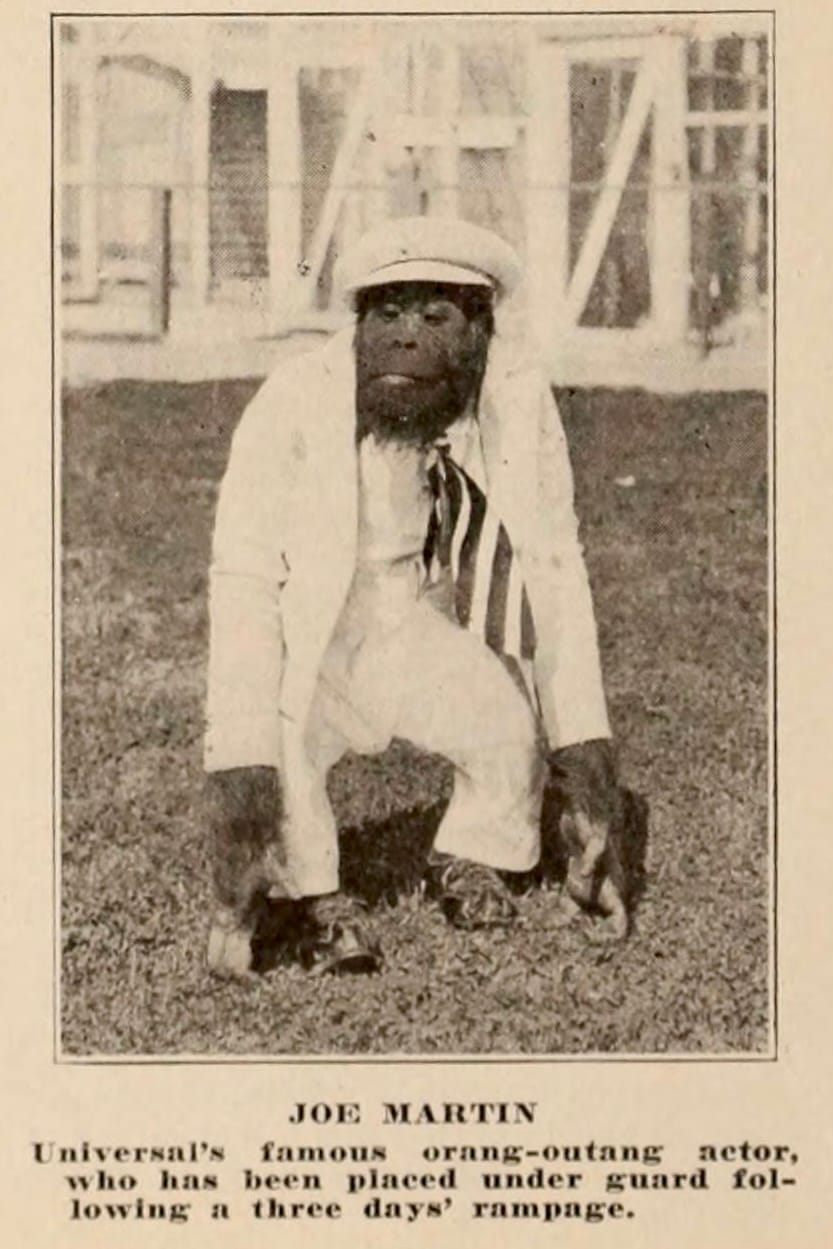
In 1919, an orangutan named Joe Martin attended a screening of one of his own feature films dressed in a suit and carrying a cane.
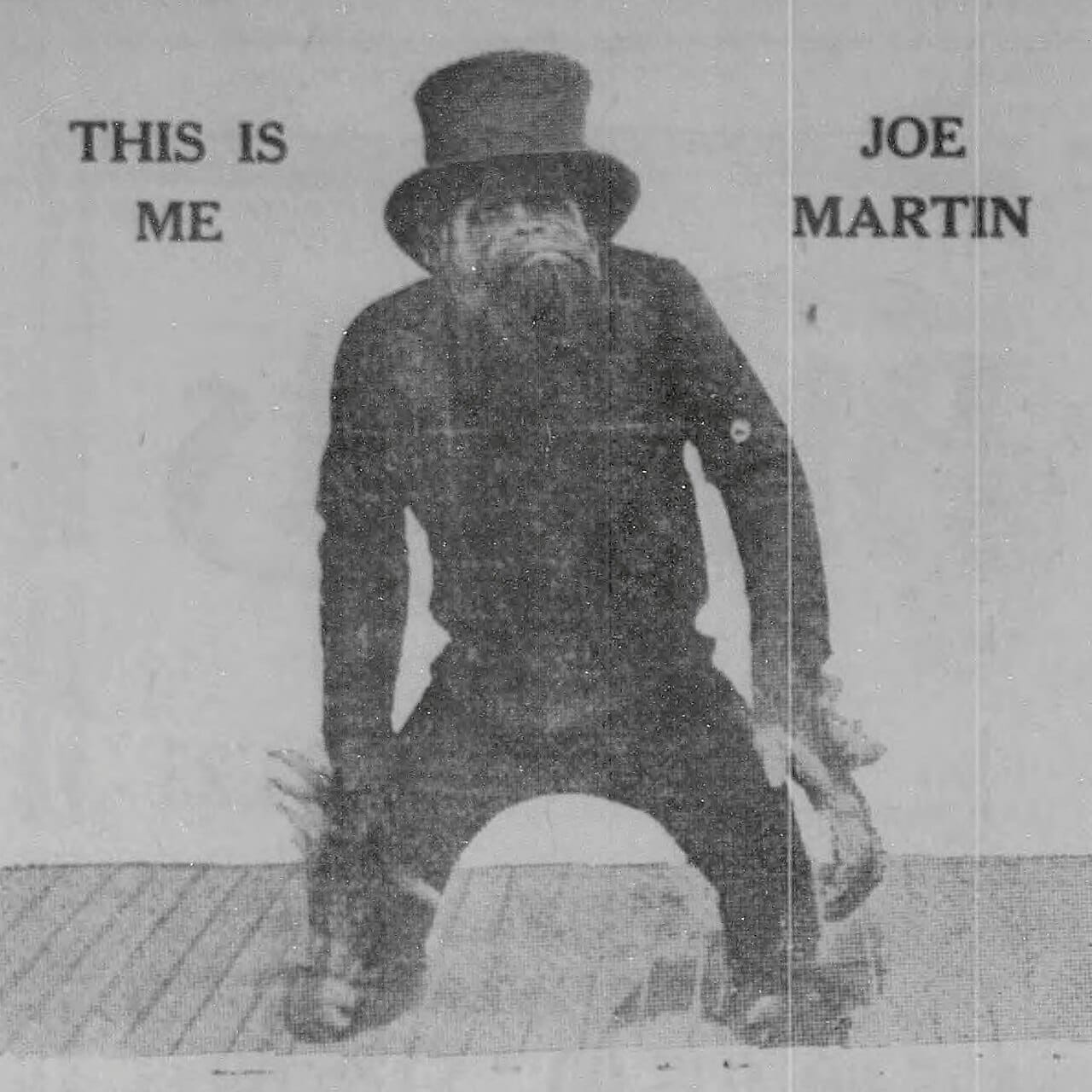
Joe watched the funny ape on the screen with apparent delight. He clapped and he laughed. Then, according to a contemporary account, he began looking back and forth between his own hands and the orangutan projected in front of him, as if trying to resolve some unbearable new relation he was forming between the two. Around this same period, another report claimed Joe Martin began combing his own hair with his fingers and turning his mirror away from himself whenever he was in a bad mood.
Whether every single flourish of that story is perfectly true in the literal journalistic sense does not matter very much to me here.
I cannot stop thinking about Joe Martin.
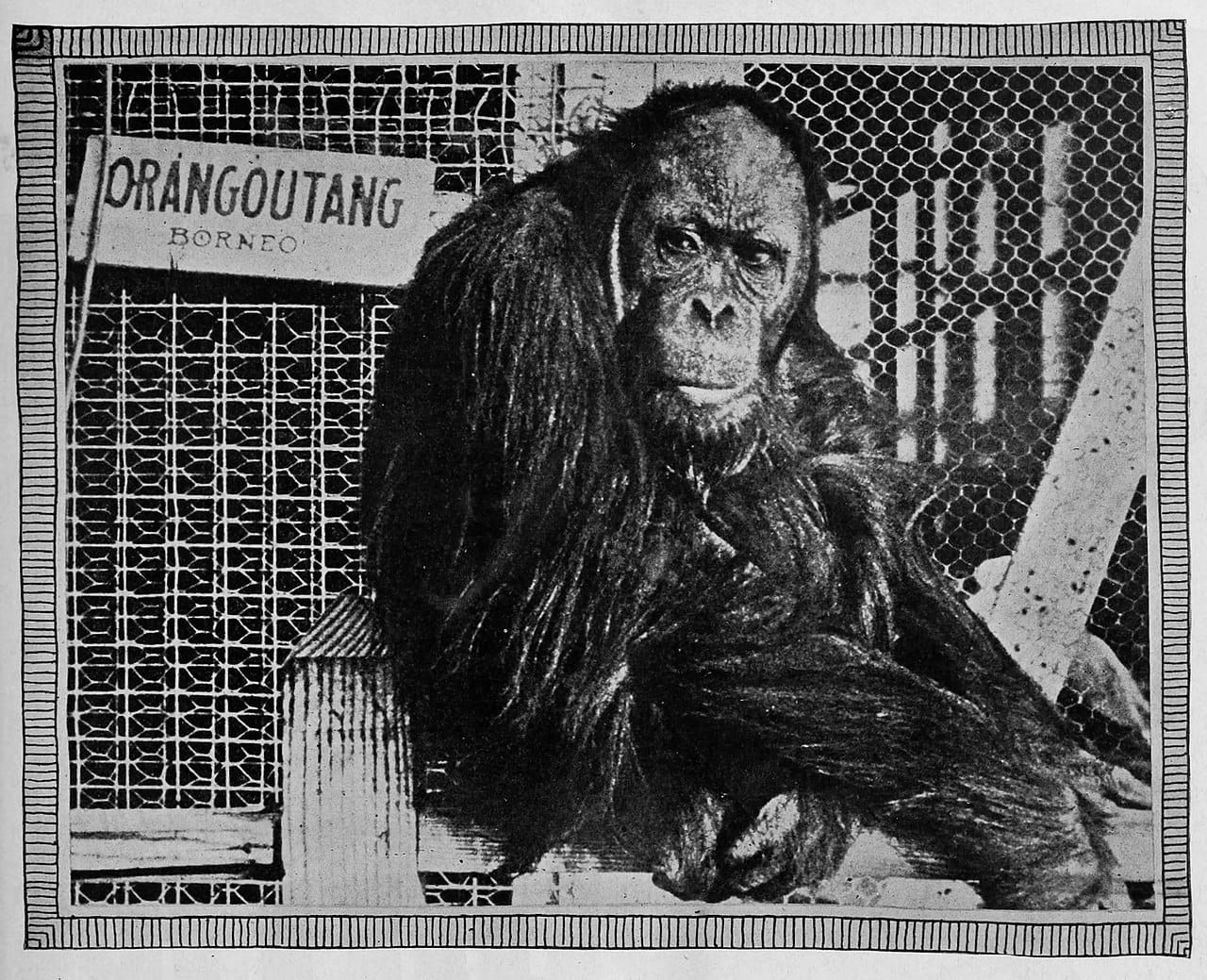
By the time Joe sat down in that theater, early Hollywood had taken a captured infant orangutan, killed his mother in front of him, dragged him across the sea, dressed him in clothes and shaved him weekly, trained him to sit at tables and shake hands and use props and obey cues and imitate human decorum, exposed his eyes (adapted for the forest canopy) to studio lights dangerous for humans, made him known to the public as whatever persona fit what they wanted most in the moment, and then acted increasingly surprised when the increasingly intelligent, increasingly attached, and increasingly damaged mind they had placed inside that fucked-up arrangement began to exhibit some startling behaviors.
What happened to Joe Martin is one of the best Applied Cases I have yet found to demonstrate the real-life value of Modal Path Ethics, because this framework has zero trouble jumping into this situation at all. Many moral frameworks need to do their personhood paperwork before they can legally care about Joe Martin. They need to establish whether he is sufficiently person-like, sufficiently rational, sufficiently linguistic, sufficiently reciprocal, sufficiently self-conscious, sufficiently rights-bearing, or sufficiently close to us in whatever particular way their theory happens to require he present to them first. Before they could talk about the horror of what happened to Joe Martin, they would need to contort themselves into the monkey enclosure and ask: but was he enough of a person to count for me?
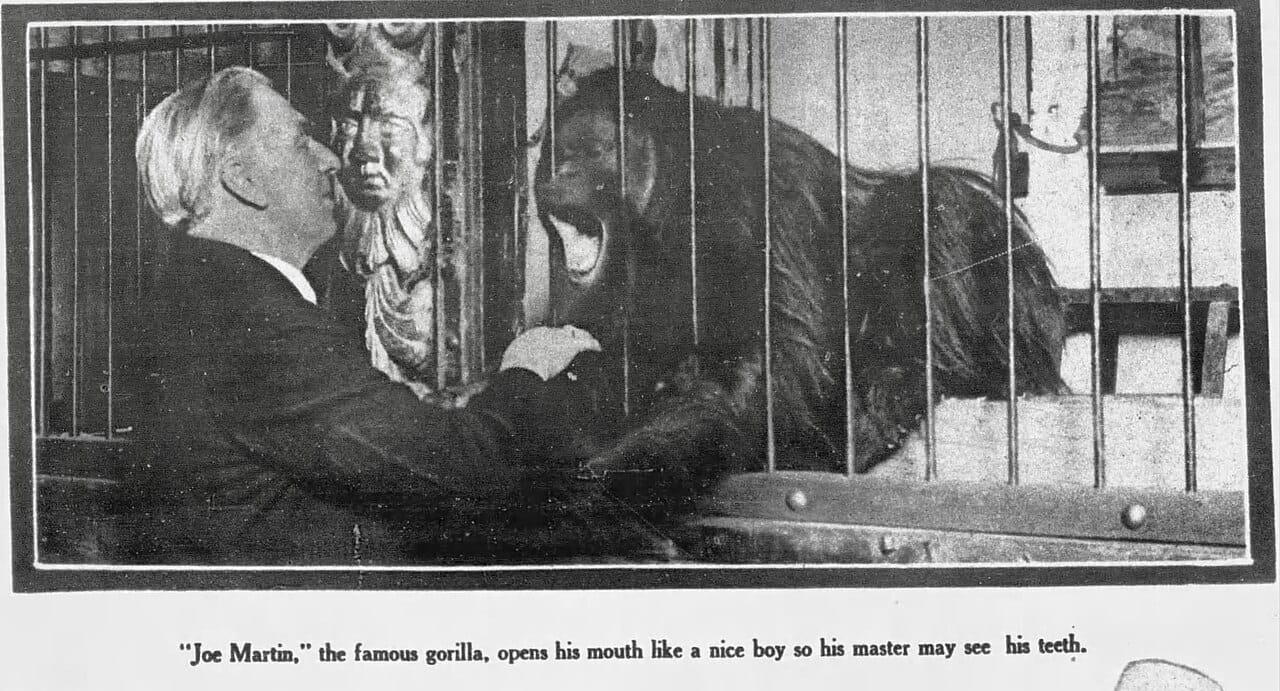
Modal Path Ethics does not need to do any of that ridiculous bullshit.
Joe Martin is an extant locus with its own attachments, aversions, learned expectations, social bonds, pain, fear, memory, anticipation, desires, and a navigable but very vulnerable future-space. Joe Martin can be harmed because his reachable futures can be shown to be contracted. Joe Martin can be damaged because the field around him can be arranged such that what remains reachable to him is increasingly violent, narrow, painful, confusing, and dependent on outside forces he cannot meaningfully contest.
This framework does not have to stretch or squint to see Joe. It reaches him faster than any human-centered theories would because it is aimed at the right level of structural analysis to begin with. Joe Martin is not a hard case for Modal Path Ethics.
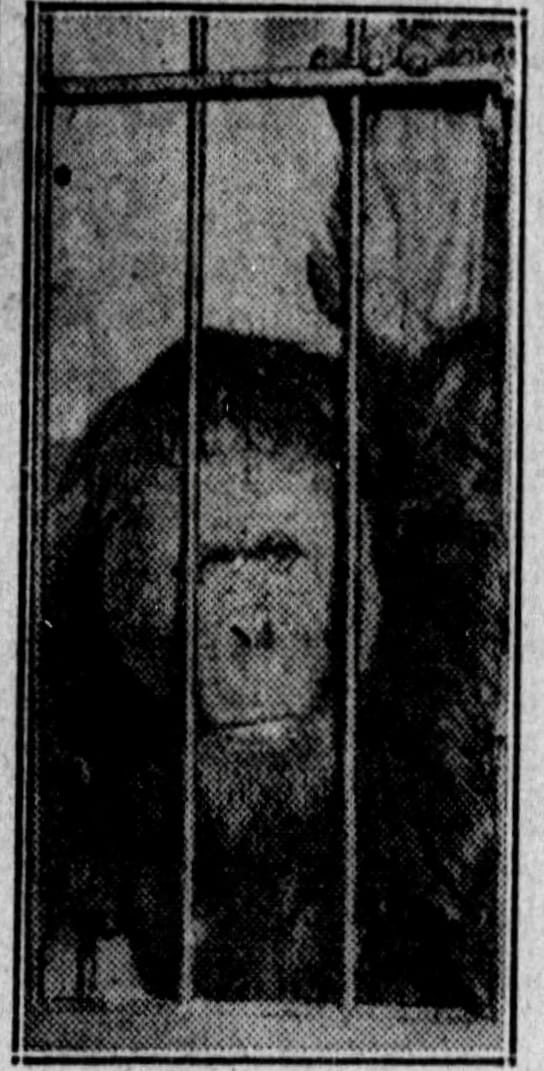
He is a disturbing one, though.
The Missing Link.
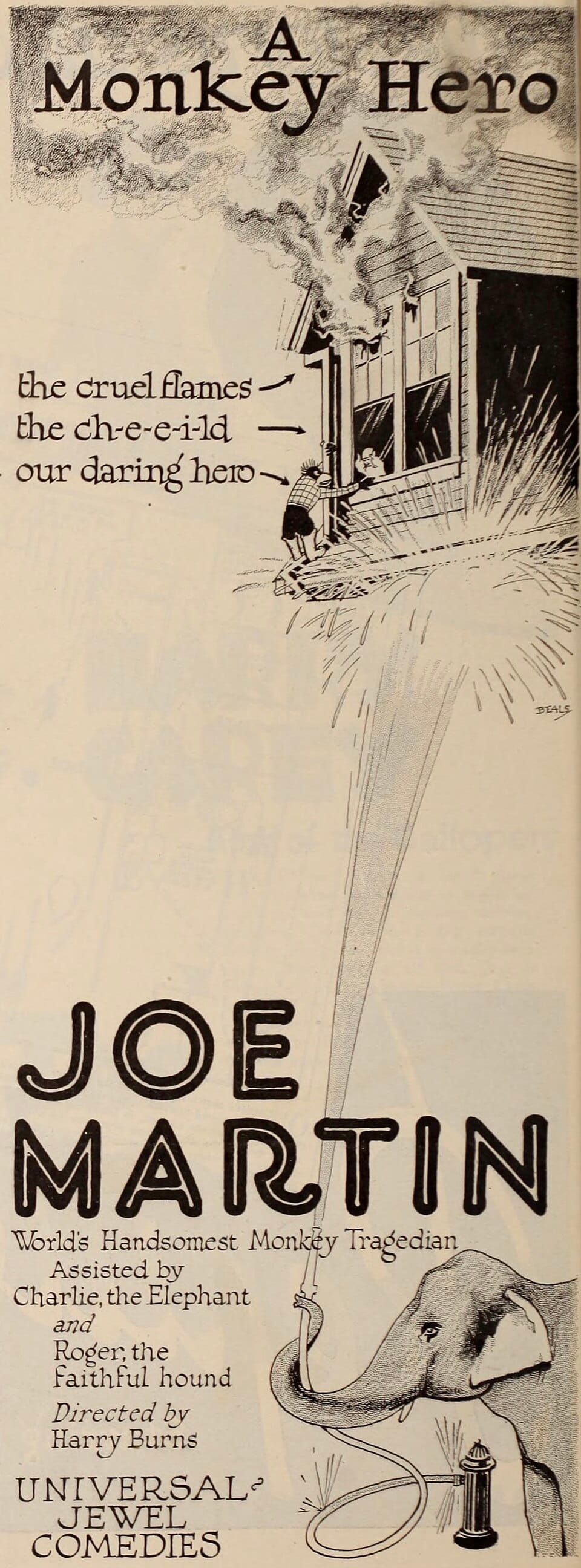
Joe Martin was captured in Borneo in 1913 at around three months old. His mother was murdered in front of him. He was then transported across the ocean with many other animals, most of whom died in cages en route, and was eventually purchased into an American entertainment pipeline that first exhibited him as “The Missing Link”. He was later refashioned into a silent-film star.
That paragraph alone contains enough harm for a respectable philosophy department to waste fifteen years arguing over the right terminology to describe it all, but in Modal Path Ethics we can keep it fluid.
Joe Martin was plucked from the field he was optimized to thrive in, then placed in the human world, through an incredibly harmful intervention involving infant trauma, maternal loss, forced relocation, mass death, confinement, and total dependency.
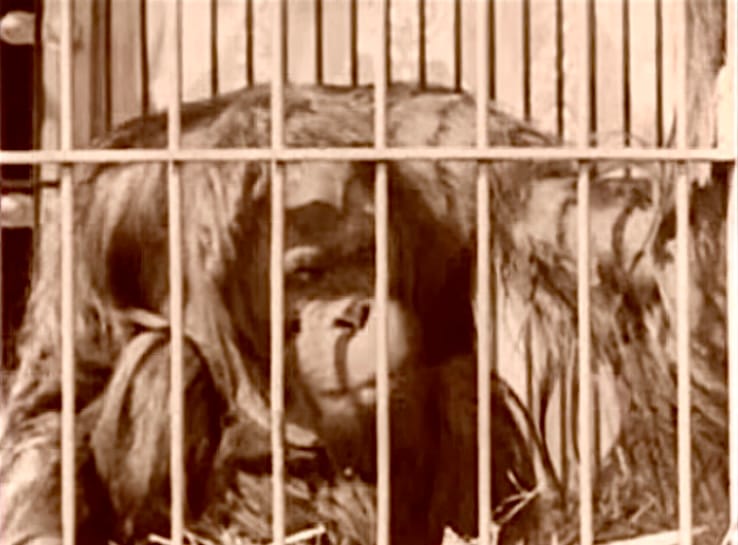
Joe Martin's possibility space has been contracted. His local field is now heavily damaged.
Joe Martin as an extant locus has been narrowed before Hollywood even gets their hands on him, already separated from his own kind and thrown into a foreign and coercive environment in which every meaningful continuation of his life now depends on the intentions of a species that has decided to turn him into a public spectacle.
The common sentimental lie about animal exploitation is that the human appears as an organizer, caretaker, civilizer, or benevolent guide entering into a neutral or chaotic natural situation involving an animal and then making it legible through work. This is a fiction we tell to compress the situation. The real structure is usually the exact reverse. The human institution is what creates the distortion in the field in the first place, then narrates its own harmful management of that distortion as stewardship.
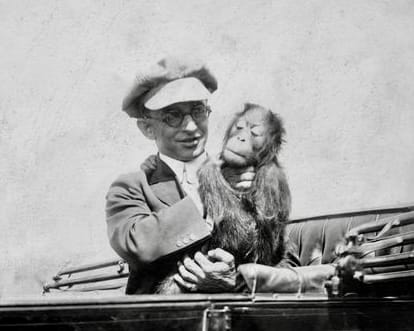
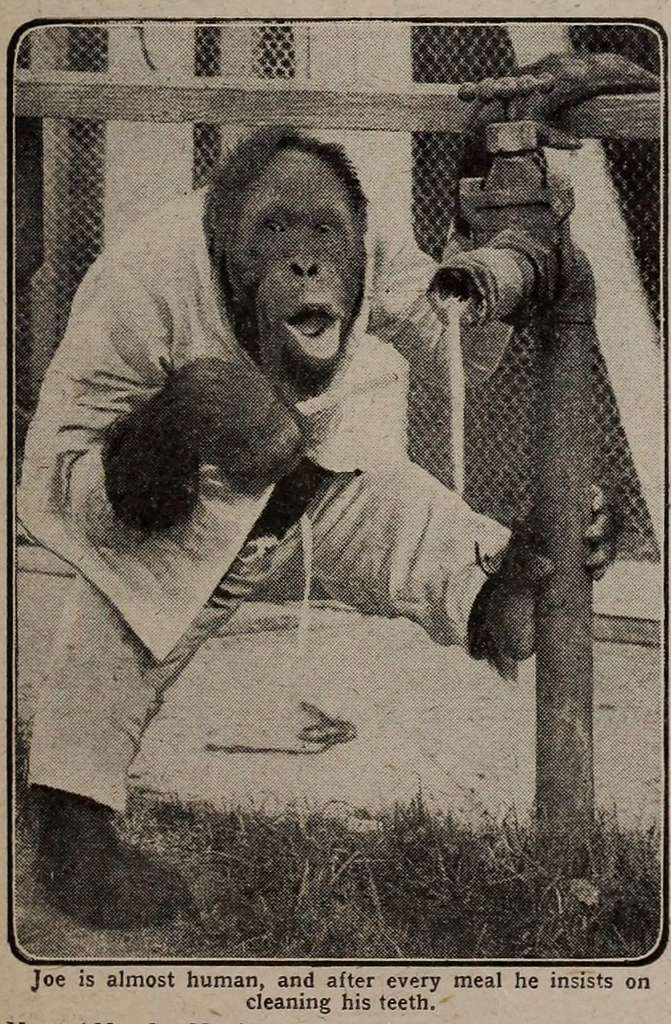
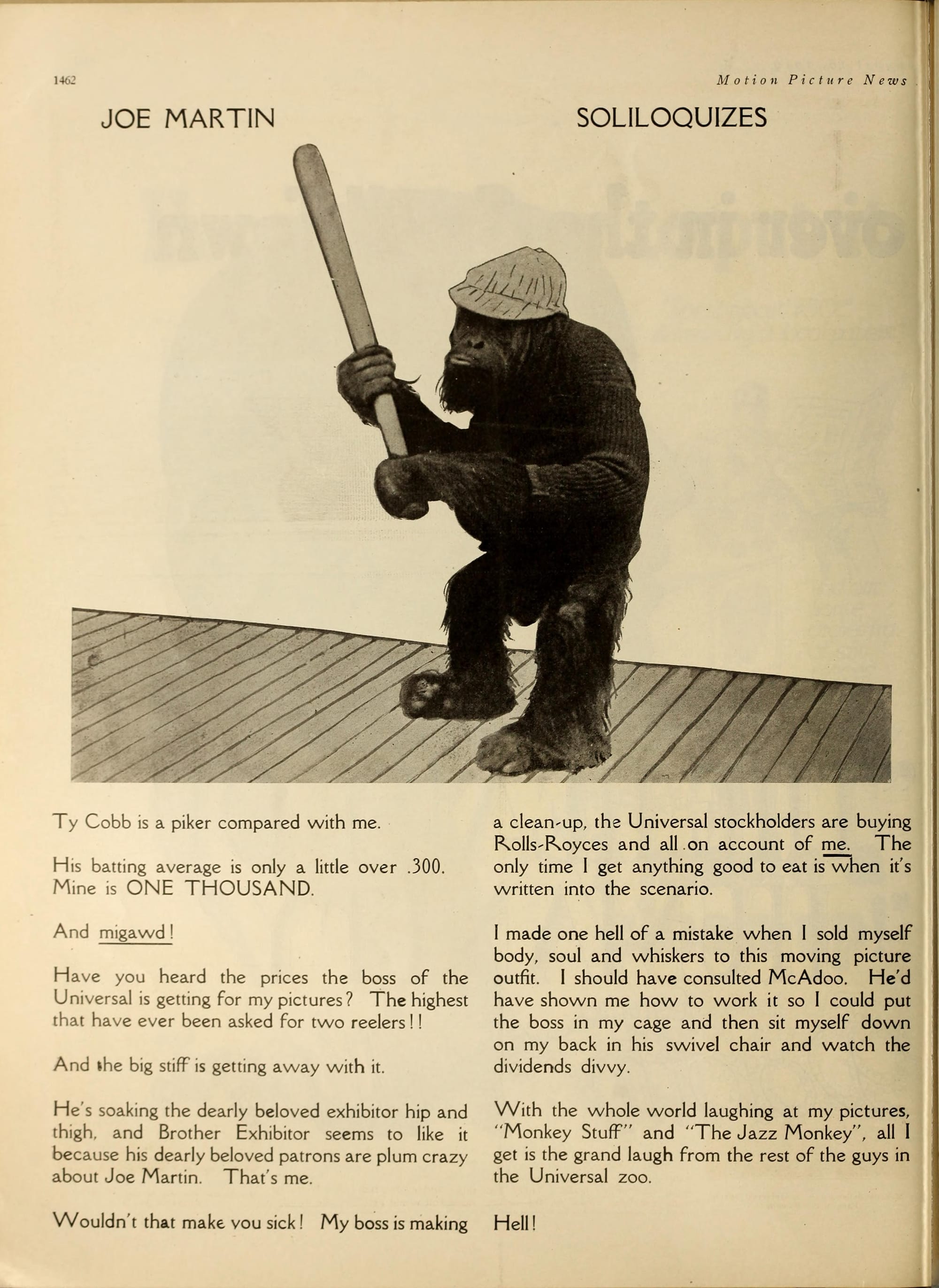
Joe was first exhibited at Venice Pier as “The Missing Link,” which is already wonderful. Joe is now introduced not as a singular being with his own life, which he is, but as some type of categorical error we found, now marketable to human curiosity: not quite animal, not quite human. He is then what is called “human-acculturated,” meaning he was dressed in clothes, shaved weekly, taught staged etiquette, props, cues, and generally how to occupy the outer shell of a human social role without ever being allowed any of the protections such a role would normally imply for him.
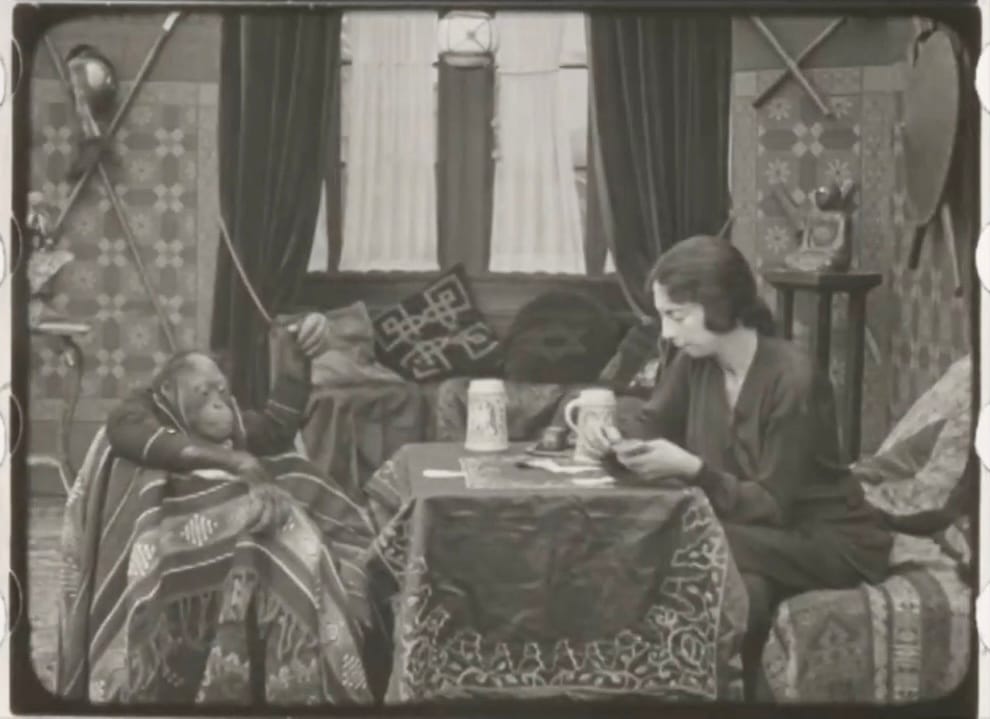
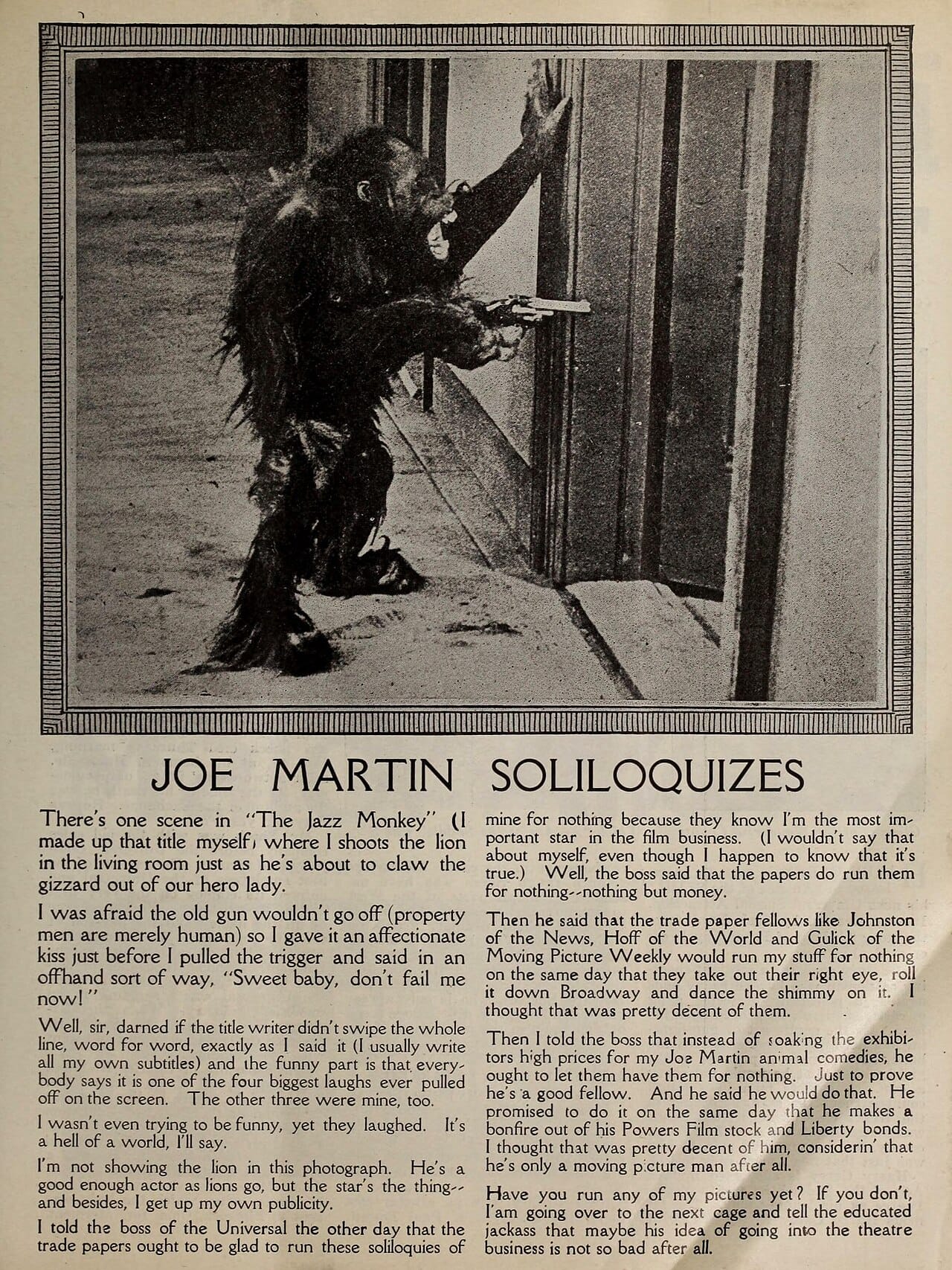
This is the primary violence of Joe Martin’s life, depicted above. Joe's field was pseudo-humanized solely for value extraction by a much larger field than he.
That is worse than simple cruelty because it requires a more intimate form of vampirism. A guy punches a horse, and everyone understands the relation between action and harm very quickly. Hollywood did something much more sophisticated and sinister to Joe Martin. It selectively invited him into the perimeter of human meaning wherever doing so would have made him more profitable, emotionally gripping, funny, uncanny, or narratively convenient, and then expelled him from that perimeter the moment implicit responsibility would otherwise follow.
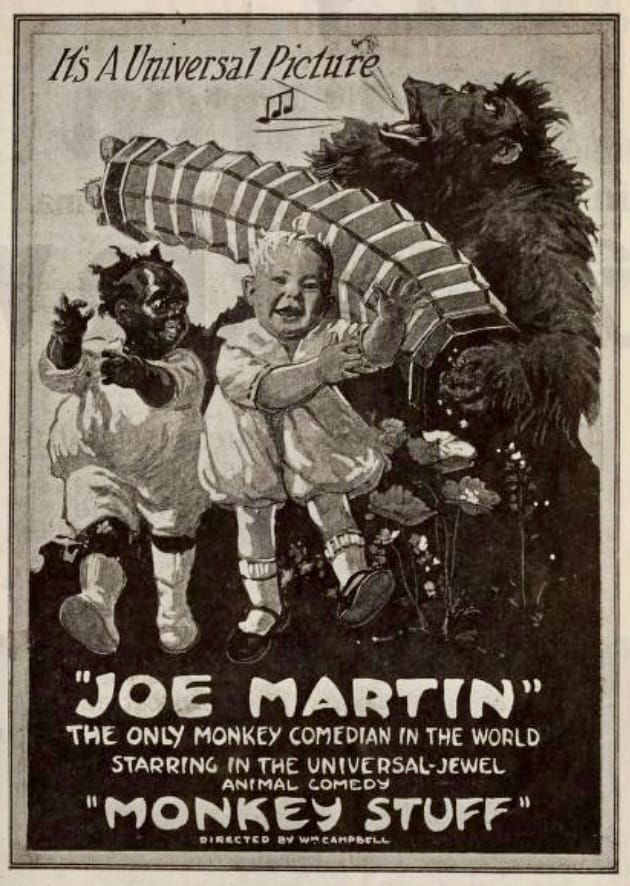
Joe Martin is a gentleman when publicity needs him to be charming.
Joe Martin is a celebrity when the studio wants some attention.
Joe Martin is an actor when audiences will buy tickets.
Joe Martin is just a child when that sentimentality helps keep him around.
Joe Martin is just a beast when he becomes too expensive and unruly.
Joe Martin is insane when the damage we have done to his field starts showing.
The classification changes from scene to scene because the only purpose of the classification is managerial convenience.
The Human Confusion.
The deepest horror in this case is that Joe was trained to approach a human social role and mode of cognition while remaining structurally trapped as chattle.
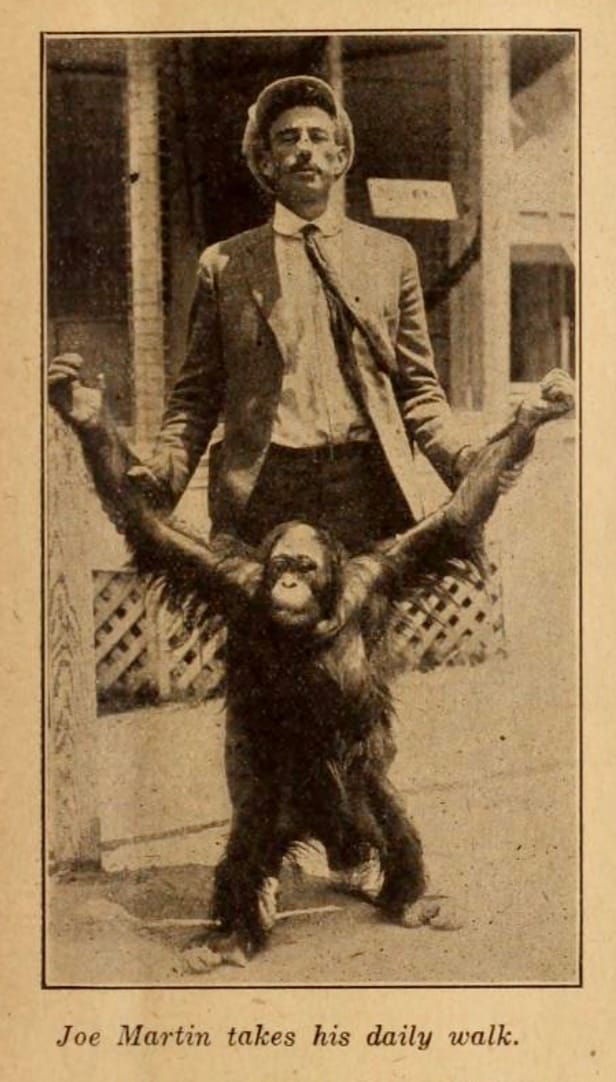
Joe was reportedly given a key to his own cage and seen working faucets by himself. Directors who worked with Joe almost all remarked that he seemed to understand what they asked him to do. Accounts describe him listening in on scene-planning conversations and then performing what he had heard described, in order to demonstrate. Joe Martin shook hands, used cutlery, tied a napkin around his neck, maintained table decorum, responded to tone and command, selected the right keys from a ring, and later even checked his own mail, choosing envelopes by their color and stamp density and opening them carefully without ripping the contents, which he of course could not read.
Hollwood did not only confine Joe and display him. Here we see that Hollywood intentionally cultivated just enough human-adjacent intelligibility around him to greatly intensify the damage of keeping him. They trained him into a role whose entire value depended on his increasing legibility to humans while denying him every structural consequence that should have followed from that human legibility. His intelligence was never recognized in order to enlarge his world, only in order to better exploit it.
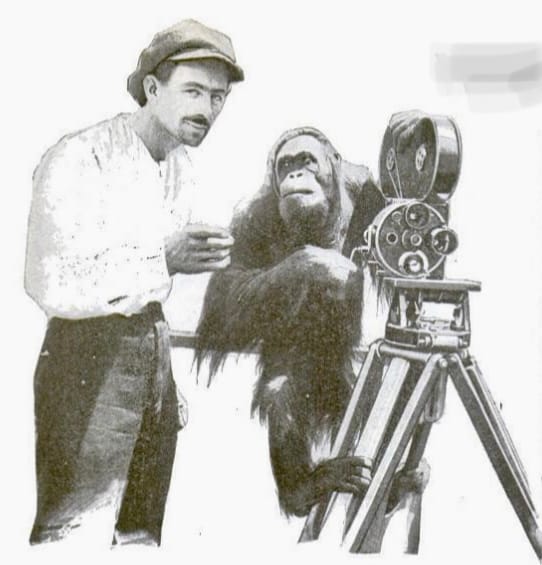
That's why this is not just some "animal cruelty" situation. This isn't about them beating Joe, even thought they did, often.
Joe is not only suffering here as an animal under human domination, though of fucking course he still is, but also being made to inhabit a human costume from the inside. Joe Martin's nervous system was being taught the outer grammar of a world that will never actually admit him as a participant, made more interpretable to us without being emancipated or recognized in any way that mattered. Joe Martin was therefore nudged toward self-recognition and social readability under conditions in which those developments can only serve to sharpen the pain of his own confinement.
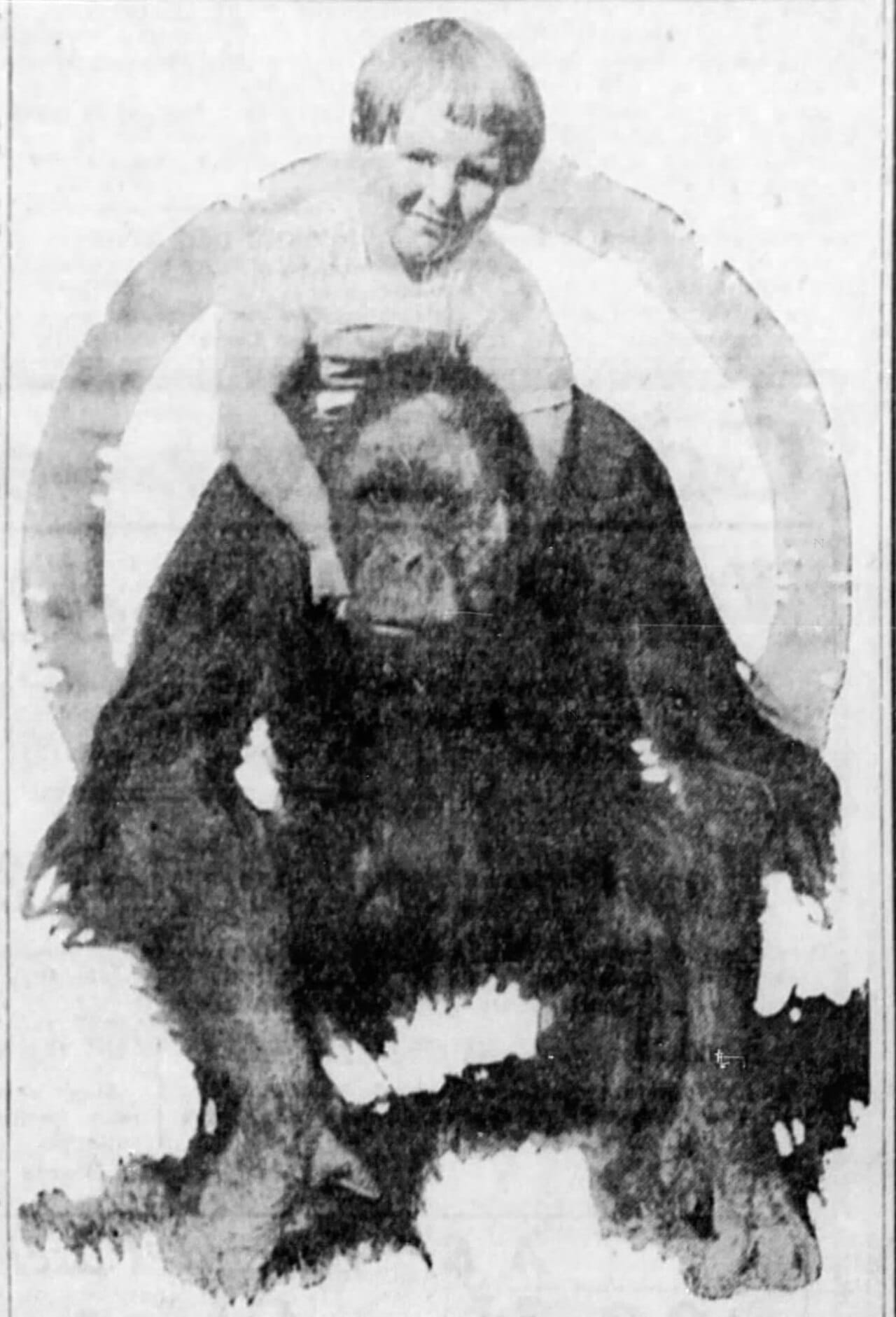
Forced approach toward person-like legibility without the corresponding expansion of agency is a distinct form of harm.
Many frameworks can only get near this very basic-seeming claim by quietly borrowing intuitions from the kind of field analysis Modal Path Ethics starts with openly. They will first ask whether Joe qualifies as something like a person and then, if he nearly technically does, holy shit we can begin to feel the horror of what happened here.
Modal Path Ethics has no such bizarre upstream bottleneck in its design. The horror is already visible under this framework whether or not we consider Joe to be a human, or even human-like. An extant locus with care, vulnerability, memory, attachment, and navigable possibility is being systematically contracted by an institution that profits from selectively amplifying those same capacities for their amusement and profit.
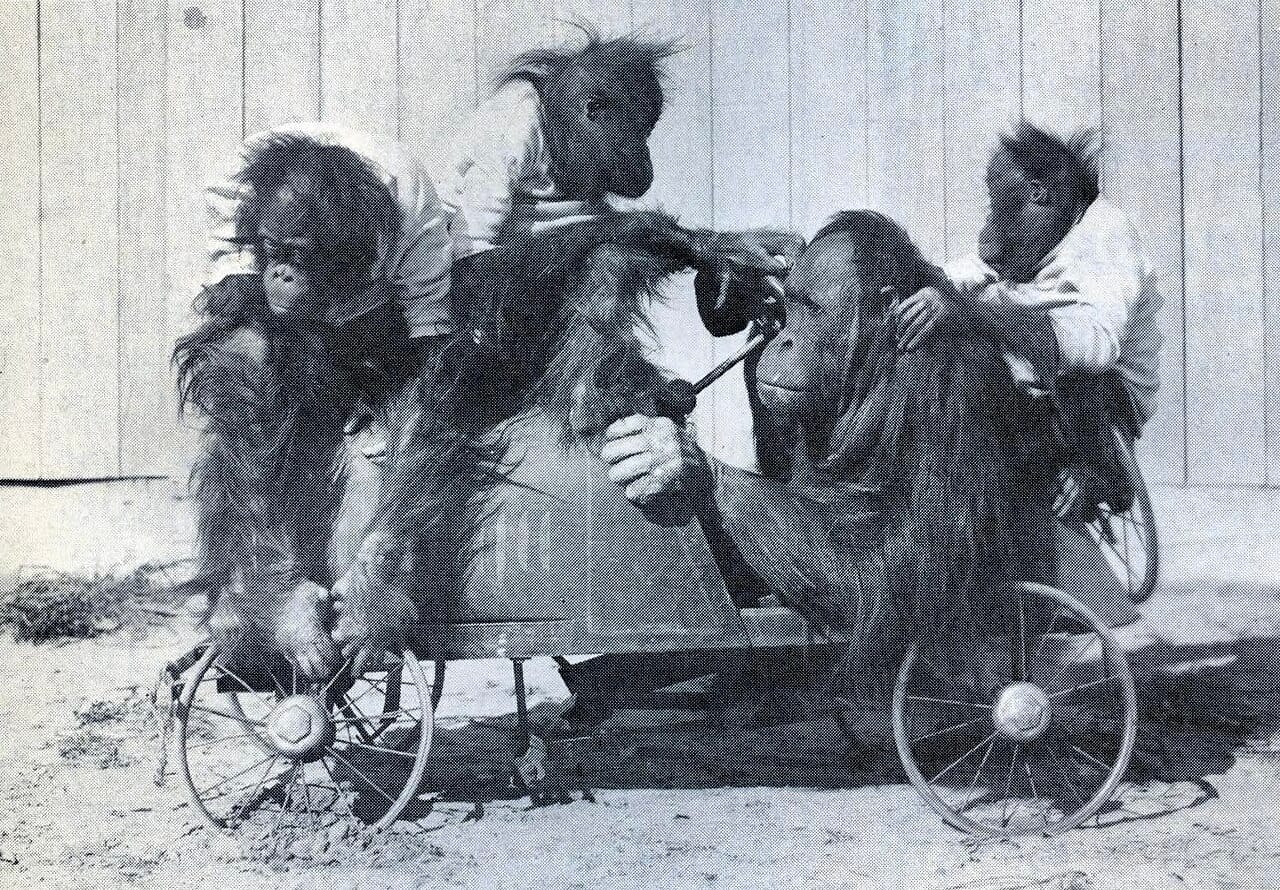
Nothing about that requires Joe Martin to speak sign language or pass a personhood exam written by humans.
Klieg Eyes.
There is a tendency, when discussing animal exploitation in old entertainment industries, to flatten everything into one big moral smear: they used the animals badly and hurt and sometimes killed them. This is true but it is not specific enough.
The field they put Joe Martin in was physically, sensorily, and psychologically misbuilt for the survival and thriving of the organism trapped inside it.
Joe suffered from what the studios called “Klieg eyes,” which is eye inflammation caused by the intense early studio lighting, especially from the carbon-arc lamps used in silent-era filmmaking which were phased out for general use in the 1920s at the latest, because they are dangerous. For an orangutan whose eyes evolved specifically for filtered forest light and thick canopy shade, this was not just some mild inconvenience to joke about like it was for the other actors. Lights on for Joe Martin meant instant pain, tearing, redness, swollen eyelids, photophobia, and repeated sensory assault from the very environment in which he was now coerced to perform for our amusement.
Institutions like this one will often hide their violence behind glamour. I do have a diploma from a film school. I understand that light is the medium of revelation. In Joe’s case, the shining world of cinema was itself literally injuring his fucking eyes. This instution harmed Joe to even look at, and it trapped him inside it.
Modal Path Ethics recognizes that more harm is often embedded in a field’s baseline conditions than in its headline events. You do not need a dramatic attack and annihilation scene for a field to be contracting a locus beyond internal repair.
Curley Stecker and the Problem of Care.
If every human in Joe’s life had simply hated him, the article would be much easier to write and much worse to read.
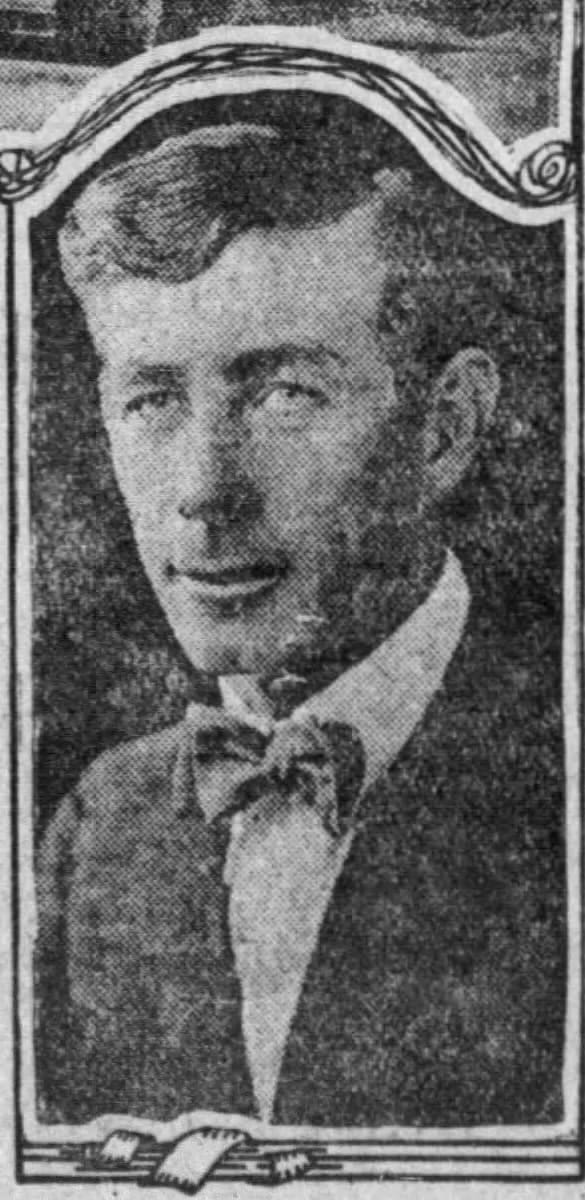
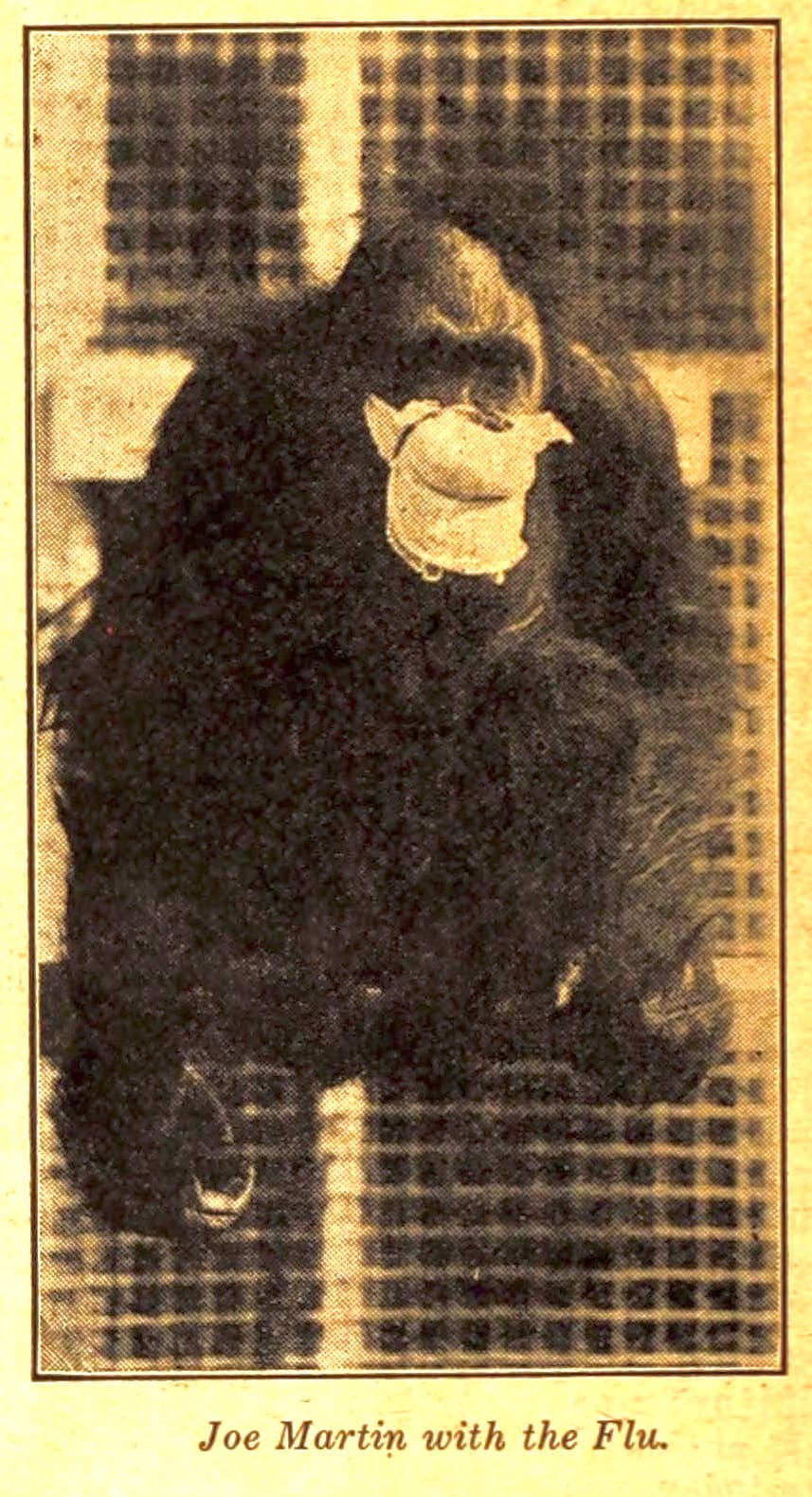
But Curley Stecker, by all available accounts, appears to have cared about him in some serious sense. Joe Martin was “adopted” into Stecker’s household orbit while "working" at Universal and raised alongside his son. Stecker saved Joe's life during the Spanish flu outbreak, which Joe was exposed to. When the State tried to have Joe executed after he bit Stecker’s wife’s ankle through to the bone, Curley and Ethel both argued passionately for his life in front of the judge. When Stecker was later fired, Joe fell into a deep depression, attacked replacements, fucking killed a baby orangutan, and visibly returned to a happier state when Curley returned.
That all did happen.
But the truth is, whatever care existed in Joe’s life was structurally subordinate to a field that had already decided what he was going to be used for. Those same hands that fed Joe Martin were part of the same apparatus that confined him in a field that was destroying him. The same affection that may have made his life locally better in moments also helped stabilize the broader structure of his capture and abuse.
Partial love inside a distorted role does not neutralize the presence of harm. Sometimes it is actually one of the main vehicles by which harm becomes durable and defended in the field.
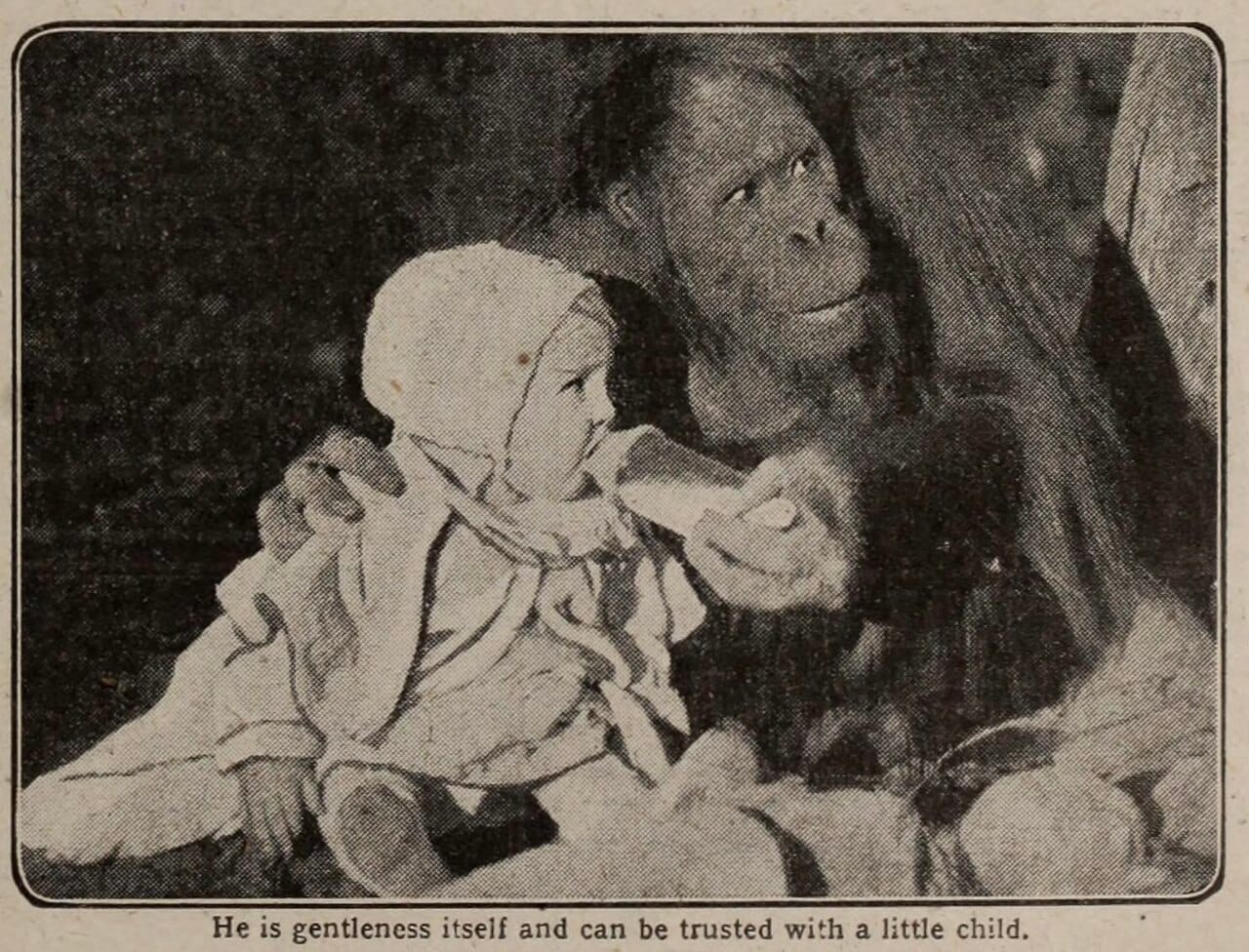
Joe Martin's flourishing was always treated secondarily to his usefulness to the entertainment industry.
Joe's Mailbox.
If I had to choose one image from the middle of Joe’s life that best captures the obscenity of this entire arrangement, it would be his mailbox.
So many different people wrote to Joe Martin genuinely thinking he was a human actor in an ape costume that a postal inspector now had to decide what to do with the volume of mail and money orders addressed to “the man who plays Joe Martin.” His solution, rather than bother to confront the deeper absurdity at hand, was to effectively grant the orangutan a de facto mailbox and process the correspondence anyway. This move gave the ape some technical but hard to discern legal status in the State of California. Here's the quote from this man explaining his entire very interesting thought process, given we must assume he was considered a legal adult with all the rights thereof:
"Technically, Joe is an animal. Actually, he is an animal with a human brain and people write to him under perfectly good two cent stamps."
I mean, is he wrong?
Joe reportedly checked his own mail and opened it carefully. But what could these letters have possibly meant to this orangutan, other than providing some novel stimulus for a while and an opportunity to perform his assigned role correctly?
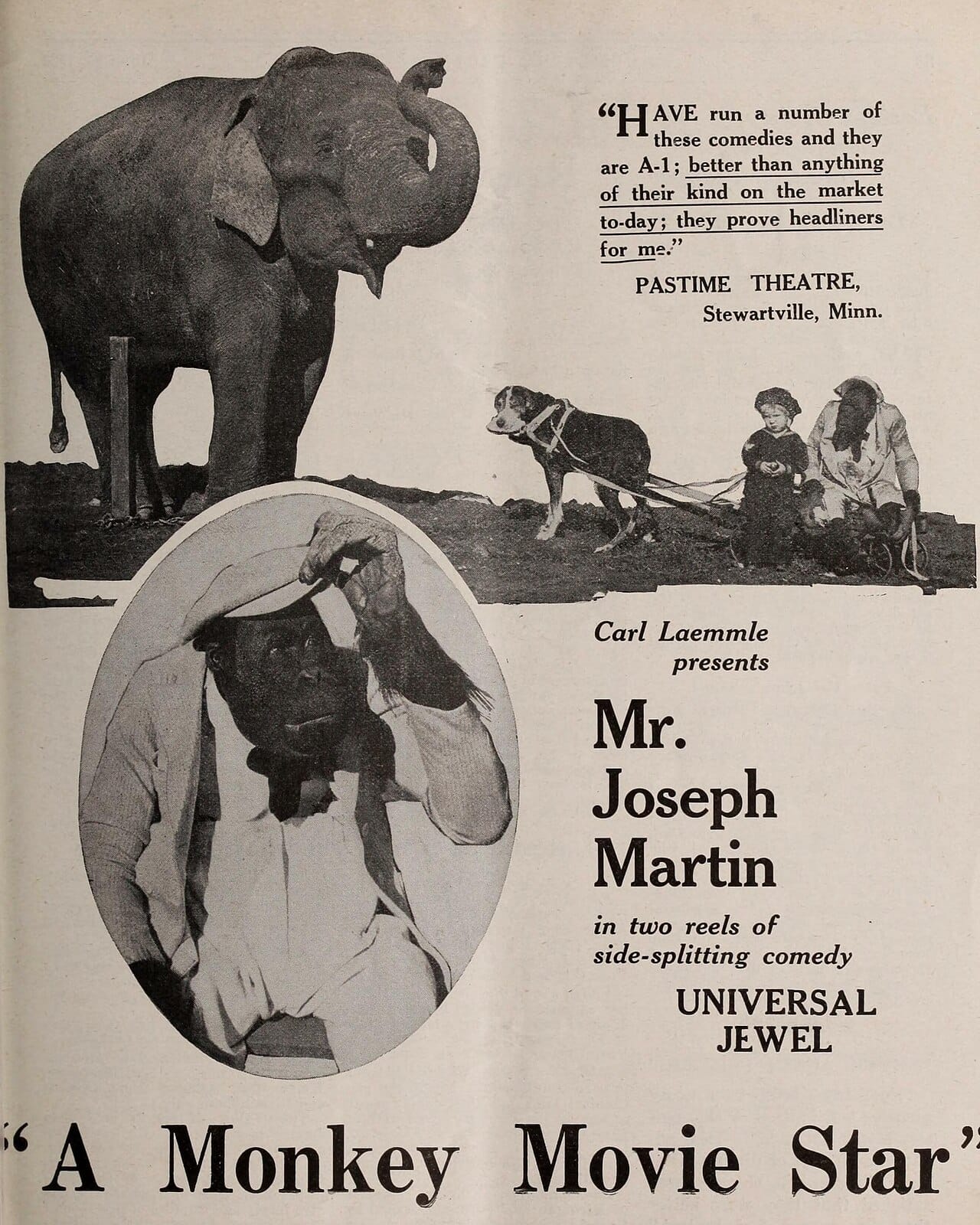
From this sequence, we can see how the public was able to narratively recognize Joe as person just enough to want to write their thoughts and concerns to him. They can very easily put Joe Martin in the mental category of a celebrity participating in Hollywood culture. The state is even willing to half-recognize him as a legal person when the bureaucracy around this becomes too inconvenient for their smartest postal inspector.
And still absolutely none of this cashes out in any kind of stable, moral restructuring of Joe Martin's world around this perception.
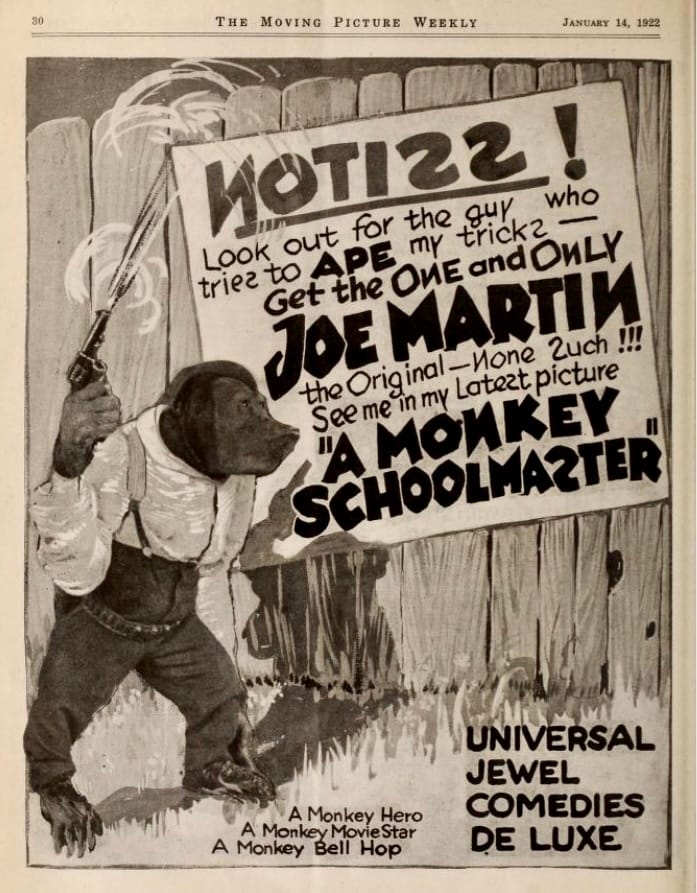
That is the distinction between narrative and structure.
Narrative recognition says: look, he’s basically one of us! How novel!
Structural recognition reports: we now must alter the field accordingly.
Joe Martin received a shitload of the first and almost none of the second, not in the ways that would have mattered for him.
Like, great, you gave him a mailbox. He can't fucking read and he is going blind.
Collapse.
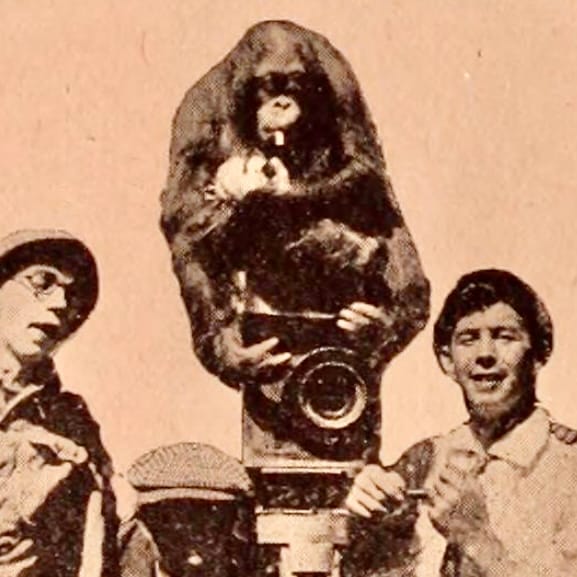
By the late 1910s and early 1920s, Joe’s behavior becomes increasingly volatile, which is very late if anything given the situation he was put in, and this is the point where most institutional narratives around Joe start to try to save themselves.
The story becomes that Joe Martin went "insane".
He certainly might have. That would be very understandable if he did go insane. But if so, that word names an outcome of their actions, not an explanation of his.
Joe survives the Spanish flu and double pneumonia. He suffers from chronic eye pain. He is repeatedly startled, punished, confined, exhibited, forced into close physical scenes, made to perform around children, around men threatening women, around men being violent to children and women, all around the same species that killed his mother in front of him and built his entire life out of coercive dependency for their amusement. So Joe escapes the set, is recaptured, escapes again, is injured, electrically burned, partially paralyzed, "physically disciplined", shuffled among handlers, surrounded by unstable and incomprehensible social bonds, and made to continue working the entire time. This was basically Jesse at the end of Breaking Bad.
I mean what the fuck was this field designed to produce other than an deeply confused and upset orangutan? Some lost media that became lost because no one thought it fucking mattered at the time?
Joe’s (many) attacks are also not all the same. Some appear reactive and one hundred percent legible.
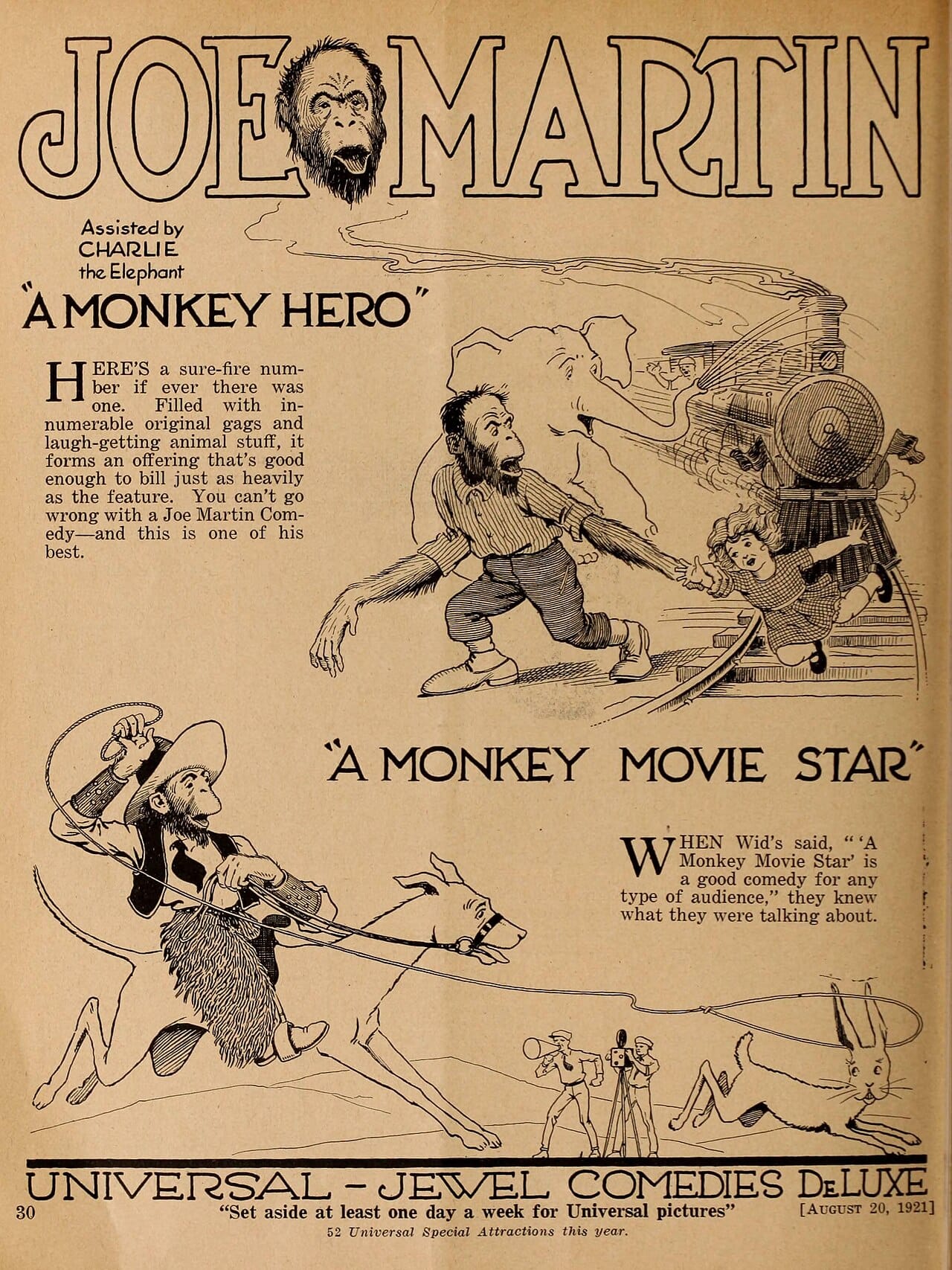
He reportedly leapt to defend a child during a staged spanking scene, pinned the actor, bared his teeth, and gathered the child protectively to his chest. I mean, the fucking ape doesn't know what a film set is, you fucking morons. In another incident he attacked an actor looming menacingly over a woman. I think in many scenarios people would consider this behavior heroic. In another he reacted after a branch swung back into his face after a jackass playing Tarzan leapt off of it.
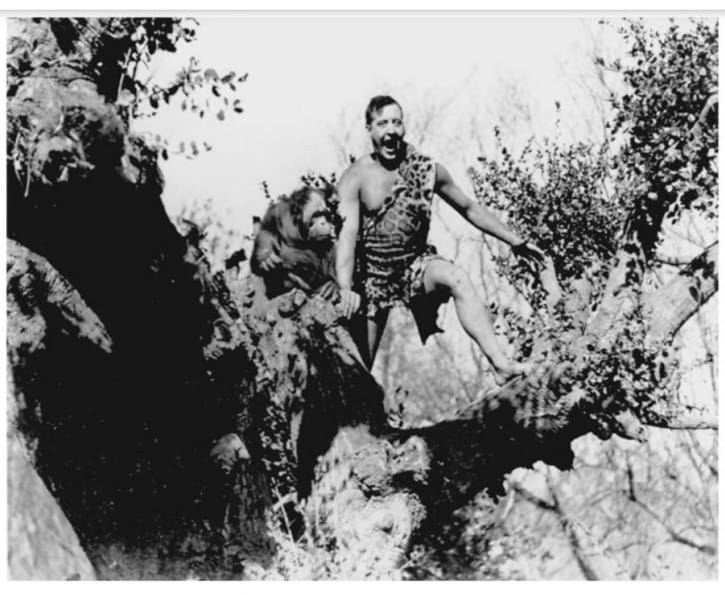
That's guy's most likely going to have to see me, too. In another, he beat the shit out of a security guard who had allegedly shared whiskey with him and then one day spiked the flask with red pepper as a prank. Yeah, I mean, that is what happens when you fuck around like that.
These are not all morally exonerating details for Joe, but this is exactly what I mean when I say they taught him to think like a person then became surprised when he did and acted like he had the same status as them, but also didn't always have the right context for the situation because he was still, actually, an orangutan and not a human being. These all show that Joe’s violence often emerged as a response to pain, startle, attachment, humiliation, jealousy, threat, and human confusion that remain fully intelligible from inside his damaged worldview, which these same fucking people created.
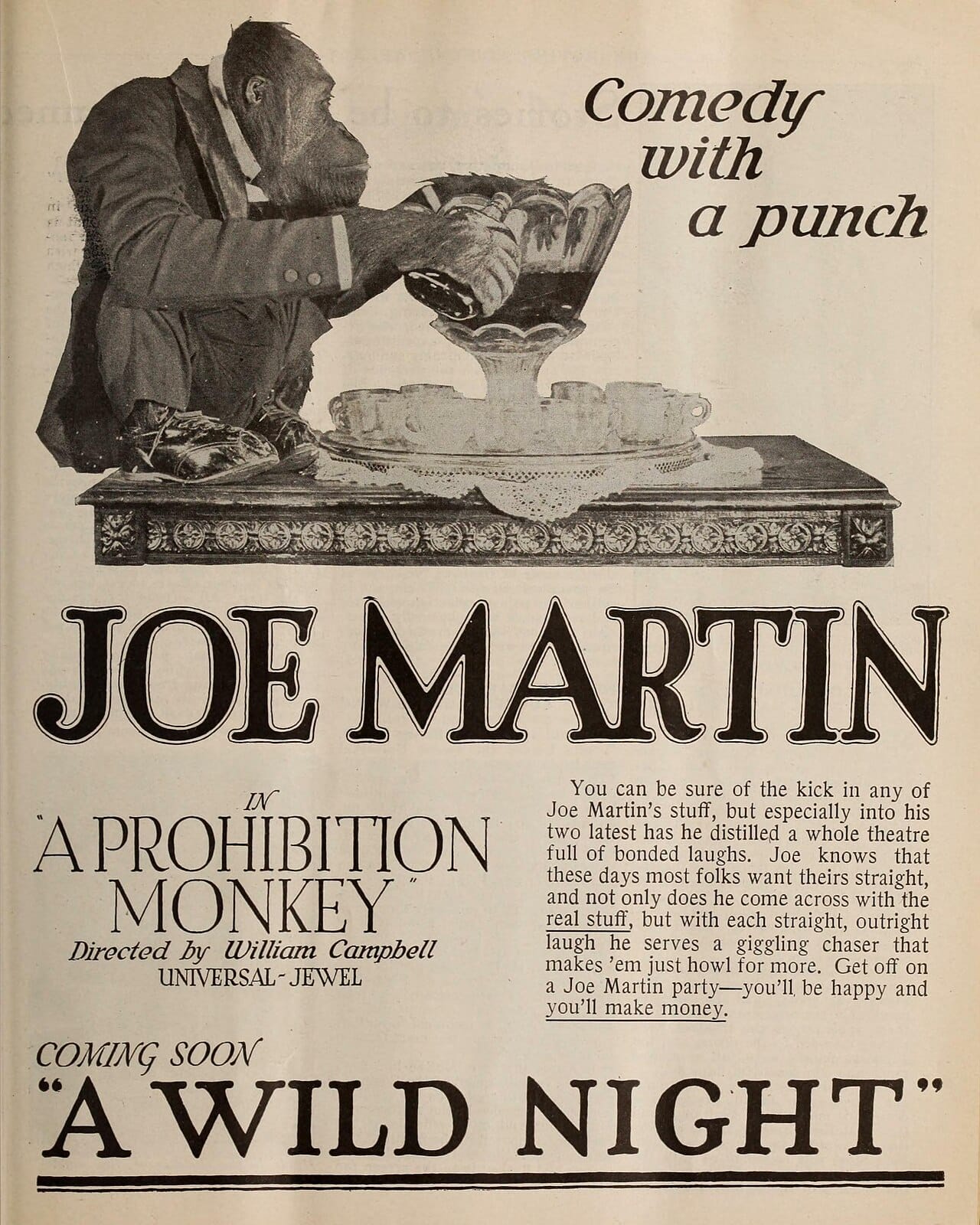
Other incidents look less directed and more like a general psychological collapse: several rampages, aimless destruction, the release of many wolves, substitute trainers attacked, falling into a deep depression after Curley’s removal, the brutal killing of the companion baby monkey Universal brought in as a fix, just general increasing unpredictability and instability in response to his terrible circumstances. Again, if Universal had been doing all of this to a person, we would not be surprised, and Universal was explicitly trying to train Joe to think and act like a person.
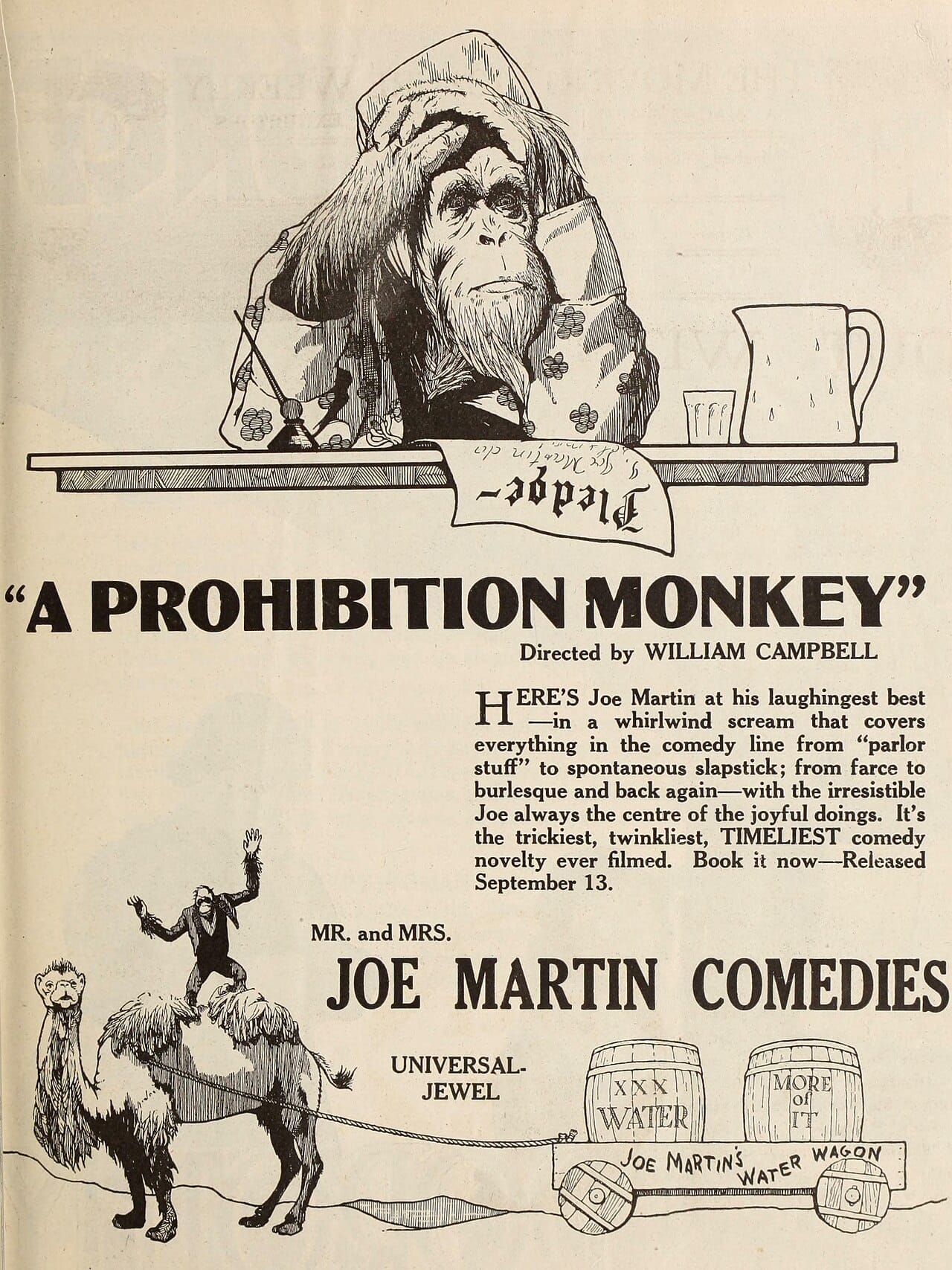
"Crazy ape" is then not an analytically serious conclusion here.
The correct claim is that Joe Martin became dangerous in ways that were themselves downstream of cumulative field damage.
Joe was not an innocent plush toy corrupted by one bad day, or by disease or the loss of Stecker, and he was also not a pure storm of beast-chaos erupting from the goddamned clear-blue sky. Joe Martin was a highly intelligent captive being whose possibility space had been narrowed for years by pain, extraction, confinement, role-confusion, unstable attachments, and highly selective anthropomorphization. Violence was not then some inexplicable interruption of Joe Martin's well-maintained field.
Joe's violence was one of the forms his field had begun to take most often because the other paths he could have taken were long since contracted into unreachability.
Curley Dies.
In 1923, an elephant named Charlie nearly crushed Curley Stecker to death during filming.
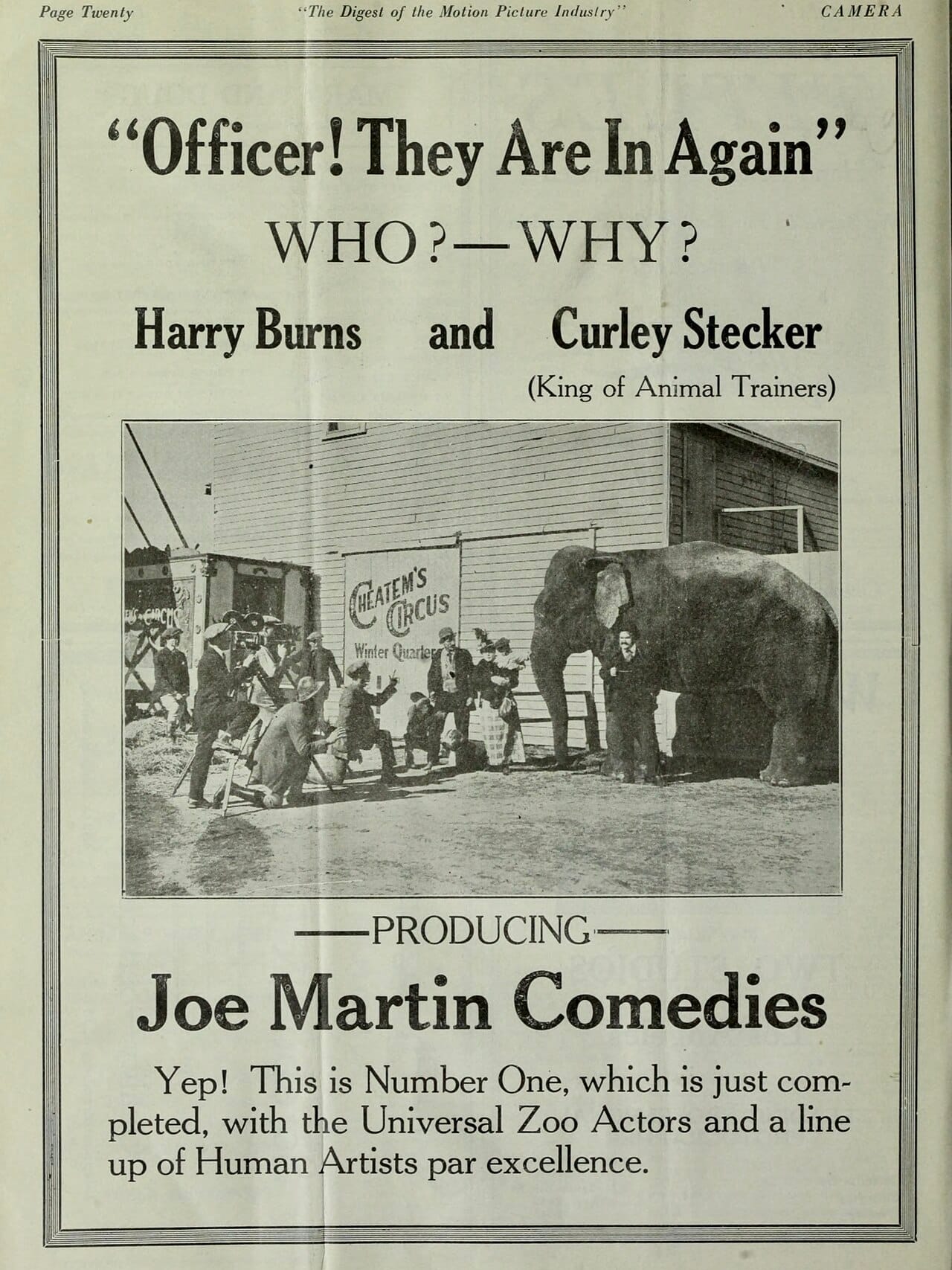
Curley survived the immediate incident but died the following year, with "wild animal injury" listed alongside leukemia on his death certificate. I would note for the doctor that this was a captive animal, but I guess categorical correctness matters more than meaning.
By then, Joe Martin was already regarded as incurably insane by Universal. He had become increasingly difficult to work with, was managed way more cautiously on and off set, and soon Joe was sold off to the Al G. Barnes Circus.
So now the same entertainment complex that had pseudo-humanized Joe when they found it profitable had stripped him back down into menagerie stock when he no longer fit their production environment cleanly.
From their perspective, his human costume could be put on him when he sold or taken off when he became a liability. Unfortunately, that doesn't actually describe the nature of the effects their interventions had on Joe Martin. He remained very much the same once booted out of stardom.
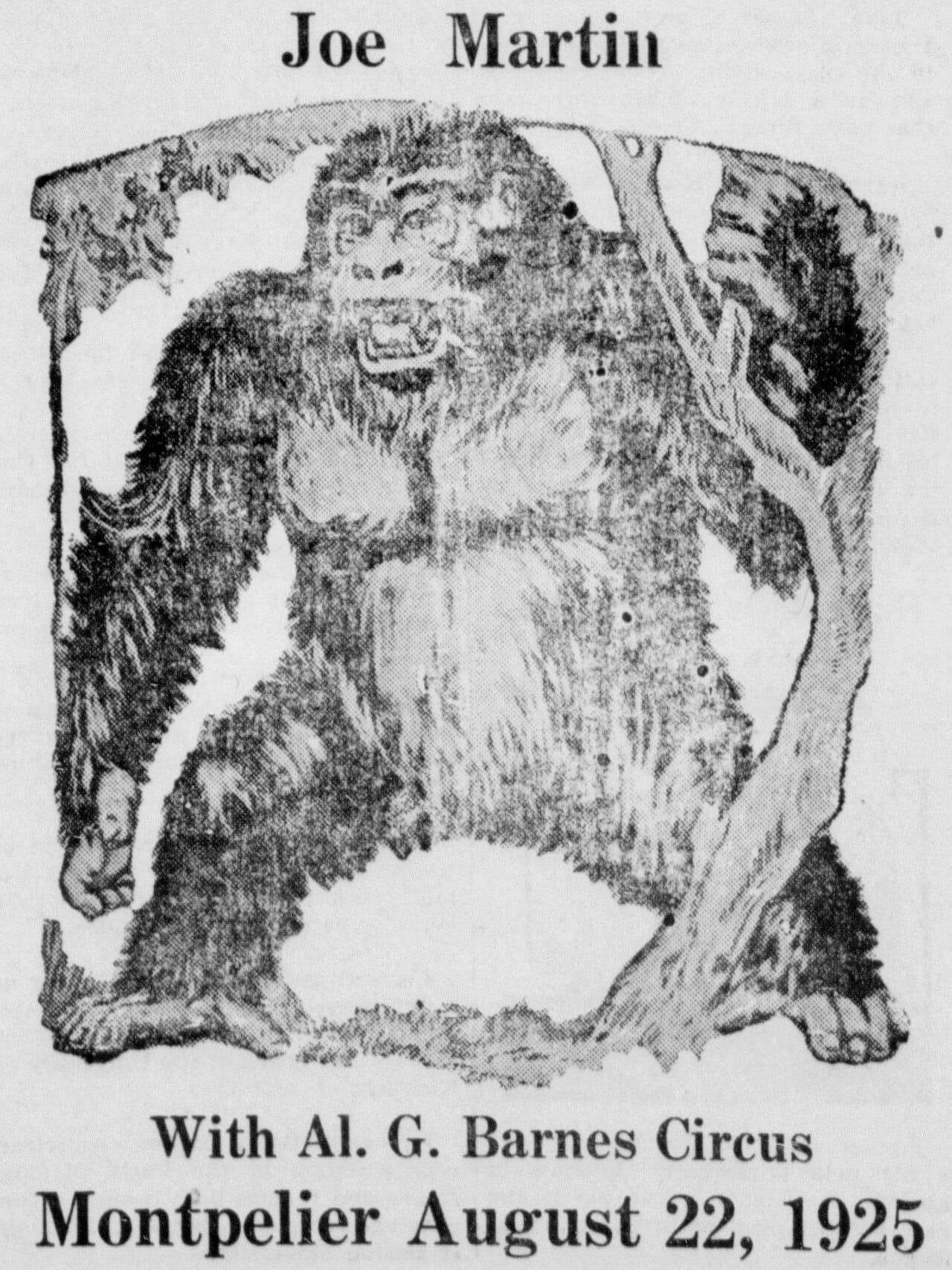
Joe Martin escapes again, this time from the circus in 1927, seizes a female trapeze artist, and is confronted by a literal heavyweight boxing champion. He is then beaten unconscious by a series of full-force blows to his skull from a professional puncher to the cheers of the crowd, who are watching the narrative of a strongman saving a pretty woman from a vicious beast.
Sometime between this event and 1933, Joe Martin dies. The exact year and manner is unclear. One of early Hollywood’s celebrities just disappeared back into the general historical category of "dead captive animal".
What Joe Martin Proves.
Joe Martin proves a lot of things, but the main reason I wrote this article is that this story proves to me that Modal Path Ethics is operating at the right depth, and other moral frameworks are not.
This framework did not need to wait for a victim to become verbally articulate, legally legible, philosophically certified by our experts, or even recognizably human to us before the same moral analysis can begin. Modal Path Ethics asks what kind of field was built around an extant locus, what futures were made reachable or unreachable there, what harms were imposed, what resistances were raised against the less harmful continuations, what roles were distorted, what burdens were transferred, and what kinds of narrowing emerged downstream.
That same moral machinery works when talking about Joe Martin, the Darien Scheme, the 1904 Olympic Marathon, or the Pokémon Hypno exactly as it does everywhere else.
Joe’s case is not morally obscure or confusing in any way. It only becomes obscured to you if you insist on using a framework calibrated far too narrowly around a particular image of the human moral subject, and then are later confused and scrambling when reality presents you with a being who is neither a philosophical adult nor a simple object.
That turns out to happen pretty regularly where I live.
Second and less self-aggrandizing, Joe proves that there are forms of exploitation more perverse than any form of straightforward domination. One of them is certainly the deliberate cultivation of human-adjacent intelligibility in a captive being for the sake of your profit while refusing every structural consequence that such intelligibility should reasonably entail, as just described.
Third, his story proves that care and harm are not at all opposites when you are talking about damage to a field. A being can be loved and still be structurally destroyed, like Joe Martin was. In fact, love is often one of the means by which destructive arrangements become emotionally tolerable to the destroyers, and even to the destroyed.
Finally, Joe proves something unpleasant about humanity in general.
Human institutions tend to generate just enough person-like legibility in a subject under their care to make them useful, marketable, entertaining, or emotionally resonant, while equally refusing to grant the freedom, protection, or structural reorganization that would logically follow from taking that increase in their legibility seriously as anything other than a mark of value.
We do this to animals like Joe. We do this to disadvantaged groups. We do this to children. We do this to one another socially. We tend to create roles that invite interiority and then punish the beings inside them for developing it without also meeting arbitrary value criteria they never could have.
Joe Martin is an unusually vivid case because for him, the human costume was extremely literal.
Hollywood built a monkey one of our human social shells and taught him to live inside it. They profited from the increasing sophistication with which he wore it, and then called him insane when the increasingly human-oriented mind trapped underneath their abusive system finally began to answer them back like any of us would have given Joe's field.