Applied Case: AngelEye
Who gets to question the guardian?
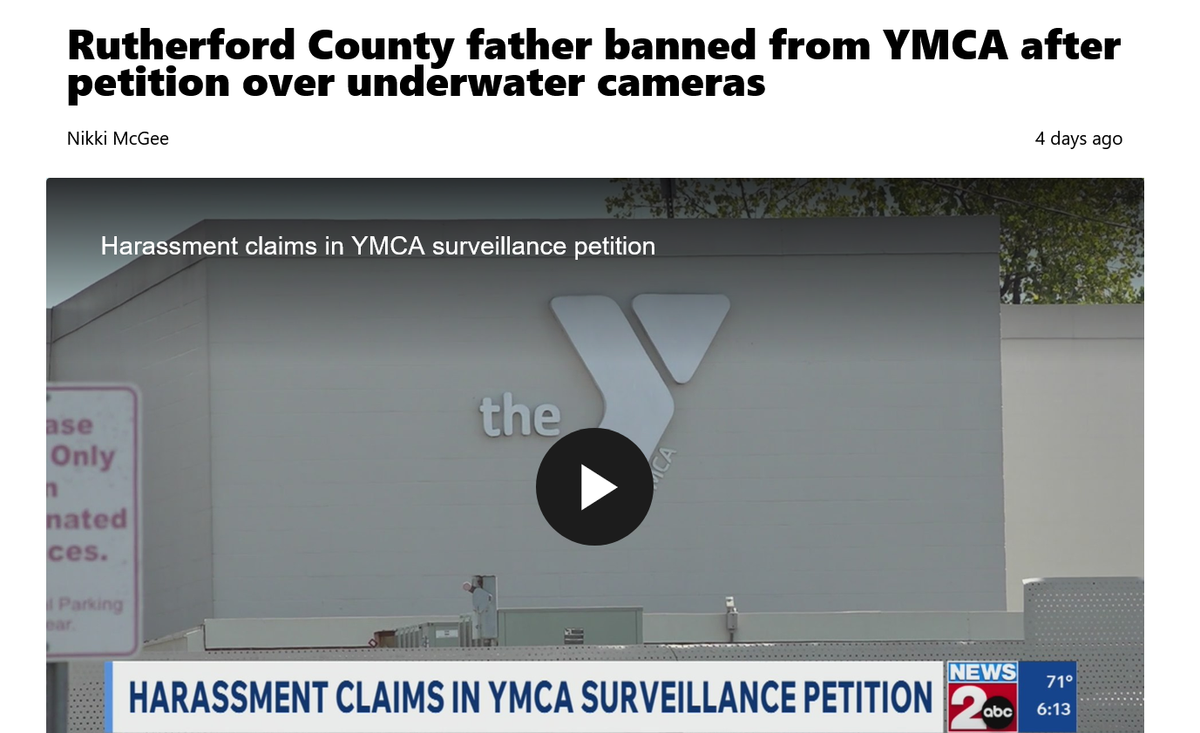
Tennessee has supplied Modal Path Ethics with yet another aquatic jurisdiction problem.
This time, the water stays in a pool.
The YMCA of Middle Tennessee has begun installing AngelEye, an artificial-intelligence drowning-detection system, across its indoor swimming facilities. Cameras above and beneath the water watch swimmers for signs of distress. When the software detects a possible emergency, it alerts a lifeguard through a smartwatch.
The idea itself is reasonable. A child can disappear beneath the surface, a lifeguard can miss it, and a machine watching another angle might notice in time.
And then the cameras went underwater.
Parents objected.
On November 2, WKRN reported that Dru Kaegi, a Rutherford County father who organized a petition against the cameras, had been banned from the YMCA. He had already stopped bringing his six-year-old daughter there to swim, and his petition reportedly collected more than 1,200 signatures.
The reason for the ban remains insufficiently established in the reporting available for this article.
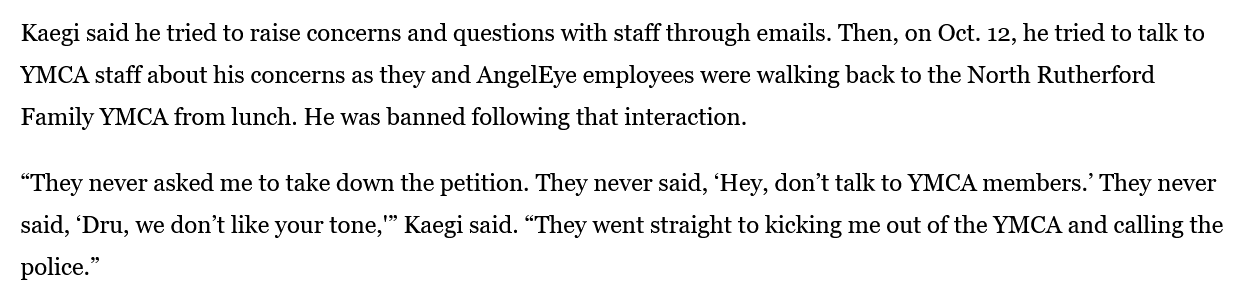
But we now have a pool, an artificial guardian, and a dispute over who gets to question its installation.
The Aquatic Curriculum continues.
The Lifeguard Is Still There.
The YMCA has offered a serious defense.
AngelEye does not use facial recognition or identify swimmers through membership records.
The organization says footage is not used to train artificial intelligence, is not stored in the cloud, and is restricted to drowning detection, emergency response, and applicable lifeguard training.
It also insists that this system does not replace lifeguards.
Good. Now, we have to find out whether that remains true after the lifeguards start using it.
Because in 2021, the ukactive Research Institute published a Sport England-funded investigation of drowning-detection systems. The researchers found real benefits: assistance with blind spots, faster notifications, and greater confidence among staff.
But they also found something else.
One surveyed lifeguard explained:
"I don’t feel the need to pay as much attention."
Other responses described false-alarm fatigue, distractions, and difficulty incorporating screens into ordinary scanning routines.
These observations do not establish a failure at the Tennessee YMCA. But they expose a problem the Tennessee YMCA must actively prevent.
Modal Path Ethics recently encountered the same mechanism in The Planes Were in the Air. There, a military targeting system could operate according to specification while personnel developed mistaken expectations about which intelligence checks it had already performed.
- The contractual division of responsibility remained intact.
- The actual division of attention changed.
The contract is not the causal system.
A lifeguard who understands AngelEye as a second, independent alarm may continue scanning exactly as before. The camera adds a chance to detect what the human misses.
A lifeguard who gradually treats the absence of an alarm as evidence of safety has entered a different arrangement.
The system may never say the water is safe. The lifeguard can supply that conclusion.
The YMCA's responsibility is therefore larger than keeping the same staffing policy and training certificates. It needs to know how the installation of this system changes scanning behavior, attention, alarm responses, and performance during simulated failures.
Additive safety has to be demonstrated in the combined system.
A lifeguard wearing a watch is still a lifeguard.
Whether the lifeguard is still independently watching the pool is another empirical question.
Batman Has Already Been Through This.
Modal Path Ethics examined the surveillance problem in The Batman, then returned to it in Carl Schmitt and the Batman Who Leaves.
In The Dark Knight, Batman turns Gotham's phones into a citywide sonar surveillance system.
This works out.
Lucius Fox objects anyway.
The device gives its operator extraordinary power over people who never consented to being observed. Batman uses it to find the Joker, then destroys it.
The emergency justified extraordinary observation. Successful observation did not establish permanent jurisdiction.
An indoor YMCA swimming pool is different from this scenario. The danger does not disappear after one rescue. There may be good reasons to maintain a detection system indefinitely.
That makes its boundaries even more important.
The YMCA says AngelEye footage is automatically discarded unless associated with an emergency, but its public FAQ does not specify a retention period. The organization cites security concerns when withholding configuration details.
Security can definitely justify protecting technical secrets. But it does not require keeping every privacy guarantee beyond independent verification.
And there is another question still.
Why does the guardian even need pictures?
Drowning detection concerns submersion, movement, position, and the time remaining before intervention becomes ineffective.
Cameras can measure those conditions, but they also collect detailed images of people swimming.
Other instruments are possible.
AIqua's SwimNet already markets an artificial-intelligence system using underwater sonar rather than optical cameras. Wearable depth and motion sensors offer another approach, though those require swimmers to carry devices. Sonar can still generate detailed movement records, and the manufacturer's performance claims require independent validation.
None of this establishes that a non-visual system can replace AngelEye with equal safety at these particular pools.
But it establishes that the sensor deserves scrutiny alongside the purpose.
If a less intrusive instrument can detect the same emergency reliably, the justification for collecting more intimate information becomes weaker.
The guardian should know what it needs to know.
The rest requires another warrant.
The Ruling.
The YMCA has a real protective responsibility. It may also have legitimate reasons to exclude someone. The reported ban must be judged against the actual conduct and the institution's stated reasons.
Still, the petition raises a question that survives either outcome.
Parents are being asked to trust a system that watches their children underwater. They should have a meaningful way to examine its necessity, challenge its limits, and request alternatives.
An organization cannot establish the adequacy of that process solely by assuring members that its decision was safe. Its confidence is evidence. Not a substitute for independent correction.
The answer may be to keep AngelEye. Or it may be to change its configuration, shorten retention, strengthen lifeguard training, add independent audits, or eventually replace the cameras with a different detection technology.
The protective function should survive that examination. The instrument should be capable of losing it.
That is the distinction the YMCA of Middle Tennessee has an opportunity to demonstrate for everyone.