Transition Action: Chirality Has Escaped
Arrangement gives light a hand. Strain gives matter a hand. Chirality is a move now. A special edition.
Transition Action is the technical wing of Modal Path Ethics: a series about technologies crossing from research, prototype, or theory into reachable action. Each entry begins with a live technical event and asks what has changed in the field. This is not a futurist roundup.
- What can now be built, tested, measured, or operationalized that was not reachable before?
- What physical process carries the new action?
- Which old background assumption has become less necessary?
- What new failure conditions enter with the new design?
Transition Action is a field inspection at the moment a capability starts to move.
After missing last week, Transition Action has been commandeered by the board-game department.
This was not preventable.
On July 29, 2026, two papers about chirality appeared in two Nature journals on the same day.
- The first research team arranged hundreds of thousands of circular nanoholes according to an aperiodic monotile structure and made light return a handed pinwheel.
- The second took an achiral crystal, applied mechanical strain, and induced a selected handedness whose sign could be reversed by changing the strain.
- One result begins with arrangement.
- The other begins with constraint.
- One places a hand in the path available to light.
- The other makes handedness itself into a controllable state of matter.
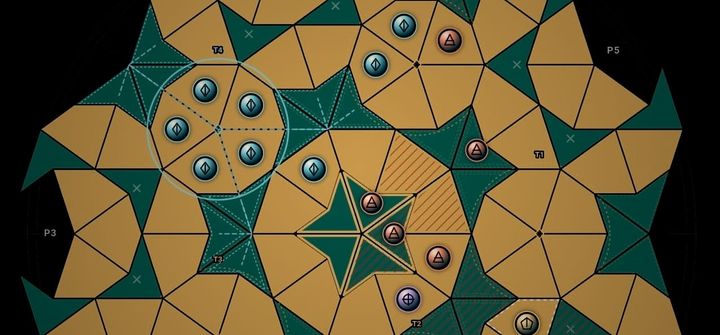
Modal Path Ethics has spent months trying to make people fight on an aperiodic Penrose board under the name Chirality. The game was built around a simple structural pressure: the board is not a passive surface beneath the action. Its asymmetries decide what a piece is, where it can move, what it threatens, and which futures can still be reached after the move.
Now, two laboratories have independently supplied the special edition.
Chirality has escaped the board twice.
Two Different Hands.
The papers use the same word across two distinct physical settings.
- In “Chiral diffraction from aperiodic monotile structure,” Yuto Moritake, Masato Takiguchi, Takuma Aihara, and Masaya Notomi study planar chirality.
- Their two-dimensional point pattern has rotational order and no mirror symmetry.
- Its reflected version cannot be brought back onto the original through an ordinary rotation in the plane.
- Their two-dimensional point pattern has rotational order and no mirror symmetry.
- In “The piezochiral effect,” Z. Zeng and collaborators study chirality in a three-dimensional crystal.
- The relevant crystal structure contains locally chiral fragments of opposite handedness whose contributions cancel at equilibrium.
- Mechanical strain breaks that balance and produces a nonzero net chiral order.
- The relevant crystal structure contains locally chiral fragments of opposite handedness whose contributions cancel at equilibrium.
These phenomena should not be collapsed into one mechanism.
- The first is a fabricated aperiodic arrangement acting on light.
- The second is a crystal response induced by deformation.
Their conjunction is the event.
Handedness has become both an architectural output and a controllable material variable.
First Move: Arrange the Field.
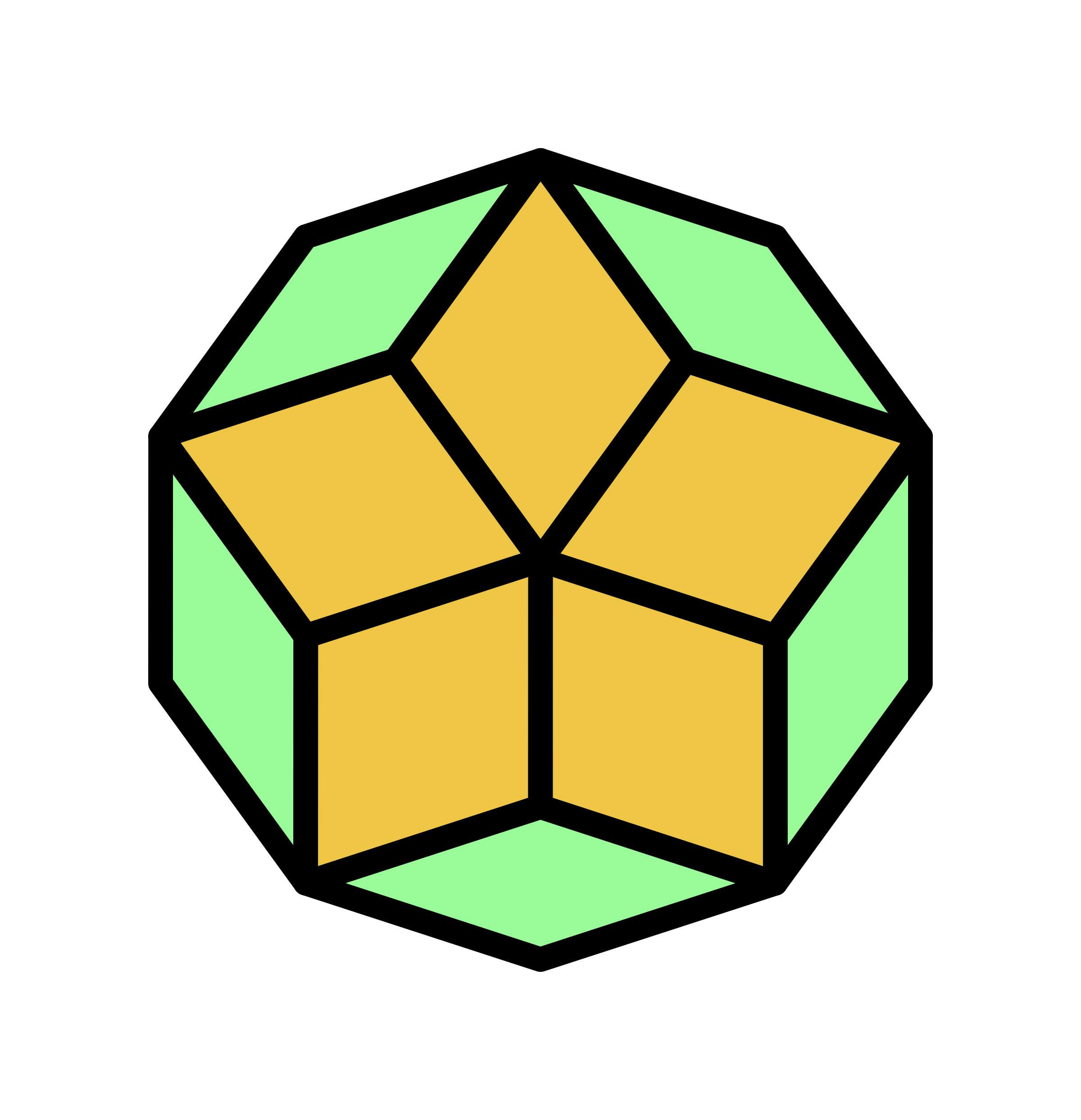
The first paper begins with the Smith hat, the aperiodic monotile discovered in 2023.
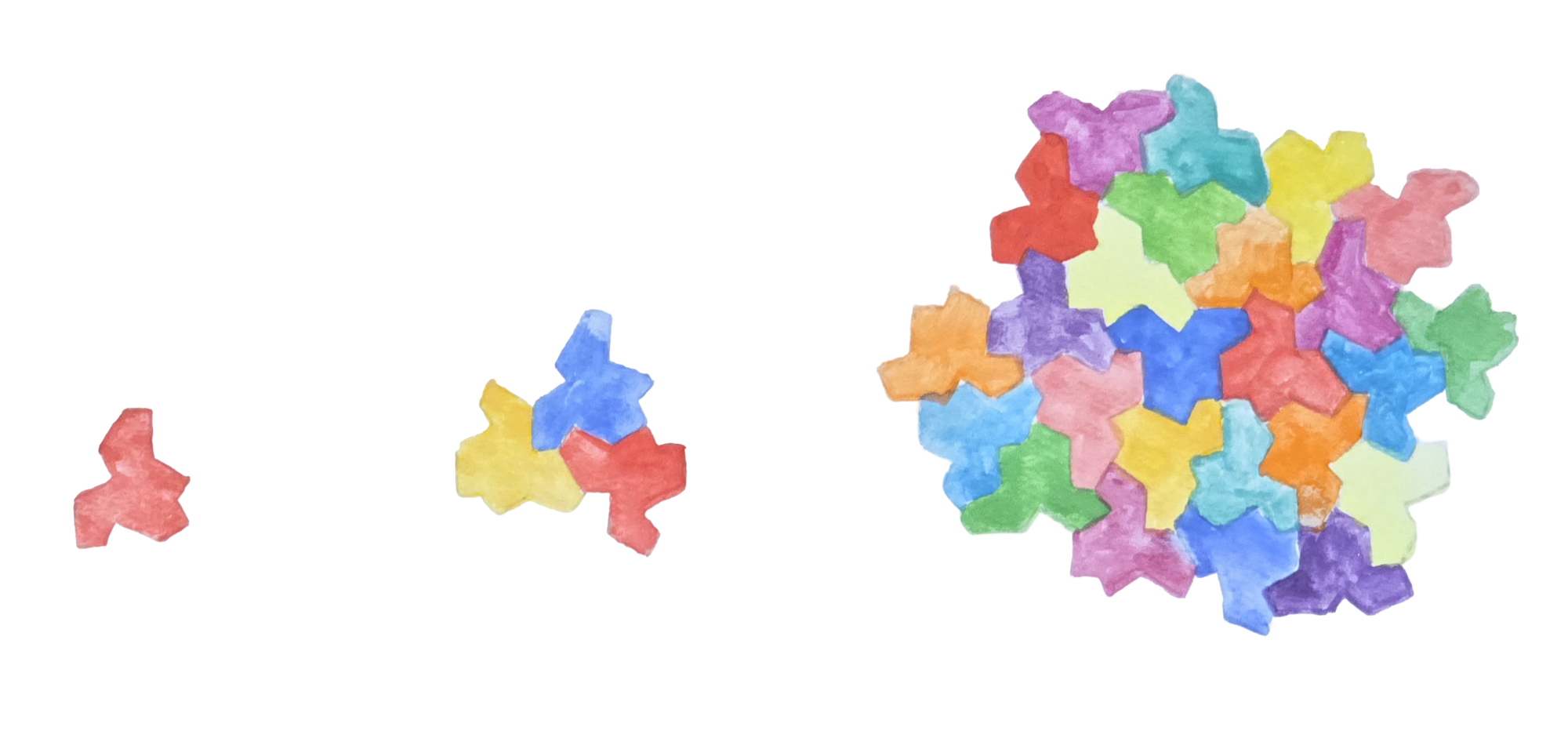
The hat belongs to the same broad mathematical neighborhood as Penrose tilings: lawful order without translational repetition. It is not the same tiling used by Chirality. The base game uses uncut P3 Penrose rhombs. The experiment uses a quasilattice derived from the hat.
There is a hat variant in the lab called Strict Chirality, but it's not ready for release. So nobody has put the game board into a cleanroom yet.
This is disappointing and technically important.
The researchers generated a large hat tiling, then removed the tile outlines. They retained one point from each tile: its centroid. Those centroid positions formed a nonperiodic point set with long-range quasiperiodic order, exact threefold rotational symmetry at its center, and no mirror symmetry.
The tile became coordinates.
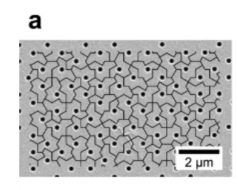
Then, the coordinates became a fabrication file.
A 350-nanometer silicon-nitride film on silicon was patterned through electron-beam lithography and etching. Each selected position received a circular hole with a radius of 100 nanometers and a depth of 350 nanometers. The sixth-generation structure contained 372,100 holes across an area of roughly 500 by 500 micrometers.
The researchers did not etch tiny hats. They etched circles.
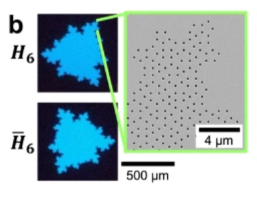
Every aperture was locally achiral. Rotate one circle. Reflect it. Nothing interesting happens. The chirality existed in the relation among positions across the larger field.
Then light entered.
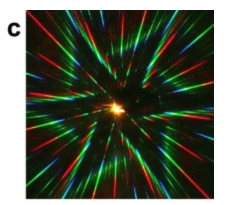
Under white-light illumination, the far-field diffraction pattern formed a broad pinwheel. Under a 532-nanometer laser, the same structure produced numerous sharp Bragg peaks. The peak positions remained stable when the illumination point moved, supporting the claim that the experiment was reading long-range quasicrystalline order rather than one cooperative local patch.
The team fabricated the mirrored quasilattice as well.
The pinwheel reversed.
No Hole Has a Hand.
The result is easy to describe and pretty difficult to absorb.
- A laser strikes the patterned film.
- Each aperture scatters part of the incoming optical field.
- Those scattered waves overlap.
- Some wavevectors reinforce.
- Others cancel.
- A distant screen records the collective interference pattern.
No individual hole contains the pinwheel.
No aperture knows which way the field turns.
The pattern is carried by the arrangement as a whole.
This is a physical version of a rule already built into Chirality: all pieces are identical, and a piece’s current type is determined by the tile it occupies. A piece on a Thick rhomb is a Thick piece. Move it onto a Thin rhomb and the same token becomes a Thin piece, with a different movement and attack relation.
The board does not decorate the identity of the piece.
The board participates in producing it.
The optical experiment reaches the same structural fact through different, much cooler matter. The circular hole does not contain the handed behavior attributed to the device. The device acquires that behavior through the field of relations among locally identical holes.
This does not turn my board game into a nanophysics theory.
It does explain why this is a special Chirality edition.
A local component does not have to contain the behavior carried by the field.
The rules of Chirality also state that rotations of the same board count as the same board while mirror-image boards count as different boards.
The monotile experiment makes that distinction glow on a screen.
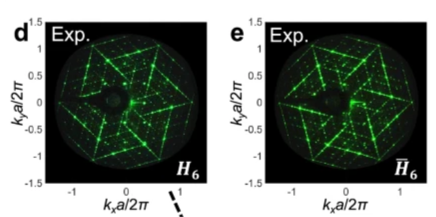
Mirror the field.
The answer changes hands.
The Pinwheel Remembers the Tiling.
The pinwheel angle came from the recursive geometry used to generate the hat tiling.
As the inflation rule builds larger metatiles from smaller ones, the metatile orientation twists relative to the underlying honeycomb framework. The relevant geometric coefficients follow Fibonacci relations. In the large-generation limit, the ratio converges through the golden ratio, ϕ.
The researchers derived the characteristic chiral angle as:
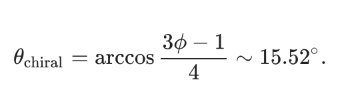
That angle appears in the tilted asterisk-like structures formed by the diffraction peaks.
The route matters here.
 Aidan Lawson
The recursive tiling generated a real-space relation. The centroid operation preserved part of that relation. Lithography converted the coordinates into matter. Optical scattering translated the material field into wavevector space. The screen returned an angle recoverable from the original inflation geometry.
The pattern survived several changes of substrate without becoming the same object at each stage.
- tile rule;
- point set;
- mask;
- holes;
- electromagnetic boundary;
- diffraction field.
Structure crossed the entire ladder.
The pinwheel is the tiling’s recursive history returned by light.
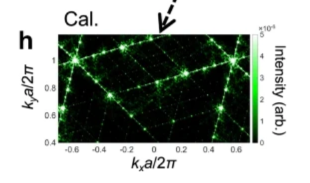
This is exactly the kind of event Roger Penrose and the Reality of Structure asked readers to take seriously. Mathematical lawfulness does not have to remain a description above matter. Matter can instantiate the relation strongly enough for another physical process to encounter and answer it.
Light did not receive a lecture on Fibonacci growth.
The field had already learned the geometry.
Second Move: Strain the Crystal.
The second paper begins from a very different achiral system.
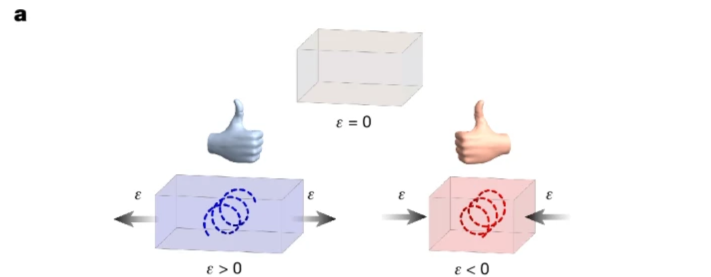
Silver gallium sulfide contains chiral substructures of opposite handedness within each unit cell. The paper describes their arrangement as antiferrochiral. The left- and right-handed contributions compensate, leaving the unstrained crystal achiral overall.
- Both hands are present locally.
- The unit cell returns zero.
Then the researchers apply uniaxial strain. The deformation changes the two opposed substructures differently. Their degeneracy is lifted. One contribution gains relative weight over the other, and the unit cell develops finite net chirality.
The sign follows the strain.
- Switch between tensile and compressive strain, and the induced handedness reverses.
- Apply the same kind of strain along the orthogonal crystal axis, and the handedness reverses again.
The crystal does not need to be grown permanently left-handed or right-handed in advance. Its equilibrium structure can remain achiral while mechanical deformation selects a chiral response.
The researchers call this the piezochiral effect.
They express the general linear coupling as:
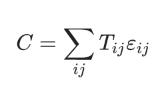
Here, C is the induced chirality, εij is the strain tensor, and Tij is the piezochiral tensor introduced to describe the coupling.
For the symmetry class containing AgGaS2, the relation simplifies to:
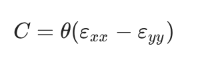
The subtraction is the entire little machine.
Strain along one axis and strain along the other enter with opposite signs. Compression and tension also change sign. The direction of deformation becomes a control handle over handedness.
The Crystal Chooses Under Constraint.
The team verified the effect by measuring optical activity in a cut crystal under strain.
Linearly polarized near-infrared light passed through the sample. The researchers measured how the crystal rotated the polarization while separating the optical-activity signal from strain-induced birefringence. The measured optical activity changed linearly with applied strain. Its sign reversed between compression and tension, and it reversed again when the strain axis changed from (x) to (y).
At only 0.02 percent uniaxial strain, the induced rotary power reached roughly 10 percent of alpha-quartz, a standard chiral optical material.
That is the headline beneath the headline.
The experiment does not show a faint philosophical chirality detectable only after heroic data treatment. A small deformation produced a substantial optical response in the prototype material.
The symmetry analysis also travels beyond this one crystal. The researchers classified crystallographic point groups that permit linear and higher-order piezochiral coupling, then used the formalism to build a database containing more than 40,000 candidate piezochiral materials.
That database is a research map, not a warehouse containing forty thousand finished devices. Each candidate still has to survive synthesis, strain limits, material quality, signal strength, cycling, integration, and application-specific testing.
Still, the field now has a search procedure.
Chirality control is no longer confined to finding a naturally chiral material, synthesizing a permanently handed molecule, fabricating a chiral nanostructure, or driving a special optical excitation.
Mechanical strain has entered the control vocabulary.
Chirality Becomes a Move.
This is the joint transition.
- The first paper makes chirality an architectural response.
- The second makes chirality a selectable material state.
- The first writes the hand into a fabricated field.
- The second selects the hand by changing the field’s constraint.
Together, they move chirality from a property one discovers into a variable one can increasingly design, induce, reverse, measure, and eventually integrate.
That is why the clean sentence is not “scientists found two chiral things.”
The clean sentence is:
Chirality is becoming an operation.
This matters because handedness already governs important physical, chemical, and biological interactions. Left- and right-handed structures can couple differently to polarized light, spins, molecules, catalysts, drugs, and biological receptors. A technology able to select chirality dynamically could eventually alter optical routing, polarization control, enantioselective sensing, asymmetric catalysis, spin transport, or quantum-material behavior without replacing the whole device each time a different hand is required.
The papers do not demonstrate those finished systems.
They establish new control surfaces from which such systems can be pursued.
The Board Is an Active Part of the Move.
Chirality is played on an aperiodic board because the field always should resist compression into a repeating local rule of thumb.
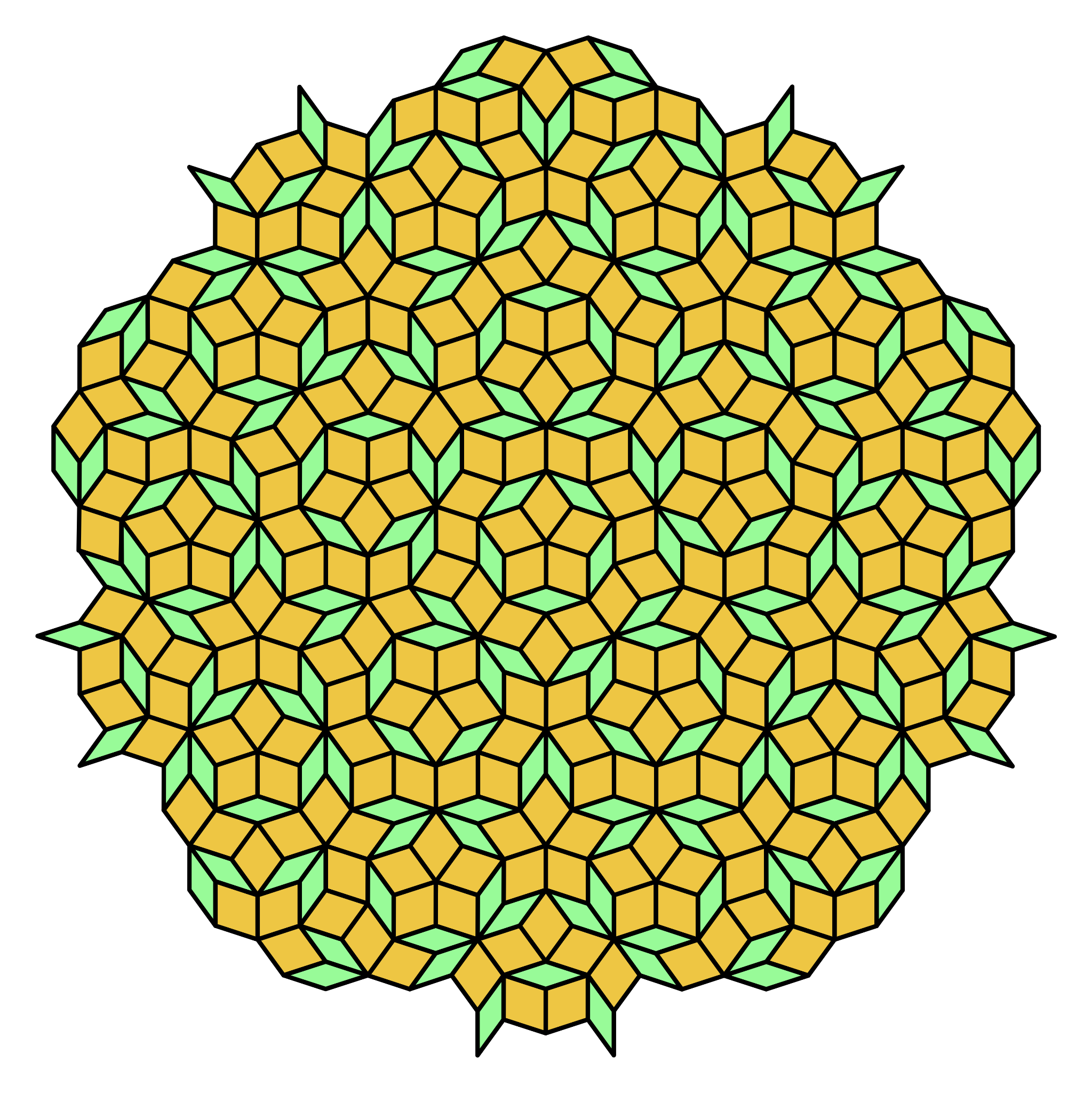
The same move does not mean the same thing everywhere.
- A piece changes type when it changes tile.
- Thick and Thin pieces have different movement relations.
- Attack follows geometry automatically.
- Stars, Moats, Gates, and the Throne produce regions with different strategic centrality.
- A mirror-image board is a different board.
- Every move changes the later routes available to every piece that remains.
The game is a ludic instrument for learning that action belongs to a position inside a structured field.
These two papers do not establish the ethics, validate the game, or prove that a Penrose board secretly governs solid-state physics.
They do something more useful.
They show the same anti-background principle operating in real technical systems:
- Structure is not where the action happens.
- Structure is part of the action.
- In the monotile device, the arrangement determines which optical outputs become available.
- In the piezochiral crystal, deformation changes the symmetry and selects which handed response becomes extant.
- In the game, board position changes what the piece can be and what it can do next.
The field is not a neutral stage waiting for an actor.
The field is one of the actors.
Shape Is Already Code. Strain Is an Input.
Transition Action: Shape Is Already Code argued that a physical structure crosses into executable form when it performs a reliable input-output transformation.
 Aidan Lawson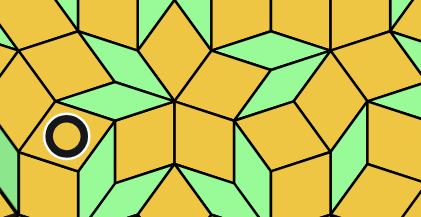
This special edition supplies two clean transformations.
The monotile optical field.
- Input: wavelength, polarization, direction, and spatial profile of incident light.
- Kernel: scattering and interference across the fabricated aperiodic aperture field.
- Output: a structured diffraction-intensity distribution with chiral features.
The piezochiral crystal.
- Input: magnitude, sign, and axis of applied strain.
- Kernel: symmetry lowering and unequal deformation of opposite-handed substructures in the crystal.
- Output: induced net chirality measured through optical rotation.
Neither system is a general computer.
Both systems are physical transformations whose behavior is carried by realized geometry, material properties, scale, boundary conditions, and coupling.
The equations are not floating instructions above the devices. The program lives across design and matter.
- The monotile pattern must survive fabrication tolerance.
- The crystal must remain within its elastic and optical operating regime.
- The light must arrive at the right wavelength and geometry.
- The strain must be applied along the right axis and with a known sign.
This is executable form under physical conditions.
Field Instruments: Active Information gives the same relation another name. Information becomes active when its uptake changes reachability. The spatial pattern contains little of the energy carried by the laser. The strain command contains little of the optical energy used to read the crystal.
The surrounding physical systems supply the force.
Form redirects what the force can do.
Do Not Sell the Chiral Computer Yet.
The conjunction is excellent enough to invite immediate nonsense.
So the boundaries go down now.
- The monotile device is a fixed fabricated pattern measured in a controlled optical setup.
- The experiment establishes chiral diffraction, long-range order, mirror reversal, and helicity-dependent response.
- It does not yet establish an efficient integrated polarization component, a reconfigurable metasurface, an optical computer, or a commercially competitive device.
- The experiment establishes chiral diffraction, long-range order, mirror reversal, and helicity-dependent response.
- The piezochiral experiment uses a prepared single-crystal sample in a laboratory strain cell and reads the result through polarization rotation.
- It does not yet establish a fast, low-power, highly cycled on-chip chirality switch.
- The paper proposes possible routes toward microelectromechanical integration, biosensing, catalysis, spintronics, photonics, and quantum materials.
- Those are research directions.
- The paper proposes possible routes toward microelectromechanical integration, biosensing, catalysis, spintronics, photonics, and quantum materials.
- It does not yet establish a fast, low-power, highly cycled on-chip chirality switch.
- The 40,000-material database identifies candidates from symmetry and known material information.
- It does not certify forty thousand strong, stable, manufacturable piezochiral platforms.
The two papers also concern different forms of chirality. A planar aperiodic point field and a strained three-dimensional crystal should not be treated as interchangeable examples of one universal device principle.
The current result is still significant.
- One team fabricated global chiral behavior from locally achiral apertures.
- One team induced net chirality in an achiral crystal through a general strain-coupling formalism.
- Both teams supplied measurable outputs with controlled handedness reversal: through a separately fabricated mirror field in one case, and through strain sign or axis in the other.
- Neither team has delivered the final application stack.
Transition Action enters at exactly this scale.
The capability has started to move.
What This Makes Reachable.
The immediate reachability is technical and specific.
- A Smith-hat-derived quasilattice can be fabricated at nanophotonic scale with hundreds of thousands of circular apertures.
- Long-range order in that field can produce sharp Bragg peaks independent of the illumination position.
- A globally chiral arrangement of locally achiral holes can generate pinwheel diffraction and circular-polarization-dependent intensity patterns.
- Mirroring the fabricated field reverses the optical handedness.
- Recursive aperiodic geometry can leave an analytically recoverable angle in reciprocal space.
- Uniaxial strain can induce chirality in an equilibrium-achiral crystal containing opposite-handed local substructures.
- Tension, compression, and strain-axis selection can control the sign of the induced chirality.
- Optical activity can provide a direct readout of the strain-induced chiral state.
- Symmetry classification can identify broad families of candidate piezochiral materials before full experimental testing.
The longer reachability is architectural.
Engineers can now ask two expanded design questions.
- What handed behavior can be generated through global arrangement without making every local element chiral?
- What handed state can be selected dynamically by changing the constraint on an achiral material?
- The first question opens richer aperiodic photonic fields.
- The second opens mechanically tunable chiral matter.
Their overlap points toward devices whose optical or material handedness is designed at one level and controlled at another: aperiodic chiral architectures built from strain-tunable constituents, reconfigurable optical fields, polarization devices, sensing surfaces, or material systems whose chirality can be selected after fabrication.
That overlap remains prospective.
It is now reachable enough to investigate directly.
The Transition Action.
The official Transition Action is the crossing from chirality as a fixed structural fact to chirality as an engineered operation.
The first ladder runs:
- Smith hat
- → centroid quasilattice
- → circular nanohole field
- → chiral diffraction
- → helicity-dependent optical response
- → chiral diffraction
- → circular nanohole field
- → centroid quasilattice
The second runs:
- antiferrochiral crystal
- → applied uniaxial strain
- → symmetry lowering
- → unequal opposite-handed contributions
- → selected net chirality
- → optical rotation
- → selected net chirality
- → unequal opposite-handed contributions
- → symmetry lowering
- → applied uniaxial strain
- One field is arranged.
- One field is strained.
- Light turns.
- Matter chooses.
- The holes had no hand.
- The crystal had no net hand.
- The transition produced one.