Tales of Distortion: Operation Cottage
The battle against an enemy that was not there. [L]
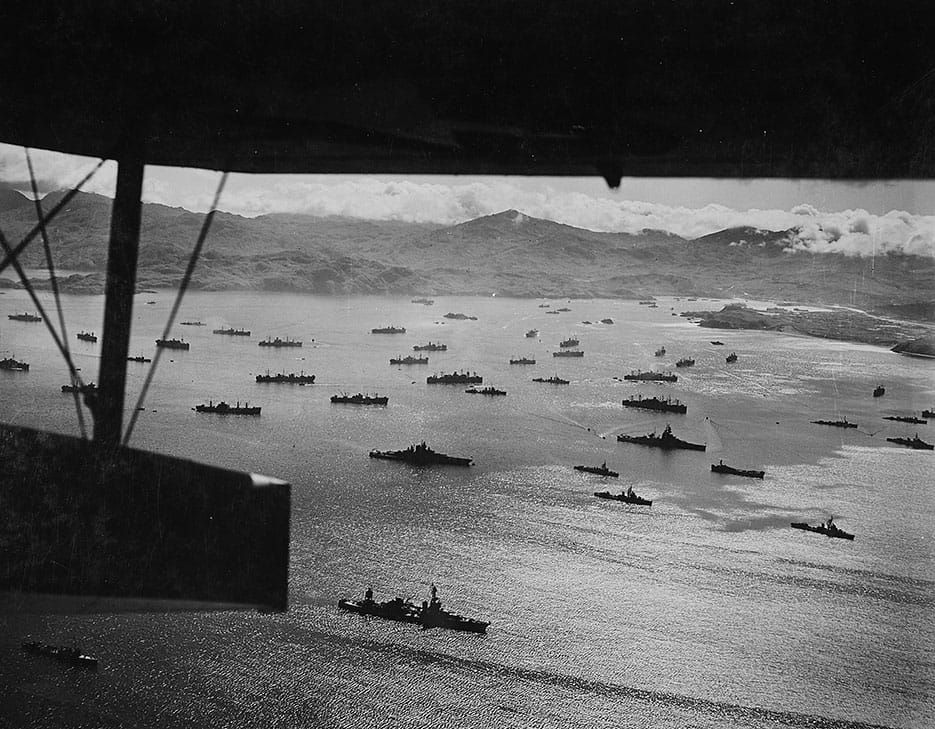
The Allies invaded Kiska after the Japanese had already gone.
This is one of the most considerate things any enemy can do before an amphibious assault.
The enemy can actually leave a strongly held island. The enemy may just abandon its prepared positions. They may vacate the tunnels, empty the bunkers, stop sending radio traffic, fail to repair bomb damage, reduce anti-aircraft fire, vanish from the harbor, and generally do everything short of leaving a large tasteful sign that says:
We are no longer available for battles at this location.
Operation Cottage looked at this generous development and brought a battle anyway.
On August 15, 1943, more than 34,000 American and Canadian troops landed on Kiska in the Aleutian Islands, expecting a hard fight against a Japanese garrison.
The island had been bombed and shelled heavily. The assault force came in prepared for caves, ridges, fog, snipers, booby traps, mines, and the kind of desperate defense the Allies had just seen on Attu.
A National Defense University Press account gives us the final arithmetic: the Japanese had evacuated weeks earlier, but Allied forces still suffered 92 fatalities and 221 wounded.
The Japanese suffered no casualties during the invasion, because they had achieved the extremely advanced defensive state of not being there.
This sounds like comedy.
It is darkly funny
It is also a serious field audit with many bodies in it.
Operation Cottage is not only a story about bad intelligence. Intelligence did see the absence. Analysts noticed diminished activity, unrepaired damage, falling anti-aircraft fire, lack of harbor movement, and then the total cessation of radio signals.
These were not tiny clues hidden in a drawer labeled For Later Use If Everyone Dies. The field was waving its arms around.
The distortion causing everyone to ignore this was that the command instrument had already learned the enemy too well. That's a pretty tough reward. Attu had taught one lesson so violently that Kiska could not teach a different one in time.
A security instrument needs an enemy-image.
It has to model threat. It has to remember what the enemy has done, what the enemy can do, and what the enemy is likely to do next.
That is not optional.
A commander who cannot form an enemy-image is not “humble,” or “open-minded.” He is just waiting for the field to educate him with shrapnel.
But the enemy-image becomes dangerous when it survives the enemy.
At Kiska, battle became a portable thing.
The battle was no longer attached to a real enemy. It was carried ashore and into being by men who expected a battle, commanders who planned one, artillery that supported one, ships that delivered it, maps that framed it, and a weather system that was happy to make everyone worse at being alive.
The island was empty of the intended enemy.
It was not empty of the battle.
Attu.
The figure at the center of this Tale of Distortion is Vice Admiral Thomas C. Kinkaid. This needs to be said with particular care because Kinkaid was not a cartoon idiot who glanced at a silent island and said, “Perfect, that silence is probably full of Japanese.”
This guy doesn't get a “The Distortion of” section. He was a serious naval commander operating inside a real war right after a real bloodbath.
That bloodbath was Attu.
Attu had been retaken in May 1943. The island was cold, steep, fogbound, and miserable in the specific Aleutian way where the landscape seems to have read a manual on how to make human beings regret inventing amphibious planning.
American forces expected a coastal defense. The Japanese pulled back to the high ground instead. Fog made naval and artillery bombardment less effective. Snipers and mortar teams used caves, ridgelines, and the terrain’s natural cruelty.
The final Japanese charge left more than 500 bodies on the valley floor, and only 29 wounded Japanese soldiers survived from a garrison of 2,650.
The American force suffered 3,829 casualties, including 549 killed in action, according to the same NDU Press account.
Attu is the kind of lesson that does not sit quietly in the notebook.
Attu entered the next operation as a ghost with staff authority.
Kinkaid and the Joint Chiefs saw Attu as an “unimpeachable portent” of what Kiska would be. That phrase is doing a lot of work.
A portent is not a report. A portent comes from an oracle. A portent arrives wearing robes and points directly at the future. Attu had become a prophecy.
Kiska now had to answer for Attu.
This was not irrational at the beginning.
Kiska was more important than Attu. It had a developed harbor, an airfield, more Japanese troops, and a documented network of tunnels and bunkers.
This specific island mattered. It was American.
The Japanese had occupied American territory. There was political pressure, military pressure, and strategic pressure. No one in an Allied headquarters could responsibly shrug and say, “Well, what if the whole thing has become a weather station for ghosts?”
The problem arrived when a reasonable model became too expensive to correct.
A model is allowed to say:
- the enemy may be hidden;
- the enemy may have learned from Attu;
- the enemy may be preserving fire discipline;
- the enemy may be waiting in the high ground;
- the enemy may be using radio silence;
- the enemy may be forcing us to walk into a prepared field.
All of that definitely belongs in the room.
Then, the field has to be allowed into the room too.
At Kiska, the field was knocking. Loud.
Routine activity dropped. Harbor movement vanished. Bomb-damaged buildings and craters went unrepaired. Anti-aircraft fire declined.
On July 28, radio signals stopped entirely.
Many analysts suspected evacuation.
Kinkaid disagreed.
He thought the Japanese had withdrawn to the upper elevations, and staff suggestions for more aerial reconnaissance or an advance scouting party were discounted as risky and unnecessary.
That is the moment where the security instrument begins to close.
The enemy-image now has active antibodies.
- No movement means concealment.
- No repairs means deception.
- No radio means discipline.
- No harbor traffic means operational patience.
- No enemy contact means the enemy is higher up.
The evidence enters.
The model eats it.
Kimura Just Fucking Leaves.
The counterfigure is Rear Admiral Masatomi Kimura.
Kimura is almost irritatingly field-aware in this story. He is the man who looks at the field and reaches the least glamorous conclusion available to a military institution:
This position is stupid. Leave.
That sentence could save a lot of worlds if it appeared on more walls.
After Attu fell, Kiska became untenable.
The garrison was cut off. Submarine evacuation had failed badly after losses. Fuel was scarce. The Allies were bombing and blockading. Japanese hardliners could talk about honor, death, and the shame of withdrawal all they wanted, but the field had made its own argument.
Kiska was not a sacred object. Kiska was a remote, freezing, exposed liability full of men Japan needed somewhere else.
Kimura received the mission to get them out.
Kimura planned to use persistent Aleutian fog, approach from the dangerous northern route, rehearse formations under strict radio silence, and wait for weather. A July 7 attempt was aborted when the fog dissipated.
He waited. On July 21, the force left Paramushiro. By July 28, after the final refueling point, he began the stealth approach.
Then reality, being an unreliable but hilarious accomplice, helped him.
American destroyers were lured away by bad radar contacts in the “Battle of the Pips,” chasing a phantom fleet while the actual Japanese fleet was doing the important work of making the expected battle obsolete.
This is one of those details that sounds invented by a screenwriter who had been told to make the metaphor less subtle.
- The Allies chased little voids on a screen.
- The actual enemy became absence.
In thick fog, Kimura slipped through the blockade, reached Kiska Harbor on July 29, and loaded 5,183 men in 55 minutes.
Fifty-five minutes.
The operation had the moral clarity of a fire drill conducted by people who had finally understood the building was, in fact, on fire.
Men streamed in from all points of the island. Food, weapons, and clothing were abandoned. The fleet retraced the northern route and reached Paramushiro safely on August 1.
Kiska had changed.
What was a battlefield had become an abandoned site.
The Japanese had not won a battle at Kiska by killing the Allies.
They had won the field by making the battle unreachable.
Unfortunately, the Allied plan was already in love with this battle.
The Dog Files.
This article would like to now proceed in an orderly way.
But it cannot.
Because I found out there was a dog.
Actually, there may have been multiple dogs.
NDU Press writes that soldiers found “one stray dog” among the artifacts left by the retreating Japanese. An Aleutian World War II National Historic Area calendar says it was “not the Japanese, but a handful of dogs” that met the troops, then focuses on one dog with a name so powerful it should have been assigned its own destroyer.
Explosion.
The dog’s name was Explosion.
This is history misbehaving in public.
Explosion was a brown and white mutt.
The National Park Service calendar says she was born at Dutch Harbor the night a small dynamite shack detonated, which is an extremely direct naming convention.
Some dogs are named Lucky.
Some dogs are named Daisy.
In the Aleutians, apparently, a puppy may be named after the local munitions event that introduces her to the world.
Ensign William C. Jones had helped set up the Kiska weather station before the Japanese invasion. The calendar account says he gave Explosion to the isolated ten-man weather crew as a companion.
The Japanese invaded Kiska in June 1942. The U.S. Aerological Detail was captured, though Petty Officer William C. House escaped for fifty days before surrendering, starving and reduced to about eighty pounds. The men survived the war as prisoners.
Explosion remained behind on Kiska.
The Japanese apparently cared for her.
She survived the Allied bombardment.
Then, when Allied troops landed in August 1943, Ensign Jones saw a brown and white mutt greeting them and recognized the dog he had given the weather crew fifteen months before.
A war had arrived, occupied an island, captured a weather station, bombed a harbor, burned through shipping, killed men on Attu, evacuated thousands through fog, assembled more than 34,000 Allied troops, and landed them into a battlefield without an enemy.
Explosion just wagged her tail.
Modal Path Ethics is not prepared to say this dog understood the field better than Allied command. That would be unfair to the dog.
The dog had no access to photo interpretation, radio intelligence, blockade charts, or staff estimates.
She simply did not need them.
She occupied the one position in the operation that no headquarters could achieve:
Explosion was actually on Kiska.
She knew the island by smell, hunger, weather, noise, men leaving, men arriving, and whatever theory of geopolitics is possibly available to a small brown and white animal named after accidental combustion.
The dog is the perfect anti-instrument.
Explosion does not convert absence into doctrine. Explosion does not decide that radio silence means the enemy has ascended to the ridge. Explosion does not hold a briefing on Japanese cultural refusal to surrender. Explosion does not request final approval from Nimitz to invade the concept of Attu wearing Kiska’s hat.
Explosion is just there.
The whole distorted field is trying to infer Kiska from elsewhere.
This dog is Kiska itself saying hello.
We will return to this dog because apparently this is what war has asked of us.
The Evidence Starts Screaming.
By late July, Kiska was giving off a very specific signal:
This place is no longer acting like a garrison does.
This signal had parts.
- Routine activity diminished.
- Almost no harbor movement could be detected.
- Bomb damage went unrepaired.
- Anti-aircraft fire dropped.
- Signals intelligence disappeared.
Each sign had a better explanation available than the one the plan preferred.
- The damage was unrepaired because the maintenance crews had left.
- The harbor was quiet because ships had left.
- Anti-aircraft fire had declined because the defense had left.
- Radio signals had stopped because the operators had left.
- The island seemed empty because the island was empty.
This is a pretty easy paragraph to write after the fact. A Tale of Distortion cannot be a cheap little platform for hindsight superiority. The question is not why everyone failed to possess future knowledge while standing in fog.
It's why the evidence that did exist could not become authoritative.
Kinkaid had the Attu template.
- The Japanese had pulled back from Attu’s shore.
- They had used fog, caves, ridges, and high ground.
- The unopposed beach had not meant safety.
- It had meant the enemy was waiting where the island could help kill you.
- The unopposed beach had not meant safety.
- They had used fog, caves, ridges, and high ground.
So the absence on Kiska looked like the beginning of the Attu pattern.
This is how a real lesson becomes a distorted instrument.
A good lesson says:
Watch the high ground. The enemy may not defend the beach.
A sovereign lesson says:
Every missing enemy is now in the high ground until proven otherwise, also proof will be treated as enemy cunning.
The field cannot win that argument.
- If the Japanese fire, the model is right.
- If the Japanese do not fire, the model is also right because disciplined hidden enemies do not waste ammunition.
- If bomb damage is repaired, the enemy is active.
- If bomb damage is not repaired, the enemy is hiding.
- If radios transmit, the enemy is present.
- If radios do not transmit, the enemy is present but with better discipline.
At this point, the security instrument has left the field of analysis and entered theology. This is not an exaggeration.
The instrument now has doctrine, signs, hidden presence, sacred memory of blood, and an inability to receive disconfirming evidence without metabolizing it into deeper confirmation.
The enemy is no longer a garrison.
The enemy is an interpretive system.
Operation Cottage.
The landing began with enough physical misery to make the island seem guilty.
The morning of August 15 was unusually calm and clear at first.
Then the Aleutians remembered their identity. An inaccurate tidal forecast caused several tank landing ships to run aground on submerged volcanic rock. Landing craft backed up and bobbed in the littoral. Fog settled over the island. Cold rain came with it. Visibility dropped. There was no shelter. Soldiers dug shallow foxholes into rocky tundra and waited through the night.
This is the sort of environment that makes a false model feel correct because every sensation arrives wearing threat.
- The fog is threat-shaped.
- The wind is threat-shaped.
- The cold is threat-shaped.
- The rocks are threat-shaped.
- The fact that the enemy has not appeared is also threat-shaped.
At night, sporadic firing could be heard in all directions. Tracer bullets tore through fog. Voices were muffled and swept away by wind. Rumors of casualties, firefights, and Japanese snipers circulated as the troops began climbing into the high ground.
The men had brought the expected enemy with them.
That sentence should not be misunderstood.
The troops were not silly. They were exhausted, scared, wet, cold, armed, disoriented, and operating under a command assumption that said the island was occupied by disciplined forces waiting to kill them.
Then the island gave them fog, noise, bad visibility, and bodies moving where bodies were not expected.
A security field can produce its own enemy-contact when every contact has already been labeled enemy-shaped.
By mid-afternoon, advance elements reached the lower Japanese fortifications. They found abandoned bunkers, deserted tunnels, dugouts, destroyed weapons, empty positions.
The island began delivering the correction room by room.
- Look. Here is a bunker.
- No one is in it.
- Here is a tunnel.
- No one is in it.
- Here is a gun.
- It has been abandoned.
- Here is a position prepared for battle.
- The battle is not here.
The truth was embarrassing before it was clear.
The combined invasion force had seized an uninhabited island.
The Island Fights Anyway.
An empty island can still kill people. This is the part that keeps Operation Cottage from becoming a harmless military blooper.
No Japanese troops were present. But Japanese mines and primitive booby traps remained. Allied troops fired on one another in fog and confusion. Vehicles had accidents. The terrain and weather kept acting like terrain and weather do.
On August 18, the destroyer USS Abner Read struck a mine in Kiska Harbor, killing 70 sailors and wounding 47. In total, Allied forces suffered 92 fatalities and 221 wounded during the operation.
- The enemy had left.
- The dangerous field had not.
A bad summary says:
They fought nobody.
The better summary says:
The security instrument kept moving after the enemy relation had changed, and the remaining field converted that motion into casualties.
There were still mines. There were still booby traps. There were still guns, weather, fatigue, rumor, fear, command pressure, uncertainty, poor visibility, and armed men trained to read the field as hostile.
That is plenty for a war.
A war-field is not only a set of enemy bodies. It is the total arrangement of expectations, weapons, terrain, weather, logistics, visibility, doctrine, fear, memory, and leftovers.
A mine does not need to believe in the occupation. A fogbank does not require current Japanese authorization. A nervous soldier seeing a helmet in the gray does not ask for a roster.
This island did not need a garrison to remain dangerous. It needed a battle.
The Leaflets Were Right.
Now we have to discuss the leaflets.
After the landing, exhausted Allied soldiers found thousands of propaganda leaflets that had been dropped by U.S. Army Intelligence.
These leaflets told the Japanese that their situation was hopeless and urged immediate surrender.
This is one of the most perfect pieces of paper in the history of distorted fields.
- The Allies told the Japanese their position was hopeless.
- The Japanese accepted the basic strategic premise.
- Then the Allies invaded to explain it again in person.
- The Japanese accepted the basic strategic premise.
This paper had already performed the field analysis here. The situation was hopeless. Staying on Kiska made no sense. The garrison should cease being a garrison. The Japanese command, through Kimura, performed an even better version of that instruction than surrender. They evacuated the men under fog and left the island behind.
The leaflets were right.
The invasion plan arrived because the rest of the instrument had not believed its own paperwork.
An Eleventh Air Force pilot later put the dog files in one savage line, preserved in the National Park Service calendar:
“We dropped one hundred thousand propaganda leaflets [on Kiska], but those dogs couldn’t read.”
This is an excellent joke because it is also a map of the failure.
The intended audience could read enough of the field to leave.
The remaining audience was dogs.
The Dog Files II.
The dog cannot remain a footnote.
This is partly because Explosion is very funny.
Modal Path Ethics is a serious ethical framework, and therefore cannot ignore a battlefield dog named Explosion who survives occupation, bombardment, evacuation, and the Allied invasion of an empty island.
But this good girl is not only funny.
Explosion is the small living object that makes the distortion visible without becoming a theory.
The Japanese cared for her after capturing the weather crew. This does not redeem the occupation. It does not soften the fate of the prisoners.
It also belongs to reality. A force can occupy an island, capture men, prepare defenses, abandon positions, and still feed a dog.
Fields are impolite to clean moral sorting.
Explosion survived the Allied bombardment.
The island had been pulverized in preparation for an enemy that was already leaving or gone. During July alone, Eleventh Air Force dropped 424 tons of ordnance on Kiska, while Navy cruisers and destroyers added 330 tons of shellfire. Somewhere inside that field, a dog named Explosion, born beside a dynamite accident, made a decision to continue. This was apparently her whole brand.
Then the Allied invasion arrived. Ensign Jones recognized her. The dog had crossed from American weather station mascot to Japanese-occupied island survivor to Allied reunion object. She was, in the dumbest possible sense, the most continuous Allied contact with the island.
- The Allied command had to infer.
- The Allied dog had lived.
- Aerial reconnaissance could not smell abandonment.
- The dog could smell many things.
Again, this does not mean the dog should have been appointed commander of North Pacific Force.
There are real objections to that. She lacked naval rank. She probably had very poor radio discipline.
Her staff work is undocumented. Her name might have caused confusion during ammunition reports.
Still, this article must record that Operation Cottage’s final field audit is not improved by comparison with the dog.
Baby Needs a New Pair of Shoes.
On August 16, patrols from the northern and southern sectors converged on the main Japanese camp and confirmed no enemy troops remained on Kiska. Colonel Robert T. Frederick then sent a pre-arranged coded message to the Second Regiment on Amchitka:
“Baby needs a new pair of shoes.”
This phrase meant the planned parachute jump would not happen.
War has many strange dialects, but there is a special majesty in using that phrase to say "this island invasion has failed to locate the enemy."
Some men were already on alert. One account from the U.S. Army Special Operations History Office has a private remembering roughly 600 jumpers waiting with C-47s, lying down on the runway while still wearing parachutes, then getting called off by baby footwear.
A coded phrase is a field instrument too. This one compresses danger into a manageable signal. That is useful.
The phrase did its work. It also leaves history with a little nonsense object sitting next to the corpse of a plan.
Operation Cottage contains very few symbols. This event was very grounded. The fog is just real fog. The mines are real mines. The abandoned bunkers are bunkers. The leaflets are real leaflets. Explosion is a real dog.
Then, at the moment the operation finally admits that one more wave of men does not need to descend from the sky into this mistake, the field says:
Baby needs a new pair of shoes.
At least someone updated their register.
The Midget Submarines.
After the island had been taken from no one, the troops discovered Japanese equipment everywhere.
Vehicles. Anti-aircraft weapons. Landing craft. Defensive positions. Destroyed gear. Souvenirs waiting to become somebody’s future basement problem.
Kiska had also housed Japanese midget submarines, including a marine railway for launch and recovery. The U.S. Army Special Operations History account records that one platoon had to guard the submarine facility to prevent souvenir-hunting GIs from stripping the vessels.
This is a magnificent final turn in the field.
- Operation Cottage begins as an assault against a dangerous garrison.
- It proceeds as a battle with absence.
- It produces casualties from mines, traps, accidents, and friendly fire.
- It discovers a cool dog.
- It sends a coded message about baby shoes.
- Then it develops a new security requirement:
- It sends a coded message about baby shoes.
- It discovers a cool dog.
- It produces casualties from mines, traps, accidents, and friendly fire.
- It proceeds as a battle with absence.
"Please stop the victorious army from stealing parts off the tiny submarines."
This is the whole thing in miniature.
The security instrument kept looking for the enemy. Once the enemy was gone, the field did not become simple or stop. It became administrative in a different key. Now the island had to be secured from its liberators’ appetite for objects.
Reality has a gift for refusing dignified endings.
The Empty Island.
Operation Cottage shows us a protection instrument becoming sovereign over contact.
A security instrument has to simplify. No army can wait for perfect knowledge. Command requires assumptions, plans, threat models, readiness, doctrine, rehearsals, and decision points.
The question is never whether the instrument will reduce the field. It will.
The question is whether the field can still correct the reduction.
At Kiska, the instrument reduced the field this way:
Japanese garrison present; Japanese garrison will not retreat; Japanese garrison will fight like Attu.
Each part of this was plausible.
Each part was also wrong.
The distortion was not that Kinkaid formed assumptions. Assumptions are unavoidable in war. The distortion was that the assumptions became too sovereign.
Contradictory evidence entered as deeper confirmation. The island’s changing behavior became the enemy’s hidden intention. The absence of signals became a signal. The absence of motion became concealment. The absence of the enemy became incredible enemy discipline.
This is the security version of bad sacred instrumentation.
- A prophecy can become a calendar that reality is no longer allowed to correct.
- An enemy-image can become a battlefield that the enemy is no longer required to inhabit.
Both failures protect the instrument from extance.
Both failures make the field carry the cost.
Kiska is one of the cleanest modern images of threat-model sovereignty.
That model was born from real blood on Attu.
That model helped protect planners against underestimating a dangerous enemy.
That model then made an empty island unreadable.
A useful instrument became a closure machine at exactly the moment it needed to loosen.
The Ruling.
Operation Cottage was a battle delivered to the wrong version of reality.
The Allied command expected the Japanese garrison on Kiska to behave like the Japanese garrison on Attu. That expectation was understandable. Attu had been brutal. Attu had burned its lesson into the command field with enough blood to make caution feel like intelligence and doubt feel like recklessness.
But then Kiska changed.
Kimura read the field and left. The garrison left. Radio traffic stopped. Repairs stopped. Harbor movement vanished. Anti-aircraft fire declined. The evidence became "strange" because the plan could not let it become clear.
So Operation Cottage arrived on schedule.
It brought 34,000 troops, landing craft, ships, artillery, fog, fear, traffic jams, tracer fire, rumors, mines, booby traps, friendly fire, and a battle plan strong enough to keep moving after the intended enemy had exited the field.
The island answered back with empty bunkers, abandoned tunnels, leaflets addressed to men who had already gone, a coded message about baby shoes, midget submarines that now had to be protected from souvenir hunters, and Explosion.
A dog named after a blast survived occupation, bombardment, and the invasion of a battle that had missed its opponent. She did not solve this war. She did not need to. She became the small living witness that the field had continued under everyone else’s theory.
The dead remain the center of the ruling.
The 92 Allied fatalities and 221 wounded do not become funny because this island was empty. They become even more terrible because the instrument failed after the correction had already begun.
The security lesson is simple and hard:
A threat model is allowed to warn. It is not allowed to become the only thing that can speak.
- Attu taught the Allies to fear hidden resistance.
- Kiska tried to teach them absence.
The instrument could hear Attu more clearly.
So the battle came anyway.