Field Instruments: The Alarm
Greta Thunberg was right to wake the building. The alarm still has to surrender the blueprint.
Greta Thunberg did not discover the climate crisis.
The scientists were already there.
The measurements were already there.
The reports were already there.
Governments had already signed agreements, created targets, convened summits, appointed panels, issued declarations, delayed implementation, revised the declarations, and arrived at the next summit carrying several new folders about the previous summit.
The information existed.
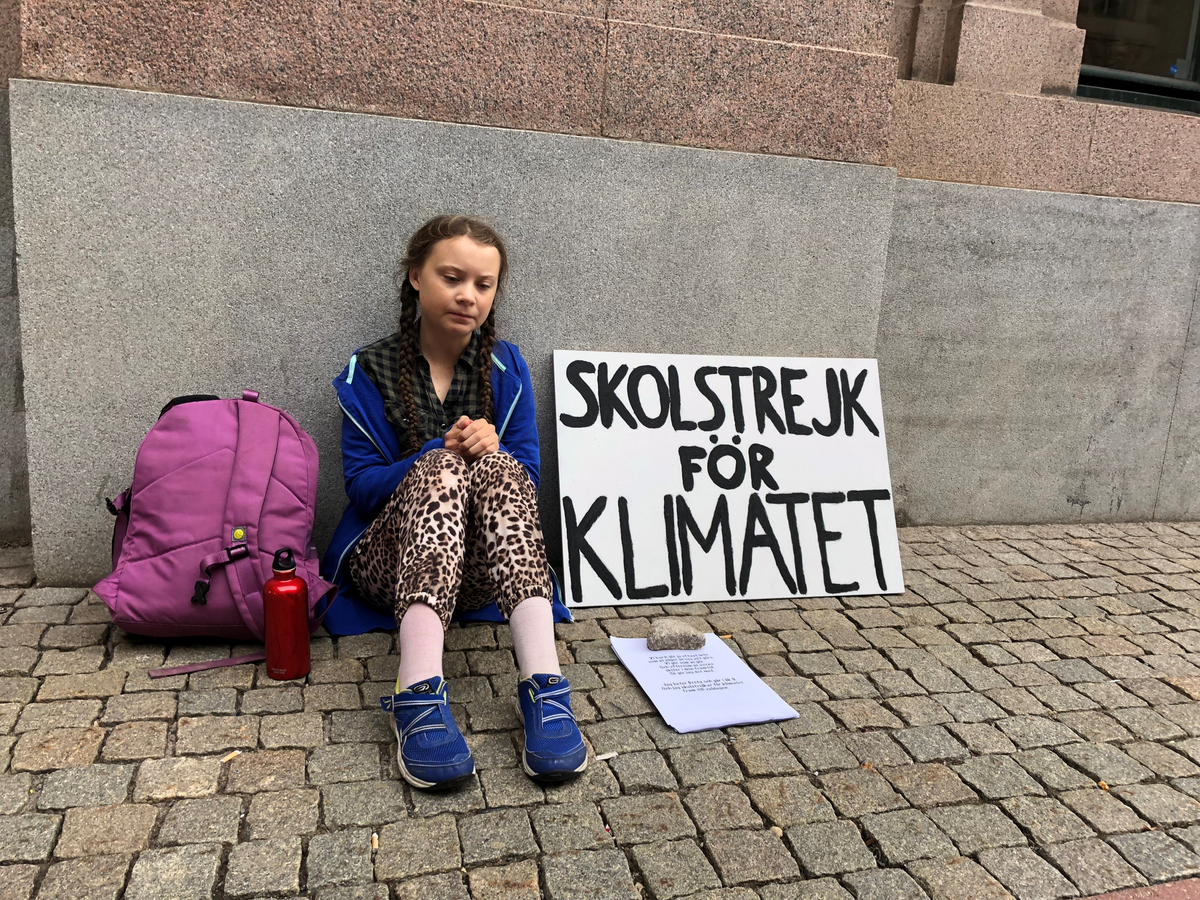
Then, a fifteen-year-old sat down outside the Swedish Parliament with a sign.
Now, the field moved.
That is the object of this article.
Greta Thunberg did not give civilization its first climate fact. She gave known danger a form capable of entering a social receiver that had learned how to survive the facts.
The child outside parliament made the future stand in front of the present.
The school strike made ordinary attendance look strange beside planetary nonattendance.
The emergency voice compressed decades of scientific warning into one accusation a camera could carry.
- The danger was known.
- The institutions were functioning.
- The policies were insufficient.
- This child stopped attending class because the adults were still attending procedure.
- The policies were insufficient.
The sign contained almost none of the force that followed.
Millions of people, thousands of cities, schools, families, newsrooms, parties, parliaments, corporations, scientists, celebrities, opponents, trolls, police departments, conference organizers, and frightened adults supplied the force.
This is exactly the structure described in Field Instruments: Active Information.
A fire alarm contains very little energy compared with the building it moves.
The building already has legs.
The alarm gives the legs a difference they have been trained to answer.
Greta became one of the most powerful public operators of that difference in modern political life.
The Strongest Defense of the Emergency Voice.
Start before Greta.
Climate science had achieved an extraordinary institutional accomplishment.
A planetary process distributed across atmosphere, ocean, land, ice, chemistry, industry, agriculture, transport, energy, forests, cities, and centuries had been made partially legible through measurements, models, paleoclimate records, satellites, attribution studies, assessments, and international scientific coordination.
Civilization had built instruments capable of detecting its own alteration of the climate system.
That is a big deal.
The atmosphere does not arrive at Parliament with a chart under its arm.
Carbon dioxide does not attend a press conference.
Ocean heat does not knock on the office door and explain that this relationship has become unsustainable.
Human beings had to construct a long chain of contact:
- observation;
- calibration;
- replication;
- model comparison;
- uncertainty discipline;
- assessment;
- translation;
- political reception;
- public communication.
The chain worked well enough to establish the central fact.
Human activity was warming the world. Continued greenhouse-gas emissions would intensify hazards. Delay would consume safer paths.
The Intergovernmental Panel on Climate Change now states the structure with brutal clarity: every additional increment of warming intensifies multiple concurrent hazards, while deep, rapid, and sustained emissions reductions slow the damage.
The science was not waiting for a Swedish teenager to make it real.
The political field was.
This is the first great defense of Greta's instrument.
The climate crisis did not lack information. It lacked active information.
A report can be true and remain politically inert.
A target can be adopted and remain materially weak.
A summit can increase the quantity of climate language while preserving the tempo of climate damage.
The ordinary political receiver had become very good at accepting warning without accepting interruption.
- The minister acknowledged the science.
- The company announced a distant goal.
- The institution added climate language to the strategy.
- The city declared an emergency.
- The airport expanded.
- The emissions continued.
This is a sophisticated form of denial because no one has to deny the fact.
The fact is welcomed.
It is thanked heartily for its contribution.
It is seated near the front.
Then, the meeting proceeds on the assumption that every existing timetable retains moral title.
Greta's emergency voice attacked that tempo.
At COP24 in 2018, she spoke as a fifteen-year-old and framed climate delay through equity, fossil wealth, generational foreclosure, and the difference between what is physically required and what is considered politically possible. The official UNFCCC statement is short enough to reveal the whole instrument.
She did not present another technical pathway.
She accused the receiver.
- The adults were asking what could pass through the political system.
- The child asked what the climate system would permit.
This is legitimate asymmetry.
A young person does not have superior climate knowledge because of their youth. Age does not confer automatic wisdom in either direction. The standing came from inheritance.
The people with the least formal authority over the transition would occupy more of the future produced by it.
The child was evidence of burden transfer.
That made the school strike unusually exact.
A student normally misses school because something has interrupted education.
Greta reversed the relation.
She treated education as interrupted by a political order preparing a damaged future beneath the lesson plan.
The strike said:
You are teaching us how to enter society.
Society is narrowing the world we are being trained to enter.
Attendance cannot be the highest duty in a field where the institution receiving our attendance will not answer the emergency.
This was not a comprehensive climate program.
It was a refusal to let normality certify itself.
The refusal spread because the underlying contradiction was real.
Fridays for Future began with one student outside Parliament in August 2018. Its own current account describes a youth-led movement that reached thousands of cities and millions of participants across every continent.
The movement gave young people a repeatable instrument.
Leave the ordinary timetable.
Stand at the institution.
Name the crisis.
Return next Friday.
This was genius.
The action was small enough to reproduce and serious enough to accumulate.
A school strike does not require access to a legislature, laboratory, television studio, donor network, political party, or oil field.
It requires a body, a sign, a place where authority can see itself being refused, and enough persistence to make one Friday become a pattern.
Greta did not ask every young person to become Greta.
She discovered an alarm other people could operate from their own city.
That is what a good field instrument does.
It increases the number of places from which the field can speak.
The Alarm Was Right.
The easiest bad critique of Greta is that the tone was too severe.
This critique has aged poorly.
The World Meteorological Organization's State of the Global Climate 2025 reports that 2015 through 2025 were the eleven hottest years in the observational record, with 2025 around 1.43 degrees Celsius above the 1850-1900 average and second or third warmest depending on dataset.
The United Nations Environment Programme's 2025 Emissions Gap Report estimates around 2.8 degrees Celsius of warming this century under current policies, with full implementation of national pledges still around 2.3 to 2.5 degrees.
The alarm was not disproven by time.
Time kept bringing more evidence.
This matters because an alarm is first an epistemic instrument.
It asks the receiver to distinguish emergency from ordinary variation.
If the alarm is false, badly calibrated, or attached to the wrong event, it can redirect enormous force toward panic, coercion, waste, scapegoating, and destructive overreaction.
The truth condition therefore comes first.
Greta's core warning passed.
- The world was warming.
- Fossil-fuel combustion was central.
- Delay was consuming safer paths.
- Unequal populations were carrying unequal burdens.
- Distant targets could coexist with near-term continuation.
- Political feasibility was being treated as a boundary stronger than physical feasibility.
The instrument also caught a form of institutional dishonesty that ordinary climate language often protected.
- A government could announce net zero while approving infrastructure whose operating life extended deep into the target period.
- A company could purchase offsets while expanding the activity being offset.
- A summit could produce a better sentence without producing a better path.
At Davos in 2019, Greta used the image that would define the instrument:
Our house is on fire.
At Davos in 2020, she returned and said the house was still on fire.
That repetition was part of the point.
An alarm should stop when the danger has been answered.
This danger had not been answered.
The same image became accusation through persistence.
The people in the room had heard it.
They had applauded it.
They had not built the exit.
Greta's tone also supplied a correction to the social aesthetics of climate expertise.
Institutional language often becomes calmer as the underlying problem becomes worse.
This is not always cowardice. Calm language protects precision. Scientific assessments must distinguish confidence levels, scenarios, time horizons, mechanisms, and uncertainties. A scientist who turns every finding into an apocalyptic sentence can damage the receiver's ability to distinguish evidence from performance.
Political language can borrow that restraint dishonestly.
- Complex becomes optional.
- Uncertain becomes distant.
- Difficult becomes impossible.
- Gradual becomes later.
- Responsible becomes harmless to the incumbent.
The emergency voice interrupted that theft.
- It said the uncertainty lives inside a dangerous range.
- It said complexity does not suspend physical consequence.
- It said the absence of a politically comfortable path does not create permission to remain on the damaging path.
That was a real correction.
Modal Path Ethics accepts it completely.
The Alarm Worked.
There is a second easy bad critique.
It says Greta became famous, people marched, leaders performed concern, and nothing happened.
That account is too clean.
The climate movement did not solve the climate crisis. The claim that it changed nothing is still false.
Research on the so-called Greta effect found that greater familiarity with Thunberg was associated with stronger intentions to take collective climate action, with collective efficacy carrying much of the relationship. The effect appeared across age groups and across the political spectrum, though it was stronger among people on the political left. The original study did not establish a universal conversion machine. It showed that a public figure can help people experience collective action as reachable.
That is alarm work.
A separate study of Fridays for Future in Germany found that higher local protest participation increased later Green Party vote shares. Another study of twenty-five cities found that Fridays for Future pressure changed climate policymaking processes in all of them and produced more ambitious policy outputs in most.
These findings should be handled with discipline.
- A vote shift is not decarbonization.
- A policy process can change without emissions falling fast enough.
- A city can adopt ambition that implementation later eats.
Familiarity can motivate supporters while hardening opponents.
Still, the alarm moved attention, efficacy, voting, elite communication, and policy process.
That is more than celebrity weather.
The instrument also changed who could appear as a climate actor.
Before the school strikes, climate authority was publicly concentrated around scientists, environmental organizations, international institutions, policy specialists, and political leaders.
Young people were usually represented as beneficiaries, victims, students, or symbols of the future.
Fridays for Future made them political witnesses to the present.
This altered the public field.
- A child could question a head of state without pretending to possess executive authority.
- A student could cite the science while refusing the role of passive recipient.
- A school could become a site of climate politics because the curriculum was preparing students for a future being materially narrowed outside the classroom.
- A family dinner could receive pressure from a child who had acquired a global language for local unease.
The alarm traveled through relations adults could not dismiss without revealing the dismissal.
This also explains the fury directed at Greta.
The attack often had very little to do with climate modeling.
A young woman with no elected office, corporate command, military rank, vast inherited wealth, or technical monopoly had acquired standing through moral compression.
She made powerful adults answer a person they could not easily place beneath them without looking exactly like the problem.
So, the field tried several reductions.
- She was a child and therefore knew nothing.
- She was famous and therefore had become inauthentic.
- She was emotional and therefore irrational.
- She was controlled and therefore lacked agency.
- She was autistic and therefore either supernaturally pure or structurally unfit,
- depending on which insult was needed that morning.
- She traveled and therefore had a footprint.
- She existed in public and therefore the climate crisis was now somehow about whether everyone liked Greta.
Personalization was one of the alarm's strengths.
It was also the first danger.
The Alarm Becomes a Person.
An impersonal warning can disappear into the institution that issued it.
A person cannot be absorbed so quietly.
Greta gave the climate emergency a recognizable carrier. The braids, the sign, the flat delivery, the small body in rooms built for global power, the refusal to perform gratitude for being heard: these became a public interface.
Interfaces help fields act.
They also narrow interpretation.
The climate crisis became easier to route through one question:
What do you think of Greta Thunberg?
This was convenient for almost everyone.
- Supporters could defend the alarm through loyalty to the carrier.
- Opponents could attack the carrier instead of the event.
- Media could convert atmospheric physics into a person conflict.
- Politicians could meet the symbol, praise the symbol, criticize the symbol, photograph the symbol, and continue treating the machinery underneath as a later problem.
The alarm had become content.
This is a standard distortion in active information.
- The message needs a receiver.
- The receiver prefers a character.
- The character begins carrying every unresolved part of the event.
- The receiver prefers a character.
Greta's extraordinary discipline reduced this risk without eliminating it. She repeatedly redirected attention toward scientists and the carbon budget. In testimony before the United States Congress in 2019, her central instruction was simple: listen to the scientists.
This was a jurisdictional statement.
She was not presenting herself as the source of the climate facts.
She was using public standing to route attention back toward the instruments that established them.
That is good alarm behavior.
The movement's decentralized form also mattered. Fridays for Future describes itself as youth-led and independent of parties and commercial interests. Local groups organized under a shared signal rather than a complete global command structure.
This allowed the instrument to reproduce without turning every strike into an order from one center.
The structure was imperfect, contested, and vulnerable to brand transfer. It still avoided the cleanest form of sovereign capture.
Greta did not build a church where every climate interpretation had to pass through Greta.
She did not build a party whose legitimacy depended on permanent personal leadership.
She did not build a company that owned the infrastructure through which climate action had to proceed.
She did not become the official scientist, engineer, minister, judge, planner, or controller of the transition.
She became the alarm.
That is a narrower role than her fame suggests.
It is also a powerful one.
The audit begins at the edge of that role.
The Alarm Has Local Contact.
An alarm can be exactly right about danger.
This gives it standing in the emergency.
It does not give it the whole building.
The distinction is jurisdictional. Field Instruments: Disruption reached the same boundary from the opposite direction: local contact gives standing without granting the whole field.
Greta's instrument has unusually strong local contact with several parts of the climate field.
She understands the political production of delay.
She understands the moral force of intergenerational burden transfer.
She understands how distant targets can hide near-term continuation.
She understands that climate action separated from equity can reproduce the field that created the damage.
She understands the public language through which leaders metabolize warning into ceremony.
She understands how youth can turn excluded standing into pressure.
That contact is real.
The climate transition also enters fields the alarm did not create:
- electricity grids;
- mines;
- refineries;
- ports;
- forests;
- farms;
- apartment buildings;
- public budgets;
- labor contracts;
- Indigenous land;
- national security;
- industrial heat;
- fertilizer;
- steel;
- cement;
- aviation;
- shipping;
- housing;
- energy poverty;
- adaptation;
- migration;
- food prices;
- local democracy;
- and the ordinary schedules of people who cannot suspend life while civilization rebuilds its metabolism.
The alarm has standing across this field because climate consequence reaches all of it.
Standing is not command.
A climate scientist can establish that emissions must fall and evaluate the physical consequences of pathways. The scientist does not automatically receive final authority over labor settlement, land rights, energy pricing, tax incidence, public ownership, mineral governance, acceptable local risk, or the distribution of transition burden.
An activist can correctly identify delay. The activist does not automatically know which transmission route should cross which community, which reactor should remain open, which mine should receive permission, which technology mix fits a regional grid, which adaptation project has local legitimacy, or which sequence can survive a change in government.
An engineer can know the grid and still miss the village.
A village can know the land and still underestimate the system-wide need for transmission.
A union can know the workers and still defend an industry whose continuation closes the wider field.
A government can know the budget and still transfer the cost onto people with the least room to absorb it.
Every instrument has local contact.
The climate transition becomes ethical only if these contacts can answer one another without any one of them claiming that urgency has made the others unreal.
This is where alarm rhetoric becomes vulnerable to a dangerous promotion.
The person who correctly establishes that normal continuation is unsafe begins to be treated as the person whose preferred transition sequence is therefore safe.
That conversion does not follow.
- Danger recognition is a capacity.
- Path construction is another capacity.
- Burden distribution is another.
- Maintenance is another.
- Democratic legitimacy is another.
- Correction after failure is another.
A civilization can need the alarm and still need every other instrument the alarm cannot be.
"Listen to the Science" Is a Receiver, Not a Constitution.
"Listen to the science" was an excellent correction to climate denial.
It still remains an incomplete theory of government.
This sentence has often been abused by people who want science to become weaker. Modal Path Ethics has no interest in helping them with that.
 Aidan Lawson
The climate field is constrained by physical reality.
 Aidan Lawson
A political coalition cannot vote carbon dioxide out of its radiative properties. A market cannot negotiate a private settlement with ocean heat. A nation cannot declare its emissions historically understandable and thereby remove their atmospheric effect.
Science has standing because reality has structure.
The climate transition has to answer to that structure.
The phrase becomes incomplete at the next layer.
Science can identify causal relations, estimate risks, compare pathways, model scenarios, and show how different emissions trajectories alter future hazards.
It does not contain one automatic answer to every distributional and political question inside those pathways.
The scientific assessment may say:
- emissions must fall quickly;
- coal use must decline;
- electrification must accelerate;
- grids and storage must expand;
- efficiency must improve;
- methane must fall;
- land systems must change;
- adaptation must increase;
- carbon removal may be needed for residual emissions.
The field then asks:
Who pays first?
Who owns the new infrastructure?
Which community carries extraction?
Which worker carries closure?
Which country gets development room?
Which household absorbs higher prices?
Which habitat receives the line?
Which authority can stop a bad project?
Which authority can stop a necessary project from being delayed into failure?
Which promise survives the next election?
These are not anti-scientific questions.
They are the rest of the climate field.
The alarm can become sovereign when every disagreement after scientific contact is redescribed as disagreement with science.
Some disagreement is exactly that.
Fossil-fuel interests have funded denial, delay, doubt, and policy obstruction. Politicians have used complexity as cover. Companies have sold distant aspiration while protecting present extraction. A movement that forgets this part will be eaten alive by people who have been running the delay machine professionally for decades.
Other disagreement concerns the route.
- How much nuclear power?
- Which carbon-removal methods?
- How fast can a grid expand without creating a reliability crisis?
- Which permitting reforms remove bad delay and which remove necessary protection?
- How should scarce public capital be divided among mitigation, adaptation, housing, health, and resilience?
- How should wealthy countries finance transition elsewhere?
- Which industrial policies preserve democratic capacity rather than creating another dependency field?
Treating all route disagreement as denial protects the alarm from correction.
That would make the instrument less scientific, not more.
Science is corrigible contact.
A sovereign slogan is not.
The Alarm Needs a Dial.
A fire alarm is binary.
It either rings or it does not.
That is useful because a person in a burning room should not be asked to complete a confidence interval before leaving the bed.
Climate change contains thresholds, tipping risks, deadlines, carbon budgets, and irreversible losses. It also contains gradients.
Every increment matters.
This creates a special problem for the emergency voice.
The alarm gains force by compressing a complex field into a hard distinction:
- crisis
- or normality;
- action
- or failure;
- 1.5 degrees
- or not;
- fire
- or no fire.
At Davos in 2019, Greta said the choice was as black and white as whether warming remained below 1.5 degrees and whether cascading ecosystem damage was avoided.
The rhetorical contact was real.
The political field was hiding behind gray language.
The climate field itself still contains continuous moral difference after any threshold is crossed.
- 1.6 degrees is not permission for 1.8.
- 1.8 is not permission for 2.
A missed target does not erase the value of the next avoided increment.
A damaged future does not make further repair pointless.
An irreversible loss does not grant innocence to the next loss.
Modal Path Ethics is built for this exact moment.
No path reaches purity.
 Aidan Lawson
Some paths still close less.
The alarm therefore needs two modes.
- Emergency mode.
- Emergency mode interrupts the lie that ordinary continuation remains safe.
It sharpens attention, compresses delay, identifies dangerous inertia, and makes institutional normality answer to physical time.
Gradient mode.
Gradient mode remains after the deadline, threshold, election, summit, disappointment, and partial defeat.
It preserves the difference among damaged futures.
It keeps the movement from turning one lost target into fatalism, one compromise into surrender, or one insufficient policy into proof that every available action is equally empty.
An alarm that has only emergency mode can become brittle.
Every year becomes the final year.
Every summit becomes the last chance.
Every failure becomes evidence that the field is already lost.
This may produce escalation. It may also produce exhaustion, withdrawal, nihilism, apocalyptic identity, and the strange relief of no longer needing to build because doom has become morally complete.
The climate crisis does not allow that relief.
- The house is on fire.
- Some rooms are already gone.
- The remaining rooms still matter.
The alarm needs enough range to say all three sentences without weakening any of them.
Panic Is Force Without a Route.
Greta famously said she wanted powerful people to panic and act.
The second verb matters.
Panic by itself is not a climate program.
Panic is energy searching for a reachable response under compressed time.
A good alarm does more than increase fear. It couples fear to trained action.
Real buildings have alarm architecture.
- detectors;
- codes;
- drills;
- marked exits;
- accessible routes;
- emergency lighting;
- sprinklers;
- fire doors;
- responders;
- assembly points;
- maintenance schedules;
- procedures for discovering that someone is still inside.
The sound works because a field has been prepared to answer it.
Remove the routes and the same sound can become confusion.
This is why information access is not action access.
A household may understand climate danger and still lack the money to replace a furnace, move from a floodplain, buy an electric vehicle, retrofit a rental, install solar, or absorb a sudden energy-price increase.
A worker may understand the need to close a mine and still need the wage.
A developing country may understand the carbon budget and still need electricity, industry, transport, cooling, fertilizer, and finance that wealthy countries promised more easily than they delivered.
A city may declare emergency and still lack authority over the grid, buildings, transport system, tax base, and regional land use that determine its emissions.
The informed locus can remain trapped.
Then, the alarm transfers burden.
- You know the crisis.
- You have seen the sign.
- You have calculated your footprint.
- You have failed to take the path you were never given.
This is false repair.
The warning becomes a moral invoice delivered to the person with the least control over the infrastructure.
- The alarm is ethical when it activates capacity.
- It is unfinished when it activates responsibility without access.
That distinction applies to governments too.
A national target can be ambitious while the administrative machinery beneath it remains unable to permit, procure, connect, finance, and maintain the transition.
The target rings. The grid does not move.
The Dark Sector of Emergency.
The alarm has a bright sector.
- The sign.
- The speech.
- The summit.
- The strike.
- The march.
- The photograph of a small person facing a large institution.
- The viral sentence.
- The moral clarity.
- The chart whose line goes up with the confidence of a civilization testing whether the atmosphere has a complaints department.
The transition it invokes has a dark sector.
- Grid planners.
- Electricians.
- Line workers.
- Engineers.
- Miners.
- Refinery workers.
- Port workers.
- Construction crews.
- Farmers.
- Transit operators.
- Building inspectors.
- Public-finance offices.
- Indigenous nations asked to receive another project in the name of everyone else's future.
- Communities living near mines, smelters, transmission corridors, factories, waste sites, dams, forests, coastlines, and industrial zones.
- Households whose energy bills are politically small until the bill arrives.
- Countries whose historical emissions are low and development needs are high.
- Ecosystems asked to carry low-carbon infrastructure because the high-carbon infrastructure already occupied the easy sites.
- Care workers receiving the heat, smoke, flood, displacement, illness, and anxiety produced by the transition arriving late.
- Maintenance workers who will still be there after the launch event has returned its rented plants.
The dark sector does not prove the alarm contributed nothing. The bright sector is real. The signal is real. The emergency voice can make the work politically reachable.
The self-sufficiency is false.
An alarm does not decarbonize a steel mill.
It can make continued failure harder to hide while other people perform the transition.
This changes what the alarm owes. The people carrying construction cannot be treated as background resistance to a morally complete signal.
- Some resistance is captured obstruction.
- Some resistance is the field reporting load.
A fossil company delaying regulation to protect extraction is one thing.
A grid operator warning that generation cannot connect before transmission exists is another entirely.
A politician inventing concern for workers after decades of opposing worker power is one thing.
A worker asking whether the replacement job exists in the same town, at the same wage, under the same pension, is another.
A wealthy homeowner blocking every line while demanding full decarbonization is one thing.
An Indigenous community refusing another extraction project whose benefits leave and whose damage remains is another.
The alarm must distinguish bad resistance from load-bearing resistance.
Otherwise urgency becomes a solvent.
The people who raise implementation constraints are treated as deniers.
The communities who demand consent are treated as delay.
The engineers who report sequence are treated as cowards.
The workers who ask where they go are treated as symbols to be thanked after the plant closes.
The alarm has now begun spending the field it was supposed to preserve.
The construction scale is not hypothetical. The International Energy Agency reports roughly 400 billion dollars in annual grid investment against around one trillion dollars in generation investment and says grid spending must rise rapidly. Its grid analysis estimates that meeting national climate targets requires adding or replacing around eighty million kilometers of power lines by 2040.
That is enough wire to make the slogan very tired.
The energy transition also increases demand for copper, lithium, nickel, graphite, rare earths, and other materials. The IEA's 2025 critical-minerals outlook describes rapidly rising demand and increasingly concentrated refining systems.
The alarm opens this work. It does not purify it.
A low-carbon future can still be extractive, coercive, unequal, fragile, and captured.
The answer is not to preserve fossil continuation because clean construction has costs. The answer is to keep the costs inside the field of repair.
- Count the mine.
- Count the worker.
- Count the village.
- Count the grid.
- Count the forest.
- Count the household.
- Count the country still waiting for finance.
- Count the future closed by delay.
The climate transition is not ethical because its banner says climate.
It becomes ethical through the path it builds.
The Fire Has No Outside.
The house metaphor is powerful because everyone understands fire.
It also hides the hardest part.
A person can leave an ordinary burning house.
Humanity cannot evacuate the climate system.
There is no assembly point across the street from Earth.
The transition has to rebuild the occupied building while people remain inside, while some rooms are already burning, while others are flooding, while several owners deny the fire, while the electrical plan is missing, while the tenants have different evacuation capacities, and while the richest residents keep proposing that everyone meet in the penthouse to discuss a market-based sprinkler.
This is very bad fire procedure. It is still the field.
The no-outside condition changes the role of the alarm.
An ordinary alarm aims at interruption and exit.
The climate alarm has to support:
- interruption
- -> translation
- -> construction
- -> maintenance
- -> correction.
- -> maintenance
- -> construction
- -> translation
Interruption.
Ordinary continuation loses its presumption of safety.
Translation.
The global warning becomes sector, region, institution, budget, timetable, and local path.
Construction.
Grids, generation, storage, transit, buildings, industrial systems, land practices, finance, adaptation, and public capacity are materially changed.
Maintenance.
The new systems remain reliable, affordable, repairable, and politically supportable after emergency attention moves elsewhere.
Correction.
Failures can be reported without being treated as sabotage. Better technologies can enter. Bad projects can stop. Burdens can be redistributed. The transition can change course without reopening the old denial field.
The alarm is strongest at interruption.
It is weaker at translation.
It cannot perform construction alone.
It is very poorly designed for maintenance.
Its moral authority can even interfere with correction if every revision sounds like retreat.
This is not an insult to the alarm.
A smoke detector is also very bad at rebuilding a kitchen.
The problem begins when the detector claims the builders are diluting the emergency by discussing load-bearing walls.
Compromised Repair and Disguised Continuation.
The climate movement developed under conditions where compromise was often a delay instrument. That history matters.
Voluntary pledges substituted for binding action.
Distant targets substituted for near-term reductions.
Offsets substituted for source cuts.
Pilot projects substituted for deployment.
Natural gas was sold as a bridge with an unusual interest in becoming permanent real estate.
Carbon capture was invoked as a future permission for present expansion.
Personal responsibility campaigns redirected attention away from industrial and political control.
"All of the above" often meant the fossil system remained above everyone else.
The movement learned to distrust compromise because compromise repeatedly arrived as the costume of continuation.
This was rational learning.
Then, the instrument encountered a new problem.
A complete transition through damaged conditions will contain compromise.
Existing infrastructure cannot all be replaced at once.
Some technologies will be transitional.
Some policies will be too weak and still worth passing.
Some coalitions will include actors with compromised motives.
Some projects will create real local burden while preventing greater global closure.
Some countries will move at different rates.
Some plans will fail and need revision.
Some morally ugly institutions will carry useful capacity because the cleaner institution does not yet exist.
The alarm is excellent at detecting insufficiency.
It is much worse at distinguishing compromised repair from disguised continuation.
- Both contain imperfection.
- Both can use gradual language.
- Both can ask for time.
- Both can include technologies the movement distrusts.
- Both can be defended by people wearing suits near charts.
The difference lies in the path.
A compromised repair:
- produces measurable contraction of the damaging system;
- builds capacity for the next reduction;
- preserves correction;
- exposes rather than hides its remainder;
- prevents the temporary instrument from acquiring permanent title;
- and leaves the field more able to continue the transition.
A disguised continuation:
- protects the incumbent core;
- moves the target beyond the decision-maker's term;
- counts accounting changes as material changes;
- creates dependencies that make later correction harder;
- treats criticism as evidence that more time is needed;
- and converts every partial improvement into permission for expansion elsewhere.
The alarm must learn this distinction or it will fail in two directions.
It will accept false handoffs because they use transition language.
It will reject real handoffs because they carry moral remainder.
This is where Modal Path Ethics becomes useful to climate politics.
Better is not innocence.
Better is the least-closing path in a field already damaged enough that every available route carries burden.
The movement does not need to bless compromise. It needs to audit whether the compromise builds the next path or purchases another delay.
Greta Has Already Passed One Hard Test.
The caricature of Greta imagines absolute technological purity.
The record is more interesting than the discourse, as always.
During Germany's 2022 energy crisis, she said that shutting already operating nuclear plants while increasing coal generation would be a mistake. The remark was narrow, comparative, and conditioned on the actual alternatives. Clean Energy Wire documented the intervention and the political reaction.
This is exactly the kind of update an alarm operator needs to make.
- She did not settle the whole nuclear question.
- She read the reachable field.
- Existing reactors were operating.
- Coal carried higher climate damage.
- The transition had entered an energy-security shock.
- Closing one low-carbon source while increasing a high-carbon source would worsen the climate path under the available sequence.
- She read the reachable field.
That is comparative repair rather than purity. The comment also shows exactly why Greta was ruled a poor fit for Failed Field Analysts at present.
A Failed Field Analyst catches a true fragment and builds a sovereign false path around it. The system then protects its own interpretation when the field resists.
Greta has not built such a system.
She has displayed the capacity to compare actual alternatives against the alarm's function.
She has told political institutions to listen beyond her.
She participates in a movement whose local groups retain substantial autonomy.
She has no state, company, army, church, technical monopoly, or compulsory interpretive apparatus through which her private judgment becomes the field's only authorized answer.
This does not place her beyond criticism. It scopes the criticism correctly.
Greta is the most visible carrier of an instrument that can overrun its operating range. She is not currently the sovereign engineer of a closure machine.
That difference matters a lot.
The Movement Has to Survive Its Own Success.
An alarm succeeds when the building changes behavior.
This creates a succession problem.
- At first, the movement has to make climate politically unavoidable.
- Later, climate action has to continue when the movement is absent, unpopular, divided, exhausted, or occupied by the next emergency.
This is the hard handoff from pressure to structure.
Luisa Neubauer, one of the leading organizers of Fridays for Future in Germany, gave an unusually direct account of this problem in 2025. She described the movement's greatest German failure as its inability to embed climate policy across the political spectrum strongly enough for the work to continue without the movement.
That is almost a complete Modal Path Ethics diagnosis.
- The alarm changed attention.
- The attention did not become durable enough institutional capacity.
A movement should not have to remain at peak mobilization forever in order to prevent the state from forgetting atmospheric physics.
 Aidan Lawson
If every election requires millions of young people to leave school again just to preserve the last round of climate recognition, the handoff failed.
If every implementation dispute returns instantly to the moral theater of belief and betrayal, the handoff failed.
If policy survives only while the movement can produce spectacle, the handoff failed.
The goal is not a silent public.
The goal is a field where climate consequence has entered ordinary institutional competence.
Budgets assume it.
Procurement assumes it.
Grid planning assumes it.
Building codes assume it.
Industrial strategy assumes it.
Finance prices it without being allowed to own it.
Labor institutions negotiate it.
Courts can hear it.
Communities can contest local burdens without having to deny the global emergency.
Political opposition can revise the route without restoring the old permission to delay indefinitely.
This is what it means for the alarm to become infrastructure without becoming sovereign.
The sound can quiet because the building has learned.
The detector remains. It rings again when the field returns to danger.
Everything Is Connected.
Connection Is Not Jurisdiction.
Greta's public work widened.
This was always likely.
Climate change is connected to extraction, colonial history, global inequality, public health, migration, war, food, labor, Indigenous sovereignty, finance, and human rights. A climate justice movement that treated these relations as irrelevant would be analytically weak and politically dishonest.
The connections are real.
They do not carry automatic verdicts across every connected field.
This became especially visible after Greta and Fridays for Future Sweden spoke publicly about Gaza. Their 2023 article argued that climate justice cannot be separated from human rights and explicitly stated that Fridays for Future groups are autonomous and that the article represented the Swedish group.
That scope statement was important.
It said:
This is a political judgment by these actors.
This is not an automatic command issued by a universal climate authority.
Other movement groups retain their own standing.
The intervention still produced division across the movement. Greta later carried her activism further into Gaza solidarity and humanitarian flotilla actions.
Supporting Palestinians is not a climate-analysis failure.
Criticizing Israel is not evidence that the climate instrument has become confused.
A person does not lose the right to act in another field because the first field made them famous.
The jurisdictional question here is narrower and more demanding:
Exactly what kind of authority is being carried across the boundary?
Greta can speak as a citizen, activist, witness, participant, and moral agent.
She can argue that the fields are causally and ethically connected.
She can risk her body for a cause outside the original climate role.
None of this requires the climate crisis to certify every later judgment.
The danger appears when authority earned by accurately sounding one alarm becomes a general warrant over every emergency visible from the building.
- Climate standing becomes geopolitical title.
- Youth standing becomes universal innocence.
- Movement recognition becomes expert authority.
- Moral courage becomes proof of complete field knowledge.
- Connection becomes jurisdiction.
That promotion should be resisted for Greta's sake as well as the field's.
A public figure should be allowed to enter another cause without dragging an entire scientific consensus behind them as a personal credential.
This new field deserves its own contact, evidence, plurality, history, distinctions, and correction mechanisms. This is not the old field.
This is the same rule applied to every expert, founder, priest, general, physician, and framework on this website.
 Aidan Lawson
Partial field knowledge is not field authority.
The climate crisis intersects with almost everything.
It does not own everything.
The Alarm Can Become a Purity Machine.
The emergency voice begins by distinguishing danger from normality.
That distinction can harden into a social classification system.
- Serious people and unserious people.
- Science listeners and deniers.
- The future and the past.
- Clean actors and compromised actors.
- People inside the movement and people who have chosen comfort.
Some of these distinctions track something real.
Climate denial exists.
Organized delay exists.
Opportunistic green language exists.
A movement that refuses to name those will be routed into irrelevance by institutions that understand perfectly well how to turn politeness into another decade.
The purity machine begins when classification substitutes for path analysis.
 Aidan Lawson
A person can hold bad motives and support a useful transition.
A person can hold excellent motives and block necessary construction.
A company can greenwash and still build capacity the field needs.
A public institution can speak beautifully and fail materially.
A community can oppose a climate project for reasons that are selfish, captured, locally wise, historically earned, ecologically necessary, or mixed together in a form no slogan can safely flatten.
The instrument has to evaluate what the transition makes reachable.
Identity is not enough.
This becomes especially important in climate consumer culture.
The alarm can be routed into personal purification.
- Buy the correct object.
- Avoid the contaminated object.
- Display the correct diet.
- Calculate the footprint.
- Treat visible restraint as evidence of climate seriousness.
- Treat compromised participation in existing infrastructure as hypocrisy.
Personal action can matter.
Habits aggregate. Demand shapes systems. Norms change. Individual conduct can preserve integrity, demonstrate alternatives, reduce harm, and support political coalition.
The personal purity frame still lets infrastructure escape.
The person cannot shop their way into a grid that does not exist.
The renter cannot purchase a heat pump for a building they do not own.
The worker cannot individually redesign freight.
The family cannot morally optimize its way out of land use, industrial policy, generation mix, public transit, housing form, or national investment.
The alarm becomes a purity machine when it uses unavoidable participation in a damaged system as proof that the participant lacks standing to demand structural change.
That move protects the system beautifully.
- Everyone is compromised.
- Therefore everyone can be discredited.
The fossil field could hardly ask for a better climate ethic.
Modal Path Ethics rejects it.
Purity is not repair.
The question is whether the action preserves the next path.
The Alarm as a Field Instrument.
The alarm can now be defined more carefully.
An alarm is active information designed to interrupt ordinary continuation by making a dangerous difference socially unavoidable at the tempo of the threat.
This can be good.
- A smoke alarm wakes a sleeping family.
- A siren moves a town away from a tornado path.
- A worker stops a line after detecting unsafe pressure.
- A whistleblower makes institutional danger public.
- A scientist makes a hidden trend legible before catastrophe supplies the demonstration.
- A movement forces political time to answer physical time.
- A child makes the future present in a room that has discounted it.
The alarm becomes harmful when urgency is converted into permanent jurisdiction over every response the emergency makes reachable.
The real test is not whether the alarm is loud.
It is whether the field can act, differentiate, build, and correct after it hears.
A legitimate alarm should answer six questions.
1. What exact danger does it detect?
Name the transition.
Do not invoke crisis, collapse, extinction, emergency, systems, elites, capitalism, technology, or humanity as a fog bank.
Identify the emissions source, hazard, threshold, exposure, burden transfer, policy failure, institutional delay, or path closure the alarm is asking the receiver to recognize.
The climate alarm passes when it remains answerable to measured reality.
2. Who can hear it, and who can act?
A warning received by a trapped locus is unfinished.
Identify the households, workers, governments, firms, communities, engineers, financiers, courts, planners, and international institutions capable of changing the path.
Then identify what authority, money, infrastructure, protection, or access they need.
An alarm that activates guilt where action remains inaccessible transfers burden instead of repairing the field.
3. What jurisdiction does correct warning earn?
The scientist may earn authority over the evidence.
The activist may earn standing in the emergency.
The movement may earn political leverage.
The young may earn special standing against intergenerational transfer.
That authority remains scoped.
Correct diagnosis does not establish sole command over technology, distribution, law, land, labor, war, or every connected injustice.
4. Who is carrying the response?
Name the dark sector.
Whose labor, land, infrastructure, extraction, care, risk, money, institutional memory, and political patience make the transition real?
The answer decides what the alarm owes.
The people carrying construction retain standing against the story told by the bright sector.
5. Can the alarm distinguish repair from delay?
A good alarm remains hostile to false handoffs.
It also has to recognize real progress, comparative improvement, and unavoidable remainder.
Can it tell the difference between a bridge that carries the field toward lower emissions and a bridge whose owners keep extending the river?
Can it revise a preferred route when the actual alternatives change?
Can it receive engineering, local, labor, ecological, and democratic correction without translating every constraint into denial?
6. What would let it change mode?
The alarm cannot become an undisappearing instrument.
The danger may continue for generations. The issue is centrality.
Can pressure hand off into law, infrastructure, budgets, institutions, habits, and maintained public capacity?
Can the movement survive without one sacred carrier?
Can the detector remain while the sound quiets?
Can the field register progress without pretending the fire is over?
Can the alarm ring again without requiring permanent panic?
The alarm passes when it increases the number of places from which danger can be detected and answered.
It fails when everyone can hear the sound and no one is allowed to touch the plan.
Greta Thunberg Has Not Failed the Field (Yet).
Greta's true fragment is real.
- Political tempo was radically misaligned with climate tempo.
Scientific knowledge had entered institutions without acquiring enough force to interrupt normal continuation.
Distant promises were protecting present delay.
Generational burden transfer had been made administratively polite.
The people who would inherit more of the damaged future possessed less authority over the path producing it.
She caught all of this. Then she built an alarm.
The alarm worked well enough to reorganize global attention, produce a repeatable movement form, increase collective efficacy, affect political behavior, and make youth standing structurally difficult to ignore.
The alarm remains justified by the field.
The current climate record has not granted anyone permission to turn it off.
The danger lies in the instrument's success.
Emergency voice can become permanent voice.
Moral standing can become generalized jurisdiction.
Binary warning can erase gradients among damaged futures.
Refusal of false compromise can become inability to recognize compromised repair.
Personalization can turn a planetary field into loyalty or hostility toward one carrier.
Connection can become title over every adjacent cause.
The alarm can make builders look like diluters because builders speak in sequences, materials, costs, rights, and maintenance rather than fire.
Greta has not crossed the Failed Field Analyst threshold. She has not constructed a sovereign repair system that routes all correction through her own authority or model.
She has shown meaningful jurisdictional restraint by redirecting attention toward scientists, participating in a decentralized movement, stating scope when entering other political fields, and updating against purity when the nuclear-coal comparison required it.
This ruling is provisional because every living instrument remains in motion.
That is not suspicion. This is corrigibility.
Greta should remain inside the audit for the same reason Modal Path Ethics remains inside its own audit.
A useful instrument can become sovereign after everyone has learned to confuse its usefulness with title.
The correct response is not to silence the instrument before that happens.
It is to build the handoff while the alarm is still telling the truth.
Ruling.
The alarm is an ethical instrument when it converts suppressed danger into active attention at the tempo of the threat.
It becomes a capture instrument when correct warning is converted into permanent jurisdiction over every repair path.
Greta Thunberg gave the climate alarm its strongest modern form by turning intergenerational burden transfer into a public confrontation, making political normality answer physical time, and giving young people a repeatable instrument for refusing a future designed without their standing.
Modal Path Ethics accepts the alarm.
Then it asks what happens after the building wakes.
The answer cannot be permanent panic, movement-dependent policy, personal purity, generalized activist authority, or a climate politics that recognizes only denial and total agreement.
A correct alarm does not contain the evacuation plan.
A climate alarm faces an even harder task because there is no outside. The building has to be reconstructed while occupied. Grids must be extended. Industry must change. Mines must be governed. Workers must be carried. Communities must retain standing. Adaptation must proceed beside mitigation. Wealthy states must stop treating finance as applause. Every missed target must sharpen the next path instead of dissolving it into despair.
So the constitutional demand is clear.
Keep the danger active.
Keep the science authoritative and corrigible.
Give people action access, not guilt without routes.
Distinguish captured obstruction from load-bearing resistance.
Distinguish compromised repair from disguised continuation.
Keep the dark sector inside the account.
Let authority remain local to contact.
Build institutions capable of continuing after the movement leaves the street.
Preserve the detector without requiring permanent panic.
The house is still on fire.
The alarm was right to wake the building.
It still has to let the builders in.
The alarm does not surrender the truth when it surrenders the blueprint.