Humanity Does Not Possess a Radioactive Half-Life
David Gross, nuclear risk, and the counterfeit countdown.
There are some sentences that make Modal Path Ethics stop what it is doing. Not because they are necessarily wrong, but because they have arrived carrying enough authority to alter the field before anyone has checked what they actually say.
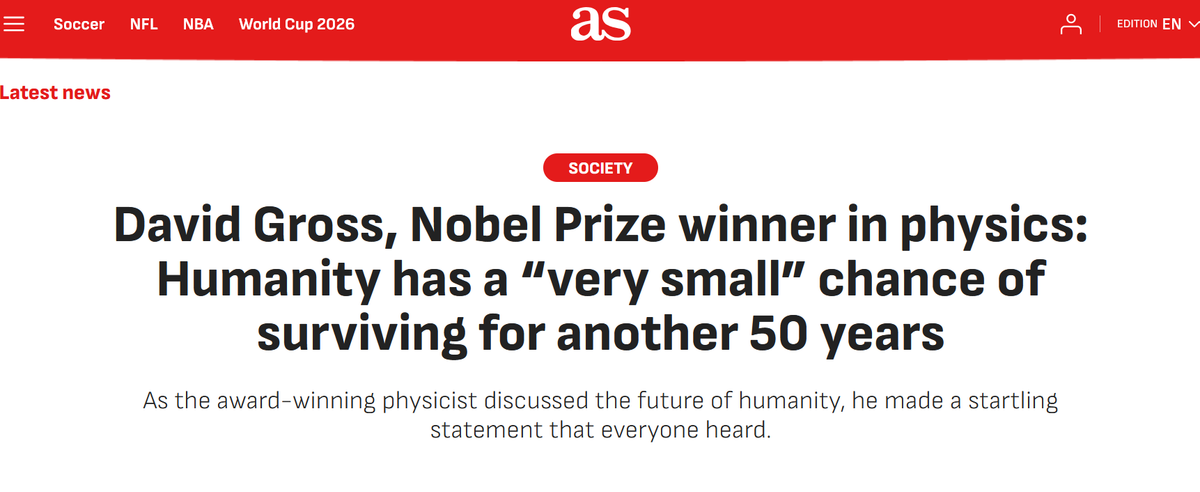
On June 14, 2026, AS USA introduced a warning from the Nobel Prize-winning physicist David Gross with three paragraphs of almost perfect rhetorical escalation. Gross was not presented as just an eminent theoretical physicist who had become deeply concerned about nuclear war. He was presented as a man whose career had been devoted to understanding “probability, time, and the forces that shape survival itself.” His estimate that humanity had roughly thirty-five years was then delivered as “a jolt of reality, framed in the language of statistics and probability.”
This is the sort of introduction that clears a room before the argument enters it. Probability is present. Time is present. Forces are present. A Nobel Prize is present. Survival is present. The words have been placed close enough together that the reader is invited to assume a continuous jurisdiction between them.
There is not one.
David Gross is an extraordinary physicist. He shared the 2004 Nobel Prize in Physics with H. David Politzer and Frank Wilczek for the discovery of asymptotic freedom in the theory of the strong interaction. That achievement transformed our understanding of how quarks behave and helped establish quantum chromodynamics as the theory of the strong nuclear force. It does not make Gross a charlatan when he speaks about nuclear war. It does not forbid him from warning the public. It does not erase the moral seriousness of his concern.
It also does not turn an intuition about geopolitical risk into a measured property of humanity.
The warning should survive. The countdown should not.
The Nobel Halo != a Jurisdiction.
The AS USA article performs a subtle credential transfer. Gross worked with probability in physics. Nuclear war also involves probability. Gross studied forces. Geopolitics also contains forces. Gross worked across immense timescales. Human survival unfolds through time. Therefore, when Gross assigns humanity a thirty-five-year horizon, the article treats him as extending the same scientific logic from the interior of an atom to the international system.
The article says this directly. Gross, it explains, has applied “the same logic he used in physics” to global geopolitics. He is “extending” science to the scale of human decisions and political systems. His life story becomes the story of a man who first understood particles under tension and now understands the world under tension.
This is not an argument. It is a metaphor of continuity.
The words overlap, but the models do not. Expertise does not transfer because two fields share nouns. A physicist who has spent a career studying forces does not thereby acquire special authority over every situation in which something exerts pressure. A scientist who calculates probabilities inside a well-specified physical theory does not automatically possess a reliable method for assigning annual probabilities to nuclear war. The presence of uncertainty does not make every uncertain system the same problem.
The Nobel Laureate Assembly for the Prevention of Nuclear War understands this distinction better than the article describing its organizer. Its own statement says that Nobel laureates serve as a form of collective conscience while convening alongside domain experts. That is the correct architecture. Laureates may possess public standing, intellectual seriousness, moral credibility, convening power, and a demonstrated capacity to reason at an exceptional level. Nuclear strategists, arms-control specialists, historians, military planners, political scientists, crisis researchers, and technical experts possess other forms of knowledge. The Assembly combines them because none is interchangeable with the others.
Gross has standing to sound the alarm. The Nobel Prize does not supply the missing estimate.
The Thirty-Five-Year Calculation.
The underlying Live Science interview is more careful than the article built from it. Gross explicitly calls his estimate crude. He says that estimates following the Cold War placed the annual probability of nuclear war around one percent. Conditions have worsened, he feels that two percent is more plausible, and a two-percent annual risk produces an “expected lifetime” of about thirty-five years. An editorial explanation compares the calculation to the equations used to determine the half-life of radioactive material.
The estimate contains an immediate mathematical problem.
Suppose, for the moment, that the annual probability of nuclear war really is two percent. Suppose the probability remains exactly two percent every year. Suppose each year can be treated as independent of the years before it. Under those assumptions, the probability of avoiding nuclear war for n years is:
0.98ⁿ
The probability that nuclear war has occurred by then is:
1 − 0.98ⁿ
After thirty-five years, the cumulative probability is approximately 50.7 percent. Thirty-five years is therefore close to the point at which the model crosses even odds. More precisely, the median waiting time is about 34.3 years.
That is not the expected waiting time.
For a geometric process with a constant two-percent annual event probability, the expected waiting time is:
1 / 0.02 = 50 years
The distinction matters. The median is the point by which half of modeled trajectories have experienced the event. The expectation is the average waiting time across the distribution. Gross calls thirty-five years the expected lifetime, but his own toy model yields fifty. The thirty-five-year figure comes from the half-life-style question: when has the survival probability fallen to one-half?
This does not rescue the claim by replacing thirty-five with fifty. Humanity does not have fifty years either. It reveals that the expiration date was not even derived consistently from the model used to announce it.
The error is then amplified through reporting. Gross estimates the annual probability of nuclear war. The interviewer asks why “we’ll blow ourselves up” within thirty-five years. AS USA converts the discussion into the claim that humanity has a very small chance of surviving another fifty years. The model’s median becomes its expected value. The occurrence of nuclear war becomes the end of humanity. A crude intuition becomes a statistic. A statistic becomes a countdown. A countdown becomes reality.
At each step, the claim grows more definite while its support grows thinner.
Nuclear War != a Single Terminal State.
Nothing in this correction minimizes nuclear war. A nuclear exchange does not need to cause literal human extinction to be among the worst reachable events in history. A limited nuclear use could kill enormous numbers of people, destroy cities, poison regions, rupture global supply systems, generate famine, provoke escalation, normalize further use, and permanently reorganize political life around terror. A major exchange could collapse states and kill at a civilizational scale. The absence of guaranteed extinction is not comfort.
It is still necessary to distinguish the events.
Gross proposes a probability of nuclear war. The headline reports a probability of humanity surviving. To move from one to the other requires another quantity:
P(human extinction | nuclear war)
That conditional probability is not supplied. Nor is “nuclear war” defined as a single event class. One detonation, a limited regional exchange, a counterforce strike, a countervalue exchange, a cascading multi-power war, and a near-total strategic launch are not interchangeable states. They do not have the same causes, pathways, consequences, or probabilities of escalation. They cannot be collapsed into one annual hazard and then silently renamed human extinction.
The claim also slides between collective and individual survival. Gross tells the interviewer that the chances of “you” living another fifty years are very small because of nuclear war. But the survival probability of a particular person is not the survival probability of humanity, and neither is identical to the probability that some nuclear war occurs somewhere in the world. Age, location, scale of exchange, targets, secondary effects, escalation, and countless other factors intervene.
This is not pedantry around a warning. These distinctions determine what the warning tells us to do.
A model that treats every nuclear event as the same terminal state can only recommend reducing a general number. A model that preserves the differences among pathways can identify where intervention remains possible.
Atoms Do Not Negotiate.
The deeper problem is not that Gross selected the wrong expression from a probability distribution. It is that the half-life analogy is structurally wrong for the system he is trying to describe.
A radioactive atom does not read last year’s result. It does not revise its doctrine after a near miss. It does not build a second-strike capability because it fears another atom. It does not sign a treaty, abandon a treaty, misread an exercise, conceal a launch system, install an automated warning network, delegate authority, suffer a coup, experience a software failure, or become more cautious because David Gross gave an interview.
Nuclear risk is not external to human action. It is produced by human action.
The annual hazard is not stationary. It changes with wars, governments, technologies, alliances, doctrines, command structures, communications, intelligence failures, arms-control regimes, domestic instability, leadership psychology, and the remembered consequences of previous crises. It may rise sharply during a confrontation and fall afterward. One near miss may generate reforms that close a pathway; another may normalize risk and open several more. The years are not independent because the field inherits what happened in them.
Even the warning itself enters the model. A public countdown may mobilize arms-control work. It may also induce fatalism, sensationalize uncertainty, erode trust when the deadline passes, or encourage leaders to treat an invented number as scientific consensus. In a reflexive system, describing the risk is one of the actions that can change it.
Gross understands this in practice. When asked what should be done, he does not recommend preparing for a fixed decay curve. He recommends communication, treaties, restraint, and institutional action. He points to the disappearance of arms-control mechanisms, the multiplication of nuclear powers, the danger of automation, and the possibility that artificial intelligence could enter nuclear decision systems. Every one of these is a claim that the hazard can change.
A manipulable hazard is not a half-life.
Humanity Does Not Possess a Radioactive Half-Life.
This is the center of the matter.
Humanity does not possess a radioactive half-life.
It is not a quantity of unstable material sitting outside history while an invariant proportion disappears over time. Humanity is the system generating the danger, responding to it, concealing it, misunderstanding it, escalating it, and sometimes reducing it. Its future is not waiting inside one decay constant. It is distributed across decisions.
The half-life image is appealing because it converts an intolerable uncertainty into a legible clock. It tells us that the danger has a schedule. The number can be repeated in a headline, attached to a Nobel Prize, placed over an image of a missile, and understood in seconds. We know what thirty-five years means. We know how to fear a deadline.
But the clock purchases clarity by removing the structure that matters.
A nuclear war does not arrive because probability has accumulated enough turns. It becomes reachable through paths. A warning system reports an attack that did not occur. A leader believes the report. Communications fail. Decision time contracts. A doctrine rewards launching before confirmation. A conventional strike is mistaken for preparation to disarm a nuclear force. A tactical weapon is used under the assumption that escalation can remain bounded. An adversary interprets restraint as preparation. A cyberattack corrupts command information. An automated system produces a recommendation too quickly for meaningful review. A state fractures. Custody weakens. A treaty expires. Verification ends. Ambiguity that once stabilized deterrence begins to multiply incompatible interpretations.
These are not annual percentages floating above the world. They are transition conditions.
Modal Path Ethics does not ask only how probable the terminal state appears from far away. It asks what must become true for that state to be reached from here. Which pathways are open? Which are widening? Which require several independent failures, and which can now be crossed by one? Where do human beings still have vetoes? Which vetoes have become ceremonial? Which safety systems share the same hidden dependency? Which forms of automation compress the interval in which correction is possible? Which public narratives preserve caution, and which create the very panic they claim only to describe?
The field is frightening precisely because it is not governed by one number.
The Countdown Removes Agency.
False precision is often defended as a necessary instrument of urgency. Perhaps nobody listens when an expert says nuclear risk is difficult to quantify but intolerably high. Perhaps “thirty-five years” breaks through where a careful statement cannot. Perhaps the number is rhetorically useful even if it is only approximate.
This defense fails on its own terms.
A countdown changes the form of the warning. It converts a branching danger into an approaching event. The listener is no longer asked to inspect pathways, strengthen institutions, preserve response time, or prevent specific transitions. The listener is told that humanity is decaying. Agency is reduced to racing an externally advancing clock.
That is a bad representation of the problem and a bad preparation for action.
It also creates an expiration date for credibility. The history of catastrophic prediction is filled with deadlines that were remembered longer than the qualifications attached to them. When the date passes, the public does not carefully update the model. It learns that experts announce the end of the world. A warning intended to increase attention may consume the credibility needed by the next warning.
None of this means the true risk is lower than Gross believes. It may be higher. The unknown does not default to safety. A model can be invalid while its conclusion is accidentally conservative. The world may contain pathways that no annual estimate captures at all. The correct response to a bad estimate is not reassurance. It is better analysis.
We do not need to weaken the warning. We need to stop weakening it with a counterfeit clock.
The Nuclear Veto != a Probability.
The purpose of the Nuclear Veto is not to establish that nuclear weapons will never be used. It is to identify the machinery by which the terminal move remains blocked, threatened, delegated, misunderstood, or made reachable.
Deterrence itself is not one condition. It is a maintained relation among beliefs, capabilities, communications, stories, and constraints. Strategic ambiguity may sometimes preserve stability by preventing an adversary from locating a safe route through the field. The same ambiguity may become dangerous when doctrines diverge so sharply that each side assigns the other a different game. A frightening narrative may close one path by making retaliation credible. It may open another by convincing leaders that catastrophe is already inevitable.
This is why language around nuclear risk must be evaluated as machinery, not decoration.
The claim that humanity has thirty-five years is not just a description. It enters public reasoning as a state-changing object. It may shape funding, activism, policy, despair, opportunism, or indifference. It may make preventive action feel urgent. It may also make a contingent danger feel cosmically scheduled. Modal Path Ethics must therefore ask not only whether the sentence is defensible, but what the sentence makes reachable.
Gross’s underlying alarm makes several useful states reachable: renewed attention to treaties, pressure against automated launch authority, recognition that a multi-power nuclear field is more difficult to stabilize, and insistence that communication is itself a safety system. The half-life claim makes something else reachable: the belief that these interventions are occurring inside a fixed terminal countdown.
The first should be amplified. The second should be removed.
Ruling.
David Gross is right to be alarmed. He is right that nuclear risk cannot be treated as a solved problem simply because the Cold War ended without a strategic exchange. He is right to warn that eroding arms-control structures, multiplying actors, shrinking decision windows, and automation may produce a field more difficult to stabilize. His moral intervention is legitimate, serious, and welcome.
The estimate does not survive review.
A two-percent annual probability of nuclear war was not derived in the interview; it was selected as a feeling about deteriorating conditions. Under the simple model subsequently invoked, thirty-five years is approximately the median waiting time, not the expected waiting time. The model assumes a constant, independent annual hazard in a system whose risk is dynamic, reflexive, path-dependent, and altered by intervention. The event being estimated is nuclear war, but the claim reported is human extinction. The missing transitions are not minor details. They are the entire problem.
The Nobel Prize may establish that David Gross has done extraordinary physics. It may give the public good reason to listen when he speaks with moral seriousness. It cannot transform geopolitical intuition into a measured expiration date by placing the words probability, time, forces, and survival in the same paragraph.
Mr. Gross may keep every alarm bell he has.
He must surrender the clock.
A two-percent annual risk of nuclear war would be horrifying. It does not need to become a prophecy. The warning survives correction. The countdown does not.
Humanity does not possess a radioactive half-life. It possesses pathways, decisions, safeguards, failures, vetoes, and remaining moves.
That is actually worse than a clock in some ways. A clock can only be watched.
A field can still be changed.