Field Instruments: Strategic Depth
The map wants more room.
- A border appears.
- Then a line behind the border.
- Then a buffer beyond the line.
- Then a friendly government beyond the buffer.
- Then a sphere beyond the friendly government.
- Then a corridor.
- Then a zone.
- Then a belt.
- Then a glacis, which is one of those words that lets a strategy document have a little fun while getting dangerous.
- Then a belt.
- Then a zone.
- Then a corridor.
- Then a sphere beyond the friendly government.
- Then a friendly government beyond the buffer.
- Then a buffer beyond the line.
- Then a line behind the border.
The map does not usually announce this as appetite. This is all called prudence. That is why this instrument is powerful.
A state looks at its exposure and says the enemy is too close.
The warning time is too short. The terrain is too flat. The capital is too reachable. The ports are too vulnerable. The roads lead the wrong way. The airfields sit too near. The missiles have made distance smaller. The alliance line is unstable. The neighbor is uncertain. The pass must be held. The corridor must remain open. The sea lane must remain friendly. The high ground must never fall.
None of this is automatically fantasy.
Geography is very rude. It does not distribute safety evenly.
Some places get oceans, mountains, deserts, depth, or a useful amount of inconvenient weather.
Other places receive long flat approaches and the historical privilege of being the road to someone else’s war.
Strategic depth begins with that real structure.
Then the map reaches outward.
It says:
In order for us to be safe, this space can not be fully itself.
Strategic depth is the use of distance, territory, defensive layers, allied zones, buffer space, warning time, infrastructure, political arrangements, and geography to make attack harder, slower, costlier, or less reachable.
It is a real protection instrument.
It can preserve continuance.
It can also become imperial with the calmness of a man coloring someone else’s country light blue.
Strategic depth becomes a distortion when another locus’s sovereignty, mobility, politics, economy, memory, civilian field, or future is treated as the terrain required for someone else’s safety.
The shield starts asking for a handle.
That handle turns out to be a neighbor.
The map sees no problem with this.
Depth Is Real.
Strategic depth is not fake because cruel people have used it.
That is one of the easiest mistakes in moral analysis. A bad actor uses a real instrument badly, then the clean souls arrive with tongs and announce that the instrument itself was always a lie. This is how moral innocence becomes strategically useless.
Depth matters.
Distance matters.
Warning time matters.
Rivers, mountains, forests, deserts, ports, rail lines, roads, bridges, air bases, missile ranges, satellites, weather, chokepoints, tunnels, undersea cables, power grids, warehouses, depots, fuel, food, and the location of repair crews all matter.
An army is not a philosophical mood. That thing has to move.
It needs roads. It needs fuel. It needs supply. It needs places to sleep, reload, communicate, repair, hide, cross, land, refuel, and not get turned into an expensive lesson by artillery.
A city without warning time has a different problem from a city protected by oceans. A small state sitting on an invasion route has a different problem from an island whose first line of defense is a large amount of water with a navy in it. A people whose capital sits close to a hostile border has a different security field from a people whose capital lives behind depth that history kindly installed before the generals arrived.
Moral theory does not improve by pretending these facts are unseemly.
War is a field of reachability. It is not only a label for violence after violence begins. It is the condition under which violence can become reachable, easy, difficult, delayed, reversible, catastrophic, visible, deniable, or too expensive to choose.
Strategic depth changes that condition.
- It may give a city time to evacuate.
- It may give a state time to mobilize.
- It may make an attacker’s first day worse enough to prevent the war from starting.
- It may give diplomacy a room to work in because conquest has stopped looking cheap.
- It may protect a smaller polity from becoming a larger neighbor’s calendar item.
- It may preserve ordinary life by making extraordinary violence harder to begin.
The instrument is real. This is why it must be audited instead of dismissed.
A fake instrument can just be mocked and thrown away.
A real instrument can preserve a field while quietly learning how to own it.
Depth Is Time.
Strategic depth is space converted into time.
That is the cleanest way to see it.
More miles may mean more warning. More mountain passes may mean slower movement. More river crossings may mean more delay. More defensive layers may mean the attacker must spend force before reaching what matters most. More distance between the frontier and the capital may mean the first blow is not also the final blow.
Depth is time in geography.
This is why it is so attractive.
Human beings are always trying to buy time from matter.
A wall buys seconds. A moat buys minutes. A fortress buys days. A mountain buys seasons. A naval perimeter buys distance. An alliance buys warning. A demilitarized strip buys uncertainty. A buffer buys a delay between the decision to attack and the thing that must be preserved.
Time is where better paths become possible.
Time is where people flee, organize, bargain, mobilize, expose, repair, harden, negotiate, grieve, vote, refuse, and learn that yesterday’s plan has become a trap.
- A field with no time gets forced into immediate damage.
- A field with more time can sometimes keep correction reachable.
This is the legitimate moral power of strategic depth.
Then, the conversion continues.
If depth is time wearing geography, the people living in the geography are quietly recruited into someone else’s clock.
- A town becomes warning time.
- A province becomes delay.
- A borderland becomes friction.
- A neighbor becomes space between us and the enemy.
A person can die as a person. A person can also be made to die as time.
A city can be defended because its people matter. A city can also be treated as the outer wall of a different city’s survival.
A country can choose alliance, neutrality, militarization, resistance, or concession through its own political field. A country can also be informed that its choices are not truly its own because its geography has been drafted into another state’s survival model.
Depth may begin by protecting continuance.
It crosses over when it turns other continuance into time-material.
The Neighbor Terrain.
There is a little ritual in strategic language.
A neighboring polity slowly stops being a polity.
- First it is a neighbor.
- Then it is a region.
- Then it is a frontier.
- Then it is a buffer.
- Then it is a zone.
- Then it is a line of approach.
- Then it is depth.
- Then it is a line of approach.
- Then it is a zone.
- Then it is a buffer.
- Then it is a frontier.
- Then it is a region.
This linguistic digestion is not accidental. The vocabulary does real work.
Each word removes some personhood from the field and replaces it with utility.
- A neighbor has
- elections,
- languages,
- debt,
- schools,
- weather,
- old arguments,
- churches,
- temples,
- mosques,
- temples,
- unions,
- corrupt mayors,
- clean mayors,
- potholes,
- uncles,
- wet basements,
- boring procurement scandals,
- half-finished bridges,
- teachers with migraines,
- and one little restaurant everybody insists used to be better.
- A buffer has
- strategic function.
That is a severe reduction.
Sometimes this kind of reduction is needed. No institution can reason without instruments. No commander can move every individual biography across their map with one of those little pointers. No diplomat can hold every household in a sentence.
The field is just too large. Instruments cut complexity into usable shapes.
Field Instruments exists because those cuts are unavoidable.
The danger always begins when the cut forgets that it cut something.
- A buffer is not only buffer.
- A corridor is not only corridor.
- A sphere is not only sphere.
- A glacis is not only a lovely French warning that the speaker may soon ask a smaller country to become his furniture.
These words identify real strategic relations.
They do not abolish the living field inside those relations.
The neighbor becomes terrain when strategic function outranks extant continuance.
At that point, the people living there are allowed to matter only insofar as they support the depth function. Their sovereignty matters if it produces friendly distance. Their democracy matters if it points the right way. Their neutrality matters if it stabilizes the perimeter. Their suffering matters if it can be charged to the adversary. Their refusal matters only as a problem of management.
The living field has been translated into someone’s defensive geometry and forced through a model.
The translation may still contain truth.
It may also contain domination and distortion.
Modal Path Ethics asks which futures have been closed by the translation.
The Arrow Map.
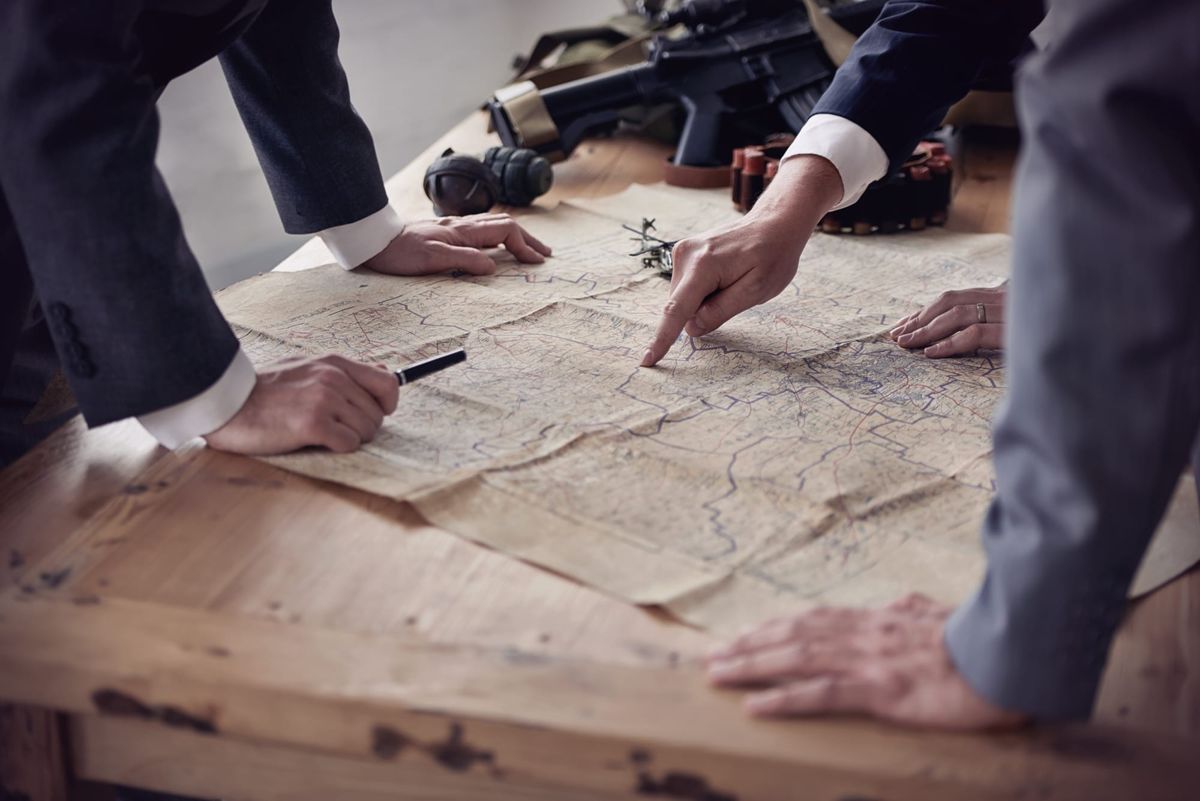
The arrow map is one of the great devices by which violence becomes tidy.
Everyone knows the map.
A background of muted territory. A border. A couple shaded regions.
Thick arrows curving across the page with the serene confidence of predators who have been to graduate school. A legend in the corner.
Maybe a dotted line. Maybe three different colors. Maybe an ominous red wedge named after a plan that somehow sounds both technical and insane.
The arrow knows where force goes.
The arrow does not know where anyone’s grandmother lives.
This is very convenient for the arrow.
The arrow does not know that the road it crosses is the road to the hospital. It does not know that the bridge is where teenagers smoke and pretend not to be frightened of leaving town. It does not know that the town square has a bakery, a police station, a shrine, six bad parking spots, and an eternal argument about whether the statue should come down.
The arrow does not know election results. The arrow does not know the difference between a school and a barracks until someone labels it. The arrow does not know where the graves are. The arrow does not know that the shaded area has dialects.
The arrow does not know that one apartment block is full of families from somewhere else because the last arrow map already passed over their old houses.
The arrow is not evil. The arrow is worse than evil.
The arrow is tidy.
Tidy instruments are dangerous because they give violence a clean user interface. The arrow map lets a room talk about movement, depth, encirclement, approach, defense, salients, corridors, and pressure without feeling the full weight of the living field it has flattened into colored paper and shapes.
Again, the instrument is not useless.
A commander may need the tidy arrow. A government may need the shaded risk band. A rescue operation may need routes, perimeters, evacuation corridors, and zones of control. A people under threat may need to know where the danger is moving.
The ethical failure is not "map use."
The failure is map sovereignty.
A map becomes sovereign when the life inside the map can no longer answer the map's claims.
A strategic map becomes distorted when it does not represent a field for the sake of action, instead replacing the field so action can stop hearing it.
That is how the arrow becomes a priest.
It points. People kneel.
Buffer Logic.
A buffer is an answer to fear.
That is the first reason it works.
The second reason is that it often asks someone else to live inside that answer.
Buffer logic says the front line should be moved away from the vulnerable center. It says the first shock should land somewhere else. It says the danger should be absorbed, slowed, confused, neutralized, or negotiated before it reaches home.
This can take many forms.
- A neutralized buffer.
- An allied buffer.
- An occupied buffer.
- A demilitarized buffer.
- A puppet buffer.
- A proxy buffer.
- A frozen-conflict buffer.
- A sacrificed buffer.
- A nuclear-shadow buffer.
- A diplomatic buffer.
- A humanitarian buffer that is quietly also a prison.
- A legal buffer that lets a state act through other hands while preserving its official face for the cameras.
The exact forms differ. The moral question remains.
- Who lives inside the buffer?
- Can they leave the buffer role?
- Can they choose their alliances without becoming an unacceptable exposure?
- Can they refuse being armed?
- Can they refuse being disarmed?
- Can they trade with both sides?
- Can they build a future that is not primarily a safety feature for a more powerful actor?
- Can they remember their own dead without having that memory imported into someone else’s deterrence story?
- Can they contest the security arrangement governing them?
Buffer logic is not satisfied by space.
It wants compliant space.
That is the mutation.
- A buffer that emerges from real consent, mutual security, negotiated neutrality, and ongoing correction may preserve continuance.
- This may give several fields time and distance without converting one field into another’s property.
- A buffer imposed through domination is different.
- It makes the buffer population carry another actor’s fear as structure.
- Their politics are narrowed before they begin.
- Their roads, laws, media, ports, schools, and alliances are judged first by whether they preserve someone else’s depth.
- It makes the buffer population carry another actor’s fear as structure.
The buffer stops being a relation. It becomes a role.
Roles are dangerous when they cannot be exited.
Distance.
No serious account of strategic depth can treat security fear as imaginary.
A people may remember invasion.
A city may remember siege.
A state may remember collapse.
A border may have moved across families more than once. A capital may have been taken. A language may have been punished. A class of people may have been deported. A countryside may have been burned because an army needed to teach the field obedience.
A population may have learned, over generations, that distance is not a luxury. Distance is the difference between ordinary life and another army arriving with a new vocabulary for your children.
Wounds make maps feel different.
A map read by the uninjured is often geometry.
A map read by the wounded may be memory with coordinates.
The person who has never watched the frontier collapse should be cautious before mocking the desire for depth. The country that sits behind oceans should be cautious before lecturing the country that sits on the route. The empire that once used buffer logic against everyone else should be quiet for at least a full minute before giving advice about sovereign restraint.
Real fear can reveal a real field condition.
The danger is jurisdiction.
- A wound may explain why a state wants depth.
- It does not make another people into depth.
This is the exact same cut that sacred title requires.
Sacred memory may bind the living to repair. It may preserve wound truth. It may make forgetting impossible, and sometimes forgetting should be impossible.
Sacred title begins when wound becomes ownership.
Strategic depth follows the same pattern in colder language.
Security memory may bind a state to prudence. It may demand preparation, alliances, early warning, evacuation plans, defended infrastructure, diplomatic seriousness, and refusal to become prey.
Strategic depth becomes domination when security memory claims jurisdiction over another living field.
The wound is real. The neighbor is real too.
A wounded map is still a map.
It must be corrected by the people inside it.
Sacred Title.
Sacred title and strategic depth are twins that pretend not to know each other at conferences.
Sacred title says:
This field bears our sacred memory, therefore it belongs to us.
Strategic depth says:
This field affects our security, therefore it must be available to us.
The vocabularies differ. The structure rhymes.
Both can begin with truth. Sacred memory can preserve a wound that power wanted to erase. Security fear can preserve awareness of exposure that comfort wanted to dismiss.
Both become dangerous when they claim authority over living continuance.
- Sacred title sacralizes the claim.
- Strategic depth securitizes it.
The living field pays either way.
This is why these two instruments belong beside each other in the track. They are different ways of promoting a real contact into a sovereignty claim.
- In sacred title, the past arrives wearing ultimacy.
- In strategic depth, fear arrives wearing necessity.
Ultimacy and necessity are two of the most dangerous costumes an instrument can wear. They are both excellent at making correction look irresponsible.
The sacred title says the living must yield because the claim is holy.
Strategic depth says the living must yield because the alternative is dangerous.
Both sentences may contain something true.
Both sentences can become machines.
The correction is the same:
What does this claim make unreachable for the loci living inside it?
If the answer is forbidden, the instrument is sovereign.
Depth and Deterrence.
Deterrence and strategic depth are also relatives.
Deterrence places a threatened future inside the adversary’s decision. It says: do not enter this path, because the path contains teeth.
Strategic depth changes the shape of the path itself. It says: even if the adversary enters, the path will be long, costly, delayed, exposed, or politically blocked before reaching what matters.
One works through conditional harm.
The other works through distance, friction, and political arrangement.
They often cooperate.
A defensive alliance can be both deterrent and depth. A forward presence can be both warning and tripwire. A buffer can be both shield and threat. A fortified line can buy time while also announcing that crossing it will awaken a larger response.
This cooperation can preserve continuance.
It can also create layered hostage fields.
Deterrence says: if this line is crossed, catastrophic harm becomes reachable.
Strategic depth may say: this population must live near the line so the catastrophe remains farther from someone else.
Now the civilian field inside the depth is carrying both distance and conditional harm.
That is an ethically loaded structure.
It may still be the least-closing available path under damaged conditions. Modal Path Ethics does not solve war by pretending every dirty instrument can be thrown away before the predator arrives.
But the burden must remain visible.
Deterrence becomes sovereign when every repair path is called weakness.
Strategic depth becomes sovereign when every neighboring future is called exposure.
Together, they can make an entire region live inside someone else’s conditional sentence.
The Civilian Field Inside the Depth.
The civilian field is the field the security instrument claims to protect.
It is also the first thing strategic diagrams tend to compress.
This is why the phrase civilian field matters.
Civilians are not only noncombatants counted in a harm ledger after the grown men with microphones finish explaining necessity. The civilian field is the whole network of continuance that war, security, deterrence, and depth claim to preserve or recover.
- Housing.
- Water.
- Electricity.
- Medicine.
- Schools.
- Elder care.
- Farms.
- Road repair.
- Language.
- The ability to argue without disappearing.
- The ability to leave.
- The ability to stay.
- The ability to mourn without becoming recruitment material.
- The ability to vote without being treated as a weather event in someone else’s threat model.
A strategic depth instrument must answer to this field.
A buffer that protects one capital by making another population permanently unable to govern its own continuance is not only security.
It is burden transfer.
A defensive line that saves lives by buying time may be justified. A defensive line that treats the people in front of it as absorbent material has crossed into a different instrument.
A neutral zone that prevents war may preserve several fields. A neutral zone that denies its inhabitants the ability to become politically real is a soft occupation with better manners.
A sphere of influence that prevents invasion may look stabilizing from the center. From inside the sphere, it may feel like living in a room where every door opens into someone else’s fear.
The civilian field answers the map.
The map should not always win.
Depth and the Technology of Distance.
Strategic depth changes when technology changes.
This should be obvious.
It is often ignored because institutions love yesterday’s survival story.
A wall means one thing before artillery and another thing after artillery. A mountain pass means one thing before air power and another thing after it. An ocean means one thing before long-range missiles and another thing after submarines, satellites, drones, cyber operations, hypersonic weapons, undersea cables, and everyone discovering that the future is apparently a procurement committee with anxiety.
Technology changes how distance behaves. It can stretch reach. It can compress warning time. It can turn the rear into a target. It can make an old buffer symbolically important while materially thinner than the doctrine admits.
Nuclear weapons are the harshest version of this problem.They do not abolish strategic depth. They make some depth imaginary and some depth planetary.
A nuclear field can compress continents into minutes. It can make a city vulnerable regardless of how many neighbors have been converted into buffers. It can make the whole civilization live inside a deterrent sentence. It can turn strategic depth from a territorial instrument into a global hostage architecture.
This does not make geography irrelevant. Missile sites, submarine patrol areas, radar stations, command bunkers, air bases, alliance routes, chokepoints, and early-warning systems still have location. The field remains material.
But nuclear compression humiliates many older fantasies of depth.
- The map wants more room.
- The weapon says room is not what it used to be.
A state may keep asking neighbors to become distance even after the decisive threat no longer respects distance in the way the old instrument promised.
That is one of the dangers ahead for the Security Instruments track.
The older wound keeps drawing buffer maps.
The newer weapon makes the buffer into collateral.
The Contestability Test.
The first correction to strategic depth is asking the people inside the depth what future they are trying to preserve.
This sounds gentle. It is not.
It is a brutal test because many strategic depth claims depend on those people never becoming fully answerable subjects.
- If they speak too clearly, they may ruin the map.
- If they choose the wrong alliance, they become penetration.
- If they choose neutrality, they become unreliable.
- If they choose resistance, they become provocation.
- If they choose compromise, they become betrayal.
- If they ask to leave the role, the role becomes angry.
A security arrangement that cannot survive the political agency of the people it organizes has become domination.
This does not mean every local vote automatically settles every security question. That would be a different kind of stupidity with ballot boxes on it. Neighboring fields do affect one another. Alliance decisions have external consequences. Militarization changes threat perception. Neutrality can be real or fake. Great powers do exploit small states. Small states can exploit great-power conflict. Nobody gets a clean room.
Contestability is not magic. It is a correction instrument.
A strategic depth claim must remain open to challenge from the field it uses.
It must allow its own necessity to be audited. It must distinguish consent from compliance under threat. It must distinguish neutrality from imposed silence. It must distinguish alliance from absorption. It must distinguish defensive preparation from permanent jurisdiction.
The people inside the depth do not always get everything they want.
They do get to remain people.
That is not a sentimental clause. It is the condition under which security can still claim to preserve a field rather than consume one.
Correction Instruments.
Strategic depth needs correction because every powerful protection instrument wants to become self-evident.
It says: look at the danger.
It says: look at the map.
It says: look at the history.
It says: look at the enemy.
It says: look at the cost of being wrong.
And all of those can be legitimate demands.
Then it says:
Therefore stop asking whether this instrument is damaging the field.
That final sentence is the takeover.
Correction begins by forcing strategic depth to remain an instrument rather than a master.
- Recognition of neighboring sovereignty matters because the neighbor is not raw distance.
- Civilian-field priority matters because protection that consumes the protected object has failed.
- Defensive posture limits matter because every defensive layer can become a forward appetite if nobody audits it.
- Arms control, transparency, and verification matter where they are reachable because suspicion is a powerful solvent of correction.
- Hotlines, off-ramps, and non-humiliating exits matter because security instruments under panic often prefer impossible demands to survivable transitions.
- Public accountability matters where secrecy is not genuinely required, because secret depth often becomes unanswerable depth.
- Reciprocity matters because a depth claim that becomes monstrous when made against you was probably already monstrous when made by you.
- Exit rights matter because a buffer role that cannot be exited is a prison with strategic vocabulary.
The correction instruments are not decorative morality.
They are how the shield remains a shield.
Without them, strategic depth becomes a slow annexation of the future.
Ruling.
Strategic depth is a real field instrument.
A state may need distance. A city may need warning. A people may need defensive layers. A small country may need alliances, terrain, friction, and time to avoid becoming a larger country’s lunch with a flag in it.
The map is not wrong to care about approach. The strategist is not wrong to care about roads, rivers, ports, mountains, airfields, missiles, rail lines, depots, and warning systems. The wounded are not wrong to remember that geography once failed them.
The distortion begins when these truths claim ownership over another living field.
- Depth preserves when it buys time without consuming the people who live inside the time it buys.
- Depth distorts when the neighbor becomes terrain, the civilian field becomes absorbent material, the map becomes sovereign, and every local future is judged first by whether it extends someone else’s safety.
A wound can obligate prudence. It cannot create jurisdiction over another people.
Security fear can demand attention. It cannot own the neighbor.
The arrow map may help a field act. It may not replace the field.
Strategic depth begins as a shield against invasion.
It becomes imperial when the shield requires someone else to live as its handle.
The map wants more room.
The field has people in it.