
Applied Case: The Fifth Fish
Every lawful catch depends on somebody stopping.
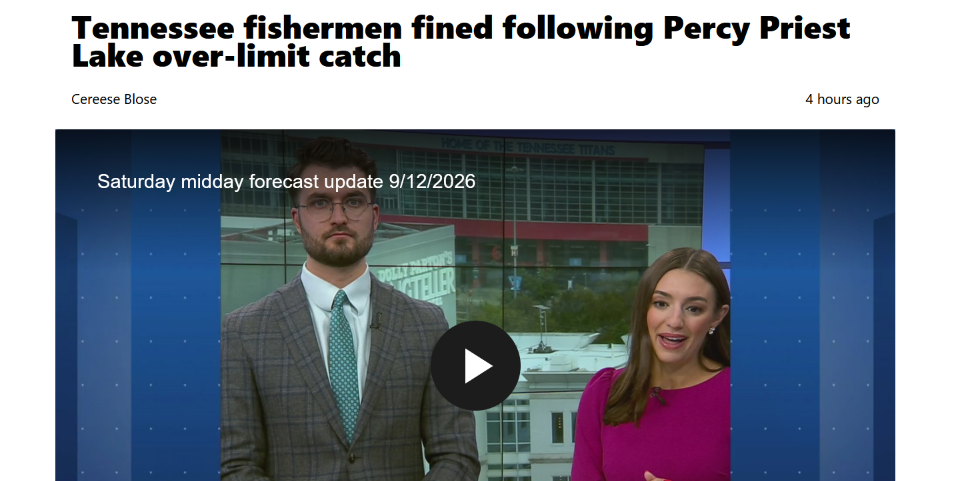
Tennessee has found another boat problem for me to solve.
This time, the boat works perfectly.
On June 27, Tennessee Wildlife Resources Agency game wardens Dusten Moffitt and Matt Brian stopped a boat on J. Percy Priest Lake after sunset because it was operating without the required lights.
That was problem number one.
Then, they looked in the boat.
There were twenty-two striped bass and hybrid striped bass aboard.
Percy Priest permits an angler to harvest two striped or hybrid striped bass per day, in combination. There were two people aboard.
Tennessee therefore recognized a lawful path for four fish to leave this lake.
The other eighteen had followed a very different path.
The officers issued citations. A court later found both anglers guilty on two counts.
Each was ordered to pay $785 in fines and court costs.
Their fishing privileges were suspended for one year.
- Twenty-two fish.
- Two anglers.
- Four lawful removals.
The interesting fish is number five.
The Fifth Fish.
Nothing magical happens to a fish when it crosses a creel limit.
Fish number four does not glow green.
Fish number five does not emerge from the water carrying a felony flag.
The boat remains the same boat.
The rod remains the same rod.
The cooler remains fully capable of holding another fish.
The angler remains physically capable of catching one.
The lake still contains fish.
The transition becomes different because the angler has reached the boundary governing access to a shared field.
The first four fish move through an authorized path:
- shared fishery
- lawful capture
- private possession.
- lawful capture
Then comes the fifth.
Same physical move.
Different institutional relation.
The fifth fish is where access is mistaken for title.
An angler has been given a path into the resource.
That path does not say:
Everything you remain physically capable of removing now belongs to you.
It says something much stranger and much more important:
You may take from this field while accepting the conditions required for the field to remain available to other takers.
That is Common Pool Logic.
And Modal Path Ethics has already played this game.
The Fish Have Finally Arrived.
In The Great Ludic Audit, the Common-Pool Resource Game received one of the strongest reviews in the entire collection.
The structure is simple.
- A productive field already exists.
- Players decide how hard to exploit it.
A forest can be cut.
An aquifer can be pumped.
A pasture can be grazed.
A fishery can be fished.
At first, greater appropriation can create greater private return.
Then, the pressure enters the resource.
The group can often preserve greater total value by taking less than each participant is individually capable of taking.
The public-goods problem asks:
Who contributes?
The common-pool problem asks:
Who stops?
Those are different actions.
- A contributor gives something private toward a shared capacity.
- A common-pool user already has access to shared capacity and must decline some available extraction so the productive field survives.
Modal Path Ethics called the free rider’s opposite number the over-appropriator.
- The free rider contributes too little.
- The over-appropriator takes too much.
There was one embarrassing problem with the laboratory version.
Everybody could buy another boat. The fish remained theoretical.
Tennessee has corrected this deficiency.
We now have fish.
Twenty-two of them.
Restraint Is Infrastructure.
Consider the angler who catches two hybrid striped bass.
They could probably continue fishing.
The boat still works. The hooks remain operational.
Percy Priest has not erected a physical wall around the third fish.
So the angler stops.
That action produces almost nothing visible.
- No new fish appears.
- No public building opens.
- No restoration crew arrives.
- No one writes a check.
The angler goes home with fewer fish than they were physically capable of obtaining.
From inside a narrow private account, that can look like unused extraction capacity.
- The third fish was available.
- Why leave it there?
Because the third fish is part of what the angler contributes.
Restraint is infrastructure.
The person who stops taking helps produce the future fishery through the thing they decline to convert into private possession.
This was one of the nastiest findings in the Common-Pool Resource Game.
Restraint can be exploited.
- One person limits extraction.
- The resource improves.
- Another person receives a better resource to exploit.
- The responsible user has now helped manufacture somebody else’s private opportunity.
This is why:
Be responsible.
is just not enough.
And:
Please care about the lake.
is not a fishery-management system.
A stable commons needs ways to keep restraint from becoming a sucker strategy.
Monitoring. Rules. Shared expectations. Consequences. Correction.
A user willing to leave the third fish behind needs some reason to believe the next boat will not simply take it.
Tennessee Is Building Some of These Fish.
Percy Priest makes the common-pool structure unusually visible because parts of the fishery are quite literally produced by public institutions.
The Tennessee Wildlife Resources Agency maintains approximately 132 fish-attractor sites on the reservoir.
Hybrid striped bass are also a managed fishery. Tennessee Wildlife Resources Agency hatcheries produce the hybrids by spawning striped-bass females with white-bass males and stock them into Tennessee reservoirs.
So the fishery does not consist of:
water + fish + guy.
There is a larger production field.
- Hatcheries.
- Fisheries biologists.
- Stocking.
- Habitat work.
- Fish attractors.
- Regulations.
- Licenses.
- Boats.
- Public access.
- Reservoir management.
- Game wardens.
- Courts.
- The accumulated restraint of everyone who followed the limit yesterday.
The U.S. Army Corps of Engineers operates and maintains the Percy Priest project. Tennessee Wildlife Resources Agency manages the fishery and its harvest rules. Anglers then enter this already organized field and convert a limited portion of its yield into private use.
This destroys a very convenient story.
The fish in the cooler did not come from nowhere.
The opportunity to catch them did not come from nowhere.
A successful fishing trip already sits on top of work performed by people the angler will probably never meet.
Somebody bred fish.
Somebody maintained habitat.
Somebody studied the reservoir.
Somebody wrote the regulation.
Somebody maintained the access point.
And somebody stopped at two yesterday.
Then, another person arrives with a cooler.
The fishery has already been provisioned for them.
The appropriation happens last.
Garrett Hardin Does Not Get This Fish.
This is exactly where the old Tragedy of the Commons story can become too easy.
Two anglers took too many fish.
Therefore:
See? Shared resources collapse because everybody selfishly takes as much as possible.
No. Garrett Hardin has been through enough on this website. We are not giving him these fish.
A real commons is already an institution.
Modal Path Ethics found the central failure in Hardin’s famous pasture by asking where the institution had gone.
His herders had no durable rules, no monitoring, no shared memory, no conflict process, no meaningful ability to revise the arrangement, and no graduated system through which violations could be corrected before catastrophe supplied the feedback.
The pasture had been stripped of governance and then presented as evidence that sharing fails.
Elinor Ostrom went looking at real common-pool systems and found something far more irritating to inevitability.
People had rules.
They monitored.
They sanctioned.
They resolved disputes.
They adapted arrangements to local conditions.
They nested institutions when one scale could not carry the whole resource.
Percy Priest looks much closer to that world.
There is a defined resource. There are species-specific harvest rules. There is monitoring. There are sanctions. There is a court. There is a public management agency. There is a larger reservoir authority. There is stocking and habitat work.
There are anglers who can continue participating as long as they remain inside the institution governing that participation.
Then, somebody violates the rule.
That does not prove the commons has failed.
An institution that assumes nobody will ever cheat is not an institution.
That is a wish.
The important question is what happens after somebody takes fish number five.
The Game Warden Is Part of the Fishery.
These twenty-two fish apparently came to official attention because the boat was on the water after sunset without the required lights.
That is almost offensively useful.
- The common-pool violation was sitting inside a boat.
- The boat was sitting inside the dark.
The dark did not report anything. These fish did not call Tennessee.
Another instrument had to encounter the extraction.
The wardens stopped the vessel. Then the hidden individual action became institutional information.
This is exactly the observability problem from the Common-Pool Resource Game.
A damaged shared resource can become publicly visible while the actions producing that damage remain private.
- An aquifer falls.
- A forest thins.
- A fish population changes.
The resource reports the aggregate pressure. It does not automatically identify which user took which unit.
Modal Path Ethics put the problem this way in the game audit:
My restraint can improve the resource and thereby create a better opportunity for someone else to exploit it.
That is why monitoring is part of the resource system.
The game warden therefore does not stand outside the fishery like a moral referee who arrived after nature finished happening.
Monitoring is one of the instruments through which the fishery remains governable.
The patrol affects the strategy before the violation occurs.
The possibility of inspection changes the expected return from over-appropriation.
The court preserves memory after the boat has gone home.
The suspension changes what the same user can legally extract during the next year.
These institutions do not grow fish.
They alter the game being played around the fish.
A Logical Fish Is Logical Against You.
The Golden Rule has unfortunately arrived at the lake.
Modal Path Ethics previously condensed the problem into one useful line:
A logical move is logical against you.
If I may take the fifth fish because the fish is reachable, then reachability has become the governing rule.
Everybody else gets that rule too.
The sixth fish is logical.
The seventh is logical.
The twenty-second fish is logical.
The next boat receives the same reasoning.
So does the boat after that.
The private argument destroys itself when returned through the field.
The Golden Rule is doing something stronger here than asking whether we would enjoy another person taking extra fish. It asks whether we are willing to inhabit the system generated by the action-logic we are using for ourselves.
That system cannot contain:
I get to exceed the limit because my additional catch is locally advantageous,
alongside:
Everyone else must observe the limit so that good fishing remains available to me.
Those two claims require different worlds.
That is the common-pool problem in one cooler.
A Fine Does Not Respawn the Fish.
The Negative Boat taught us that punishment does not lift the hull.
Now Tennessee has produced the sequel.
A fine does not respawn the fish.
The court can assess $785.
The state can suspend fishing privileges for one year.
Neither operation returns eighteen fish to the water.
That tells us what enforcement is for.
The sanction acts on the future decision field.
It says that the gain from violating the extraction rule will not be evaluated only through the contents of the cooler. The state can add another consequence.
Otherwise the field teaches a terrible lesson.
- Imagine ten anglers follow the rule.
- Each stops at two.
- The eleventh takes eleven.
If nothing else happens, the eleventh angler has discovered the locally superior strategy.
- The ten restrained anglers produced the opportunity.
- The over-appropriator captured it.
Repeat that enough times and restraint becomes something for fools.
So sanctions perform a protective function around cooperation.
They help keep the restrained user from becoming prey.
The $785 does not repair the fish in the physical sense.
The suspension does not reverse what happened on June 27.
They can still help repair the strategic relation by changing what over-appropriation costs on the next trip.
Punishment is never allowed to impersonate physical restoration.
Those twenty-two fish are still gone.
The point is to keep their absence from becoming instruction.
Do Not Build an Ecological Apocalypse Out of Eighteen Fish.
Now, we need to resist ourselves.
Twenty-two fish makes a very satisfying number.
Eighteen unlawful fish makes an even better one.
We could immediately begin writing the collapse of Percy Priest Reservoir.
Modal Path Ethics will not.
This incident, standing alone, does not establish population-level damage to the Percy Priest fishery.
It does not prove this reservoir was near a tipping point.
It does not tell us what would have happened to those specific fish if they had remained.
It does not establish that one cooler threatened the ecological future of Middle Tennessee.
Those questions remain unanswered.
We do not need any of those claims today.
The common-pool problem appears before catastrophe.
That is why there is a limit. Governance that activates only once the fishery has visibly collapsed is late enough to become archaeology.
The relevant structure is cumulative.
- One person takes an extra unit.
- Then another.
- Then enough people learn that the written rule and the actual game are different.
That is how institutional limits can disappear without anybody repealing them.
A rule becomes fictional when violating it is repeatedly more attractive than participating in it.
The important resource being protected is therefore larger than the eighteen fish.
It is the credibility of restraint.
The Negative Boat.
We should return to the boat.
Of course we should.
Modal Path Ethics began the Negative Boat series with another Tennessee water problem.
A privately useful vessel eventually crosses zero. Its remaining private value falls below the cost of repair, storage, recovery, or responsible disposal.
- The owner’s incentive weakens.
- The material boat remains.
- The private account closes.
- The lake keeps the books.
That case followed value in one direction:
private asset → common liability
The Fifth Fish follows the opposite transition:
common resource → private asset
- The first failure occurs when somebody tries to push a liability outward after privately receiving the useful life.
- The second occurs when somebody pulls value inward past the boundary protecting the shared productive field.
The negative boat says:
Exit does not erase responsibility.
The fifth fish says:
Access does not erase restraint.
They are the same boundary problem facing opposite directions.
In The Negative Boat, the owner attempts to leave the material consequence outside the account.
Here, the over-appropriator attempts to bring additional common value inside the private account.
- One dumps the tail.
- The other captures the surplus.
The lake receives both moves.
Tennessee then has to reconstruct the relation around them.
The Account Still Makes a Cut.
The second Negative Boat article found the deeper accounting problem.
Every account needs a boundary.
Some things become bright enough to receive a category, a number, a date, a responsible institution.
Other relations remain outside.
The danger begins when exclusion from the account acquires the practical meaning of nonexistence.
The boundary of the account is not the boundary of the field.
The Fifth Fish gives us another version.
The private angler’s account is wonderfully simple.
- I caught a fish.
- I possess the fish.
- I can eat the fish.
- This trip went extremely well.
Nothing inside that account has to display:
- the next angler’s opportunity;
- the state’s hatchery work;
- the public management system;
- the stock that remains;
- everybody else’s restraint;
- the enforcement capacity keeping restraint credible;
- the cumulative rule under which the fishery continues.
The cooler is a very efficient accounting instrument.
- It has an inside.
- It has an outside.
- Fish on one side are yours.
- Everything else becomes scenery.
Common Pool Logic exists because the scenery is doing work.
The Fifth Fish Logic.
The case is small enough to carry cleanly.
A shared productive field permits private use.
Private use is good.
Fishing is supposed to result in people catching fish.
A commons that cannot be used has solved its extraction problem by destroying the reason for having the resource.
The ethical demand is therefore not abstinence.
It is bounded appropriation.
Take. Then stop.
The stopping condition is part of the permission to take.
That gives us a general structure.
1. The field has to remain productive.
A common pool is not a static pile waiting to be divided once.
Its continuation matters.
2. Users may receive real private benefit.
The fish can go home.
Commons governance does not require pretending private use is morally suspicious.
3. Access carries a boundary.
The ability to reach another unit does not create title to that unit.
4. Restraint has to be protected from exploitation.
If compliant users repeatedly preserve resources for noncompliant users to seize, the institution trains defection.
5. Monitoring is part of production.
A common-pool rule that cannot encounter violations eventually becomes advice.
6. Sanctions protect the next round.
They cannot reverse extraction. They can keep the violation from becoming the dominant strategy.
7. The rule remains answerable to the field.
A creel limit is still an instrument.
It has to respond to evidence about species, stocking, ecological conditions, fishing pressure, public use, and management goals.
The number two is not sacred. The institution exists to preserve the fishery.
If better evidence requires another number, change the number.
Then enforce that one.
That is the difference between governance and command.
The Ruling.
Two anglers left Percy Priest with twenty-two striped and hybrid striped bass.
The physical story is tiny.
A boat.
Two people.
A cooler.
Some fish.
The institutional story reaches much farther.
Tennessee Wildlife Resources Agency produces fish, maintains habitat infrastructure, studies the reservoir, defines harvest conditions, licenses access, patrols the water, and brings violations into a court system. The U.S. Army Corps of Engineers maintains the larger reservoir project. Thousands of anglers enter and leave that field carrying their own private reasons for being there.
Most of them will never meet.
They still affect one another.
Every person who stops at the limit leaves something reachable for somebody else.
That restraint is easy to overlook because nothing enters the cooler.
Nothing appears on a receipt.
Nobody gets photographed beside the fish they chose not to take.
Their contribution remains in the water.
That is why common-pool governance is so easy to misunderstand.
The resource can look ownerless while carrying institutions everywhere.
The restraint can look like doing nothing while helping produce the next opportunity.
The violation can look local while borrowing value from everyone who obeyed.
The sanction can look punitive while protecting the conditions under which restraint remains rational.
The Fifth Fish exposes the whole structure.
A right to take from a common pool is a right to participate in a continuing resource. It is not title to the next unit simply because the next unit remains reachable.
Four fish could leave Percy Priest.
The fifth required somebody else to stop.
And eighteen fish later, Tennessee supplied the rest of the institution.
Every lawful catch depends on somebody stopping.


Comments ()