Applied Case: The Satellite Did Not Fire
The weapon may be the satellite.
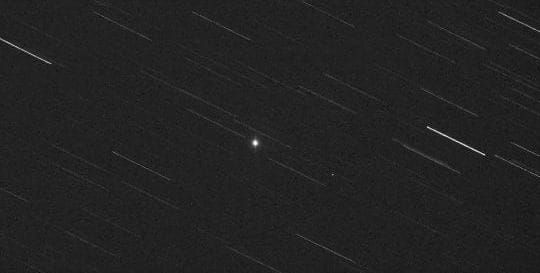
In October 2026, Russia's Kosmos 2612 approached ICEYE-X36, an American-registered commercial radar satellite belonging to a company whose imagery supports Ukraine. According to LeoLabs' tracking reported by Ars Technica, the Russian spacecraft deliberately matched orbits, maneuvered around its neighbor, and came within approximately 500 meters.
Then it left.
No shot was fired. No attack or damage was publicly established.
At the United Nations on October 21, Russian diplomat Konstantin Vorontsov insisted that Russia's activities were “purely peaceful in character.” American officials called the maneuvers threatening and consistent with an orbital weapons operation.
Both were discussing a weapon the public could not establish was present.
And then the story became even weirder.
In September, US Air Force Secretary Troy Meink had acknowledged for the first time that the United States possessed operational weapons in orbit.
He declined to identify them. No thank you.
So America had publicly admitted possessing space weapons while Russia denied the character of an observable maneuver. The American admission was more explicit about possession. It established very little about what those weapons could do or how they would be used.
The Ban Cannot Find the Weapon.
The 1967 Outer Space Treaty prohibits nuclear weapons and other weapons of mass destruction in orbit. It does not categorically prohibit conventional orbital weapons.
Russia and China have proposed extending that prohibition. Their 2014 draft treaty would ban placing weapons in space and threatening or using force against other parties' spacecraft.
But what qualifies as a weapon?
A satellite with propulsion can ram another satellite. A robotic servicing arm can inspect or seize one. Communications equipment can be used to interfere with another spacecraft. A vehicle designed for inspection may be capable of destruction without carrying anything recognizable as a conventional weapon.
The draft defines weapons partly through their production or conversion for harmful purposes. That leaves an enormous verification problem when legitimate functions and destructive capabilities share the same equipment.
A state may possess the capacity to attack without possessing an identifiable weapon.
Blanket prohibition cannot resolve that problem by declaring the relevant objects forbidden. Even legitimate spacecraft can become instruments of attack.
Specific prohibitions remain worthwhile, as do enforceable restrictions on dangerous proximity operations, interference, destructive testing, and unconsented manipulation of other spacecraft. Verification must follow what objects can actually do, what they do, and which claims independent evidence can support.
The Security Instrument.
Kosmos 2612 illustrates the distinction nicely.
Independent observers could establish its maneuvering behavior. They could not conclusively establish its hidden equipment or intent. Its close approach is a documented event; its classification as a weapon remains contested.
- Russia's declaration of peaceful purpose does not settle the operational danger.
- America's declaration that the maneuver resembled a weapons operation does not settle every question of intent, legality, or military necessity.
Commercial observers could reconstruct conduct without accepting either government's account as final. Their measurements did not answer every question, but they made the competing accounts answerable to something outside themselves.
That is the opening worth preserving.
A weapons prohibition that cannot identify its weapons risks becoming a contest of declarations. A behavioral rule without independent verification risks the same fate. And a military authority that alone decides what counts as peaceful may eventually discover that every action it wishes to take happens to qualify.
The Russian satellite left without firing.
After it demonstrated why firing might be unnecessary.
The question is whether the rest of the world can continue to distinguish protection, intimidation, and attack before one of those distinctions becomes impossible to enforce.