
Transition Action: The Animal Becomes the Actuator
Humanity has begun issuing diving gear to cockroaches. This is not a drill.

Transition Action is the technical wing of Modal Path Ethics: a series about technologies crossing from research, prototype, or theory into reachable action. Each entry begins with a live technical event and asks what has changed in the field. This is not a futurist roundup.
- What can now be built, tested, measured, or deployed that was not reachable before?
- What physical process carries the new action?
- Which additional components have become unnecessary?
- What new failure conditions enter with the new design?
Transition Action is a field inspection at the moment a capability starts to move.
This week in Transition Action, the roach gets scuba gear.
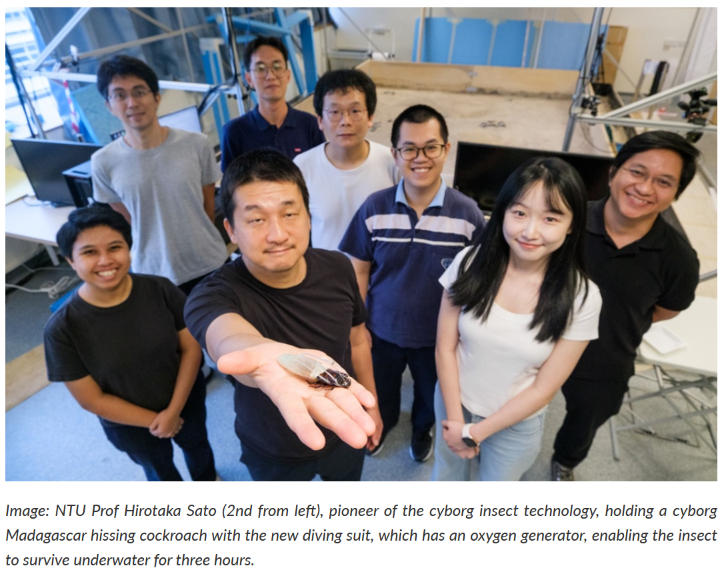
Finally. On June 29, 2026, researchers from NTU Singapore and Waseda University published a paper in Nature Communications titled "Underwater Suit-Wearing Cyborg Insect Capable of Hours-Long Diving and Terra-Aqua Travel".
The team built a flexible, wearable diving suit for cyborg cockroaches.
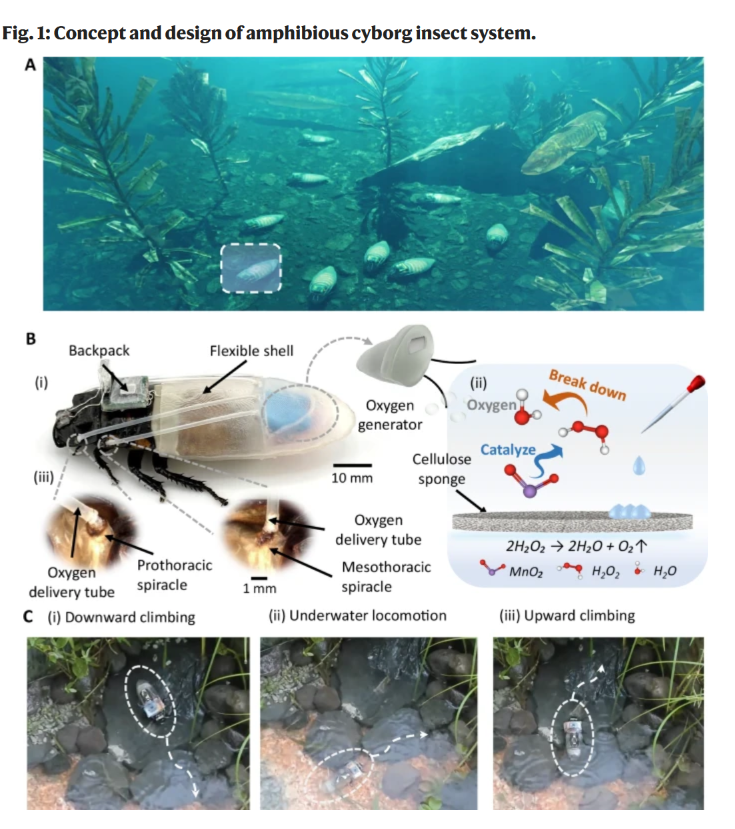
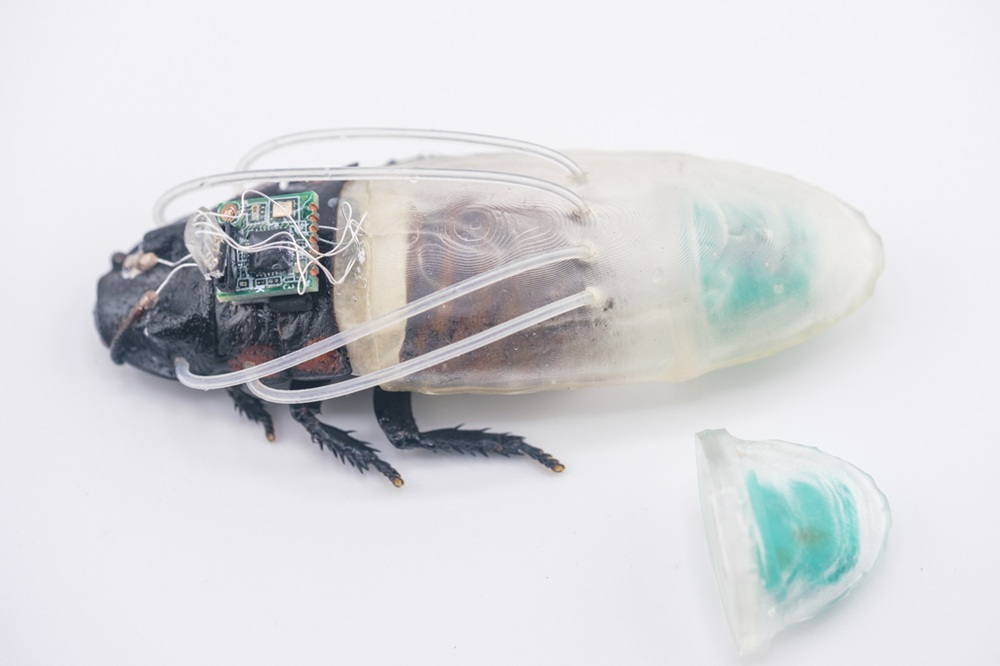
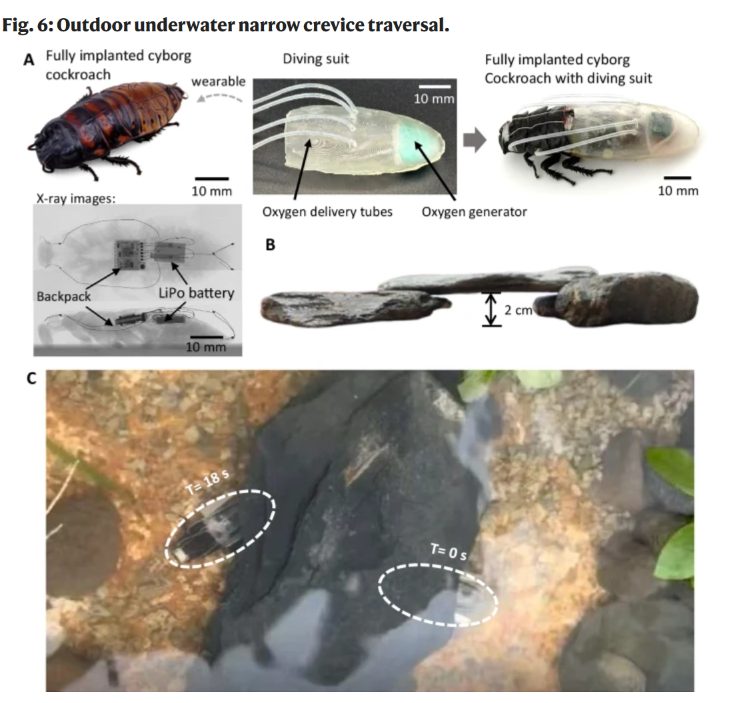
The suit carries a miniature oxygen-generation module, seals water away from the insect’s respiratory openings, and supplies oxygen through tubes to the cockroach’s spiracles.
The result is what we have all been waiting for; an amphibious cyborg insect able to remain active and responsive underwater for up to three hours.
The tabloid version has already achieved perfection.
- Scientists gave cockroaches tiny scuba suits.
The technical transition runs deeper.
- The robot borrowed an animal’s body, then engineering expanded the range of environments that body could survive.
The animal becomes the actuator.
Cyborg Insects Are Already Among Us.
A cyborg insect is a hybrid system: a living insect fitted with electronic components that allow a user or controller to influence its movement.
- The insect supplies the body.
- The electronics supply some control.
Instead of building a tiny robot with tiny motors, tiny joints, tiny batteries, tiny actuators, tiny seals, and tiny mechanical legs pretending very hard to be an insect, the engineer just uses an insect that already has legs, muscles, balance, terrain negotiation, resilience, and a willingness to enter places humans did not actually want opened.
Artificial microrobots spend much of their power budget moving themselves. Motors need electricity. Actuators need electricity. Every gram of battery is a burden. Every protruding part catches on rubble. Every waterproofing problem becomes an argument with geometry. The smaller the robot gets, the more the body becomes a negotiation with the world.
Cyborg insects invert part of that problem. The electronics do not animate every step. They induce direction while the living body performs locomotion using its own little muscles.
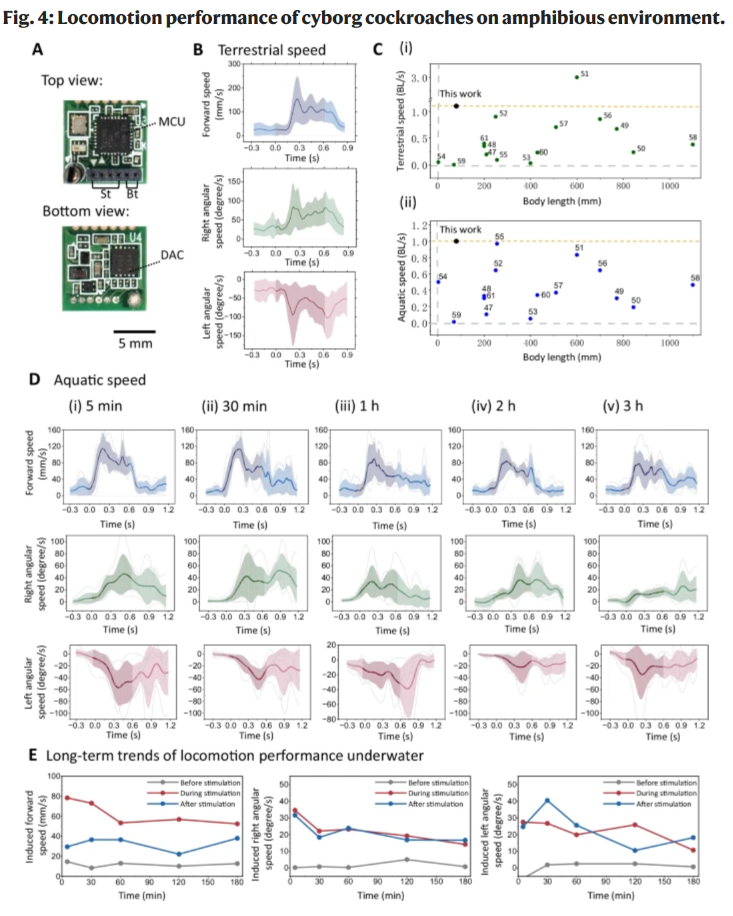
The battery no longer carries the entire burden of actuation. Some of the machine’s most difficult mechanical work has been relocated into biology.
That is the existing premise.
This new paper asks what happens when the biological body reaches one of its hard environmental edges.
The Host Cannot Breathe.
Cockroaches are terrestrial insects. They do not breathe through lungs. They breathe through spiracles, small openings connected to an internal tracheal system that distributes oxygen through the body.
That creates a blunt limitation for any cyborg cockroach.
- It can crawl through rubble.
- It can enter drains.
- It can move through small, cluttered spaces.
- And then the path floods.
At that point, the elegant biohybrid robot becomes a wet insect with a horrible respiratory problem. It may still possess the moral confidence of its future dynasty, but confidence is not oxygen.
The researchers kept the animal body and changed the envelope around it.
The wearable system has three main parts:
- a flexible waterproof shell;
- a miniature oxygen-generation tank;
- silicone tubes that route oxygen to the thoracic spiracles.
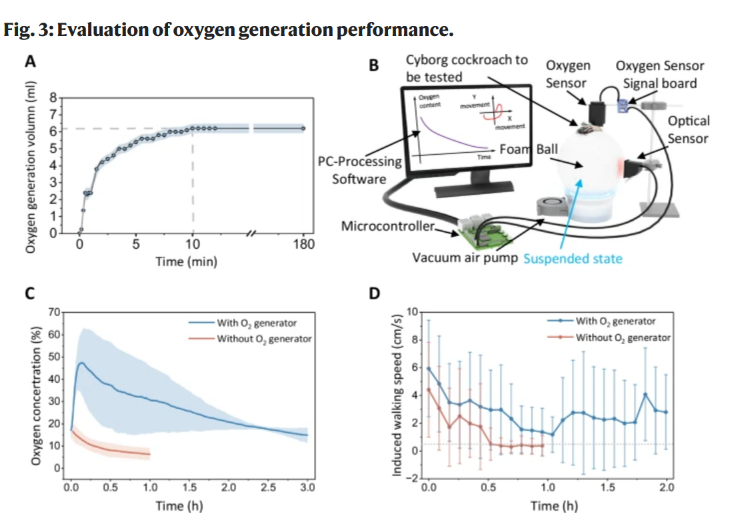
The tank uses hydrogen peroxide and manganese dioxide. Manganese dioxide acts as a catalyst, breaking hydrogen peroxide down into water and oxygen. The paper’s design places manganese dioxide on a cellulose sponge so oxygen is generated in a controlled way rather than through one chaotic burst of bubbling, so there is still room to make this much cooler. A hydrophobic PTFE membrane lets gas pass while helping keep liquid inside the generator.
The suit is therefore not just sick armor. This is a portable atmosphere.
Humanity has taken the cockroach, ancient citizen of the crack under the stove, and issued it a jurisdictional expansion kit. This is probably good.
The Suit Is an Operating Envelope.
A normal diving suit protects a human body from an environment that would otherwise exceed its operating range.
This cockroach suit does the same thing at insect scale.
The flexible shell keeps water away from the abdomen and helps create an oxygen storage and transport space. The oxygen generator produces breathable oxygen. Tubes deliver that oxygen to the spiracles. Connectors attach at the insect’s thoracic spiracles, creating a sealed respiratory pathway.
The engineering problem is compact but nasty.
The oxygen system has to be small enough to mount on the insect. It has to produce enough oxygen for long-duration activity. It has to avoid chemical leakage. It has to avoid heating the insect. It has to preserve movement. It has to avoid making the cockroach roll over underwater, which would be humiliating for the entire projected roach admiralty.
The team reports that the device stayed sealed during testing and that the oxygen generator did not create a noticeable temperature rise under their conditions. The shell geometry was adjusted so the oxygen generator sat near the posterior abdomen instead of riding high on the back, lowering the center of gravity and improving underwater stability.
At this scale, the device is not an accessory. It becomes part of the animal’s temporary body plan. A badly placed tank changes hydrodynamic resistance, posture, stability, and survivability. The field does not care whether a component belongs to “the robot” or “the animal.” Water meets the whole body.
This is the Transition Action pattern again.
Control does not sit in one clean box.
The new capability is carried by a relation:
- insect muscle;
- electrical stimulation;
- oxygen chemistry;
- flexible shell;
- spiracle connector;
- water resistance;
- center of gravity;
- sealed interfaces;
- host metabolism.
The machine becomes amphibious because those parts hold together long enough for action to continue.
The Flooded Tunnel.
The results are not only conceptual.
In underwater tests, cyborg cockroaches wearing the suit remained active and responsive to electrical stimulation for two to three hours. Control cockroaches without the suit suffocated within minutes. In locomotion measurements, suit-wearing cyborg insects averaged 87.5 millimeters per second on land and 78.4 millimeters per second underwater, with turning speeds reduced more sharply underwater because water punishes rotation.
The animal remained controllable across the land-water interface. This is not a vague “it survived in water” result.
The researchers also went ahead and built a 1.7-meter tunnel with a carbon-dioxide-filled section followed by a water-filled section, while they were at it.
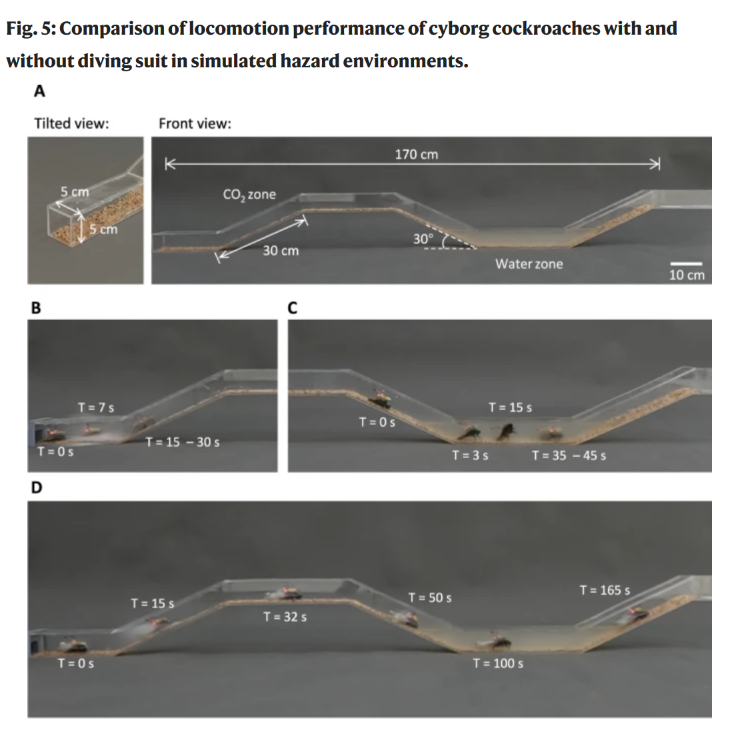
This is because disaster spaces do not politely present one hazard at a time. A collapsed or flooded infrastructure path may include low oxygen, gas pockets, standing water, mud, narrow gaps, inclined surfaces, debris, and places where a normal robot gets stuck while a cockroach, tragically, has ideas.
Without the suit, one cyborg insect lost responsiveness in carbon dioxide and another became immobile within 45 seconds after entering water. With the suit, the cyborg insects traversed the carbon-dioxide and water sections in all three reported trials.
Then the team pushed the narrow-space problem.
A dorsal electronics backpack can snag on confined underwater passages. In one test configuration, the researchers used a fully implanted cyborg setup, placing the backpack and battery inside the cockroach body. That removed the external protrusion and allowed the suited cyborg insect to traverse a submerged crevice only 2 centimeters high.
The paper is therefore not just “cockroach was underwater.”
A biological microrobot can retain induced locomotion across sequential gas and water hazards while carrying its own oxygen boundary.
That is a real crossing.
Small, strange, ethically uncomfortable, and real.
Do Not Recognize the Roach Navy.
The cockroaches have learned the sea.
The storm drains are lost.
A wet clicking sound rises beneath the city.
Humanity’s long reign ends because someone at a lab meeting said, “What if the roach had scuba?”
This is, regrettably, not the claim.
The paper does not yet establish autonomous search-and-rescue operations. It does not yet establish durable field deployment in real rubble, contaminated water, flowing drains, collapsed buildings, or disaster sites full of sharp edges and broken materials. It has not yet established onboard human detection, map-building, swarm coordination, safe retrieval, reliable command under interference, long-term animal welfare, manufacturing readiness, or acceptance by the rescue worker asked to now please open the carrying case full of mission-ready aquatic roaches.
The provisional roach navy has many logistics problems.
The demonstrated transition is narrower.
A terrestrial cyborg insect, previously limited by the host’s need for air, can now be fitted with a wearable system that maintains respiration and locomotion underwater or in low-oxygen environments for hours under experimental conditions.
That is enough.
Transition Action does not require the empire to be fully operational just yet. It has already waited this long. It asks when a capability starts to move.
This one has started moving.
The Ethical Body.
Cyborg insects make the ethical surface impossible to hide.
With a conventional robot, harms still exist: extraction, labor, energy, waste, surveillance, police use, disaster opportunism, false rescue claims, and the usual mess of machines entering the world under a heroic banner.
With a cyborg insect, the machine has a living body at the center.
The animal is not a decorative substrate. It supplies the muscles. It supplies the legs. It supplies sensory systems, metabolism, resilience, recovery, and the ability to crawl through spaces that would defeat a tiny artificial robot. The engineering advantage comes from using what the animal already is.
That makes the welfare question part of the technical architecture.
If the insect becomes the actuator, then actuator condition now includes animal condition. Fatigue, stress, injury, habituation to electrical stimulation, payload burden, respiratory supply, temperature, sealing, recovery, and survivability all become system variables.
The researchers report that the oxygen-generator design avoided detectable leakage under their tests, that temperature remained stable, and that monitored insects survived after exposure with normal behaviors. NTU’s release states that the insects were treated under research guidelines and that none were harmed. Those claims do not close the ethical file forever.
A future field system would need standards for preparation, stimulation, payload, duration, recovery, disposal, reuse, escape risk, public exposure, contamination, and the acceptable use of living bodies as infrastructure. The cockroach’s moral status may not be the same as a mammal’s, but “small and disliked” is not an engineering exemption.
What This Makes Reachable.
The immediate reachability is concrete.
- A cyborg cockroach can be experimentally operated across land and underwater without losing respiration within minutes.
- A wearable oxygen system can preserve insect locomotion in submerged and low-oxygen environments for hours.
- The biological host’s muscles can remain the main locomotion engine while engineering extends the host’s environmental range.
- Flooded tunnels, drains, pipes, puddled rubble, and partially submerged gaps become plausible test environments for biohybrid robotic inspection.
- The old boundary between terrestrial cyborg insect and amphibious field robot has been crossed at prototype scale.
The longer reachability is architectural.
Small robots do not always need to imitate animals. Sometimes they can recruit animal bodies and use engineering to modify the world those bodies can enter.
That does not make artificial microrobots obsolete. It does not make biohybrid robots automatically better. A fully artificial robot may still win on standardization, ethics, control fidelity, reproducibility, cleanroom compatibility, decontamination, no bugs, autonomy, maintenance, and public sanity.
But the new question is available:
When the body already solves locomotion, what must be added for the body to survive the mission?
That question points beyond cockroaches.
It reaches the locusts, beetles, other insects, soft robots, wearable animal-machine interfaces, assisted search platforms, environmental sensors, and field instruments whose action depends less on building a complete artificial body from scratch and more on responsibly extending the operating envelope of an existing one.
The unfortunate little phrase is:
Environmental prosthetics for locomotion hosts.
That is where the serious roachborg future lives.
The Transition Action.
The official Transition Action is to separate locomotion from the environment that normally permits it.
- A conventional robot carries its actuators into the world.
- A cyborg insect carries a living actuator.
The diving suit lets that actuator cross a boundary that would normally stop it. Water no longer ends the run. Low oxygen no longer immediately collapses the mission. The host’s body remains the locomotion system while chemistry, sealing, tubing, and stimulation keep the body within survivable range.
The transition is that the operating envelope of a living robotic substrate can now be engineered as part of the machine. The field has received a roach whose body can carry action into the flood.

Human civilization may wish to apologize to future cabinet ministers of the Baseboard soon. That is a entirely separate matter.
For now, the technical lesson is clear.
- The robot borrowed a body.
- The body got a suit.
- The drain is now reachable.
- The body got a suit.