
SLIME WATCH II: The Slop Button
LinkedIn has installed the filter.

Slime Watch has felt a tug in the noosphere.

The bucket is moving.
Something has happened.
On July 30, LinkedIn added an option to the three-dot menu on posts:
Seems like AI slop.
Three weeks later, more than one million people had pressed this thing.
LinkedIn says users are now seeing around 40 percent fewer views on material the platform classifies as artificial-intelligence slop than they were seeing a few weeks earlier. It is also beginning to tell authors when other members thought one of their posts seemed artificial-intelligence-generated.
Excellent.
Twelve days ago, Slime Watch went into the field for the very first time (and then quickly went back in the bucket) because News Corp had discovered a “slimy sea of AI slop” to swim around in and, with absolutely magnificent timing, positioned its own licensed journalism as part of the filtration system.
The first investigation established the rule.
Slime is a classification technology.
Take several distinct problems
- bad information
- synthetic information
- stolen information
- generic information
- automated information
- repetitive information
- low-effort information
- untraceable information
pour them into one sick vat, label the substance SLOP, and whoever controls the filter suddenly acquires a very interesting new jurisdiction.
Slime Watch asked one question above all others:
What does the filter remove along with the dirt?
We have received an answer much sooner than expected.
LinkedIn has built the filter.
And one million people have volunteered for labeling duty.
There Is Really Still Just So Much Slime.
We should establish immediately that LinkedIn has a real problem.
 Aidan Lawson
Not that one.
This procedure has standards.
Slime Watch does not arrive at every filtration system screaming CENSORSHIP while knocking over the water treatment plant.
LinkedIn describes its problem clearly.
- The platform wants “real voices, authentic perspectives, and lived expertise.”
- It says artificial intelligence can be useful for refining language,
- while large-scale artificial-intelligence production can fill the feed with polished material that carries little original perspective or substance.
- LinkedIn is also targeting automated comments, repetitive responses, generic posts, engagement manipulation, fake profiles, and other forms of industrialized professional weather.
- It says artificial intelligence can be useful for refining language,
This opponent is not imaginary.

Everyone has seen the slop.
- A chief executive posts seventeen paragraphs about how being denied an oat-milk substitution taught him the seven principles of antifragile leadership.
- A stranger replies:
- Great insights, David!
- Adaptability really is the key to thriving in a rapidly changing world.
- Great insights, David!
- David replies:
- Absolutely, Jennifer!
- The leaders who embrace change today will define tomorrow.
- Absolutely, Jennifer!
- Nobody is home.
- The building continues networking regardless.
- A stranger replies:
LinkedIn says its early system correctly identified generic content 94 percent of the time in initial testing. When content appears artificial-intelligence-generated and lacks clear perspective, the platform makes it less likely to travel widely beyond the author’s immediate network. LinkedIn has also been attacking comments produced at scale with little human involvement.
A professional commons can obviously be damaged by synthetic flooding.
Attention is finite. Feed space is finite. Human willingness to read another post beginning “I wasn’t going to share this, but…” may already be approaching a hard physical limit.
If one person can generate a useful post in twenty minutes while another can generate ten thousand plausible posts in the same period, the second actor can change the informational environment without improving it.
Scaling changes the field.
- LinkedIn needs spam controls.
- LinkedIn needs ranking.
- LinkedIn needs automation defenses.
- LinkedIn needs some way to keep a professional network from becoming two language models congratulating one another on career milestones until our only sun burns out.
This slime is real.

Now, we have to inspect the bucket.
What the Actual Hell Is AI Slop?
LinkedIn’s own description starts splitting and shattering almost immediately.
Artificial-intelligence slop is described through several properties:
- low effort;
- artificial-intelligence generation;
- polished surface form;
- lack of unique perspective;
- lack of substance;
- generic repetition;
- automated production;
- production at scale;
- minimal human involvement.
These are all different things.
- A post can be artificial-intelligence-generated and excellent.
- A post can be completely human and absolutely fucking worthless.
- A post can be generic because artificial intelligence produced it.
- A post can be generic because its author attended business school.
- A post can be repetitive because it was produced automatically.
- A post can be repetitive because seventy thousand human professionals have independently discovered that failure is really just an opportunity wearing work clothes.
- This is not a new phenomenon.
- A post can be repetitive because seventy thousand human professionals have independently discovered that failure is really just an opportunity wearing work clothes.
- A post can contain artificial-intelligence assistance
- while carrying firsthand information unavailable anywhere else.
- A person can use artificial intelligence
- because they know exactly what they mean
- and have difficulty expressing it in the dominant professional dialect.
- because they know exactly what they mean
LinkedIn already knows this.
Its own guidance says artificial intelligence can help people write. The platform has offered artificial-intelligence tools for transforming a member’s notes into a draft post, rewriting profile sections, and drafting professional messages.
Those tools explicitly encourage users to edit generated material and add their own experience and point of view.
So LinkedIn already possesses the necessary distinction:
Artificial-intelligence assistance is not identical to absence of human contribution.
Excellent.
So.
Then why does the report button say AI slop?

Why does the production method sit inside the quality judgment?
A button marked Generic Repetitive Garbage would be so much less fashionable.
A button marked This Post Appears to Contribute No New Perspective Regardless of Substrate would be very difficult on mobile.
So now we get:
Seems like AI slop.
This category is emotionally efficient. It contains a packed-in theory of cause.
The user does not report:
This contributed nothing.
The user reports:
I suspect I know what produced the thing that contributed nothing.
The quality judgment has acquired an ontology.

Slime Watch appears.
The Acceptable Person Machine Returns.
Unfortunately for LinkedIn, Modal Path Ethics has already been here, including in this article.
On July 30, which I now realize with extreme joy is the same day LinkedIn announced the official Slop Button, this website published Fictional Earth: LinkedIn and the Acceptable Person Machine.

That investigation had found a platform with a local professional grammar.
The successful LinkedIn citizen is:
- ambitious without desperation;
- confident without arrogance;
- vulnerable without instability;
- principled without becoming difficult;
- distinctive without becoming unpredictable;
- human without allowing humanity to interfere with operational continuity.
LinkedIn did not invent those professional pressures.
It built an extraordinary machine for carrying them.
This platform connects people across institutions. It preserves professional memory. It activates weak ties. It lets a worker reach an employer their immediate social world never touched. It gives expertise a publishing surface and unemployment a signal.
It also turns professional identity into continuous public composition.
Every life event arrives asking whether it can become professionally useful.
- Layoff becomes resilience.
- Grief becomes perspective.
- Failure becomes learning.
- Conflict becomes leadership.
- Caregiving becomes transferable skill.
- Burnout becomes boundaries.
- A strange life becomes Five Lessons for Founders.
That grammar existed before current generative artificial intelligence. Artificial intelligence simply became very, very good at speaking it, and for too long.
This was the earlier ruling:
The machine can draft the person and grade the draft.
- LinkedIn artificial intelligence can help articulate the candidate.
- LinkedIn artificial intelligence can help articulate the recruiter’s requirements.
- LinkedIn systems can compare the two.
- Artificial intelligence can help draft outreach.
- Artificial intelligence can help draft the answer.
- Artificial intelligence can polish the professional voice through which everyone explains what happened afterward.
Now we have an update.
- The machine can draft the person.
- The machine can grade the draft.
- The machine can now also ask one million people to help improve the grading rubric.
The Acceptable Person Machine has acquired an official Slime Department.
LinkedIn Voice Was Already Synthetic, Do Not Lie to Me.
This is the funniest goddamn part of this entire incident.
Artificial intelligence did not invent LinkedIn Voice.
Humans trained on that first.
- The dramatic one-sentence paragraph.
- The career wound with the completed redemption arc.
- That suspiciously useful stranger encountered at an airport.
- The founder who learned deep humility immediately after announcing a nine-figure valuation.
- The incredible story that begins with failure,
- travels through vulnerability,
- and reaches three lessons I’ll carry with me forever
- before the reader has finished wondering whether any of this shit actually happened.
- travels through vulnerability,
This language became common because it survived the platform.
- People learned which forms traveled.
- People copied successful forms.
- Consultants taught the forms.
- Creators optimized the forms.
- Employers rewarded some forms
- and quietly punished others.
- People copied successful forms.
The professional field trained human writers toward a local basin of acceptable expression.
Then, generative artificial intelligence arrived.
Of course it learned the basin.
- The model had been trained on humans.
- The humans had been trained on LinkedIn.
- The model became extremely competent at producing LinkedIn.
- LinkedIn looked at the result and experienced a terrible recognition event.
This platform had taught everyone how an Acceptable Person sounds.
Artificial intelligence learned its lesson too well.
And so now LinkedIn is in the unenviable position of having to distinguish the Acceptable Person from a machine imitating the Acceptable Person using the grammar through which the Acceptable Person became Acceptable.
They have routed that dilemma through a button that reads "seems like AI Slop".

Slime Watch wishes the company every success in the challenging years ahead.
The Slop-Lock.
This system now has a feedback structure worth stating clearly.
- LinkedIn rewards a professional grammar.
- Humans learn the grammar.
- Human-produced LinkedIn enters the wider training field.
- Artificial intelligence learns the grammar.
- Artificial intelligence makes the grammar cheap.
- The feed fills with increasingly perfect examples of the grammar.
- Humans begin associating the grammar with artificial intelligence.
- Humans report material that feels artificial-intelligence-generated.
- LinkedIn uses those signals alongside its own classifiers.
- Writers learn which language gets treated as artificial intelligence.
- Humans alter their writing to demonstrate humanity.
- Artificial intelligence learns the new human-demonstration grammar.
- Round and round we go.
The important transition happens around step ten.
Once people know a classifier is looking for artificial-intelligence slop, the classifier itself enters composition.
- Writers begin anticipating it.
- Fewer suspiciously clean transitions.
- More irregular rhythm.
- More concrete anecdotes.
- More personal detail.
- More little signs of imperfection.
- More sentences apparently typed before coffee.
- Probably fewer —s, which have somehow become embroiled in a global criminal investigation.
Eventually the performance requirement changes.
- Professional writing no longer has to be polished.
- It has to be human-polished.
Authenticity becomes another optimization target.
This is one of the oldest tricks available to a classifier.
Measure a proxy strongly enough and the field begins producing your proxy.
- LinkedIn wants authentic human contribution.
- The feed learns to produce signals of authentic human contribution.
Those are simply not the same object.
- A person can strategically insert messiness.
- A model can strategically insert messiness.
- A content farm can strategically insert messiness.
Right now, there is an artificial-intelligence prompt somewhere containing:
Make this sound less AI-generated. Add idiosyncratic sentence structure, a specific personal detail, one mild self-correction, and avoid generic motivational language.
The machine will help the post pass the test for being insufficiently machine-like.
The filter has entered the water.
One Million Tiny Classifiers.
LinkedIn does deserve some credit for the implementation.
The report does not appear to function as a direct public downvote where one person presses AI SLOP and the post is immediately driven into the slimy sea.

The user reports provide a signal inside a larger moderation and classification system. LinkedIn is also planning to tell authors when members thought a post seemed artificial intelligence-generated, apparently with an assumption of good faith rather than immediate punishment.
Good. Now, consider what this signal actually contains.
A million LinkedIn users have been asked to recognize artificial-intelligence slop by feel.
What are they detecting?
Possibly:
- generic corporate prose;
- repetitive structure;
- formulaic vulnerability;
- excessive polish;
- automated comments;
- vague inspirational claims;
- engagement bait;
- suspicious formatting;
- synthetic images;
- factual weirdness;
- rhetorical cadence;
- too many bullets;
- anything annoying;
- anything that sounds like their fucking boss;
- anything their competitor posted five minutes ago.
Some of those judgments will be excellent. Humans are extremely good at recognizing local texture before they can articulate the rule.
Some will be absolutely fucking terrible. People are also extremely good at converting aesthetic dislike into forensic confidence.
The important point here is that AI slop is not sitting in nature with a barcode on it. This category is being operationalized through a relation among:
- platform policy;
- classifiers;
- editorial judgment;
- user reports;
- cultural expectations;
- current model styles;
- current human styles;
- and the economic value LinkedIn assigns to different kinds of feed contribution.
The users label. The model learns.
The model changes distribution. Users encounter the changed distribution.
Their sense of what normal LinkedIn looks like changes. And then they label again.
The classifier is not simply detecting the culture.
This classifier is participating in the culture it will later detect.
That distinction needs to remain fully visible.
Forty Percent Less What?
LinkedIn says users are now experiencing about 40 percent fewer views on what the company classifies as artificial-intelligence slop compared with several weeks earlier.
That all sounds excellent until Slime Watch remembers what the hell LinkedIn is for. This is not a meme forum with an unusually aggressive résumé feature.
LinkedIn is an opportunity graph.
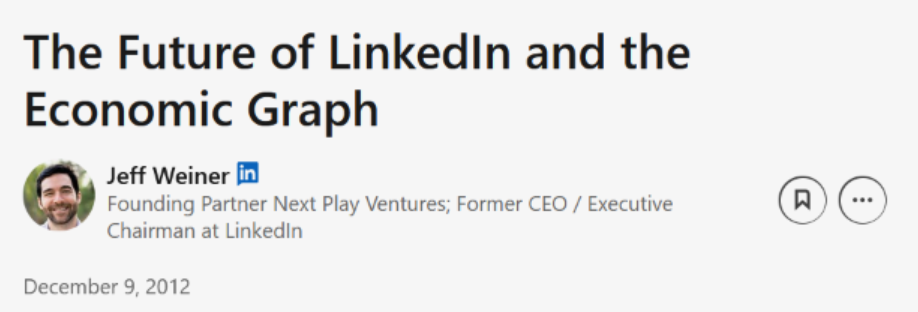
The platform itself emphasizes that a useful professional insight can “open a door or create a new opportunity.”
And its ranking changes especially matter for material traveling beyond a person’s immediate network. That outer region is important. The earlier Modal Path Ethics audit gave LinkedIn its strongest defense through weak ties.
- A close friend usually occupies much of the same local world.
- An acquaintance may know the employer, client, collaborator, investor, research group, or institution that your immediate circle cannot reach.
This is one of LinkedIn’s greatest accomplishments.
A person can become visible somewhere they were previously absent.
So reduced distribution is not trivial.
LinkedIn does not need to ban someone for a classification error to matter.
It can simply make them less reachable.
This is why Slime Watch does not ask whether the filter is punitive. It asks what the filter changes.
- A false positive on a music platform may hide a song.
- A false positive inside a professional opportunity graph can alter who encounters the person.
That deserves a much higher standard than:
Eh. Sounds kinda ChatGPT.
The Acceptable Human.
There is another asymmetry here.

Artificial-intelligence detection is often easiest when the artificial intelligence behaves stereotypically.
That creates a pressure toward detecting style rather than origin.
Style can be shared.
Consider who has strong reasons to use artificial-intelligence writing assistance.
- A person writing in a second language.
- A dyslexic professional.
- Someone with a disability affecting composition.
- A technically excellent worker who has always hated writing about themselves.
- A person attempting to translate field-specific expertise into a professional register they were never taught.
- A career changer who knows the old domain and lacks the vocabulary of the new one.
- A person whose natural prose would be judged unprofessional before any artificial intelligence entered the room.
Artificial intelligence can function here as an articulation instrument.
- The resulting post may be heavily assisted.
- The knowledge may still belong completely to the person.
This is why LinkedIn’s own official language is better than the button.
LinkedIn says artificial intelligence can help refine language. The important thing is that posts and comments represent the member’s own voice and perspective.
Correct.
That distinction should govern the instrument.
The problem is not whether the sentence passed through a model.
The deeper question is:
What human contact survives inside the sentence?
- Did the person supply the observation?
- Did the person supply the experience?
- Did the person check the claim?
- Did the person choose the judgment?
- Could the person answer questions about what they published?
- Did the model assist articulation?
- Or did the model produce a professionally plausible object whose author contributed little beyond pressing Post?
Those cases are materially different.

A Slop Button that encourages the field to treat them as one wicked substance teaches the wrong distinction.
The Human Can Also Be Pure Slop.
Slime Watch must establish one constitutional provision before this series goes any farther:
Humans retain the right to produce garbage.
This right will be exercised.

Human slop is ancient.
Human slop has institutions.
Human slop has tenure.
Human slop has quarterly targets and an editorial calendar.
There are formulaic human writers.
There are repetitive human commenters.
There are engagement farmers who could produce five hundred empty posts without a graphics processor entering the county.
There are executives who have been generating generic leadership wisdom through entirely organic processes for decades.
A classifier that treats badness as evidence of artificiality therefore commits a category error.
Likewise, a classifier that treats artificiality as evidence of badness commits the reverse one.
The distinctions have to remain separable. Otherwise an entirely human post can become suspicious because it resembles machine output.
And of course it resembles machine output. The machine learned from us.
The accusation completes the loop.
- A human writes in a standardized field.
- The standardized field trains artificial intelligence.
- Artificial intelligence reproduces the standard.
- The standard becomes associated with artificial intelligence.
- The human is now punished for sounding like the machine that learned to sound like the human.
- The standard becomes associated with artificial intelligence.
- Artificial intelligence reproduces the standard.
- The standardized field trains artificial intelligence.
This is the kind of thing Slime Watch was activated for.
LinkedIn Has the Better Theory Hidden in Its Own Documentation.
The funny part is that LinkedIn already appears to understand most of the repair.
Its official announcement does not say all artificial-intelligence content is bad.
It distinguishes useful assistance from overuse, emphasizes perspective, context, expertise, human involvement, and actual contribution, and separately targets automation, repetitive comments, generic content, fake accounts, and low-substance material. Those are better categories. Keep them.
The filter should preserve them.
- Mass automation is a behavior and scale problem.
- Generic repetition is a quality problem.
- Low original contribution is a contribution problem.
- Artificial-intelligence assistance is a production-method fact.
- False identity is a provenance problem.
- Spam is a distribution problem.
- False information is an epistemic problem.
- Engagement manipulation is an incentive and coordination problem.
These failures can overlap. Overlap does not make them identical.
The repair is exactly what Slime Watch demanded in the first investigation:
Keep separate failures separate long enough to apply the right instrument.
Do not ask one classifier to become quality critic, authorship detector, authenticity tribunal, spam filter, originality judge, and theory of the person.
That is too much jurisdiction for one little button hiding behind three dots.
The Slime Watch Fix.
LinkedIn should filter this feed.

The professional commons is worth protecting.
The current system can become safer by refusing one promotion:
Do not promote a slop judgment into a human-authenticity judgment.
A workable design follows from that.
Tell creators why distribution changed.
- Was the post repetitive?
- Was it detected as automated?
- Was it substantially similar to many recent posts?
- Did it contribute little beyond material already present?
- Was a synthetic identity involved?
- Did users report it as appearing artificial-intelligence-generated?
Keep those signals decomposable. Allow correction. Do not let ambiguous user reports silently become a permanent reputation layer attached to the person. Treat weak evidence as weak evidence. Remember that assistive artificial-intelligence use can increase human participation rather than replace it.
Keep production method distinct from contribution.
Keep provenance distinct from quality.
Keep quality distinct from identity.
Keep identity distinct from professional worth.
And please preserve the possibility of this sentence:
This post was heavily assisted by artificial intelligence and is excellent.
Also preserve this one:
This post was written entirely by a human and should never have happened and someone will pay.
A healthy classifier needs both states.
The button should report the failure.
It should not guess what organism produced it.
The Ruling.
LinkedIn found a real problem.

Mass synthetic production can reduce the informational value of a professional commons. Automated comments can create fake social proof. Generic generated posts can consume attention without carrying corresponding experience, judgment, expertise, or contact.
The platform responded with automation defenses, editorially informed classifiers, reduced distribution for generic material, user reports, and new feedback to creators.
Much of that is sensible.
Then, the category began to spread.
Artificial-intelligence generation.
Genericity.
Automation.
Repetition.
Low effort.
Low substance.
Lack of perspective.
Human authenticity.
These things started answering to one word:
Slop.
LinkedIn already taught professional culture how an Acceptable Person sounds.
Artificial intelligence learned their language.
Now the Acceptable Person Machine has to distinguish the person from the imitation using a professional grammar that both were trained to produce.
So it has asked one million people for help.
The machine can draft the person then grade the draft.
The crowd can now train the machine on what a person is supposed to sound like.
That final promotion is where Slime Watch specifically objects.
The feed needed a filter. The filter does not get to define the human.
Slime Watch will return.



Comments ()