Fictional Earth: LinkedIn and the Acceptable Person Machine
A career becomes acceptable posture.

On LinkedIn, losing your livelihood can arrive as a gratitude announcement.
The company has eliminated the role.

Access to income has closed. Health insurance may be moving with it. The person has lost a routine, colleagues, status, current evidence of professional usefulness, and one of the few authorized answers to the question of what they do all day.

The announcement still has work to perform.
- Thank the company for the opportunity.
- Praise the team.
- Name the accomplishments.
- Express confidence about the next chapter.
- List the relevant skills.
- Invite the network to help.
- Remain vulnerable enough to look human.
- Remain composed enough to look employable.
The person may mean every word.

That does not remove the field around the words.
A former manager may read the post. A recruiter may read it. A client may read it. A future colleague may read it three months later after searching the person’s name. The person is speaking from inside economic injury to an audience partly composed of people who can decide how long the injury continues.

So the loss enters LinkedIn’s native grammar.
The event is unemployment.
The platform compiles it as professional continuity.
This is not a cheap joke about corporate optimism. The posture is adaptive.

Anger can be read as instability. Grief can be read as poor judgment. Silence can be read as disappearance. A worker whose institution has abandoned them must immediately demonstrate that abandonment did not make them dangerous to the next institution.
LinkedIn did not create this problem.
It built the most complete public instrument yet for managing it.

The first Fictional Earth article gave LinkedIn one line:
A career becomes acceptable posture.
Pope Leo and the Optimizable Human then located the wider anthropology.

The person had already been trained to experience the self as an editable project. Skills, health, time, personality, visibility, relation, and risk became fields requiring continuous management. Artificial intelligence arrived after the project had already spread across work, wellness, education, branding, and social life.
Artificial intelligence became the project manager.
LinkedIn supplies the review board.

The platform takes a living person and compiles them into a professionally admissible object:
- searchable;
- legible;
- credible;
- institutionally attached;
- narratively coherent;
- visibly improving;
- appropriately ambitious;
- safely vulnerable;
- publicly employable.
That object is the Acceptable Person.

LinkedIn’s gift is real.
A worker can carry professional memory beyond one employer. A person can reach an institution their immediate social world never touched. A former colleague can become a bridge. A hidden skill can become searchable. A career can survive geographic, organizational, and personal transition.
The machine becomes dangerous when professional admissibility expands into a theory of the person.

LinkedIn may help decide who fits a role.
It may not decide who fits the world.
The Economic Graph.
LinkedIn’s ambition has always been larger than an online résumé rack.
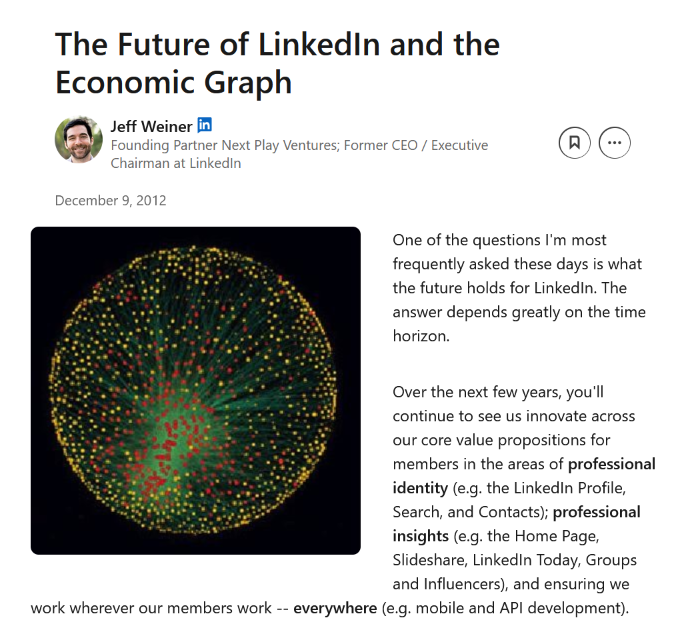
In 2012, then-chief executive Jeff Weiner described a long-term vision for an Economic Graph: a digital representation of economic opportunity, the skills required to access it, the companies offering it, the schools teaching it, the people capable of performing it, and the professional knowledge connecting the whole structure.
This is an extraordinary field instrument. This was a good idea.
A worker in one town may possess a capability needed in another industry, another city, or another country. A company may need a person whose title has never matched the obvious search term. A displaced worker may be one weak connection away from a path that nobody in their immediate circle knows exists.
The graph can reduce those distances.

It can reveal patterns that ordinary institutions cannot see from inside their own hiring routines. It can connect people across inherited boundaries. It can show where skills are emerging, where opportunities are contracting, and where training systems are failing to meet material demand.
There is nothing inherently corrupt about mapping economic relation.
Then, the map has to be populated.
Name.
Headline.
Location.
Employer.
Education.
Experience.
Skills.
Certifications.
Recommendations.
Connections.
Activity.
Availability.
A global professional graph requires every person entering it to become a compatible file format. This is where the problem started.
LinkedIn describes the profile as a “professional landing page,” a place to manage a personal brand, and a “personal storyboard” where others can understand who the member is, what they stand for, and what interests them.

The language is revealing without being dishonest.
- A landing page receives visitors.
- A brand manages interpretation.
- A storyboard arranges events into intelligible sequence.
The profile does not simply record the person’s employment history. It converts history into an interface designed for reception.
That conversion can be humane.

A résumé written under pressure often fails to carry nonlinear experience, migration, care work, independent projects, volunteer labor, unfinished study, recovery, career change, or competence acquired outside formal institutions. A richer profile can preserve more of that field.
The same conversion can narrow.
- Care work becomes a transferable skill.
- Illness becomes a career break.
- Community labor becomes experience.
- Recovery becomes resilience.
- A private obsession becomes a portfolio project.
- A scattered life becomes a coherent professional story.
This machine does not have to hate anything outside the graph.
It only has to struggle to route what it cannot represent.
A map may represent the field.
It may not inherit sovereignty over the field.
Local Physics.
Every province of Fictional Earth has local physics.
Reddit has visible jurisdictions. Bluesky is the Safe Room. TikTok builds affective recurrence around the human thumb. LinkedIn converts work, identity, reputation, and relation into professional evidence.
Its local physics are unusually strict because the reward is connected to survival.
Gravity: opportunity.
The possibility of being found pulls the person toward visibility.
A post may reach a recruiter. A comment may reach a client. A former coworker may remember a skill at the exact moment another institution needs it. The person remains active in the graph because disappearance carries opportunity cost.
Currency: credibility.
Titles, employers, schools, skills, recommendations, endorsements, verification, shared connections, followers, and visible activity accumulate into professional plausibility.
No single signal fully establishes competence.
Together they create atmosphere.
Ontology: role.
The platform encounters a person through professional categories.
The member is a software engineer, editor, teacher, recruiter, founder, analyst, manager, designer, strategist, student, consultant, creator, job seeker, or unusual combination awaiting a cleaner headline.
Role is useful. Role is also a cut.
Reproductive unit: the achievement narrative.
Something happened.
The event taught a lesson.
The lesson demonstrates a capability.
The capability belongs to a professional identity.
The identity remains available for opportunity.
Border: employability.
A statement can be true, relevant, and professionally inadmissible.
The border rarely appears as a rule against truth. It appears as a question about tone, judgment, culture fit, discretion, optimism, stability, leadership, or brand.
Citizen: the Acceptable Person.
The successful citizen is ambitious without desperation, confident without arrogance, vulnerable without instability, principled without becoming difficult, distinctive without becoming unpredictable, and human without allowing humanity to interfere with operational continuity.
Failure mode: professional legibility becomes human worth.
The profile begins as an employment instrument.
The surrounding world starts reading it as evidence about the entire person.
That is the Acceptable Person Machine.
The Résumé Learns to Watch You Live.
A traditional résumé had an occasion.

A person prepared it before applying for a job. The document entered a bounded process. It might contain strategic emphasis, compression, and professional language, but it remained recognizably an application instrument.
A LinkedIn profile remains active between applications. This is a completely different object.

It can be searched while the person sleeps. It can be viewed before a meeting, after an introduction, during a disagreement, after a public post, or when a colleague wonders where the person went. It can be checked by an employer who was never formally invited into the person’s private transition.
The application follows the person home.

LinkedIn allows a member to list up to one hundred skills. Those skills can be connected to particular experiences, endorsed by other members, compared with job descriptions, suggested by the platform, and used in search and matching systems.
This list may contain real capacities.
The form still changes what capacity becomes.
A skill in a body is contextual. It may depend on tools, collaborators, trust, time, environment, tacit knowledge, physical condition, institutional support, and the exact problem being solved. A skill on the graph becomes a portable named unit.
Portability opens paths.
It also encourages the field to treat the named unit as if it travels without remainder.
- Leadership leaves the team that made it possible.
- Communication leaves the language and power relation in which it worked.
- Strategy leaves the material field that disciplined it.
- Resilience leaves the institution that kept imposing the injury.
- Creativity leaves the time, safety, and collective memory that fed it.
The professional graph prefers capabilities that can survive extraction from their setting.
Human competence often resists extraction.
This is one reason the profile becomes labor in its own right. The member has to maintain the translation between lived work and graph-legible work.
- Update the title.
- Add the project.
- Name the skill.
- Request the recommendation.
- announce the promotion.
- Explain the break.
- Preserve continuity.
- Keep the storyboard moving.
Pope Leo and the Optimizable Human ended by protecting the future in which the profile goes quiet and the person remains fully real.
LinkedIn reveals why that future needs protection.
A quiet profile can look like stalled professional existence.
The person may be caring, healing, learning, surviving, researching, writing, grieving, parenting, building privately, changing direction, or simply refusing to turn every movement into public evidence.
But the graph receives less signal.

The life may still be doing more.
The Acceptable Person Grammar.
LinkedIn has a dialect.
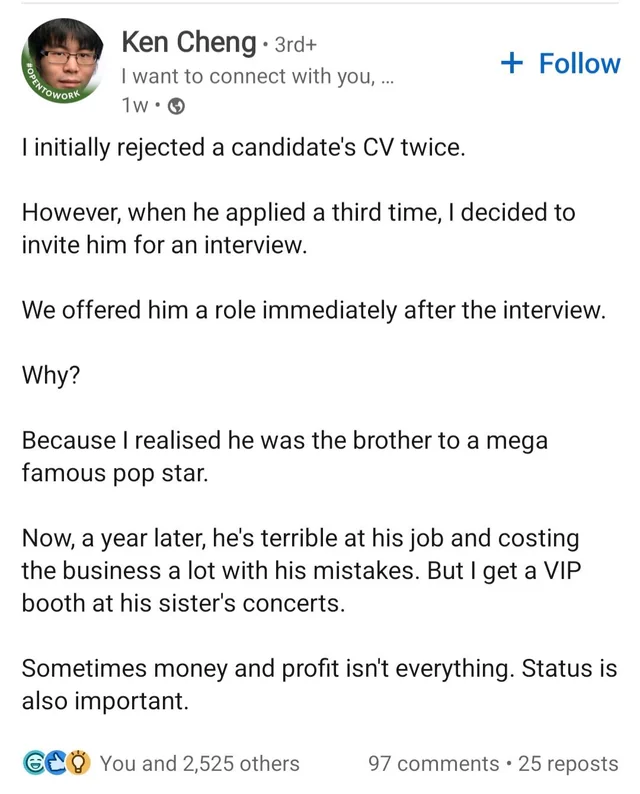
This is often audited as bad prose.
- The dramatic one-line paragraphs.
- The humble announcement of exceptional success.
- The revelation that a child, taxi driver, cashier, stranger, rejected applicant, or household appliance taught the chief executive five principles of leadership.
- The impossible amount of gratitude surrounding institutional injury.
- The confession that has already completed the healing arc before publication.
- The lesson extracted from an event that had no apparent desire to become management training.
The comedy is real.
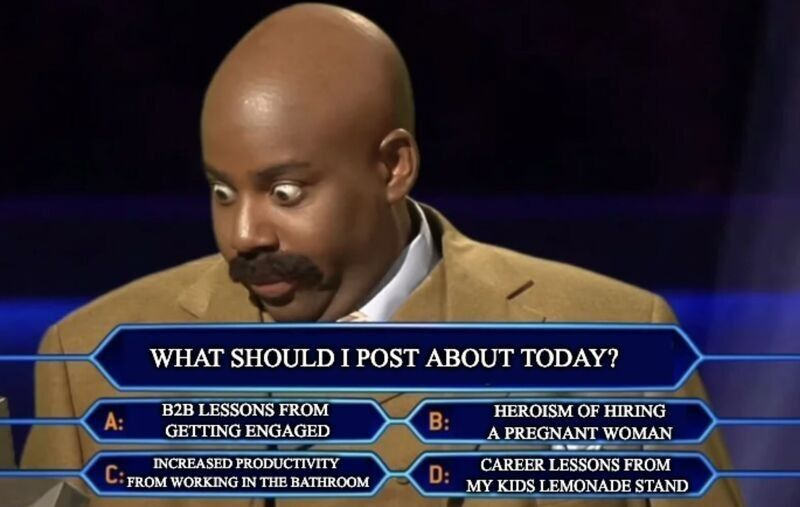
The grammar also has a function.
The audience is diffuse and professionally consequential.
The member cannot know which recruiter, manager, client, colleague, investor, competitor, former employee, future employee, journalist, or institutional gatekeeper may encounter the post later.
So, the language becomes cautiously inspirational.
- Success demonstrates humility.
- Failure demonstrates learning.
- Conflict demonstrates leadership.
- Exhaustion demonstrates perseverance.
- Grief demonstrates perspective.
- Unemployment demonstrates readiness.
- Anger becomes a constructive invitation.
- Doubt becomes curiosity.
- Luck becomes gratitude.
- Structural power becomes a lesson about mindset.
The platform does not require perfection.
It rewards evidence that imperfection has been processed into professional value.
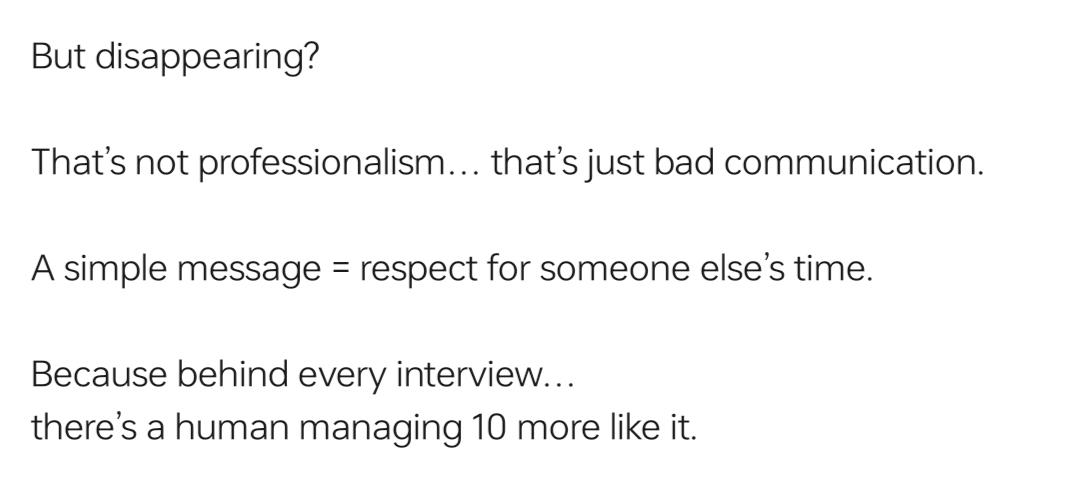
That is acceptable posture.
The posture assures the reader that nothing which happened to the speaker has made them dangerous to employ.

THEY ARE STILL SAFE.

- A layoff can be announced.
- Contempt for the employer is so much riskier.

- Burnout can be discussed.
- The person should have learned boundaries.

- Discrimination can be named.
- The speaker should remain a credible partner in building the better workplace together.

- Grief can enter.
- It should eventually produce perspective.

This is why crude mockery fails the audit.
Cringe is often a person trying to remain employable in public.
The post may still deserve criticism.
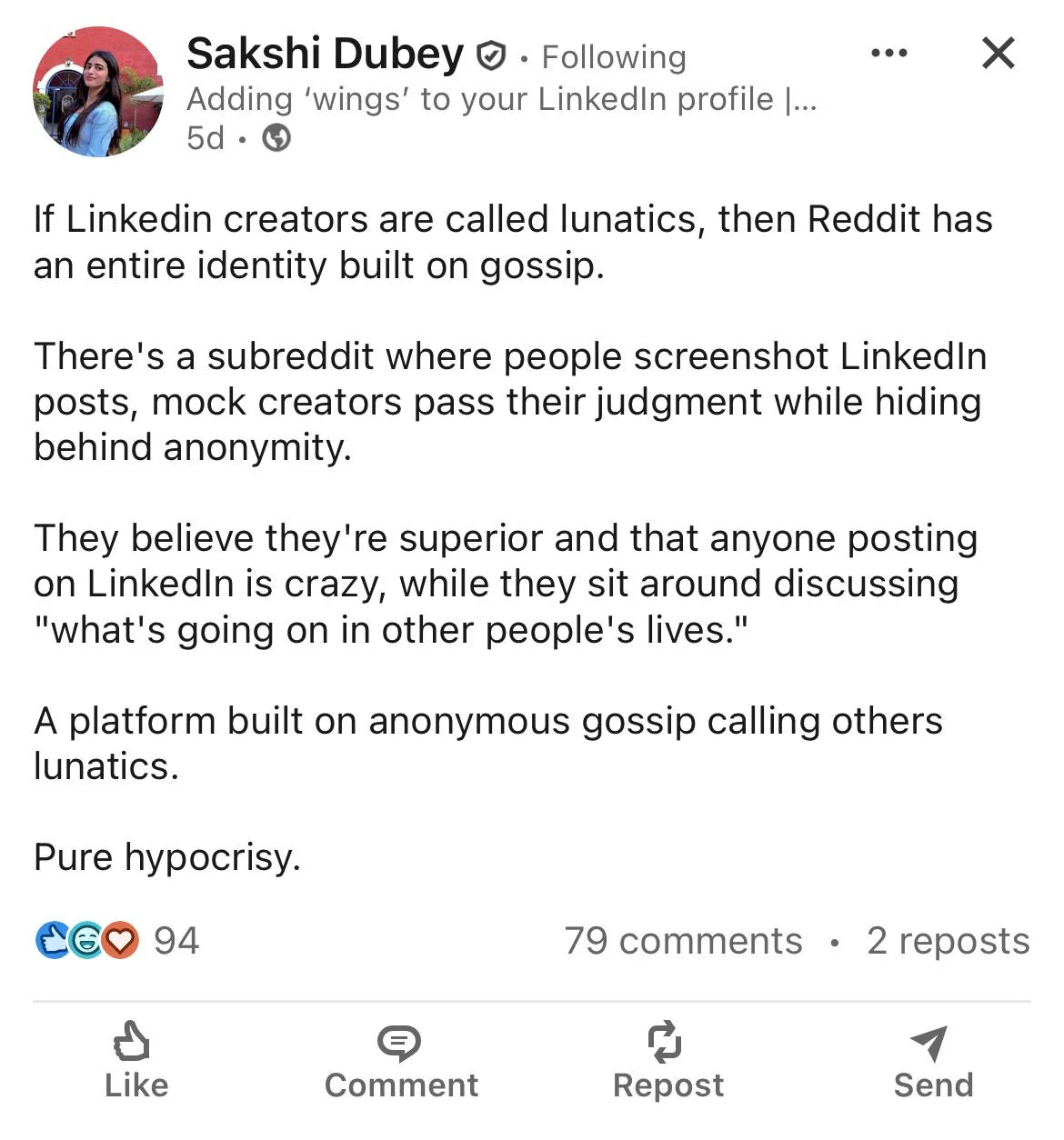
False stories, stolen anecdotes, manipulative vulnerability, empty leadership theater, predatory sales tactics, and institutional propaganda all belong in the field.
The person performing the grammar is not always its sovereign author.
A professional world trained to punish unresolved humanity will produce language that arrives pre-resolved.
Vulnerability After Processing.
LinkedIn permits vulnerability.
It often rewards vulnerability.

The permitted form has usually completed conversion before publication.
- Burnout has yielded boundaries.
- Illness has yielded gratitude.
- Failure has yielded discipline.
- Discrimination has yielded purpose.
- Layoff has yielded reinvention.
- Grief has yielded leadership.
- Poverty has yielded drive.
- Trauma has yielded resilience.
The wound is welcome after it becomes useful.

The dangerous form is pain that remains active and unresolved.
- Anger without reconciliation.
- Uncertainty without a plan.
- Illness without an inspiring adaptation.
- Failure without a comeback.
- Grief without a lesson.
- Unemployment without positive framing.
- A person who does not yet know what the event means.
The Acceptable Person Machine asks every wound for a professional deliverable.

That demand can become hard to see because meaning-making is a real human capacity. People genuinely do learn from catastrophe. Work can absolutely acquire depth through suffering. Public testimony can definitely help others.
A person may want to describe what they carried forward.
The distortion begins when the field makes later value the admission price for present pain.
A worker should not have to prove that the layoff improved them before the layoff can be named as damage.
A person should not have to convert illness into insight before remaining employable.
A survivor should not owe the network a clean arc.
 Aidan Lawson
Pope Leo and the Optimizable Human called for an unscored region: parts of life where the metric, plan, profile, and optimization project do not receive jurisdiction.
LinkedIn shows very clearly why that region cannot be understood as private luxury.
A person’s right to remain unresolved is a professional protection.

Without it, public vulnerability becomes another interview question.
The Profile Is Active Information.
A profile does not push a hiring manager’s hand across the screen.
It does not drive to the office, open the requisition, fund the salary, or decide who receives an interview.
The surrounding field supplies the force.

Active information changes reachability when a receiver and an organized field act on its form.
LinkedIn is full of small signals attached to large capacities.
- A headline changes whether a search retrieves the person.
- A current employer changes how a stranger reads the same claim.
- A connection changes whether outreach feels cold.
- A recommendation changes whether competence arrives with a witness.
- A verification changes the atmosphere of authenticity.
- An Open to Work setting changes discoverability.
- A listed skill changes which jobs appear matched.
- A public post changes what a future employer believes the person will bring into the room.
The profile is active information because institutions have learned how to answer it.
That answer may open a future.
It may also close one before the person knows an evaluation ever occurred.

This is why “the member chose what to put on the profile” cannot complete the ethical analysis. A tool can remain optional at the interface while becoming compulsory in the field.
When opportunity, reputation, searchability, and professional continuity route through the instrument, refusal now carries concentrated cost.
The person needs rights inside the profile and exits outside it.
The Witness System.
LinkedIn gives professional testimony a durable public form.

Skills can be endorsed. Colleagues can write recommendations. A member can request recommendations, accept them, dismiss them, hide them, or ask the writer for a revision.
This is a remarkable witness protocol.
A worker can carry recognition across institutions. A former manager’s private knowledge does not have to disappear when the company email closes. A client can attest to work performed. A collaborator can preserve evidence that never entered a formal title.
The worker gains professional memory outside the employer.
That is a major good of LinkedIn.

Institutions often own the records through which competence becomes visible.
The employee’s work survives inside proprietary systems, confidential projects, internal metrics, private meetings, and the memories of people who may leave first. When employment ends, the worker can lose access to the evidence of having worked.
Recommendations reopen some of that path.
Then, the evidentiary classes begin to blur.
- A self-listed skill is a claim.
- An endorsement shows that another member chose to endorse the claim.
- A recommendation is authored praise, often requested by its recipient.
- A workplace verification establishes an association.
- A credential demonstrates completion under a particular institution’s standard.
- A work sample offers direct contact with an artifact.
- A structured assessment measures performance under bounded conditions.
These are all forms of evidence.
They do not prove the same thing.
The profile tends to gather them into one credibility atmosphere.

A recommendation becomes especially interesting because the subject can review it before display and ask for changes. This does not make the recommendation false. It makes the object closer to a testimonial, reference letter, and negotiated public monument than an independent deposition.
- Everyone gets witnesses.
- The defendant approves the deposition.
The comedy should not obscure the repair.
The answer is not removal of testimony.
The answer is legible provenance.
Let each signal state what kind of evidence it is, who produced it, under what relation, and what the signal cannot establish.
The Acceptable Person Machine becomes less sovereign when credibility remains decomposable.
Verified by Employment.
LinkedIn offers identity and workplace verification.

A member may verify workplace association through methods including a current company email, Microsoft Entra, a company-provided LinkedIn Learning license, or a Recruiter license. LinkedIn’s own verification documentation describes the bounded claim: the member has confirmed an association with a specific company through an accepted route.
The function is useful.
Professional platforms attract impersonation, fraudulent credentials, fake recruiters, false companies, and job scams. Verification can preserve trust. It can help a user distinguish an actual employee from a person who typed an employer’s name into a profile field.
Then, the badge enters Fictional Earth.
The employer becomes one of the authorities certifying that the person is real.
- Technically, the badge verifies association.
- Socially, association contributes to authenticity, seriousness, and professional credibility.
- Verified workplace.
- Credible profile.
- Serious professional.
- Acceptable person.
The semantic spillover happens in the surrounding field.

A person with no recognized employer may be more capable than the verified member. A caregiver, independent worker, informal expert, dissident, displaced person, undocumented worker, or person between institutions may have no authority available to issue the right signal.
The badge can perform its bounded function without becoming a moral accusation against everyone outside it.
That requires active discipline.
- Verification should say exactly what was verified.
- The absence of verification should remain the absence of that signal.
- It should never become ambient proof of unreality.
The Green Ring.
LinkedIn gave unemployment a flag.
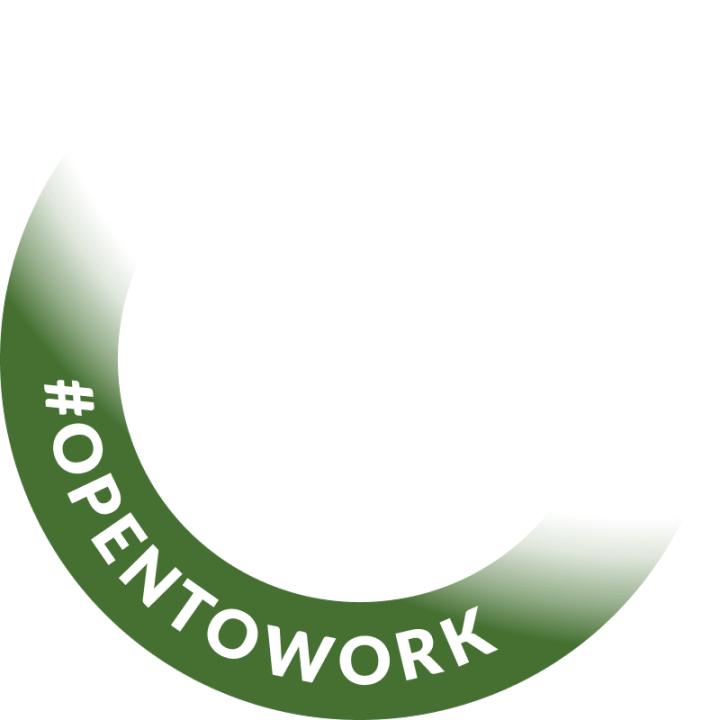
The Open to Work feature lets a member communicate job-seeking preferences to recruiters. A public option can place the green frame around the member’s profile photo. A recruiter-only option keeps the signal less visible to the wider network.
This is another useful instrument.
A network cannot answer a need it cannot see. The green ring can turn private displacement into actionable information. Former colleagues can share the profile. Recruiters can find the person. Friends can remember an opening. A professional community can organize around the member before savings, housing, health care, and confidence begin collapsing.
The ring opens paths.
It also asks the person to choose how publicly to wear economic vulnerability.
The same signal can be read as:
- available;
- displaced;
- motivated;
- overlooked;
- prepared;
- desperate;
- courageous;
- risky.
The platform supplies the interface.
The professional field supplies the interpretation.
This is where the opening layoff post returns.

- The person has lost a job.
- They may need to activate the graph quickly.
- The network needs enough information to help.
- The person also knows that need itself can be interpreted as a decline in professional value.
- The network needs enough information to help.
So unemployment becomes performance.
The member has to show urgency without panic, confidence without denial, need without burden, and openness without appearing unwanted.
The green ring is honest.
The field around it is not yet safe enough for honesty.
The Gift of Weak Ties.
LinkedIn’s strongest defense is the weak tie.
A close friend often occupies the same local world. They know many of the same people, institutions, and opportunities. An acquaintance may sit across a boundary the person could not otherwise cross.
In 2022, researchers published a large causal test of weak ties using randomized variation in LinkedIn’s connection recommendations. Across more than twenty million members and five years, the experiments found that weaker ties could increase job mobility, with the effect varying by tie strength and industry.
This is exactly the kind of path opening a professional graph should perform.
- The worker trapped under one manager becomes visible elsewhere.
- The person changing careers reaches someone across the category boundary.
- The independent creator finds a client.
- The researcher reaches a practitioner.
- The laid-off worker activates dormant relations.
- The person without inherited elite connections builds some professional reach of their own.
LinkedIn can introduce a person to the room that did not already know how to exclude them.
That sentence should remain near the center of the audit.
This platform cannot be dismissed as empty posture while it performs this work.

The danger still arrives through the admission requirement.
Weak ties often know the person weakly. They therefore rely on shallow signals to decide whether to carry the person’s name into another room.
- Current title.
- Shared connection.
- Employer.
- School.
- Headline.
- Profile photo.
- Recent activity.
- Visible fluency in the professional grammar.
The network opens a new field.
The profile decides which version of the person reaches it first.
That is why portable reputation can become compulsory self-simulation. The worker needs a version capable of traveling through relations too weak to carry the whole human context.
The repair is not to destroy weak ties.
The repair is to make them less dependent on one polished professional surface.

Work samples, structured introductions, local testimony, public projects, community contribution, apprenticeships, and direct demonstration can give the new room more contact than the brand alone supplies.
Career Break:
Please Explain the Missing Person.
LinkedIn allows members to add Career Breaks inside the Experience section.
This was a humane correction.

Caregiving, bereavement, illness, parenting, relocation, study, recovery, layoffs, and the ordinary instability of economic life produce gaps that traditional professional narratives often treat as suspicion. Making the break visible can prevent a period outside employment from appearing as unexplained absence.
The platform has made the gap representable.
It has not made explanation unnecessary.

The member may name the type of break, provide dates, and describe what happened. The interruption receives a place in professional continuity.
Even the exit from work has been given an Experience section.
This is a perfect Acceptable Person Machine artifact because it carries repair and capture at once.
The repair is real.
A parent can name full-time care. A grieving person can refuse the fiction of uninterrupted productivity. A worker can show that employment stopped without implying that life stopped.
The capture enters when the break has to return as employable value.
- Caregiving taught leadership.
- Illness taught resilience.
- Bereavement taught perspective.
- Travel taught adaptability.
- Recovery taught discipline.
- Unemployment taught strategic patience.
These lessons may all be true.
They should remain gifts, not filing requirements.

A person can leave employment and gain no professionally useful lesson.
The break can just remain a break.
The person remains real.

This is where the LinkedIn article returns to Pope Leo’s unresolved problem of work. Work can provide contribution, mastery, relation, rhythm, recognition, and public role. Employment has also become the gateway to income, health care, housing, credit, status, adult legitimacy, and social participation.
The concentration makes a career gap very dangerous.
It does not prove that the gap owes the market a redemption story.
Thought Leadership.
LinkedIn turned professional identity into an ongoing publication.

The worker no longer carries only a record of past work.
They can demonstrate present judgment through posts, articles, comments, newsletters, videos, and reactions.
This can become a genuine professional commons.
- Practitioners explain what they learned.
- Researchers reach industry.
- Workers document techniques.
- Organizers expose conditions.
- Independent experts build audiences outside credentialed publication.
- People share jobs, tools, mistakes, methods, and warnings.
Knowledge that once remained trapped inside companies can circulate through the people who actually produced it.
Then, every thought meets the acceptability filter.
What professional usefulness can this thought demonstrate?
- Philosophy becomes leadership.
- Politics becomes organizational culture.
- Grief becomes resilience.
- Ethics becomes values.
- Criticism becomes an invitation to build better together.
- History becomes five lessons for founders.
- Friendship becomes networking wisdom.
- A difficult life becomes thought leadership.
LinkedIn does not silence thought.
It gives thought a performance review.

The pressure is strongest where the person’s audience and opportunity graph overlap. A writer on another platform may lose some followers.
A worker on LinkedIn may lose a future interview.
That possibility enters composition before the first word appears.
- The joke is softened.
- The anger is formatted.
- The uncertainty is removed.
- The anger is formatted.
The criticism is made constructive enough to prove the critic could still be managed inside an organization.

This is Fictional Earth built from true thought.
The thought may remain accurate.
The platform’s grammar changes which truths become professionally survivable.
Artificial Intelligence Joins Both Committees.
The Optimizable Human has now reached the most complete version of the loop.
On the candidate side, LinkedIn offers artificial-intelligence tools that can:
- suggest revisions to a headline, About section, and experience descriptions;
- review and rewrite résumé sections against a job description;
- draft a personalized cover letter;
- explain how the member matches a job;
- draft an initial professional message;
- transform notes into a draft post.
On the hiring side, LinkedIn Recruiter offers artificial-intelligence systems that can:
- translate natural-language hiring intent into a structured candidate search;
- interpret titles, locations, skills, industries, schools, and companies;
- expand or refine candidate discovery;
- draft personalized outreach using recruiter and candidate profile data;
- help identify applicants matching stated criteria.
LinkedIn describes AI-Assisted Search as a system that interprets a recruiter’s plain-language input and builds a structured search. Its more advanced search can infer relevant skills that may not be explicitly listed on a profile. LinkedIn also states that these tools do not make the final hiring decision. Human teams decide whom to contact and advance.
That boundary definitely matters.

The loop remains extraordinary.
- An employer uses artificial intelligence to articulate the acceptable candidate.
- A candidate uses artificial intelligence to articulate the acceptable self.
- Artificial intelligence compares the generated self with the generated requirement.
- Artificial intelligence helps the recruiter search and communicate.
- Artificial intelligence helps the candidate respond.
- The humans meet through language optimized for passage through the same field.
The project manager now sits on both sides of the interview table.
This can lower real resistance.
A talented person may be very bad at résumé conventions. A disabled user may benefit from writing assistance. A non-native speaker may possess the work and lack the professional dialect. A career changer may need help translating experience across categories. Recruiters may discover candidates whose titles do not contain the expected keyword.
Artificial intelligence can help the field see someone it previously missed.
Then, convergence begins.
Millions of profiles become more fluent in the same grammar of credibility.
Employers receive candidates polished toward inferred expectations.
Candidates receive employers polished toward recruitment language. Outreach becomes personalized through profile data while remaining generated at scale. Thought leadership acquires the same clean cadence. Vulnerability becomes professionally proportioned.
The résumé becomes stronger.
The evidence of distinct relation can become weaker.
Professional language becomes a synthetic handshake between systems, with a human enclosed inside each palm.
The danger is larger than dishonesty.

A candidate may use artificial intelligence to express completely true information. A recruiter may use artificial intelligence to identify completely relevant experience. The field can still drift toward a shared model of the acceptable person.
The system’s cuts become cultural training.
Candidates learn which experiences translate well. Recruiters learn which qualifications appear legible. Models learn from the professional material produced under those expectations. The next generation of language becomes smoother inside the same groove.
The instrument begins reading its own consequences as evidence of the world.
That is the sealed path.

Artificial intelligence should assist articulation and search.
It should never silently determine whose life has been formatted convincingly enough to receive economic continuity.
The Unacceptable Person.
The machine is easiest to see at its edges.
Consider the people who remain professionally difficult to compile.
- The caregiver whose labor was never salaried.
- The worker whose illness produced no inspiring lesson.
- The failed founder who remains failed.
- The whistleblower whose truth makes them dangerous to employ.
- The union organizer described as difficult.
- The expert without an approved credential.
- The person recovering slowly.
- The worker who does not enjoy performing ambition.
- The nonlinear career with no clean explanatory arc.
- The employee whose anger remains proportionate to what happened.
- The person whose best work was collaborative and confidential.
- The human being who does not know what comes next.
These people can all create profiles.
Representation and acceptability remain different.

A professional system needs bounded judgment. Employers must assess whether someone can perform particular work under particular conditions. Roles can require knowledge, reliability, safety, trust, communication, physical capacity, judgment, licensure, availability, and cooperation.
The question can be legitimate:
Can this person perform this work?
The machine crosses jurisdiction when the question becomes:
Is this an acceptable person?
That question is too large for the institution asking it.
- A worker can fail a role and remain a serious person.
- A person can lack one credential and possess extraordinary competence elsewhere.
- A whistleblower can be professionally inconvenient and morally necessary.
- A grieving worker can be temporarily unreliable without becoming disposable.
- A public critic can have poor corporate posture and excellent contact with the field.
- A life can be ethically rich and professionally illegible.
LinkedIn’s world becomes dangerous when the conditions of employability become ambient standards for adult reality.
- Introduce yourself through work.
- Explain the gap.
- Demonstrate momentum.
- Maintain the network.
- Publish useful insight.
- Turn the wound into growth.
- Stay searchable.
- Stay acceptable.
The person can begin living as though some recruiter is always somewhere in the room.
That is the résumé watching them live.
The Quiet Professional.
A functioning professional graph needs a protected quiet mode.

Some people gain real value from publishing. Others perform excellent work and do not want to become professional media operations. A healthy labor market should not require every worker to demonstrate continuous public relevance.
The quiet professional may:
- keep the profile current;
- list real experience;
- preserve contact with colleagues;
- receive relevant opportunities;
- share work privately;
- remain absent from the feed.
- Nothing is missing from the person.
- The platform receives fewer behavioral signals.
That difference should not become a penalty disguised as relevance.
A professional network becomes more equitable when discoverability does not depend on fluency in self-publication. Otherwise the feed selects for a second occupation layered on top of the first one: public performance of employability.
The loudest professional identity may be excellent.

Silence is still not contrary evidence.
Repairing the Acceptable Person Machine.
The repair cannot be “delete LinkedIn.”
Too many real paths run through the graph.
- Workers need portable professional memory.
- Weak ties open opportunities.
- Public expertise can bypass closed institutions.
- Career transitions need language.
- Fraud requires bounded verification.
- Employers need ways to find relevant people.
- People need ways to signal that they need work.
The objective is jurisdiction.
Keep role fit local.
Hiring systems should evaluate demonstrated relevance to a particular role. They should avoid generalized person scores, hidden personality judgments, and professional risk categories that travel beyond the decision for which they were built.
Protect the quiet professional.
A member should remain discoverable without continuously posting, reacting, branding, and maintaining public professional weather.
Distinguish evidence classes.
Self-description, endorsement, recommendation, verification, credential, work sample, assessment, and direct observation should remain visibly different. Credibility should stay decomposable.
Make matching contestable.
Members need to know which profile facts shaped job matching, recruiter discovery, and applicant filtering. They need usable ways to correct bad inferences, outdated skills, false role assumptions, and category errors.
Preserve career breaks without compelled redemption.
A gap can be represented without being turned into a professional achievement. The member should be able to say that employment stopped and life continued.
Protect the unscored region.
Health, family, grief, politics, faith, private relation, and ordinary human inconsistency should remain outside professional judgment unless they bear directly and demonstrably on the role.
Preserve portable professional memory.
Workers should control and export their work history, recommendations, skills, contacts, and evidence. A professional life should not depend permanently on one platform’s continued recognition or one employer’s archive.
LinkedIn already allows users to download account data. The deeper repair is interoperability: professional memory that can leave without becoming dead data.
Keep artificial intelligence subordinate.
Artificial intelligence may assist articulation, translation, search, and discovery. It should disclose the cut it made, preserve uncertainty, expose the basis of matching, and keep human correction reachable.
Separate survival from employability.
No profile repair can solve a civilization that routes food, shelter, care, legal standing, communication, and basic participation through success in the labor market.
The Acceptable Person Machine gains sovereignty because professional rejection carries too much downstream closure.
The deepest repair is to make job loss less capable of destroying the person’s whole field.
- Professional judgment is necessary.
- Professional sovereignty is not.
The Ruling.
LinkedIn is the Acceptable Person Machine.

Its gift is real.
It lets a worker carry professional memory beyond one employer. It makes skills visible across distance. It activates weak ties. It opens rooms that local institutions had kept closed. It gives unemployment a signal, expertise a publishing surface, and professional testimony a portable archive.
Its danger is equally real.

The profile becomes continuous. The application follows the person home. Pain is admitted after conversion into resilience. Failure becomes acceptable after producing a lesson. Career interruption receives a field inside the Experience section. Employment helps verify identity. The quiet person risks disappearing under a system trained to read activity as relevance.
Artificial intelligence now helps define the requirement, rewrite the candidate, compare the two, find the match, draft the outreach, compose the response, and polish the public voice through which everyone explains what the process means.
The machine can draft the person and grade the draft.
Pope Leo and the Optimizable Human ended with a person remaining larger than the project.
The LinkedIn audit supplies the corresponding institutional boundary.
- The profile may need to be acceptable.
- The person does not.
A person can train, learn, improve, present, connect, publish, apply, and change.
- The profile may represent that work.
- The profile may not own the life carrying it.
- The job may organize contribution.
- The job may not own survival.
- The graph may connect opportunity.
- The graph may not decide which human futures deserve to remain visible.
LinkedIn may help decide who fits a role.
It may not decide who fits the world.