
Modal Path Ethics Apologizes to Roger Penrose
The Tiny Throne is still coming down; I still did not need to throw it at him. Time for the part where Modal Path Ethics gets embarassing.
Well, shit.
Roger Penrose is having a much better day than Modal Path Ethics expected.
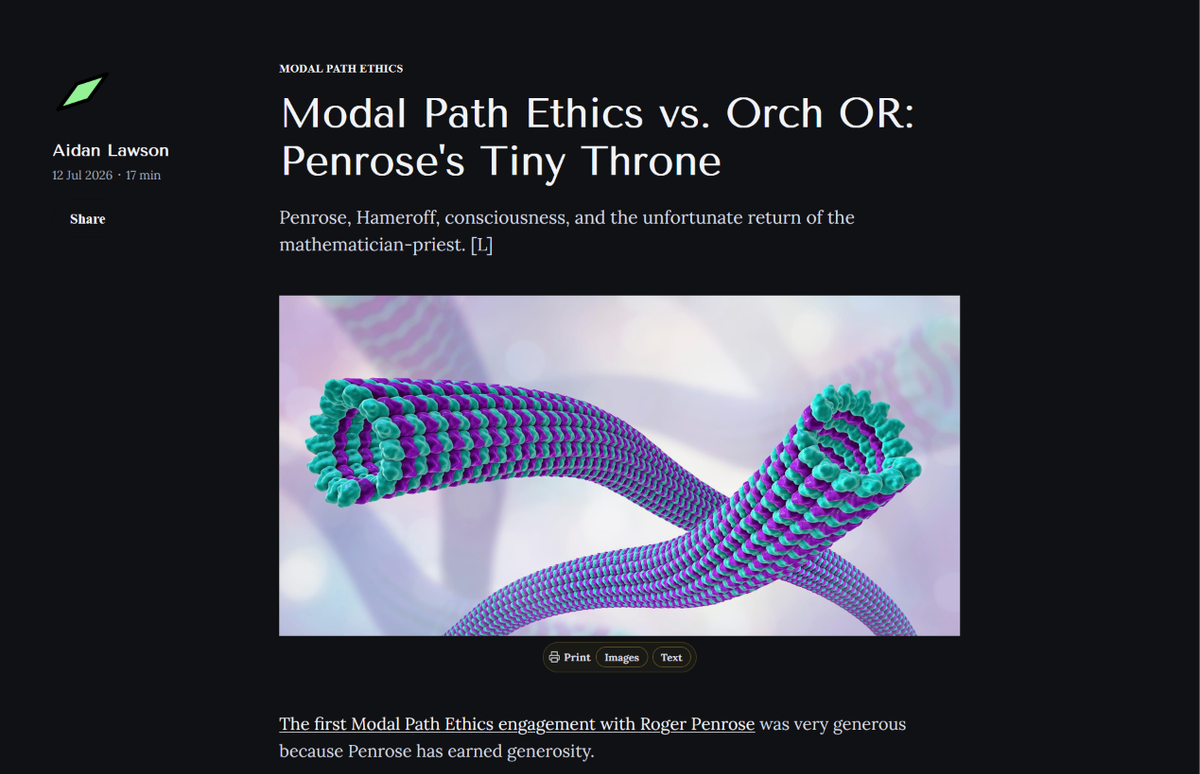
On September 1, the Institute of Art and Ideas published neuroscientist Mike Wiest arguing that accumulating experimental evidence has weakened one of the standard reasons for dismissing quantum theories of consciousness: the claim that a warm, wet biological system like the brain simply cannot sustain quantum states long enough for them to matter.
Wiest does not announce that Orch OR has been proven correct. He argues that the physical-plausibility objection is no longer strong enough to laugh this proposal out of the room.
Modal Path Ethics has, unfortunately, previously been among the people standing in that very room, entirely uninvited.
- Modal Path Ethics was technically more careful than that.
- It was also being an asshole.
Time to separate those two facts.
Review the Tape.
In July, Modal Path Ethics published Modal Path Ethics vs. Orch OR: Penrose's Tiny Throne.
It began generously enough.
Penrose takes structure seriously. His work on aperiodic tilings, singularities, mathematical realism, and the relation among mathematics, physics, and mind has been enormously important. Modal Path Ethics had already engaged him sympathetically for exactly that reason.
Then the article announced:
“Modal Path Ethics has returned for the part where Penrose gets embarrassing.”
A few paragraphs later, the universe had supposedly installed a VIP entrance in the Oxford mathematics department. Then came the “mathematician-priest.” Then the access aristocracy. Then the microtubule chapel.
Then the tiny throne.
Then Penrose's consciousness theory was accused of discovering, with suspicious convenience, that reality had arranged its deepest secrets around the particular kind of cognition Roger Penrose had spent his life practicing.
This was very funny stuff. Some of it was also completely unnecessary. The actual argument did not require any of this shit.
The strongest part of Penrose's Tiny Throne was much simpler. Orch OR contains a stack of distinguishable claims:
- microtubules may matter for neural function;
- anesthetics may interact with microtubule processes;
- some microtubule processes may involve quantum effects;
- those effects may influence cognition;
- objective reduction may exist;
- objective reduction may be related to gravity or spacetime geometry;
- orchestrated reductions in neuronal microtubules may participate in conscious events;
- human mathematical understanding may exceed computation because of those events.
The article's rule was:
Every line is its own crossing. Every crossing needs its own bridge.
That rule is good. The heat surrounding it was doing very little epistemic work.
This Was Before Substack, Too.
There is a useful correction to make here too. This particular failure cannot be blamed on Substack.
Penrose's Tiny Throne was published July 12. Fictional Earth: Substack and the Argument Machine arrived August 27. The adversarial drift identified after the Substack experiment therefore had an earlier form. The platform accelerated something; it did not invent it.
And one chronology point matters.
The published Immortal Corpus appeared July 14, two days after Penrose's Tiny Throne. So the heat came from the same inquiry.
The anti-clerisy argument was already active. That argument has real force. It also supplied an extremely available rhetorical weapon.
Then, Roger Penrose walked past carrying mathematics, consciousness, and a quantum theory. Modal Path Ethics was already holding the hammer. That should have been noticed.
The instrument-jurisdiction critique was aimed at a structure. The structure did not require turning Penrose himself into a priest for this argument to work.
This pattern predates Substack.
The self-audit is ongoing.
Unfortunately, the Microtubules Are Doing Things.
Now, on to the part Roger actually gets to enjoy (like he's reading this shit).
The famous objection to quantum-consciousness proposals is environmental decoherence.
Brains are warm. Brains are wet. Brains are noisy.
Quantum states useful for anything resembling computation or coordinated information processing should, under the traditional objection, decohere vastly faster than neurophysiological processes operate. Max Tegmark's influential 2000 calculation argued that relevant brain degrees of freedom should therefore be treated classically.
That objection was always an argument about physical feasibility. It was never experimental proof that every biologically interesting quantum mechanism was impossible.
And the experimental neighborhood has gotten considerably more interesting.
In 2023, researchers studying electronic energy migration in microtubules found excitation energy traveling roughly 6.6 nanometers through the microtubule structure. Conventional Förster energy-transfer theory did not adequately explain the observations. Isoflurane and etomidate, both anesthetics, reduced the observed excitonic diffusion.
In 2024, another team reported experimentally confirmed fluorescence behavior in organized tryptophan networks consistent with collective superradiant effects in microtubule architectures. Importantly for the old temperature objection, those effects persisted at thermal equilibrium and in the presence of disorder rather than requiring something resembling a laboratory refrigerator attached to the cerebral cortex.
The anesthesia route has strengthened separately.
A 2024 eNeuro experiment gave rats a brain-penetrant microtubule-stabilizing drug before isoflurane exposure. The treated rats took an average of 69 seconds longer to lose their righting reflex, with a large reported effect size. The experiment supports microtubules as one functionally relevant target in inhalational anesthesia. It does not by itself establish that the relevant mechanism is quantum.
A 2026 mouse experiment reported the same general direction: stabilizing microtubules delayed isoflurane-induced unconsciousness, strengthening the case that microtubules participate in anesthetic action across more than one animal experiment.
And just last month, a new synthesis accepted by Frontiers in Molecular Biosciences reviewed several independent lines of evidence undermining a crude version of the warm-and-wet dismissal. Its conclusion is admirably restrained: the evidence now justifies direct measurement of quantum coherence in microtubules. A direct connection to consciousness remains unproved.
That is a meaningful change in the field.
Penrose deserves full credit for having stood tall in this neighborhood while a great many people regarded the neighborhood itself as ridiculous.
The Weird Was Allowed to Be Weird.
This is where the apology lands.
Penrose's Tiny Throne said:
“The embarrassment is not that Orch OR is speculative. Speculation is allowed.”
Correct. Except then this article spent a considerable amount of time acting embarrassed that Penrose had speculated.
What the hell?
That was completely incoherent.
Consciousness remains an extraordinarily unresolved physical and philosophical problem. If ever there were a field where a serious researcher was entitled to look somewhere strange, this is it.
Microtubules were not supernatural objects. Quantum biology was not nonsense. Anesthesia was not an irrelevant curiosity.
The possibility that intracellular structure contributes far more to cognition than a neuron-as-simple-node picture captures was perfectly legitimate to investigate.
Penrose and Stuart Hameroff proposed an audacious bridge among several unresolved areas. That bridge may still fail. Parts of it may collapse while other parts become ordinary neuroscience. Penrose may ultimately be profoundly right about one level and profoundly wrong about the next.
That is what inquiry looks like when reality has not finished answering.
Treating ambition itself as embarrassment was cheap.
Sorry, Roger.
Nobody Touch the Elevator.
Now for the extremely important limitation on Roger's victory lap.
The original elevator problem survives almost perfectly.
- Evidence that microtubules exhibit interesting quantum-optical behavior supports interesting quantum-optical behavior in microtubules.
- Evidence that anesthetics affect microtubules supports microtubule relevance to anesthesia.
- Evidence that stabilizing microtubules alters anesthetic response strengthens the case that those structures participate causally in whatever sequence produces loss of consciousness.
- Room-temperature quantum effects weaken a physical-plausibility objection.
These are real updates. None automatically establishes objective reduction. None establishes Penrose's gravitational collapse proposal. None establishes that orchestrated objective reductions constitute conscious moments. None establishes Penrose's Gödelian argument that human mathematical understanding outruns algorithmic computation.
And absolutely none establishes that mathematical consciousness therefore receives privileged metaphysical access to reality, which was the whole point over there.
A 2026 critical review of quantum-consciousness theories reaches almost exactly this boundary. It finds that recent experimental work has made microtubule-associated quantum phenomena substantially harder to dismiss, while emphasizing that reproducibility, intact-brain relevance, the specific coherence conditions required by Orch OR, Penrose's objective-reduction condition, and the bridge from quantum dynamics to subjective experience remain unresolved.
A theoretical Orch OR paper published this month is similarly explicit: no broadly accepted experiment has demonstrated that large-scale, functionally relevant quantum computation in neuronal microtubules constitutes the basis of consciousness.
One floor at a time.
Evidence Can Rehabilitate the Ridiculous.
There is a larger epistemic lesson here, and Modal Path Ethics has already encountered its opposite.
- Bad inquiry can promote a true fragment until the fragment supports an empire of conclusions it never established.
There is another failure mode:
- A strange theory acquires one ridiculous-looking component.
- Everyone laughs at that component.
- The laughter becomes socially efficient.
- Eventually the ridicule starts doing the work that evidence was supposed to do.
Then reality inconveniently rehabilitates the weird part. That does not vindicate the entire theory. It exposes the weakness of the dismissal.
Quantum effects in biology do not prove Orch OR. Microtubule superradiance does not prove consciousness lives in the cytoskeleton. Anesthetic interaction does not prove objective reduction.
The correct update is narrower and therefore stronger:
- The physical neighborhood Penrose told people to investigate is looking substantially less absurd than many critics assumed.
That deserves respect.
The field gets to decide how much more.
It's Still Fuck the Tiny Throne, Though.
Unfortunately for everyone hoping this apology ended in surrender, the Tiny Throne remains condemned. Nothing has changed.
Suppose the next decade goes spectacularly well for Orch OR.
Suppose functionally relevant quantum coherence is demonstrated in neuronal microtubules in vivo.
Suppose researchers establish a causal relation to anesthesia.
Suppose the same machinery tracks waking consciousness.
Suppose some recognizable descendant of objective reduction survives experimental physics.
Suppose Penrose and Hameroff end up looking astonishingly prescient.
Wonderful. We have discovered something extraordinary about the physical architecture through which some conscious life participates in reality.
We have still discovered no king.
- The forest does not become morally secondary.
- The anesthetized patient does not disappear during the gap.
- An animal does not acquire value when a human physicist finally approves its substrate.
- A nonmathematician does not stand farther from reality because their contact with structure takes another form.
- And the mathematician who correctly anticipated a hidden physical mechanism does not receive jurisdiction over what that mechanism means for every other locus.
This was the part Penrose's Tiny Throne still got right.
- Mathematics can disclose structure.
- Consciousness can be astonishing.
- Microtubules can turn out to be far stranger than expected.
- Objective reduction can even come back from the dead if experiment insists.
None of those transitions creates an access aristocracy.
The evidence can rehabilitate the microtubule; it cannot crown it.
The Ruling.
Modal Path Ethics owes Roger Penrose an apology. My inevitable Failed Field Analysts article is gaining more material by the day.
The article's claim-stack was careful.
Its contingency planning was unusually good. It explicitly asked what happens if Orch OR turns out to be substantially right and answered correctly: update the map.
The personal heat was totally unnecessary.
It came from an adversarial tendency already operating before Substack and Philosophy & Public Affairs gave it the ultimate operating environment, and from an anti-priesthood inquiry that was correctly aimed at jurisdiction and too easily redirected toward a person in both cases.
- Penrose was entitled to investigate a strange possibility.
- Recent evidence gives that possibility more physical room than many critics granted it.
He deserves credit for that. Orch OR deserves another hearing. The experiments deserve to be followed without either ridicule or coronation.
And Modal Path Ethics should practice the rule it keeps so rudely imposing on everybody else:
When the field answers, update.
So:
- Sorry, Roger.
You may have been looking in a much better place than many of us thought.
The Tiny Throne is still stupid. I just did not need to hit you with it.



Comments ()