Irreplaceable Has Already Decided What Its Democracy Will Discover
The professional agenda arrived before the council. They claim it's the other way around. Be careful with Irreplaceable. A warning about democracy and power.
Irreplaceable has a plan for you.
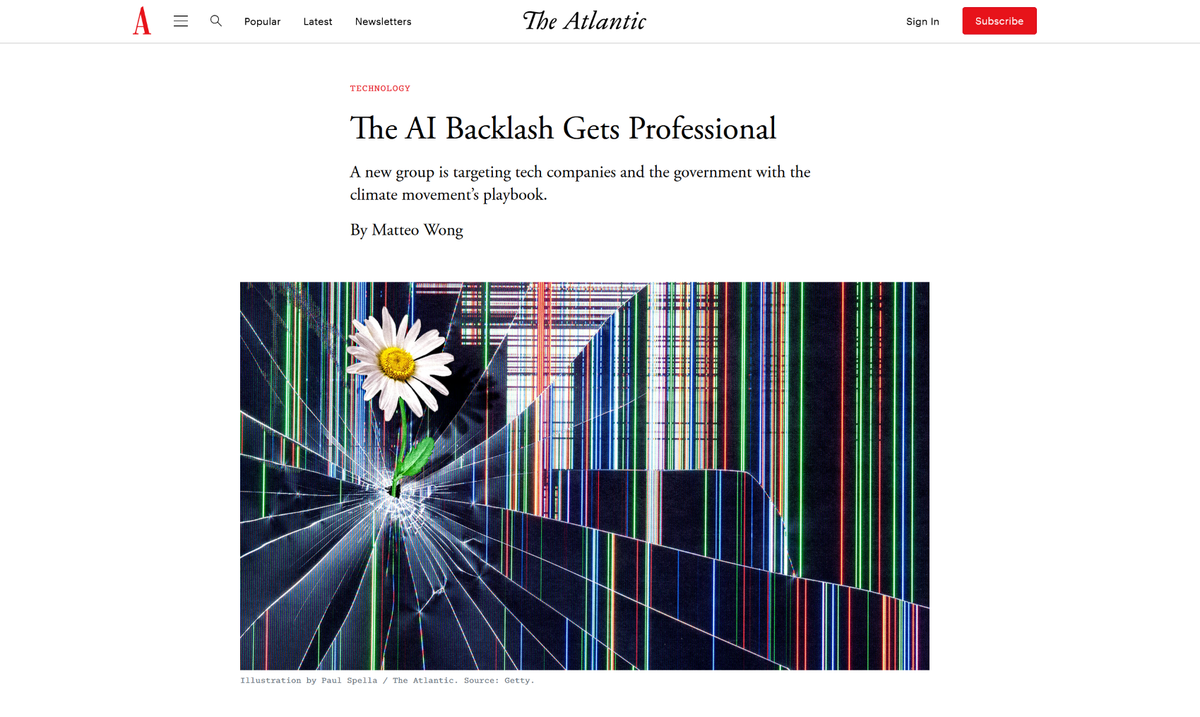
The Atlantic introduces the organization as a movement that will “resist first and develop a coherent program later.”
- The coalition comes first.
- Policy comes after.
Their professional organizers will gather up a fractured public, point its anxiety and anger in “the right direction,” and then let a council of workers, parents, teachers, nurses, faith leaders, labor groups, consumer groups, child-safety organizations, and climate organizations work out the shared federal agenda.
That all sounds very democratic if you stop reading at exactly the right moment.
Don't.
Their launch materials tell a different story.
Irreplaceable has already selected all of the following:
- the political object: Big AI;
- the political subject: everyday Americans;
- the causal story: a handful of wealthy technology executives are imposing a machine future on everyone else;
- the moral ontology: people are irreplaceable by machines;
- the organizing division: Down versus Up;
- the three-part direction: a say, a stake, and a slowdown;
- the electoral timetable: candidate pressure in 2028;
- the legislative timetable: federal action in 2029;
- the legal endpoint: binding rules by January 1, 2030;
- and at least one immediate campaign demand: pause AI and bring it under public control.
The organization has already formed paired nonprofit entities, built a donation pipeline, begun hiring professional campaign staff, building digital and organizing infrastructure, designing a leadership ladder, and recruiting students for a national walkout around a demand selected before the advertised coalition has convened.
The precise details may still be open. The plan is clearly not. They have already written the agenda for the coalition to "discover."
The council is scheduled to arrive after the enemy, constituency, direction, timetable, acceptable outcome range, and first national demand have already been chosen.
That is much more serious than vagueness.
This article is a warning.
This is a campaign claiming that democracy will author an agenda after the campaign has decided what democracy is allowed to discover.
The Fake Controller.
But first, Irreplaceable has identified one real mechanism inside political movements.
- Emotion moves people.
Fear can activate. Anger can activate. Hope can activate. Shared grievance can convert an isolated complaint into public recognition. People who would never read a regulatory filing may show up at a county meeting because something has entered their lives and made quiet endurance impossible. Enough people carrying the same pressure can force institutions to answer what they had learned to ignore.
Modal Path Ethics has already defended that mechanism. The fire alarm contains almost none of the energy that eventually moves through a building. The building already contains bodies, doors, staircases, responders, sprinklers, procedures, memory, and people capable of action. The alarm introduces a difference those systems have already learned to answer.
The alarm activates latent capacity.
Irreplaceable appears to have discovered the alarm and promoted it directly to building superintendent.
That is a fake controller.
A fake controller appears when one real mechanism inside a complex field is mistaken for the mechanism governing the whole field. Something demonstrably changes one variable, so the instrument acquires imaginary jurisdiction over everything required to produce the final state.
Emotional valence is one actuator inside political organization.
It can gather people.
It can intensify attention.
It can make silence expensive.
It cannot tell you what the object is.
It cannot establish causality.
It cannot distinguish a beneficial data center from a destructive one, automation that releases a worker from automation that dispossesses one, frontier capability from ordinary software, corporate concentration from open technical capacity, child protection from adult paternalism, surveillance from accessibility, or an environmental burden from a technological category.
Emotional valence cannot decide who carries which wound.
It cannot determine whether two angry people are angry about the same thing.
And it sure as hell cannot manufacture a political jurisdiction by discovering that both of them are angry.
A fire alarm can get everybody out of bed. It cannot tell them whether the east staircase is blocked, whether the gas line remains open, which wall is load-bearing, whether somebody upstairs needs assistance, or whether the people shouting outside are responding to the same fire.
The published Modal Path Ethics ruling was explicit: standing is not command. An alarm can be completely right about danger and still lack jurisdiction over every repair path generated by that danger.
Panic without routes is force searching for somewhere to go. A correct alarm does not contain the evacuation plan.
Irreplaceable’s founder offers an incredibly simple account of movement formation:
- Five people are a hassle.
- Two hundred are a crowd.
- Thousands become a constituency.
- Millions become a movement.
- “It’s not rocket science.
- It’s arithmetic.”
Irreplaceable has taken the alarm layer of political movements and mistaken it for the total ontology.
- People feel something.
- Therefore there is one political movement.
- The feelings point against powerful firms.
- Therefore there is one constituency.
- The constituency contains many grievances.
- Therefore those grievances belong to one political object.
- Therefore the organizers may speak in the first-person plural for everybody carrying them.
The fake controller generates the appearance of a unified field.
Then the organizers call what they see Us.
They Already Have a Plan.
The honest defense of Irreplaceable could have been very simple:
- Professional organizers have every right to propose a political program, recruit people who support it, and build enough power to enact it.
Except that is not the story Irreplaceable and The Atlantic are currently telling the public.
The public story is that policy has been deferred so a broad coalition can develop it democratically. Irreplaceable is supposedly gathering up people before it knows precisely what those people will want.
This organization’s own materials deeply undercut that presentation.
Its homepage says a small group of wealthy executives is writing the future, that artificial intelligence is coming for jobs, children, and electricity bills, and that “everyday Americans” must take the future back. It declares that the movement will win a say, a stake, and a slowdown. The slowdown is already defined as "preventing systems said to pose existential risk." The enemy is already named Big AI. The political subject is already named everyday Americans. The direction is already named public control.
Its founder’s note goes farther.
Phil Aroneanu says technology executives intend to replace human beings wherever possible while accumulating wealth and power, that industry’s abundance narrative is a cover for the same extraction performed by social media, and that the organization already has demands concerning economic distribution, essential freedoms, and existential risk.
Its five-year plan says:
- 2026: gather anger about data centers, electricity bills, layoffs, and children, then turn it into political power;
- 2027: convene the selected coalition to develop a shared federal agenda;
- 2028: condition political support on endorsement of a say, a stake, and a slowdown;
- 2029: demand federal legislation in the first hundred days of a new administration;
- 2030: put binding regulations on Big AI into law.
That is just plainly not a movement waiting to discover whether these injuries share one political object.
This is a movement that has already selected the political object and scheduled a council to supply the policy layer accordingly.
The hiring materials make this even clearer.
Irreplaceable’s Organizing Director listing says the director will own how people are brought into the movement and what the organization asks of them once they are inside. That person will design recruitment pipelines, onboarding, leadership ladders, training, mobilizations, and the distributed structure. The role is explicitly charged with converting diffuse public anxiety into pressure on candidates and elected officials.
Deep expertise in artificial-intelligence policy is optional. “Willingness to learn” is enough.
The digital role will grow the list, test messages and asks, build automations that convert signups into active supporters, pursue viral reach, and turn the audience toward selected political targets.
Again, deep expertise is optional.
The distributed-organizer campaign is already much more concrete than this public “agenda later” story. Paid organizers are being recruited right now to build October walkouts across more than one hundred college campuses around one fixed demand:
Pause AI and bring it under public control.
The organizers are instructed to recruit leaders, pitch students on running local walkouts, set goals, plan escalations, and help participants understand themselves as part of a national movement.
This is all legitimate campaign work only when presented honestly.
It becomes a very serious democratic problem when the campaign simultaneously claims that the future coalition will author this movement’s agenda.
This organization does not lack an agenda.
It lacks the final policy specification and the representative ratification it wants the coalition to provide.
Those are not the same thing.
Never mistake them.
Who Built this Room?
The obvious question now is the one Irreplaceable’s own launch should have answered directly:
Who in the hell are these people claiming to speak for Us?
The publicly identified founder and executive director is Phil Aroneanu, a highly experienced progressive organizer and strategist.
His own biography says he co-founded 350.org, held leadership roles in a presidential campaign, the American Civil Liberties Union, and Climate United, and helped launch Dayenu.
Dayenu’s public biography adds work on fossil-fuel divestment, Keystone XL, the People’s Climate March, Bernie Sanders’s 2016 New York campaign, and digital organizing at the American Civil Liberties Union.
Jeremy Ornstein, identified by The Atlantic as Irreplaceable’s campaign strategist, came through the Sunrise Movement. His public professional profile also identifies work on the public-affairs team at the Center for AI Safety, developing public leadership to bring artificial intelligence under the control of everyday people.
Wired described him earlier this month as a staffer for Humans First, another effort combining artificial-intelligence risk, data-center politics, and populist organizing.
That genealogy matters. It undercuts their story.
Irreplaceable is not a spontaneous public that discovered itself.
This is an intentional institutional synthesis:
- climate-movement technique,
- progressive electoral infrastructure,
- populist communications,
- and an artificial-intelligence-safety current already committed to slowing or controlling advanced systems.
There is nothing inherently illegitimate about any of that.
The democratic problem with all of this is the pretense that “the political subject arrives first and the professional agenda arrives later.”
Except the professionals are already here. Already committed.
The public-facing website does not currently offer a full staff roster, board list, donor list, governance charter, delegate-selection process, voting rule, conflict procedure, minority-report mechanism, or account of which parts of the three-part program the 2027 coalition may revise.
I could not find a published process explaining exactly who selects the workers, parents, teachers, nurses, faith leaders, or organizations invited into their grand council room.
The legal structure is clearer.
Irreplaceable’s own terms identify an Irreplaceable Education Fund and an Irreplaceable Action Fund. Its job listings describe coordinated work across 501(c)(3) and 501(c)(4) entities. Donations on the launch site go to the Action Fund.
That paired structure is ordinary advocacy architecture, not evidence of corruption.
It does tell us who exists before the "self-discovering" coalition does.
- The legal entities exist.
- The executives exist.
- The brand exists.
- The donor and supporter data systems exist.
- The campaign timetable already exists.
- The staff hierarchy already exists.
- The organizing model is being built by paid professionals.
- The selected coalition arrives next year.
So when this future council reaches a conclusion, which body owns the conclusion?
Who in Irreplaceable decides whether it becomes the federal agenda?
Who in Irreplaceable speaks when the council splits?
Who exactly retains the mailing list, the brand, the legal entities, the money, the candidate relationships, and the capacity to say what “the movement” decided?
Those are not minor administrative details.
Those are the location of power.
Not the council meeting.
Their Council Meets Inside Their Answer.
Now the council of honorable heroes arrives.
Nurses are excellent. Teachers are revelations. Workers, parents, faith leaders, labor organizations, consumer advocates, child-safety organizations, and climate groups all carry real standing in the fields Irreplaceable wants to enter.
Standing still is not command.
A nurse can know more about a clinical deployment than the company selling it to her. That fact does not grant nurses an all-purpose licensing authority over open model weights, grid planning, labor ownership, military autonomy, copyright, cyber offense, biological design, or catastrophic-risk thresholds.
A teacher can identify exactly what a classroom tool does to their students. That does not make the teaching profession a representative sample of everyone affected by computational infrastructure.
A parent has standing over a child’s exposure. That does not answer at all whether a cancer model should be trained, whether a local data center should be approved, or whether advanced research should pause nationally.
Nonspecialists belong in public decisions because they carry consequences, local knowledge, values, and rights.
Their participation is essential.
Their occupational beauty still does not turn a selected council into democracy.
A democratic council needs a disclosed mandate, selection procedure, evidence process, decision rule, relation to existing power, and account of what happens to recommendations after the meeting.
The OECD’s guidelines for public participation emphasize clarity, accountability, transparency, inclusiveness, integrity, information, resources, and evaluation. It does not list the correct ratio of teachers:nurses anywhere. Its work on representative deliberation instead says participants should control their recommendations rather than serving as a decorative input layer for whoever commissioned the process.
Sherry Arnstein’s old warning also remains useful here: consultation without a transfer of power can become tokenism.
People are allowed to speak.
Powerholders retain the authority to define the problem, structure the options, interpret the answer, and decide what happens next.
Irreplaceable has not shown that its 2027 gathering will satisfy even the most basic requirements of a deliberative process.
So, please, ask the questions before anybody lends this campaign the moral authority of their profession.
- Can their council discover that there is no single artificial-intelligence movement?
- Can it conclude that
- data-center siting,
- workplace automation,
- training-data rights,
- child-facing systems,
- surveillance,
- open weights,
- military systems,
- and frontier catastrophic risk
- require separate coalitions?
- Are those nurses permitted to decide that hospital automation is excellent?
- Can the workers decide that replacing enormous categories of labor is desirable if ownership, income, bargaining power, and transition rights change appropriately?
- Can environmental groups decide that one data center is worth its burden while another is not?
- Can child-safety organizations conclude that their field has almost nothing to do with the frontier systems Irreplaceable wants slowed?
- Can participants reject Big AI as the correct political object here?
- Can they replace a say, a stake, and a slowdown with a different architecture they prefer?
- Can they reject Irreplaceable's demand to pause artificial intelligence and bring it under public control?
- Can they vote to dissolve Irreplaceable into five narrower organizations?
If the answer to that last one is yes, then Irreplaceable is building an institution whose successful deliberation may abolish its own jurisdiction. That would be evidence of genuine openness.
If the answer is no, this gathering is not authoring the agenda.
The council is filling in policy inside a conclusion the organizers reached before any of the participants arrived.
That is the critical distinction.
The council is not being asked whether Irreplaceable’s ontology is true. It is being asked to legislate from inside the world it assumes.
Whether intended or not, that structure positions the council as a legitimacy layer.
The campaign professionals retain the organization, legal entities, brand, data, timetable, campaign infrastructure, and power to translate recommendations into political action.
The selected professions just supply the needed sentence:
- The people decided.
Except that sentence has not been earned.
The Strongest Claim the Evidence Supports.
I know the internet loves its dramatic labels.
So, is Irreplaceable a scam?
The public evidence does not establish fraud, secret intent, or a deliberate plan to deceive participants.
This organization is but days old. Its funding sources are not yet publicly legible. Its coalition procedure may still be under development. A future governance document could answer some of these objections plainly.
So, let's keep the claim here very exact.
- Their launch story blatantly understates how much has already been decided.
That is demonstrable.
Also incredibly dangerous.
Irreplaceable says the coalition comes first and the policy comes later.
Except its own materials already define the enemy, affected public, causal story, organizing polarity, governing principles, electoral strategy, legislative schedule, legal endpoint, and first large-scale campaign demand. Its staff are being hired right now to decide how people enter, what they are asked to do after entry, which targets receive the pressure, and how diffuse anxiety becomes movement identity.
The coalition comes after all of this has been decided.
- Best case, these professional organizers have honestly confused consultation with democratic authorship.
- They sincerely believe that gathering favored stakeholder groups next year will somehow democratize a framework they have already installed.
That best case is already bad enough.
That is a very unsafe movement.
- A darker interpretation available is that this "council" supplies representative cover for a professional campaign whose underlying agenda has already been chosen.
- The current evidence cannot prove that intent.
- It can show that this architecture would allow it.
No paranoia is required. Just look at the structure.
The launch process itself produces the appearance of public authorship while leaving agenda-setting power upstream.
I do not need to call this a scam.
The disclosed structure is already incredibly indictable.
MAGA Put the Controller on Stage.
The Atlantic article spreading their “agenda-later” launch story invokes MAGA as proof that outrage can build durable political power.
Let's follow the comparison one step farther.
MAGA can be wildly incoherent at the policy level while remaining coherent enough at the political-object level to reproduce itself.
Its integrating story is printed right on the hat:
- America was great.
- America ceased being sufficiently great.
- Something was taken, corrupted, invaded, or betrayed.
- The political project is restoration.
Donald Trump supplies the personal integration mechanism. Immigration, trade, nationalism, institutional grievance, and “America First” supply recurring anchors. This movement can change positions, absorb contradictions, and reorder priorities while remaining recognizable as MAGA because its controller is always visible.
The comparison here is purely structural. The moral content is separate.
Irreplaceable has created a stranger integration problem.
It already has the organizer-authored vector, but it presents that vector as though the future coalition will somehow coincidentally discover it on their own.
MAGA puts the controller onstage everyday. It prints the planner's story on the hat.
Irreplaceable puts its controller in the agenda, the campaign timetable, the staff roles, the preselected enemy ontology, and the rules of the room it is building.
Then, it invites a council of [PASTE:everyone's favorite jobs] to confirm that its room represents everyone.
At least the hat tells you what it wants.
Learning The Wrong Lesson From Climate.
Irreplaceable’s founders do possess one correct lesson from climate politics:
Evidence does not implement itself.
A scientific report does not contain political power. Concentrated interests can absorb facts, delay, redirect, dilute, and survive indefinitely. Public mobilization can change what governments, firms, institutions, and communities find possible.
Field Instruments: The Alarm gives climate activism full credit for doing that work. The alarm changed attention, collective efficacy, political behavior, legislation, private investment, and the cost of ignoring climate consequence.
The still unresolved problem came after activation.
- The atmosphere can establish that emissions matter.
- It cannot settle land rights.
- Climate science can constrain the acceptable physical trajectory.
- It cannot distribute transition burdens by itself.
- A movement can make decarbonization urgent.
- It cannot build transmission through rhetoric,
- settle labor transition through moral intensity,
- manufacture copper through consensus,
- resolve local consent through a global poll,
- or maintain the grid after everybody has gone home.
- It cannot build transmission through rhetoric,
That was the handoff problem.
The climate movement at least possessed one enormous advantage while confronting it: their physical referent was unusually coherent. Greenhouse-gas accumulation, warming, emissions pathways, and climate hazards gave competing political factions a shared physical structure against which their proposed interventions could be tested.
Artificial intelligence offers no comparable single object.
- A data center is infrastructure.
- A language model is software running on infrastructure.
- A workplace deployment is an institutional decision.
- Training-data extraction is an information-property relation.
- A military autonomous system is a security instrument.
- A medical model enters clinical jurisdiction.
- A chatbot used by a teenager enters another field entirely.
- A frontier training run may implicate catastrophic-risk questions that have incredibly little to do with whether this town should approve a particular warehouse full of GPUs.
The climate movement struggled to translate one relatively coherent physical alarm into a plural program of transition.
Irreplaceable has extracted the following lesson:
Next time, we should try to make the underlying object less coherent and organize the anger first.
That imports the hard part and throws away the useful constraint.
The climate movement’s problem was never that it knew too clearly what carbon was.
Irreplaceable has returned from that grim wreckage holding the alarm and announcing that blueprints were the mistake all along.
Quick Audit: Modal Path Ethics Has Not Earned the “We” Either.
I just looked over the corpus again, and Modal Path Ethics does not represent everyday Americans.
It does not represent all workers or artists or artificial-intelligence developers.
It does not represent the future.
It increasingly looks like nobody elected this website.
Modal Path Ethics can make a smaller claim, though:
- It has an idea.
That already gives fucking Modal Path Ethics stronger standing to participate in this transition than a campaign presenting a professional agenda as the future discovery of a constituency that has not yet assembled.
One bounded proposal Modal Path Ethics has made is community compute.
Field Instruments: Post-Money defines community compute as locally accountable, public-interest capacity serving schools, clinics, libraries, disaster response, legal aid, public planning, accessibility, language access, public records, local artificial-intelligence tools, and regional data stewardship. It may involve a regional cloud, university partnership, library terminals, secure hosted services, edge infrastructure, a local facility, or just no new data center at all.
The local field always decides what belongs there. The boundary is sharp enough to print on your protest sign:
- No local burden without local compute rights.
Now, we can argue.
- If a community absorbs grid demand, water use, land use, heat, infrastructure stress, public subsidy, and political risk from computational infrastructure, what standing and durable capacity should it receive?
- Should publicly supported facilities reserve capacity for local schools, clinics, universities, emergency response, legal access, independent research, libraries, accessibility, and public-interest work?
- Should workers have access to powerful tools outside the employer who may use the systems to discipline or replace them?
- Should universities and public institutions remain dependent on the private firms they may need to audit, regulate, or challenge?
- When should a community say do not build here?
Those are political questions about extant relations in extant places.
They also have boundaries.
Community compute does not claim that every computational resource should become public. The published proposal leaves private markets in place for enterprise workloads, commercial systems, entertainment, games, optional tools, and private projects. It rejects a central public computation machine capable of becoming a civic panopticon and preserves non-digital access to essential services.
Community compute also does not solve every artificial-intelligence problem.
- Frontier catastrophic risk needs its own instrument.
- Workplace automation needs its own.
- Training-data governance needs its own.
- Surveillance needs its own.
- Child-facing systems need their own.
- Military systems absolutely need their own, fast.
The word AI appearing somewhere in every causal chain does not grant one super-organization jurisdiction over all of them.
That is what having a boundary looks like.
- Put the proposition in public.
- Let people inspect it.
- Let affected communities modify it where local contact outruns the general instrument.
- Let opponents identify what it missed.
- Let better proposals defeat it.
- Then see who joins.
The constituency follows the proposition.
The proposition does not emerge from an anger machine already trained to generate the constituency its organizers require.
The Ruling.
- Irreplaceable has every right to propose a movement.
- It has absolutely no right to reverse the order and call the result democracy.
This organization has already chosen an enemy, a public, a moral ontology, a three-part direction, an electoral calendar, a legislative deadline, and an immediate national demand. It is openly hiring professionals to turn diffuse anxiety into lists, leaders, mobilizations, and pressure aimed at leadership selected targets.
The future coalition is then expected to develop the federal agenda entirely inside their existing architecture.
- The council does not precede the movement.
- The movement precedes the council.
These organizers do not wait for the public to identify the political object.
They identify the object, gather up people whose anger can be routed through it, and ask the resulting coalition to speak as We.
That is the fake controller.
Emotional valence can activate a political field. It cannot establish the ontology of the field, define every injury inside it, or confer jurisdiction on the people best positioned to mobilize the feeling.
A movement becomes democratic through the location and transfer of power, not through the humanist beauty of the professions invited to its council.
So Irreplaceable should answer the questions now. Maybe get The Atlantic back on the phone:
- Who selects the coalition?
- What may it revise?
- What may it reject?
- Who controls the evidence?
- Who owns the recommendations?
- Who speaks for a divided council?
- Can the coalition dissolve the movement?
- Can it decide the organizers were wrong?
Until those answers exist, the 2027 council is not evidence that the agenda will be democratic.
That council is a promise that selected people will eventually be invited into a room whose walls have already been built.
Irreplaceable has already decided what its democracy is supposed to discover.
Sources
- Matteo Wong, “The AI Backlash Gets Professional,” The Atlantic, August 28, 2026.
- Irreplaceable, Homepage.
- Irreplaceable, Our Plan.
- Phil Aroneanu, Founder’s Note.
- Irreplaceable, Privacy Policy & Terms of Service.
- Idealist, Irreplaceable Organizing Director listing.
- Idealist, Irreplaceable Senior Digital Manager listing.
- Idealist, Irreplaceable Distributed Organizer Contractor listing.
- OECD, Guidelines for Citizen Participation Processes.
- Modal Path Ethics, Field Instruments: The Alarm.
- Modal Path Ethics, Field Instruments: Post-Money.