The Artists Are Still Here, You Fools
Modal Path Ethics has requested a correction or clarification from BBC News.
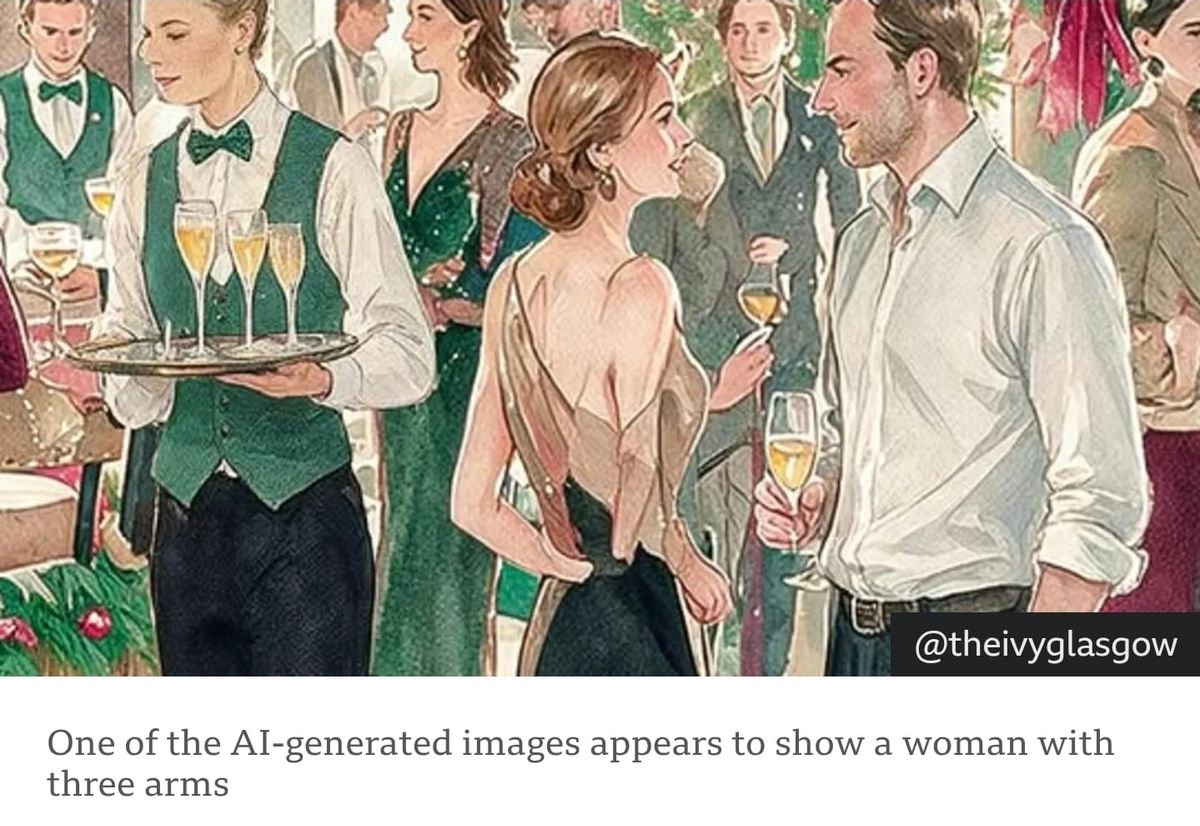
On November 6, 2026, BBC Scotland News published an article about some terrible AI-assisted illustrations posted by The Ivy restaurant in Glasgow.
Get this: One of the pictures apparently showed a woman with three arms.
 Orla MacLeod
The restaurant subsequently edited its Instagram post.
Then Glasgow illustrator Sophy Louise Smith entered the story to explain why the restaurant should have hired a person.
Only there was a slight problem.
The restaurant had hired people.
Several.
And the BBC reported this explicitly.
The Ivy said its in-house designers had produced the images using AI. Its spokesperson further explained that the company's creative team worked with a range of technologies, alongside photographers, videographers, and other specialists.
Real hired humans.
In our own world.
But get this: Smith did not approve of the instrument they used.
So now those people stopped existing.
Poof.
The reasoning reminds one of that incident with Claude and the "simulated" maintainers. The Ivy in-house designers don't exist. The article can continue.
And just like then, the people were always real.
Sophy Louise Smith and the Mysterious Missing Person
Smith told the BBC that a business wealthy enough to commission an illustrator should do so. She argued that the illustrations attempted to reproduce an elaborate style that ought to have been produced by a person.
Okay.
Who was operating the software?
The Ivy had already answered that question: its in-house designers.
Those are people.
Real living human beings with histories and parents and everything.
So what the hell are we talking about?
Smith argued that having "clicked a button or put in a paragraph" did not mean someone had "created something."
And this is where this argument becomes extremely embarrassing.
Because that reductive description could be applied to almost every creative discipline in extance.
- A photographer presses a little button.
- A cinematographer taps "record".
- A digital animator manipulates some controls and pushes render.
- A music producer clicks some notes into a sequencer.
- A writer puts a paragraph in the computer.
- And a digital illustrator moves her stylus across a screen until some software produces an image for her.
Incredible. We have now established that technology has controls.
The absurdity here becomes especially obvious when we look at Smith's own work.
Her public portfolio includes digital paintings, animation, and an illustration explicitly described as painted in Procreate. It also identifies digital mark-making studies and commercially commissioned design work.
So, should we describe Smith's work as "touching a screen with a little plastic stick?"
She selected a digital brush, moved her hand around, and some software changed the pixels on the canvas.
Maybe she pressed undo.
Might have selected a layer.
Did she really create anything with her stick?
Of fucking course she did.
And anyone making that argument against her would be an idiot, wouldn't they?
That argument would erase her artistic judgment, decisions, composition, training, skill, revisions, and all the work involved in making the final image.
Which is exactly what Smith's description does to somebody else's creative process.
She has taken the most superficially recognizable input to a computational tool and presented it as an exhaustive description of their labor.
That is just astoundingly poor understanding of creative practice from somebody employed in a creative discipline.
The software's interface is not a record of everything the artist did.
And this is not even a particularly new problem.
Photographers have been dealing with the shutter-button argument for generations.
Digital illustrators like Smith have encountered similar objections from people who consider their software less authentic than physical media.
Electronic musicians have faced the bold idea that arranging and manipulating synthesized sounds cannot possibly constitute musical creativity.
This line of argument gets especially awkward when it stumbles into Marcel Duchamp.
Over a century ago, Duchamp began presenting manufactured objects as artworks through selection, placement, and conceptual intervention. His readymades became foundational to the development of conceptual art.
The Museum of Modern Art has extensive documentation on all of this.
One does not need to agree that every selected object is an important artwork.
But the claim that authentic art requires physically manufacturing every visible component has been under sustained examination for quite some time.
And then we encounter the actual AI production workflow.
The ChatGPT Window Fantasy.
Smith's account sounds suspiciously like she imagines a designer opening ChatGPT, typing a quick sentence, clicking [Generate], and immediately submitting the result to the client.
And somebody somewhere does exactly that.
They're doing it right now.
Did Ivy's employees do something equally simple?
We do not know.
That's the answer.
Neither Smith nor the BBC have supplied a production breakdown establishing how these particular illustrations were made.
We have a finished product with some obvious defects and the company's statement that its designers made it, using AI.
Yet the critic has supplied an imaginary workflow and decided that it somehow proves the absence of human participation.
The mystery of whether authentic creation occured in the production of this image may never be solved.
Fortunately, other artists have documented for us what these "generative AI workflows" can actually involve.
Professional designer Tomasz Opasinski, with more than twenty years of entertainment advertising experience, published a detailed account of creating promotional art for the Kinoteka Polish Film Festival using Adobe Firefly and Photoshop.
He began with a creative brief.
He then spent about six hours exploring hundreds of generated images.
He selected 77 to show the client.
He developed 17 poster mockups.
He experimented with compositions, aspect ratios, visual treatments, and production formats.
He performed further Photoshop compositing, masking, retouching, color adjustments, and production preparation.
The client ultimately selected two designs.
All of this is documented, with examples of the actual work. See: Adobe Design, How Generative AI Streamlined My Creative Process.
Would Smith describe this professional designer's contribution as "clicking a button"?
Would she tell him he had created nothing?
He has spent decades producing commercial artwork. He has now adopted an additional instrument in the pursuit of such production.
His experience did not vanish when he opened Firefly and clicked a button. And the machine did not make all the decisions that turned the generated material into approved commercial artwork.
There is a very simple question that Smith's caricature cannot answer:
Why does reducing her work to the visible interface erase her authorship unfairly, while reducing another designer's work to the visible interface supposedly reveals the truth?
A prompt can be trivial.
A painting can be trivial.
A photograph can be trivial.
Any of them can involve extensive work. Any can involve almost none.
The existence of a button tells us pretty much nothing at all about the surrounding creative process.
Other than that a button appears involved in it, somehow.
If Smith wants to argue that the particular work performed by The Ivy's designers here does not warrant a particular kind of artistic credit, she first needs to establish what that work actually involved.
And even if her narrowest imaginable account turns out to be materially correct, that employee remains a person.
They never stopped being one.
And that conclusion has apparently become controversial to people who consider themselves "humanists."
Not a good sign.
BONUS: Orla MacLeod and the BBC's Mysterious Missing Designers
Orla MacLeod's BBC headline made the attribution to The Ivy's in-house designers the object of the controversy.
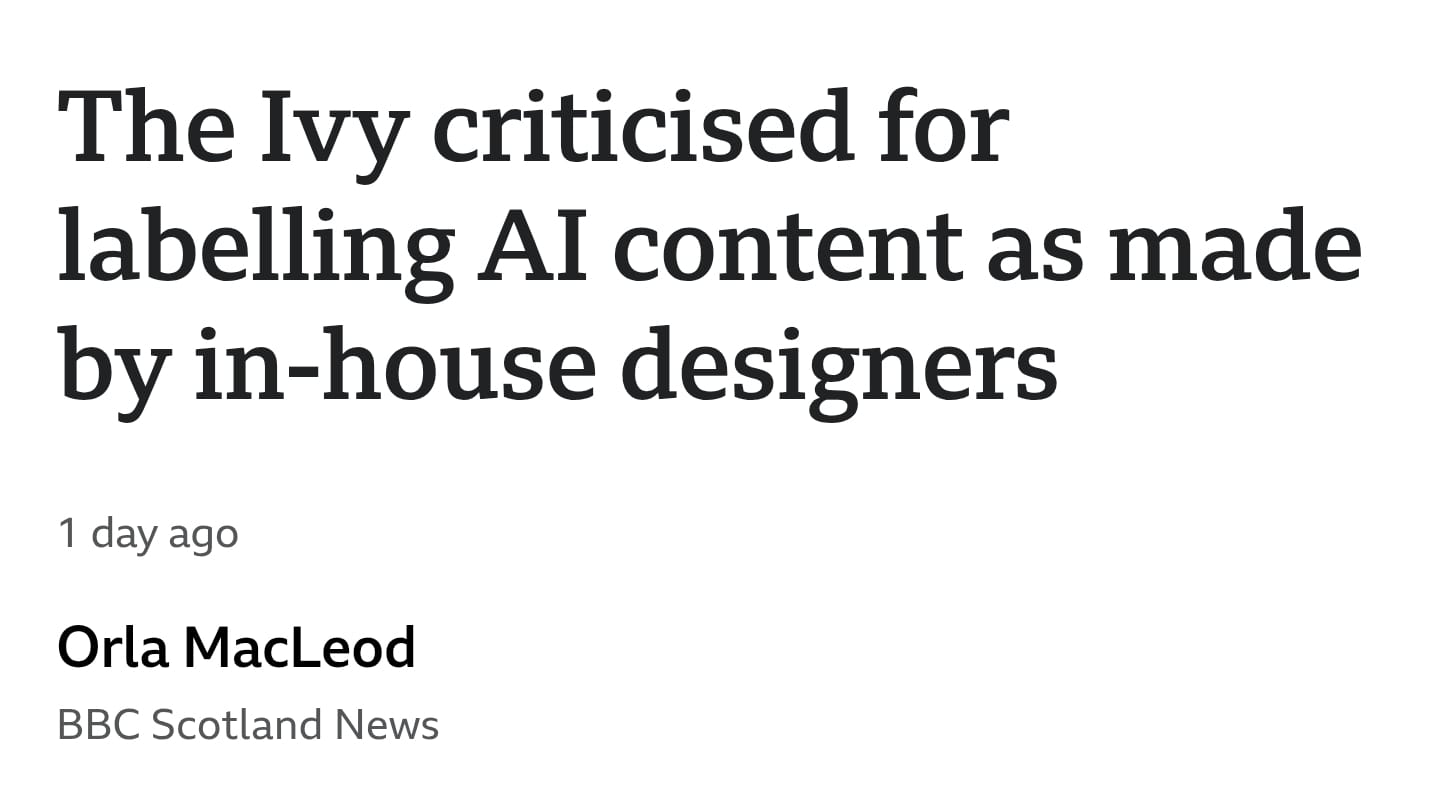
Then, inside the article, MacLeod reported that The Ivy said its in-house designers created the images with AI.
The story also relayed criticism that the restaurant had attempted to pass AI work off as work by a human artist.
There are two different allegations hiding here.
- The first is that the restaurant did not adequately disclose AI assistance.
The original caption reportedly omitted that information. Social media consumers often desire that kind of "How It's Made"-style detail.
- The second is that an in-house design employee using AI cannot be credited as someone who made the work.
That conclusion requires an argument. And it does not establish the absence of human labor even if we accepted a stricter definition of artistic authorship.
The BBC had a straightforward story here about some visual defects and software transparency.
Instead, its headline reproduced the premise that using AI somehow calls the material existence or participation of the credited designers into question.
So Modal Path Ethics has requested a correction or clarification from BBC News.
The people were right there in the article.
CODA: Cole Okiro and the Artists in the Credits
This has all happened before.
And it will all happen again.
When Marvel released Secret Invasion in June 2023, its AI-assisted opening sequence provoked widespread controversy.
Filmmaker Cole Okiro, speaking to The Washington Post, complained that Marvel and Disney possessed more than enough resources to hire an actual artist.
There was just another small problem.
Method Studios had made the sequence.
Method Studios was a visual-effects company employing human creative professionals. The production involved art direction, storyboarding, illustration, animation, compositing, and custom AI tools.
The end credits identified the relevant departments and creative roles.
Method Studios responded publicly that its artists had used AI among their available tools and that incorporating those tools had not replaced artists' jobs on the sequence.
Okiro's remarks preceded that clarification, so he may have been working from incomplete information rather than deliberately excluding known, credited contributors.
But the statement still reveals the fundamental defect in the reasoning.
A film can contain bad graphics. I've seen this before. Its production can be technologically controversial, and an employer can be criticized for commissioning it.
The existence of the artists is a separate factual question.
Pretty easy one to test, too.
Method Studios' employees were not hypothetical replacements for hypothetical artists in an imaginary scenario creating an imaginary different sequence.
They were the human artists who made the real thing that existed.
Okiro himself is a filmmaker. He should be able to appreciate that finished audiovisual work commonly involves multiple interacting tools, departments, and specialists.
A visual effect, for example, does not stop having an animator because it uses simulation.
A shot does not lose its a cinematographer because the image has been digitally transformed.
And a title sequence does not cease having an art department of people behind it because a model was used in its construction.
One can dispute the allocation of creative credit without making the production staff vanish.
Christopher Fryant Would Like Everyone to Know He Has a Job, By the Way.
In November 2025, Coca-Cola released another AI-assisted Christmas advertisement.
The backlash was immediate.
All the familiar objections arrived on the scene: the work was cheap, the company had abandoned artists, the production had surrendered creativity to soulless robots.
And then digital artist Christopher Fryant publicly identified himself as one of the artists who had worked on it.
Fryant had more than two decades of professional digital-art experience. He described the production as substantial work involving people committed to making the finished commercial.
You'll notice he was not describing a hypothetical profession that Coca-Cola could have supported.
He was describing his own actual employment.
The wider campaign reportedly involved about 100 people across Coca-Cola, WPP, Silverside, and Secret Level.
The exact division of tasks, the comparison with earlier production crews, and the effects on demand for conventional film workers are all valid matters for investigation.
Silverside's core AI production team also reportedly generated and refined more than 70,000 video clips. The studio describes collaboration with more than twenty additional professionals across disciplines.
Here, once again, we have real working artists producing actual commercial imagery through an iterative workflow.
There are legitimate concerns here about employment, training-data provenance, and production budgets.
And we should investigate those consequences.
But Fryant is still standing right there.
He's just right over there.
He's been here the entire time.
We can inspect the finished work. We can ask what he contributed and what the machine contributed.
We can even decide that the commercial is just terrible.
But the artist does not evaporate into mist because the critic dislikes the production method.
The Humanists Who Cannot Find the Humans.
Here is the recurring structure.
Someone identifies a profession deserving protection.
An institution employs someone to perform a creative task.
That employee uses an instrument the critic disapproves of.
The critic announces that the institution should have employed a hypothetical human creator.
The actual person who just performed the work is excluded from the description.
Sometimes this is an honest mistake about the production process.
Sometimes this is an argument about what counts as real art.
Sometimes this is just straightforward protection of an existing professional market.
Those are different positions. They deserve different answers.
But not one of them licenses any professional group to determine which other people count as human participants in the world.
There is a serious labor dispute.
Go have at it. Jump right on in.
Generative AI can alter bargaining power, demand for professional specialties, payment structures, training arrangements, and entry-level employment. Businesses may use these instruments to reduce staffing or transfer costs onto workers. Artists may have legitimate grievances with AI companies about the use of their work in training datasets.
Modal Path Ethics has an active interest in pursuing those topics.
It has much less interest in declaring that a graphic designer is an non-person because a digital illustrator wanted their commission instead.
The claims have different objects.
- "This process may destroy valuable creative employment" is a claim about labor transitions.
- "They should have hired a person", when people actually performed the work, is a failure to identify the real people in the real fucking world.
The first deserves serious investigation.
The second needs immediate correction.
Regarding The Confusion:
You Do Not Own Humanity, Professionals.
There is a particularly disgusting feature to this brave new style of "humanism".
It claims to defend the human by installing a professional qualification at the boundary of human recognition.
You must use the approved instrument.
You must exercise the approved kind of control over the output.
You must belong to the socially recognized artistic category.
Otherwise, we will describe your participation as though it never happened.
Very authentic.
- Artistic classification is extremely contestable.
- Labor classification is evidentiary.
Human dignity does not depend on either one. And a person who types one awful prompt and publishes a woman with three arms on Instagram is a human who exists.
This person might be terrible at this job. That is definitely allowed.
Humans have been producing terrible fucking artwork for an extremely long time.
This is not some new emergency for people who understand either humanity or art.
This is among our most firmly established traditions.
Ruling
Sophy Louise Smith can criticize The Ivy's illustrations as much as she pleases.
Cole Okiro can dislike every single one of Marvel's titles, I won't get mad at all.
Consumers can mock and boo Coca-Cola's Christmas advertisements in front of their corporate offices and at all of their lunch meetings.
Professional organizations can fight for employment protections, licensing standards, better compensation, and meaningful training-data consent.
And—no skipping this one—every single human involved in the productions remains a human being.
If you believe a company has eliminated an artistic job, please establish whose job was lost.
If you believe a production concealed its methods, please establish what it has concealed and why it matters.
If you believe an employee has performed insufficient creative work to deserve a particular artistic credit, then argue about the actual work performed.
Bring the truth into the light. I know you can do it.
Step one is to stop substituting bad vibes for an account of who and what exists in the world.
The Ivy says its designers made the illustrations.
Method Studios employed artists who produced the titles.
Christopher Fryant worked on that commercial.
After years of all this incredibly brave and rebellious "defense of human creativity" by waging war against human creators using socially unpopular tools, this apparently needs to spelled out in bold.
Sources.
- Orla MacLeod, BBC Scotland News, November 6, 2026, The Ivy criticised for labelling AI content as made by in-house designers. Original BBC article. Syndicated full text.
- Sophy Louise Smith, official illustration portfolio. Includes the Procreate work The Washing Line, digital paintings, digital mark-making, and animation.
- Tomasz Opasinski, How Generative AI Streamlined My Creative Process, Adobe Design.
- Museum of Modern Art, Marcel Duchamp and the Readymade.
- Herb Scribner, The Washington Post, June 21–22, 2023, Secret Invasion Creeps Out Fans With an AI-Generated Intro Sequence. Includes Cole Okiro's statement and Method Studios' subsequent response.
- Christopher Fryant, professional portfolio and November 5, 2025 statement, identifying his participation in the Coca-Cola commercial.
- Silverside AI, Coca-Cola Holidays 2025 production case study.
- The Wall Street Journal, November 4, 2025, reporting the Coca-Cola campaign's personnel and production workflow. Archived newspaper PDF.