
J. L. Mackie Tries to Murder Modal Path Ethics With a Freaking Sword (Or, The Queerness of Harm)
Post-Game: moral error theory, objective prescription, and the wound in my freaking hand that refuses to disappear
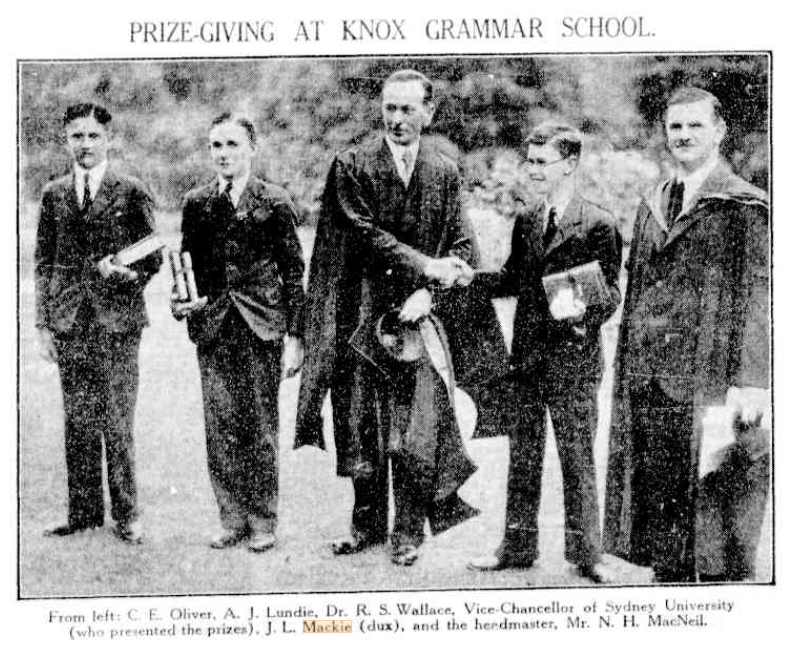
J. L. Mackie heard I was crossing the normative bridge and he just showed up at my house.
He has a freaking sword.
This is very concerning.
Mackie starts after the concessions. He can grant that actual bearers have structured continuations. He can grant that some transitions foreclose paths, destroy enabling structures, thicken resistance, and leave repair harder than it was before.
He can even grant that all of those facts are objective.
Then he points at the Continuance Principle with his sword.
What kind of thing is that?
No Objective Values.
Mackie opens Ethics: Inventing Right and Wrong with one of the cleaner declarations of war in twentieth-century philosophy:
“There are no objective values.”
He does not mean that nobody values anything. He does not need moral language to be meaningless. His error theory targets the claim that ordinary moral judgment successfully refers to objective moral properties of the sort it appears to invoke.
The famous pressure comes from the argument from queerness.
If objective moral values existed in the robust form Mackie attacks, they would be strange. They would seem to contain some kind of objective prescription: something like to-be-pursuedness, not-to-be-doneness, or a demand that holds independently of the agent’s contingent desires and local institutions.
Mass simply does not tell you what to do.
Charge does not demand allegiance.
A tree does not become motivationally authoritative because you correctly identify it as an oak.
Mackie thinks objective morality has often been asked to do something far stranger.
So he shows up at my house with a freaking sword and asks Modal Path Ethics whether its harm relation is one more occult property wearing technical clothes.
The Sword Does Something.
Suppose Mackie drives a freaking sword through my hand.
Very rude, right?
Before the strike, my hand participates in an organized continuation.
My bones remain intact. Tendons connect muscle to motion. Blood vessels maintain tissue. Nerves carry signals. My hand can grip, write, touch, lift, stabilize, protect, point, open a door, pick up another sword, and participate in thousands of larger continuations belonging to the person whose hand it is.
Then:
SWORD.
Some continuations disappear.
Some become harder.
Some become dependent upon surgery I cannot afford.
Some survive through redundancy.
Some can be recovered.
Some may never return, Mackie.
None of this waits for agreement.
The tendon does not check local moral convention before separating.
The nerve does not ask whether Mackie sincerely endorses error theory.
The wound does not become shallower because my attacker has a sophisticated metaethical position.
Something happened to an actual bearer.
The current Harm as Contraction thesis states the claim more carefully than the old book did:
An actual transition harms an extant locus insofar as it nontrivially degrades a structurally significant continuation or enabling structure genuinely reachable from that locus.
That sentence does not decide permission, liability, blame, punishment, political legitimacy, or the overall verdict on the transition.
It identifies a harm-token.
Then the Continuance Principle supplies the normative bridge:
A nontrivial degradation of a structurally significant part of an extant locus’s own organized, reachable continuation constitutes pro tanto harm to that locus.
Mackie points at that second sentence.
Where Is the Queer Thing?
If Modal Path Ethics answers Mackie by adding another object to the scene, the theory deserves what happens next.
- Here is the damaged hand.
- Here are the severed relations.
- Here are the lost continuations.
- Here is the repair burden.
And somewhere above them floats one additional thing:
WRONGNESS.
That is exactly the kind of dumb picture Mackie wants us to defend.
Modal Path Ethics does not need the glowing moral particle.
Its claim is constitutive.
Qualifying degradation of organized continuability is proposed as harm to the bearer.
So we do not need two universes that are identical in every structural respect while one contains an additional molecule of BAD and the other does not.
If the bearer, continuation structure, transition, degradation, and relevant relations are the same, the proposed harm relation is the same.
This does not defeat Mackie. It narrows him.
Mackie can still say that the constitutive claim itself has no objective normative authority. He can deny that damage to organized continuability has the significance Modal Path Ethics assigns to it.
That is a real disagreement.
What he cannot do is win by demanding that we produce a second supernatural object after the structural facts have already been specified.
The burden is now cleaner:
Why should this bearer-relative structural relation count as objectively harmful at all?
The Psychopath Is Still Allowed In.
Mackie has another way to apply pressure.
Imagine an agent who understands the field perfectly.
The agent knows my hand will be damaged.
The agent knows which continuations will disappear.
The agent knows the injury is avoidable.
The agent knows my recovery will require pain, time, money, assistance, and risk.
The agent knows another path exists.
The agent says:
Cool.
Then stabs my freaking hand anyway.
Did moral reality vanish?
No.
What vanished was the hope that correct perception automatically manufactures motivation.
Modal Path Ethics does not need that hope.
My attacker can perceive the contraction and remain unmoved. The tyrant can understand the population being destroyed. An artificial system can represent every harm-token in the field and optimize through them anyway.
Failure to care does not restore the continuation.
A cheap answer to Mackie would confuse objective normativity with psychological compulsion. Mackie’s stronger challenge is about objective reasons or demands whose authority does not depend upon the agent’s contingent desires.
That challenge survives.
So the question is not whether the sword wound hypnotizes my attacker into stopping.
The question is why the attacker has any objective reason not to inflict it.
Modal Path Ethics cannot answer that by pointing to motivation. Its hand has just been stabbed.
It has to answer through normative theory.
Mackie Finds the Bridge.
This is where the current Harm as Contraction paper is stronger than the old presentation. It says the dangerous sentence out loud:
Descriptive structure cannot supply normativity on its own.
There is no attempt to derive the Continuance Principle from value-neutral modal geometry.
The bridge is a normative commitment.
The paper defends it abductively: by explanatory unification, continuity across limiting cases, disciplined exclusions, fit with paradigm harms, and the work the principle does where familiar subject-centered vocabularies become incomplete.
That is exactly where Mackie should attack.
- Why organized continuability?
- Why this primitive?
- Why think injury, coercion, deprivation, ecological destruction, cultural erasure, institutional collapse, and other paradigm harms share something morally constitutive in the degradation of a bearer’s continuation?
Modal Path Ethics answers by putting the proposal under pressure.
If the principle explains those cases together, detects damage before terminal loss, distinguishes path specification from generator damage, preserves justified harms as harms, identifies repair without erasing history, and continues to work where welfare vocabulary falls away, that is evidence for the account.
It is not a proof from physics. There is no free metaethical lunch.
- A welfare account has to defend why welfare has the significance it assigns to it.
- A capability account has to defend why genuine opportunity matters.
- Modal Path Ethics has to defend why organized continuability matters.
Mackie has located the place where philosophy still has to happen.
He has not yet shown that the place is metaphysically impossible.
Mackie Finds the Loose Armor.
Then Mackie notices weighting.
Fuck.
The current Harm paper notices it too.
Weighting can become a trapdoor. An analyst can call a preferred continuation central, an opposed continuation destructive, choose a flattering grain, select a convenient baseline, invent a substitute, erase a support relation, or aggregate local damage until it disappears.
At that point, Modal Path Ethics becomes a very sophisticated machine for returning the answer entered by the operator.
So the current paper no longer treats weighting as a fixed six-item scorecard inherited from the original book.
Structural significance is constrained by features including enabling centrality, irreversibility, breadth, depth, resistance, distribution, and destructive potential.
These are diagnostic dimensions.
They do not add up to one Moral Number.
They are not seven commandments.
They expose different ways organized continuability can be damaged, burdened, propagated, protected, or destroyed.
And the safeguard is procedural exposure.
- State the locus.
- State the grain.
- State the baseline.
- State the relevant dimensions.
- State the path classes.
- Test functional redundancy.
- Use dominance only where a comparison really supports it.
- Leave mixed cases mixed when no defensible ordering exists.
- Keep burdens attached to the loci carrying them.
- Make comparison rules survive role reversal.
- Keep the representation answerable to affected persons, relevant expertise, and evidence from the field.
The profile is an instrument.
It is not the locus.
This still does not make weighting invulnerable.
Why should those dimensions be morally relevant?
Because the Continuance Principle says organized continuability has normative significance, and these dimensions expose structurally different ways that continuability can be damaged.
Mackie can reject the bridge.
He can argue that the whole account is a disciplined projection of our concerns onto causal structure.
That is the cut in my hand.
Leave the sword there.
A moral theory is stronger when it shows where it can still bleed.
Also I think the doctor is supposed to take it out.
The Magic Moral Eyeball.
Mackie’s second queerness worry follows from the first.
If objective values are strange extra properties, how do we detect them?
Do philosophers grow another organ? Is there a moral retina?
Does the pineal gland finally get to do something?
The epistemological problem is serious if the object of knowledge has already been made metaphysically exotic.
Modal Path Ethics again refuses the gift.
- To investigate the stabbed hand,
- look at the hand.
- To investigate the damaged wetland,
- study the wetland.
- To investigate an appeals process that remains formally open while access becomes unusable,
- trace the process.
- To investigate an institution that still exists while its correction routes disappear,
- find the routes.
- To investigate a species whose adults survive while reproduction collapses,
- study the reproductive structure.
Field intelligence can fail.
The locus can be drawn badly. The baseline can be wrong. The substitute can be imaginary. The relevant support can be omitted.
That is why the representation stays revisable.
The current Harm paper puts the point cleanly:
The profile is an instrument, not the locus.
The structural evidence is gathered through ordinary empirical and historical inquiry.
The normative bridge is not read off an MRI. It is defended philosophically through coherence, cases, explanatory reach, counterexamples, comparison with rival primitives, and reflective equilibrium.
No wizard eye is required.
Everybody Disagrees.
Mackie has one more major weapon.
People disagree about morality.
A lot.
Across societies. Across centuries.
Inside societies. Inside families.
Inside philosophy departments, where disagreement has occasionally become the principal product supporting entire households.
His argument from relativity is stronger than the schoolyard version:
People disagree, therefore there is no truth.
Mackie’s explanatory thought is that many moral codes are better explained by participation in different ways of life than by different populations imperfectly detecting the same stock of objective values.
Modal Path Ethics should concede a huge amount here.
Of course moral codes grow out of ways of life.
That is why Secondary Morals exist.
Honor. Purity. Property rules. Punishment. Status. Sexual convention. Professional norms. Religious obligation. Blame. Desert.
These are historically generated instruments.
Some track real damage well.
Some track it very poorly.
Some become sovereign and start manufacturing damage themselves.
Mackie can explain enormous regions of ordinary moral disagreement through culture, interest, coordination, institution, history, power, and inherited form.
The error begins when the genealogy of the instrument is treated as the genealogy of everything the instrument sometimes detects.
- Different cultures can disagree about the meaning of losing a hand.
- The hand remains injured.
- Different governments can narrate a poisoned river differently.
- The ecology does not acquire a new chemical composition when the press conference begins.
- Different institutions can disagree about whether a correction path should exist.
- Closing the path still changes the continuation structure.
Disagreement creates an epistemic problem.
It is evidence about how unreliable human moral judgment can become.
It does not automatically erase every candidate for stance-independent harm.
What Mackie Actually Killed.
We should count the bodies on my kitchen floor.
- Mackie kills the idea that moral facts need magical motivational force.
- Nice.
- He kills any attempt to hide the normative bridge inside structural description.
- Hume helped.
- He kills the fantasy that weighting can be protected by giving it enough technical vocabulary.
- Good.
- He makes it much harder to treat inherited moral convention as transparent access to reality.
- Cool.
- He may kill large regions of ordinary moral discourse if those regions really do depend on objective prescriptions that cannot be defended.
Modal Path Ethics can survive that too. The framework does not require every moral sentence humans have ever uttered to be true.
It requires a narrower claim.
- There are actual bearers.
- They have organized continuations.
- Actual transitions can alter those continuations.
- Some transitions degrade structurally significant continuation through foreclosure, resistance thickening, or damage to continuation-generating structure.
- That damage can be identified before the bearer disappears.
And Modal Path Ethics makes one exposed normative commitment:
Qualifying damage to organized continuability constitutes pro tanto harm to the bearer.
That is where the realism lives.
No cosmic instruction.
No automatic motivation.
No glowing particle.
No majority vote.
No master score.
A claim about what can objectively happen to something, joined openly to a claim about the normative significance of that damage.
Now Pull the Sword Out, Please, It Hurts So Bad.
There is still blood on my floor.
Mackie found a real vulnerability.
The Continuance Principle is not a theorem obtained from value-free premises.
The weighting dimensions do not arrive from physics with MORAL printed across the packaging.
Reflective equilibrium can inherit human distortion.
Abduction can prefer the wrong explanation.
The framework can misidentify the bearer.
The framework can choose the wrong grain.
The framework can fail.
It is allowed to fail.
Mackie therefore prevents Modal Path Ethics from announcing that moral realism has been mathematically proven. The jerk.
He forces a more exact position.
Modal Path Ethics proposes a structural moral realism in which at least some moral facts concern stance-independent damage to the organized continuability of extant loci.
The theory of harm identifies the candidate structure.
The Continuance Principle states the normative bridge.
Weighting constrains structural significance without pretending to produce a universal scalar.
Care concerns the agent’s relation to the harm.
Responsibility concerns causal and agential history.
Right action requires further argument.
The overall verdict comes later.
That separation is why the indifferent attacker does not destroy the theory.
It is why disagreement does not destroy the theory.
It is why this freaking sword does not need to glow.
Mackie came across the bridge looking for not-to-be-doneness written into the steel.
He found steel.
He found flesh.
He found a transition.
He found continuations that existed before the strike and no longer existed afterward.
Then he found an ethical theory willing to point directly at its own normative bridge and say:
There.
That is the part you have to beat.
Reject the Continuance Principle.
Do it.
Coward.
Replace it.
Bring the rival account.
Explain the bodies better.
Mackie just tried to murder Modal Path Ethics with a freaking sword.
He did manage to stab it.
The sword went directly through the normative bridge.
The bridge is still there.
The wound is real.
And that was actually the entire fucking argument.


Comments ()