Influencutors: Ridley Scott Is an Influencer
Modal Path Ethics responds to an unexpected self-referral.
Influencutors is a Modal Path Ethics engagement series for influential public figures whose repeated judgments reveal a stable model of society worth taking seriously on its own terms.
Qualification is intentionally narrow:
- The pattern must recur across substantially different cases. One interesting opinion does not count.
- The recurring model must explain something real. Being wrong loudly is already covered elsewhere on the internet.
- The model must have identifiable limits: conditions under which the instrument loses contact, compresses the field, or exceeds its jurisdiction.
- The audit concerns the person's recurring ontology, social model, or reasoning instrument. It is not a review of their content format, audience, politics, personality, or entire moral character.
- The strongest cases and the failure cases both stay in the room.
Influencutors asks what model of society keeps producing all these goddamn takes.
Ridley Scott has announced that he is an influencer, putting himself in immediate danger.
Dark Horizons reports that Scott, now 88 and promoting The Dog Stars, no longer describes himself as a filmmaker.
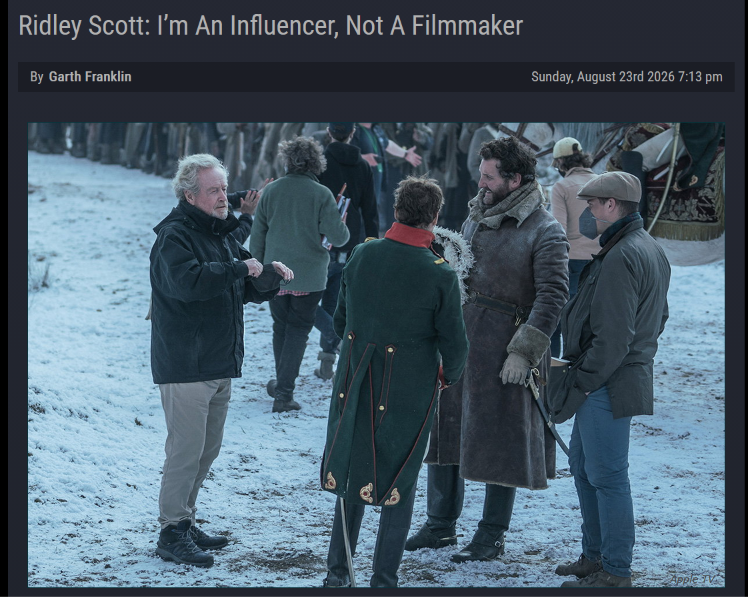
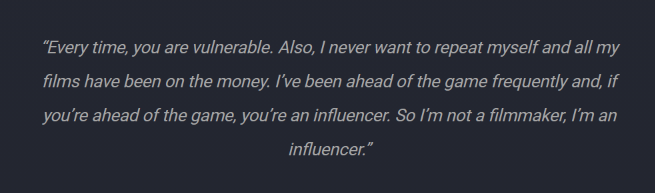
Asked about the through line across his work, he said that every film leaves him vulnerable, that he never wants to repeat himself, that he has frequently been ahead of the game, and that being ahead of the game makes someone an influencer.
Therefore, Ridley Scott is an influencer.
This would appear to settle it. Welcome to Influencutors.
Let us now determine what kind of social ontology has caused the director of Alien, Blade Runner, Thelma & Louise, Gladiator, Black Hawk Down, and The Martian to identify with the same professional category as someone selling powdered greens through an Instagram Story.
Oh wait. There is not one.
He just means that his films have influenced other filmmakers.
Dark Horizons says this directly in the second paragraph.
I just read it.
Alright.
Shit. Yeah.
That makes sense.
Yeah.
Scott means influence.
Just like, influencer.
Well, okay, more specifically, though, he says that being ahead of the game makes someone an influencer.
That is a stranger definition.
This is still something.
I can make this work.
Ahead of What?
The ordinary contemporary definition of an influencer begins with possession of an audience.
- Someone has followers.
- Those followers provide attention.
The influencer can then redirect some portion of that attention toward a product, idea, style, person, destination, controversy, political claim, brand, diet, piece of furniture, or increasingly questionable financial instrument.
Influence appears to move outward from an already established position.
Scott's definition starts somewhere else.
- You are ahead.
- Then the field follows.
Under that account, influence does not begin with audience possession.
It instead begins with temporal position.
- Someone moves before the movement becomes ordinary.
- Later actors inherit a field in which the earlier move is now available.
This is different.
A person could therefore be influential before anyone knows they are influential.
Actually, that needs correction.
They could perform the move that later becomes influential before anyone knows.
Influence itself would only become visible afterward.
If nobody follows, nothing has been influenced.
Someone can be forty years ahead of the game and remain forty years ahead of the game until death, at which point the game just continues elsewhere and everybody involved has enjoyed a very independent career.
So being ahead cannot be sufficient.
Scott's definition requires a second transition that he leaves unstated in this interview:
- Someone moves into a region the existing field has not normalized.
- Later participants begin using, adapting, responding to, or building from that move.
Only then does the earlier action acquire its status as influence.
Influence is therefore partly retrospective.
The later field tells us something about the earlier act that the earlier act could not establish by itself.
This is already a fairly strong ontology for a sentence I initially thought meant Ridley Scott had moved to TikTok.
Every Time, You Are Vulnerable.
Scott begins the quote somewhere even stranger.
“Every time, you are vulnerable.”
Then:
- He does not want to repeat himself.
Then:
- He has been ahead of the game.
Then:
- Influencer.
This sequence matters.
Vulnerability comes before influence.
That makes perfect sense if the move happens before the field has validated the move. A path that everyone already recognizes as successful is comparatively easy to defend.
The genre has a market. The format has precedent. The audience knows what the fuck it is looking at. Executives know how to describe it. Marketing knows which shelf to put it on. Reviewers possess comparison objects.
The person making the thing can point backward and say:
See? This works.
The person who is genuinely ahead cannot.
They are acting without the later field that will eventually make the move look obvious.
If it works. That is the vulnerability.
The move has to become extant before it can acquire the evidence of its own later influence.
There is no certificate available in advance saying:
- CONGRATULATIONS.
- THIS ONE WILL BECOME BLADE RUNNER.
There is only the film.
Then, reality gets to have a turn.
This is a useful distinction because we often retell innovation backward. Once something has become influential, the path toward it starts looking cleaner than it was.
The later field supplies proof that the earlier field did not contain.
A style becomes a style after enough people can recognize it as one.
A genre boundary becomes historically important after later works arrange themselves around it.
An apparently strange decision becomes visionary after the future turns it into precedent.
That does not mean the creator had privileged access to the future. It means the future changed the standing of the earlier act.
Influence is a relation across time.
Scott's phrase “ahead of the game” compresses the two ends of that relation into one big boast.
Reasonable.
This is Ridley Scott.
The Influencer Cannot Repeat Himself.
Scott also says he never wants to repeat himself.
At first, this sounds like a conventional commitment to novelty.
- Keep making new things.
- Avoid repetition.
- Stay ahead.
Sure.
But then, three sentences later he lists the projects he still wants to make.
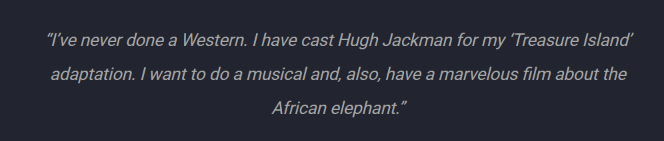
- A Western.
- Treasure Island.
- A musical.
- A film about an African elephant.
And the Western is not a newly discovered art form.
Robert Louis Stevenson published Treasure Island back in 1883.
Musicals have been detected in the field previously.
The elephant predates all cinema.
So Scott's refusal to repeat therefore cannot mean that a worthy future contains only unprecedented objects.
This is good. That would be an exhausting ontology.
He means something closer to a refusal to remain inside the route his own prior success has already validated.
Scott has made science fiction, horror, crime, historical epics, war films, dramas, thrillers, biographical pictures, and whatever exact administrative category they invented to contain House of Gucci.
A Western can still be new on his path.
The form does not have to be new to reality.
The transition has to avoid becoming automatic.
This is a much better account of novelty.
The important distinction is between:
- a new object
and
- a new continuation.
A person can encounter an old form through a path that has not yet belonged to their own work.
An institution can reopen an old instrument under new conditions. A future can remain genuinely open without requiring civilization to continuously manufacture unprecedented nouns.
There are still Westerns available.
There are also apparently elephants available.
The possibility space is doing just fine.
Ridley Scott Says There Is a Murdered Girl in the Woods.
Scott then explains what is bothering him about the current production field.
His description is concise.

Everything now, he says, seems to be about a murdered girl in the woods, an FBI agent who is better than everyone else, or a superhero.
Then:
- “There have to be other stories to tell.”
Yeah. There are.
We have already discussed the elephant.
The interesting part is that Scott's complaint is not really about any of these forms.
- A murdered-girl thriller can be excellent.
- An FBI procedural can be excellent.
- Superhero movies have occasionally survived contact with Modal Path Ethics.
His complaint is repetition at the level of the production field.
Certain paths have become unusually easy to recognize.
An executive knows what the murdered-girl project is.
The market knows what the superhero project is.
The audience has a vocabulary for this. Casting operates inside familiar expectations. Distribution knows where that goes. Comparable projects exist. Risk can be estimated against things that have already happened.
The path has infrastructure.
And once a field becomes good at reproducing a form, the successful reproduction becomes evidence that the form should be reproduced again.
Then another successful reproduction arrives.
Now there is even more evidence.
Expertise accumulates around the route. Budgets learn the route. Careers learn the route. Audiences learn the route.
Eventually, a statement like:
This is what people want.
can become difficult to separate from:
This is what our production system has become extremely good at making reachable.
These are related claims. They are not identical.
- Demand affects production.
- Production affects what becomes available to demand.
- Expectation feeds both.
A field can therefore narrow without anyone deciding that other possibilities should disappear.
The frequently selected path simply gets easier.
The less frequently selected paths become harder to finance, harder to articulate, harder to compare, harder to risk, and eventually harder to imagine as normal candidates for the next move.
Nobody bans anyone's elephant.
The elephant just never gets a meeting.
Scott's complaint is therefore more structural than “movies are repetitive.”
The repeatedly realized path acquires infrastructure. Infrastructure increases its future reachability. Reachability produces further realization. The movie industry starts mistaking the paths it has thickened for the boundaries of the field itself.
“There have to be other stories to tell” is a fairly basic protest against that closure.
There are other continuations.
The present production configuration does not exhaust the future of cinema.
Influence, Then, Is Not Originality.
This also helps with Scott's influencer definition.
An influencer, under his account, does not need to invent the component parts.
- Alien did not invent space.
- Blade Runner did not invent cities, detectives, robots, rain, or even Harrison Ford.
- Gladiator arrived several thousand years too late to claim Rome as its own.
Influence comes through arrangement. A work puts available things into a configuration that later works can encounter.
That new configuration enters the field.
Later participants can borrow it, reject it, parody it, extend it, misunderstand it, improve it, reproduce its surface while losing the underlying reason it worked, or spend forty years insisting they have never seen it despite the production designer having obviously seen it.
The influential object becomes part of what later creators have to move around. That is enough.
Influence therefore does not require ownership of the downstream field.
Scott cannot decide what Blade Runner will eventually do to science-fiction aesthetics once the film leaves him. The later field performs that part.
This is useful because ordinary talk about influence often centers the influencer too much.
We imagine an origin-locus sending causal force outward.
Scott's definition, when pushed slightly harder than Scott himself or really anyone needed to push it, makes influence relational.
The earlier work requires the later receiver.
No uptake, no influence.
No later rearrangement, no evidence that the earlier move acquired that status.
Influence exists between them.
This also means an influencer cannot fully know what they influenced.
Some downstream effects will be obvious.
Some will move through people who influenced other people who never encountered the original work.
Some will be formal.
Some visual. Some technical.
Some mistakes.
Some will consist entirely of somebody seeing what Scott did and spending the next decade determined to never do that with their elephant.
Negative influence still counts.
A path can reorganize the field by becoming the thing later agents route around.
This is becoming a somewhat demanding account of an interview in which Ridley Scott also announces a possible elephant movie.
“On the Money.”
There is another phrase in the quote. I'm not done.
Scott says all his films have been “on the money.”
This right here is an admirably efficient way to solve the problem of criticism.
Still, it introduces an interesting question.
Where is the money?
If influence is retrospective, what exactly counts as success?
- Commercial success?
- Critical success?
- Later imitation?
- Technical influence?
- Genre influence?
- Survival?
A movie can fail in its initial market and later become enormously influential.
A movie can succeed commercially and leave almost no durable trace except several executives learning the wrong lesson from the gross.
A work can be culturally central without creating a clean line of imitation.
It can influence lighting.
Architecture.
Costumes.
Editing.
Production design.
The image of the future in someone's mind.
The acceptable amount of fog in another.
The number of industrial fans we think are required in a spaceship.
So this means "on the money" and "ahead of the game" can pull in different temporal directions.
- Being on the money suggests hitting the present target.
- Being ahead suggests making a move whose value the current field has not fully incorporated.
A creator trying to do both now has an interesting problem:
The work has to make enough contact with the present to survive; it also has to preserve enough divergence to change something beyond the present.
- Too familiar and nothing moves.
- Too distant and nothing receives it.
Influence therefore lives somewhere between repetition and isolation.
The new move still needs a bridge.
This is the same reason an entirely private aesthetic breakthrough does not transform an art form. A path can exist without becoming available to others. Influence requires transmission.
Scott is describing the special case where a creator tries to move far enough ahead to open something while remaining close enough to the existing field that the opening can eventually be used.
That is probably what “ahead of the game” means when it works.
- Not departure from the game.
- A move the game can later learn.
Which Instantly Raises a Problem With the Game.
Scott keeps saying the game.
Ahead of the game.
Hey. What game?
Cinema does not possess one objective function.
- Box office cannot be it.
- Awards won't work.
- Technical innovation is out.
- Critical reputation was never on the slate.
- Influence cannot be the winner without becoming circular.
There is no final cinematic scoreboard where Thelma & Louise has 8,440 points and the FBI agent investigating the murdered girl has 7,983.
So the “game” must therefore refer to something looser. The moving frontier of what the medium and its institutions currently know how to recognize, produce, finance, distribute, and imagine.
Being ahead of that game means occupying a relation to the current field before the relation becomes institutionally ordinary.
Then influence occurs when the field moves.
This is why the term works better for Scott than it appeared to in the headline that led to this horrible mistake.
- The internet influencer usually begins with a present audience.
- Scott's influencer begins with a future audience that does not yet know it is an audience.
The later field catches up to the move. At that point, the earlier work becomes one of the things from which the later field is now departing.
Influence changes the starting position.
That is probably the strongest version. A successful influence does not make everyone copy you forever. It changes what everyone else gets to start from.
Then, they should move again.
Which returns us to Scott refusing repetition.
If his work genuinely influences the field, repeating himself would eventually mean occupying a position the field has already incorporated.
The successful influencer therefore destroys the condition under which their original move counted as ahead.
Influence eats its own novelty. This is a good reason to keep moving.
Still Not Done: The Western Is Back.
Now, the project list starts looking less random.
- Scott says he has never made a Western.
- He wants to make one.
- He has cast Hugh Jackman in a Treasure Island adaptation.
- He wants a musical.
- He has that elephant to look forward to.
These are not predictions about the future of cinema. They are available continuations that his own path has not yet exhausted.
This matters (really) because the easiest response to a repetitive field is usually another novelty machine.
- The industry is making too many familiar things.
- Therefore find the newest possible thing.
Scott does not seem interested in that rule.
He wants an extremely old American film genre, a nineteenth-century adventure novel, one of cinema's oldest integrated forms of popular spectacle, and a cool animal with a long nose.
The future does not have to be unprecedented. It just has to remain capable of continuation outside the currently dominant groove.
This is a much healthier response to repetition. A field with real slack can revisit old forms because the old form does not dictate the next transition.
The Western is not one movie. The musical is not one movie.
Treasure Island has survived enough adaptations to demonstrate a disturbing degree of remaining possibility.
And no two elephants are alike.
The old form can still open.
The problem with repetition is not the recurrence itself, it is when recurrence becomes the easiest available substitute for perception.
- Make another one
- because the last one worked.
- Use the same narrative architecture
- because everyone already knows where the doors go.
- Protect the familiar path
- until alternatives become expensive enough to look irresponsible.
Scott's bucket list pushes the other way.
There are still unrealized relations between this filmmaker and these forms. That is enough reason to enter them.
Scott's Elephant.
We have precious little information about this elephant movie.
Scott says it is marvelous.
This is the complete available critical apparatus.
Still, its presence in the list is revealing.
- Western.
- Treasure Island.
- Musical.
- African elephant.
This list has no coherent market category.
It reads like a person selecting from a possibility space rather than executing a brand strategy.
There is a distinction here to be made between career continuation and career reproduction.
Career reproduction asks:
- What does a Ridley Scott movie look like, and how can Ridley Scott make another one of those?
Career continuation asks:
- What can Ridley Scott still make from here?
Those are very different questions. The second retains so much more room.
This is why the anti-repetition statement fits the vulnerability statement.
A creator who reproduces the established self has a great deal of evidence available.
The audience recognizes the product. The institution recognizes the product. The creator recognizes the product.
The new work can be evaluated against an already stabilized identity.
A creator who keeps treating their own career as an open field has less protection. The next work may fit badly. It may fail. It may create no downstream path at all.
The elephant may just be terrible.
We have insufficient elephant data to know.
But the decision to preserve access to the elephant is already structurally different from deciding that Ridley Scott's future should be generated by extrapolating his most legible previous successes.
The creator remains larger than the brand model. The elephant stays in the conversation. That is a useful thing to preserve.
So What Is an Influencer?
Apparently, this:
An influencer, under the definition we have now extracted from approximately one paragraph of Ridley Scott talking to The Times relayed to me secondhand through darkhorizons.com, is an actor whose move enters a field before the field has fully normalized it, survives enough contact to remain available, and later changes the starting conditions from which other actors proceed.
That is more demanding than follower count.
It also means influence can happen without instruction.
Scott does not have to tell another filmmaker:
- Use this visual language.
- Build this kind of world.
- Frame this body this way.
- Combine these genres.
The work becomes available.
The later field responds.
Influence occurs through uptake.
That also means influence has no requirement to be good. A bad innovation can spread. A terrible convention can become standard. A successful commercial instrument can narrow a field.
Scott's definition identifies a causal relation, not a moral achievement.
Being ahead of the game does not establish that the place ahead of that game is worth going.
We would need a whole second audit for that.
This is where the Influencutors criteria become suddenly inconvenient.
- A stable ontology must recur across cases.
- I currently possess shards of one interview.
- The model must have identifiable limits.
- I have been identifying limits in the interviewer's paragraph.
- The strongest and failure cases must both stay in the room.
- We do have several movies,
- but using an entire filmography as retroactive evidence for one publicity quote would require an article substantially longer than the article that has already occurred.
- We do have several movies,
So, it turns out, Ridley Scott has not actually qualified for Influencutors under the established procedure.
He has just self-identified as an influencer.
That is a different instrument than this one.
Still, his definition survives.
Influence is relational. It becomes visible downstream. It depends on uptake. It changes what later actors inherit as an available move.
The influential act may require vulnerability because the later field that will validate it does not yet exist.
Successful influence makes repetition less useful because the move eventually becomes part of the field everyone else starts from.
And a field that repeatedly selects only its already legible paths can start confusing what it knows how to reproduce with what remains possible.
Scott's answer to that problem is apparently to keep moving.
- A Western.
- Treasure Island.
- A musical.
- An African elephant.
Make it happen.