
Enforce Your Existing Standards, Please
Journalism has somehow mistaken an accountability failure for a wording problem.
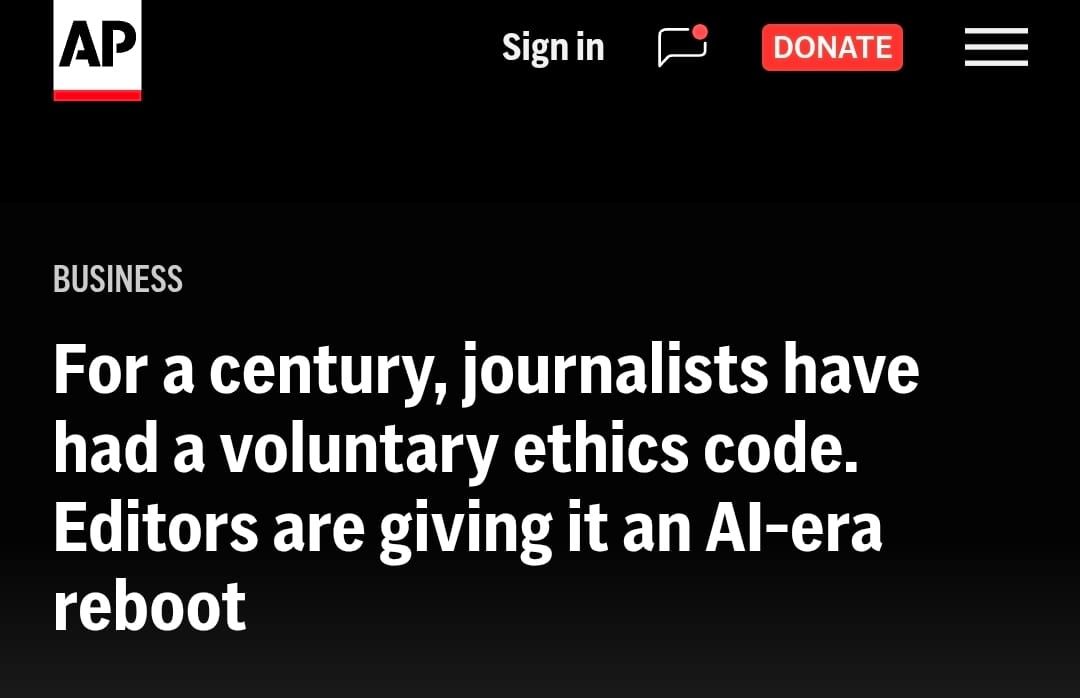
The Associated Press opens its report on the Society of Professional Journalists' proposed ethics-code revision with the perfect image: the current code pinned to a newsroom bulletin board, peeking out from behind the coffee pot.
That is right about where the profession has placed enforcement too.
The Society of Professional Journalists has spent the past year reviewing a code last revised way back in 2014. The proposed draft preserves its four foundational duties: seek truth and report it; minimize harm; act independently; be accountable and transparent. It adds some useful language for the artificial-intelligence era. Speed, technology, and medium do not excuse inaccuracy or unfairness. Journalists remain responsible for what they publish regardless of the tools used.
Correct.
An invented quotation is still an invented quotation. A synthetic photograph presented as documentary evidence is still fabricated content. An unverified model output is still unverified information. A newsroom that hides how a consequential story was produced still has a transparency problem. An owner who cuts verification to save money still has an independence and accountability problem.
Artificial intelligence changes the speed, scale, and economics of these failures.
It does not create a new ethical species.
The standards needed to identify the basic failures are already here. The proposed code requires provenance checks, continuing correction, resistance to internal and external pressure, prompt and prominent acknowledgment of mistakes, exposure of unethical conduct inside news organizations, and adherence to the same standards journalists demand from others.
Then, the Society of Professional Journalists removes the instrument that could make any of this answerable.
Its revision page says the code will remain voluntary, that the Society will not investigate complaints, and that it will not sanction journalists or news organizations.
Its standing ethics FAQ goes further: public scrutiny and more speech are preferable to quasi-judicial findings.
So it seems the profession has retained the standard and declined a correction channel.
Legal enforceability is not the only available consequence. The Society of Professional Journalists does not need to license journalists, regulate publication, or decide who may call themselves press.
It can create a voluntary signatory system.
A journalist or outlet could publicly adopt the code and consent to bounded review. Complaints would require evidence. The signatory would receive notice, a chance to respond, and an appeal. Findings would be published. Remedies could require a correction, clarification, disclosure, or explanation. Persistent refusal would cost the outlet its signatory status and eligibility for ethics-based recognition.
Nobody loses the right to publish here. The Society simply stops lending the authority of its code to an organization that refuses to answer to that code.
You may freely operate outside the code.
You may not borrow the authority of the code while making yourself unreachable by it.
The Associated Press report ends with a committee member wishing that more owners of journalism outlets would read the code because employees are often pressured to violate their ethics.
An owner willing to exert that pressure does not suffer from inadequate access to a one-page document.
The pressure exists because the incentive has force and the standard does not.
Asking the worker to preserve ethics while satisfying the owner transfers the accountability burden to the person with less authority.
That is the trust crisis in miniature.
Journalism certainly has no shortage of ethical vocabulary. It has institutions that invoke ethics as a credential while treating accountability as optional.
The Society of Professional Journalists simply does not need another poster.
It needs a real path from complaint to evidence, from evidence to finding, and from finding to repair.
Enforce your existing standards.
Please.


Comments ()