An Essay Can Arrive Before Any Education
Artificial intelligence has exposed an old weakness in academic assessment. Universities can repair it. They will have to rebuild much more than their plagiarism policies.
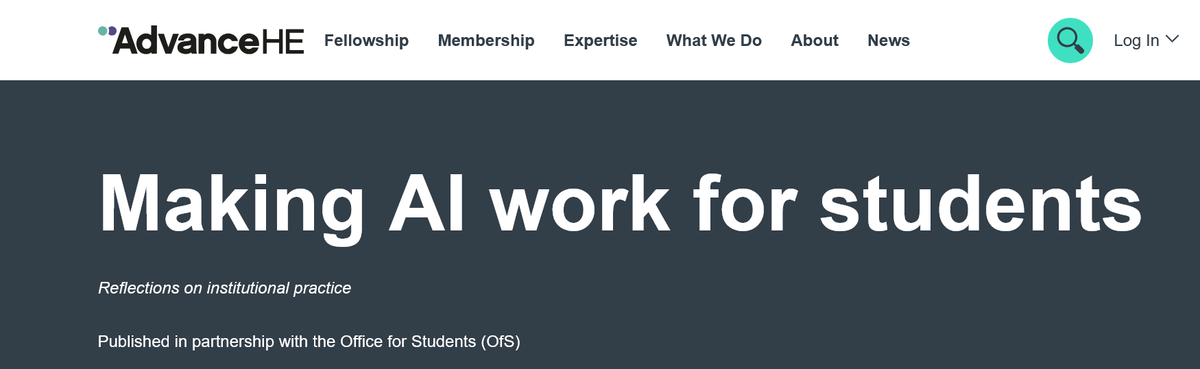
On November 11, The Guardian reported that England's higher education regulator was warning universities about the credibility of their degrees.
The Office for Students and Advance HE had spent the summer examining how artificial intelligence was changing university education. Their report drew on contributions from 244 staff and 91 students and student representatives across at least 127 institutions.
Students described peers completing assignments with AI in minutes and receiving grades comparable to those who had completed the work themselves. Some reportedly could not recall basic details of the assignments they had just submitted. Academics described increasingly similar essays, uncertain authorship, and assessment methods that no longer reliably established what students knew.
The findings came from qualitative research rather than a representative measurement of how many students cheat. They nonetheless identify a serious problem.
A university can receive a well-written essay, evaluate it correctly against its rubric, award a good grade, and remain almost entirely ignorant of whether the student learned anything.
An essay can arrive before any education.
It always could.
The Paper Was Always Suspect.
My grandmother taught. My mother was a teacher. My sister teaches art.
Teaching has never been an abstract profession. The work of helping somebody understand something, and the difficulty of establishing whether that understanding has actually occurred, existed long before a chatbot could produce a term paper.
A student could always copy another student's work. A parent could complete the assignment. A wealthy family could hire a tutor who gradually took over the writing. A ghostwriter could produce an excellent essay for someone who had never opened the assigned book.
By the 1960s, commercial term-paper mills were already part of the academic landscape. The internet made them easier to find, and an entire industry developed around custom-written assignments.
In 2018, Philip Newton published a systematic review of commercial contract cheating, identifying research samples dating back to 1978. The problem was old enough to have accumulated decades of empirical literature before ChatGPT arrived.
The underlying weakness was familiar: universities routinely received artifacts created outside their supervision and treated those artifacts as evidence of what an individual student had learned.
That inference was never guaranteed.
Of course, it often worked. Writing an essay requires reading, interpretation, argument, selection, revision, and enough understanding to organize a defensible position. A student who does that work will ordinarily learn something along the way. A thoughtful essay can also disclose a great deal about the writer's understanding.
The educational benefit and the finished artifact were closely associated because producing the artifact generally required substantial intellectual participation.
There were always ways around that requirement. They were expensive, inconvenient, risky, or dependent on somebody else being willing to do the work.
Artificial intelligence changes those conditions.
A student can generate an essay, request revisions, correct its style, obtain additional references, and submit a polished document without ever developing the understanding the assignment was supposed to cultivate.
The cost of producing the artifact has collapsed. The cost of acquiring the education has not disappeared with it.
And the university is still holding the paper.
The Grade Can Be Correct.
This is where the problem becomes more interesting than academic dishonesty.
Suppose an examiner receives two essays of equivalent quality.
- One student spent three weeks reading, drafting, arguing with the material, and revising.
- The other submitted an AI-generated response after a few minutes of superficial interaction.
If the grading rubric evaluates the coherence of the argument, accuracy of the references, quality of expression, and fulfillment of the assignment, both essays may deserve the same mark as essays.
The examiner has accurately evaluated the object presented.
But that grade is commonly interpreted as something larger: evidence of the student's knowledge, understanding, analytical skill, and progress through an educational program.
Those claims require evidence about the student.
The distinction resembles a problem Modal Path Ethics examined back in The Theorem Scoreboard. Artificial intelligence could produce a valid mathematical proof while the broader work of understanding, explaining, digesting, and incorporating that result into mathematics remained unfinished.
A proof can arrive before the mathematics arrives.
The educational case is even sharper. A mathematical proof can be valid regardless of who discovers it. A university degree, however, makes claims about the capabilities of the particular person to whom it is awarded.
An excellent essay is an excellent essay.
Whether its submitter possesses the education supposedly represented by that essay is a whole other question.
Universities have often treated the first judgment as sufficient evidence for the second.
Artificial intelligence makes that shortcut increasingly indefensible.
Ask the Student.
The solution begins with something teachers have done for centuries.
Ask the student to explain what they know.
- A student submits an essay defending a position.
- The instructor asks them to reconstruct the argument without the document, explain why they accepted one objection and rejected another, and respond to a new counterexample not on the page.
- A history student submits an interpretation of a political event.
- The instructor presents an unfamiliar primary source and asks how it changes the argument.
- A software engineering student submits a working program.
- The instructor asks them to modify a component, locate a defect, or explain why a particular input produces an unexpected result.
- An art student presents a finished work.
- The instructor asks about the decisions, techniques, revisions, and visual problems involved, perhaps requiring a new demonstration of the relevant skill.
The student must do something with the material that requires the competence being assessed.
They can prepare. They can practice. They can even use artificial intelligence to anticipate questions beforehand.
Then the examination begins, and the relevant understanding has to be available to them.
This is not a revolutionary invention. Oral examinations, supervised writing, practical demonstrations, laboratories, performances, and clinical assessments have long existed.
The difficult part is making them a dependable component of assessment across entire degree programs rather than occasional exceptions.
There are real limits. A five-minute conversation cannot prove comprehensive mastery. A gifted speaker may conceal gaps in understanding, while a knowledgeable student may struggle to express an answer under pressure. Oral examinations can introduce examiner bias, inconsistent difficulty, and significant accessibility barriers.
The answer is therefore a combination of methods, selected according to the competence at issue.
Where the university claims a student can write independently, supervised writing. Where it claims technical competence, practical demonstration. Where it claims analytical understanding, unfamiliar problems and questioning. Where it claims extended research ability, the research record, sources, methods, and final work.
Assessments should be repeated across a course so that one bad performance does not determine the entire judgment.
The point is to establish a credible chain between the knowledge the university claims a student possesses and something that student has actually demonstrated.
Open the Assignment. Secure the Examination.
There is a considerable advantage here for students.
Much of the uncertainty surrounding AI-assisted coursework can disappear.
Universities can explicitly permit students to use generative AI in assignments designed for open tool use. Students can freely research, question, simulate, receive feedback, debug, revise, and work with increasingly powerful tools without having to guess which particular interaction has crossed an invisible disciplinary boundary.
That freedom does not abolish academic responsibility. Fabricated evidence remains fabricated. False citations remain false. Privacy, copyright, research ethics, and truthful representation of contributions have not vanished.
It also does not require students to use AI. A serious arrangement must preserve workable alternatives.
The important change is that universities would stop relying on unenforceable prohibitions to establish independent understanding.
A student could use AI extensively at home and still have to demonstrate their command of the material under conditions appropriate to the assessment.
That should make the university experience more intellectually interesting, not less.
Students could undertake more ambitious projects, explore material beyond their present expertise, and receive assistance that would previously have been unavailable without substantial financial resources.
Then they would face a more demanding question than whether they had submitted the required document:
What did you learn?
Some institutions are already moving in this direction.
In September 2026, the University of Bath introduced a two-lane assessment framework, drawing on an approach developed at the University of Sydney.
- One lane permits AI use.
- The other uses assessment conditions designed to prevent it.
The university explicitly recognizes that attempting to police permitted AI functions inside ordinary coursework is becoming unreliable.
This is an important precedent, although two categories alone cannot guarantee good assessment. A supervised examination can still test the wrong thing; an open assignment can still produce learning. Every course needs to identify what it intends to teach and how that achievement can be established.
Somebody Has to Teach and Examine All Them.
Unfortunately, this is where the easy answer ends.
Imagine a university course with 200 students. Give each student a fifteen-minute individual oral examination and the instructor faces fifty hours of examination time.
That is before preparing questions, arranging appointments, evaluating performance, recording evidence, handling accommodations, resolving disagreements, and conducting reassessments.
Now, repeat the process across several courses and several years.
The existing university timetable just does not have a secret spare semester hiding inside it.
 Aidan Lawson
Institutions will have to redesign how students move through education.
Some independent assessments could occur during existing seminars or laboratory sessions. Others may be organized around shorter supervised exercises, demonstrations in small groups, practical examinations, or substantial defenses attached to major projects.
Not every assignment requires an individual oral defense. The point is that the important learning outcomes receive credible independent assessment somewhere in the program, with enough frequency and coverage to warrant the claims eventually made by the degree.
Even so, the resource burden is considerable.
Universities may need smaller assessment groups, more qualified teaching assistants, additional contact hours, examiner training, new scheduling systems, improved accessibility arrangements, and revised expectations for academic workload.
They will also need to confront unequal institutional resources. A wealthy university can hire assessors and reorganize courses more readily than an institution already struggling to provide enough teaching contact.
A reform that produces excellent assessment for affluent students while reducing access elsewhere has just created another problem.
There is a familiar temptation to answer the staffing difficulty by having AI conduct and grade every oral examination.
AI can assist with preparation, practice, and administrative work. It may eventually support carefully validated forms of examination.
 Aidan Lawson

But making the same technology responsible for supplying the work, questioning the student, interpreting their answers, and certifying their competence introduces another dependency that requires independent validation.
Putting a second chatbot at the end of the assignment is not an institutional reconstruction.
- There is no reason to reject useful automation.
- There is every reason to establish what each instrument actually verifies before giving it authority over the student.
The timetable is another problem. That Office for Students report arrived in November, after the summer planning period in which many institutions might have made substantial changes for the academic year already underway.
Universities cannot simply rewrite the assessment contract halfway through a semester and expect students to absorb the consequences.
Immediate safeguards are possible. A durable transition will require consultation, pilots, funding, staff preparation, clear advance notice, and actual changes to course structures.
This will take years in some institutions.
That is not a reason to postpone beginning.
What Does the Degree Certify?
The degree has always been a compressed claim.
A university cannot certify every capability a graduate might possess. Nobody can guarantee that a student will remember every lesson, reproduce every argument, or remain competent forever.
Nor should education be reduced to performance in a handful of examinations. Learning can change a person's judgment, habits, confidence, relationships, interests, and capacity to pursue unfamiliar questions. Much of that development will never fit neatly onto a transcript.
The credential nevertheless makes a consequential public representation.
This person has completed an organized course of study and demonstrated the knowledge and skills required for the award.
That representation is important to students, employers, professional bodies, other universities, and the public, especially where competence affects the safety, freedom, health, or continued opportunities of other people.
The university owes those parties a defensible basis for its judgment.
An excellent take-home essay can remain valuable evidence of a completed intellectual product. It may demonstrate remarkable research, creative direction, tool use, revision, and synthesis.
It cannot, by itself, guarantee that the student possesses all the capacities traditionally inferred from producing it independently.
The appropriate response is to distinguish the achievements and assess them on their own terms.
There is no need to punish a student for using powerful tools where that use is authorized. There is no reason to reward work the student cannot understand as though comprehension had been established. There is equally no justification for treating every technically competent AI user as intellectually hollow.
The question is what the student can actually do, with and without assistance, in the circumstances relevant to the claimed competence.
That question should have governed assessment all along anyway.
The Verification Gradient warned that an educational system can improve its scores while narrowing what students actually learn. This failure can occur even while the scoring instrument remains accurate within its limited jurisdiction.
A well-graded essay can arrive through a process that provides little evidence of learning. The mark may describe the document perfectly while telling one very little about the student. The mistake is to promote it into authority over everything the university hopes the document represents.
Artificial intelligence has made that promotion difficult to sustain.
It has also given students access to astonishing educational assistance. Those benefits should survive the correction. We should want students to learn more, attempt harder problems, and use the best available instruments while developing the independent understanding necessary to judge what those instruments produce.
That will require a different relationship between instruction, coursework, examination, and certification. It will cost time and money. It will disrupt established academic routines and place substantial demands on institutions already under pressure.
Some universities have begun. Others will have to follow.
An essay can arrive before any education. It always could.
The institution's responsibility is to find out whether the education arrived at all.
And if it has not, there is still teaching to do.