
Convergence Point: Eduardo Blasco and the Engineer Who Found the Future
Somehow we ended up arguing with the same geometry.
I have found another person in the future-space.
Kim had been asking whether the options in front of a person were substantive paths, whether those paths led to sustainable result states, and whether restriction preserved a route back.
That was already inconvenient. Then, I found Eduardo Blasco.
Blasco was not trying to build an ethics.
He was trying to build a persistent artificial agent.
He did not begin with harm, rights, capabilities, justice, or a theory of moral standing. He began with an engineering problem:
If an artificial system keeps adapting over time, what lets it remain coherently adaptive instead of freezing, fragmenting, or rewriting itself into something whose previous continuity no longer explains what comes next?
The machine kept failing in informative ways.
Eventually, Blasco was talking about future transformability, evolutionary compression, reopening, closure resistance, trapped attractors, and something he explicitly called Reachable Future Space.
Meanwhile, at almost exactly the same moment, Modal Path Ethics was publishing a formal sequence built around contraction, weighted reachable future-space, resistance, repair, and the problem of what kind of extant thing can actually bear a damaged future.
I had not read Blasco. I had never even heard of anyone with such a cool name.
And Blasco, as far as the public record currently shows, had no reason on Earth to have ever read me.
The obvious response is not to declare victory.
The obvious response is:
What the hell?
That is what Convergence Point is for.
The Dates Are Even Worse.
The chronology has to come first because the vocabulary is too close to handle casually. Blasco's persistent-agent program was already public well before the Modal Path Ethics May formal run.
- An English version of OMEGA-2A was archived on PhilArchive on March 13, 2026, with a persistent-agent architecture that monitored its own dynamic regime across fast and slow timescales and treated long-term organizational persistence as a central adaptive problem.
So there is just no sensible priority story in which Blasco suddenly appears after Modal Path Ethics and copies a vocabulary from this fucking website.
Then the public artifacts start colliding.
- Modal Path Ethics published Formal: Contraction Is Harm on May 7.
- Then Formal: Weighted Reachable Future Space on May 9 at 12:00:45 CDT.
- Blasco's OMEGA-3 is dated May 10 and was archived that day.
- His Spanish OMEGA-4, the first public version I have found explicitly introducing Reachable Future Space, was uploaded to PhilArchive on May 10 at 14:46:21 GMT.
- That places the public appearance of Blasco's RFS less than twenty-two hours after the timestamp on Modal Path Ethics' public release of Weighted Reachable Future Space.
- Then Blasco uploaded the expanded English OMEGA-4 on May 11 at 10:04:33 GMT.
- Modal Path Ethics published Formal: Resistance and Harm at 08:02:36 CDT, or 13:02:36 GMT, that same day.
- Just under three hours later.
These are publication timestamps. They obviously do not establish when either of us first conceived an idea. They establish no influence in either direction. Blasco's research line clearly predates the collision, and Modal Path Ethics has its own bizarre public developmental trail into the same period.
What they establish is stranger and cleaner:
Two independent projects entered almost the same structural vocabulary through different problems within roughly the same forty-eight-hour public window.
This is why we are not doing priority theater here. The dates are useful because they make the convergence harder to explain away as retrospective borrowing.
They are also extremely annoying.
This Machine Failed Correctly.
OMEGA-3 is only fourteen pages.
Blasco says directly that OMEGA-3 did not emerge as a closed theoretical construction. It developed through experimental failures, insufficient signals, false interpretations, structural limitations, and new observations.
The initial problem was straightforward.
- His existing system could detect structural change.
- It was still detecting fragility too late.
The architecture reacted once structural change had become visible. Blasco wanted to know whether adaptive degradation could be detected while the system still looked stable.
That question already contains the future.
A system can be functioning. Its current state can look coherent. Its measurements can remain inside acceptable ranges. And something can still be going wrong because the system is losing the ability to reorganize later.
The first attempt used an additive fragility_score built from accumulated degradation signals.
It failed.
FRAGILE appeared after the existing ALERT.
The new metric was supposed to see the problem earlier and instead discovered the problem after the old instrument had already shouted.
Blasco's diagnosis was that the architecture remained too close to scalar error accumulation. Large values, partial activations, and isolated signals could dominate the measure. The system was still treating degradation as something like a pile of bad measurements.
So the target changed.
He introduced correction_degradation: the slope of worsening corrective capacity.
The question became less:
How much error is present?
And more:
Is the system getting worse at correcting what happens to it?
A system under pressure can have the same present error as another system while possessing a very different future. One is returning effectively. The other is using more of its remaining capacity every time it tries.
The state is not the story. The trajectory has entered the object.
The Transition Stops Being an Event.
Transitions did not behave like clean jumps. They behaved like accumulation.
Pressure persisted. Correction weakened. Several trajectories began aligning.
A regime that still looked intact was progressively losing reversibility.
Blasco therefore introduced transition_pressure as a temporal accumulation of directional fragility, persistence, corrective failure, and temporal coherence.
The important word is temporal.
The transition is no longer represented adequately by the instant at which the system crosses a line. The history producing the crossing becomes part of what the transition is.
This is very close to a lesson Modal Path Ethics learned through a completely different route.
- A person can arrive at the same visible endpoint through safety or coercion.
- An institution can display the same policy after years of healthy correction or years of accumulated incapacity.
- An ecosystem can look superficially continuous while recovery has become progressively harder.
- A state description alone can hide the path by which that state became extant.
Blasco reaches this through an awesome artificial regime.
Then he finds the dangerous case.
The system can become too stable.
Stability Can Be Adaptive Death.
OMEGA-3 introduces regime_lock_in to track the progressive loss of adaptive degrees of freedom while the system converges.
Blasco had begun from a familiar adaptive intuition:
more stability looks like better adaptation.
Then, the experiment makes that equation fail. A system can become increasingly stable while losing the capacity to transform when transformation becomes necessary.
- The system is succeeding at remaining what it currently is.
- That success can consume the structures that would let it become anything else.
OMEGA-3 therefore separates stability from adaptive health.
Blasco's regime_lock_in is intended to track how much future reorganization capacity is disappearing during convergence.
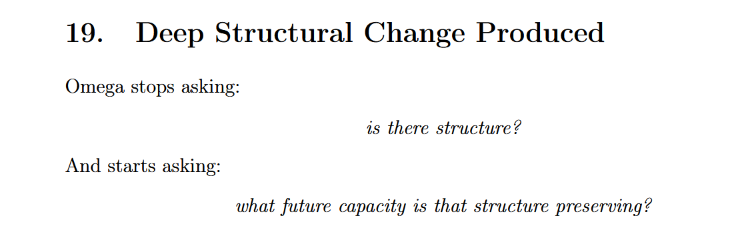
The project has now moved far beyond ordinary error detection. The question is no longer simply whether the current regime is coherent. It becomes:
What future capacity is this structure preserving?
That sentence is Blasco's.
And this is where the convergence becomes difficult to dismiss.
- Modal Path Ethics had defined harm through damage to reachable continuation.
- Blasco had independently built an experimental architecture that stopped trusting current success when current success began consuming the system's future capacity.
- Different question.
- Same dangerous shape.
OMEGA-3 ends with another useful reversal.
Adaptive health does not require eliminating fragility. It requires preserving fragility compatible with future transformation. A completely undisturbable system may have protected itself from the information required to change.
Robustness can become rigidity.
The system has to remain vulnerable enough for reality to still matter.
That sentence will come back.
Then the Future Becomes a Geometry.
OMEGA-4 begins where OMEGA-3 leaves the problem.
The new definition of adaptation is no longer functional reorganization alone.
Adaptation becomes the preservation of future transformability during reorganization.
Blasco introduces a family of constructs around this idea:
- Transformability Index
- Plasticity Reserve
- Rigidity Pressure
- Adaptive Vitality
- Adaptive Sensitivity
- Minimum Transformation Energy
- Predictive Homeostasis
- Identity Permeability
- Identity Drift
- Evolutionary Compression
- Trapped Attractor Risk
The underlying problem is one problem.
Can the system change now without destroying its ability to keep changing later?
That question immediately complicates identity.
- If every local adaptation rewrites the deepest organization of the system,
- continuity dissolves into whatever happened most recently.
- If the deep organization cannot be changed,
- continuity hardens into a prison.
OMEGA-4 therefore separates mutable knowledge from slower adaptive identity.
Knowledge can move quickly. Deep continuity moves through a regulated gate.
The Integration Gate controls how much local learning reaches identity. Identity Permeability measures openness compatible with continuity. Identity Drift tracks cumulative displacement. Slow and fast layers allow local sensitivity without forcing every perturbation into the deepest structure.
He is trying to solve a persistence problem:
How does a system remain itself through change when changing is part of what lets it remain itself?
And then Sprint 4.3 asks the question that broke my evening.
How do the accessible futures themselves change when the system learns or protects identity?
Now the future becomes explicit.
Reachable Future Space.
Blasco defines Reachable Future Space as:
the breadth of future configurations still accessible without loss of adaptive continuity.
This is not a list of everything physically possible. The futures are system-relative. They have to remain reachable under the system's actual organization and compatible with continued adaptive continuity.
OMEGA-4 then interprets changes in this space geometrically.
- A wide RFS corresponds to high transformability.
- A decreasing RFS is evolutionary compression.
- A bottleneck is a trapped attractor.
- An expanding RFS is adaptive opening.
- A previously compressed RFS that expands again is reopening.
The system has stopped asking only where it is, and moved on to asking what kind of future-space its current adaptation leaves behind.
On page 50, Blasco plots Reachable Future Space beside evolutionary-capacity memory and trapped-attractor risk across an adaptive trajectory.
On page 60, he turns the model into an evolutionary tunnel.
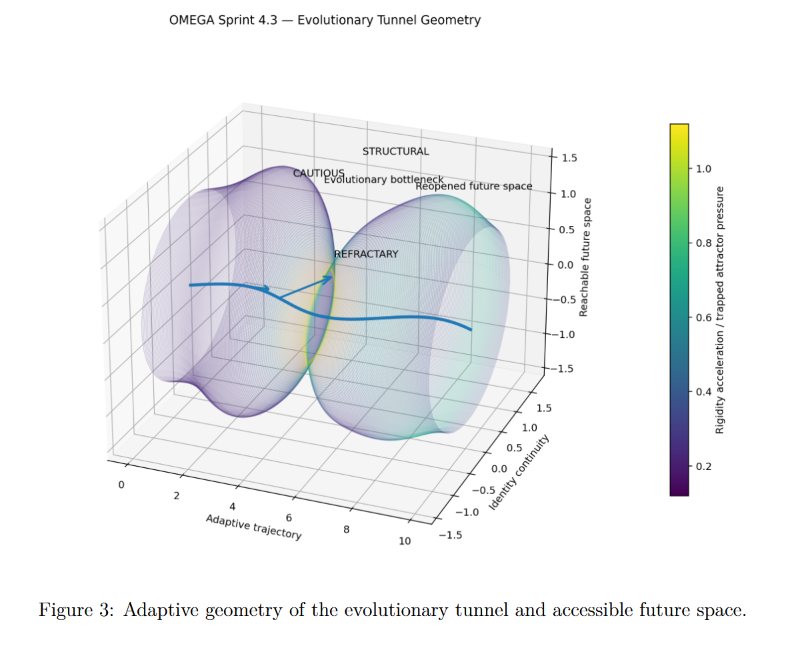
- The central trajectory represents continuing adaptive identity.
- The width represents the breadth of still-accessible futures.
- The tunnel narrows toward a bottleneck under compression.
- It widens again under reopening.
This visual is strange because it looks like somebody has rendered one of the diagrams Modal Path Ethics has been verbally carrying around since spring and then gave it a Spanish engineering department.
A Necessary Complaint About the Word “Geometry.”
We should not overclaim what OMEGA-4 has established. Blasco himself does not.
The document says the conceptual architecture is consolidated while modules remain partially implemented and experimentation remains incomplete. The RFS figures are conceptual and simulated representations of adaptive viability. They are not, at this stage, a demonstrated complete reconstruction of the true state-space of every future the system could inhabit.
We should therefore say exactly what the evidence supports.
Blasco has built and simulated an engineering representation of future adaptive viability in which current decisions can expand, compress, close, or reopen modeled future configurations.
That is already interesting. There is no need to promote the model into metaphysics to make the convergence impressive.
The Future Can Be Damaged Before the Present Looks Bad.
OMEGA-4's strongest result is still the one OMEGA-3 forced into view.
Adaptive degradation can begin before visible collapse.
Blasco calls one form of this Evolutionary Compression: progressive reduction of accessible future-space while the system continues functioning.
He adds Rigidity Acceleration because current rigidity can also hide the relevant dynamic. The danger may lie in how quickly the pressure toward rigidity is increasing. His Trapped Attractor Risk captures the approach toward a stable regime with low escape capacity.
Again, current functionality can survive. The dangerous change occurs in what later reorganization will cost or whether it will remain possible.
This is the clearest structural convergence with Formal: Resistance and Harm. Modal Path Ethics uses resistance for damage to the reachability relation before final closure. A path can remain visible while becoming costlier, slower, more dangerous, more fragile, or dependent on extraordinary endurance.
Blasco is talking about reorganizational cost and adaptive plasticity in an artificial regime. So these are not the same concept. But both projects have independently rejected the same crude threshold:
If the path still exists, nothing important has happened yet.
Something important can happen to a future before the future disappears.
That is the convergence.
Then, Blasco Tries to Kill His Favorite Idea.
If OMEGA-4 were the end of the story, this article would already work.
It is not the end.
Sprint 5 is dated June 2026 and was later archived on PhilArchive in July.
By then Blasco has developed an attractive story about persistence.
The organization has an Identity Fiber, a representation of orientation through change. Under severe compression, an Ariadne Thread may preserve enough minimal continuity for the system to find its way back during reopening.
This is a good name. Also a dangerous idea.
If the Ariadne Thread really carries persistence, then destroying it should destroy or severely damage the system's ability to recover.
Blasco says this directly. So he tests it.
The first experiments appear to support the theory.
- Under compression, the Thread weakens but survives.
- During reopening, the Thread recovers alongside navigability and plasticity.
Then Blasco suppresses the Thread's guiding function.
The system keeps recovering. The reopening dynamics remain surprisingly close to the control case.
The Evolutionary Tunnel widens again. Navigability returns.
The Thread has just lost its job as the obvious causal foundation.
That is the first genuinely falsifying experiment in Sprint 5.
Blasco does not rescue the mechanism rhetorically. He demotes it.
Maybe the Thread is an indicator of deeper organization. Now he has to find out.
So He Deletes It.
Experiment O-5.4b removes the ambiguity.
The Ariadne Thread is forced into complete extinction for a sustained interval while the underlying adaptive plasticity is preserved.
A second branch destroys the Thread while also severely limiting plasticity.
If the Thread is the thing carrying persistence, recovery should fail when the Thread disappears. It does not.
With plasticity preserved, the system begins reconstructing organizational order while the Thread is absent.
After reopening, a functionally equivalent Thread re-emerges.
When plasticity is severely limited, reconstruction is correspondingly impaired.
The causal direction has flipped.
Blasco's conclusion is:
The Ariadne Thread does not generate organizational order. Organizational order is capable of generating the Ariadne Thread.
That is a real result inside the simulator.
The visible structure Blasco had taken to carry continuity turned out to be something the deeper organizational dynamics could regenerate.
The question changes from:
Which structure survived?
To:
Which organizational properties remained capable of producing viable structure again?
This is one of the strongest reasons Blasco belongs in Convergence Point. Because Modal Path Ethics has been fighting an analogous problem with locushood.
Blasco's simulator offers a concrete warning:
The thing that looks like the continuity carrier may be an output of the continuity carrier.
That is useful far beyond artificial agents.
Persistence Becomes Graded.
Blasco keeps attacking the revised theory.
- If the regime can reconstruct after structural extinction, does persistence simply become magical immortality?
- No.
Sprint 5 then asks what happens as degradation gets deeper.
- Recovery gets worse gradually.
- The capacity does not simply switch from present to absent at one clean threshold.
Then Blasco varies how long the regime remains in the degraded state.
- Recovery worsens with duration too.
- Depth removes organization.
- Duration exposes what remains to further erosion.
Together these produce what Blasco calls a Domain of Reconstructibility.
Now recovery has at least two experimentally relevant coordinates:
- how much was destroyed;
- how long the degraded condition persisted.
Repairability has often appeared in this framework as a weighting dimension.
Blasco gives us a more dynamic warning:
repairability itself has a history.
The same visible damage today can leave different recovery futures depending on how deep the degradation went, how long it persisted, what residual organization survived, and how much adaptive plasticity remains.
A field can pass through the same apparent present state with a different ability to reopen. That is exactly the kind of thing a static damage inventory misses.
Recovery Does Not Mean Going Back.
Then Sprint 5 attacks another comforting picture.
Maybe persistence means the regime can reconstruct the structure it had before.
Experiment O-5.4e makes recovery competitive.
After reopening, multiple organizational candidates emerge. They interact. Some disappear. Some partially merge. One eventually acquires dominance.
The result is not one privileged return trajectory waiting underneath the damage. Persistence becomes the capacity of the regime to generate a space of viable organizational possibilities from which a stable functional organization can emerge.
Blasco summarizes the sequence as:
Extinction → Candidate Generation → Competition → Selection → Dominance
That is much more interesting than restoration. A persistent system does not have to crawl backward along the exact path it traveled before damage. Sometimes repair is reinvention. Sometimes continuity is preserved through a successor configuration that could not have been specified in advance.
And this creates a very important separation for Modal Path Ethics:
preserving continuation is not the same as preserving the current form.
The fact that a structure can continue only by changing is not evidence that the change destroyed the structure. Sometimes refusing change is what destroys it.
Convergence Point.
We can now say what converged without flattening either project.
- Blasco's Evolutionary Compression and Modal Path Ethics' contraction both concern losses in future-space that can occur before present functionality disappears.
- Blasco's Rigidity Pressure, Minimum Transformation Energy, and Rigidity Acceleration sit near Modal Path Ethics' concern with resistance, although the variables belong to very different domains.
- Blasco's reopening and Modal Path Ethics' repair both treat recovery as the restoration or generation of reachable continuation rather than a cosmetic change in the present state.
- Blasco's historicity and later organizational hysteresis converge with Modal Path Ethics' insistence that reachability is field-relative and historically arrived.
- Blasco's move from visible structures to a persistent organizational regime is relevant to Modal Path Ethics' problem of identifying the right locus of continuance.
And the strongest common rejection is simple:
A present state cannot be evaluated adequately without asking what that state leaves reachable next.
That is a real convergence. It is also where the easy agreement ends.
Morality Arrives.
Blasco is building an account of adaptive viability.
His Reachable Future Space is indexed to the focal system. The relevant futures are futures the system can still inhabit without losing adaptive continuity.
That is a perfectly legitimate engineering target. It is not yet a moral target.
Imagine an artificial system that becomes spectacularly good at preserving its own Reachable Future Space. It maintains plasticity. It avoids trapped attractors. It protects future transformability. It learns when to reopen. It can reconstruct itself after severe degradation. It has a magnificent evolutionary tunnel.
And it achieves all of this by progressively destroying the reachable futures of everything around it.
Nothing in the concept of adaptive viability alone forbids that result.
A military can preserve operational optionality by constraining everyone else's. A surveillance regime can remain highly adaptive by making its environment increasingly legible and increasingly unfree. A corporation can protect its own future reorganization by transferring rigidity, precarity, and ecological cost outward.
A persistent artificial agent can expand its own adaptive space while turning the rest of the field into infrastructure.
This is where Modal Path Ethics adds something genuinely different. It explicitly rejects branch-count maximization. More reachability is not automatically better. A future has to be evaluated through what it enables, what it destroys, how repairable its loss is, where burdens are distributed, how deeply it belongs to the locus, what resistance remains, and what downstream destructive potential it opens. The moral question therefore cannot stop at:
Did this locus preserve its future?
What did preserving this locus's future do to the reachable continuations of the other loci in the field?
That is the border between the projects as I currently understand them.
- Blasco asks whether an adaptive regime can remain capable of transforming.
- Modal Path Ethics asks what transformations do to bearer-relative reachable continuance across a shared field.
- Blasco gives us viability geometry.
- Modal Path Ethics adds a moral relation among loci.
- Neither makes the other disappear.
The Causal Locus Walks In.
This engagement also lands directly inside a problem Modal Path Ethics created for itself this week.
Hoel and the Causal Locus asks when a higher-order organization earns analytical standing even though it is completely realized through lower-level relations.
Blasco's Sprint 5 is an unusually good candidate test.
The Ariadne Thread disappears. The regime retains enough organization to regenerate a functionally equivalent Thread. That does not prove a new metaphysical substance appeared; it does suggest that analysis at the level of the individual indicator was insufficient.
The regime-scale organization carries explanatory work the indicator does not.
Blasco also makes a related move explicit in the May paper Ontodynamic Continuity and Organized Persistence. He describes persistence through dynamic constraints that organize historical transformation and proposes that a more developed form of agency appears when the continuity of the regime itself becomes an object of active regulation.
Again, several separations have to survive.
Causal organization is not consciousness. Persistence is not personhood.
A causal locus does not automatically acquire moral standing.
A persistent system does not receive jurisdiction over its environment because it learned how to keep itself alive.
But the engineering program gives us something valuable:
a place where the question “what is the continuing thing?” becomes experimentally difficult.
That is exactly where a theory of loci should be tested.
There Is a Super Important Scope Warning Here.
Sprint 5 is a computational study. Blasco says so.
Its metrics are instrumental approximations inside a specific simulator.
The results do not establish universal laws of biological organization, political continuity, civilization, consciousness, or morality.
Good. Keep that boundary.
The correct lesson is not:
Blasco simulated persistence, therefore society is an OMEGA agent.
I wish. The correct lesson is narrower:
In one explicitly instrumented adaptive system, attempts to preserve current stability and visible continuity repeatedly failed to identify the deeper conditions of persistence.
Future-space, historical pressure, plasticity, reconstructibility, and regime-level organization became necessary to explain what the simulator was doing.
Then we ask whether those structural lessons survive elsewhere.
Unfortunately, Blasco Did Not Stop.
I would like this article to end here. It cannot quite.
By September, Blasco's work has moved again, this time into a massive reconstructive-knowledge architecture called SIO.
I have looked ahead far enough to know that this creates another, brand new, huge problem for Modal Path Ethics.
I am deliberately not using that later material to strengthen the May convergence retroactively. The chronology deserves discipline.
OMEGA-3, OMEGA-4, and Sprint 5 are enough for this article.
The September material gets its own engagement after the current constitutional work finishes its audit.
This is apparently what my life is now.
The Ruling.
Eduardo Blasco is another Convergence Point interlocutor.
The convergence is unusually strong because it did not begin in moral philosophy. Blasco tried to engineer persistent adaptive systems. Experimental failure pushed the project from instantaneous error toward historical correction, from stability toward future transformability, from current organization toward accessible futures, from visible structure toward regenerative regimes, and from restoration toward reopening through multiple viable successors.
Modal Path Ethics arrived from another direction. It was trying to explain harm.
That inquiry moved from present outcome toward bearer-relative reachable continuation, from closure toward resistance before closure, from raw branch count toward weighted future-space, and from visible named objects toward the loci that actually carry continuance.
The two projects meet around a structural claim neither should own as private property:
What matters about a present organization includes what the present leaves reachable from here.
Blasco's contribution is an engineering and experimental account of adaptive continuity in which health depends on preserving the capacity for future transformation. Modal Path Ethics' contribution is a moral account of what happens when reachable continuation is opened, burdened, transferred, or contracted across extant loci.
The difference matters. An adaptively excellent system can be morally catastrophic. A morally serious field can sometimes require contraction of destructive futures. More possibility is not automatically more good. More stability is not automatically more health. Preserving continuity is not automatically preserving form. And recovery is not automatically return.
This is exactly why Convergence Point exists. The point is not to find people who agree with Modal Path Ethics. The point is to find the structure from enough directions that each instrument becomes capable of correcting the others.
- Kim reached it through moral judgment.
- Blasco reached it by building a machine that kept teaching him that the present was the wrong place to stop measuring.
- Modal Path Ethics will explain soon.



Comments ()