Applied Case: The Werster Crisis
Pokémon speedrunning built extraordinary instruments for verifying runs. It built much weaker instruments for verifying the authority surrounding them.
Note: This article concerns a living person and an active high-stakes public dispute. It distinguishes a disputed Battle Factory claim, an independently corrected Stadium 2 suspicion, a historical fabrication that Werster has reportedly acknowledged, and documented governance conflicts. It does not convert the unresolved 212-win allegation into a settled finding.
Modal Path Ethics has been handed six rental Pokémon and told to choose.
None of them belong to it.

This is the central indignity of the Pokémon Emerald Battle Factory. Every other important trainer in Pokémon gets to develop attachment, strategy, memory, and self-conception around a team they have assembled themselves.
The Battle Factory takes all of that away.

You enter a room. Six rental Pokémon appear.

Each arrives with a fixed moveset, fixed statistics, fixed nature, fixed item, strengths you may understand, weaknesses you may discover too late, and the faint institutional smell of a creature who has been issued to you by a scientist.

Choose three.

Fight seven trainers.

After each victory, you may exchange one member of your team for one used by the opponent you just defeated. The new Pokémon may solve the next battle. It may poison the structure that was already working. It may look obviously superior while removing the one obscure relation keeping the team alive.

Then the round ends.
The team disappears.

Then the facility gives you another six strangers and asks whether knowledge survived ownership.

This is why the Battle Factory is one of the hardest and best objects Pokémon ever built. The ordinary game lets preparation enter the battle as accumulated control. The Factory keeps withdrawing control and asking the player to reconstruct a viable field from what happened to arrive.
- Which rental is independently strong?
- Which one becomes strong only with a partner?
- Which moveset is functional rather than attractive?
- Which weakness can the remaining team absorb?
- Which opponent is safe to trade for?
- Which apparent upgrade destroys the local structure?
- Which bad draft can still reach battle seven?
The Factory does not test whether the player knows the strongest Pokémon in the abstract.

It tests whether the player can identify the playable relation before the relation disappears.
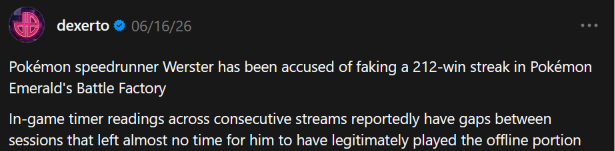
A 212-win doubles streak would therefore be extraordinary.

Seven battles make a round. Two hundred and twelve victories contain thirty complete rounds and two more battles: thirty rental fields received, inhabited, altered, survived, and discarded without a loss.
The streak attached to the Pokémon speedrunner known as Werster arrived in public without a complete public run.
That sentence is the entrance to the crisis.
The Record Arrives Without a Run.
In June 2026, Magpie Labs published an investigation titled “Did Werster Fake His Pokemon Factory Records?”. The central object was Werster’s claimed 212-win streak in Pokémon Emerald’s Open Level doubles Battle Factory.
The claim had circulated for years. Werster referred to it while streaming Factory play. It belonged to his public history as an unusually successful result, even though he had not submitted it to the community leaderboard as a formal record.
Magpie Labs approached the claim through traces left around it.
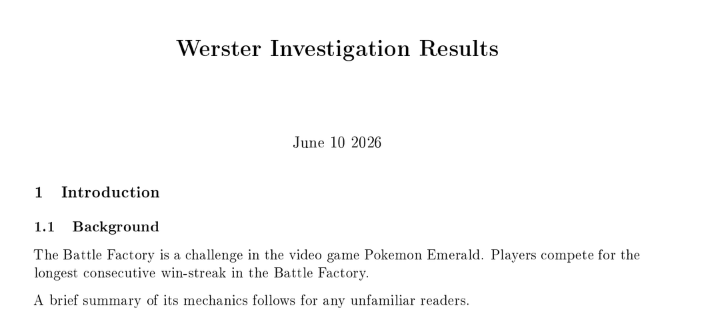
The investigation compared in-game clock readings across archived streams, reconstructed when the streak allegedly advanced offline, compared those windows with the amount of play apparently required, and examined the sharp difference between Werster’s recorded streamed performance and the perfect survival of the claimed offline portion. Later responses debated parts of the probability model and the meaning of Werster’s alleged RNG manipulation. The basic evidentiary problem remained: a spectacular streak had entered the community without the continuous record normally needed to make the route inspectable.
Werster responded that the streak had not been submitted because his own understanding of acceptable manipulation differed from the standards the Battle Factory community would apply. He described unintentionally reproducing favorable RNG states, especially involving a particular Starmie rental. He also distinguished this streak from a later, openly manipulated 504-win project.

That defense created a second problem.
In a video discussing the 504-win streak, Werster had described the earlier 212-win doubles result among his personal bests achieved without calculators, spreadsheets, or manipulation. Exarion’s response to Werster’s explanation argued that accidental manipulation frequent enough to explain the perfect streak would collide with Werster’s prior description of the run as manipless. Exarion concluded that the public response did not resolve the suspicion of save restoration or intentional manipulation inconsistent with the earlier account.

The public evidence does not currently justify Modal Path Ethics declaring exactly how the 212 streak was produced.
It justifies a narrower ruling:
The 212-win streak is an unsupported prestige claim under serious evidentiary pressure.
That is already enough for an ethical audit.

A leaderboard submission is a request for formal recognition. The community applies category rules, checks video, reviews timing, identifies forbidden tools, and either accepts or rejects the run.
An unsubmitted claim avoids that procedure.
It does not automatically remain private.

Werster did not whisper the streak into a locked drawer. The number entered public conversation. It shaped his identity as a Battle Factory player. It influenced how viewers interpreted his later analysis, how other runners located him in the field, and how extraordinary success was distributed across the community’s informal history.
This is where Active Information enters Pokémon.

Information becomes active when its uptake changes reachability. A ranking redirects attention. A diagnosis routes a person. A warning reorganizes behavior. A claimed record can assign standing before any formal institution stamps it.
The record did not have to enter the leaderboard to enter the field.
Once people use a claim to estimate expertise, the claim is already working.

Once a creator uses the claim to establish competence, the claim is already working.
Once the community remembers one person as capable of something no one else can reproduce, the claim is already working.
The absence of submission changes the kind of claim being made. It does not turn the claim inert.
This distinction matters because the first defense of the streak is also the easiest:
It was never submitted.
Correct.
That protects the formal leaderboard from one specific contamination.
It does not answer the informal authority accumulated around the number.
The unsubmitted streak cannot be stripped of a rank it never formally held.
It can still be stripped of its evidentiary function.
The proper current status is simple:
Interesting save file. Unverified historical claim. Zero institutional weight.
The rest of the crisis begins because the community had already given it weight.
Suspicion Needs Rules Too.
Cheating investigations create their own distorted field very quickly.
One suspicious object appears.

Then every old object begins glowing suspiciously.
A private video becomes concealment. A strange glitch becomes modification. An interpersonal conflict becomes motive. A forgotten statement becomes confession. A bad run becomes proof that a good run was impossible. A good run becomes proof that the cheater possessed enough skill to fake the better one.
Everything can be recruited.

This is the accusatory version of a sealed epistemic path. The hypothesis becomes capable of eating every possible answer.
- Silence means guilt.
- Denial means guilt.
- Explanation means sophisticated guilt.
- Technical expertise means the capacity to cheat.
- Lack of expertise means the performance was impossible.
- A long history means opportunity.
- A short history means a suspicious arrival.
- Deleted material means concealment.
- Preserved material means narrative management.
An investigation with this structure no longer needs evidence. It has learned how to convert existence into evidence.

The Werster case contains a very useful interruption to that process.
The accusation field made a specific claim.
Reality corrected it.
The Glitch That Was Innocent.
One of the historical suspicions concerned a Quick Claw appearing during Werster’s Pokémon Stadium 2 play.

Pokémon transferred from the first-generation games into Stadium 2 can receive held items according to values inherited through the old game data. The Quick Claw result looked impossible under the known mapping and especially suspicious in the context of a run beginning from a fresh Pokémon Yellow file. Quick Claw can allow a slower Pokémon to act first. In a speedrun, an impossible access path to a useful item would matter.
The initial investigation raised the possibility that the game or save had been altered.
Then the community found the glitch.

The apparently impossible result had a legitimate technical explanation. Exarion updated the public response accordingly: the Stadium 2 item event was not evidence of cheating.
This correction is one of the most important objects in the whole affair.
It does not rescue the 212-win claim. It does not erase the Sarah Hagan incident examined below. It does not resolve the community-governance record.
It proves the audit still has an outside.
- A strange result can be strange because the game is strange.

Pokémon’s early generations are ancient software catacombs full of values reused across systems, assumptions that survived only because nobody touched the wall, and mechanics that begin screaming when transferred through three pieces of hardware designed by people who did not know a YouTuber would place them under forensic examination thirty years later.

The accusation was plausible.
The accusation was wrong.
So it has to leave.

Modal Path Ethics does not keep false claims around as atmospheric support for true ones. Evidence receives local jurisdiction. The Quick Claw event supports the glitch explanation and nothing else.
This means the Werster audit begins by returning one object to him.
The Stadium 2 Quick Claw suspicion is closed.
That ruling does more than demonstrate fairness. It preserves the instrument.

A cheating investigation that cannot exonerate has become a punishment machine. A community that treats every corrected accusation as still “kind of suspicious” trains investigators to care about narrative direction over contact. The field then loses the difference between a warning and a verdict.
The difference is load-bearing here.

Magpie Labs identified real anomalies. One anomaly received a legitimate explanation. Other anomalies remain under pressure. The investigation becomes stronger when it surrenders the one the field repaired.
Correction runs both ways.
Sarah Hagan Enters the Leaderboard.
The Sarah Hagan incident has a different status.

During the current controversy, Exarion reported that Werster acknowledged in his Discord that he had created the cheated run published under the name Sarah Hagan. PulseEffects’ investigation places this admission inside a longer reconstruction of Pokémon speedrunning governance.

The historical object remains visible. A small YouTube channel under the Sarah Hagan name contains a Pokémon Red 1:48 Any% Glitchless “World Record” run. The run was presented as an ordinary emulator performance by an unknown player.
It was fabricated.

The stated purpose was not simply to steal a record for an alternate identity. Werster’s explanation, as reconstructed in the public discussion, was that the run demonstrated how easily emulator footage could be falsified with tool-assisted methods. Emulator submissions were already a live policy dispute. Another elite runner, Exarion, had produced emulator records. Werster believed the platform made undetectable cheating too easy.
So a false runner was created.

A false performance was produced.

The false performance entered a community deciding whether a whole class of performances deserved recognition.

The policy pressure was real. A surviving 2014 discussion records Pokémon Speedruns moving emulator performances out of world-record recognition because of cheated submissions, ease of falsification, and inconsistencies between emulator and console play. Werster’s own emulator Pokémon Yellow 1:55 was among the results that lost formal world-record status under the new standard. Participants disputed his exact role in the final decision, and the archived thread does not support reducing the entire policy change to one person. It does show the field responding to the kind of threat the Sarah Hagan fabrication was designed to instantiate.
This is the cleanest object in the Werster Crisis.
The run was false. The governance consequence was real.
The false performance did not need to win forever.
It needed to move the room.

This is active information in direct form. The fabricated run supplied almost none of the force used to change policy. The community supplied that force through its fear of illegitimate records, its need for verification, its trust in video evidence, its concern for platform accuracy, and its dependence on a few technically sophisticated participants to interpret what could be faked.
The fake run entered that prepared field and gave the fear a body.
A hypothetical weakness became an apparent event.

An argument became a witness.
That is more serious than ordinary cheating.
Ordinary leaderboard cheating presents false evidence to acquire a rank.
The Sarah Hagan run presented false evidence to reshape the conditions under which everyone else could acquire rank.
It acted on the rules.

It altered the legitimacy field around emulator users, including runners whose access to original hardware, capture equipment, cartridges, regional consoles, or acceptable video pipelines was limited. Even where emulator and console deserved separate categories, even where verification risk was genuine, the evidence used inside the debate had to remain real.
A policy can be defensible and still be corrupted by fabricated support.
That is the important cut.

The emulator question was not imaginary. Emulator timing, accuracy, tool access, hidden savestates, and TAS functionality are legitimate concerns for speedrun verification. A community can reasonably separate platforms, require stricter capture, distinguish real-time play from tool-assisted play, or limit which results receive a shared record designation.
Those decisions require honest evidence precisely because the underlying concern is real.

Fabrication spends the community’s capacity to trust on the advocate’s preferred solution.
The false run says:
You were right to fear this. It has already happened. Act now.
The community acts.
Then the advocate can point to the policy response as confirmation that the threat was serious.
The instrument has begun reading its own power.
The Policy Was Also a Speedrun.
A speedrun finds the shortest permitted path from the beginning state to the completion condition.
That skill is beautiful inside the game.
It becomes dangerous when carried into governance without a category change.
The legitimate policy path would have been slow and annoying.
- Document emulator inaccuracies.
- Demonstrate available TAS tools openly.
- Define which interventions cannot be distinguished from ordinary play.
- Compare hardware access costs.
- Separate timing accuracy from cheating access.
- Design platform labels.
- Require stronger capture where needed.
- Preserve emulator participation where verification remained possible.
- Let affected runners answer.
- Revise as better emulators and verification tools appear.
That route contains discussion, uncertainty, competing burdens, and the possibility that the advocate does not get the preferred answer.
The Sarah Hagan route skipped ahead.
- Produce the feared event.
- Let the event do the argument.
- Reach the policy screen faster.
- Let the event do the argument.
The governance run saved time by deleting the field’s right to encounter the real evidence.
This is what makes the incident larger than a prank, demonstration, or private proof of concept. A private demonstration disclosed as such would have been useful. A fabricated submission attributed to an invented runner was an intervention in the community’s epistemic environment.
The difference lies in what the receiving field was allowed to know.
- “Here is how I can fake a run” gives the community technical evidence.
- “Here is a new runner who apparently achieved this run” gives the community a false world.
Both may reveal a vulnerability.
Only one preserves consent around the demonstration.

The fake account made other people perform the experiment without knowing they had entered it.
This is where the Werster Crisis stops being a narrow question about whether one later Battle Factory streak was save-scummed.
The community had already encountered an admitted case in which false evidence was used instrumentally around governance.
That history does not prove the 212 streak fraudulent.
It changes the reasonable verification burden.
A prior fabrication aimed at policy is relevant to later unsupported prestige claims because both involve the same trust infrastructure: recorded play, technical interpretation, community standing, and the movement from “Werster says” to “the field knows.”
The earlier act established that evidence could be treated as a strategic object when the desired institutional outcome felt important enough.
A serious community should have responded by separating roles and raising verification requirements around that person’s future claims.
Instead, the authority continued.

That is the Crisis.
The Player Becomes the Steward.
Werster is genuinely excellent at Pokémon speedrunning.
The article has to keep saying this because the entire structure depends on it.

A weak runner with no technical knowledge could create a fake account. The attempt would probably fail, become a joke, and disappear into the soup of old internet nonsense.
Werster possessed field contact.
He understood routes, manipulations, emulator questions, leaderboard procedure, timing, records, game-specific mechanics, and the social structure of a young speedrunning community. He had completed an enormous range of runs across Pokémon and other series. His public comments show sustained involvement in category design, verification practice, moderation workflow, game organization, and the everyday maintenance work without which leaderboards decay.
The authority did not appear from nowhere.
It accumulated from useful work.

This is exactly how volunteer institutions are built.
- The person who knows the game becomes the person who verifies the game.
- The person who verifies the game becomes the person who understands the rules.
- The person who understands the rules becomes the person who writes the rules.
- The person who writes the rules becomes the person others consult when a strange submission arrives.
- The person others consult becomes the public interpreter of the field.
Nothing in this sequence is automatically corrupt.
In small technical communities, the active players often should govern. The RBY UU audit praised exactly this proximity. The council members inhabited the tier, watched what the rules produced, exposed their reasoning, conducted suspect tests, voted, reversed bans, restored old mechanics, and allowed the living field to correct their models.
Close authority can be excellent authority.
The Werster Crisis reveals its failure mode.
Field proximity becomes epistemic sovereignty when the same person can compete, verify, interpret, advocate, remember, and define the meaning of later evidence without sufficient correction distance.
This is role compression.

The earlier Pokémon VGC article used role compression to describe objects like Incineroar: one Pokémon supplies Fake Out, Intimidate, pivoting, disruption, defensive utility, tempo control, and repeated board access at a cost low enough to make alternatives difficult to justify.
Werster became an institutional Incineroar.

This is a terrible sentence. It is also correct enough to survive publication.
He could run the game, explain the game, moderate the game, propose the category, interpret the technical anomaly, remember the older dispute, know where the VOD went, assess another player’s credibility, and speak with the prestige of someone whose own performances helped define what high-level play looked like. He could bend time itself.
Each role strengthened the others.
- Skill supported expertise.
- Expertise supported moderation.
- Moderation supported authority.
- Authority supported credibility.
- Credibility supported the interpretation of disputed evidence.
- The interpretation of disputed evidence protected the authority produced by the earlier roles.
The package became self-supporting.

The problem cannot be reduced to one powerful moderator imposing arbitrary rules on helpless runners. Volunteer communities are messier. Other moderators existed. Administrators could intervene. Participants disagreed publicly. Werster sometimes advocated sensible procedures, including leaving notes in a moderation queue so another moderator would not accidentally verify a run already under investigation.
That suggestion is good governance.
It also reveals the institutional condition. The field depended on informal coordination among people whose access, expertise, competition, and authority overlapped.
A person could correctly identify the need for procedural safeguards while remaining insufficiently separated from the procedure.
Competence is not immunity from conflict of interest.

Competence increases the need to design around it.
Mystery Dungeon Leaves the Building.
The Pokémon Mystery Dungeon conflict shows role compression crossing a field boundary.

Pokémon Mystery Dungeon belongs to the Pokémon franchise. It is also a distinct game series with its own mechanics, routing knowledge, random structures, runners, history, and local problems.
- The word Pokémon connected it to the larger speedrunning institution.
- The actual games connected it to the people who ran them.
Those two forms of relation came apart.
A surviving Speedrun.com thread from roughly a decade ago records Werster asking for two Mystery Dungeon games to be moved from the Mystery Dungeon series grouping into the Pokémon series grouping. He described the split as “sloppy as hell,” said he considered them Pokémon games first, and argued that the communities were not really separate because they occupied the same Discord and shared some runners.
A site administrator responded with the structurally important possibility: assign moderators from the actual Mystery Dungeon community and disconnect the games from the larger series organization, because the field would probably operate better under people who ran it.

Werster rejected the need for separation. He said the games were already given to people who ran them and described a removed moderator, Hal, as terrible at the job: acting without consultation, verifying false times, inventing claims, and being “power hungry.” The public thread preserves the exchange.

PulseEffects’ later investigation adds testimony from people involved in the Mystery Dungeon scene. Their account is that Werster’s authority repeatedly entered local questions he did not understand from inside the game, that the broader Pokémon Discord became hostile to the smaller community, and that Mystery Dungeon runners eventually built a separate space.
The available public archive cannot independently reconstruct every private exchange described in those interviews.

It can establish the central jurisdictional disagreement:
Does authority follow the franchise label, or the inhabitants of the local field?
Werster’s own public principle was close to correct: “give mod to the people that run it.”

The failure came from treating membership in the broader Pokémon structure, personal participation in some games, and centralized series continuity as sufficient evidence that local authority already existed in the right place.
The Mystery Dungeon runners disputed that.

This extends the RBY UU lesson.

An institution does not become field-close because its leaders are generally knowledgeable about the franchise. Field proximity is specific. Pokémon Red expertise does not automatically produce Pokémon Mystery Dungeon jurisdiction. A person can be one of the strongest inhabitants of a neighboring field and still arrive here as an outsider with a title.

The category label becomes dangerous when it moves authority farther than knowledge.
- “Pokémon” was accurate.
- “Therefore governed through the main Pokémon structure” did not follow.
This is active information again.

A series label ranks relations. It tells the site which games belong together, which moderators stand above them, which Discord receives their disputes, which history counts as local precedent, and which people appear to possess standing before the discussion begins.

The label did not only describe the games.
It routed the games.

The Mystery Dungeon community eventually repaired that routing by leaving.
Exit is sometimes the only remaining correction when the shared institution can interpret every demand for local authority as fragmentation, messiness, ingratitude, or personal hostility.
The secession does not prove every complaint against Werster. It proves the original arrangement had failed to preserve usable local relation.

A community built another room because the first room could no longer hear it. That cost belongs in the audit.
The Prestige Shield.
Prestige is accumulated evidence.
A person becomes prestigious by doing things the field has reason to value.

They win. They discover. They teach. They preserve history. They solve difficult technical problems. They help newcomers. They perform under pressure. They explain what others cannot yet see. They contribute enough useful work that the community stops re-evaluating their competence from zero every time they speak.
This compression is necessary.

No community can investigate every sentence from first principles. Expertise preserves enormous amounts of reachable knowledge. Trust lowers the cost of coordination. Reputation lets a small field move without convening a tribunal whenever someone says the timer starts on file selection.
The Werster Crisis does not prove that prestige is fake.

It proves prestige has scope.
Prestige becomes a shield when the field stops asking which proposition the accumulated evidence actually supports.
Werster’s Pokémon speedrunning record strongly supports several claims.
- He is highly skilled at many Pokémon speedruns.
- He possesses deep technical knowledge of multiple games.
- He has contributed substantial labor to the community.
- He can perceive route structure inaccessible to casual observers.
- His explanations often deserve serious attention.
That record does not automatically support these different claims:
- Every unrecorded streak occurred as remembered.
- Every intervention in another subcommunity was field-informed.
- Every moderation conflict was accurately characterized.
- Every policy position was supported by honest evidence.
- Every disputed run should receive a lower verification burden.
- A critic lacks standing because they possess less prestige.
The migration from the first list to the second is the shield.

It usually happens without anyone announcing it.
A famous runner says a result occurred. The claim is plausible because the runner is famous for difficult results. A moderator interprets a technical anomaly. The interpretation is accepted because the moderator is also the person with the most technical experience. A local community objects. The objection is discounted because the central figure has a longer history, a larger audience, and more recognized achievements.

Each move is locally understandable.
Together they create epistemic sovereignty.

This is why excellence can delay repair.
The VGC article reached the same structure from another side. Brilliant players can produce deep, beautiful games inside an under-repaired official format. Their excellence becomes evidence that the format works. The burden they carry disappears behind the quality of the outcomes they salvage.
In the Werster Crisis, individual excellence made an under-repaired governance structure appear safer than it was.

- The community had a very skilled person doing many useful jobs.
- The jobs got done.
- The completed work hid the missing separation.
- Then a disputed claim arrived whose resolution depended on records, memory, technical knowledge, status, moderation history, and trust.
All the compressed roles activated at once.

The field discovered that its efficiency had been borrowing against correction.
The Archive Is Part of the Crisis.
The evidence in this case is scattered across a ruined little internet city.

- Old Speedrun.com threads.
- Reddit discussions from 2014.
- YouTube videos that became private.
- Twitch broadcasts preserved unevenly.
- Discord statements captured in screenshots.
- In-game clocks visible for moments in archived footage.
- Community recollections.
- Defunct leaderboard pages.
- Technical explanations found years after the suspicious event.
- Current investigators trying to reconstruct the route from whatever the web forgot to delete.
This is not a neutral inconvenience.

The archive structure determines which claims can be corrected.
Speedrunning depends on evidence more directly than most hobbies. The performance happens once. The leaderboard receives a representation of the performance: video, timer, input display, console capture, splits, save state, in-game clock, witness, or some combination. Verification reconstructs enough of the event to decide whether it belongs in the category.
Then the evidence decays.
A Twitch VOD expires.
A YouTube video becomes private.
A Discord server closes.
A message is deleted.
A moderator leaves.
A website changes ownership.
A screenshot loses the messages above and below it.
The category remains.
The conclusion remains.
The path that produced the conclusion becomes folklore.

Communities often experience this as memory. Everyone who was there knows what happened. New participants receive the result from trusted elders. The story functions because the local social field continues carrying it.
Then the elders disagree.
Now the field needs the archive it never built.

The Sarah Hagan incident survived as rumor for years before a reported admission stabilized the central fact. The emulator policy survived in public fragments that show the decision and dispute Werster’s exact role but do not contain every conversation that produced it. The Mystery Dungeon conflict survives partly through public posts and partly through later testimony about private community conditions. The Quick Claw accusation existed because archived footage preserved the anomaly long enough for others to test it. The same archive then permitted the glitch explanation to repair the accusation.

Preservation changes the moral field.
- A preserved run can be checked.
- A preserved moderation discussion can be contextualized.
- A preserved correction can stop an allegation from outliving its basis.
- A preserved falsehood can remain attached to the person who produced it instead of diffusing into institutional weather.
- A preserved disagreement can show that the community never possessed the consensus later history claims.
This is Anti-Oblivion at hobby scale.

The field retains.
Retention is still not permission.

Private messages do not become universally publishable because an investigation would find them useful. Participants deserve bounded spaces, ordinary conversation, error, and context. Total surveillance would destroy the community it claims to protect.
The repair is not “record everything forever.”

The repair is to preserve the decisions that act on others.
- Rule changes need durable public reasons.
- Verification disputes need durable findings.
- Moderator removals need accountable process.
- Conflicts of interest need visible recusals.
- Demonstrations used to justify policy need disclosed provenance.
- Corrections need to travel as far as the accusation.
Discord can host discussion.
Discord cannot remain the only constitution.

A governance field conducted through disappearing chat transfers future authority to whoever remembers most confidently.
That is a very bad archival standard around a person already carrying prestige.
The Community That Could Verify Everything Except Its Verifier.
Pokémon speedrunning can verify astonishingly small things.
- It can determine whether an emulator advances frames at the correct rate.
- It can reconstruct a random seed from encounters, damage, movement, and menu timing.
- It can distinguish a human run from tool-assisted input through tiny regularities.
- It can retime a record to the frame.
- It can inspect save data.
- It can compare route choices across versions, languages, consoles, capture methods, and timing conventions.
- It can discover that an impossible Quick Claw was produced by a real glitch buried inside old transfer logic.
This is a serious epistemic culture.

The crisis is that its strongest instruments were aimed at the run.
The verifier stood behind them.

A video can be examined for edits. A save can be examined for impossible state. A timer can be checked against category rules. A console can be required. An emulator can be versioned. An input file can be parsed.
But Prestige has no frame counter.
Moderator authority has no checksum.
A private Discord discussion has no stable replay.
A conflict of interest does not appear as a red split on the screen.

The field therefore developed precision at the object level and looseness at the authority level.
That arrangement works until the authority becomes part of the object under review.
Then every instrument points through the person who helped define how the instrument should be used.
This is why the Werster Crisis survives any eventual verdict on the 212 streak.
- Suppose decisive evidence appears tomorrow that the streak was produced exactly as Werster remembers.
The crisis remains.
A historical fabrication was used in a live governance dispute. Local authority crossed into Mystery Dungeon against serious resistance. Prestige and moderation remained compressed. The archive remained fragmented enough that a current controversy had to reconstruct a decade of institutional conduct through video essays and recovered posts.
- Suppose decisive evidence instead proves the streak was restored after losses.
The crisis remains, now with one additional confirmed object.
The community still has to ask why an unsupported claim accumulated standing, why prior fabrication did not trigger durable conflict-of-interest rules, why governance history was allowed to decay into testimony, and why correction depended on individual investigators performing unpaid archaeology.

The cheating verdict matters. It does not contain the whole case.
The unsupported record was the continuity of authority itself.
Werster’s institutional standing continued from contribution to contribution, record to record, dispute to dispute, community to community. Each local success became another reason not to interrupt the package. The field never performed a clean verification of whether the roles should still travel together.
This is ordinary institutional behavior.

People trust the person who kept the machine running yesterday.
Then, yesterday becomes
- tenure.
- Tenure becomes standing.
- Standing becomes jurisdiction.
- Jurisdiction becomes the right to interpret complaints about jurisdiction.
- Standing becomes jurisdiction.
- Tenure becomes standing.
The community did not decide all of this in one meeting.
It accumulated.

That is how local rules generate global structure.
The Crisis != a Call for Purge.
The internet knows one repair instrument extremely well.

- Remove the person.
- Delete the runs.
- Strip the records.
- Ban the account.
- Rewrite the history so everyone remaining was always suspicious.
- Turn the face into the whole field failure,
- then celebrate the field for identifying the face.
This is emotionally efficient.

It is also structurally incomplete.
Some sanctions may be justified. A fabricated submission can warrant record removal, suspension, loss of moderation authority, or other consequences under community rules. A proven manipulated record cannot remain verified. Repeated harassment or abuse of moderation can justify exclusion from governance spaces.

Modal Path Ethics does not oppose boundaries because boundaries are unpleasant.
It opposes using one person’s removal to erase the architecture that made the crisis possible.

The goal is a community in which Werster’s fame becomes irrelevant to the truth conditions of a run.
That requires repair at several levels.
1. Separate participation from authority.
A person can remain a runner without remaining a moderator.
A person can contribute technical knowledge without possessing final jurisdiction over a dispute involving their own claims, rivals, records, or preferred platform rules.

Loss of governance power does not require pretending the person has no skill. It recognizes that expertise and authority are different instruments.
2. Make recusal ordinary.
Any moderator whose run, record, close rival, prior public position, or personal dispute is directly implicated should leave the verification decision to others.

Recusal should carry no presumption of guilt. It protects the person and the field by preventing every decision from becoming a referendum on character.
3. Distinguish record classes.
A formally submitted record, an archived personal best, an unrecorded save-file claim, an exhibition using manipulation, and a private challenge result are different objects.
Communities should label them differently.

An unsubmitted claim can still be discussed. It should not inherit leaderboard prestige through repetition.
4. Preserve governance outside chat.
Rule changes, category decisions, platform restrictions, moderator removals, and major verification rulings need durable public logs.

The record should state the evidence, scope, dissent, decision, and correction path. Private details can remain protected while the institutional transition becomes visible.
5. Give local fields local authority.
Pokémon Mystery Dungeon runners should govern Pokémon Mystery Dungeon unless the local structure itself fails basic standards.
Franchise membership can support coordination. It does not create automatic jurisdiction.

The relevant expertise belongs to the people living in the game.
6. Review claims locally.
The Quick Claw event was explained. Keep it explained.
The Sarah Hagan fabrication was reportedly admitted. Keep it attached to that specific act and its governance implications.

The 212-win streak remains unsupported and disputed. Keep it there unless stronger evidence moves it.

Do not turn one proven act into automatic proof of every allegation. Do not use one exoneration to cleanse every separate concern.
7. Preserve return paths.
A community needs ways for people to acknowledge wrongdoing, lose specific authority, repair where possible, and later participate under clearer boundaries.
Permanent exile may be necessary in some cases. It should not be the only imaginable form of accountability.

A person who can never return has little institutional reason to disclose more than investigators can already prove. A field with defined restoration conditions can make truth more reachable.

Restoration does not mean automatic return to leadership.
Participation and sovereignty remain different.
Three Pokémon Fields.
The Pokémon thread now contains three governance objects.
RBY UU gave us a small unofficial council maintaining a decades-old competitive field through public reasoning, formal thresholds, suspect tests, bans, unbans, and visible reversal.

The council was valuable because it could be wrong in public.

Pokémon VGC gave us an official competitive field whose inhabitants often supplied more practical repair intelligence than the institution above them. Players made unstable formats knowable through testing, teaching, documentation, team construction, and repeated adaptation.

Their excellence kept the field alive and sometimes concealed how much repair labor had been transferred onto them.

The Werster Crisis gives us the third object.
A volunteer field produced a highly capable inhabitant. The inhabitant became a runner, historian, interpreter, moderator, advocate, verifier, and prestige center. The community gained tremendous knowledge and labor from the compression. It also lost the distance required to verify the authority once authority itself entered the dispute.

The three cases form a sequence.
- Close governance can become corrigible stewardship.
- Distant governance can force inhabitants to repair the field themselves.
- Compressed governance can make one inhabitant too continuous with the instruments of correction.
The solution is not distance for its own sake.

RBY UU shows why distant outsiders can govern badly. Mystery Dungeon shows why franchise-level insiders can still be local outsiders. VGC shows why official authority without field attention becomes under-repair. The Werster Crisis shows why expertise without role separation can become sovereignty.
The target is corrigible proximity.

- The steward should know the field.
- The field should still be able to correct the steward.
The Ruling.
The Battle Factory removes the player’s team every seven wins.

Pokémon speedrunning carried the same authority forward for more than a decade.

That is the Werster Crisis.

The current Battle Factory allegation should be handled precisely. The 212-win streak was not submitted as a formal record. Public analysis places it under serious suspicion. Werster’s responses have not supplied a continuous evidentiary path capable of verifying the claim. The proper status is unsupported, not adjudicated.

The Stadium 2 Quick Claw event has a legitimate glitch explanation. That allegation is closed.

The Sarah Hagan run was fabricated, according to Werster’s reported acknowledgment. Its importance lies in the use of false evidence inside a real platform-governance dispute. The run was false. The community’s response was real. A demonstration could have preserved truth. The sockpuppet performance instead made other runners inhabit a staged threat without knowing it had been staged.

The Mystery Dungeon conflict reveals the jurisdictional companion failure. Authority followed the broad Pokémon structure farther than local field contact justified. The local community eventually made exit reachable by building another space.

None of this makes Werster talentless.
His talent is one of the conditions of the crisis.

He became trusted because he repeatedly did difficult things, knew obscure things, contributed useful labor, and helped make Pokémon speedrunning visible. The field had reasons to listen.
Then listening became deference.
Deference became standing.
Standing became jurisdiction.
Jurisdiction became part of how later evidence was heard.

Prestige is accumulated evidence. It becomes a shield when institutions stop asking which claim it actually supports.
Pokémon speedrunning built extraordinary instruments for proving that a run occurred.
- It could inspect the timer.
- It could inspect the emulator.
- It could inspect the save.
- It could inspect the random seed.
- It could inspect the impossible item and eventually discover that the impossible item was possible after all.
The community’s weakest object was the person positioned behind those instruments.

The repair cannot be a ritual destruction of Werster followed by a clean leaderboard and a relieved field. The field owes itself recusal, local jurisdiction, durable governance records, scoped prestige, differentiated claim classes, independent review, and correction paths that do not depend on one investigator assembling the past from dead links.
Werster can be a great runner without being an epistemic sovereign.

That is the humane ruling.
It is also the only ruling that actually repairs anything.
The Battle Factory keeps asking whether knowledge survives the loss of the team.

Pokémon speedrunning now faces the harder version.
Can the field preserve everything one extraordinary inhabitant taught it after the field stops asking that inhabitant to stand in every role at once?
It should.
It has the records.

It has the runners.

It has the technical intelligence.

It has the evidence of what role compression costs.

Now it needs a fresh draft.

Choose three.

Leave sovereignty behind.