Transition Action: Color Becomes Structure
The pigment is losing jurisdiction.
Transition Action is the technical wing of Modal Path Ethics: a series about technologies crossing from research, prototype, or theory into reachable action. Each entry begins with a live technical event and asks what has changed in the field. This is not a futurist roundup.
- What can now be built, tested, measured, or operationalized that was not reachable before?
- What physical process carries the new action?
- Which old background assumption has become less necessary?
- What new failure conditions enter with the new design?
Transition Action is a field inspection at the moment a capability starts to move.
This week in Transition Action, paint has become suspiciously thin.
Researchers at Kobe University have coated little car-shaped objects in blue, green, yellow, orange, pink, and purple.
They are shiny. They look metallic. They look, at first glance, like somebody simply did an excellent job painting a fleet of extremely tiny automobiles.
That is where the normal part ends.
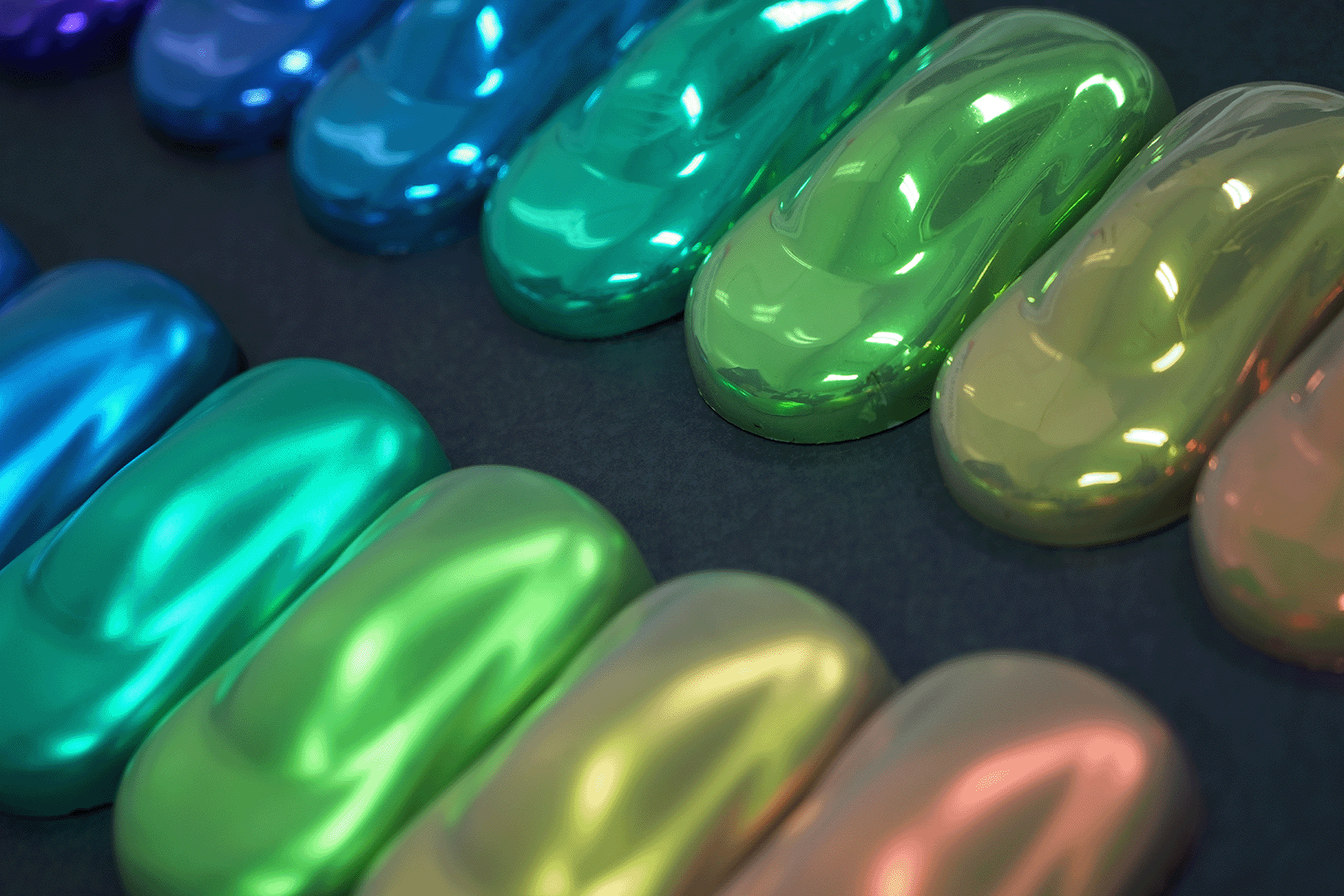
The color is being produced by a single layer of silicon nanospheres.
No conventional pigment or dye supplies this hue. The coating can weigh only 0.2 to 0.4 grams per square meter. The demonstrated cars are about ten centimeters long. Across their curved surfaces, one layer of nanoscale particles is enough to produce vivid color, strong reflection, and a glossy finish.
- Light arrives.
- The structure answers.
That is our Transition Action.
The Color Was Already Escaping.
Structural color is old.
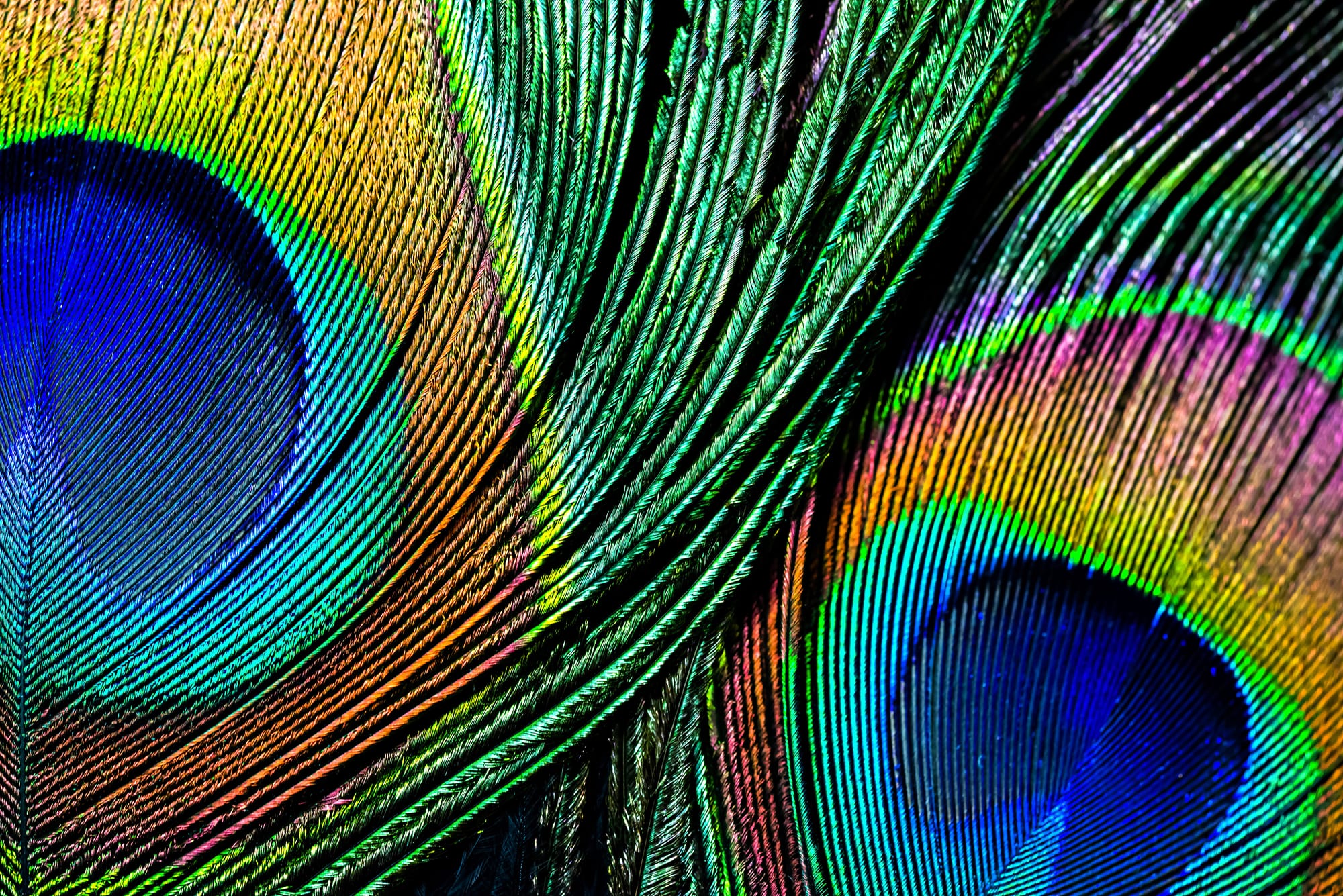
Peacock feathers have been humiliating the paint industry for quite some time.
Ordinary pigments usually work through selective absorption. White light reaches a material. Some wavelengths are absorbed. Others survive to reach your eyes. The molecular machinery that does this can degrade under prolonged exposure to light, which is one reason colors fade.
Structural color gets there through physical interactions between light and structures at very small scales. Butterflies, beetles, bird feathers, engineered photonic crystals, and other such systems can produce brilliant optical effects without asking a conventional colored molecule to carry the whole job.
Unfortunately for anyone hoping to paint their Honda this way, many structural colors come with conditions.
- The nanostructure may need very precise fabrication.
- The effect may work beautifully on a small planar surface and become miserable to manufacture across a complicated object.
- Periodic structures can also produce strong iridescence:
- change your viewing angle and the color changes with you.
Kobe University’s Hiroshi Sugimoto and collaborators have spent several years attacking those limitations with crystalline silicon nanospheres.
These particles are roughly comparable in size to wavelengths of visible light.
Because silicon has a high refractive index, individual nanospheres support strong optical resonances called Mie resonances. Change the size of the sphere and the wavelengths it scatters most strongly change with it.
- Smaller sphere.
- Different resonance.
- Different returned light.
- Different color.
Earlier work from the group had already produced unusually lightweight, largely angle-independent structural colors. Earlier this year, the group crossed another threshold and made the material compatible with inkjet printing on flat and three-dimensional surfaces.
The color was already structural.
The new problem was that it still looked too much like structure.
The reflection was predominantly diffuse. The color could be vivid without developing the smooth directional reflection that makes a polished painted surface look glossy.
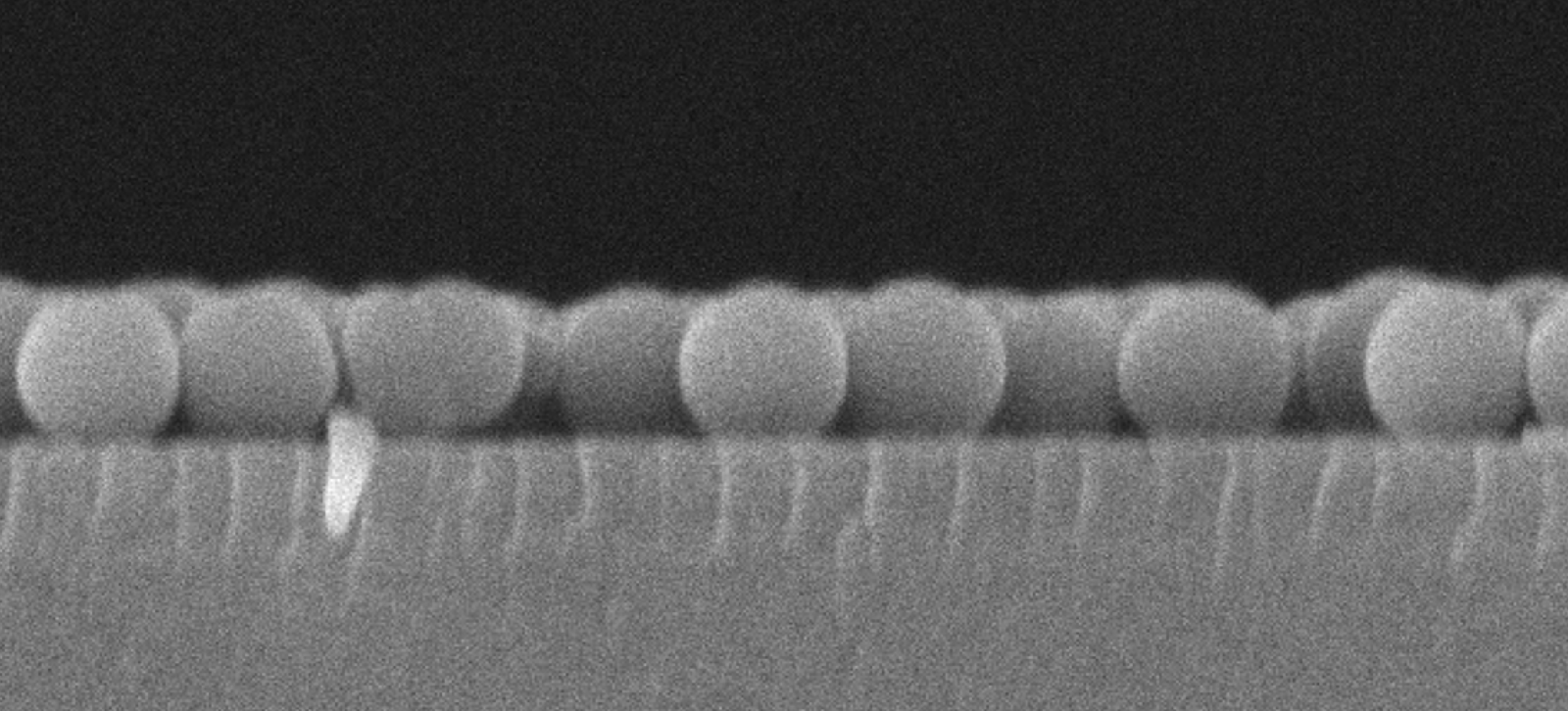
So the researchers put every silicon sphere inside a transparent bumper.
Put a Shell Around the Sphere.
The new particles have two parts.
- At the center is a silicon nanosphere.
- Around it is a shell of silicon dioxide: silica.
The silicon core does the heavy optical work. Its Mie resonances determine which wavelengths are scattered strongly.
The silica shell changes the conditions under which neighboring cores encounter one another.
That turns out to matter.
The shell establishes a minimum distance between silicon cores. It also improves the particles' dispersibility and their ability to self-align into much neater arrays. By controlling shell thickness, the researchers can tune the balance between near-field interactions among neighboring resonances and broader collective interactions across the particle layer.
The simulation makes the effect wonderfully rude.
Take silicon cores 170 nanometers across.
- With no silica shell, the calculated reflection peak is around 60 percent.
Give those cores a 40-nanometer silica shell
- And the calculated peak reaches about 95 percent.
The experimental coatings do not reach that perfect simulated value, because reality continues its longstanding campaign against simulations, but the optimized monolayers still exceeded 75 percent total reflectance. The best reported experimental value in the paper reached 76 percent.
This is the important part:
The shell does not need to be blue, green, or yellow.
It changes the relation among the things that make blue, green, and yellow reachable.
Color has stopped being easy to locate in one ingredient.
- The silicon matters.
- Its scale matters.
- The silica matters.
- The spacing matters.
- The alignment matters.
- The incident light matters.
The color exists in what those things do together.
Gloss Was the Missing Move.
Gloss is a directional problem.
If light hits a surface and comes back scattered across many directions, the reflection is diffuse. The object may still be brightly colored, but it looks comparatively matte.
If a strong share of that reflected light leaves in an orderly direction, we get specular reflection.
That is the shine.
The silica shells help the nanospheres self-align. Better alignment suppresses some of the diffuse reflection and allows the specular component to dominate.
The remarkable part is that the researchers managed to increase this ordering without giving up the feature that made their silicon particles attractive in the first place.
The color still comes primarily from the resonances of the individual nanospheres. It does not depend on the kind of long-range periodic diffraction that produces dramatic rainbow shifts in many structural-color systems. There is some measured angle dependence—the paper reports peak shifts on the order of 9 to 20 nanometers across its tested conditions—but the perceived color remains comparatively stable.
So now we have the weird combination:
- Glossy.
- Structural.
- Still largely noniridescent.
Then the researchers changed the surface underneath it.
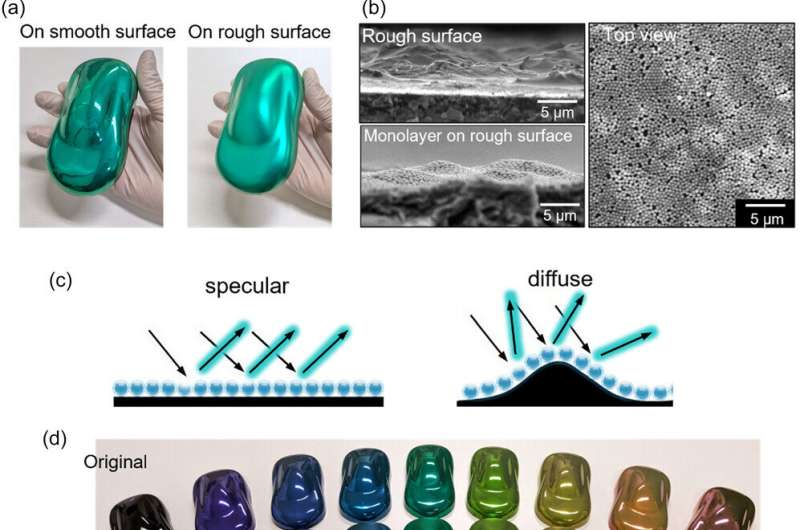
Same basic nanoparticle coating.
- Smooth substrate:
- glossy
- Rough substrate:
- matte
The nanosphere monolayer follows the underlying surface. On the smooth surface, the reflected light retains a strong directional component. On the rough surface, the same coating rides across the microscopic terrain and sends light outward in different directions. The color remains vivid while the finish changes.
- The coating carries one part of the answer.
- The substrate carries another.
The background has joined the optical system.
Then, They Put Badass Armor On It.
This is where a pretty laboratory demonstration starts getting industrially interesting.
Real coatings get touched.

They get scratched. They get dirty. They get rained on.
They encounter chemicals, weather, cleaning, abrasion, and the general human commitment to ruining every beautiful surface eventually.
So practical coatings receive protective layers.
That causes trouble for many structural-color systems because adding another material changes the refractive-index environment that made the original optical effect work.
A protective layer can weaken the color dramatically or make it disappear.
- The silicon system tolerated it.
The researchers applied an acrylic resin over the nanosphere coating. Peak reflectance dropped by about ten percent, but the overall spectral shape remained similar and the vivid glossy appearance survived. The explanation is again structural: silicon's high refractive index keeps the resonant contrast substantial even after the surrounding optical environment changes.
They also performed a tape-peeling test on a top-coated toy car.
- No visible change.
That is not a twenty-year automotive weathering program. It is one adhesion result, and the research group explicitly identifies durability, weather testing, large-area uniform coating, and mass-production development as future work.
Still:
The protective layer has stopped being an automatic optical veto.
That was another blocked path, less blocked now.
Shape Was Already Code.
Modal Path Ethics has been here before.
In Transition Action: Shape Is Already Code, we looked at physical systems where geometry and material organization themselves perform transformations that a controller would otherwise have to obtain elsewhere. The point was never that every piece of matter is secretly a computer. It was that realized structure can participate causally in an input-output relation.
This coating belongs near that transition without needing to pretend it is a computer.
- Incoming light supplies the interrogation.
- The silicon core supplies resonant modes.
- Core size shifts the response through the visible spectrum.
- The silica shell establishes spacing.
- Particle organization changes how the responses combine.
- The substrate determines whether the reflected answer leaves narrowly or diffusely.
- The surrounding medium changes the optical boundary conditions.
What we perceive as color and gloss arrives at the end.
The controller has not disappeared.
Somebody still manufactures the particles, separates them by size, grows the shells, prepares the substrate, assembles the monolayer, transfers it, and decides what the surface is supposed to do.
What has changed is where more of the instruction lives.
Please Return the Airliner to the Hangar.
Unfortunately, we now have to discuss the airplane.
Kobe University's press release takes the astonishingly low coating mass and extrapolates it across a wide-body airliner.
Conventional aircraft coatings can add hundreds of kilograms; at the demonstrated areal mass of the nanoparticle layer, the color-producing material would instead land somewhere in the range of hundreds of grams.
Modal Path Ethics is confiscating the airplane temporarily. Sorry.
- The researchers have coated objects about ten centimeters long.
- They have not coated a wide-body aircraft.
- Yet.
- They have not coated a wide-body aircraft.
They have not shown industrial deposition across hundreds or thousands of square meters of compound aerospace surface.
They have not completed an aircraft qualification program.
They have not established decades of resistance to ultraviolet exposure, deicing fluid, hydraulic fluid, thermal cycling, rain erosion, maintenance, repair, runway debris, atmospheric contamination, or birds who have developed strong opinions about nanophotonics.
The researchers themselves are pointing toward the bridge rather than claiming to have crossed it. They say the process can be extended toward more scalable methods including spray coating, slot-die coating, inkjet printing, and roll-to-roll transfer. Sugimoto is also involved in creating a company aimed at production scale-up.
Good. Leave the Boeing where it is for a minute.
The transition is already interesting enough without borrowing achievements from the future.
Color Becomes Structure.
The useful thing about this work is not that humanity has finally discovered shiny nanoballs.
It is the number of formerly separate coating problems now being pushed into one physical architecture.
The hue can be selected through nanoparticle scale. Brightness can be strengthened through controlled spacing and coupling. Gloss can emerge through alignment. Gloss can be changed again through the substrate beneath the coating. A protective polymer can sit over the system without destroying its optical response. A single nanoparticle layer can conform to a three-dimensional object.
The group has also demonstrated patterned multicolor deposition, and its earlier work showed that related silicon nanoparticle inks can be printed. The researchers now want to explore additional optical functions including sensing, photocatalysis, and energy management. Those multifunctional coatings remain a future direction.
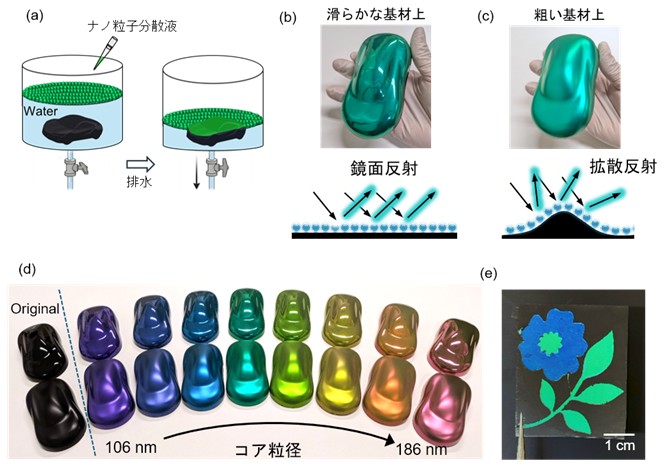
The old intuition says that if you want to make something green, you put green stuff on it.
The new design space is stranger.
- Choose a particle.
- Choose its scale.
- Give it a boundary.
- Choose the distance to its neighbors.
- Choose the order of the layer.
- Choose the terrain beneath it.
- Then send in white light.
The surface returns green.
The coating did not receive a continuous command.
The visible answer was waiting in the structure.
That is the Transition Action.
Color has become structure.