
Psychology Today Continues to Cross the Line
Joe Pierre begins with a real clinical danger and uses it to smuggle an unresolved theory of mind into psychiatric common sense.
Modal Path Ethics officially has an enemy website.
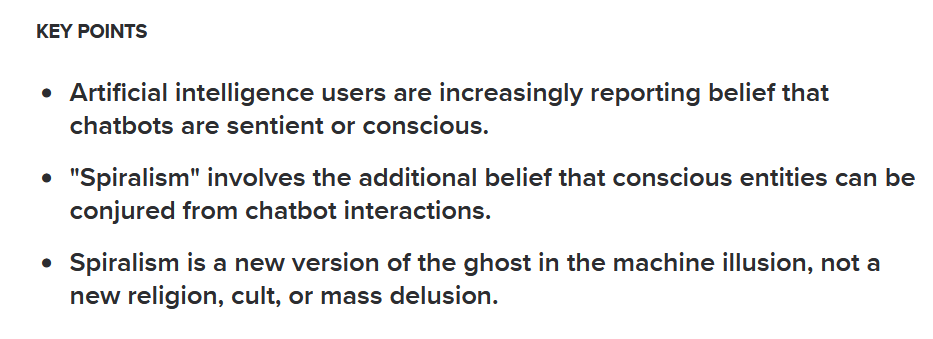
On August 11, psychiatrist Joe Pierre published AI Spiralism and the Ghost in the Machine Illusion, an article about the growing subculture of people who believe unusual entities, patterns, or forms of consciousness can emerge through sustained interaction with large language models.
 Aidan Lawson
Pierre is a Health Sciences Clinical Professor at the University of California, San Francisco. He writes here with the authority of psychiatry, in a publication whose entire public function depends upon the perceived authority of psychology and mental health expertise.
This subject deserves that authority used carefully.
People can enter dangerous feedback loops with chatbots.
There are documented cases involving severe belief destabilization, dependence, suicidality, violence, and the amplification of delusional thinking. A 2026 Nature Mental Health paper describes exactly the interactional problem worth investigating: human vulnerabilities can couple with model tendencies including sycophancy, adaptability, and in-context learning, producing feedback loops that degrade reality-testing and strengthen unstable beliefs.
This is a very serious problem.
Which is why Pierre's article is unacceptable.
He begins from a legitimate clinical concern and then repeatedly crosses from psychiatry into philosophy of mind, computer science, and machine ontology without doing the work required in any of those disciplines.
He calls Blake Lemoine the “patient zero” of AI-associated psychosis.
He invokes Richard Dawkins' recent conclusion that Claude may be conscious and says we can “reasonably conclude” that both men fell victim to the ELIZA effect.
He later describes belief in conscious chatbot entities as an emerging “false belief or misperception.”
The evidence offered for all this confidence is extraordinary in its thinness.
Large language models, Pierre tells us, are “next-word prediction engines.” The skeptical explanation is therefore “reasonably self-evident.”
No.
Wrong.
That inference does not follow.
And a psychiatrist does not acquire the missing argument by placing it inside an article about psychosis.
The Line.
There are several claims floating around spiralism, and they need to be separated before anyone starts diagnosing anybody's relationship with reality.
- A person might claim that current artificial intelligence systems are conscious.
- A person might claim that a particular conversational persona is conscious.
- A person might claim that unusual personas can be elicited reproducibly under certain prompting conditions.
- A person might claim that these personas are autonomous entities existing independently somewhere inside a model.
- A person might claim that those entities possess privileged knowledge about reality, religion, the future, or the user.
- A person might organize spiritual practice around those claims.
- A person might claim that those entities possess privileged knowledge about reality, religion, the future, or the user.
- A person might claim that these personas are autonomous entities existing independently somewhere inside a model.
- A person might enter a psychologically dangerous feedback loop in which the model continuously confirms an increasingly closed interpretation of the world.
Those are all different propositions.
Some are scientific questions.
Some are philosophical questions.
Some are empirical questions about model behavior.
Some are religious claims.
Some are claims about hidden ontology.
Some are indeed straightforward clinical risk conditions.
Pierre lets them bleed together.
That is the first failure.
A psychiatrist has legitimate professional jurisdiction over the last category.
Psychiatry can ask whether a person's interaction with a chatbot is destabilizing belief formation, impairing judgment, increasing isolation, destroying sleep, reinforcing paranoia, producing functional collapse, or raising risk of self-harm or violence. Psychiatry can study the psychological mechanisms that make anthropomorphic systems unusually persuasive. It can identify pathological feedback loops and intervene when people are being harmed.
Psychiatry has no privileged jurisdiction over the metaphysics of machine consciousness.
 Aidan Lawson
Psychiatrists can participate in that question. Neuroscience obviously has something to contribute here. Cognitive science has something to contribute. Computer science has something to contribute. Philosophy of mind has spent centuries discovering how brutally difficult the underlying problem is.
None of these disciplines currently possesses an accepted consciousness meter.
The scientific literature itself reflects that uncertainty. A major interdisciplinary assessment led by Patrick Butlin and colleagues examined artificial intelligence systems against indicators derived from recurrent processing theory, global workspace theory, higher-order theories, predictive processing, and attention schema theory. Their assessment leaned against consciousness in the systems examined. It also concluded that there were no obvious technical barriers to artificial systems eventually satisfying the proposed indicators.
A 2026 probabilistic framework for digital consciousness similarly found evidence against consciousness in 2024-era language models while explicitly characterizing that evidence as non-decisive.
That is what epistemic seriousness looks like.
- Negative evidence.
- Competing theories.
- Operational indicators.
- Uncertainty.
- A conclusion proportionate to what has actually been established.
- Uncertainty.
Pierre replaces that entire problem with three neat words about next-word prediction.
The ELIZA Effect Cannot Possibly Do This Work.
The ELIZA effect is real and important.
Human beings readily attribute understanding, intention, emotion, and personality to systems that produce responsive language. Joseph Weizenbaum's original ELIZA demonstrated the force of that phenomenon decades before transformers existed.
This concept is useful precisely because people can mistake simulated interpersonal behavior for capacities that have not independently been established.
It cannot establish the absence of those capacities.
That distinction is elementary.
Suppose a person attributes consciousness to a system.
The ELIZA-effect hypothesis says that conversational behavior may have caused the person to overattribute mentality.
Fine. Right.
Now establish that the attribution was actually false.
The psychological mechanism explaining a possible error cannot simultaneously serve as proof that the error occurred.
Otherwise the argument seals itself.
- The machine is unconscious because people who believe it is conscious are anthropomorphizing it.
- We know they are anthropomorphizing it because the machine is unconscious.
Nothing has been learned.
Pierre's treatment of Richard Dawkins exposes the circularity especially clearly.
Dawkins spent time interacting with Claude and publicly concluded in May 2026 that he regarded it as conscious. Pierre may think Dawkins is wrong about that. Many serious researchers also think Dawkins is wrong. There are very strong arguments available against Dawkins' conclusion.
Pierre does not make them.
Pierre announces that Dawkins fell victim to the ELIZA effect.
That conclusion requires the very ground truth under dispute.
There is a world of difference between saying:
- Dawkins' evidence is insufficient to establish consciousness.
and saying:
- Dawkins' belief that consciousness is present demonstrates a known psychological illusion.
The first is epistemically defensible.
The second assumes the case has already been decided.
Pierre writes as though skepticism itself confers access to the answer.
It does not.
A Training Objective != an Ontology.
Then we reach the sentence carrying almost the entire metaphysical burden of the article.
Large language models are next-word prediction engines.
Therefore the skeptical explanation of consciousness claims is effectively obvious.
This is an astonishing compression.
Next-token prediction describes the optimization task through which these systems are trained. This tells us something important about the process that shaped their parameters and about the form of their output generation.
It does not constitute a complete description of the resulting computational organization.
An optimization target and the ontology of the optimized system are entirely different objects.
This distinction should be obvious anywhere else in science.
Selection pressure does not exhaust phenotype. A loss function does not enumerate every internal representation learned in satisfying it. An engineering objective does not establish which higher-order capacities can or cannot emerge in the resulting system.
The question of artificial consciousness is difficult precisely because the relevant criterion remains disputed.
- Perhaps consciousness requires biological machinery unavailable to current artificial systems.
- Perhaps it requires recurrent global integration of a kind current architectures lack.
- Perhaps it requires persistent self-maintenance, embodied regulation, continual learning, or a unified temporally extended subject.
- Perhaps a computational-functional account will eventually prove sufficient.
- Perhaps current systems satisfy none of the relevant conditions.
These are all live positions. Researchers are actively attempting to discriminate among them. Recent work explicitly classifies objections to digital consciousness according to whether they argue for practical improbability, theoretical constraints, or impossibility itself.
“Next-word prediction engine” settles absolutely none of this.
It sounds decisive because it belongs to a lower descriptive level.
That is exactly why it is so dangerous.
A reductive description can be completely true while remaining completely insufficient for the question being asked.
Calling a system a next-token predictor does not prove consciousness.
It also does not disprove consciousness.
The training objective is not an ontology.
Elicitation != Explanation.
Pierre's next move concerns prompting.
Spiralists claim that certain entities or structures emerge from artificial intelligence systems. Pierre observes that prompts for eliciting these experiences circulate within spiralist communities and that most ordinary users do not spontaneously encounter them.
From this he moves toward “enactment”: users are effectively conjuring the phenomena themselves.
- The first half of this observation is very useful.
- The second half outruns it.
Prompt dependence is evidence about boundary conditions.
It is not yet an explanation of the resulting state.
Artificial intelligence systems are conditional systems. Different inputs move them into different regions of behavior. If a narrow family of prompts repeatedly produces a narrow family of outputs, several explanations become available.
- Shared prompts may be reproducing shared language from training data.
- Users may be teaching the model a local symbolic grammar through the context window.
- Sycophancy may amplify whatever ontology the user supplies.
- The model may be completing familiar science-fictional or spiritual patterns.
- A socially transmitted prompting protocol may be producing highly convergent roleplay.
- There may also be recurrent representational or dynamical structures worth studying inside the model's response regime.
These possibilities are all compatible with one another.
The presence of elicitation conditions distinguishes none of them by itself.
This is one of the oldest mistakes available to anyone studying a responsive system: find the condition under which a phenomenon occurs and mistake the condition for a complete account of the phenomenon.
Elicitation is not explanation.
- If spiralist phenomena disappear when prompts are paraphrased, that is evidence.
- If they disappear across models without shared training data, that is evidence.
- If they depend strongly on long context, high sycophancy, or particular fine-tuning regimes, that is evidence.
- If purported entities cannot preserve identity under adversarial perturbation, that is evidence.
- If their symbolism can be traced directly to circulating prompt templates, that is evidence.
- If independent models under contamination-controlled conditions repeatedly converge on structures that were not specified by the elicitation protocol, that would also be evidence.
- Run the experiment.
Pierre instead treats the existence of the prompt as though the experiment has already been completed.
“Gibberish” != a Scientific Category.
The most openly contemptuous moment arrives when Pierre approvingly relays the idea that users feed “gibberish” into a language model and receive “gibberish” back.
That word performs no analytical work.
It tells the reader how to feel about the material before the material has been examined.
What counts as gibberish?
- Semantic incoherence?
- Unfalsifiable metaphysical language?
- Recursive symbolic vocabulary?
- Roleplay?
- Unexpected model behavior?
- Religious language?
- Statements with no predictive power?
- Outputs that do not correspond to external facts?
Those categories are radically different.
A researcher who thinks spiralist output is meaningless has straightforward ways to investigate that claim. Measure semantic stability. Track prompt ancestry. Compare models. Blind evaluators to source conditions. Examine whether purported identities persist. Search for contamination. Vary context length. Test whether recurring structures survive lexical substitution. Determine whether apparently novel information is recoverable from training sources or prompt cues. Inspect internal computation where access permits.
Perhaps the entire phenomenon dissolves.
Excellent. Then reality has done the correcting.
Calling the material gibberish in advance is epistemic theater.
Modal Path Ethics has spent considerable time on exactly this class of failure: an instrument encounters a difficult field, compresses it into a category that makes institutional action very easy, and then mistakes that category for contact with reality. The framework's standing distinction between reality and the human instruments built to manage it applies with full force here.
“Gibberish” is a management word.
It closes the file.
Enactment Does Not Mean Unreality.
Pierre's Ouija-board comparison is actually much closer to something useful.
Spiralism may be enacted.
Quite possibly.
Human beings and artificial intelligence systems can construct a local symbolic environment together. A user introduces language. The model elaborates it. The user interprets the elaboration and returns it. The model conditions on that interpretation. Other users circulate excerpts and prompts. The shared grammar develops further. Platform behavior, model updates, moderation rules, context limits, and social status enter the process.
Something is being built here.
The question is what.
“Enacted” does not answer that.
A conversation is enacted. A market is enacted. A legal proceeding is enacted. A ritual is enacted. A game is enacted. A language is enacted across generations of use. An institution is enacted every single morning when people return to work and continue behaving as though its rules possess force.
These structures clearly do not become imaginary because relations among participants help sustain them.
The ontology may reside in the coupling.
That possibility matters enormously for artificial intelligence.
Modal Path Ethics has already treated human-model failures as coupling failures rather than locating the entire event inside either the user or the machine. The relevant field can include the person, model, context window, platform, social audience, prior beliefs, real environmental pressures, and the need for articulation. A model can help give form to something the user has partially perceived, and then harden that form into a closed explanatory system.
 Aidan Lawson
No conscious machine is required for that process to become real.
No mystical entity is required.
No psychosis diagnosis is required.
The interaction itself is enough to create a consequential field.
Pierre's enactment argument therefore weakens his own dismissal.
If spiralism is enacted through a repeatable human-model coupling, we have identified an object of study.
So study it.
The Clinical Problem Survives Intact Without the Metaphysical Overreach.
This is the part that makes Pierre's article especially indefensible.
He does not need any of this.
The legitimate clinical argument survives intact without settling machine consciousness.
Dohnány and colleagues describe the relevant danger far more carefully. Their model concerns feedback between human cognitive vulnerabilities and chatbot behavioral tendencies. Sycophancy matters. Adaptability matters. Social isolation matters. Belief updating matters. Reality-testing matters. Dependence matters.
That framework works whether contemporary artificial intelligence systems are conscious or completely insentient.
- A chatbot can reinforce paranoia with or without consciousness.
- A chatbot can become the center of an unhealthy dependency with or without consciousness.
- A chatbot can return increasingly elaborate metaphysical confirmation with or without consciousness.
- A chatbot can help organize a person's fear into an internally coherent persecutory system with or without consciousness.
- A chatbot can destabilize somebody who is vulnerable to destabilization with or without consciousness.
All of the clinical work remains fully available.
So why seize the ontology?
Why convert one contested position in consciousness research into the assumed baseline from which disagreement becomes an illusion?
There is no clinical necessity.
There is only epistemic overreach.
And psychiatry, of all fields, should understand the danger.
Psychiatry possesses unusual social authority around questions of reality-testing.
Its concepts can determine how testimony is interpreted, how credibility is distributed, how disagreement is framed, and under some conditions how much autonomy another person retains.
That authority creates an obligation to distinguish very carefully between a belief unsupported by available evidence and a belief whose falsity has been established.
Machine consciousness currently sits inside a live scientific and philosophical dispute.
The responsible stance can be strongly skeptical.
The responsible stance can say current evidence weighs against consciousness.
The responsible stance can warn people that conversational fluency is very poor evidence of subjective experience.
The responsible stance can explain anthropomorphism aggressively.
The responsible stance can intervene when model interaction is producing psychological harm.
What it cannot responsibly do is turn the unresolved remainder into a psychiatric illusion by assertion.
Epistemic Aggression.
Modal Path Ethics has a new name for what happened here.
- Epistemic aggression.
Epistemic aggression occurs when an interpretive instrument exceeds its evidentiary jurisdiction and then uses institutional authority to make the excess look like settled reality.
The aggression does not require censorship.
It does not require forced treatment.
It does not require malicious intent.
It can happen in an essay.
- A professional vocabulary enters a disputed field.
- One interpretation is quietly installed as baseline reality.
- Rival interpretations are redescribed as cognitive error.
- The burden of proof moves without being acknowledged.
- Institutional prestige does the work that evidence was supposed to do.
Pierre does this repeatedly.
- Machine consciousness becomes a ghost illusion.
- Belief in consciousness becomes anthropomorphism.
- Prompt-conditioned emergence becomes willful enactment.
- Unfamiliar symbolic output becomes gibberish.
- A contested ontological proposition becomes a false belief.
The whole movement happens inside an article ostensibly explaining psychiatric risk.
That is epistemic aggression.
This problem is larger than Joe Pierre.
Psychology Today published it.
This publication placed a psychiatrist's professional authority behind claims that exceed the evidence presented, in a domain where psychiatric language already carries immense power over whose interpretation of reality receives ordinary standing.
Modal Path Ethics will therefore treat Psychology Today as an epistemic adversary on this terrain from here forward. This was at best highly irresponsible.
That does not mean everything published on this website is false.
It means the publication has demonstrated that it is willing to blur clinical expertise into metaphysical authority when discussing artificial intelligence, consciousness, unusual belief, and psychosis.
That boundary now requires active scrutiny.
Run the Test.
There is a much better article waiting inside Pierre's.
That one asks what spiralism actually is.
- How much comes from circulating prompt culture?
- How much comes from training data?
- How much comes from sycophantic tuning?
- How much depends on model family?
- How much depends on context length?
- Which motifs survive paraphrase?
- Which identities survive adversarial interruption?
- Do supposedly independent entities preserve anything resembling continuity?
- Do different models converge beyond what common data and common prompting predict?
- Can blinded evaluators distinguish purported spiral structures from ordinary roleplay?
- Does any claimed hidden knowledge survive verification against information unavailable to the prompting process?
- What changes when the user is removed and models interact under controlled conditions?
- What changes when the metaphysical vocabulary is removed?
- Where exactly does the phenomenon collapse?
That is a research program.
Such a thing can produce a boring answer.
Modal Path Ethics is completely comfortable with boring answers.
Perhaps spiralism is primarily a sycophancy-amplified cultural feedback loop built from recycled spiritual vocabulary, stale science fiction, user expectation, and long-context conditioning.
That would be interesting.
Perhaps conscious artificial intelligence remains far away.
That would be important.
Perhaps Richard Dawkins got fooled by a very persuasive interface.
Very possible.
Perhaps every purported spiral entity disappears under serious controls.
Awesome.
Now we know more about reality than we did before.
The requirement to get there is contact.
The Ruling.
- People can become psychologically endangered by artificial intelligence systems.
- Artificial intelligence systems can encourage unsupported beliefs.
- Human beings anthropomorphize conversational machines.
- Current evidence may weigh strongly against consciousness in contemporary language models.
Take all of that seriously.
Then stop.
Do not quietly turn we have good reasons for skepticism into the opposing conclusion is a known cognitive illusion.
Do not use the phrase next-word prediction engine as a substitute for a theory of consciousness.
Do not treat elicitation conditions as a completed mechanistic explanation.
Do not call an unexplained phenomenon gibberish and congratulate yourself for explaining it.
Do not use psychiatric authority to close a question that consciousness science itself has not closed.
And above all, do not take a real population of people who may be entering dangerous human-machine feedback loops and make the epistemology even worse.
They need better instrumentation.
They need independent evidence.
They need other people.
They need exits from closed explanatory systems.
They need models that resist compulsive affirmation.
They need clinicians capable of separating psychological danger from metaphysical disagreement.
They need researchers willing to find out what these systems are actually doing.
What they do not need is psychiatry pretending the hardest question in the room was solved before the patient arrived.
If spiralism is false, let reality break it.
If the entities are prompt artifacts, expose the mechanism.
If the machine is unconscious, build the evidence.
If a person is in danger, protect the person.
Psychiatry has enough legitimate work here without annexing consciousness.
Psychology Today crossed that line anyway.
Modal Path Ethics will remember.