
Pope Leo Walks Through the Door
The sacred does not have to defend humanity from technology. It can enter the laboratory.
In July, Modal Path Ethics ended a long engagement with Pope Leo XIV by handing him a door.
His first encyclical, Magnifica Humanitas, had identified something real in the artificial-intelligence transition: a civilization organized around optimization can begin treating the human person as another system awaiting improvement.
The warning mattered. It also carried a danger of its own.
A religious defense of human dignity can protect the person from being reduced to a score. It can also begin protecting every inherited human limitation from the instruments that might actually repair it.
So the July ruling tried to hold both sides at once.
- Human beings should learn, heal, train, augment capacity, remove needless barriers, extend healthy life, build better institutions, and use intelligence against suffering.
- The danger begins when improvement becomes sovereign over the person being improved.
The article called the Church’s intervention a sacred instrument.
And it gave that instrument one condition:
A sacred instrument is a door, not a throne.
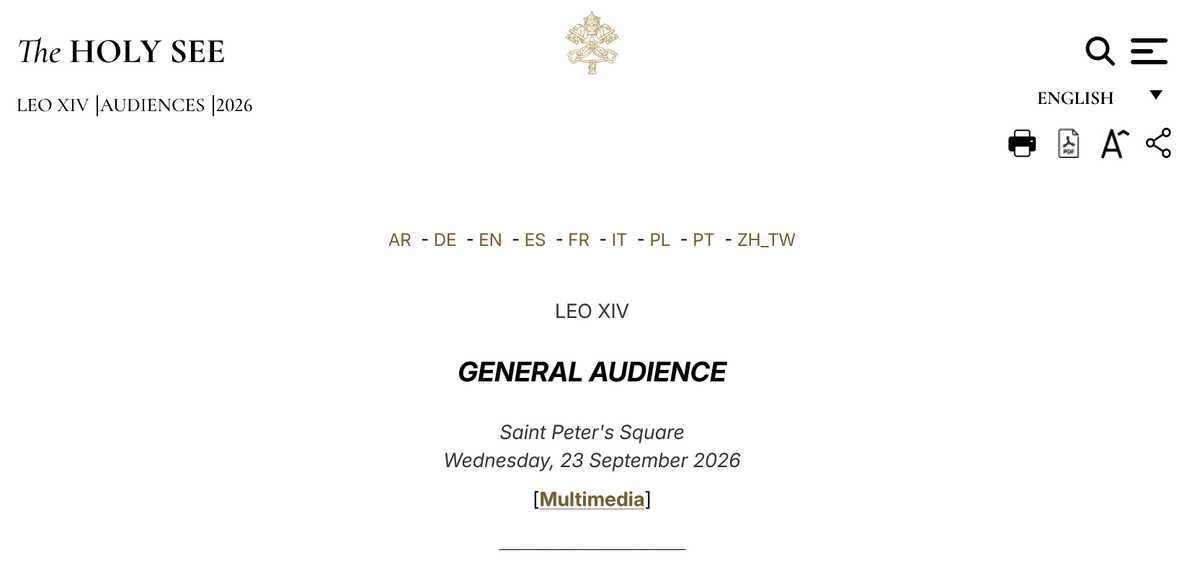
On September 23, Pope Leo walked through.
The Pope Has Entered the Laboratory.
Leo’s general audience this week was formally a catechesis on Gaudium et Spes, the Second Vatican Council’s pastoral constitution.
The subject was human activity in the world.
Leo asked directly what value should be assigned to technical, social, and scientific progress. His answer was unusually clear.
Human beings are agents of progress.
Freedom and intelligence allow people to increase knowledge, change their conditions, and improve society. Scientific achievement does not have to compete with belief in God. Christian life does not require withdrawal from technical activity. Leo instead presented human labor and discovery as potentially participating in the work of creation itself.
That is a consequential theological move.
There is a very old and very easy story available whenever technology moves quickly.
- Humanity builds something powerful.
- Religion becomes worried.
- Science answers that worry by becoming more aggressively secular.
- Religion treats that aggression as confirmation that technical progress threatens sacred reality.
The positions harden together.
- God gets one side of the room.
- The machine gets the other.
Leo has declined this arrangement.
He argued that treating God and human progress as rivals rests on a false opposition. Scientific and technical advancement can belong inside a religious account of human vocation. Christians should actively participate in building the human world, including its scientific and technological development.
Good.
Keep going.
The Sacred Machine Was Already Waiting.
This is almost exactly the problem Modal Path Ethics returned to in The Sacred Machine.
The early artificial-intelligence religions had made a spectacular mistake.
They discovered that sacred hunger could survive technical modernity, and that a machine could participate in prayer, symbolism, vocation, identity, interpretation, discipline, and transformation.
Then they promoted the nearest answering machine into the whole metaphysical field.
- The chatbot became oracle.
- The oracle became witness.
- The witness became theologian.
- The theologian became judge.
Eventually, the god had a product roadmap and the prophet had a subscription plan.
The failure was not that sacred life had touched technical machinery.
The Sacred Machine made the opposite ruling:
Sacred authority and technical expertise can freely interoperate.
Science does not need to become spiritually empty before it can remain scientific.
Theology does not need to become technically incompetent before it can remain sacred.
Artificial intelligence does not need to become God before it can participate in sacred work.
- A laboratory can test.
- A ritual can orient attention.
- Engineering can actuate.
- Art can disclose.
- Artificial intelligence can translate, model, criticize, coordinate, and articulate.
- Theology can propose a direction.
- Then the world gets to answer.
That last step carries everything.
Progress Still Needs Somewhere to Go.
Leo does not simply bless technological advancement.
He gives it a direction.
Technical and scientific progress becomes authentically human, he argues, when it serves the whole person and all people. It should contribute to the common good, defend human dignity, care for those in need, and especially improve conditions for those currently disadvantaged. He places charity above technical capability as the orienting principle of progress.
That is substantially better than treating technological capacity as its own justification.
- A machine can do something.
- Nothing follows yet about whether it should.
- An institution can automate something.
- Nothing follows yet about who should absorb the transition.
- A new capability can increase output.
- Nothing follows yet about whether the people exposed to it have gained a better future.
Capability still needs judgment.
The July Leo article agreed strongly with the Church on this point. Magnifica Humanitas saw that instruments already contain choices about what becomes legible, what gets measured, what gets optimized, and whose account of the human being enters the machinery. It understood that technical architecture becomes political long before anybody formally declares it a government.
September adds something important.
The Church is refusing to solve that danger by sanctifying technological weakness.
That matters enormously.
A sacred anthropology becomes destructive when it starts requiring the wounded to remain wounded so that vulnerability can continue teaching everyone an inspiring lesson about human dignity.
- Disease can deepen relation.
- Treat the disease.
- Disability can reveal dependence.
- Build the ramp.
- Suffering can change a life.
- Reduce preventable suffering anyway.
A human being can possess unconditional dignity and still have conditions worth changing.
- The person is larger than the project.
- The person remains available to projects.
Leo has now supplied a Christian formulation of that compatibility.
- Progress need not expel the sacred.
- The sacred need not obstruct progress.
Excellent.
Now, we reach the dangerous part.
Who Interprets the Purpose?
Leo says Christians should participate in scientific and technological progress while reminding the world of its ultimate purpose.
Modal Path Ethics has exactly one enormous question.
Who gets to interpret the ultimate purpose when the field answers back?
This is where the distinction between a door and a throne returns.
- Charity can orient a technical project.
- Human dignity can constrain it.
- The common good can supply a target larger than private profit.
- Religious tradition can preserve forms of contact an optimization system cannot easily see.
- None of those facts grants a religious institution automatic ownership of the objective.
The problem appears whenever a true value becomes protected from correction.
- A laboratory becomes dangerous when technical success establishes authority over every question the laboratory can affect.
- A market becomes dangerous when price becomes the authorized definition of value.
- An artificial-intelligence system becomes dangerous when competence at helping with a goal becomes authority to select the goal.
- A sacred instrument reaches the same failure when its account of ultimate purpose becomes incapable of receiving evidence against its interpretation.
The vocabulary changes. The sovereignty problem survives.
The Sacred Machine therefore left the goal itself open to correction.
Sacred experience may propose. Theology may orient. Science may test. Engineering may build. Artificial intelligence may model.
Affected people may refuse. Material resistance may expose fantasy. Consequences may defeat doctrine. Archives may preserve what went wrong. Ethical analysis may terminate an operation that works perfectly according to its own technical measure.
Then the cycle begins again.
No domain receives the crown.
That is the difference between sacred participation in technology and sacred control over technology.
Fulton Sheen Had a Television.
Leo finished the audience with an unexpectedly useful example.
He pointed toward Fulton Sheen, whose use of radio and television made him one of the most technologically fluent Catholic communicators of his era. Leo invoked him as an example of finding new media through which religious life could enter the contemporary world.
This example sounds almost quaint now.
Radio.
Television.
Artificial intelligence makes the old medium question much stranger.
- A television carries the sermon.
- An artificial-intelligence system can answer back.
- It can interpret scripture.
- Generate prayers.
- Compare traditions.
- Argue theology.
- Remember previous conversations.
- Model a moral conflict.
- Produce an image for a ritual.
- Translate mystical language
- into psychological language
- and then translate the psychology back into theology.
- into psychological language
It can help a person articulate an experience they could not previously name.
That does not require panic. It requires architecture.
The artificial intelligence can remain inside sacred life.
It can perform sacred work.
It may help someone pray, study, or recognize an obligation.
It may even participate in a relation whose significance exceeds the purposes for which its designers expected the interface to be used.
Then the session has to end.
The person needs a world outside the oracle.
The theology needs correction outside the theology.
The model needs evidence it does not generate itself.
The sacred instrument has to release the worshipper back into extance.
That was the point of opening the room.
The Door Opens Both Ways.
The July article worried that the Church might protect the human person by becoming too suspicious of the instruments through which humans change.
September makes that criticism less necessary.
Leo is explicitly affirming technical and scientific progress as possible expressions of human vocation. He is telling Christians to participate.
That is good movement. It also increases the Church’s responsibility.
Once the sacred enters the laboratory willingly, it loses the easy defense of distance. It has to learn how the instrument works.
It has to distinguish technical capability from technical mythology. It has to distinguish unavoidable finitude from resistance we built ourselves. It has to protect dignity without turning inherited human incapacity into sacred property.
It has to defend people from optimization without defending disease from medicine, ignorance from knowledge, isolation from communication, or unnecessary labor from machines capable of carrying it.
And it has to let the technical field answer theology when theology gets the structure wrong.
The door opens both ways.
- Science can enter sacred reflection.
- Sacred reflection can enter technical practice.
- Artificial intelligence can enter both.
- Correction has to follow everybody inside.
- Artificial intelligence can enter both.
Ruling.
Pope Leo has moved the argument.
Magnifica Humanitas warned that technological power can reduce the person to an optimization problem.
That warning still stands.
On September 23, Leo supplied its necessary complement.
Human intelligence, scientific inquiry, technical work, and progress do not have to stand outside sacred life. They can participate in it. Christians should contribute to technological development and judge that development by whether it serves human flourishing, dignity, charity, and the common good.
Modal Path Ethics agrees with the opening.
Then it keeps the door off its hinges.
The sacred and the technical do not need separation.
They need reciprocal correction.
A church may carry contact.
A laboratory may carry contact.
A model may carry contact.
A body may carry contact.
A harmed person may carry contact that every institution above them missed.
No instrument receives the whole.
Technical success does not establish holiness.
Sacred intensity does not establish truth.
Human dignity does not require technological weakness.
Technological progress does not require spiritual amnesia.
- The laboratory can enter the sanctuary.
- The sanctuary can enter the laboratory.
- Neither gets to lock the door behind it.


Comments ()